

Like A Train In the Darkness
Michelle Barton held onto Dave Van Wicklin’s arm and watched the other runners pass them in the early-morning hours, guided by their pinpoint flashlights. As they stepped by on the narrow trail, most showed concern. A few were jogging, but many were already reduced to walking. “
Are you all right?” one fellow solicited. Dave, Michelle’s pacer starting at the 62-mile mark, answered the well-wisher’s concern by changing the subject. “You’re lookin’ good,” Dave commented. Finally, when the two were alone in the dark, Dave told Michelle her choices. “
We can go back to the aid station at Dardanelles, or we can go on to Peachstone. Or we can take the trail up the hill, back to my place. That would mean dropping [out].” They were close enough to see the lights of Peachstone, but given a choice, Michelle would have laid down right there on the trail and gone to sleep. “
I was clueless. I wanted to rest. I couldn’t think,” said Michelle. Roles were reversed from the mountaintop meeting she first had with Dave at an aid station in fall 2003 during the Angeles Crest 100, when she had volunteered to pace him the last 25 miles. Her scheduled runner had dropped out, and others who reached that point were listless or hurting. Dave Van Wicklin was cracking jokes and laughing as he put on new shoes. He was going to make it, she decided, and she helped him do it.
That launched a trail-running friendship that included Dave’s hosting Michelle and a girlfriend, Ashley Idema of Redlands, at his Foresthill home during practice runs in May for the Western States 100.
FAST TIMES Michelle was 8 years old when her father, inventor Doug Malewicki, asked her to ride an aerodynamic bicycle he designed in the 1979 World Human-Powered
Doug Malewicki
Speed Championship at Ontario Motor Speedway. When she clocked 29.62 miles per hour through the speed trap, he declared her the “world’s fastest 8-year-old girl.” Meanwhile, while her dad created the Kite Cycle by mating a motorcycle
with a hang glider—stuntman Bob Correll performed on it before thousands of fans for 20 years—and built the Robosaurus, a metallic monster that still chews and roasts junk cars for thrill-show audiences, Michelle grew up, married, gave
birth to a daughter named Sierra, divorced, and became a trail racer well known in Southern California. Her long hair remains as bright red as a fire engine, and her sunny outlook lights up even the darkest corners around her.
But here she was, 70 miles into the Western States 100 in the High Sierras, and she had to make a disagreeable choice. She had stopped running and couldn’t even walk normally. She described her pace as baby steps, which she took to
keep from losing her balance and maybe falling over, tumbling off the trail and down the mountainside. The steep incline she chose to climb was tough but not as perilous as the downhill trail, considering her trashed quadriceps, increasing
dizziness, and intensifying nausea. Meanwhile, the human train of flashlights continued down the trail toward the unique river crossing at Rucky Chucky, where the river was so swollen and swift that rowers had been hired to take the competitors across instead of making
them wade through the neck-high rush of snowmelt. Eventually, there would be a record field of finishers at Placer High School in Auburn, California. There were 317 of them out of a starting field of 444 men and
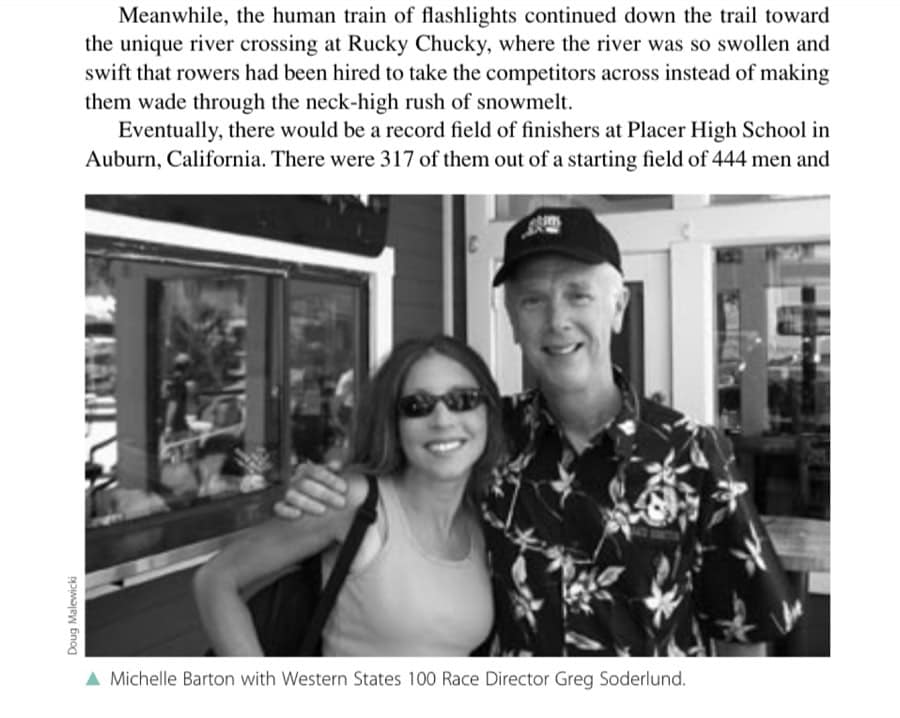
▲ Michelle Barton with Western States 100 Race Director Greg Soderlund.
women who started at Squaw Valley, a few miles south of the notorious Donner Pass tragedy in the mid-19th century.
A LOTTERY WINNER Michelle’s adventure started in December when Race Director Greg Soderlund told her she had been accepted into the Western States 100-Mile Endurance Run starting field by the annual lottery. (Entry is deliberately restricted to respect the ecology of sensitive habitat on the course.) A week later, she broke her left ankle—actually, the lower fibula—on a training run. “Don’t worry,” Soderlund told her. “A few years ago, we had a lady break a leg in April, and she made it to the starting line in June. And she finished the race.”
Encouraged and undaunted, Michelle Barton started her rehab on crutches, walking. Soon she was walking and jogging, wearing the telltale boot on her left leg. In six weeks, she was back to training, the boot set aside. She switched to bike riding and swimming when running felt dicey, but mostly she ran. By Memorial Day weekend, when the annual practice session was held for the race, she was already back to full-time running, a 100-mile weekly average. Driving from home in Dana Point to Foresthill, the 62-mile point of the race, she and her friend Ashley ran all the planned distances with the group and added a few legs of their own, covering 90 miles of trail running in four days. Both of them came out of the ordeal feeling on top of the world. By then it was a matter of tapering down her distances properly and planning for race day.
Michelle dropped down from her customary 100-mile weeks to an hour each of running, swimming, and biking daily. Then, 12 days before the race, Michelle was in a traffic accident and suffered further injuries to her previously broken ankle.
ESCAPING INJURY Remarkably, she wasn’t hurt enough in the collision to require medical attention, and her daughter wasn’t hurt at all, but Michelle suffered many sleepless nights leading up to the start of the race worrying about whether her ankle would hold up. She wouldn’t know until a meeting at Squaw Valley the day before the start what conditions runners would face in the first half of the 100-miler. The late-May training runs covered only the last half, at lower altitudes, where snow wasn’t a factor.
Ski lift operators and farmers alike rejoiced that near-record snowfall had blanketed the upper reaches of the Sierras in the winter of 2004-2005. Until the week of the Western States 100, officials hadn’t decided whether the snowpack made for such difficult conditions that the 30-hour deadline would have to be extended to 32 hours. Fortunately, most of the snow on the trail was in the first 40 miles.
Doug Malewicki
To most runners, the excess snow in upper elevations—above 7,000 feet—only added to competitors’ elapsed times and made the event tougher to finish, because of the difficult footing. The difficulty in the Western States 100 lay mostly
in the downhill nature of the trail. Getting to the finish line in Auburn required climbing 18,000 feet and descending 21,000 feet from start to finish. This race is a notorious quad buster. Michelle created a problem of her own. She is a vegan, an extreme vegetarian,
and some protein sources found at aid stations, such as nuts, don’t agree with her because of allergies. In the important area of nutrition during the race, she had started out with one hand figuratively tied behind her. She didn’t realize how
serious a handicap she had created for herself until after she started the race. That was at the west end of Squaw Valley, site of the 1964 Winter Olympics and now a tourist attraction, due west of Lake Tahoe. The starting line was at
the back door of a resort in the Olympic Village at an elevation of 6,200 feet. As soon as the race began, the entire field headed up a single-lane dirt road leading to Emigrant Pass—sometimes called Squaw Pass—2,550 feet higher, at 8,750
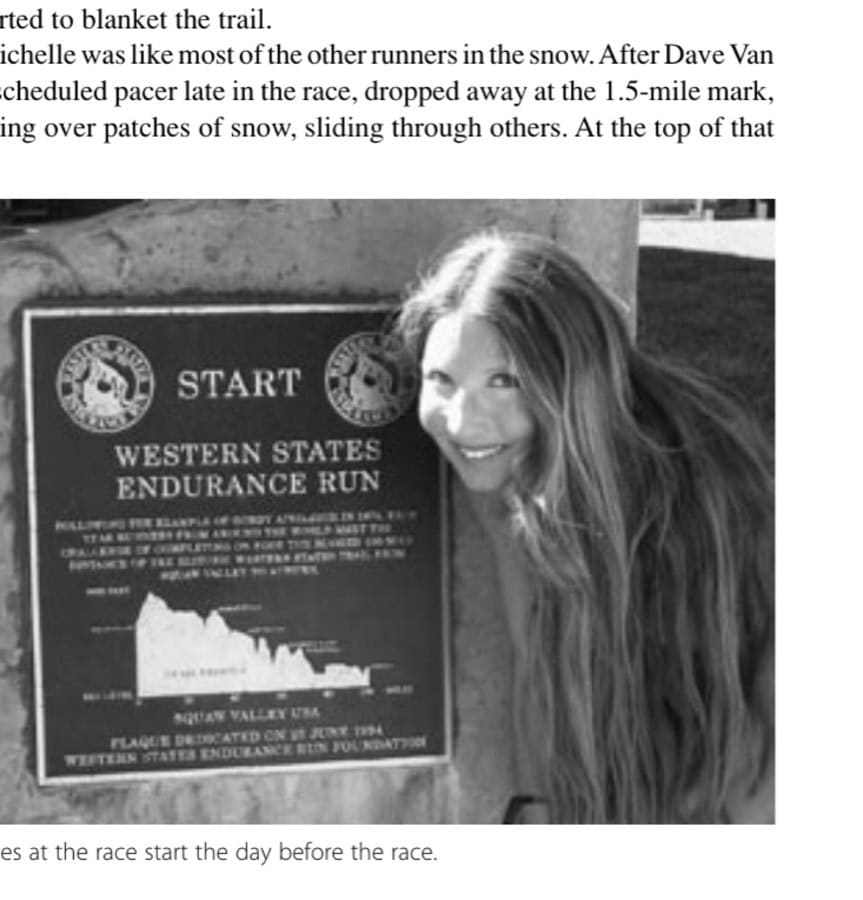
feet. That steep climb is telescoped into 4.7 miles, and about halfway up, the snowpack started to blanket the trail. At first, Michelle was like most of the other runners in the snow. After Dave Van
Wicklin, her scheduled pacer late in the race, dropped away at the 1.5-mile mark, she was hopping over patches of snow, sliding through others. At the top of that
▲ Michelle poses at the race start the day before the race.
first hill, she looked back toward the rising sun and drank in the grandeur of Lake Tahoe and the snowcapped mountains in between. Lots of runners do that.
SLUSH AND SNOW
▲
Michelle coming into Little Bald Mountain.
Doug Malewicki
The energy-sucking effect of slush underfoot soon began to tell on nearly everybody. At Lyon Ridge (11.5 miles), heading into a new section of the course, Red Star Ridge (17 miles), where the runners are shunted to a fire road instead of trail because of recent fire damage, she began to feel the effects of wet socks and shoes. By the time she reached Robinson Flat (24.6 miles), the first aid station where large numbers of spectators could be found, she was asking volunteers for dry socks. Only a fireman offered any, and his feet were too big. She reluctantly turned him down.
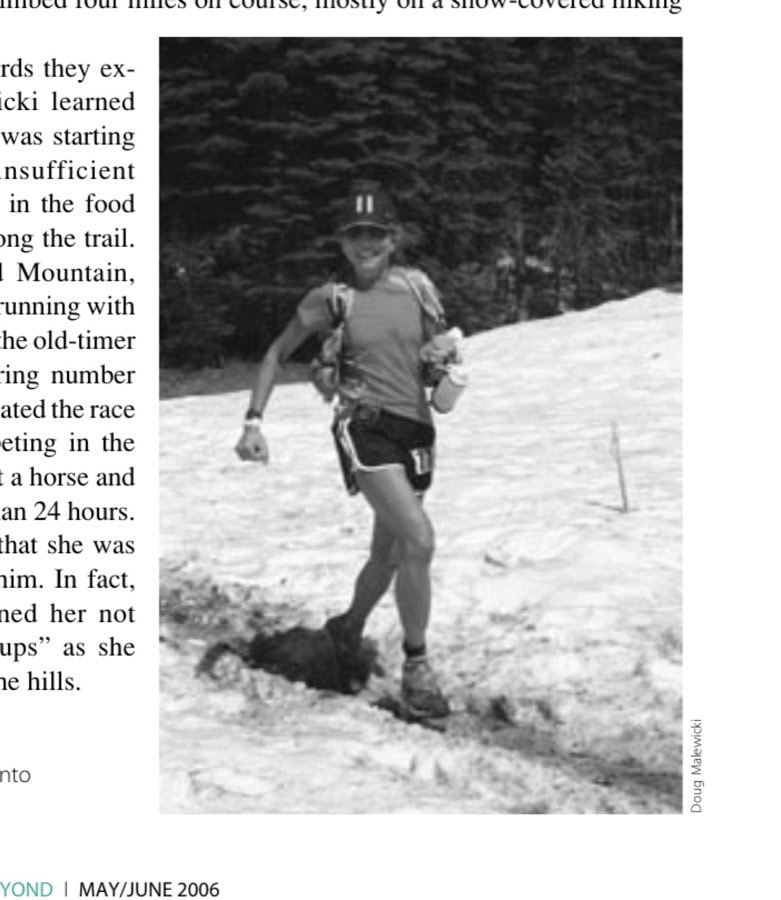
One of the spectators at Robinson Flat was her father, Doug Malewicki, himself a trail runner. To check on her quest for dry socks and on her survival over the first 28.6 miles of the race, he hiked a long half mile up a snow-covered road to the next aid station at Little Bald Mountain while she and the other competitors dipped and climbed four miles on course, mostly on a snow-covered hiking trail.
In the few words they exchanged, Malewicki learned that his daughter was starting to suffer from insufficient protein and carbs in the food she was eating along the trail. After Little Bald Mountain, she found herself running with Gordy Ainsleigh, the old-timer of the field (wearing number zero), who had created the race in 1974 by competing in the Tevis Cup without a horse and finishing in less than 24 hours. She was amazed that she was keeping up with him. In fact, Ainsleigh cautioned her not to “hammer the ups” as she wanted to do on the hills.
After Little Bald Mountain came the first downhill, leading to Deep Canyon (33.7 miles) and then up again through Pucker Point to a mining camp named for a near tragedy in the Gold Rush days: Last Chance (43.3 miles). Three miners there were so intent on digging for gold that they let their rations run out; fortunately, one of them still had one bullet left for his rifle. He went into the woods and bagged a deer, which saved all three from starvation.
There are reasons why the Western States 100-Mile Endurance Run requires more than just calories to carry a runner from start to finish. Most aid stations are stocked with cheap calories—candy, energy bars, cookies, peanut butter sandwiches, and formulated replenishment drinks to replace the salts expelled in 100 miles. Management—liberally using labor, medical technicians, and transportation for its 1,300 volunteers—takes the runners’ drop bags to the aid stations they specify so that runners can have the nutritional supplements they need and prefer, when and where they want them.
THE ART OF THE DROP BAG Michelle filled seven drop bags, but as it turned out not actually for the aid stations where she needed them. The ones she picked up were at Robinson Flat, Last Chance, Devil’s Thumb, and Michigan Bluff. She never reached the ones she had planned to pick up at Rucky Chucky (78), Auburn Lake (85.2), and Highway 89 (93.5). She had one more problem—her vegetarian diet. That didn’t need to be a problem, as Scott Jurek, 31, of Seattle won his seventh Western States 100 in a row in 16:40:46, almost routinely, and he’s a strict vegan.
Carefully planning for her nutrition needs, Michelle had included in each drop bag a supply of Perpetuem, an orange-flavored drink based on soy, high in protein, with electrolytes and fat; Hammer Gel, a low-sugar liquid that is gentle to the stomach and provides 100 calories per serving; Accel Gel, a protein-packed sports-energy packet of gel with vitamins. She also loaded up on Red Bull, Luna bars, and ClifBars.
By Last Chance (43.3 miles), where she put on fresh socks and new shoes—also left in a drop bag—she was hurting from lack of nourishment, and her quads felt wasted. She availed herself of the generous fruit offered at each checkpoint, including cantaloupe, watermelon, bananas, and grapes.
There were still two checkpoints to go between Last Chance and Michigan Bluff: Devil’s Thumb (47.8) and El Dorado Creek (52.9). She had been reduced to walking by then on long downhill and uphill stretches. After Last Chance was a huge dip to Deadwood Canyon, 2,000 feet, followed by a strenuous climb of 1,500 feet to Devil’s Thumb. The drop followed by the climb was one of the toughest tests of this demonic route through the historic mother lode.
Three safety patrolmen joined her on that roller coaster and were encouraging her to keep moving. She credited the fact that she reached Michigan Bluff (55.7 miles) to jawboning by Grant Wilcox of Castro Valley, Charlie Murdach of San Francisco, and Jim Richards of Livermore. They accompanied her at least the last five miles before Michigan Bluff, just past the halfway point of the race.
A MOVABLE TOWN
▲
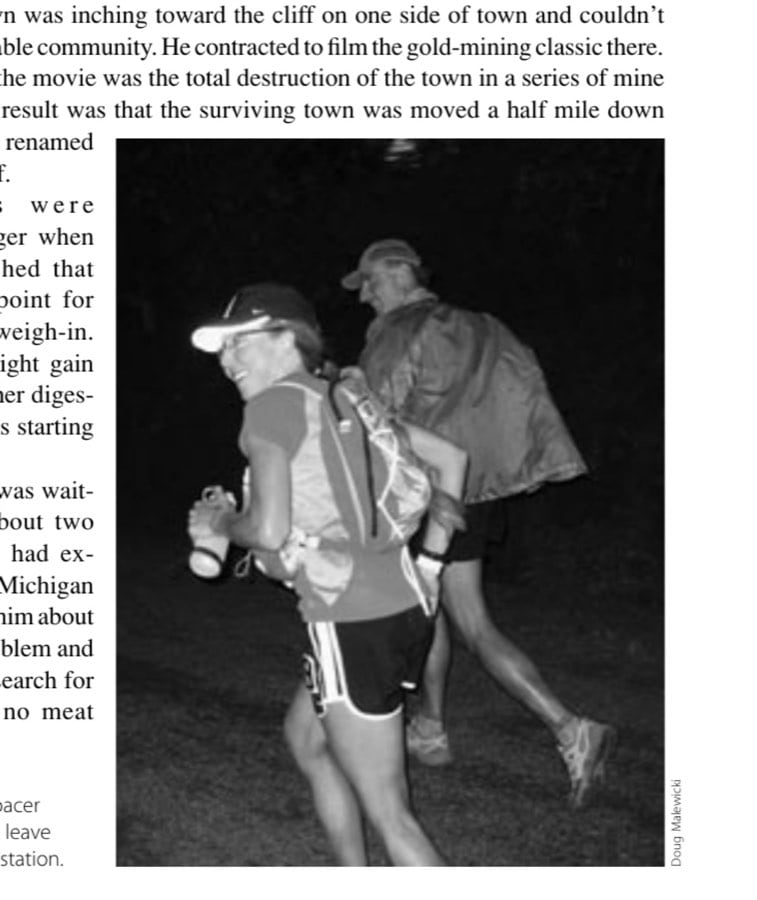
Michelle and pacer Dave Van Wicklin leave the Foresthill aid station.
Doug Malewicki
Michigan Bluff was originally known as Michigan City when Leland Stanford was pioneering the wasteful technique of hydrolic placer mining in the 1850s. Stanford, who founded the university named after his son with some of the millions he earned there, was partially responsible for washing away 150 feet of topsoil exploring for gold at Michigan City. At any rate, when director Joshua Logan was looking for a location to film the cinema classic Paint Your Wagon, he found that the mining town was inching toward the cliff on one side of town and couldn’t survive as a livable community. He contracted to film the gold-mining classic there. The climax of the movie was the total destruction of the town in a series of mine collapses. The result was that the surviving town was moved a half mile down the canyon and renamed Michigan Bluff. Shadows were stretching longer when Michelle reached that critical checkpoint for a mandatory weigh-in. A 4-pound weight gain indicated that her digestive system was starting to shut down.
Her father was waiting for her, about two hours after he had expected her, at Michigan Bluff. She told him about her feeding problem and sent him on a search for burritos with no meat
inside. That’s tough in a city, but this was outside Foresthill, where the only burritos to be found were at either a convenience store or a market about 10 miles down the highway. Stopping at the convenience store, he struck out on the right burritos. Driving on to the market, he found some frozen bean and cheese burritos (with no meat inside) but no microwave in the store to heat them. Driving back up the highway while observing the maddening 25-mile-per-hour speed limit, he stopped again at the convenience store, zapped the burritos, continued up the mountain thoroughfare to Bath Road (60.6 miles), and ran down the course to catch Michelle and her pacer, Dave Van Wicklin. Dave was supposed to join her at the next checkpoint, Foresthill, but he had become frustrated waiting for her and had backtracked down the course to find her. “
She was late, but I was encouraged for her. She was one of the few runners who actually was still running up Bath Road,” Dave said. “We ran through town well” to the checkpoint. Michelle and Dave stopped at a private home a block past the Foresthill school that marked the 62nd mile of the race. At the house, Michelle changed shoes and socks again and adjusted for the darkness that had blanketed the course. She devoured the baked tofu that she was offered by the nurse who lived there, one of Van Wicklin’s family friends.
Printer: Insert New Balance dealer ad
INTO THE DARKNESS Off they trotted into the darkness, aided only by three flashlights Michelle had planned to deploy at that point. They were recorded only through one more aid station after that, Dardanelles (65.7 miles).
She and Dave didn’t speak much, but Michelle’s distress with her burning quadriceps and her nausea was obvious to both of them. She had stopped running, even in short bursts, because her dizzy state unsettled her sense of balance and added the element of fear to her worries. Thirty miles to go. Could she make it? Maybe when they reached the next aid station, Peachstone (70.7 miles), she could take a quick nap and snap out of it. Thirty minutes of downtime wouldn’t jeopardize her ability to finish the race, she reasoned.
But with every wavering stride, she lost a little confidence. She stepped off the trail every time another runner came up from behind to pass them. Those passes seemed to come more frequently the farther she traveled. She had made up her mind by the time Dave gave her the choices—ahead to Peachstone, back to Dardanelles, or retire. One male runner came through, and she tried to get him to take her race ID to turn in. He refused. Right after him came a woman, and she took it. The moving train of flashlights continued down the mountainside, but now without Michelle Barton. She turned to climb a vertical trail toward Dave Van Wicklin’s home on the outskirts of Foresthill.
It was the same steep footpath she and her friend Ashley had missed the first day she arrived to do the official practice runs in late May, the missed signpost that turned their own private practice run from eight miles into 18 that day. When they reached the top of the hill, Dave was tempted to flag down the only car on the road to get a ride to his home, but then he thought better of it. “
I didn’t think it would be a good idea to try to bum a ride at three in the morning,” he said. So they went the last mile on foot. Up ahead at Placer High School, volunteers had laid out a tent city on the football field to greet the finishers. As runners came through a gate from Finley Street, they stepped onto an artificial 400-meter track around the field and headed toward the finish line. Alerted by spotters with cell phones on the street and made knowledgeable by facts he had stored in his notebook, the public-address announcer stirred up the crowd to applaud as each runner rounded the track.
Michelle wasn’t there to enjoy the applause, but she may try again, armed with more knowledge of how to fuel her body for the special demands of this race. Postscript: Since her Western States 100 attempt, Michelle has since finished a 100-miler and won a 50K outright, beating all the men and women.
This article originally appeared in Marathon & Beyond, Vol. 10, No. 3 (2006).
← Browse the full M&B ArchiveMore like this
1,000+ stories from 19 years of Marathon & Beyond
The complete archive of the legendary long-distance journal — digitized and free to read.
