

Loincloths, Moais, And Much More
Easter Island Marathon, June 11, 2006—Diane Kenna, a lithe and efficient 41-year-old runner, would have had plenty of reasons to question her own judgment, particularly as she was powering her way up the brutal three-mile hill after the turnaround point at the 2006 Easter Island Marathon.
Up to this point, she had led the whole way. Running fast and first were hardly new concepts to Kenna. She had clocked a 3:03 marathon at Boston in 1993. Five years later, she had been the first woman across the finish line at the grueling Death Valley Marathon. Nonetheless, in the 80-degree heat and ever-present humidity of this remote South Pacific island in mid-June 2006, Kenna could feel herself wilting. Still, she gamely continued the extended slog up toward the top of the Rano Aroi Volcano.
Making matters worse for Kenna on this muggy Sunday morning, she could hear the determined footsteps of Fernando Heredia drawing nearer. Although the two had yet to meet, Kenna would later learn that the 31-year-old Heredia was competing in his first marathon.
Why, she couldn’t help wondering, had she made a spur-of-the-moment decision 48 hours earlier to compete in a sprint triathlon for which she had neither trained nor had proper equipment? Just 15 minutes before the triathlon had started, Kenna had signed up for the race—part of a three-day trifecta of sporting events on Chile’s Easter Island. (Sandwiched between Friday’s triathlon and Sunday’s marathon had been Saturday’s dramatic 35-kilometer mountain-bike competition that included the long haul up to the summit of the Rano Kau Volcano.) And yes, Easter Island is that island, the one with the enormous stone faces.
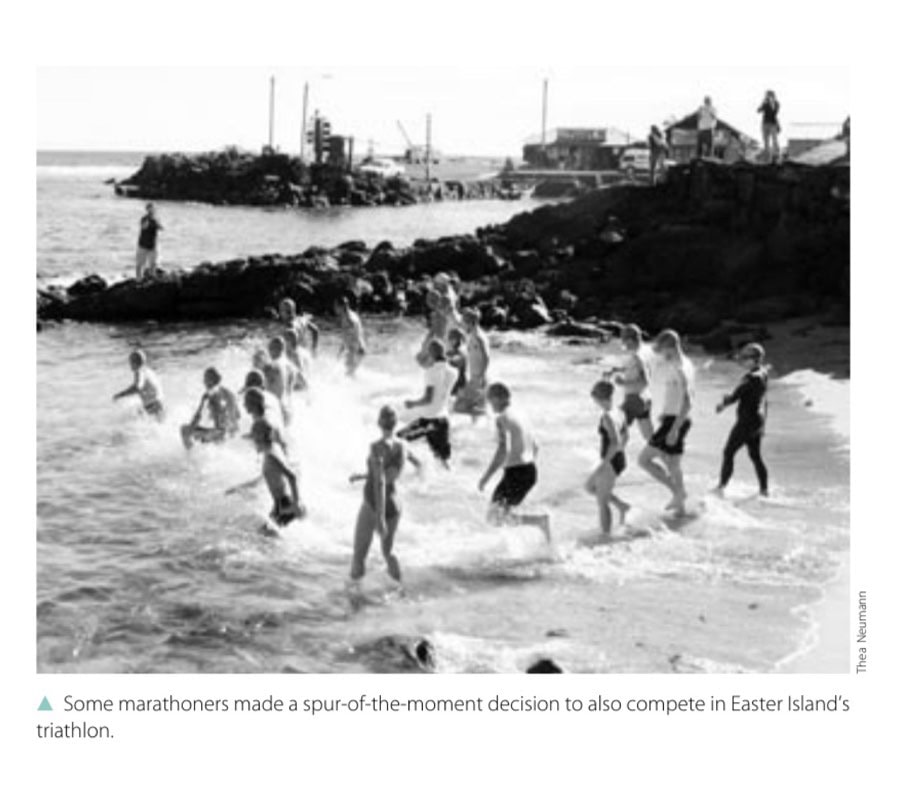
A novice swimmer, at best, Kenna had completed the entire 750-meter ocean swim—navigating reasonably tough waves—while floating on her back. Fortunately, a spectator had thrown a pair of swim goggles to her as she was about to wade into the cool Pacific waters. Kenna kicked the swimming portion, largely leaving her arms useless at her side. Unbelievably, she was not last out of the water but merely second to last. Had she been distracted by a bevy of well-toned
Thea Neumann
▲ Some marathoners made a spur-of-the-moment decision to also compete in Easter Island’s triathlon.
islanders who had swum in scanty loincloths, leaving little to the imagination? Who knows?
PUTTING THE FEAR OF GOD INTO LANCE ARMSTRONG It was on the 20-kilometer bike leg, though, that Kenna looked most uncomfortable. She had borrowed a mountain bike minutes before the race. The bike was far too small even for her 4-foot-11-inch frame. Kenna’s knees jutted up just under her chin with each pedal rotation. She had fared better on the 5K run.
Two days later, as the marathon dragged on, Kenna was jarred out of this flashback. She knew Heredia was gaining fast. The upbeat, beer-swilling Kenna is not the sort of personality prone to “What ifs?” But even she couldn’t help wondering whether her legs would have responded more enthusiastically on the climb had she not endured the triathlon’s rigors. (The hour and 50 minutes she had spent on the triathlon course, under a broiling sun, had surely taken its toll, even on the ultrafit Kenna.)
Still, Kenna’s most acute soreness wasn’t from the triathlon at all. Hardly. No, the native New Yorker had decided to go horseback riding the day before
the marathon—even though she possessed zero equestrian skills. Her buttocks, shoulder blades, and lower back were aching. No surprise, Heredia cruised by Kenna somewhere around mile 15. In keeping with the informal nature of the race and of the island, no mile markings were on the course. As an empathetic Heredia slid past, he called out, “This is horrific, isn’t it?”
Well, it’s hardly the Badwater 135 or the Pikes Peak Ascent. But as far as marathon courses go, it’s a toughie. Think rugged trail marathon in terms of elevation profile and lack of spectators. But Kenna had not been the only one to casually toss her marathon-training regimen out the window in the days before the race. Heredia, too, had been charmed by the magic of Easter Island. When Heredia’s hospitable mates had offered him the use of an all-terrain vehicle to roam the many archeological sites on the island, he had eagerly taken off on his own.
Keep in mind that Easter Island is effectively one of the world’s largest outdoor museums. In addition to the famous stone faces—called moais—dozens of well-preserved caves, quarries, and petroglyphs dot the island. Heredia, an outgoing man with an infectious zest for life, had tried to see them all. As he had bumped and bounded over the potholes on the island’s choppy dirt roads, Heredia
ad
had wondered, briefly, whether he ought to be home reading a book instead of abusing his body.
SOME PAINS IN COMMON Even as Heredia passed Kenna, he himself was feeling tenderness in many of the same spots. It turns out that an ATV excursion and a horse ride are not dissimilar. Heredia felt twinges in his back, shoulders, and forearms.
Why would Kenna and Heredia have chosen to exhaust themselves before the marathon? Were they unsophisticated sorts, perhaps? Hardly. Kenna’s day job is director of Global Debt Capital Markets at Merrill Lynch, while Heredia is a highly trained medical doctor, actually a gynecological oncologist. Interestingly—but ever so apropos for the laid-back Easter Island where doors are not locked and crime is virtually nonexistent—neither Kenna nor Heredia had any regrets about straining their bodies since they had arrived on this picturesque island of some 4,000 inhabitants. The theme of the marathon seemed to be: who needs to pamper your body and taper when there is so much to do on Easter Island?
As it turned out, Heredia won with a time of 3:24, but Kenna was not far behind. As she was barreling down a hill around mile 25, one of the scores of dogs that freely roam the island had suddenly jumped across her path. She slipped and tumbled hard on the gravelly road. Kenna finished with raw and bloodied hands, 33 seconds behind Heredia. “
It was one of the tougher marathons I’ve run,” said Kenna, a veteran of 42 other marathons around the globe. “But I’d definitely do the triathlon again. There are times for fast marathons, and this wasn’t one of them. This was about the experience.” Kenna was reflective about the run. “I had a moment out there, when I just fell in love with the island, the ocean views, the yellow flowers, the horses. It’s hard to put into words.”
Both Kenna and Heredia stated later that the single distinguishing characteristic of the marathon was the simple fact that the race was not the sole focus of most runners on the island—nor should it have been. For the Easter Island Marathon is really about the fun and adventure of being on the magical island. “This island has so much else to offer,” said the matter-of-fact Heredia.
Quickly, then, the background on the race: the marathon—along with the triathlon and mountain-bike race—has been offered annually since 2002. The brains behind the three events is Race Director Rodrigo Salas, a former member of the Chilean national water polo team who now puts on race events every weekend somewhere in Chile. The imminently likeable Salas is equal parts promoter, huckster, and master of ceremonies. Salas can talk anybody under the table in Spanish, English, or even Russian.
THEN THERE’S THE MATTER OF MEASURING THE COURSE Veteran runners used to efficient race organization ought to steer clear; this is not your race. Three runners who ran with GPS devices independently calculated the
marathon course between 25.25 and 25.3 miles—a bit shy of regulation distance. Salas, for his part, said GPS isn’t accurate on Easter Island and he was “sure” the course was the right length. Was it accurate? Who knows? More to the point, who
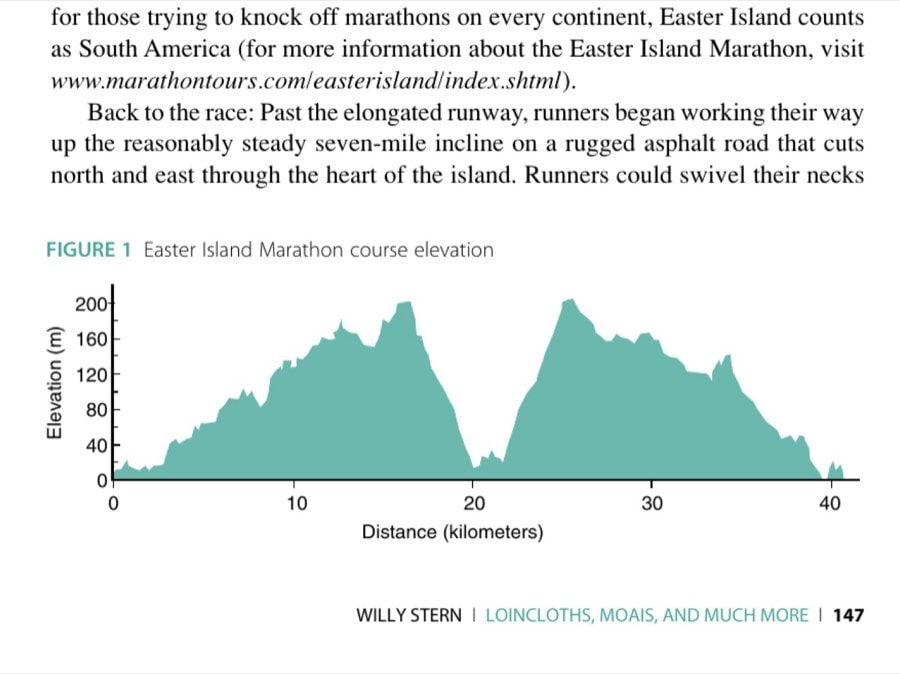
among the participants really cared? Well, there was one runner, a 36-year-old American woman who posted a tidy 3:36; this time would have qualified her for Boston had the race been properly certified. What of the course? The course profile (see figure 1) gives a sense of what it
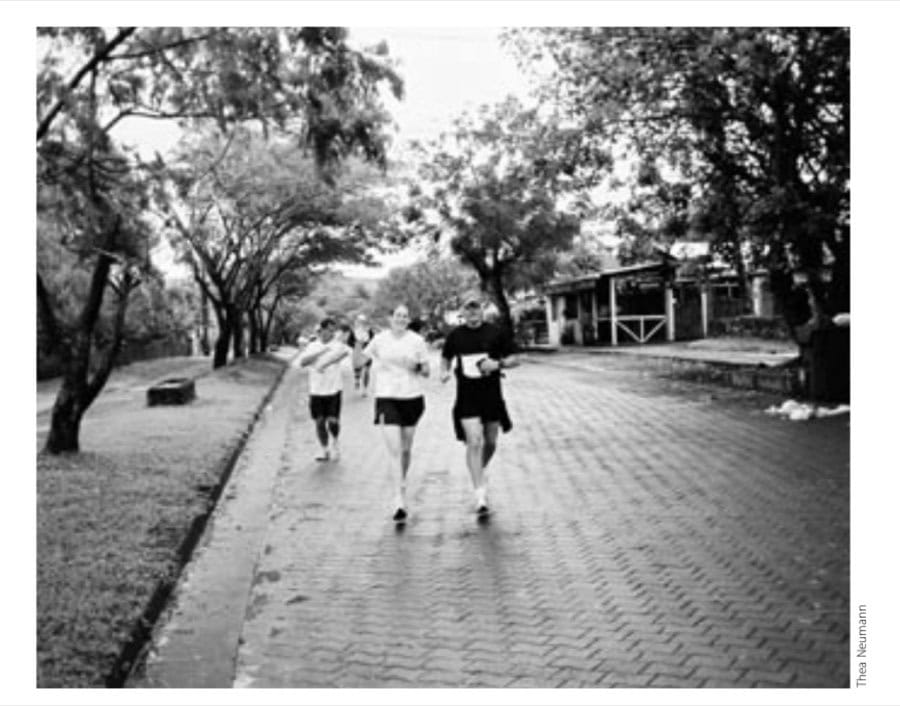
feels like to run on a subtropical island formed by the eruptions of three volcanoes, the first some 3 million years ago. The first mile or so is staged on the cobblestone streets of the island’s only town, Hanga Roa, where a few dozen curious islanders
turned out. Other than the usual coterie of nonrunning spouses and friends, they represented the race’s only spectators. The course snaked out past the airport, home of one of the longest runways in the South Pacific basin. Paid for by U.S. tax dollars, the runway had been built
for NASA as an alternative landing site for the space shuttle. Interestingly, Easter Island is often billed as the most remote inhabited island in the world. The Chilean coast is 2,400 miles away to the east; Tahiti is just a tad
farther to the west. That’s about the same distance as from New York City to Boise, Idaho. Here’s another way to place Easter Island: go due south from Phoenix, Arizona, cross the equator, and you will eventually land on Easter Island. Yes,
for those trying to knock off marathons on every continent, Easter Island counts as South America (for more information about the Easter Island Marathon, visit www.marathontours.com/easterisland/index.shtml ).
Back to the race: Past the elongated runway, runners began working their way up the reasonably steady seven-mile incline on a rugged asphalt road that cuts north and east through the heart of the island. Runners could swivel their necks FIGURE 1 Easter Island Marathon course elevation
Elevation (m)
200 160 120 80 40 0 0
10
20
30
40
Distance (kilometers)
left or right to catch magnificent Pacific Ocean vistas on either side of this tiny island. Horses roam freely. At various points, dozens of moais—typically pushed over on their noses—could be seen in the open fields and wild terrain that cover the island. The vast majority of the marathon route has been designated as a nature preserve.
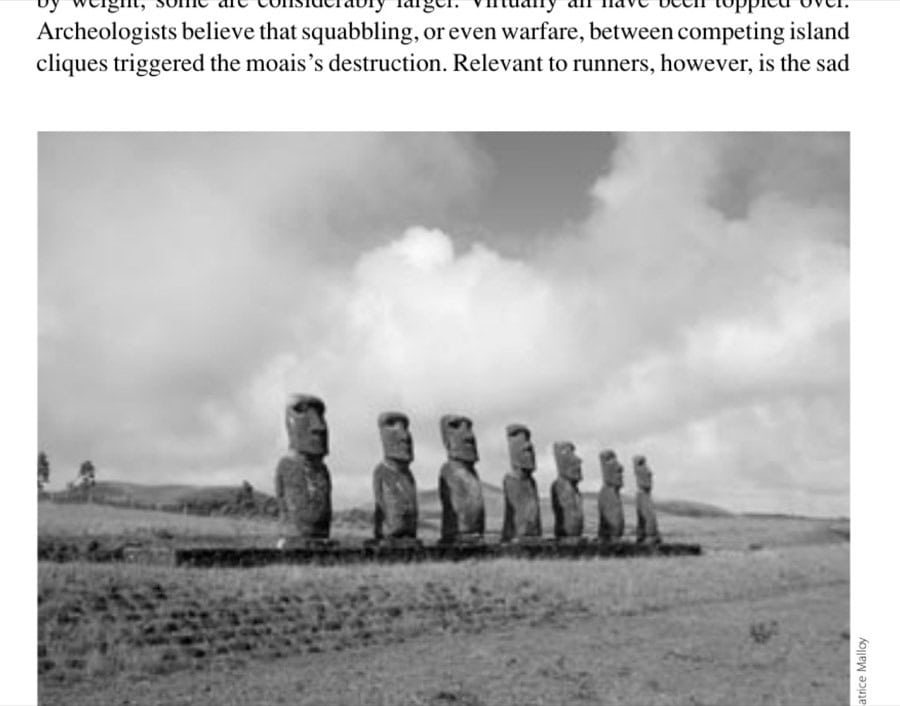
Archeologists disagree over how these massive stone structures were erected, but this much is certain: more than 800 of these faces were built sometime between A.D. 700, when Polynesians first settled the island, and the 18th century, when the first Europeans visited the island. A Dutch sailing ship arrived on Easter Day, 1722, hence, the island’s name. Native islanders, descendants of the original Polynesians, speak their own language, and call the island Rapa Nui. (The cotton race T-shirts dished out to all marathoners read simply “Maraton Rapanui 2006,” which will make no sense to your friends back home.)
A HISTORY OF THE MOAIS
Patrice Malloy
In any event, the stone figures average more than 20 feet in height and 14 tons by weight; some are considerably larger. Virtually all have been toppled over. Archeologists believe that squabbling, or even warfare, between competing island cliques triggered the moais’s destruction. Relevant to runners, however, is the sad
▲ All the original moais were knocked over long ago. These seven have been restored.
Jane Mullen
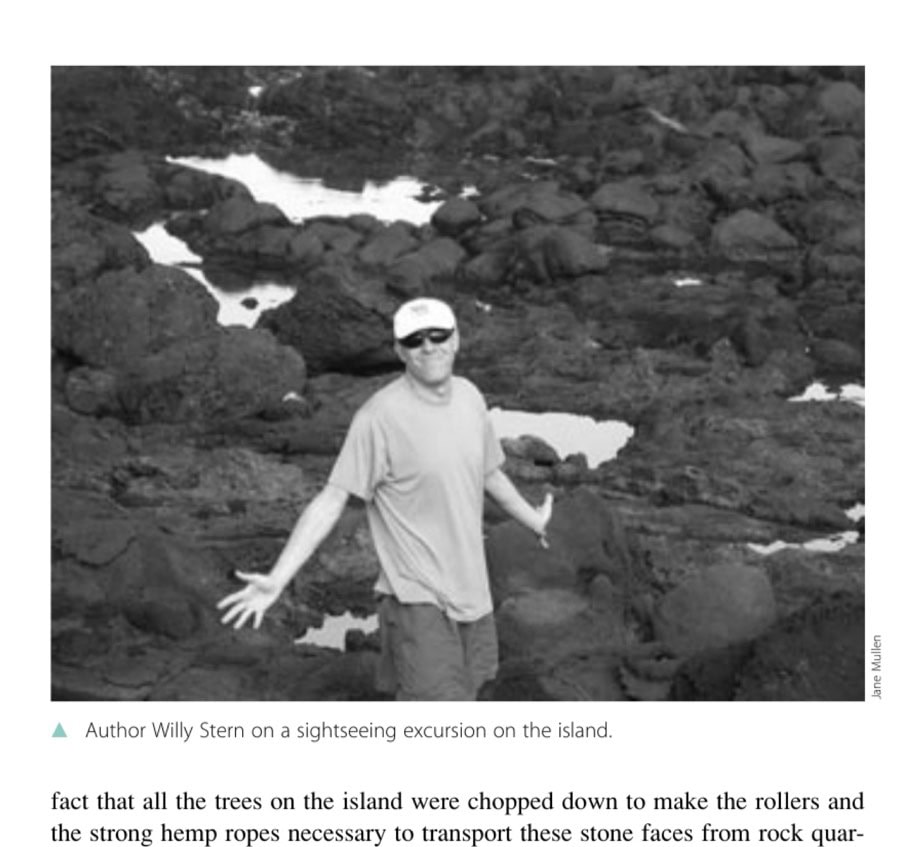
▲ Author Willy Stern on a sightseeing excursion on the island.
fact that all the trees on the island were chopped down to make the rollers and the strong hemp ropes necessary to transport these stone faces from rock quarries (from which they were painstakingly carved) to their present resting spots around the island.
In short, this translates into virtually no shade on the marathon route today. We were teased with snippets of sun protection from the odd eucalyptus tree, an introduced species. In days of yore, more than 40 types of trees could be found on the island. Jared Diamond’s 2005 book, Collapse, offers a wonderfully readable narrative as to how civilization on Eastern Island was slowly strangled by the islanders themselves as they hacked down the last of their trees.
The trees may be gone, but observant runners spotted several species of sea birds, including the lovely frigate bird. Aid stops appeared every three miles or so and were manned by islanders who were paid to be there; the concept of race volunteer is alien to Chileans. At no point did any of us runners have an accurate notion of how far along we were, although, in keeping with the island’s laid-back mantra, no one seemed to mind much. Nobody called out split times. Traffic wasn’t stopped, but I would be surprised if I saw 15 moving cars on the sleepy island during the entire race. Forget about a postrace feed.
There were hardly any spectators from mile two until mile 25, with the exception of the turnaround point, just off the pristine white sands of Anakena Beach. Here any number of tourists and locals frolicked in the gentle waves. The halfway point was marked by a lonely orange cone in the middle of the road. True to form, no race officials were present to note our arrival at the cone. The honor system was in full effect; this was not a race for timing chips.
The last three-plus miles before the turnaround point were a steady downhill trek. Yes, this was tough on our quads but even tougher on the psyche as each downward step would eventually mean repeating the step on the way back up.
During the 2003 marathon, one runner had hit the turnaround point, taken one mournful look back up the mountain—where Heredia would eventually pass Kenna—and had opted for a quick, if refreshing, dip at the beach.
A FIELD OF 25 HARDY SOULS
Thea Neumann
Our only companions on the road were the other runners whom we passed either coming or going. It was an odd bunch. Only 25 participated in the marathon. (A
▲ The first (and last) mile of the marathon course took runners over cobblestone streets through Easter Island’s only town.
half-marathon and 10-kilometer race were also offered.) Of those doing the full marathon, 20 lived in North America and had come courtesy of Marathon Tours, the Boston-based travel outfit that organizes group tours to marathons around the globe. Two local islanders covered the full distance. A German software engineer, a Brazilian journalist, and Heredia, the Chilean physician, rounded out the field.
Our only other distraction on the course was an ambulance that had been enlisted by Salas to cruise up and down the lonely highway. We quickly learned to flash a thumbs-up signal to the driver if we didn’t require medical attention.
Other oddities: Race Director Salas put on the traditional—if mediocre—pasta dinner at one of the 25 local restaurants in Hanga Roa. For reasons that remain unclear, this gratis pasta repast was not held the night before the marathon. Instead, we gobbled down lumpy spaghetti and sipped orange Tang, en masse, two nights before the marathon.
Despite the fact that air temperatures on this maritime subtropical climate can easily run into the 70s or 80s in June, Salas had the race go off at 10:00 A.M.—ensuring that we would run through the midday heat. Asked why we didn’t start the race at 7:00 A.M. or 8:00 A.M., Salas gamely explained he couldn’t count on the aid-station workers to get out on the course any earlier. Is this correct? Perhaps. Certainly, there was a fair amount of grumbling among runners about the late start time.
The last mile of the race, the stretch where Kenna was surprised by the dog, was back in town; runners had to make numerous turns there at unmanned, if quiet, intersections. Some junctions had small red signs indicating which way to turn. Many had no signs at all. Salas hadn’t mentioned any such signage before the race. By mile 25, some of us were a tad bit confused as to where we were to go.
The marathon cost an eyebrow-raising $150 US to enter, as did the triathlon and mountain-bike race. Salas said the expenses associated with toting the race gear to the remote island by airplane mandated the steep entry fees. More opportunistic athletes quickly found that as race time approached, entry fees appeared negotiable. Jaime Costas, a 46-year-old police officer from Fort Lauderdale, jumped in the triathlon and the mountain-bike race at the last second and paid half price. Like Kenna, he had trained only for the marathon but couldn’t resist. “
I’d never been on a mountain bike before,” said the engaging Costas. “But once you get here and see the beauty of this place, well, you kinda’ felt like you didn’t want to miss out on anything.”
My Most Unforgettable Ultramarathon (And What I Learned From It) BY WILLIAM B. LATTER
CLEARWATER, FLORIDA, November 25, 2005—My most unforgettable ultramarathon is one that did not happen. I was ready, injury free, mentally centered, gear packed, and car loaded when the phone rang in the middle of the night. It was a call I will never forget. The pain was searing, palpable. Words failed me.
REGRETS? I’VE HAD A FEW A life without regrets is a life that has not been lived, one without challenges, risks, or exploration. Regrets are the natural outcome of failure. Failure is the natural outcome of finding limits, exceeding them, and sometimes going too far. Failure, if risked but not sought, is an opportunity to learn, to try again, to become more. Yet we question our failures as lost opportunities, risks that should not have been taken, and even as moments of weakness. These are the regrets we must accept when we risk failure. Regrets are not something to seek out. They are to be avoided. But they should not be shunned to the point of never risking a life with regrets. Winston Churchill said, “Success is not final, failure is not fatal: it is the courage to continue that counts.” We might at times succeed, but life continues and the challenges remain. We might at times fail, but chances for success are always present. Going on in the face of potential failure and regret makes us great beyond anything we could plan for ourselves.
Any runners who have gone beyond their limits, only to find there was no limit, knows all of this very well. Whether we are risking months of hard work to come up short of a personal best in a 10K or putting it all on the line in taking the chance of not completing a marathon or an ultrarun, we always come out better for having tried and not succeeded than having not made the attempt at all. Running is a microcosm of life.
I do not cherish my regrets. Some nag me. Some make me unhappy. Yet if I take a moment to look at them, I see that there is much to be learned from those
regrets and the risk I took that led me to them. For this reason, I appreciate them, trust them to teach me more about who I am, and rely on them to help define me and make me better. Not all failures we encounter are of our own making. Not all regrets come from chances we expected to take. Is it fair to have regrets about training lost, preparation wasted, and hearts broken simply because fate stepped in to take away a dream at the very moment of its realization? Is it fair to those who might have unwittingly and unwillingly snatched that dream away? Yes, it is fair. It must be forgiven, but fairness is not always fair to all. It is exactly at such times that we must step back and look into ourselves. We must understand that fate casting its dreaded shadow is as much a risk that we accept when we start on a quest as are injury, illness, or simply a bad race day. Is it right to be angry, to be sad? Of course it is. Emotion is what defines us as human beings. What we do with the power of those emotions can make us much better, much stronger, and better people. Failure and regrets are a part of a life well lived.
DEATH, BE NOT PROUD About two and a half weeks before that late-night phone call, Deborah (my new fiancée) received a call from her father. He had been having a difficult year. Things just got worse. In the spring, he had been diagnosed with two independent forms of cancer. Two operations were required, one right after the other. During this time, my surviving brother’s fight with a typically deadly cancer was in full swing. His wife was also diagnosed with breast cancer and would need surgery and chemo. My mother’s long-gone cancer had returned, and she needed chemotherapy. I ran a lot during this period. It felt like it was all I could do. Deborah’s father had gotten through surgery OK, and things looked good. But, there still was something wrong. That call two and a half weeks earlier was to let Deborah know that he had terminal brain cancer. He had just gone through two operations and difficult recoveries only to be presented with this. Four months, maybe five. He was making plans for those to be good months. I did the only thing I could. The San Diego One-Day Race was soon approaching. The race director had requested a short bio from me and the other runners. I thought long and hard, then sent this: “Too many people in Bill’s life have suffered, died, or are living with cancer. Currently, Bill’s brother, sister-in-law, and mother are all living with cancer. Today, Bill is running this race in honor of Irving Levine, who is suffering from a particularly bad form of cancer. Bill knows very well that every step he takes today is a gift. No matter how many of those steps he is able to make, he does so for those living with cancer and cannot.” I was as ready for this run as I had been for anything in my life. I’ve obtained advanced degrees, prepared observations with the world’s most powerful telescopes, and prepared for presentations before hundreds of people. It seemed at the time that none of this compared to
the meticulous preparation I had put into this one 24-hour effort. Physically, I had done all the right training, including three 30-plus-mile runs. Mentally I had tested myself and found myself prepared. This would be a race on a one-mile loop course through the night. I needed a six-hour run, a long period on a track, and a good long run at night as well as a test of some drinks and food. I figured I might just as well combine them all into one unusual training run.
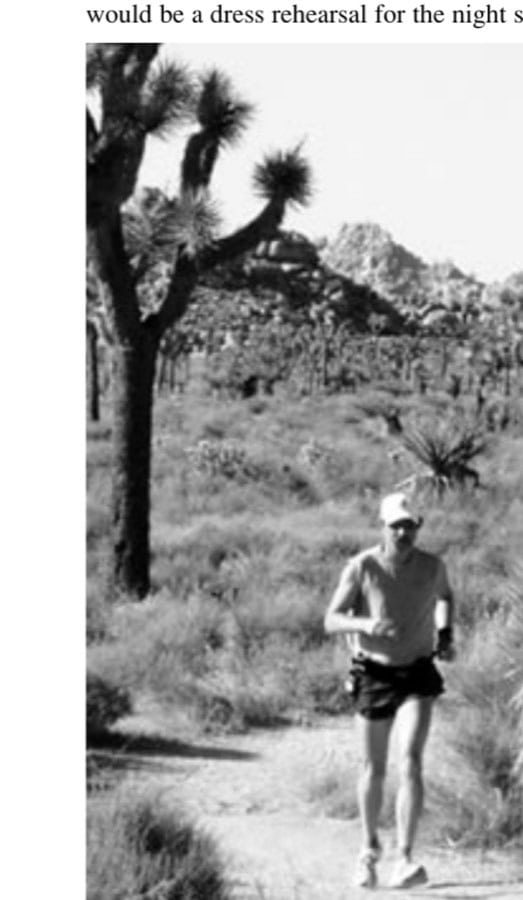
WHAT WAS I THINKING? I started Saturday night at about 10:00 P.M. on the local high school track. This would be a dress rehearsal for the night segment of the race. I laid my gear, fluids, and food in a single
location, as they would be in San Diego. I was ready for something longer than 12 hours, not my planned six. The only things missing from the picture were other racers. Indeed, it would not be long before there
would be no one at all. The track was fairly busy until about 10:30 P.M. The lights went out a half hour later. Deborah came by not long after that to run with me and (mostly) to make sure I was OK, which I was.
She went home. Oddly, it was not long before I felt completely alone. I have never felt so fundamentally alone. Through the night I ran. Around and around. Reverse. Around
D. Levine
▲
Finding art in the science of training for a track ultra—the author on a trail run in the desert.
and around. Alone. In the dark. At about 2:30 A.M., I became convinced the track had grown twice as wide and became fully carpeted. (It was actually a standard dirt track.) I covered 33 miles, at the time the longest run of my life. It was one of the greatest, if not most insane, experiences that I ever imposed on myself.
The basic plan was to loop and loop, change direction, and loop some more. Pace was to be something a bit faster than my planned 24-hour pace. I did that. I took in roughly 300 calories an hour, drank, urinated, spoke to myself, kept putting one foot in front of the other, and went nowhere. It was dark, strange, and at times surreal.
Lessons learned: drink more, lube more (ouch), eating about right, never do that again!
NOTHING REMAINS THE SAME The day after I learned of Irv’s brain cancer, work took me to Europe. Reluctantly, I went. Deborah flew to Florida to spend a few days with her father and to help him get organized for what was coming. Deborah’s plan was to return home in time to support me in my 24-hour effort. Plans are what plans will always be—necessary but useless. Upon my return home, while I was in a serious fog brought on by jet lag, Deborah called to say that she needed to stay in Florida for a few more days. Her father had acquired an infection that was getting serious. I was not completely rational and not thinking clearly. I became very upset. Yet there was still no reason to believe she would not be back for the run. I offered to fly out, but Deborah said to stay home and get ready. Irv liked the idea of my running in his honor. He ran one race per year, a 5K Thanksgiving Day Turkey Trot. It was his tradition, and one to which he was dedicated. I did as Deborah asked. I hoped. Life does not deal cards off the top of the deck. Irv all too rapidly fell from being a strong, brave man facing his end with dignity and hope. In just days, this vital, honorable, fighting man was brought down by a microscopic beast. He battled, but he was losing this fight. Deborah knew it. He knew it. I was too far away and too much in my own world to know it. Was I in denial? Perhaps. Deborah was battling her own demons: Should she leave her father for a few days to support this run? Would that be wrong? She sought advice. She spoke with a counselor and her rabbi. Deborah knows me to the core. She knows what running means to me. She knew that running this race in Irv’s honor was my way of giving all that I could. She wanted to be there. She arranged her flight and packed. I am not sure I understood the struggle taking place within her at the time. Indeed, I am certain I did not. Two nights before the race start, I was sleeping fitfully when that call came. I looked long at the telephone before answering, haunted by what I knew would be said. Deborah, quietly, could say only that her father had made the decision for us. He had passed shortly after midnight. Slowly, I got up and did the only thing I could do. I gathered up the gear I had so carefully laid out for the run, and I put
J. Stinson
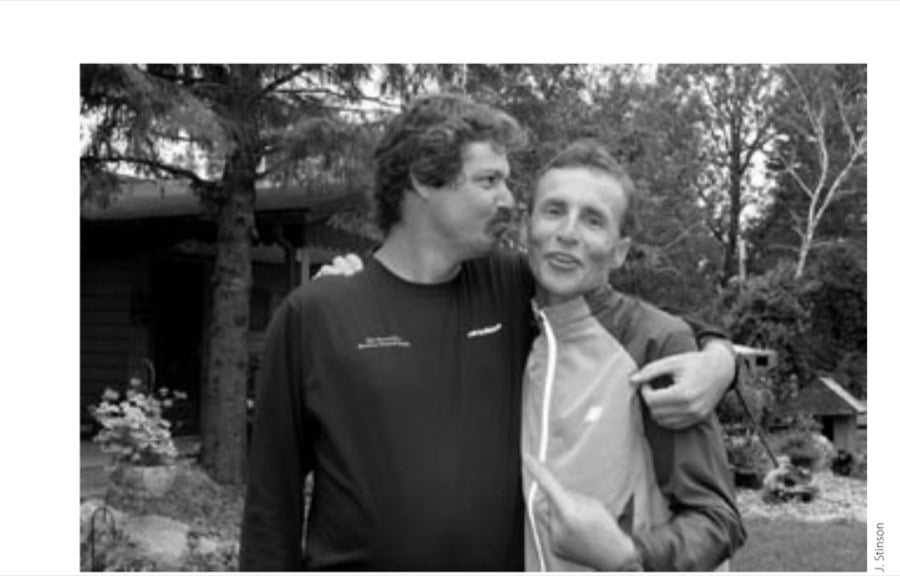
▲ The author in Minnesota attempting to share his ultrarunning training secrets with Dick Beardsley, two months before the San Diego 1-Day Race.
it all carefully away. I closed the box on it and walked out of the room. I was on the next flight I could arrange to Florida.
THERE WILL BE A FUTURE I felt that I had failed. I had failed to see the risk, the risk to my time, to my mental state, and to those I cared about and who had helped me to prepare. I failed to care enough to fully understand what was happening, what was happening to Deborah and most of all to her father. I failed to understand that my run would not change anything—that my dedication was only an attempt to make my run have value in the face of so much pain and struggle simply to survive. This is not a failure I knowingly risked. Yet there it was. I had to accept it. I had to take the regret I was feeling and find some way to make it worthwhile. I had to give something of myself. It was the only thing I could do. On the day of the funeral, I asked if I could say a few words.
Deborah’s eulogy to her father was beautiful. It was powerful. It described a strong man of strong convictions. He was a genuinely good man, one whom I would now not be able to get to know better. I felt more regret not because of something I did not do but because I risked caring about this man.
I followed Deborah in the service with the only thing I had to offer. To place my running in context of why it is what it is for me, I read a segment of my story
that had just come out in Marathon & Beyond. It was a story about a marathon that challenged me beyond what I thought were my limits. I talked about how runners were circling the course in San Diego as I spoke. But this year I was not there to run for Irv. I said to those in attendance that I would not be stopped. I committed to Irv’s friends and family that I would train for and run the San Diego One-Day Race in his honor next year and that I would do so each year as long as my legs and mind would let me. My San Diego One-Day Race would now become Irv’s yearly Turkey Trot. It is all I can do. No regrets.
AUTHOR’S UPDATE For reasons unclear to me, the San Diego One-Day Race is no more. However, I have not backed down from my annual promise. I selected the 2006 Angeles Crest 100-Mile Endurance Run as my first alternate. I could not be certain I would complete this journey in the 33 hours given, but I promised myself that I would not end that quest unless medical personnel or a checkpoint cutoff time stopped me.
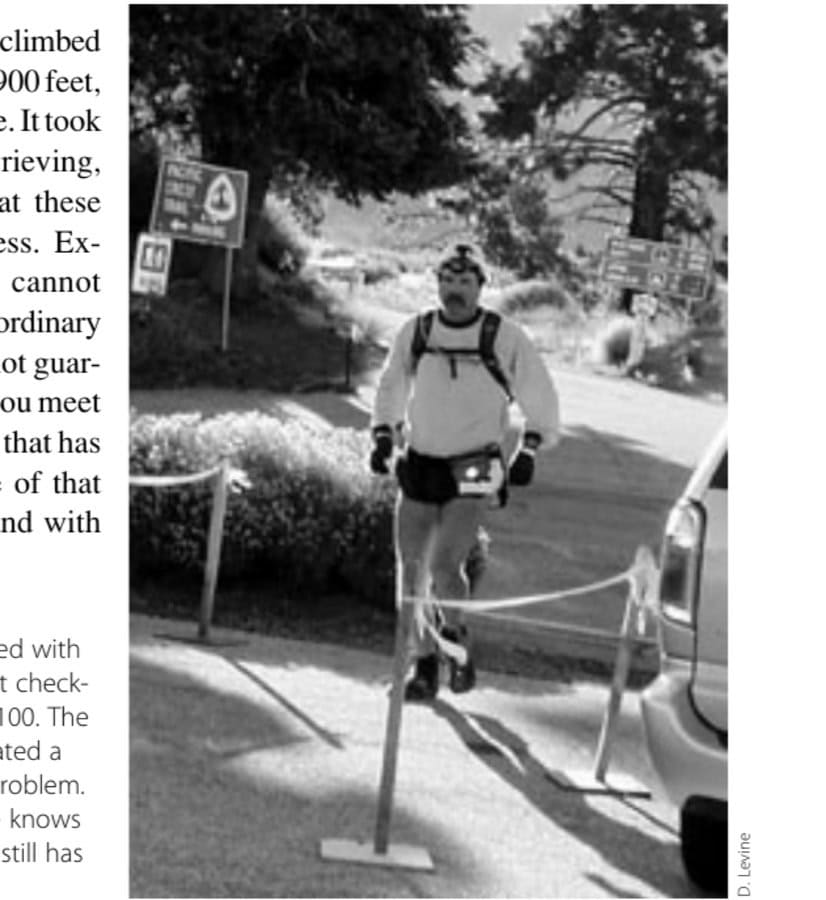
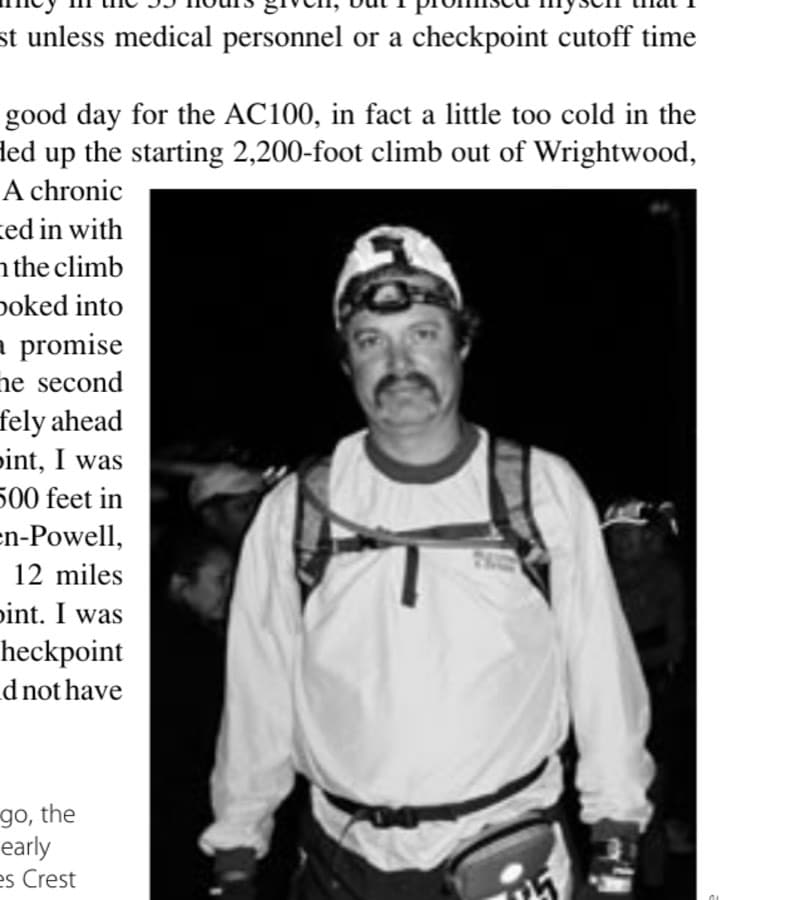
It was an unusually good day for the AC100, in fact a little too cold in the early running. As I headed up the starting 2,200-foot climb out of Wrightwood, I knew I was in trouble. A chronic lower back problem kicked in with a vengeance. Each step on the climb was like having a knife poked into my spine. But I had a promise to keep. I made it to the second checkpoint of the race safely ahead of the cutoff. At that point, I was faced with a climb of 3,500 feet in 3.5 miles up Mount Baden-Powell, then Throop Peak, and 12 miles before the next checkpoint. I was afraid coming into that checkpoint (Vincent Gap) that I would not have
D. Levine
▲
Geared up and ready to go, the author prepares for a chilly early morning start of the Angeles Crest 100. His mental gaze is fixed on a distant line 100 miles into his future.
the courage to endure the pain and make that climb. But I turned away from my most supportive crew member, Deborah, without hesitation, left that checkpoint, and made the climb. I did not drop. I did not quit. I did this because I made a promise to myself. Yet it was clear that I was doomed to not make the distance. It was not in my power to fight the pain for another 25 hours.
I ran down toward Islip Saddle knowing I was done. I came rushing down the mountain into the checkpoint giving it all I had left—flying for a short time and finding a bit of joy in just running. Sometimes, fate has a cruel sense of humor. A rock jumped up and grabbed my foot as I was running downhill at full speed. The resulting face plant could have been a lot worse than it was, but I would be working the embedded tiny rocks from the Pacific Crest Trail out of my hands, elbows, and knees for several days—a lasting reminder of a checkpoint cutoff missed.
My crew cheered me into the checkpoint as if I were the first runner, as did the checkpoint workers and the medical worker. I was saddened. My crew chief, Booth Hartley, said he was honored to have been part of my effort. I planted my face in a towel to hide for a bit. My crew was ready for a long day and night. It ended for them much too soon. They were the best, and I know they will be there for me again.
I completed 26 miles, climbed 6,700 feet, descended 5,900 feet, and am listed as last place. It took some time and some grieving, but I have accepted that these numbers are meaningless. Extraordinary challenges cannot always be met with extraordinary success. Courage does not guarantee victory. It is how you meet challenges and face fear that has meaning. Today I write of that experience with pride and with no regret at all.
D. Levine
▲
The author’s face is etched with pain as he runs into the first checkpoint of the Angeles Crest 100. The icy conditions have aggravated a long standing lower back problem. Trailing the field already, he knows that his goal is lost. But, he still has a promise to keep.
Oh, one last thing: all that stuff about never running alone at night again—please ignore that. In my preparation for the AC100, I went out and did it again, this time for 12 hours and 60 miles. I will never understand what makes me do that sort of thing. Must be some sort of defective wiring, I guess.
And What I Learned From It 1. Running very long and alone through the night, in the pitch dark, over an unchanging surface, is a surreal experience. It is not unacceptable to question the sanity of those who do such things.
2. A scientific approach will provide a reliable and effective training plan. There is art in turning that plan into an enjoyable adventure every day. Be an artist, and you will be a lifetime runner. Do things that might cause others to question your sanity. It is fun.
3. More than anything, I learned (once again) that life will do whatever it has planned, not what you would like it to do. You simply must take it as it comes. Live for the moments. They are what have meaning. Let the bad moments go. Keep the good ones. Make moments good—you have the power to do so. Live one day at a time.
4. Tragedy is rarely a solitary event. As much as it might feel that only you are hurt, it nearly always is the case that others are affected much more. Keep your training and racing in perspective. Support those in greater need than you. There will always be other races.
5. Preparation is what racing is all about. It is a journey. The race is a symbol. It is the proof of the work, the fun, the commitment. This race did not happen, but I know I was ready. Did I really need to prove it? No, not really, not to myself. When things settled down enough, I finally put my running shoes back on and took off on a rails-to-trails path near Deborah’s father’s house. It was a bittersweet run. I went on and on, getting faster and faster, never feeling as if I would tire. Was I ready to run more than 100 miles in 24 hours? Oh, yes, I was. Did I need to do so to prove it? No.
6. Feeling helpless in the face of forces beyond your control is a part of life. Hopelessness is not. There is always hope.
7. Regrets are part of a full and well-lived life. Risk having a few, learn from them, but do not seek them out.
8. Running is not life. Life is not running. Running is a detail that helps define us, helps us live life, and helps us see light in the darkness. Love running. Do not become running.
This article originally appeared in Marathon & Beyond, Vol. 11, No. 3 (2007).
← Browse the full M&B ArchiveMore like this
1,000+ stories from 19 years of Marathon & Beyond
The complete archive of the legendary long-distance journal — digitized and free to read.
