

London Marathoning: Then and Now
As a born-and-bred Londoner and, in childhood, a survivor of the Blitz of 1940–41, I am naturally very attached to this historic city. “A man who is tired of London is tired of life,” Samuel Johnson said. Then again, as a survivor of some 100 marathons (albeit with rather indifferent performances, except for my 35th place in the 1968 Boston Marathon), I must have some sort of fixation on the marathon. And let’s remember that the modern marathon distance of 26 miles, 385 yards was arrived at by measuring the 1908 London Olympic Games course. So it is understandable that a marathon race run in London is—and always has been—something special for me.
My first marathon race in London was in 1960. This was the second marathon I had run, the first being in 1957, over the 1956 Olympic course in Melbourne, Australia, where my family and I lived for three years after attending the Games.
I’m not really sure why I ever attempted a second marathon, especially in view of the near catastrophic first. I had not realized in those far-off days in Australia that marathon runners (a rare species whose sanity was doubted by most spectators) were always accompanied by a “handler” on a bicycle. This handler provided his runner water, wet sponges, and other requisites.
Having no handler myself, I begged for water from the handlers of nearby runners, but as the very small field split up, this option gradually closed to me. There was no water through the suburbs of Melbourne.
It was a warm day, but then the famous hot wind began to blow off the northern deserts and the temperature shot up. I was determined to finish, which I did in exactly 4 hours. Unfortunately, the last 10 miles did very strange and unpleasant things to my young body and mind. My wife was horrified to see me weaving my way to the finish in a slow walk to all but collapse at her feet.
She was the only spectator left at the finish—all the other 15 runners had completed the race and gone home with their supporters and handlers. At that time the hazards of dehydration during hot-weather marathoning were not well understood. But I learned a lesson that I never forgot. For some time I thought, This marathon running really is tough.
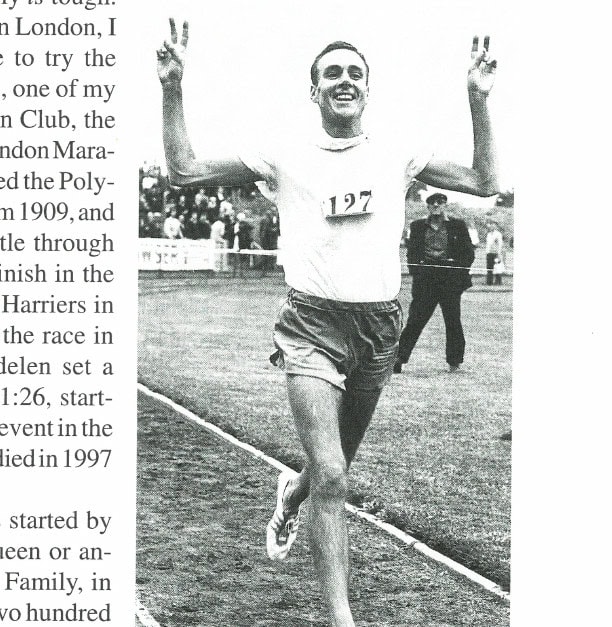
Three years later, back in London, I summoned up the courage to try the distance again, with Dennis, one of my teammates from my London Club, the Herne Hill Harriers. The “London Marathon” of those days was called the Polytechnic Marathon, dating from 1909, and was run from Windsor Castle through the suburbs of London to finish in the stadium of the Polytechnic Harriers in Chiswick. (Note: This was the race in which, in 1963, Buddy Edelen set a world marathon best of 2:11:26, starting a flurry of interest in this event in the United States. Sadly, Buddy died in 1997 at age 59.)
Sometimes the race was started by Her Royal Highness the Queen or another member of the Royal Family, in the Castle grounds. One to two hundred runners made up the field.
Thirty-seven years after my first marathon in London, I was back to run in the great extravaganza now known as “The Flora London Marathon,” then the world’s largest with 29,135 finishers (to be replaced seven months later by New York’s 30,427 finishers), triple starts, and a spectacular finish outside Buckingham Palace in Central London. I could hardly help pondering the many changes in marathon racing in London in a mere 37 years. What follows are some of my recollections of my first and my latest London marathons.
THE POLY: THE HEIGHT OF SIMPLICITY
Entry into the Windsor-to-Chiswick “Poly” Marathon was a simple matter, as I recall. No great rush to compete, no qualifying times, or long lists of instructions, health warnings, and so on. It was, quite simply, a marathoner’s marathon, the place where, in 1953, Britain’s Jim Peters became the first human being to break 2:20 in the marathon; he ran a 2:18:40.4.
I suppose I must have filled in an entry form and waiver at some point. I recall no publicity before the event, and my perusal of London newspapers from 1960 (on microfilm) during my 1997 visit turned up nothing.
I took the train from Central London to Windsor and walked up to the imposing Castle, where a Guardsman directed me in military tones to the changing room. In those days in England, we traveled to a race in street clothes; a changing room was always provided where we could put on our racing gear. For the Poly, the changing room was in the old, brick barracks and stables housing the resident Guards unit assigned to the Castle. The toilets, I recall, were of indescribable antiquity, but in retrospect I would consider them “quaint.” Construction of Windsor Castle was begun in 1070 by William the Conqueror, but I don’t think the toilets were quite that old.
“Off-duty” Guards sergeants marched smartly about, which I still found intimidating, since I had completed my stint in the Royal Air Force not too many years before.
We put our street clothes in individual bags we had brought with us and threw them into a small van. (No need for labels since 149 runners could easily identify their own bags at the finish.)
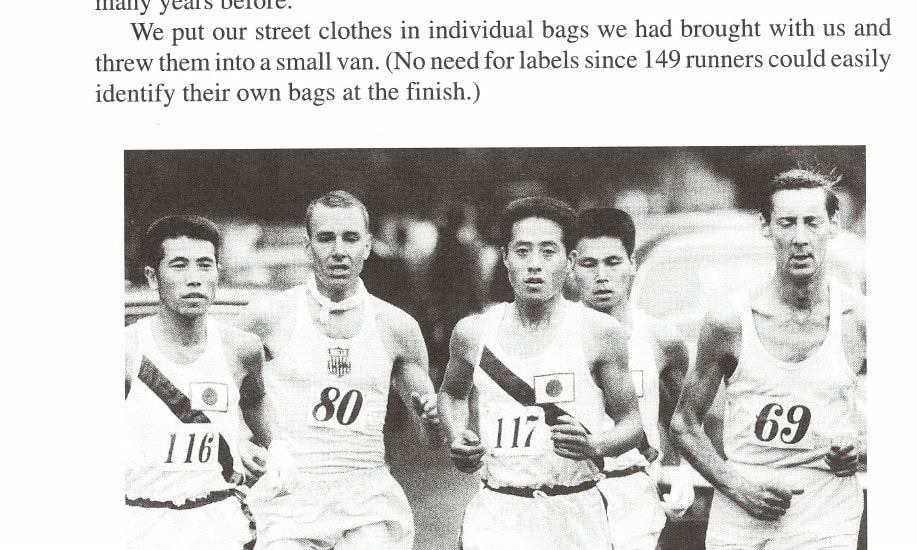
Dennis and I jogged down to the start, with the brilliant green of the lawns and the towering Castle ramparts as backdrop. The Queen and Prince Phillip were not available to start us this day since it was also the occasion of the Trooping at the Color ceremony, and they had important duties, on horseback, on Horseguards parade ground in Whitehall.
TODAY’S LONDON MARATHON
Entry into the Flora London Marathon in 1997 was a different matter. Everyone in the world wants to run London, which by this point is one of the world’s great marathons, one of the largest, and certainly one of the most exciting. Publicity starts the day after the previous year’s race and builds to a crescendo in the weeks before the race. Some 41,000 entries are accepted, but many thousands are turned down, perhaps to run another day.
I was fortunate, being an “overseas runner” (although I remain a British citizen). Several months before the race and after a number of telephone calls to the United Kingdom, I was accepted. A few days before the race I went to the huge Olympia Exhibition Halls in London to collect my number, profuse instructions, and free “goodies” in a huge plastic bag printed all over with FLORA in big green letters.
Runners with their families were arriving constantly, whole underground trainloads spilling out every few minutes like troops arriving at the front before the Battle of the Somme (indeed, 41,000 runners are the equivalent of four divisions).
On the morning of the race these same “soldiers” were back on trains again to assemble for the coming battle, having heeded the advice that the railway is much the preferred way to reach the start (and it was free on raceday).
It was vital that I go to the correct start: Blue, Red, or Green, to match the color of my number. The Blue and Green starts were on Blackheath, a beautiful open space once the rallying ground for medieval popular uprisings in London and a haunt of highwaymen; and the Red was inside Greenwich Park, where the British, in their modesty, decided that the world’s time and space (well, in terms of longitude, at least) begin and end.
I went to the Blue start with runners numbered 1 through 21,999. Portable toilet facilities were plentiful and clean. I packed my sweat suit and other now-unnecessary items into a plastic bag with my number printed on the side and deposited it carefully on the appropriately-numbered truck, 1,000 numbers assigned to each truck.
After that, we entered the holding pens and arranged ourselves at the start according to our estimated run times. Since I estimated 4:15:00, I was a long way back. And then we waited interminably for the starting cannon.
FLASHBACK TO 1960
We left Windsor Castle with the gun, smoothly and unimpeded on the long downhill sweep into the town. (One must remember that castles are very often built on hills—at least those that are not built on clouds.) No holdups or jogging on the spot. Dennis and I had agreed to run the whole distance together, which we did.
The runners all seemed experienced and serious. I’m sure costumes would have been frowned upon, if not a cause for disqualification. I doubt that anyone ran for charity back then. Spectators were few and far between for most of the way and seemed to have encountered the race by accident (“Look! Must be Zatopek!” I heard as I ran). Water was available at six miles and every three miles thereafter, according to the rules. The day was not particularly hot, so this was adequate. When we were well into the endless suburban streets, we could often see no other runners behind or in front of us, raising occasional concern that we had run off the course.
Dennis wanted to make a bathroom stop, which I timed at 45 seconds. Generally this race was a measured, almost pleasant run for me, quite different from my Australian initiation three years earlier. Eventually we approached the finish and triumphantly entered the Polytechnic Stadium to substantial applause for the final lap of the track.
The Kinnaird Trophy track and field meet was just coming to an end as the marathon winner, Arthur Keily, 39, entered the stadium. The athletic correspondent for The Sunday Times reported, “In the stadium the afternoon had been rather dull until the arrival of the marathon.” The Times correspondent described Arthur as “oldish, even for a marathon runner.” Nevertheless, Keily ran 2:19:06, a time bettered in Britain at that time only by Jim Peters. The 1960 Boston Marathon, run some two months earlier, was won by Paavo Kotila in 2:20:54. This made oldish Arthur (who is still running and racewalking, by the way) a prospect for the 1960 Olympic Marathon, although the Russian, S. Popov, had a world best of 2:15:18.
Dennis and I finished together in 110th and 111th positions, among 149 finishers, in 3:15:42. I was pleased by my 45-minute improvement in time, but we both realized that we had just missed a Surrey County Standard award (requiring 3:15 or less) because of our leisurely bathroom stop.
IN SEARCH OF THE START LINE
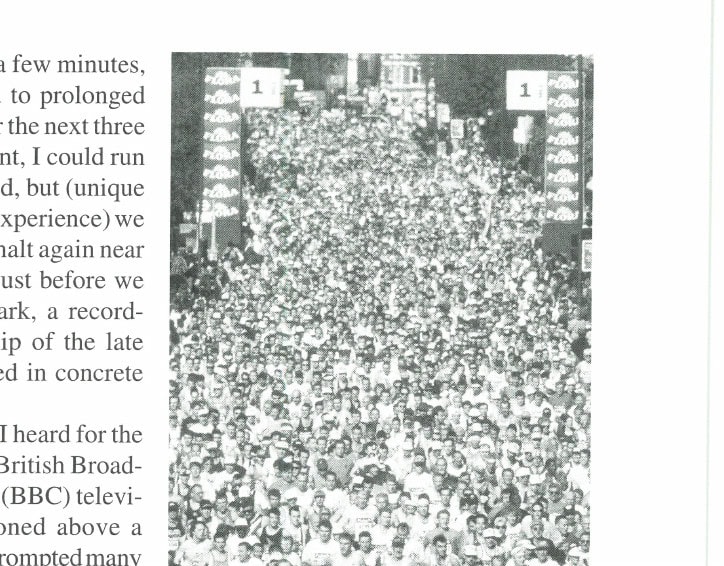
My transit of the 1997 London Marathon course is inevitably much clearer in my mind than my 1960 recollections. As with all big marathons, for those well back, progress was very slow following the starting cannon. I reached the starting line within a few minutes, but I was subjected to prolonged shuffling periods for the next three miles. After this point, I could run relatively unimpeded, but (unique in my marathoning experience) we came to a complete halt again near the six-mile point, just before we passed the Cutty Sark, a record-breaking clipper ship of the late 1800s, now anchored in concrete near the Thames.
The explanation I heard for the back-up was this: a British Broadcasting Corporation (BBC) television camera positioned above a rather narrow street prompted many participants to pose, causing the whole river of runners to back up and shuffle to a standstill again. All of these things considered, I concluded that I lost about 15 minutes in the first six miles of the race—a record of sorts for me.
THE CHARITABLE CAUSE
A remarkable feature of the Flora London Marathon is the pervasive presence of the Charitable Cause. Almost everyone was running for something: Multiple Sclerosis, Oxfam, Motor Neuron Disease, and so many more, their chosen cause emblazoned on their running shirts. Very nice, really: good causes and a warm feeling for the runner who is going to finish in 20,000th position.
Those who were not running for a cause (and some who were) often wore a costume, which reminded me of the extravagancies of the San Francisco Bay-to-Breakers race. Even before the race started, I was disconcerted to note half a dozen London policemen, complete with the famous helmets and brandishing truncheons, apparently invading the ranks of the waiting runners. Was the Irish Republican Army (which was active in London at that time) making a showing at the London Marathon? No, just a police running team in shorts, brandishing the whole length of the course.
There were quite a number of (male) fairies, provoking encouraging shouts of “Come on, yer great fairy!” There were also a number of (North American) Indians. One, running just in front of me, bare-chested but complete with war paint, a headdress, and tomahawk, attracted the attention of a group of giggling young women. “I wouldn’t ‘arf like to ‘ave a feel of your chopper!” one shouted. Some costumes—bears, rabbits, trees—must have been extremely burdensome to the runner within and insufferably hot as the day warmed up.
RUNNING THROUGH HISTORY
The London Marathon course passed through so much history. At 12 miles we crossed the Thames over Tower Bridge, an inspiring sight on a bright spring morning. Then we were off to The Isle of Dogs, with little left to see of the old Dockland’s congestion, squalor, and mystery when London was a leading world port, and past the towering Canary Wharf building, symbolic of the new order. At 22 miles we passed the Tower of London, begun by the Romans, and the scene of so many imprisonments and executions in years gone by.
But at this point I was more concerned by the hideous cobblestones for a half-mile around the Tower—large, rounded stones between which our tired feet slipped and slithered. After this I felt better and quite enjoyed the run along the Thames, where many of the 500,000 spectators gathered, past the Houses of Parliament, into Birdcage Walk, the length of Buckingham Palace, and on to the finish in The Mall.
Great masses of brilliant tulips filled the flower beds around the Palace. Like many other older runners from London, I’m sure, I was transported back to another time when, at 16, I stood on this same ground on VE night in 1945, part of a huge, exuberant crowd cheering the Royal Family and Prime Minister Winston Churchill as they appeared on the Palace balcony, at the end of our five and a half-year ordeal.
The feelings of achievement, inspiration, and relief in running the last 100 yards of a marathon have not changed one bit for me after 100+ marathons over 40 years. I know enough now to smile and position myself correctly on the road in front of the finish line to ensure a happy, unobstructed finish photograph. But life, which somehow becomes three-dimensional to me during a marathon, soon clicks back into the familiar two-dimensional mode soon after the finish.
THE FINISH EXPERIENCE
The “Finish Experience” in 1997 was in striking contrast to my lone finish in Melbourne in 1957 or to my 1960 Poly finish and illustrated how far marathon
racing had come in 40 years. Although I firmly believed in those distant days that vigorous activity was very beneficial to health (and the scientific evidence is now overwhelming), the current popularity of marathon running then would have been quite inconceivable to me.
In the Flora London Marathon we finished in some 10 lanes at a rate of about 133 runners per minute; in 1960 we finished in a single lane on the Polytechnic Stadium track at the rate of about 1.8 runners per minute. To learn our time in 1997, we glanced at the huge overhead clock; in 1960, we consulted our wristwatches. Now we proceeded to the enrobing area to be wrapped in glittering, silver thermal blankets (imprinted with “FLORA” in big green letters), and then received, in quick succession, a nice medal from long jangling racks of medals, water, and a snack (mass production has come to marathon running, Henry Ford!). Our numbered plastic bags were easily found, laid out in numerical order in front of our numbered truck. In 1960 we shivered if the wind blew. I don’t recall receiving a finisher’s medal, but I may have received a certificate by mail later.
COMPARING THE FIELDS
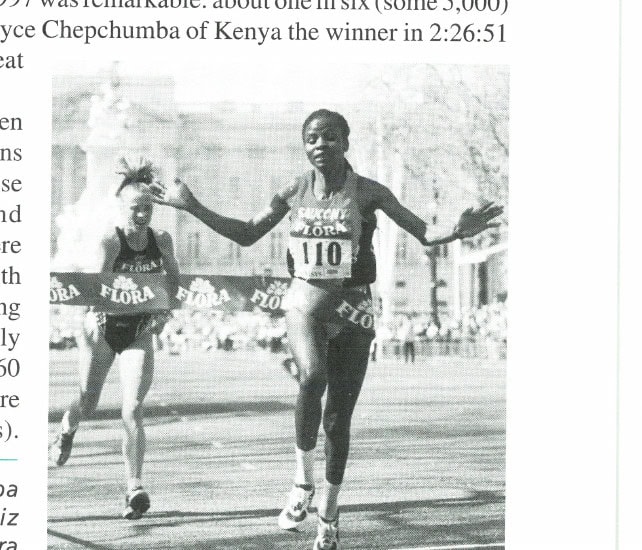
A few comments about the make-up of the fields. Apart from the enormous increase in the total size of the fields between 1960 and 1997, the substantial participation by women in 1997 was remarkable: about one in six (some 5,000) runners was female, with Joyce Chepchumba of Kenya the winner in 2:26:51 over Liz McColgan of Great Britain, by one second!
Of course, in 1960 women did not compete in marathons in London, or anywhere else for that matter. Men and women age 50 and over were well represented in 1997, with some 1,100 entered, according to the race program. Probably no men over 49 ran in the 1960 Polytechnic race (but ages were not recorded in the results).
However, as mentioned earlier, Arthur Keily, the winner, was 39; and I do recall a number of fairly mature male runners of that era. In 1960 there were no overseas runners as far as I could tell, although in looking recently at the results, I pondered for a moment on two runners from “Belg.,” until I remembered my old London club rivals, Belgrave Harriers. In 1997, large contingents arrived from overseas. The male and female winners were from Portugal and Kenya, respectively, and among the men, only two Britons finished among the first 10 finishers.
JUST A FACE IN THE CROWD
An interesting contrast for the run-of-the-mill participant is the anonymity of the individual runner at the start and finish of modern marathon races. At the finish of the Polytechnic Marathon, Dennis and I nodded or chatted with dozens of runners we had known for years. In those days at the start of marathon races the runners would immediately recognize a newcomer. “Who is he? What time does he run?” In the modern megamarathon we are lucky to encounter one runner at the finish whom we actually know. I ran into Karin, a fellow Californian, at the finish of the Flora London Marathon, and we took photographs of each other. After this, I walked slowly out of the huge finish area, picking my way among thousands of recumbent, silver-clad runners, recognizing none.
I went slowly through Admiralty Arch into Trafalgar Square and down Whitehall to The Captain’s Cabin, a watering hole favored by Herne Hill Harriers running in the race. As it happened, I had passed three of my clubmates during the race, and I had had a few seconds of conversation, although I did not know them personally. We immediately recognized our club vest, which I was also wearing for the occasion: red and black hoops, the original uniform modeled on the fashionable swimsuits of the day—1889 (one year after Jack the Ripper’s exploits in London). During this period numerous cycling and running clubs were formed in London as a way for young men (but not women) to escape from the late-19th century smoke, noise, congestion, and horse dung into the calm of the countryside, to exercise in healthy surroundings. During my run, four different voices, owners unseen, emanated from the crowd: “Up the Hill!”—voices from the past, some real connection with my youth, whoever they were. At The Captain’s Cabin, I downed a couple of Bass ales and chattered with the few older members I still know, nodded to the many unknown others, and then wandered back to the Waldorf Hotel in Aldwych and sleep.
MONEY MATTERS
A few words about money. The 1960 Polytechnic Marathon may have cost $2,000 (US) to mount. This is a guess, and I stand to be corrected. The 1997 event was extremely expensive to put on. Flora Margarine (a component of the giant Unilever), the major sponsor, provided US$15,000,000 to support the two runs in 1996 and 1997. And there were many other smaller-income sources.
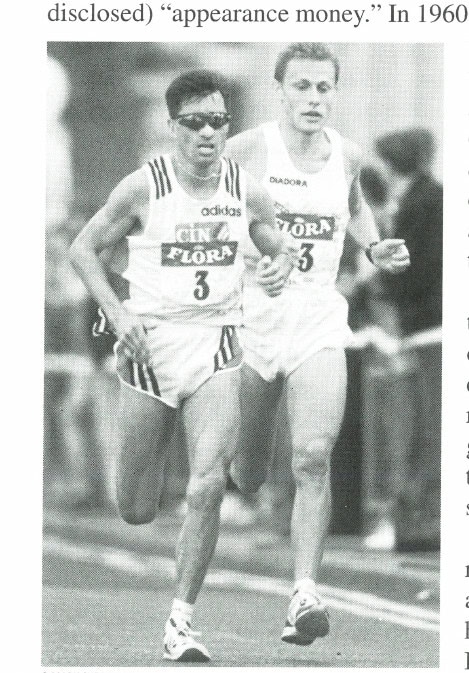
I paid $75 to enter the 1997 race. In 1960, as I recall, the entry fee was closer to 75 cents! In 1997 the total prize money exceeded $500,000, with $105,000 going to Antonio Pinto for his 2:07:55 course record first place, plus any (undisclosed) “appearance money.” In 1960 there was no prize money, although the winner did get to clasp the gigantic Sporting Life trophy. Harold Abrahams, 1924 Olympic 100-meter champion (subject of the film Chariots of Fire) and for many years standard bearer of Olympic purity in Britain, would no doubt turn in his grave to learn what has transpired since 1960. I have mixed feelings about this turn of events. Certainly, the commercialization of the megamarathons has enabled huge numbers of lower-level runners to participate and enjoy the glamour of the big races. And in 1996 the London Marathon runners raised some $16,000,000 for charities.
On the other hand, the average runner never meets the elite runners and feels only a very small part of a huge whole. I am reminded of my first Boston Marathon in 1963. I arrived at Logan Airport and caught a cab to the Lenox Hotel. The driver asked me what I was doing in Boston. I said, “I’m running in the marathon,” and he said, “What marathon?” I knew then that I was an important piece of a small whole.
Of course, the staging of all marathon races, then and now, calls for great dedication and hard work by many people. The complexity and cost of the London Marathon today staggers the imagination of an old-timer like me. Yet through my past modest organizing efforts as president of the East Bay Road Runners Club and the Fifty-Plus Runners (now Fitness) Association in California, I can at least conceive of the effort required to mount the huge events. So I’ll take this belated opportunity to thank the countless officials, course measurers, water station staff, and all the others who have enabled me to complete the Melbourne Marathon in 1957, the Flora London Marathon in 1997, and my 100-odd marathons worldwide in between.
I don’t know who was the major force behind the 1960 Polytechnic Marathon (young runners seldom inquired about such things and still don’t), but I suspect that Arthur Winter was involved. Arthur, in his history of the race, From the Legend to the Living, describes the remarkable running of the 1940 Polytechnic Marathon, as the British Army in France was falling back to Dunkirk, and the future looked very grim. For security reasons the race was run entirely within the ground of Windsor Castle. It was won by Les Griffiths, of Herne Hill Harriers. Arthur records: “As our race concluded, the air raid sirens sounded—even the Luftwaffe had waited for us to finish our modern game of bowls.”
The 1997 Flora London Marathon was organized by the London Marathon Company, chairman Jim Clarke, through a management team, with Alan Storey, general manager. A prominent member of the Board of Trustees of the London Marathon is Chris Brasher, cofounder of the event with John Disley. I remember Chris, bowler-hatted, arriving on foggy nights at the Duke of York’s barracks in London for training sessions with the late coach Franz Stamphl in the early 1950s. Later, I watched him take the Olympic steeplechase at Melbourne in 1956. A charming and eloquent host, Chris was kind enough to include me and my wife in a dinner party just prior to the 1997 London Marathon, to share reminiscences of earlier running days.
OFFICIAL STARTER
Lieutenant-General Lord Freyberg, in the absence of a member of the Royal Family, was honorary starter of the 1960 Polytechnic Marathon. We were honored to have the race started by a gallant man, winner of the Victoria Cross in 1917 in the First World War. He was a New Zealander, later in command of all New Zealand forces in World War II. The Flora London Marathon’s official starter in 1997 was Linford Christie, Olympic 100-meter champion at Barcelona in 1992 and World 100-meter winner in 1993. The 1997 marathon program, referring to the starter, admits: “The ability to get away smartly is hardly of prime importance (to most runners), especially if you don’t expect to cross the start line in under eight minutes and you are dressed as a rhino.” I didn’t catch a glimpse of Linford, but it was nice to have him fire the cannon.
Medical Support
Another important and extremely hard-working person in the modern London Marathon is the medical director, Daniel Tunstall-Pedoe, MD. There is no doubt that the number of medical problems in a marathon, from blisters through dehydration to fatal heart attack, are proportional to the number of runners and their age- and sex-distribution. An exacting event involving over 41,000 participants, increasing numbers of them older men, running through the streets of a large city, with unpredictable weather conditions, calls for a large, efficient team to provide assistance and sometimes emergency treatment along the course, and a large medical facility at the finish, with rapid access to a well-equipped hospital. Dr. Tunstall-Pedoe has put all of this together over the years so that the Flora London Marathon is now a model for all large marathon races.
In spite of this, a rare fatality is virtually unavoidable in megamarathons, and one runner died in the 1997 race. This would be roughly equivalent to one fatality if the 1960 Polytechnic Marathon had been repeated 200 times. Dr. Tunstall-Pedoe reflects on some experiences in the first 16 years of the modern London Marathon, noting that on average one in five runners stopped for some sort of help from the more than 20 St. John aid stations on the course; but only one in a thousand of these was sent to the hospital, and only infrequently did the person stay overnight.
But unusually cold or hot weather can take a larger toll. In the 1996 race the temperature was about 70 degrees Fahrenheit, and water was scarce for slower runners (even though a very generous six liters was available per runner) because many earlier runners repeatedly poured full bottles over their heads. Dehydration led to 50 finishers being sent to St. Thomas’s Hospital and (even though most of these were not actually admitted) resulted in the event just qualifying as “a major medical disaster.” This made me think of my 1957 Melbourne Marathon experience, when I really should have received intravenous fluid!
The medical arrangements in 1960 might be seen as “primitive,” as they necessarily had to be at that time. But we had no complaints. And the faithful St. John staff were at the finish.
The Other Dennis
Finally, I should like to mention my cousin Dennis (a different Dennis than my 1960 running companion). As much as I love my cousin, I have to say that he has never been athletically inclined, and I count him among those people who probably doubt my sanity when it comes to running marathons. So, what does he have to do with the Flora London Marathon? Well, for much of his very
This article originally appeared in Marathon & Beyond, Vol. 2, No. 3 (1998).
← Browse the full M&B ArchiveMore like this
1,000+ stories from 19 years of Marathon & Beyond
The complete archive of the legendary long-distance journal — digitized and free to read.
