

Look Back In Wonder
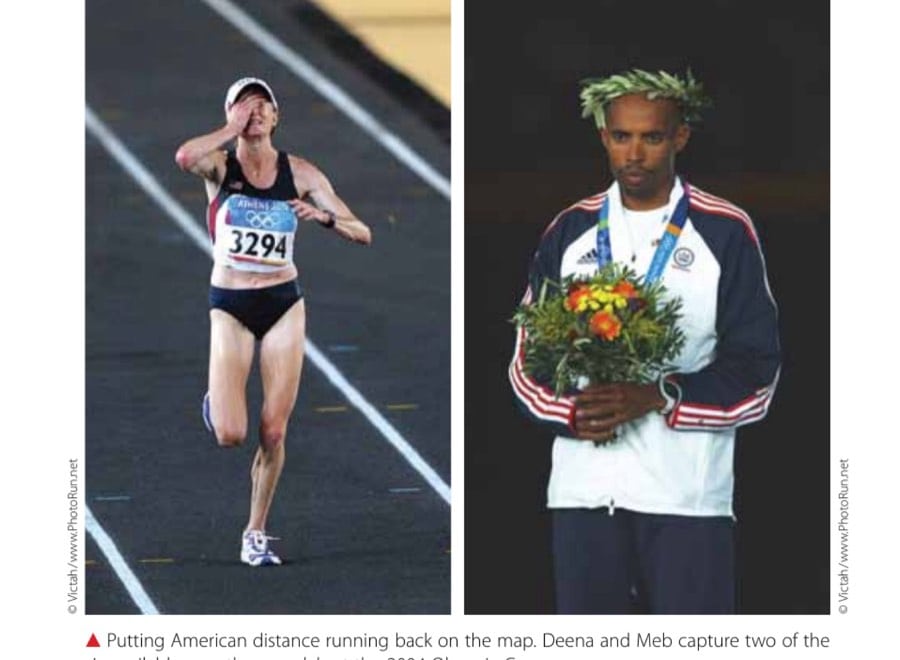
Can it really be 10 years since Deena Kastor’s and Meb Keflezighi’s historic runs at the 2004 Olympic Games? Thank goodness for the miracle of YouTube and for the timelessness of its content. Even a decade later, watching Deena enter the Panathenaic Stadium in Athens and witnessing her reaction when she comes to the realization that, yes, she has just earned the bronze medal in the women’s marathon continues to inspire. Her jubilation remains as spontaneous, her relief as raw, and her tears of triumph as heartwarming as they were that magical night in Greece. “
I started crying because there were so many people in those stands who had so much to do with me being there,” Deena says. “My family—I thought about all the amazing and constant support they’d given me since I was 11 years old . . . my ultimate life mentor, Coach Vigil . . . my husband, Andrew . . . my manager, Ray Flynn . . . everybody was there and they were all able to share in that moment.”
Watching Internet footage of the men’s race is no less compelling. There is the bizarre incident involving some wacko dressed in a kilt. There’s Meb, lurking, stalking and eventually attacking. And there are the three medalists—Italy’s Stefano Baldini, Meb, and Brazil’s Vanderlei de Lima—virtually floating around the ancient track toward the finish line as they are buoyed by the cheers of tens of thousands of spectators. “
Athens was a breakthrough for me in terms of the marathon,” Meb says. “Somebody else had a better day, but I had a phenomenal day.” These were our Deena and our Meb—the two Southern Californians who were determined to help bring US distance running back to relevance. From the moment they first established themselves as professional runners, they encouraged us all to dream big. They convinced us that we could accomplish just about anything if we simply put our hearts into it, and then they disappeared into the solitude of the mountains of Mammoth Lakes to show us how.
Laying the groundwork It was Deena’s and Meb’s coaches, Joe Vigil and Bob Larsen, who together formulated a plan to breathe new life into American distance running. They joined
© Victah/www.PhotoRun.net
© Victah/www.PhotoRun.net
forces in 2001 to resurrect the concepts of group training, heavy mileage, and perhaps most important, training at altitude. The theories adopted by Team USA California, which would later become Team Running USA, were certainly not new. The success of athletes such as Frank
Shorter, Bill Rodgers, Dick Beardsley, and Alberto Salazar could be directly attributed to a combination of some or all of those training methods. But heading into the new millennium, US marathoners were in the midst of an ugly drought.
While Steve Spence had captured bronze at the 1991 World Championships and Mark Plaatjes had won gold at the 1995 version of the same event, by 2004 it had been 20 years since an American woman had stood on the podium at an Olympic
Games and it had been 28 years since an American man had done so. Conventional wisdom held that marathoners from the United States had grown soft. It was assumed that they lacked the genetic makeup, ability, motivation, and
discipline to compete with runners from the East African countries. Both Vigil and Larsen had been around the game long enough to know that trying to change that perception would be no easy task. In Deena and Meb, they
▲ Putting American distance running back on the map. Deena and Meb capture two of the six available marathon medals at the 2004 Olympic Games.
found prodigious talents who could handle just about anything in training that the two coaches could throw at them. In the years leading up to Athens, both runners had become the American record holders in the 10,000 meters on the track, both had earned an array of national championships, and both had gained valuable experience in top-flight international competition.
But the Olympic Games are different. Only the most astute observers in the United States realize that world championships in track and field are contested biennially, and fewer still pay attention to such things as national titles or records. For pretty much everyone else, the Olympics are the only thing that matter.
After the 2004 U.S. Olympic Marathon Trials, where Deena and Meb both placed second to secure spots on the team, Vigil and Larsen set about designing a training schedule that would give the two runners the best opportunity to succeed in Greece. The program would include a pair of difficult 26-mile runs over steep terrain in the month before the competition.
By the time August rolled around, both runners were convinced that they were operating on a different level. “I knew that I was in the best fitness of my life, because of the training that I had put in throughout the entire summer,” Deena recalls. “There were just no setbacks or hiccups at all.”
Meb’s buildup was just as flawless. He had become so fit, in fact, that when he toured the hilly, challenging Olympic Marathon course with Larsen and teammate Dan Browne, he remarked about the absence of noteworthy climbs. “I have no idea what I’m going to feel like when I’m running this,” he told them, comparing what he was seeing to the mountains he and Deena had been tackling during their buildup, “but these are not hills.”
It’s one thing to successfully knock off a rigorous block of training, however, and another thing altogether to nail a taper and execute a race plan.
All roads lead to Athens The women’s and men’s marathons were designed to be like tidy little bookends to the track and field competition at the XXVIII Olympiad. The course itself, which would take the runners from the city of Marathon to Athens, paid homage not only to Pheidippides, the Greek messenger whose heroism gave birth to the sport of marathon, but also to the creation of the modern Olympic Games in 1896, where the long-distance footrace played a central role.
Deena would be squaring off against some of the greatest marathoners in history. Great Britain’s Paula Radcliffe, with a personal best of 2:15:25, was the overwhelming prerace favorite. Kenya’s Catherine Ndereba, whose credentials included victories in Boston, Chicago, and the 2003 World Championships, was no less formidable.
But just as the grueling training months had raised Deena’s fitness to new heights, so too had they done the same to her confidence level. “It kind of sounds cliché, that the journey is where the experience is, but I really felt the epitome of that,” Deena says, recalling her mind-set at the time. “I was in such a great place mentally and emotionally because of the elevation I’d gotten as an athlete. The psychological and physical maturity I got from training for Athens—it would always be a part of me. So even going into the race, I didn’t feel that ultimate pressure that I had put on myself to try to win a medal. I felt as if I was there. The training itself was my medal.”
Meb, who would have his own goliaths to contend with, was just as mentally primed. “Going into the race, I didn’t know that I’d be able to beat Paul Tergat,” Meb says. “He held the world record at the time, 2:04:55. My best time was 2:10:03. . . . He was just in a league of his own.”
Everyone else, though, as far as Meb and Larsen were concerned, was fair game. “There were other people who had run faster than me—2:07 and 2:08—but would they be able to do that on race day?” Meb says. “I was confident that I could challenge them just because of my conditioning. I was probably in 2:052:06 shape.”
In truth, the biggest obstacle for Deena and Meb heading into the Games wasn’t the course or even athletes with such intimidating pedigrees as Radcliffe and Tergat. It would be the challenges associated with racing hard for two-plus hours in Greece’s notoriously hot summer climate.
The pieces all fall into place Throughout their pre-Athens careers, Deena and Meb had proven that they could flat out race: any time, any day. Deena’s gritty performance at the 2000 World Cross-Country Championships, in which she was stung by a bee in her throat yet continued to race and run well, was legendary. Meb’s effort at the 2004 US Olympic Trials—in which he very nearly pulled out of the competition just several weeks beforehand due to a series of physical setbacks and inconsistent training, yet then came within five seconds of winning—was just as gutsy. Both had solidified their reputations as being tenacious brawlers.
But even the greatest of prizefighters have a talented support team behind them. Deena and Meb insist that a lot of the success they enjoyed in Athens could be directly attributed not only to Vigil and Larsen but also to the expertise of others affiliated with Team USA, including Randy Wilber, a physiologist for the USOC, and David Martin, marathon chairman of USATF.
Once the US marathon team had been selected, all six members, who also included Alan Culpepper, Colleen De Reuck, Dan Browne, and Jen Rhines, attended a seminar at the Olympic Training Center in Chula Vista led by Wilber and Martin. “
They went over acclimating and all those tiny percentages of doing things right that add up to medals,” Deena says. “It was all about how to beat jet lag, how to stay hydrated in hot and humid conditions, and how to keep your core temperature down.”
As competition at the Olympics got underway in earnest on August 14 and athletes such as Michael Phelps and Paul Hamm began to demonstrate their prowess in their respective sports, Team USA’s marathoners had already been hunkered down on the island of Crete for one last training block before the start of the track and field competition.
The regimen on Crete, roughly an hour’s flight from Athens, included running reduced mileage, eating plenty of fresh, local cuisine, and taking restorative swims in the Mediterranean Sea. “It was about both rejuvenating and tapering for the race as well as just putting ourselves in a calm place so that we could focus on the task ahead,” Deena says.
It was on Crete where Meb had an unfortunate encounter with a stray dog that left him with rattled nerves, abrasions, and a tweaked knee. The injuries forced him to take an entire day off from training, and initially the pain in his knee was so pronounced that he couldn’t walk up or down stairs.
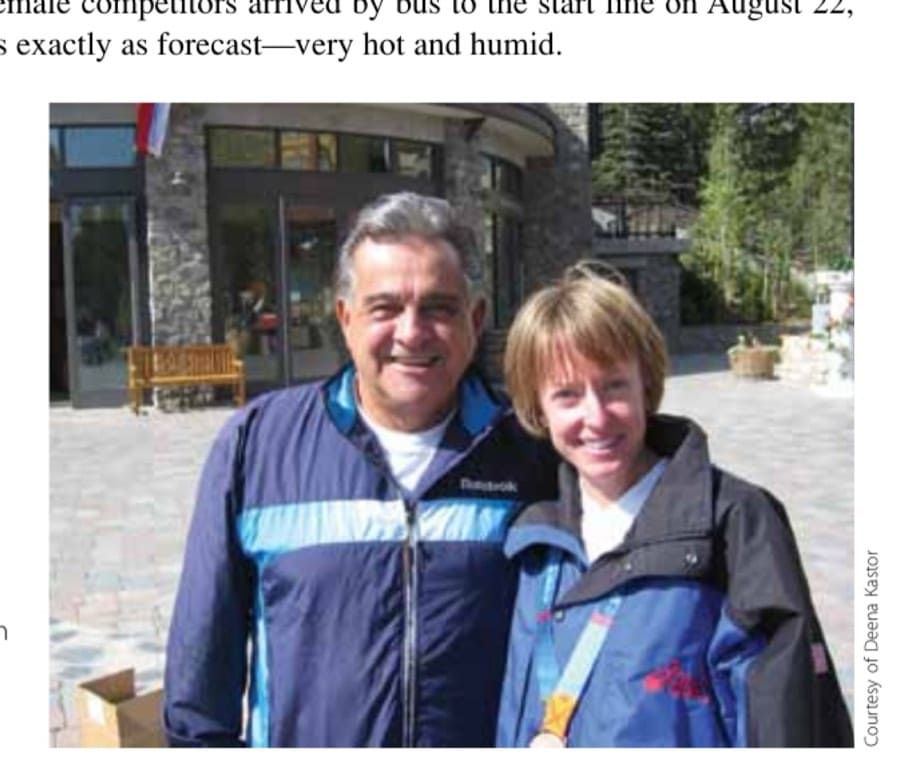
When the female competitors arrived by bus to the start line on August 22, the weather was exactly as forecast—very hot and humid.
Courtesy of Deena Kastor
▲
Deena with her life mentor, Joe Vigil, after the 2004 Olympics at the Mammoth Lakes Parade for Meb and Deena in which Mayor Rick Wood honored them.
“Everyone was going to overheat,” Deena says. “I just wanted to be the last one to do so. That was my big thing—to just try to postpone the overheating.” Just prior to the race, Deena and her teammates wore special cooling vests, remained indoors for as long as possible, and continually sipped on iced fluids. Once the gun went off, Deena focused on doing all the little things she had learned to stave off dehydration, including keeping her head and wrists as cool as possible. “
I did not pass up a single water station or sponge out on the course,” she says. Deena’s approach was so conservative that for most of the race she was just an afterthought as the commentators and camera operators focused on Ethiopia’s Elfenesh Alemu, Radcliffe, Ndereba, and the eventual winner, Japan’s Mizuki Noguchi. But that’s precisely the way Team USA had planned it. “
It was just one of those days that unfolded the way we had trained for,” Deena says, adding that she never did feel the effects of the heat during her run. Meb, who watched coverage of the women’s race from Crete, didn’t have to second-guess the advice he had been given. The evidence was right there on the television screen, as one talented female marathoner after another, including Radcliffe, faltered. Being conservative, he realized as he watched Deena pick off one fading runner after another in the latter stages of her race, would be the key to his success as well.
By the time Meb, Culpepper, and Browne reached the Olympic Village in Athens, most of the competition over the 16-day schedule had already been concluded, and with the closing ceremonies just hours away, the ambiance had turned decidedly festive. “
People were actually exchanging their singlets and uniforms and things like that,” Meb says, laughing at the memory. “But I still had a 26.2-mile journey ahead of me.” On August 29, moments before the start of that journey, he was still uncertain whether the injury he had sustained in Crete was behind him. “
I called my brother while I was on the bus to the start,” Meb says. “I told him, ‘If things don’t go well because my knee is hurting, I might not finish. Don’t be worried.’” Once the gun finally went off, Meb, like Deena, forced himself to keep his nerves and excitement in check. He was in last place for the first mile of the race. He carefully worked his way up through the field, growing more comfortable and confident with each passing mile.
Forty-eight minutes into the race, he realized that he was on, and on in a very big way. “At 15K, I gave Coach Larsen a thumbs up,” Meb says. “I executed the plan that was formed by the physiologists, Coach Larsen, and Coach Vigil. I was told to be patient, and the plan paid big dividends for both Deena and me.”
The elusive art of perfection
© Victah/www.PhotoRun.net
The competitive athlete’s mind is wired to strive for perfection. And it’s this quest, whether attainable or not, that gives purpose to all the mind-numbing hours of training. Deena and Meb dreamed of crossing the finish line first in Athens. It’s why they made all the sacrifices they did, it’s why they put thousands of miles on their legs year in and year out, and the notion of winning was no doubt a major motivator for persevering through sickness and injury.
Though they were both more than thrilled to have earned podium finishes, it’s understandable, and perhaps even inevitable, that they later questioned whether there was something more they could have done during the race to have instead earned gold.
Deena confesses that she will always wonder whether she should have made her push earlier. “It was the only marathon I’ve ever finished where I felt as if I could have gotten a lot more out of myself,” she says.
At mile 19 she was still in eighth place, more than two minutes out of the lead. By the end of the race, she had managed to cut that deficit in half as she passed everyone except Noguchi and Ndereba. “
Maybe I was a little too conservative,” Deena says. “Afterward I had that pat on the back for a job well done, but I also had the insatiability that any athlete has—that it still wasn’t quite good enough.”
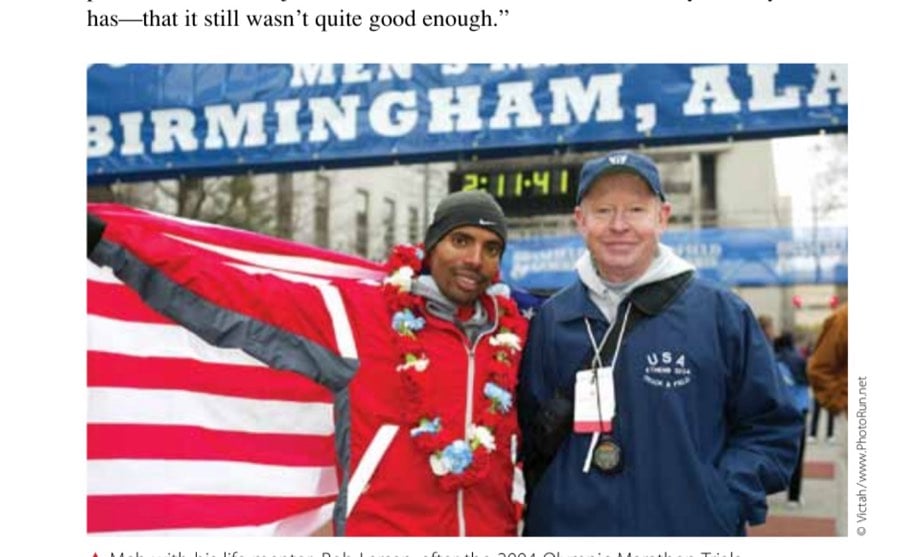
▲ Meb with his life mentor, Bob Larsen, after the 2004 Olympic Marathon Trials.
Meb’s postrace analysis a decade later is just as insightful. In a move as surprising as it was bold, de Lima had broken away from the pack at 20K and had run all alone for nearly an hour. At 30K, the chase group, which had been whittled down to eight and included Tergat, Baldini, and Meb, was still 46 seconds behind.
When none of the other runners seemed interested in trying to catch de Lima, it was Meb who finally began to force the issue. “I was the one who initiated the move, and then we got it down to four or five people,” Meb says. “That’s what racing is. I had to make a decision based on how I was feeling at that moment.”
Sensing an opportunity when he saw that Tergat “was a little heavy on his feet and not being efficient,” Meb threw in another surge that dropped the Kenyan superstar. Now the race for the top three was in full force.
De Lima was still leading, remarkable considering that a deranged spectator had momentarily plucked him off the course, but Baldini and Meb were quickly closing in on him. And then, with less than 10 minutes left before they reached the stadium, Baldini blew past de Lima and managed to put some distance between himself and Meb.
Meb will always wonder whether he should have tried harder to cover Baldini’s brilliant move, even though he realizes that doing so may have meant blowing himself up and missing out on the medals altogether. “
He made a move when it counted,” Meb recalls. “Sometimes people can do it in their first one and make it count. For Baldini, it was his 16th marathon and for me it was only my fourth.” Of course, it’s always easy to dissect a competition after the fact. And it’s a given that each of the 65 women who finished behind Noguchi and each of the 80 men who finished behind Baldini all did their fair share of second-guessing and soul-searching after their races.
But only six of the best marathoners in the world reached the podium in Athens, and no amount of analysis and reanalysis will ever change the fact that two of them were Americans.
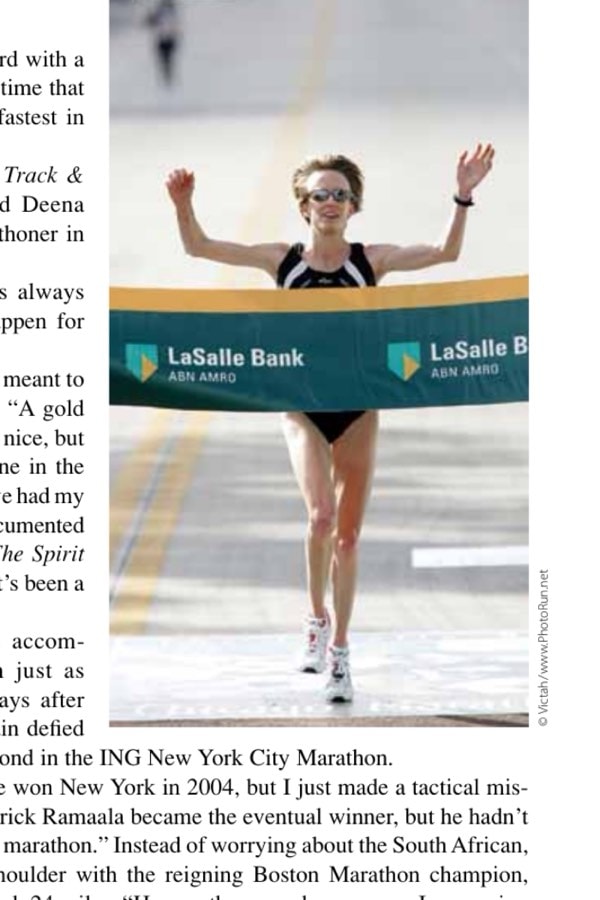
A steppingstone for even more great things As it turned out, the medals earned by Deena and Meb proved to be harbingers of stellar results to come. “I used the strength that I got training for Athens to be my platform for another training stint to try to be faster and better,” Deena says. She won the Chicago Marathon in 2005, becoming the first American woman to capture a big-city marathon since Kristy Johnston won Chicago in 1994. Several months later she ran exceptionally fast in the London Marathon and broke
her own American record with a remarkable 2:19:36—a time that still ranks as the 15th fastest in history. That year, in 2006, Track & Field News recognized Deena as the top female marathoner in the world.
Deena, for one, has always believed that things happen for a reason. “Sometimes it’s just meant to be that way,” she says. “A gold medal would have been nice, but to be ranked number one in the world in 2006 and to have had my first marathon win be documented during the making of The Spirit of the Marathon, well, it’s been a wonderful journey.”
Meb’s post-Athens accomplishments have been just as noteworthy. Seventy days after the Olympics, Meb again defied the odds and placed second in the ING New York City Marathon. “I think I could have won New York in 2004, but I just made a tactical mistake,” Meb says. “Hendrick Ramaala became the eventual winner, but he hadn’t done anything yet in the marathon.” Instead of worrying about the South African, Meb ran shoulder to shoulder with the reigning Boston Marathon champion, Robert Cheruiyot, through 24 miles. “He was the guy whose moves I was going to cover,” he says.
When Ramaala broke free at an aid station, Meb let him go. By the time he realized it was a definitive move, it was too late to catch him. Though Meb was quickly gaining on Ramaala as they made their way through the race’s famous Central Park finish, he simply ran out of room. “
I still felt strong,” Meb says. “But he made the move when it counted, just like Baldini did in Athens. But [that race] gave me even more confidence for what I could do in the marathon.”
© Victah/www.PhotoRun.net
▲
Deena captures the 2005 Chicago Marathon.
▲
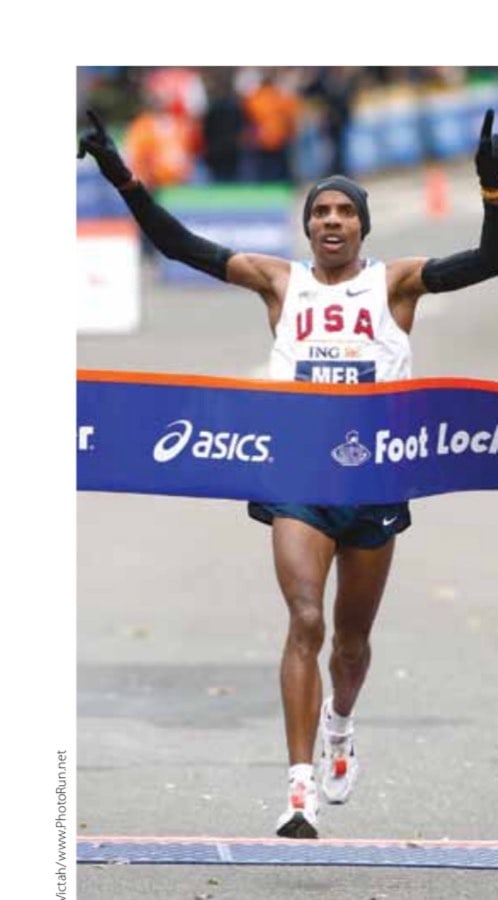
Meb crosses the line first at the 2009 New York City Marathon.
© Victah/www.PhotoRun.net
And then it happened. Five years later, Meb became the toast of the marathon world when he won New York in spectacular fashion, becoming the first American to win there since Alberto Salazar 27 years before.
Few could have predicted that four and half years later, lightning would strike again. Meb’s dramatic victory at the 2014 Boston Marathon not only helped make his case for being the greatest American mara
thoner in history, but in light of the tragedy that took place in the city just 12 months before, it transcended sport. “I’m a competitor at heart,” Meb says. “I will never know how fast I could have run, be
cause I was never in 2004 Athens shape or 2009 New York shape on a flat course. But I’ll take titles over time anytime.”
The elusiveness of the Olympic medal Winning an Olympic marathon medal is no easy task. In addition to Radcliffe, the list of acclaimed runners who tried but never managed to do so includes Salazar, Ron Hill, Bill Rodgers, Steve Moneghetti, Kenny Moore, Antonio Pinto, and Takeyuki Nakayama. True, earning a medal requires an equal measure of talent and hard work. But it also requires a sprinkling of good fortune, as shown by what happened to Deena and Meb when they tried to replicate or improve upon their Athens results in subsequent Olympiads. Deena was all set to roll at the 2008 Beijing Olympic Marathon when she broke her foot three miles into the race.
“I was so sideswiped by it because there was no warning,” Deena recalls. “Ten days before, I’d had the greatest marathon simulation run of my running career, and I was thinking to myself, Wow, I really nailed this. I really did it right.”
When misfortune struck, she quickly found herself on a support bus whose job it was to lag behind the women’s field and scoop up all DNF athletes. Deena, who had barely broken a sweat at that point, was forced to endure an introspective two-hour ride back to the stadium. “
Breaking my foot was a slap in the face, and I couldn’t come to terms with it when I was on that bus,” she says. “But I knew that there had to have been a very profound reason why that happened, so I just welcomed the opportunity to learn why while I was laid up on crutches for the next couple of months.”
What Deena discovered, after getting back to Mammoth, undergoing medical tests, and trying to solve the puzzle with her physician, was that even though she was possibly in the best running shape of her life, she really wasn’t all that healthy. She had been treated for a case of giardiasis earlier that summer, a parasitic illness she had contracted from drinking out of a stream, and she had lost 6 pounds over the course of a week. Since she was on the final buildup to Beijing, she didn’t have enough time to regain all the weight she had lost.
In Mammoth, Deena’s doctor prescribed a DEXA scan to check on the health of her bones and was stunned to see how compromised her skeletal system had become. While her calcium levels were fine, she was woefully low in her vitamin D stores. Deena, who has had several bouts of skin cancer, is hypervigilant about wearing extra sunscreen, hats, sunglasses, shirts with sleeves—just about everything she can think of to reduce sun exposure. Because of her diligence, however, she wasn’t getting enough vitamin D into her body. “
It was just the perfect storm, basically,” she says. “As athletes, we ride that line and push the envelope and the limits so often. And I went over that limit without realizing it.”
ad
No medical tests, however, will ever explain the timing of her injury. The bone break could have occurred during that last simulation run or it could have happened a month or two after the race. Maybe things do—or don’t—happen for a reason. “
As low as I was in that moment, it was probably one of the most profound moments in my career as an athlete—to feel as if you’re performing at an optimal level when, internally, you actually aren’t at all,” Deena says. “It was a pretty big eye-opening experience. But I think the lowest points of sport and life are our greatest opportunities to grow as individuals—to become strong both physically and mentally.”
Deena attempted to make the US marathon team again in 2012 but finished in sixth place at the Olympic Trials. In contrast to Deena, Meb never even made it to Beijing. Not only did he suffer a stress fracture in his hip at the US Olympic Marathon Trials on November 3, 2007, but he also lost his good friend and training partner Ryan Shay, who died of a heart attack during the race. The double blow left him reeling.
Months later, while Meb was still rehabilitating from the psychological and emotional pain, he and his wife, Yordanos Asgedom, watched coverage of the men’s marathon on television. “Sammy Wanjiru ran out of his mind, and I could not do that,” he says. “But I think a silver medal was definitely within my capabilities and certainly the bronze medal. But bottom line, I didn’t make it to the starting line of Beijing because I didn’t qualify. It is what it is.”
Four years later, Meb rebounded to win the 2012 Olympic Trials and seven months after that, at the London Games, he came oh, so close to earning a rare second Olympic medal when he finished fourth by less than a minute and a half.
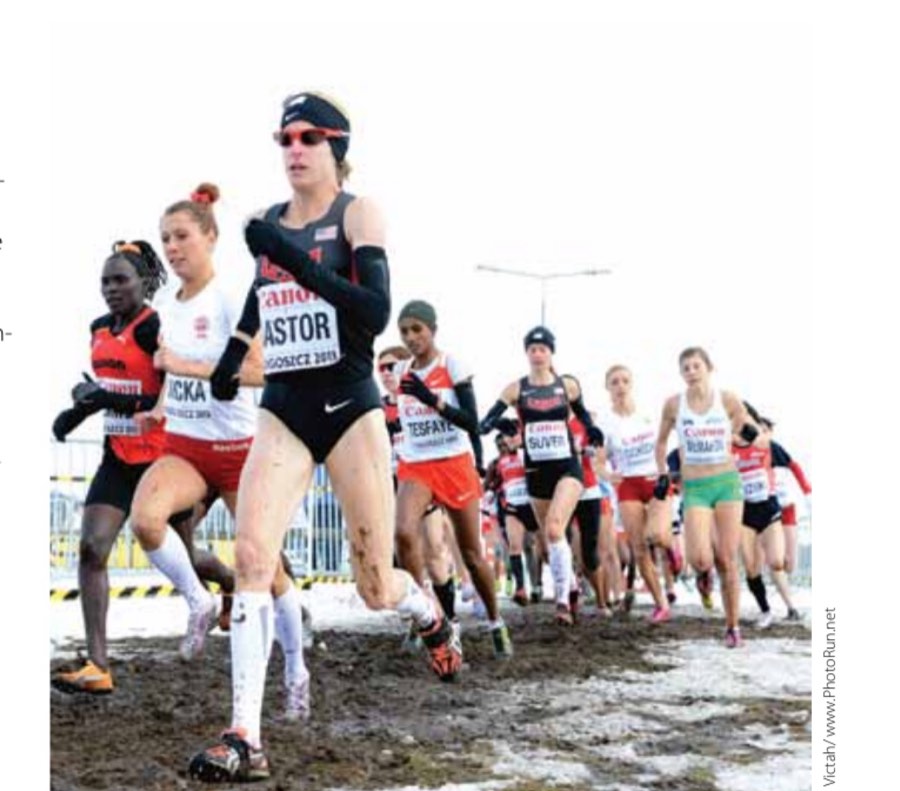
Playing it forward—one step at a time Deena and Meb are still competing, and clearly doing so at the highest level. Throughout 2013, Deena, now a masters runner, belied her age with solid performances at the Los Angeles Marathon, the IAAF Cross-Country World Championships, the Beach to Beacon 10K, and the IAAF World Championships in Athletics. On April 13, 2014, she broke the US women’s masters record in the half-marathon.
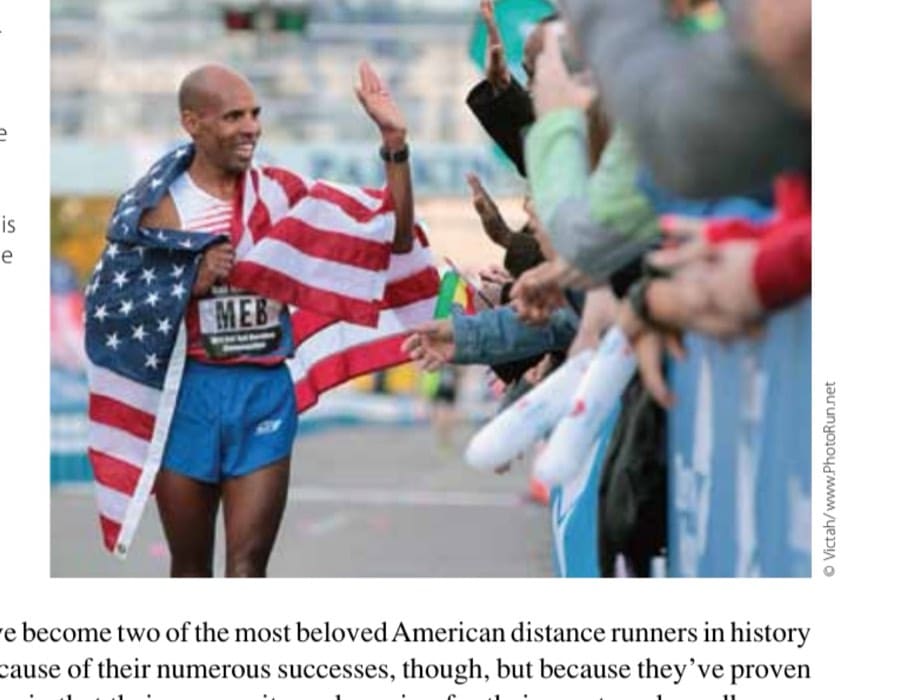
Meb, in something of a prelude of what was to come in Boston, where he would become the first American male to triumph on the famed course since Greg Meyer in 1983, won his 22nd national title when he captured the USA Half-Marathon Championships on January 19, 2014.
If nothing else, the sport of marathon is one of resilience, and few runners have embodied that principle quite like Deena and Meb.
© Victah/www.PhotoRun.net
▲
Deena battles the best crosscountry runners in the world at the IAAF CrossCountry World Championships in Bydgoszcz, Poland, in March 2013.
© Victah/www.PhotoRun.net
▲
As a precursor of great things to come in Boston three months later, Meb celebrates his victory at the 2014 USA Half Marathon Championships in Houston, Texas.
They’ve become two of the most beloved American distance runners in history not just because of their numerous successes, though, but because they’ve proven time and again that their generosity and passion for their sport are boundless.
Courtesy of Joel St. Marie
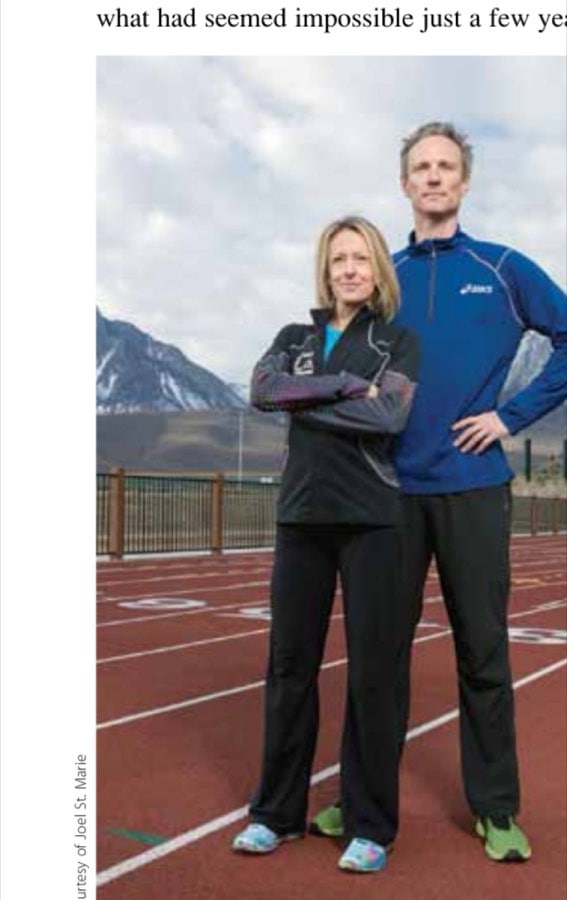
Deena and her husband, Andrew, have worked hard to establish the Mammoth Track Project as a way to give back both to the community they call home and to runners of all ages and abilities from around the world.
Meb, meanwhile, created his MEB Foundation to help promote the idea of youth maintaining excellent balance in life, in part through sport. “I’ve tried to be a good example both on and off the track, and hopefully oth
ers who follow will do the same,” Meb says. “I hope to be a centenarian, and until that day I’ll continue giving back to the sport,” Deena says. “I really believe that it changes lives in such a positive
way, that simple act of putting one foot in front of the other with a little air time in between.” It’s difficult to quantify the effect that Deena’s and Meb’s medal finishes in 2004 had on the state of distance running in the United States.
Clearly, they shifted the model that was in place at the time. They proved that what had seemed impossible just a few years earlier was, in fact, very possible. And for American marathoners who dream of one day
reaching the podium at the Olympic Games, that may well be Deena’s and Meb’s greatest legacy. “For me, it was all about sacrifice,” Meb says. “We definitely have the talent that others can do what Deena and
I did, but are they willing to make the sacrifices? Do they have the commitment to a long-term goal like we did?” “I think it’s every athlete’s obligation to do that—to make choices,” Deena says of her
commitment to Mammoth. “It’s all what you create. You have to create it. It’s not going to come to you.” ▲
Deena and husband, Andrew, founders of the Mammoth Track Project, stand on the fulfillment of a dream.
This article originally appeared in Marathon & Beyond, Vol. 18, No. 5 (2014).
← Browse the full M&B ArchiveMore like this
1,000+ stories from 19 years of Marathon & Beyond
The complete archive of the legendary long-distance journal — digitized and free to read.
