

Love That Dirty Water
Hopkinton, Massachusetts, is that sleepy little town that is famously known as the origin of the Charles River, which then meanders some 80 miles into Boston. This fact became known to me only after taking a Duck Tour in Boston in December 2012. My wife, Diane, and I took the tour while in Boston for a long weekend that we treated ourselves to in order to see Leonard Cohen in concert at the Wang Theater.
The driver of the amphibious Duck boat informed us, just before going onto the Charles River (I believe the river was named in honor of Ray Charles), that it did indeed start those many miles away in Hopkinton. It’s an interesting fact, indeed, but one that made us think of what else starts in that town every April. It’s hard to be in Boston without thinking of the marathon.
This was the first time for both Diane and me that we had ever visited Boston when it had nothing to do with the running of the Boston Marathon. I had been to Boston, starting in 1974, nine times, and Diane, starting in 1988, 16 times, and each time it had been on Patriots’ Day weekend. We stayed at the Eliot Hotel this time just for old times’ sake, and just walking out the door onto Commonwealth Avenue made our stomach turn in knots in nervous anticipation of the phantom race we were not about to run.
Boston is a beautiful town, and it was nice to visit knowing we didn’t have to run the race, too. For Buffalonians such as us, Boston sports teams are not our favorites. The Bills always hang tough against the Patriots until the opening kickoff, and then it’s quickly downhill from there; and as for the Sabres versus the Bruins, well, let’s just say the Boston club has won a Stanley Cup or two while we Sabres fans just dream of that first riot after winning a championship. Ah, the smell of burning cars and tear gas amid the celebration of final victory.
For runners, however, Boston is the “Marathon.” Thinking about that race while in Boston, I got to thinking about how much it has changed over the years since I had first taken part in that amazing event. Oh, no, you say, not another “back in the day” tale. Yes, I’m afraid it is, but first, let’s take a moment to say
“back in the day” properly, and you may enjoy such stories much more. I know I went through this same routine in my last article that appeared in the January/ February 2012 issue of Marathon & Beyond, but as a refresher course for those who read the story and as a learning opportunity to the rest of you who may want to read this, here we go. So to start with, as you begin the phrase, place the most emphasis on the word “back,” take an almost reverent pause, and finish with a flurry with a truly religious accent on the word “day.” See, doesn’t that feel better? Well, like it or not, here goes.
Return with us now, to those thrilling days My first inkling of the Boston Marathon was during my senior year at Riverside High School in northwest Buffalo. Standing near the dirty waters of the Niagara River (people can be so clever in thinking up names for institutions—Riverside indeed!), I spent many a study hall gazing out the windows and dreaming of being a river man or a tugboat captain. Dream big, I say. To occupy my after-school hours, I was on the cross-country, swimming, and track teams. It was in early March, just after the swimming season had ended, that running teammate Bill Nordstrom came to me with an interesting proposition.
It turned out Bill had plans of running the Boston Marathon, and his father had even gotten him a membership in the Delaware YMCA in November so he could run indoors during the upcoming winter. In talking to Bill recently, he admitted he had no idea how to go about training for a marathon. He knew enough not to tell our coach, Jim Decker, so he went to a former coach, Herb Mols, to vouch for him. Herb was a huge figure in local running and in the Niagara AAU, and together they fudged some numbers and told the Boston officials that Bill was more than capable of running the marathon. Bill was in.
Bill’s longest training run was the seven miles our cross-country team did in October 1965, when we ran to the Grand Island Bridge and back. During the winter, Bill would go to the Y now and again to run on the indoor track there. It’s a tiny track, and I believe the number of laps per mile is somewhere between 30 and 2,143, and thus it is tough to get those long ones in. Bill admits his longest workouts were three miles a couple of times a week. Look out, Boston!
This is where I came in. Bill came to me in March and asked if I would like to join him in running the Boston Marathon. Seeing the very puzzled look on my face, he proceeded to explain what the marathon was all about, and not really comprehending what he was telling me, I agreed to do it. We went out and ran a couple of miles in miserable weather, and he gave me an entry blank for Boston, which I still have, being the pack rat that I am.
We ran another time or two, and then I began figuring out my financial situation. Being from a family of nine kids, I knew I didn’t dare ask my folks to
pay for my stay in Boston. The entry form has no mention of any entry fee, but even I figured Boston might be a bit rich for a poor high school kid. Yeah, I had some money saved up from my part-time job of baby-sitting, and it may have been enough. But it hit me, the senior prom was also coming soon, and I even had a girlfriend who was counting on my paying for the event. How do I tell her we can’t go to the prom because I want to run 26 miles in Boston? So I had to tell Bill he would have to do Boston without me, and that was just what he did.
A different visit to the Charles
Courtesy of Bill Donnelly
It turned out that the closest I ever came to the dirty water of the River Charles in 1966 was when I saw the Standells opening for the Rolling Stones in June of that year in Buffalo, when they sang their big hit, “Dirty Water.” For those old enough to remember, the song is all about Boston, the River Charles, and hanging out with lovers, muggers, and thieves. And yes, I was a huge Stones fan. All baby boomers in the 1960s could be divided into one of two groups, those who loved the Beatles, and those who loved the Stones. I always felt vindicated by my choice, as the Beatles proved to be a flash in the pan and were gone by 1970, while the Stones are still rocking and making us boomers feel young since, thank goodness, we don’t look as old and terrible as Keith Richards does.
The 1966 Boston was historic for a couple of reasons, not the least of which was that I almost went. According to Bill, it was a hot and sunny day (he remembers getting sunburn), so the winning time of 2:17:11 was fair. The Kenyans of the day, the Japanese, took the first four places, led by Kenji Kimihara. More important, it was the first Boston in which a woman competed, though unofficially. The next year, Kathrine Switzer became the first woman to run Boston with a number, having entered as K. V. Switzer, but in 1966 Roberta Gibb ran as a bandit and
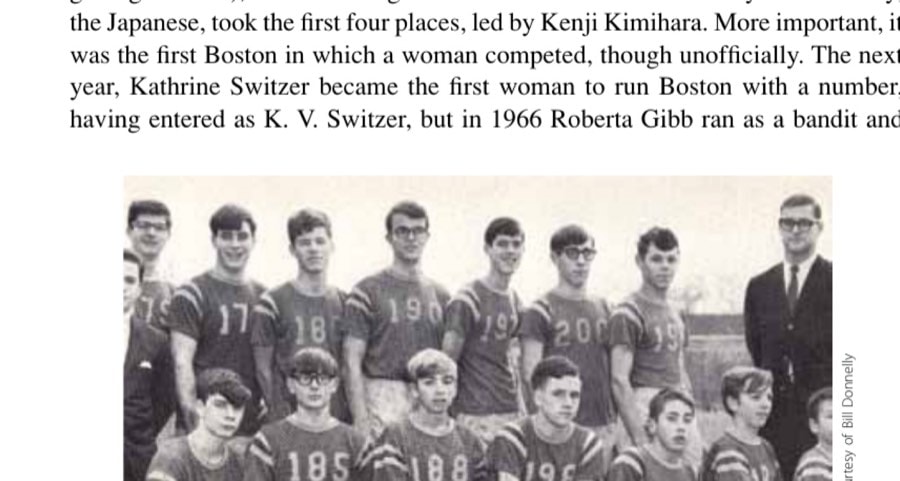
▲ The Riverside cross-country team in the fall of 1965. Future Boston Marathon runners are Bill Nordstrom (back row, #190), the author (back row, #200), and the author’s brother Mike (front row, first on the left).
finished in 3:21, and I believe she finished in 124th place. Bill didn’t know until the next day that she had run. So here was Bill Nordstrom lining up in Hopkinton with just a few hundred other runners, not really knowing what he was in for. As he remembers it, he was running along well enough, at least through Wellesley. Why doesn’t that surprise me? Somewhere in the Newton Hills, his lack of putting in 67,831 laps a day at the Delaware Y caught up with him, and he began thinking of trying to call a cab for the ride back to downtown Boston. He did not know about the bus that followed along picking up strays.
Somewhere before Heartbreak Hill, he had had enough, went through an opening in the crowds, and found a party hosted by college kids. He was a celebrity there, was immediately handed a vodka gimlet, which he chugged, and then he had another. Hey, what did he know, and besides, they didn’t have Gatorade back then. He hung around for a half hour, thinking of that cab and fueling up on the apparent sports drink of the day, vodka gimlets. Believe it or not, he started feeling better, used the bathroom, and continued the race.
Bill finished his ordeal, and he guesses it took him about 5 hours and 15 minutes. A guy from the Boston Globe took his picture as he crossed the finish line, as the paper liked to show the last-place finisher in the next day’s paper, but unfortunately for Bill, a couple of guys behind him were bound and determined to take that honor. My only way of knowing at the time that Bill had run the marathon was that for the next couple of weeks he hobbled around school on crutches and had a special pass to use the school elevator, which was of course supposed to be used by important people such as the principal, Buffalo’s mayor should he show up, the pope should he show up, and cheerleaders.
Even though I was not there in 1966, you can see the big changes in the race just by looking at my copy of the official entry blank for the 70th running of the Boston Marathon. Then it was called the American Marathon Run, and it was held on Tuesday, April 19. Up through 1968, the race was held on Patriots’ Day, April 19, unless that day fell on a Sunday. If that happened, it would be run the following Monday. In 1969, Patriots’ Day became a Monday holiday, to be held on the third Monday of April. Also, there is no entry fee listed in 1966, and runners had to report to the high school in Hopkinton to get their bib number and to be weighed (what, no fat runners allowed?) and examined by a doctor. We know there were only a few hundred starters, and this number would soon start to grow quite quickly.
At last, I make the trip I wouldn’t get around to running in my first Boston Marathon until 1974. The first running boom was just getting into swing, and things were already starting
to change. The cost of the race had grown tremendously, and it went from free to the whopping entry fee of $2—the nerve—and then to make it worse, if you took the bus to Hopkinton, the legendary Scotsman Jock Semple stood at the bus door and collected a further fee of $1 for the privilege of getting to the start. Of course, in those days, you could save that dollar and have a friend or family member drive you to the start in Hopkinton, as the town didn’t have to shut down because of the crowds, as there really weren’t any crowds.
Of course, the money we paid to run Boston back in the day was minuscule compared with what we pay now, but we did not receive a shirt for entering (how many of those do you need?) nor a finisher’s medal (how many of those do you need?), and we pretty much had to depend on the spectators for water and orange slices along the way. Of course, helping the runners with refreshments got the crowds even more into the race, as they were participants in their own way. We did eventually get a beautiful certificate, suitable for framing, with our time and finish place. All in all, I would take the certificate and the $2 cost.
So there I was, early Monday morning, April 15, getting to meet the infamous Jock Semple for the small cost of $1 (infamous if you are Kathy Switzer), and I climbed on the bus wearing my $17 Tiger Bostons (now Asics), cotton shorts, and my new Buffalo Philharmonic AC nylon mesh singlet that would cut off the nipples of a rhino, if said rhino was crazy enough to wear such a shirt while running a marathon.
I arrived in Hopkinton as one of 1,700 runners, and as this was the beginning of the first running boom, this was the largest marathon ever. We were herded into the school where we had to pass a quick physical before we were handed our running bib with number. The young interns doing the exams actually refused to pass some 20 or 30 already qualified runners because the athletes had suspected heart murmurs.
Before 1974, you could qualify for Boston by running a 3:30 marathon or certain shorter distances in certain times, but in ’74 you had to have a 3:30 clocking in a marathon to get in. So all these runners had qualified but were being told they couldn’t run because some wet-behind-the-ears intern thought he heard a heart murmur, and this was after getting almost to the starting line. Imagine if today, with today’s application fees, you went to, oh, say the New York City Marathon, and when you are already there and ready to pick up your number on Friday before the Sunday race, it was canceled at this last minute (with no refund) because of something that happened a week ago, so it should have been canceled then but wasn’t until this late date so you had to spend big bucks getting there, and now you are out all sorts of money and with little time to find another marathon to do. But I’m getting away from my story, and besides, could such a preposterous thing ever really happen? Back to the ’74 Boston, where there was such an outcry
over healthy runners being scratched that 1974 was the last year the runners had to go through a physical right before the race. The school we were in provided the only bathrooms for the runners, because no porta-potties were set up. By today’s standards, this was not a large marathon, but the few bathrooms in the school were not nearly enough for 1,700 nervous runners. Most of the runners headed into the nearby woods for relief. When I got back to Boston after more than 20 years away from it, I noticed that the woods near the school were very lush and green.
Equal rights to, well, you know I clearly remember that during one trip to the woods, just as I finished what I came to do, a woman competitor stopped next to where I was, and as she cheerfully greeted me, she pulled down her shorts and squatted to pee. Being the shy young guy that I was, I probably said “Nice day for a race!” while watching her pee without making eye contact. (Hey, now wait a minute, my eyes were on her forehead!) I did learn at that moment that watching a woman squatting to relieve herself is about as sexy as watching a squirrel burying his acorns. As there were only about a dozen female runners in that year’s Boston, to this day I wonder which famous woman pioneer in running I met on that wooded hillside. Was Nina Kuscsik or Miki Gorman my coed bathroom partner, or perhaps it was Kathrine Switzer who smiled at me so sweetly. I guess I’ll never know.
After killing time, and many trips to the woods, we headed toward the start. The shrubs and bushes of the local residents also became makeshift bathrooms, and in fact, some homeowners stood in their yards with hoses running, spraying any athlete daring to soil their yard. I’m not making this up, and really, can you blame those homeowners?
A year before my first Boston, and before I jumped from the Philharmonic AC to the Belle Watlings, the Watlings founder, Dick Sullivan, discovered a delightful older couple named the Cronins, and as only the founder could do, he charmed the heck out of them. It was the hot Patriots’ Day in 1973, and he asked if he and his teammates could take in the shade of their porch and possibly use their bathroom, and the Cronins allowed them in. It turned out that they were absolutely thrilled to be host to some actual participants in this yearly spectacular, and for the next several years, we had a place to stay and relax and relieve ourselves on the morning of the race. This sure came in handy, especially on those days the weather was most foul and the crowds were growing.
The Cronins lived on Hayden Rowe, which back in the day was the street on which the race started. Believe it or not, we took off and pretty quickly had to make a hard right turn onto Main Street, Route 135. This start would definitely not work with today’s crowd of competitors. Their house was mere yards, as in a
couple of lawns or maybe 50 yards, from the starting line. Eventually elite runners started getting themselves invited to the Cronins, and their hospitality and fame spread. A few years later, Runner’s World had a full article about the Cronins, and in said article, credit was given to the Belle Watlings for having discovered them. The Cronins unfortunately have passed away, and their shelter from the storm and their gracious hospitality and wonderful personalities are greatly missed by all who knew them. There is something to be said for those simpler times.
It’s not the Cronins Just to point out how things have changed, now we runners are herded into the Athletes’ Village, a large grassy area surrounded by fences and more porta-potties than I have ever seen, probably not enough to have satisfied the 500,000 concert goers who were at Woodstock in 1969 but enough to handle the 20,000-plus nervous and anxious runners gathered in Hopkinton. There is something about getting ready to run a race that brings out the pee in you.
Nowadays we start meandering the half mile to our different corrals. There are more porta-potties along the way, enough to have handled the relatively small number who were at the 1974 Boston, but unfortunately, this is now, with so many more bladders needing relief, and you can see that some traditions never die. Every scrub, bush, and parked car becomes a potential bathroom. Now, however, I no longer see homeowners chasing away athletes with spewing hoses. Perhaps the residents of Hopkinton came to realize that their bushes were healthier and their lawns greener, and all without the use of Green Turf Through Miracle Chemicals That May Not Be So Good for Living Organisms, Inc.
However, back to 1974. We lined up for the start with no computer chips on our shoes and with no special seeding, so you had to line up early to get a good spot. With only a dozen or so women in the field, many of those nervous men who had been lined up the longest had no qualms about emptying their bladders right there in the road. I remember the gun going off and having the strange sensation of having to run in place for a bit due to such a big crowd of runners being in front of me for the first time ever (first time for most of us in the middle of the pack, as many of us laughed when we couldn’t move when the gun fired). When we finally took off, we went through what turned out to be quite a splashy start to the race despite the blue skies overhead.
One thing that hasn’t changed in Boston over the years is the crowds of people that cheer you on. Not many sporting events have literally over a million spectators cheering on the athletes during the competition. The crowd control now is a lot better, as I can recall that in one of the Bostons I ran during the ’70s, we were running most of the way up Heartbreak Hill in almost single file because those cheering us on had closed almost completely in on us.
In those days, there were no mile marks or officials giving out times, and it wasn’t until 1978 that I first knew of someone even wearing a sports watch to get a sense of where he was. We needed these crowds of people to keep us going, and anyone who has run Boston then or since would surely agree.
Some things don’t change
© Jeff Johnson
And then there was Wellesley, the private school for women (back then we said private girls school) whose inmates (back then we said babes) make so much noise (back then we said noise) that you can hear them for a half mile before you reach them. This, of course, hasn’t changed, and last time I ran Boston I still lost 10 minutes taking up the offers of the seniors (back then we called them babes) with signs that read, “Kiss me, I’m a senior.”
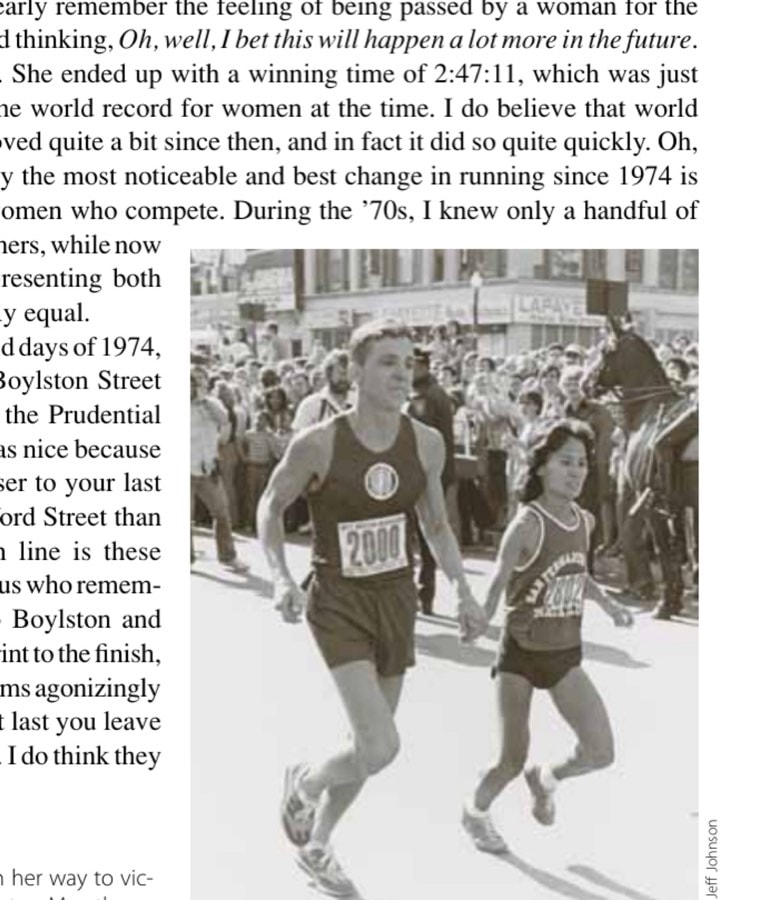
In 1974, the first woman finisher, Miki Gorman, passed me with a couple of miles to go. I clearly remember the feeling of being passed by a woman for the first time ever and thinking, Oh, well, I bet this will happen a lot more in the future. Boy, was I right. She ended up with a winning time of 2:47:11, which was just 41 seconds off the world record for women at the time. I do believe that world record has improved quite a bit since then, and in fact it did so quite quickly. Oh, yeah, I would say the most noticeable and best change in running since 1974 is the number of women who compete. During the ’70s, I knew only a handful of local women runners, while now the numbers representing both sexes seem nearly equal.
In the good old days of 1974, we finished on Boylston Street right in front of the Prudential Center, which was nice because it was much closer to your last turn off of Hereford Street than where the finish line is these days. To those of us who remember turning onto Boylston and having a short sprint to the finish, the new finish seems agonizingly far away when at last you leave Hereford behind. I do think they
▲
Miki Gorman on her way to victory in the 1974 Boston Marathon.
have lengthened the course because my times are much slower than they were back in the day. We would finish in a single finishing chute and then be pointed to the Prudential Center basement for a bowl of stew.
I ran Boston four times in the 1970s—1974, ’75, ’78, and ’79. Anyone familiar with that decade of Boston Marathons could see right off that I missed the very hot races in 1973 and those roasters in ’76 and ’77. It wasn’t that I had premonitions of fiery, torturous runs, I just wasn’t qualified for the first (I started running on April 1, 1973), and I was injured or too broke to make the other two. After 1981, I took a long break from long-distance running (mostly due to burnout) and did not get back into competitive racing until 2000. Thus, by the time I got back to Boston in 2001, my eyes were opened to the changes awaiting me. More on that in a bit, but even in the ’70s I saw the changes coming, mostly caused by how fast Boston was growing.
Then there is the matter of qualifying As I mentioned, the qualifying time in 1974 was 3:30, and at 3:30 in the afternoon (starting time then was 12 noon), the officials turned off the clock and anyone finishing after would not count and would have to requalify for the next year. Not long after 1974, the qualifying time for those runners less than 40 years of age went to 2:50, while women and masters still got the luxury of a time of 3:30 to get in. I guess times have changed in that regard big time over the years, with the biggest advantage in easier qualifying times going to us baby boomers. Perhaps that is because Boston officials figure we have more of that extra income available to spend, or perhaps it is because they have made the course significantly longer and us older folk need all the advantage we can get.
As I just said, the qualifying times to get into Boston were now set, and they only got tougher for the open division. The 1,700 contestants jumped to 2,000 by 1975, and when next I showed up in 1978, the numbers had more than doubled to over 4,000 finishers, with 186 of them being women (what a jump in the number of babes, er, females). I did notice that the marathon in ’78 was nice enough to keep the clock going until 4:00 and to list those finishers in the results book.
All of the four Bostons I ran in the ’70s were in good weather, around 50 degrees, and once with a light drizzle, which only helped us young runners. A nice touch was at the finish of the ’75 race, the officials wrapped you in one of those silver space-age blankets. (Hey, back then they were like something right out of The Jetsons.) This was a welcome first and one which Boston and most other races continue to this day.
Also in 1975, Boston had the first wheelchair race, and I know I passed one racer in 1978, and years later I wondered how this was possible since wheelchair racers got a head start and can really move now. Then I looked at the picture I
have from the Boston paper of George Murray winning the 1978 wheelchair competition in 2:26, and that chair may be the same model used to wheel me out to my car after minor knee surgery recently. My goodness, how having this division has led to amazing technological advances in racing chairs, and I’m sure it spills over into advances for everyday wheelchairs for people’s daily use (not for those hospital chairs, however).
By 1978, because the numbers were growing faster than the officials could keep up with things, the finishing chutes were starting to become a problem as runners were stopped before the finish line and had to wait to get into the chutes, thus messing up their times. I didn’t have to wait, but it was chaos at the end of the chute I was in, and I’ll never know my true results. The results in the next day’s paper showed this, as you could see the problems starting at 2:31:30, as runners’ times were listed in 15-second intervals, with nine runners hitting 2:31:30 and 16 running 2:32 even. Obviously it was a problem, but the officials straightened it out as best they could in the official results book we got with our finishing certificate. I did lose 15 seconds and four places in the official results (rats), but somehow my finishing time was left off my certificate (everything was left blank but B.A.A. President Will Cloney’s signature), so I had to fill in everything myself (it impresses the heck out of friends to see that I finished fourth in the 1978 Boston Marathon with a 2:11:16, but don’t tell Jack Fultz, because that makes his time of 2:11:17 good for only fifth place). All I can say is thank God for the computer chips.
As I said, I didn’t do Boston in the 1980s or ’90s, but my wife, Diane, did, starting in 1988. She remembers that before the computer chips, the results sometimes let you know how much time to take off your gun time for your approximate true finishing time, depending on what corral you started in. She remembers getting to take off 3 minutes and 30 seconds one year. We didn’t have corrals back in 1975, but I know I started in the middle of the pack of 2,000 runners, so I figure I should be able to take off one full minute from my time. This matters only because that was the race I had my PR in, which is only 13 seconds faster than my
▲
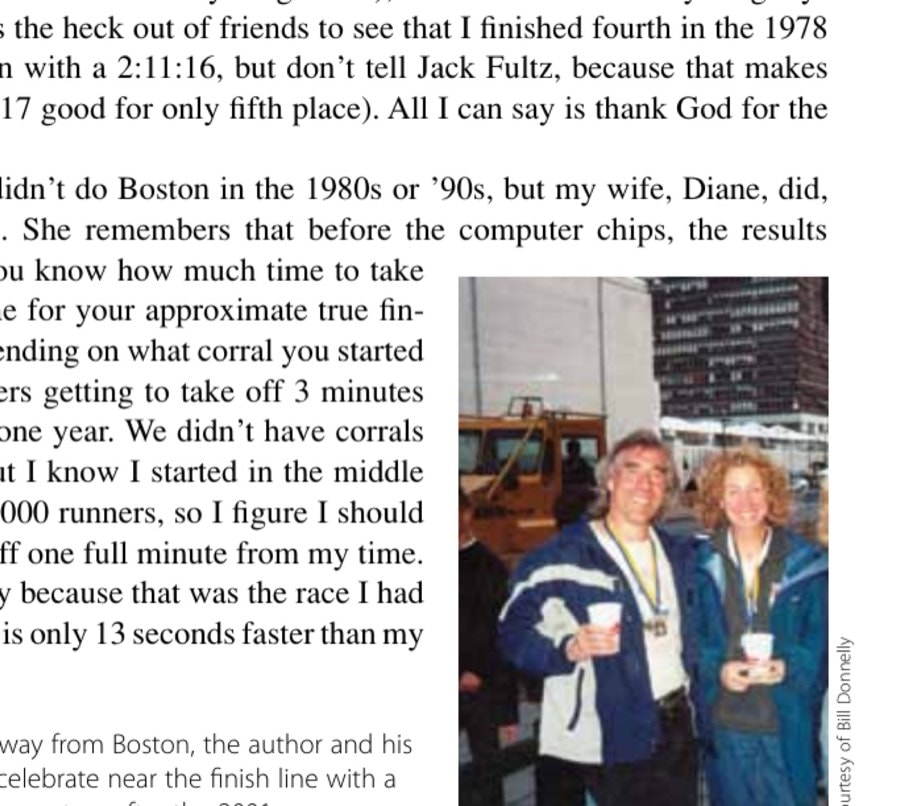
After 22 years away from Boston, the author and his future wife, Diane, celebrate near the finish line with a barley-malt beverage or two after the 2001 race.
Courtesy of Bill Donnelly
Ah, yes, the matter of getting a time
slow little brother Tom’s PR, so with that one minute I’m now officially declaring, ha, ha, Tom, I got you by 1 minute and 13 seconds (I suppose this is a moot point since my certificate time from the 1978 Boston crushes his best—ha, ha, Tom).
Diane was also there for the first use of computer chips, which happened for the nightmare known as the 100th running of Boston. With more than 40,000 runners, getting to the race was a dreadful logistical experience. Buses were backed up getting into town, and the passengers were forcing the drivers to let them off to relieve themselves in the surrounding fields and backyards. They finally arrived at Hopkinton with barely enough time to check their bags and head for their corrals. I was able to watch the start of that race, and I remember it took over a half hour to get everyone across the starting line.
Boston has worked out the glitches for the most part. Limiting the numbers to around 20,000-plus seems to help. Getting the elite women off early helps them, and I suppose starting the rest of the runners in two heats may help. The earlier start might help beat the heat on hot days (more of those with global warming) and lessens the long wait at the Athletes’ Village. I did like the 12:00 start because it brought you to Fenway Park, with that last long mile to go, just after the 11:00 Red Sox traditional home game lets out. Those crazy, malt-barley-beverage-filled fans get crazy and give you that extra kick you need to get in the rest of the way.
And how about Joanie in ’79? In the 1979 race, I remember Joan Benoit passing me. She was not favored, and earlier I had passed the favorite, Patti Lyons, who was being led by a film crew for the TV coverage (I believe PBS covered the race live that year, as there was no ESPN yet) and surrounded by runners who may have just wanted to be seen on television (much like those who every year seem to collapse just before the finish line but in front of the TV cameras and bravely crawl across the finish). Anyway, as Benoit passed me, the film crew was nowhere to be seen, so I guessed it missed Joan going by because she had short hair. I looked her up and down from behind (still in my young “I like babes” era; now it’s “I like women” era) and could clearly see she was a she. I figure she passed me in the last mile because she had on a backward Red Sox cap, and I read later that it was handed to her by one of those rowdy fans outside the Fenway. Those were great times.
Yes, going back to Boston with Diane in 2012 and having nothing to do with the race was relaxing and amazingly fun. I recommend it for anyone who has never been to Boston other than just for the marathon. I must say, though, that everywhere we went brought back thoughts of past visits. I mentioned that we stayed at the Eliot Hotel, the grand old place right on the course a block before where we turned right onto Hereford Street. (In 1978 I remember the huge crowds on Hereford and taking my cotton gloves and dramatically throwing them to the
right and left, which got a huge cheer from the throngs.) Of course, the Eliot Lounge is now gone, the legendary watering hole where Bill Rodgers was found one year by his worried wife after he had to drop out of the race. I remember going there with the Belle Watlings after the marathon, passing by the huge lines waiting to get in, and by showing the doorman our number, we got right in. What a time we had killing off many, many brain cells those nights.
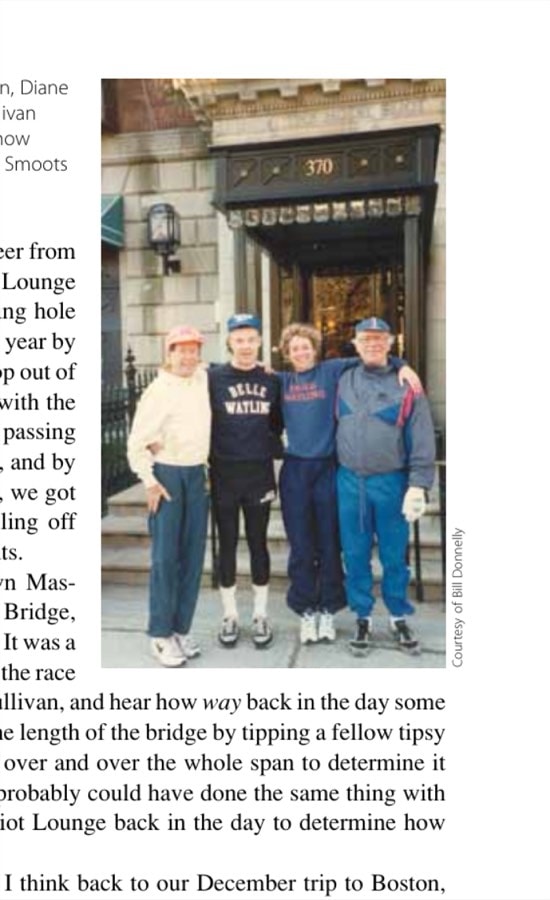
Diane and I had to walk down Massachusetts Avenue to the Smoots Bridge, which runs over the Charles River. It was a tradition to go there the day before the race with the Watlings founder, Dick Sullivan, and hear how way back in the day some drunken MIT students measured the length of the bridge by tipping a fellow tipsy MIT man by the name of Smoots over and over the whole span to determine it was so many “Smoots” long. We probably could have done the same thing with the founder after a night at the Eliot Lounge back in the day to determine how many “Sullys” long the bridge is.
I must stop now, for the more I think back to our December trip to Boston, the more I think of those wonderful memories of Boston trips past. Suffice it to say that Diane and I walked along the banks of the River Charles on a chilly, sunny day and had a beautiful time, even among all those lovers, muggers, and thieves; aw, but they’re cool people. Well, we love that dirty water, Oh, Boston, you’re my home.
Courtesy of Bill Donnelly
▲
In 1993, Jack O’Sullivan, Jack Meegan, Diane (the future Mrs. Donnelly), and Dick Sullivan in front of the Eliot Hotel after finding how many “Sullys” it takes to cross the entire Smoots Bridge.
This article originally appeared in Marathon & Beyond, Vol. 18, No. 2 (2014).
← Browse the full M&B ArchiveMore like this
1,000+ stories from 19 years of Marathon & Beyond
The complete archive of the legendary long-distance journal — digitized and free to read.
