

Making Of Amarathon
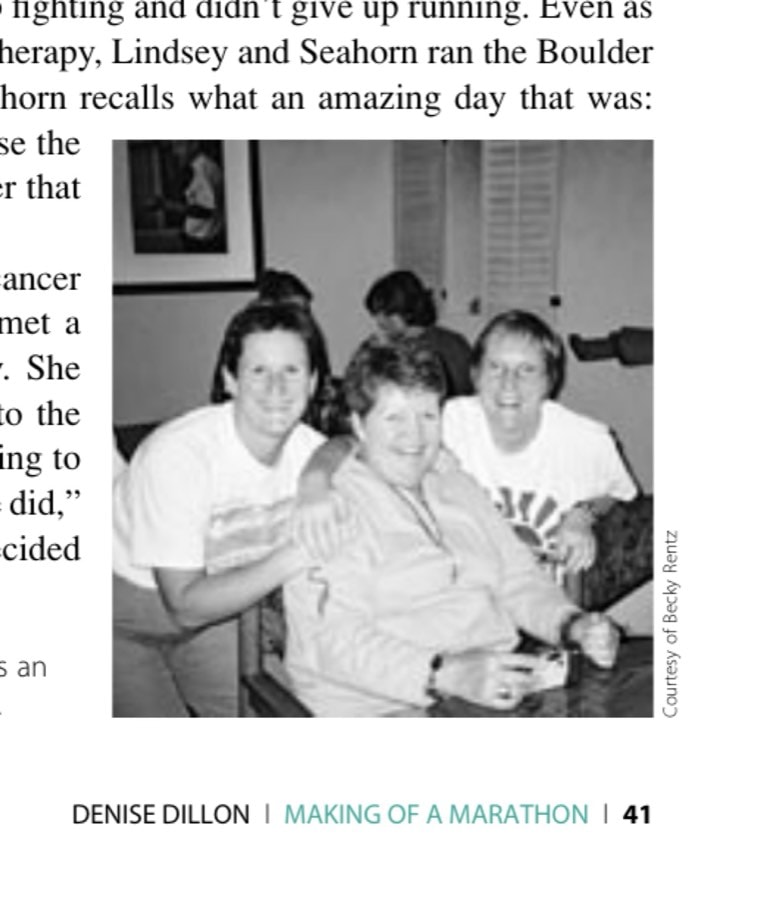
A race dedicated to a friend who was an inspiration to all—Lindsey Gabe (center).
Courtesy of Becky Rentz
The loss of a dear friend, a milestone birthday, and a longtime dream sparked the birth of the ING Georgia Marathon. Victoria Seahorn was about to turn 50 years old and had recently lost a close friend to breast cancer. She says that’s when she knew she should pursue her dream to organize a springtime marathon in Georgia for runners around the world to see Atlanta at its best. She envisioned 26.2 miles through historic streets and diverse neighborhoods that would showcase the city.
Seahorn wanted a race dedicated to spirit and life, a reminder of her dear friend Lindsey Gabe. The two women ran their first marathon together in 1993. They trained together through the Jeff Galloway program, and as many runners do after all those hours of running side by side, they formed a bond. For years they ran together, shared stories, and even volunteered for the Galloway training program to help others. Through it all, a close friendship flourished. About a decade later, Lindsey discovered she had breast cancer. Throughout her battle with cancer, Lindsey didn’t give up fighting and didn’t give up running. Even as she was struggling through chemotherapy, Lindsey and Seahorn ran the Boulder Backroads Marathon together. Seahorn recalls what an amazing day that was: “It took Lindsey nine hours, because the chemo was taking such a toll on her that she had to walk, but she finished!”
Lindsey lost her life to breast cancer in January 2005. “Lindsey never met a stranger; she would help anybody. She was so strong and gave so much to the community. I wanted to do something to give back to the community like she did,” says Seahorn. That’s when it was decided
Atlanta’s first spring marathon would become a reality and that the race would be dedicated to Lindsey. With her mind made up, Seahorn set off to find a major sponsor. “I went to ING. I thought it would be a perfect fit. They have the New York City Marathon, and I wanted to establish that feeling of a New York but on a smaller scale. I wanted to show off our city and neighborhoods and see runners, walkers, and spectators all unite on that one day,” says Seahorn.
THE VOLUNTEERS COME ONBOARD While this may have started out with one woman and her vision, soon others jumped on the bandwagon to help pull off a world-class event. Since Seahorn has been part of the running community in Atlanta for years, it didn’t take long for the calls and e-mails to start coming in from people asking what they could do to help. About 50 volunteers played integral parts in getting the inaugural ING Georgia Marathon off the ground. On race day, that number skyrocketed to close to 2,000 volunteers.
With sponsors and volunteers in place, Seahorn had to plan out a course. She sat on her living-room floor with a big map and just started circling all the interesting places she thought people coming to Atlanta would want to see. She circled beautiful places, unique places, and historic places. She then handed the map over to a friend and told him to make it into 26.2 miles. It took three revisions to come up with the basic route. But even then, there was plenty of tweaking. Volunteers repeatedly rode and ran the route, making sure it was safe and doable. They discovered some hills were a little too big and some streets were a little too narrow, so there were more changes before coming up with the final version. In the end, runners started at Underground Atlanta, went through the Sweet Auburn District, by the Martin Luther King Center and the Ebenezer Baptist Church where Dr. King gave his sermons, and on to Inman Park with its magnificent restored homes. Runners continued through the eclectic Little Five Points area, neighboring Candler Park, past Agnes Scott College, as well as the campus of Emory University. Runners cruised through the Lullwater area, which features the house from Driving Miss Daisy, onto Freedom Parkway and around the Jimmy Carter Center for one of the best views of the city. They continued into the Virginia Highlands neighborhood to Piedmont Park and back to Atlanta’s famous Peachtree Street to the finish.
To close off 26.2 miles of city streets is no easy feat. Seahorn had to schmooze city leaders. She needed the proper permits, she had to contact police, fire, and emergency crews, and most importantly, she wanted to get the city leaders on her side. Seahorn says, “I wanted to take time to know I had everybody’s support. Without city leaders behind you, putting on a successful event like this is nearly
impossible. Fortunately, I didn’t run into any resistance.” City officials, Atlanta’s mayor, and the police departments embraced the idea and were extremely helpful. Even Georgia Governor Sonny Perdue wrote a letter of support.
THE LITTLE ITEMS A RACE NEEDS TO PAY FOR With the necessary support from the political powers, Seahorn began looking at the financial side. There are enormous start-up costs to putting on an inaugural race. “There are tables, signs, mile markers, traffic cones, all the standard items needed for any race, as well as many things you just don’t think about like garbage cans and rakes . . . who thinks about rakes?” asks Seahorn. While there were plenty of volunteers, there were people who did get paid, such as police to control traffic, attorneys, a public relations firm, an accountant, the photo company, and the timing company. Money also went to Active.com for registration and to set up map tracking and text messaging, attending other race expos to promote the race, porta-potties, lanyards for media and volunteers, finisher medals totaling $47,000, plus a $39,000 purse. Even after the race is over, the bills keep piling up for street sweepers, forklifts, and truck rentals to haul equipment.
IT’S A SELLOUT! Seahorn capped the race at 15,000 runners. Atlanta already has another marathon, run on Thanksgiving Day. The Atlanta Marathon has run 46 times and has been attracting about 8,000 runners, so some were skeptical that a new marathon could get 15,000 people, but not Seahorn. “We have one of the largest running communities in the country, so I knew I could get 15,000 runners. However, I was surprised that it sold out in eight months!” says Seahorn.
A little more than one-third of the racers signed up for the full marathon, the rest for the half. The runners came from all 50 states and several countries, including a group of fun-loving Irish runners representing every county in Ireland. With elite runners from Russia, Poland, and Kenya, Seahorn didn’t want the Georgia runners to get lost in the shuffle, so she offered a special award for the top male and female runners from the Peach State. The first Georgians to cross the finish line won a trip for two to Amsterdam and registration to the ING Amsterdam Marathon.
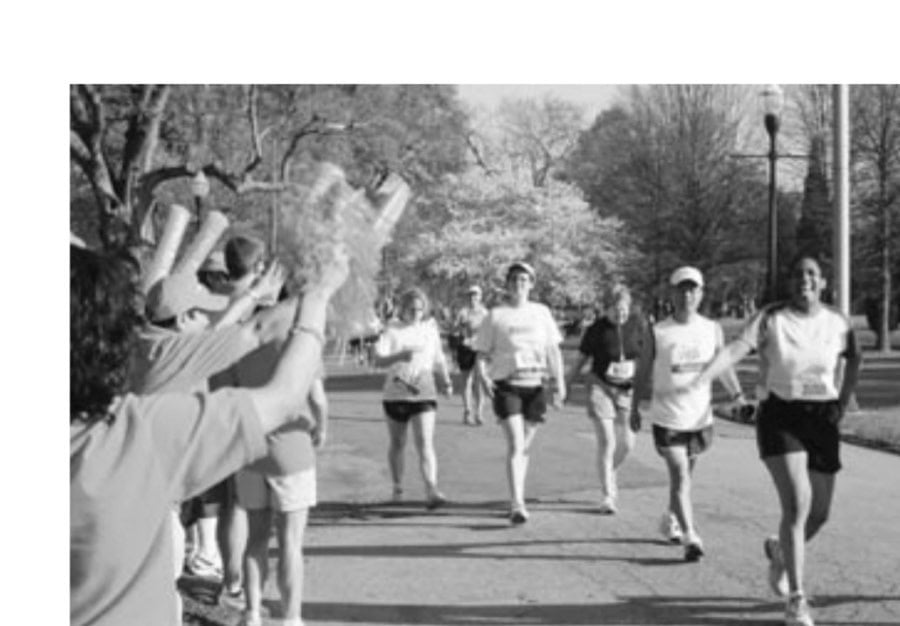
Every good marathon has great spectators, and Seahorn wanted great spectators. She wanted to get people out of their homes and on to the streets to cheer on the runners. “Cheering zones” were created along the course, and they couldn’t be missed. These were places where groups of spectators could gather, with orange blowup thunder sticks. Their goal: make a lot of noise and give the runners something to smile about. Atlanta’s Mayor Shirley Franklin issued an “Orange Up” challenge to see who could be the most creative and use a lot of orange (the
© Tom Estes / Competitive Image
▲ Orange Cheering Zone—Runners get encouragement along the course from spectators clad in the ING orange.
company color of the prime sponsor, ING). It was a guaranteed way to add some fun and get support from the different neighborhoods along the course. All the yelling and cheering were worth it. The winning cheering zone received $10,000 from ING to help support neighborhood fitness initiatives.
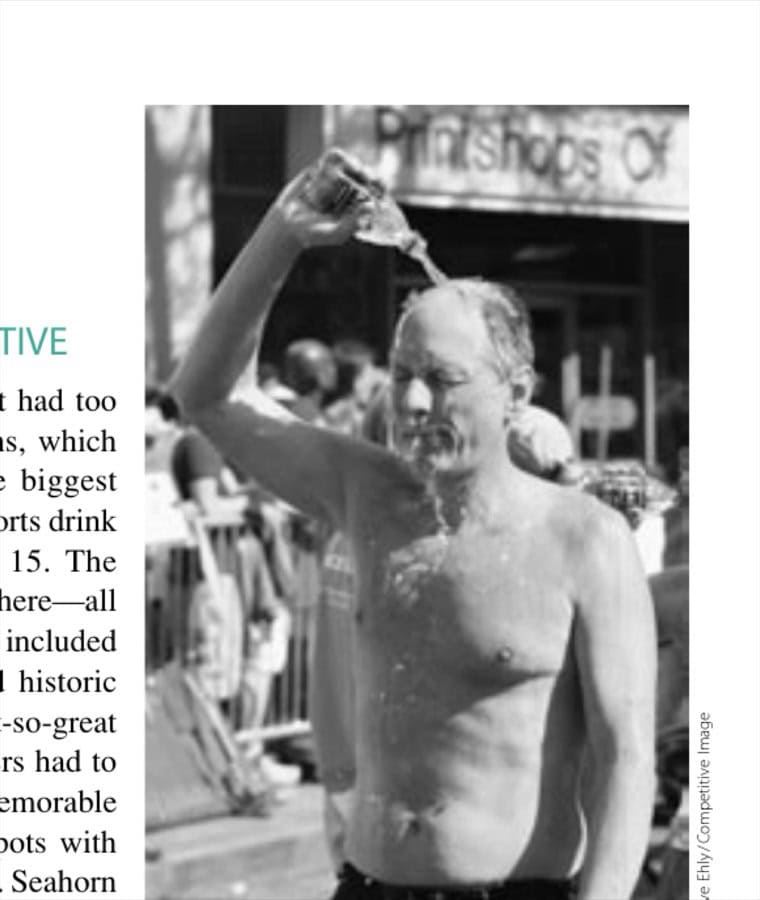
NOBODY DOES ANYTHING ABOUT THE WEATHER It took two years of planning and preparation to get to race day. Everything seemed to be in place, but there was that one thing Seahorn couldn’t control: the weather. Instead of the average 57-degree March weather that was expected, the sun shone bright, there wasn’t a cloud in the sky, and the temperature hit a record-breaking 87 degrees! Seahorn knew extra water would be needed, and there was a lastminute request for volunteers to work the medical tents.
The projected highs didn’t deter runners or spectators. There was a good crowd at the start and the finish, and runners made it through the heat with an astronomical 97 percent finish rate. “I was totally blown away by that because we did have some healthy hills. Adding in the heat factor, it was a difficult course! I’m so proud of all the runners,” says Seahorn.
▲
The only way to cool off in HOT-lanta’s record high temps.
Some runners say the start had too many tight twists and turns, which were a bit annoying. The biggest complaint was a lack of sports drink on the course until mile 15. The hills, as promised, were there—all of them. While the course included some beautiful places and historic sites, there were some not-so-great parts of the city that runners had to go through to get to those memorable places. There were also spots with plenty of traffic congestion. Seahorn says race organizers tried to get the word out using public service announcements and notices in the newspapers that the roads would be filled with runners, but several intersections had angry drivers backed up for hours. As for the half-marathoners, they were also upset about the lack of sports drink as well as no clear mile markers. That said, many of the problems were overshadowed by the excitement of a new race. As for the gripes, Seahorn is listening: “Like any first-time event, we plan to build on the best and learn from the rest for 2008.” She already has a few plans for next year, including changes to the start and finish to better accommodate the racers. She also plans to look at the problems at the aid stations as well as talk to police and evaluate the traffic congestion. Seahorn says she understands, because she’s a runner. “I’m a back of the packer. I want to enjoy myself out there. I know what I like in a race. The more feedback I get from the runners, the easier it is to make the race better and improve it.” She’s serious about that. She even sent out an e-mail to all runners asking for comments on the race. City officials seemed thrilled with the marathon; they say it had a major financial impact on the city. Officials projected that the runners and their families added approximately $21 million to the local economy. They based that number on information gathered by the hotel and restaurant industry, which looks at the number of people coming in from out of town, how many nights they spend in the Atlanta area, and the predicted money they would spend on lodging, meals,
Steve Ehly / Competitive Image
FEEDBACK, BOTH NEGATIVE AND POSITIVE
© Paul Phillips / Competitive Image
▲
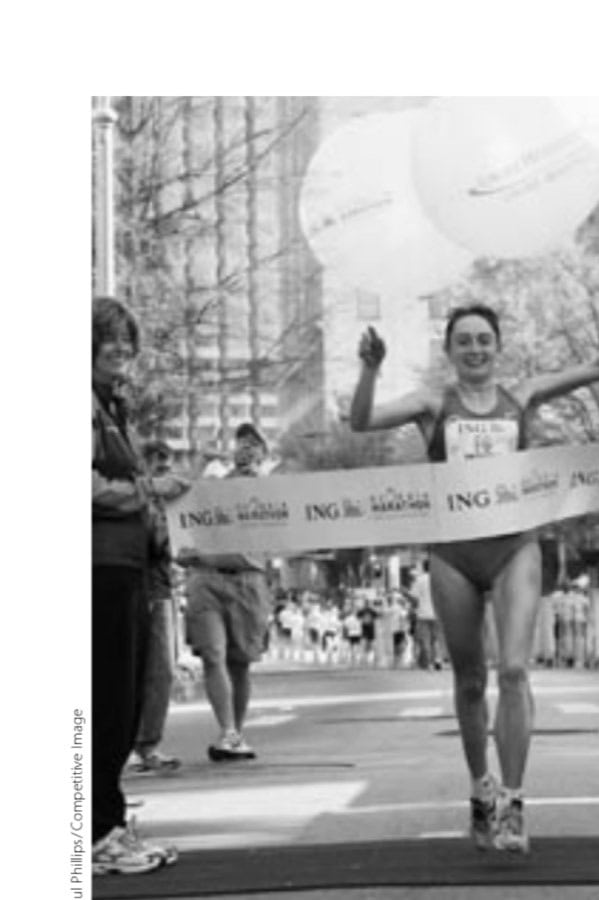
Women’s winner, Valentina Levushkina, from Russia.
entertainment, and souvenirs. Atlanta’s mayor wasn’t pleased only with the turnout; she was inspired by the runners and says she may start training for the half. As all the feedback started coming in from
runners, spectators, and city leaders, it wasn’t the criticism that brought Seahorn to tears, it was the thank-you notes, congratulations cards, and personal stories. It was early in the morning the day after the
race, when a woman knocked on the door of Seahorn’s home. She wanted to return the timing chips she and her husband wore in the race. The woman began to tell her story about having a heart attack three years earlier and how much it meant
for her to do the inaugural ING Georgia Half-Marathon. The woman said it was an incredible experience, and she was honored to meet the race director. “Before long we were both standing in my driveway crying,” says Seahorn.
It was a marathon dedicated to life and spirit. It was all that Seahorn wanted for her friend Lindsey Gabe. Lindsey’s husband, Richard, was at the starting line race morning. He had the honor of giving the countdown to start the race. Lindsey’s
son, Eric, was there as a participant. Typically a sub-three-hour marathoner, Eric ran it in six hours, which is what his mom would have completed it in. And in many ways, Lindsey was there as well, in spirit, to see it all happen.
Postscript: After receiving feedback from the competitors, a number of changes are planned for the 2008 ING Georgia Marathon. The start and finish has been moved to Centennial Olympic Park where there will be more space and less elbowing among the runners. To cut down on the
overcrowding at the start, runners will also take off in waves based on posted pace times rather than a mass start. As for the fluid problem in 2007, in 2008 there will be 22 hydration stations along the course serving water and Gatorade to ensure the course is “flooded.”
This article originally appeared in Marathon & Beyond, Vol. 12, No. 2 (2008).
← Browse the full M&B ArchiveMore like this
1,000+ stories from 19 years of Marathon & Beyond
The complete archive of the legendary long-distance journal — digitized and free to read.
