

Marathon Breakout
When neophytes ask what I think they can do in the marathon, I usually tell them it will take three tries to find out. The first is to learn the distance. The next is a range-finding shot. Then you get serious. There are, of course, exceptions. Kara Goucher’s inaugural marathon, the 2008 New York City Marathon, was the fastest women’s debut of all time and the best finish by an American in years. But Goucher had beaten Paula Radcliffe at the halfmarathon and had years of high-level training. Most of us don’t start that close to our long-run potential—which means that most of us can spend years looking for new ways to improve. When Christy Runde lined up for the 2008 California International Marathon, she had a string of good, recent performances under her belt: 3:01:54, 3:05:18, 3:02:13, 3:07:55. She had been faster in her mid-20s (with a 2:51:08 PR in the 1993 California International) but now, at age 40 with four children, her comeback seemed to have hit a plateau.
A year before, when she had asked me to coach her, she had decided there was no point running another three-oh-whatever. Her goal was to get back below 3:00, and she was willing to take a few risks to do it. Most of us have had times when our performances seem to have hit a plateau.
It’s always possible, of course, that the plateau came because we really have maxed out our talent. South African exercise physiologist Timothy Noakes, author of the encyclopedic Lore of Running, thinks there are evolutionary limits to what any of us can achieve simply by jacking up our training. Our bodies, he thinks, just aren’t designed so that elevating our training by another notch will always produce stronger, faster muscles. If that worked, we would see people winning the Olympics on 500-mile weeks.
Noakes believes this is because our ancestors were hunter-gatherers in an arid climate without a lot of food. In such circumstances, it’s counterproductive for strength and aerobic capacity to be able to increase beyond a certain point, because we would then need too much extra food to fuel the higher metabolism. “
The human body can only adapt to a certain point,” he says. “That’s the evolutionary constraint.” We runners don’t like this. “[W]e think we were designed to train five or 10 hours a day, [but] once you get to two hours a day, you probably have reached the adaptation limits,” Noakes says.
Luckily, most of us aren’t up against this ultimate constraint. That means there are still things we can do to improve our training, and adding extra mileage (or cross-training) isn’t the only option. Often, plateaus can be broken simply by training better, not longer. Amanda Rice is a talented newcomer.1 She never ran in high school or college. Rather, she took up the sport at 22, shortly before entering grad school.
Her first marathon was an impressive 3:23. She followed that with another 3:23 (on a tougher course), then 3:10, 3:11, and 2:58. Then she stepped up the intensity a notch and in the spring of 2010, shortly after her 26th birthday, ran 2:50:30.
Suddenly, she was in the hunt for the 2012 Olympic Trials. The question was, could she keep the progression rolling? The first step is to know your strengths . . . and attack your weaknesses. “The weak link determines how much you can do, how much stress you can impose on yourself through running,” says Jack Daniels, author of Daniels’ Running Formula. “So you must attend to the weak link to progress further.”
In other words, if a propensity toward gimpy hamstrings is holding you back, see what you can do to strengthen them. If you have a tendency toward runner’s knee or tight iliotibial bands, work on that. At the start of my own career, I had to spend a few weeks early each season strengthening my adductors. Otherwise, I could barely walk after even short races.
This also applies to training. Even after her 2:50:30, Amanda’s limiting factor was aerobic. “My legs would be strong, but I just couldn’t seem to get enough air,” she would tell me after a race. So we worked on that by doing long intervals on the track—workouts that included 5 1 mile at a 5:35 pace—until that was no longer the problem. Then we worked on making her legs stronger than ever by shifting more focus to short intervals—200s, 300s, and 400s—looking for workouts that left her feeling a bit rubber-legged by the end. Or as she put it, feeling like Gumby. “Embrace the Jell-O,” she laughs. “That became my mantra.” Then, 1 Both Amanda and Christy enthusiastically consented to have their names and stories used in this article.
once she had beaten back the Jell-O, it was back to the mile repeats, which (as of the time this article was written) have dropped to 6 1 mile at 5:25 to 5:30. Related to this is the need to keep variety in your training.
One reason we hit plateaus, says Jeff Simons, a sports psychologist at California State University, East Bay, who has spent many years working with elite athletes, is that our bodies get attuned to running a very specific pace, especially for distance runners. “
We used to call it the calibrated crotch,” he says. “It’s almost as though your body knows exactly what that pace is.” Flagstaff, Arizona, coach Greg McMillan agrees. “One of the things I’ve noticed in marathoners is [that] the type of training they do is fairly narrow,” he says. “Mostly it’s in a fairly narrow pace range—around marathon pace . . . If you start stacking marathon training cycle after marathon training cycle after marathon training cycle, that’s what causes people to get stuck.”
The breakout, he suggests, comes from a change in self-image. Rather than thinking of yourself as training for a marathon, think of yourself as training to become a complete runner who is getting ready for a marathon. “That’s a subtle but important difference. That means you have workouts across all the different paces. You’re not getting your body stuck in a rut.”
Noakes adds that physiologically, it appears that our bodies adjust surprisingly easily to repeated, identical stresses. “Within four weeks [the body] has probably made all the adaptations it’s going to do,” he says. “I never understand why people train every day the same way and expect to improve. Within a few weeks, or certainly a month or two, you’re going to hit a plateau. The only way you can break out is to change your training in some way.”
South African Olympic marathoner Hendrick Ramaala agrees. “A mix of long runs, speed-endurance runs, track intervals, plus easy runs should form a core of a training program,” he says. He also advocates cross-training, which he says can “help rejuvenate the body.” This from a man with a 2:06:55 marathon PR.
McMillan also identifies four training paces, although he calls them endurance, stamina, speed, and sprint. Endurance is your classic long, easy run. Stamina is run at somewhere between marathon and 10K race pace. Speed is 3K race pace; sprint is anything faster. All are important for whatever distance you’re training for, he says—which means even marathoners need sprint workouts. It’s merely the emphasis that shifts. “Just a little bit across all those zones seems to avoid this plateau phenomenon. Include some 5K-type workouts and 10K-type workouts as well as the marathon stuff.”
Racing at shorter distances may also help. Marathoners often disdain them, but they can build speed, form, muscle efficiency, and aerobic horsepower that you can carry up the ladder to longer distances.
That’s what Christy did as the first step to break through her plateau. When I suggested a 5,000-meter on the track, her first reaction was shock. “Cluckcluck-cluck,” she said, imitating a chicken. But she did it, clocking 18:57 in 90-degree heat. Within months, she had cut that to 18:10, on the roads. Hot stuff for a masters runner.
Amanda did the same. She had never run a 5K before, but as soon as she recovered from her 2:50:30 marathon, she hit the roads . . . in 17:47. Two months later, she cut it to 17:05. She subsequently dropped to even shorter distances, where she ran 4:44.69 for the 1,500 (indoor) and 9:54.97 for her debut 3,000 (also indoor).
Still not convinced? Consider Kara Goucher. Three months after placing third in her New York City Marathon debut, she ran—and won—the indoor mile at the Millrose Games in Madison Square Garden. Doing such a short race not only required her to keep some fast training in her mix, but she also found it a good gauge of how her long-term plan was going. “The mile tells me I’m not doing too much,” she said afterward. “Alberto [Salazar, then her coach] says doing the shorter races is a good indicator. When you’re training for a marathon, you may feel a little burnt. [But] in an 80-mile week, which is what I’ll end up at this week, I can still run a 4:33 mile.” Adding variety doesn’t mean ignoring the long runs, core to any marathoner’s training and key to many marathon breakthroughs.
Go online, though, and you’ll find a lot of opinions on how to do them. Some argue that you need to do all of your long runs very slowly. Others claim this will merely make you slow. Do all of your long runs at marathon pace, they say, in order to drill that pace into your muscles.
Probably better is to split the difference. “You don’t want to do the same thing every weekend,” says online coach Nicole Hunt, veteran of the 2004 Olympic Trials (2:40:39) and 2006 USA Mountain Running Champion. “You want to change it up.”
Elite coach Brad Hudson agrees. “We switch our long runs up a lot,” he says. “Just changing the stimulus is probably the most important thing.” But if you talk to coaches about how you do this, the first phrase you get back is often, It depends on the runner. There are runners who are easily injured and runners who thrive on workouts that would murder their teammates. There are runners who recover quickly and ones who need extra time.
Usually, the temptation is to do too much. “Some athletes overtrain because they think more training equals improvement,” says Ramaala. “Overtraining only leads to injuries and a drop in performance. You need a balance.”
If all of this is frustratingly nonspecific, it’s because of that key phrase: it depends on the runner. With that caveat, however, Hudson likes to start with
several weeks of long, easy runs. “Then we’ll mix in some fartlek. Eventually it becomes a harder run a lot closer to race pace.” Easy runs, he adds, are done at “maybe” 80 percent of marathon pace. For a 3:00 marathoner, that’s 8:30s to 8:40s.
In Hudson’s program, faster work begins not in the form of doing the entire run at a hard pace, but by finishing strong. Thus, you might start by doing the last six to eight miles at marathon pace, building up to maybe the last 12 miles. “
Eventually we do one hard, long run three weeks before [the marathon],” he says. “That’s within 10 or 15 seconds of race pace [per mile].” But, he warns, that’s not for everybody. In fact, that last run might not be at all suitable for nonelites, especially those doing less than 100 miles a week. “
If you go beyond 12 miles [at race pace], that’s tough,” agrees Portland, Oregon, coach Bob Williams. Another approach, described in Daniels’s book, is to embed six to eight miles of tempo into a 20-mile run. Daniels’s recipe for these long-tempo runs has varied over the years, but one of the more advanced versions has you warm up, then do 2 2 miles at tempo pace, on a two-minute recovery. Then you do several miles of easy training, followed by one or two more two-mile pickups.
Beware: this is not an easy workout. In my experience, very few runners can handle it, let alone benefit from it. And Hudson warns that the lower your mileage (and his definition of “high” is more than 110 per week), the greater your need for traditional long, slow runs. How long your long runs should be is also a subject of dispute, but if you’ve been limiting yourself to 18 to 20 miles, you might consider stepping it up. Williams likes to see four runs of 22 to 24 miles. Hunt favors 18 to 21 miles.
I myself have always liked 22-milers—but not every week. Every other week is sufficient. And I should add, my predilection for 22-milers might be a personal idiosyncrasy. In my PR days (before most runners were using carbohydrate gels), I tended to hit The Wall at 21 miles. I therefore ran 22-milers in training so that I could “tease” that sense of hitting The Wall and go just a bit beyond it. My goal was to convince my subconscious that I could not only survive The Wall but hold my pace.
Other suggestions: • Allow time for recovery. Hudson often has athletes build in “rest cycles” of seven to 10 days in the middle of their training. “They seem to help a lot,” he says. • Consider moving away from the traditional seven-day training week, in
which long runs are always done on weekends. “We try to do a long run every 10 days,” says Hudson.
• Do some tempo on short-run speed days. • Don’t try to eke out extra hard training in the final weeks before the marathon. Tapering is beyond the scope of this article, but the fact is that if you’ve been doing your training in the prior weeks, the hay is already in the barn. Your goal in the final weeks is simply to keep it from getting moldy.
Race day Sports psychologist Simons is the first to admit you can’t positive-think yourself into the physically impossible. But there is still a lot you can do before and during the race. One of the major problems some runners have, he says, is that they focus too much on the beginning or end of the race and not the middle. But the middle is the bulk of it, particularly in a marathon. And that is where a lot of runners wind up going on autopilot. “One of the ways to get through a plateau is to really think during the middle of your race,” he says.
Also important is to quit thinking solely in terms of target time. “Time,” he says, “is what happens after you cross the line. Changing your time is all that happens while you’re in the process of running. That’s where the focus needs to be.”
This type of thinking is part of what psychologists call “letting go”—or the distinction between “trying” and “doing.” Faulder Colby, a neuropsychologist and marathoner from Clinton, Washington, compares it to the difference between trying to play an instrument and making music.
If you focus on the outcome, it’s easy to choke under pressure, Colby adds. Focusing on the doing—running your race, one section at a time—is the key to putting yourself in the “zone,” a mental state where you’re running without thinking about success or failure.
Adds Simons: “We’re letting go of what’s ‘supposed’ to be for what is, right now. I don’t mean to get too metaphysical, but this makes a big impact on how our body responds. When we’ve decided on how things are supposed to be, we tend to take actions, both conscious and unconscious, that conform to that expectation. I am supposed to run just over 3:00, so somehow we do that. She is supposed to beat me, so she will. But when we suddenly go, Let’s just work with what is—what’s actually happening—we all of a sudden free up the possibilities in the moment. Not an expectation that you have to do anything incredible, but I’m going to explore what change will actually happen if I’m in the moment.”
Not that this means you shouldn’t have a race plan. “There’s nothing wrong with planning—saying, ‘Here’s what our markers are,’ ” Simons explains. “What you do when you’re actually performing is saying,
‘OK, I have a logical plan.’” Then, come race day, you need to focus on the full living of that plan. Such plans, of course, need to be reasonable. Williams likes to see runners do shorter races—anything from 10K to a half-marathon—that give “concrete evidence” that their marathon targets are feasible. (The extrapolations can be done with such tools as Greg McMillan’s running calculator, www.mcmillanrunning. com, or the tables in Daniels’ Running Formula.)
Then you must trust the plan enough not to panic and change it midway through the race. “Accept that it’s not going to be easy, but that you are capable of doing well because you have done the training,” says Ramaala.
Salazar puts it even more simply: “Trust your training.” “Trust and faith is powerful,” says Simons. “You’re saying something good can happen.” Not that the result is a given, but trusting the plan frees you up to “work” it. And if, by chance, the plan doesn’t succeed, at least you’ve learned something useful. Christy had always been a relatively high-quality/low-volume runner, so she chose not to jack her weekly mileage into the stratosphere. Rather, she went with her historic strengths, seeking to make her hard days better, never running more than six days a week, and peaking at slightly under 70 miles a week.
But she had never paid a lot of attention to running at a disciplined pace. “I’d always just gone with the flow or somebody fast,” she says. And “I tended to race my track workouts.” We started, therefore, by determining specific paces for her track workouts (which included intervals as short as 400 meters) based on her 5K times. “The pace calculator kept me on target,” she says. “By the time my last interval was done, I didn’t want one more—but I was able to stay on pace for the whole workout. The heart rate was higher, but I could do it.”
Another change was by dedicating a second weekly speed workout to increasingly long tempo runs. They started with a traditional three-mile tempo, then built to ever-tougher runs such as a pair of two-milers on two minutes’ recovery; a continuous four miles; two-two-one; and so forth. “By the end, we had a six-mile block,” she says. “I’d never been able to do that before.” But the progression was very controlled. “Some weeks I felt like I could have done more, and I made myself not do it,” she told me afterward. “I forced myself to stick with the plan.”
Finally, her long runs culminated by alternating four easy-paced 22-milers with two Daniels-style long-tempo runs and two runs with up to 16 miles at marathon pace.
▲
Christy Runde at the finish of the 2008 California International Marathon. Her chip time was 2:56:21.
© sportphoto.com
At the same time, her easy days got easier. “I’d always thought that 8:00s . . . that’s the perfect pace,” she says. “Well, not anymore. My slow runs have had to be 8:30s, or 9:15s. Sometimes I’d be walking. It had to be complete recovery. I was really in touch with how I felt.”
Years of experience also taught her how to taper. By race day, she was practically bursting with energy. The start of the California International dawned foggy and 39 degrees, a bit chilly by California standards but right in Christy’s comfort zone.
Seven weeks before, she had run a hilly half-marathon in 1:24:55, suggesting that 3:00 might be an overly conservative goal. We had talked about it and decided to go for it. The race plan was the result of considerable thought but also had opportunities to go with the moment. She was to run a conservative first mile, then go through the half no faster than 1:29. At that point, she was to pick it up a bit if she felt like it. Beginning at mile 18, she was again to assess how she felt and, if it seemed right, kick it up another notch.
From the gun, she settled into her pace quickly. She hit the mile-one split exactly on target (Garmins help) and went through the half in a near-perfect 1:29:13. For the next nine miles, she practiced being in the moment, speeding up slightly and waiting to see what would happen.
At mile 22, what was happening felt good, so she turned on the jets. Her final splits: 6:40, 6:35, 6:20, 6:20, for a finishing time of 2:56:21.
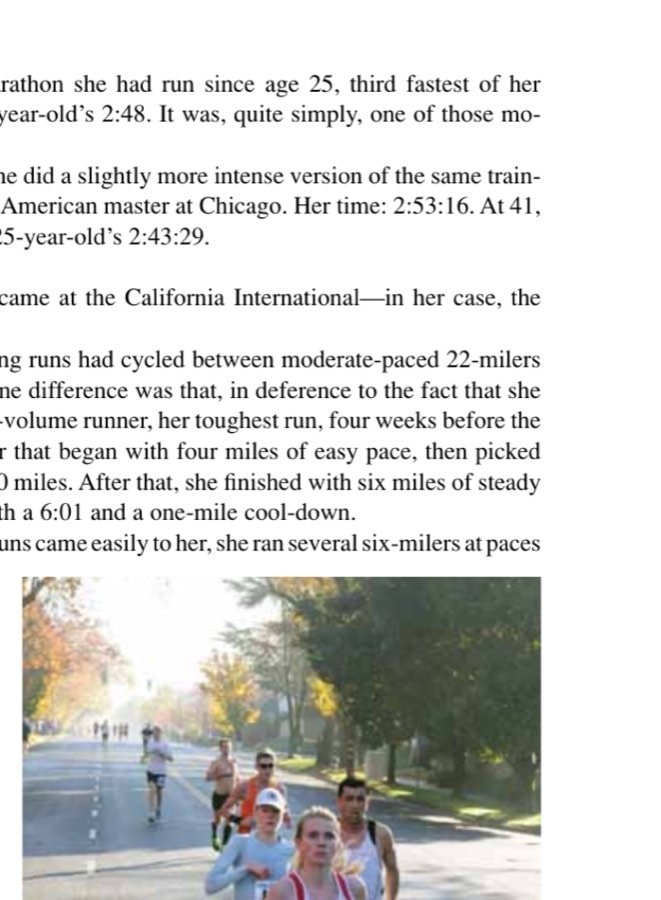
It was the fastest marathon she had run since age 25, third fastest of her life—equivalent to a 25-year-old’s 2:48. It was, quite simply, one of those moments we all live for. The following year, she did a slightly more intense version of the same training plan . . . and was first American master at Chicago. Her time: 2:53:16. At 41, that was equivalent to a 25-year-old’s 2:43:29. Amanda’s big race also came at the California International—in her case, the 2010 race.
Like Christy’s, her long runs had cycled between moderate-paced 22-milers and long-fast runs. The one difference was that, in deference to the fact that she had always been a higher-volume runner, her toughest run, four weeks before the marathon, was a 21-miler that began with four miles of easy pace, then picked up to 6:20s for the next 10 miles. After that, she finished with six miles of steady speed-up, terminating with a 6:01 and a one-mile cool-down.
Also, because tempo runs came easily to her, she ran several six-milers at paces 30 seconds per mile faster than target marathon pace. Amanda also spent some time thinking about the art of racing. “As I progress, I am realizing the three-dimensional character of the ‘runner,’” she told me afterward. “There is psychological strength as well as physical strength. You have to not only be motivated but also race ‘smart’ in order
© sportphoto.com
▲
Amanda Rice cruises down the final miles of the 2010 California International Marathon, en route to a US Olympic Marathon Trials qualifying time of 2:44:12. She would later better that time by more than five minutes at the 2011 Grandma’s Marathon.
to push yourself to a good time trial, PR and/or win. Run your own race, but use the others around you to gain the speed to accomplish the race plan.” This time, her race plan was dead simple. The US Olympic Marathon Trials qualifying time was 2:46:00. All she needed was to hit that with a comfortable enough margin that the final mile wasn’t a grueling sprint.
Amanda ran 2:44:12. Like Christy, she then did another round of the similar training, slightly more intense. Six months later, she lowered her marathon PR to 2:38:57. Will the same training work for everyone? Obviously not. All runners are different. I’m not a fan of cookbook-style training plans, at least for those who have fired their range-finding shots and run their first “serious” marathons. Also, Christy and Amanda both have near-perfect form and the proven ability to handle intense training.
But there are some elements that should work for many marathoners: • Don’t focus purely on “marathon” training. Try to become McMillan’s “balanced” runner who also runs marathons. • Speed training needs to in
clude some serious tempo runs. Three-mile tempo runs should be run at about the pace you would be able to hold for an hour-long race. If you go longer than that, you’ll need to slow them down slightly—maybe by
five to 10 seconds per mile— to keep them from being too taxing.
© Victah/www.PhotoRun.net
• Vary your workouts. “You could think of it as something like constructing a flight of stairs,” Alberto Salazar once
▲
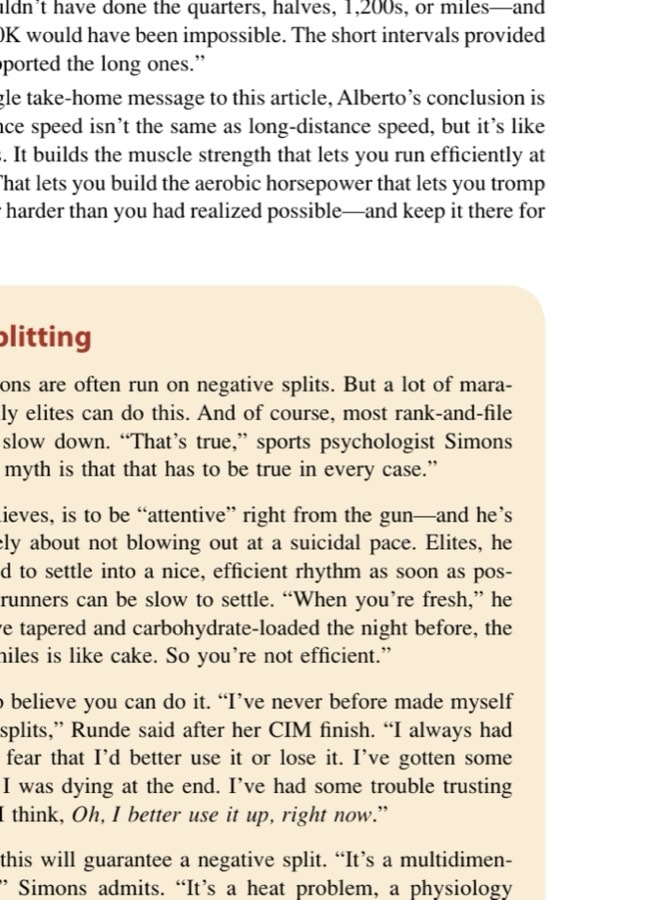
Amanda, now a Navy lieutenant and dental surgery resident at Walter Reed hospital, shown here heading for a 2:41:06, 50th-place finish at the 2012 US Women’s Olympic Marathon Trials in Houston, Texas.
told me. “When I was targeting on racing 10Ks at a 4:25 pace, for example, I needed to run repeat miles at 4:20s. But to do that, I had to be able to run 1,200s in about 3:08 to 3:10. That required a background of 800s in 2:02
to 2:04, which in turn required me to be comfortable with 59- to 60-second quarters. Those quarters drew on a base of 28- to 29-second 200s. Without the 200s, I couldn’t have done the quarters, halves, 1,200s, or miles—and
4:25s on the 10K would have been impossible. The short intervals provided a base that supported the long ones.” • If there’s a single take-home message to this article, Alberto’s conclusion is it. Short-distance speed isn’t the same as long-distance speed, but it’s like
Alberto’s 200s. It builds the muscle strength that lets you run efficiently at all distances. That lets you build the aerobic horsepower that lets you tromp the accelerator harder than you had realized possible—and keep it there for 26.2 miles.
Negative splitting The best marathons are often run on negative splits. But a lot of marathoners think only elites can do this. And of course, most rank-and-file marathoners do slow down. “That’s true,” sports psychologist Simons
admits, “but the myth is that that has to be true in every case.” The trick, he believes, is to be “attentive” right from the gun—and he’s not talking merely about not blowing out at a suicidal pace. Elites, he
says, are coached to settle into a nice, efficient rhythm as soon as possible. But other runners can be slow to settle. “When you’re fresh,” he says, “and you’ve tapered and carbohydrate-loaded the night before, the
first five or 10 miles is like cake. So you’re not efficient.” You also have to believe you can do it. “I’ve never before made myself do the negative splits,” Runde said after her CIM finish. “I always had
this tremendous fear that I’d better use it or lose it. I’ve gotten some good times, but I was dying at the end. I’ve had some trouble trusting my training, so I think, Oh, I better use it up, right now.”
Not that any of this will guarantee a negative split. “It’s a multidimensional problem,” Simons admits. “It’s a heat problem, a physiology problem, a muscle problem, an attitude problem, a strategy problem. But it is certainly possible.”
This article originally appeared in Marathon & Beyond, Vol. 16, No. 2 (2012).
← Browse the full M&B ArchiveMore like this
1,000+ stories from 19 years of Marathon & Beyond
The complete archive of the legendary long-distance journal — digitized and free to read.
