

Marathoners Are A Spoiled Lot
The other day my running buddy, Paul Hopkins, sent me a link to a blog of an ultrarunner. In this posting, the author complained of the high cost of entrance fees that marathons charge. He then made the comment that “someone was padding their backsides.” Now, I took exception to this. I mean, my backside is a tad padded, but it isn’t due to the marathon that I direct with Paul (the San Juan Island Marathon and Half-Marathon). So, what would someone like me do? I wrote back and let him know how I felt about the high costs of marathons in today’s “marathon madness.” While writing, I realized that the problem of high entrance fees is due to the marathoners or runners themselves. The problem comes down to the fact that marathoners are a spoiled lot.
Now, before you start heating up the pot of tar and gathering feathers, let me explain myself. In today’s world of marathons, we runners and marathoners—and yes, I do count myself in this group—have forced race directors and organizers to look at how they direct and manage their races and what perks they provide. Marketing is more about the perks than about the course or the race. Today’s marathoners want more than the chance to run a race. They want stuff for running, for being there—and all this stuff costs money. Race directors need to have runners so they can fund-raise for the event and for the charities they often collect funds for. It’s all about numbers. The perks are just a marketing ploy created by the demands of the shopping runner.
Here is what marathoners of today want—and all of these things cost money.
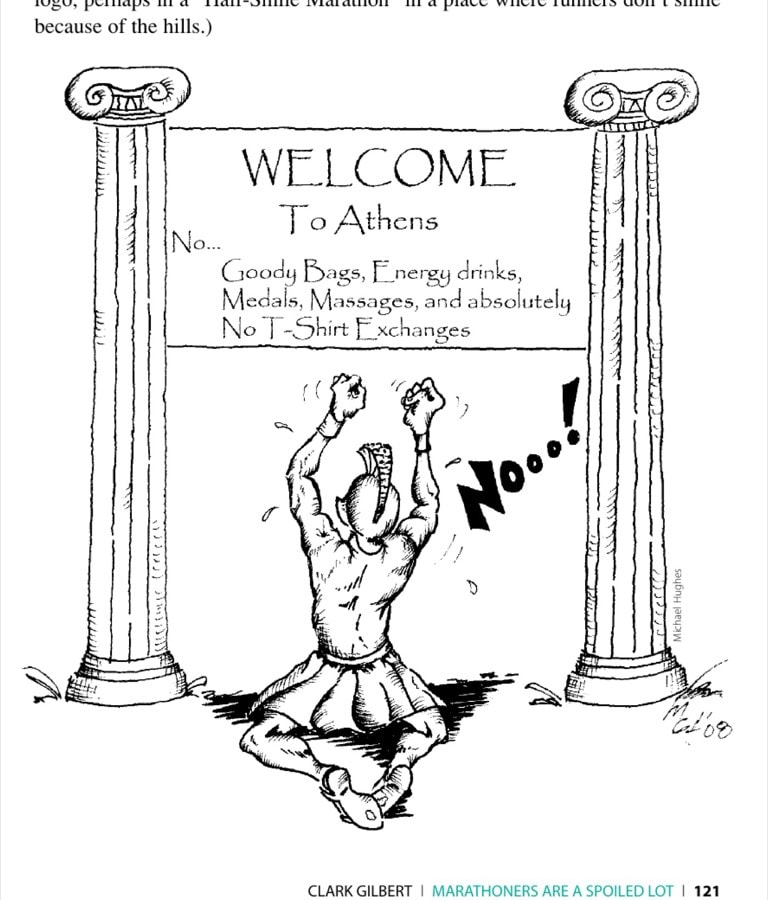
T-Shirts This is a big one. You’ve heard of Pheidippides, the Greek soldier who ran from the plains of Marathon to Athens to proclaim that the Persians had been defeated.
Michael Hughes
Contrary to belief, Pheidippides didn’t die of exhaustion but because he asked for a different-sized T-shirt than he had requested when he signed up for the run. T-shirts have been a major giveaway for years. They used to be short-sleeve, white cotton shirts with a black logo, often made by a fourth-grader and a magic marker. Then someone thought a long-sleeve would produce more of a draw, and we started seeing long-sleeve finishers’ shirts. Nowadays we don’t have cotton, we have Dri-FIT shirts that will wick (a word not once used by any marathoners in the 1970s) any moisture off a body, with a custom logo and art that would put da Vinci to shame. (I bet some race somewhere has used the Mona Lisa as its logo, perhaps in a “Half-Smile Marathon” in a place where runners don’t smile because of the hills.)
Finisher Medals I don’t remember finisher medals when I started running marathons in the late 1970s. Medals were typically reserved for those who won the race. I was told, as my very first finisher medal was being hung around my neck for finishing a Seattle race in 1986, that I was a winner for finishing. I was special, but my legs were still sore from the race. I now have a large collection of finisher medals that resides in a special box that is hidden under my bed. What else am I going to do with them? They don’t even make good bookmarks. Marathoners today expect a classy finisher medal with the date of the event printed on it. Soon they’ll be made out of gold, though I’ve got to tell you, our San Juan Island Marathon medals are made by little fairies that live on the islands in a small hollow. These medals are special. Trust me on this one—the only finisher’s medal that Pheidippides received was a tombstone.
Aid Stations In 1978, I ran my first marathon. The only aid station was about 15 miles in, and we received water and a substance called ERG, or something like that. Marathoners today want aid stations every two miles with beverages and snacks such as power gels or energy bars. Each year I will be asked by at least a couple of interested participants if we serve purified water. I always say yes, although their definition and my definition of purified water differ. If the water is clear, it’s purified, though some of our purified water has a tinge of rubber-hose taste, which gives it essence and body. Sounds like fine wine, huh? In our local marathon, we try to stand apart from the majority of marathons by being different. We provide M&Ms, gummi bears, and the best San Juan Island water ever. It’s a selling point. I ran a trail event once in which we would lie down next to a creek and drink the water freely, then get up and run. Now, that’s an aid station.
The nice thing about trail runners is that they carry their aid stations with them by using either a backpack or a fanny pack. One of my running buddies in Montana carried food, water, energy drinks, clothes, wallet, music, camera, and the kitchen sink in a backpack. Whenever we stopped to have a snack or a drink, he would rummage in his pack and pull out something unusual, such as a precooked hamburger with a bun and condiments. For all I know, he carried a six-pack of beer in there as well, which he didn’t bother to share.
I read once that Pheidippides, while running his race of races, ran through a small village where the locals gave him some water. Without breaking stride, he picked up a gourd of what he thought was water but which in fact was filled with the energy drink of the time: goat’s blood mixed with the urine of a bull and sprinkled with powdered ram’s horn. He mistakenly poured the liquid on his head to cool himself off, only to find that the sickly mixture didn’t do him any
good except slick his hair back, making him look really fast. The downside to Pheidippides’ mistake was the cluster of flies that followed him through much of the race.
Porta-Potties Another question we get asked a lot is “How many porta-potties do you supply?” We strive for six nicely placed porta-potties around our course, along with a billion trees and small bushes. Marathons of the ’70s and ’80s didn’t have honey buckets; runners made do with what nature provided, making the race more interesting and challenging. Runners would drive the course a day early, not just to study the course but to find the right places for a pit stop. Not only do today’s racers want porta-potties, they want toilet paper as well. I say, “Has the whole world gone crazy?“ I am not even going to go into what Pheidippides had to deal with.
Certified Course Everyone wants a certified course to run on. Personally, I care about that only if I am trying to make an Olympic team, which has not happened nor will happen in my lifetime. I accept that. In addition to a certified course, runners want chip timing so that their times are accurate. Again, for Olympic or Boston qualifying I can understand, but for just running the race? I wonder what would happen to a race director if he forgot to start the clock.
To certify a course, a race director gives up a couple of weekends to measure the course with a special device on a bicycle wheel and rides the course one, two, three, and even four times to ensure that the distance is accurate. Not only is this time consuming, but it is a pain in the butt, literally. I ran an ultra trial run where, at the beginning of the run, the race director first looked around and said, “That rock will be your starting point,” and then looked around and said, “That tree over there will be the finishing line.” The race distance wasn’t accurate, but nobody cared. We were all there to run our butts off and, hopefully, arrive at the right tree.
Even Pheidippides’ original course from the plains of Marathon to Athens was shorter than the modern marathon. I wonder if the last thing he heard, before dying, was “The course was short.” What a bummer.
Entertainment Bands along the course are very nice, unless they are playing the theme songs to Rocky or Chariots of Fire—then they are just evil. I was asked by a woman a couple of years ago if we had entertainment. I said, “Yep, we have the birds.” She
thought I meant the Byrds—you know, the rock group—and was a little disappointed when she discovered the flying and chirping kind. We also have foxes, but I will let your imagination run any way you wish on that one.
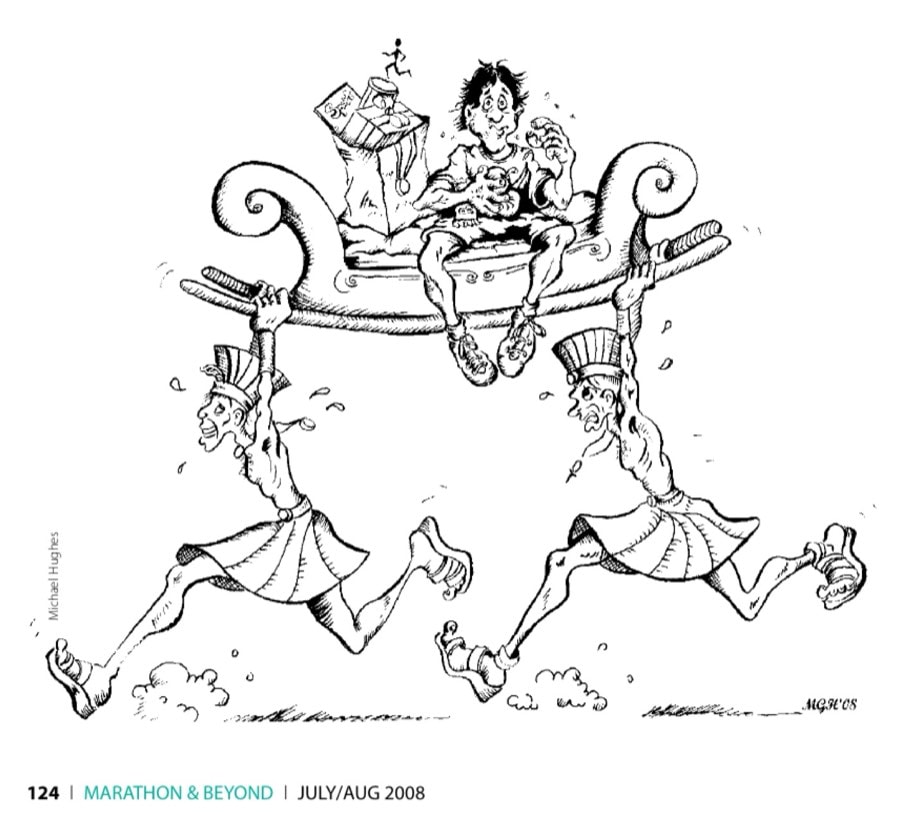
My experience is that bands make me puff up my chest and run faster than I should while I run past them, only to have to stop a block away and recover. Foxes make me do that as well. I know most people want to feel the rush and the motivation from the music and to feel the power of the vibe. To me, music is a huge distraction from my pain and suffering, which is what a marathon is about—the purging of my doubts.
I know what you are going to say: “Pheidippides had a centaur [the half-horse, half-man creature] playing a flute for him.” Maybe he did and maybe he didn’t, but it’s something we might look into for next year’s race.
Postrace Refreshment
Michael Hughes
When I finish a marathon, a cool drink offered by a nice volunteer as I wear my special finisher medal is a nice touch to end the event. It’s also a good way to prevent you from seeing lizards crawling out from under the rocks. In the old days, we had water and some stale bread that was left on the picnic table by a
tourist from Omaha. Now races provide drinks, fruit, cookies, tacos, and soup. I once ate a peanut butter sandwich after finishing a marathon. This seemed like a good idea at the time. My dehydrated mouth caused the peanut butter to turn into something like wet cement. I couldn’t swallow or open my mouth and began seeing lizards for a completely different reason. We don’t offer peanut butter sandwiches at our race, for health reasons.
I don’t have a problem with the need for postrace refreshments. I do have a problem with the half-eaten bagels, fruit, or other food items and half-full bottles of postrace Gatorade lying around for someone to clean up, even though garbage and trash cans are provided. That waste costs money and is reflected in the entrance fees.
Advertising and Marketing For a race director, trying to convince people that the race is worthy of their participation is costly. In the past, often the only printed form of advertising was a handmade flyer (probably by the same fourth-grader who did the T-shirts) announcing the race with its when and where, plus a quick entry form at the bottom. Today’s races have fancy four-color printed flyers, print ads in magazines, TV commercials, and a Web page—all to say, “Come run with us.”
I think, in the days of Pheidippides, the first marathon director had a piece of goat skin hanging in the mess tent with the words “Need volunteer to run to Athens to deliver a message to the king. T-shirt provided. Reward: possible death.”
Insurance and Permits Another thing we have to purchase is insurance to protect ourselves in case someone trips and falls down or takes a wrong turn and needs to take a cab back to the finish line. Race directors also have to pay for permits from local government, signage to prevent someone from taking the wrong turn, and so on. In the ’70s, we didn’t care about suing a race for something that happened to us. We often ran races with no shoes over broken glass, and the only litigation we needed was something you put on sore legs. It was our choice to run. The road to Athens didn’t have insurance, and I have read that the course was not well marked either.
Volunteers To pull off a marathon, a race director needs hundreds of volunteers to do everything from directing traffic to working the aid stations to picking up litter left behind. The truth is that marathons couldn’t be held if it weren’t for these wonderful people who give up their time to help. A part of the entrance fee goes to pay for volunteer shirts, snacks, real purified water, and other things as a way
to say “thank you.” Oh, sometimes a volunteer will send the leaders down the wrong street or not get the mixture of goat’s blood, bull’s urine, and ram’s horn powder just right, but they have big hearts.
Jet Airplane I don’t know any marathons that have their own jet airplane, but Paul and I want one. We dream of having a jet with our logo on it, flying into areas such as Boston, New York, and the Black Hills to attend those races. How cool would that be? Some of our race entrance fees are going into a reserve fund for this purchase. This is just one more reason you should run our race. And after we get our own jet airplane, we need to buy a condo in the Caribbean so we can decompress after the race.
The plain fact is that putting on a marathon is costly, and the cost continues to rise because of marathoners who shop around looking for the race that will provide them with all this stuff for running in it. It’s almost a bribe, as if runners say to themselves, “Well, if I don’t receive a Dri-FIT finisher shirt like so and so, I’ll go somewhere else.” What happened to running a course for the pure aspect of the sport? What about running for the thrill of the chase, combined with the experience of being with others who are doing the same thing—seeking the accomplishment of doing something worthy? This is what marathoning is about. Well, it’s about that, and beer. A marathon finish area with beer is always a good draw.
This marathon madness that has been developing over the last few decades has been very beneficial to the sport. Don’t get me wrong about that. If perks provide a tiny bit of motivation for people to get out their front door at 5:00 a.m. in January so they can get their workout in, then more power to them. I still get misty eyed when I see runners doing everything in their power to finish their marathon race, some crawling, some limping, and some performing cartwheels. It is an insight into the human element that exists within all of us but is often forgotten. Marathoning brings it out. We need more people to run marathons, not just for the sake of earning a perk, but for discovering who they are, for learning what they are made of, and for the massage at the end of the race—and for those reasons, I suppose a little spoiling isn’t all that bad.
M&B Referral Program Did you know that we have a policy of adding an issue to your subscription when a friend subscribes to M&B because you turned him or her on to the magazine? Have your friend give us your name when he or she subscribes and we’ll tack on an extra issue to your current subscription. No limits on the number of referrals.
This article originally appeared in Marathon & Beyond, Vol. 12, No. 4 (2008).
← Browse the full M&B ArchiveMore like this
1,000+ stories from 19 years of Marathon & Beyond
The complete archive of the legendary long-distance journal — digitized and free to read.
