

Marathoners Or Not, Family Members Serve To Inspire
Iwas born in November 1965 in Fullerton, California, which is outside of Los Angeles. I grew up in the town of Monroe, Oregon, a bedroom community in the rural and fertile farmlands of the Willamette Valley. Monroe is 20 miles north of the Emerald City of Eugene, which is also known as Track City USA and is the running capital of the West Coast. I was raised in the shadows of, and inspired by, the legend of the late, great middle-distance runner Steve Prefontaine, the socalled James Dean of running. I started competitive running at age 14. My first long-distance run was about eight miles when I was 12 years old. I did my first marathon in Portland, Oregon, in September 1984, as training for joining the Marine Corps two weeks later. Recovering from an injury (I stepped on a broken wine bottle that cut my tendon), I missed the three weeks of training prior to the race. I had hoped to run below three hours but finished in 3 hours, 8 minutes, 54 seconds. I took a near five-year marathon break following Portland, vowing to myself that there was no need to do another marathon; I had already eclipsed what I then considered to be the ultimate test of endurance. On the way home, and in the comfort of the canopy while seated on the couch in the back of my grandma’s Chevy Luv pickup truck, my friend George and I consoled each other. We complained about sore muscles and vowed we would never do that again. George (who finished in 3:40) held up his end of the bargain; he has yet to do another.
Although I abandoned marathons, I never quit running shorter races. I had two reasons to continue running after high school, when all of my high school running buddies dropped by the wayside. First, I had a reputation to uphold: I was from one of the major running capitals of the Western Hemisphere, and I had to keep the torch burning. Second, I was inspired by disabled family members who didn’t have an opportunity to participate in athletic events that I took for granted.
A GRANDFATHER WHO INSPIRED My maternal grandfather, Lyman, was one such inspiration. He died in 1979 of heart failure. From age 40 until his death at 75, he lived with his right leg amputated above the knee. One phrase he commonly repeated to my brother, Sean, and me was: “If I had my other leg we’d hike straight to the top of that, boys,” pointing to the tallest mountain peak from the window of his 4×4 GMC Jimmy that then served as a proxy extension for his missing leg.
From the 1940s through the 1970s, prosthetic limbs didn’t lend themselves to athletics as today’s devices do, although Grandpa Lyman made the best of what was available. He won several prestigious scuba-diving awards, defeating many two-legged divers by gathering some of the largest abalone shells ever collected off the shores of Catalina Island in the 1950s.
My dad’s brother, Don, was a quadriplegic from age 18 until his death in 1993 at age 47. I always admired his drive to go forward in life, even when his paralysis was so severe that it wouldn’t permit him to participate in the wheelchair division of races.
The awareness that two of my immediate family members lived half of their lives with serious handicaps and never got to see me run compelled me to continue, and honor their memories, where others might have quit.
Between 1984 and 1988, I competed in races of five and 10 kilometers. In 1986, I joined the Army. While I was assigned to Fort Stewart, Georgia, an Army company commander tried to persuade me to run a half-marathon in Savannah. I refused, explaining to her that I had run a marathon and wasn’t going to race that far again. ▲
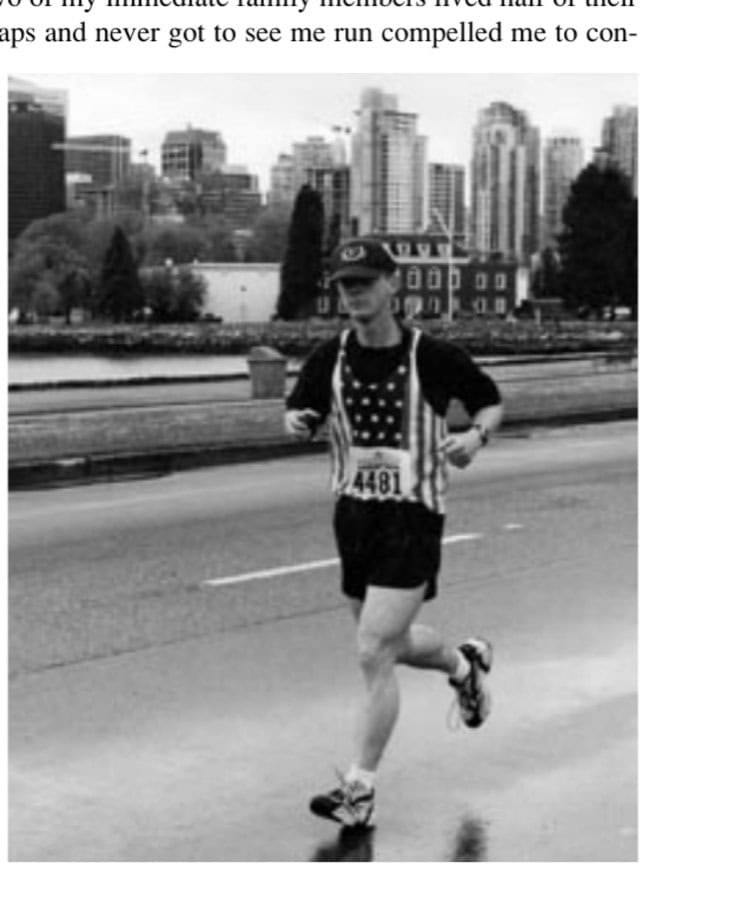
Eddie displays his patriotism while marathoning in Vancouver, British Columbia, in May 2002.
In addition to the Portland Marathon, I had run two half-marathons while still in high school: the Governor’s Trophy race in Salem, Oregon, in 1981 and the Bohemia Mining Days Marathon in Cottage Grove, Oregon, in 1982. I had the feeling that I had overcome the mental barrier of running distances of 13 to 26 miles.
In 1987, I was assigned to Germany, where I was inspired by two German friends (Bernd and Berndhardt), to reconsider the marathon’s three-hour barrier. From observing my training and racing performances, they thought I was capable of such an effort. I regularly accompanied them on long tempo runs. They were coming off 2:40 marathon performances earlier in the year in Hamburg. I had recently managed a 10K personal best of 34:16. Was I finally conditioned well enough to run below three hours? My German friends were convinced that I was, and they finally broke down my resistance to running another long race. The marathon I selected was the Köln Polizei (Cologne Police) Marathon. I agreed to let Bernd and Berndhardt pace me for my second 26.2-miler. The course consisted of five loops through a park in Cologne. I finished in 2:56:16. That accomplishment inspired me to run four additional marathons in Germany over the next three years.
A return assignment to Fort Monmouth, New Jersey, provided an opportunity to run more marathons. A 3:01:48 finish in Frankfurt, Germany, in 1991 qualified me for the 1992 Boston Marathon. With a motivation provided by new friends at the Jersey Shore Running Club, I ran the famous Massachusetts marathon three times between 1992 and 1994 and New York City in 1992 and 1994.
One of my attempts to qualify for Boston resulted in a personal best of 2:52:05 at the obscure and now-defunct Raritan Valley Road Runners Marathon near Piscataway Township, New Jersey, in 1993.
AN ODD BUT ACCOMMODATING COURSE The good performance was the result of a rare mid-January Jersey thaw, which brought a sunny 50-degree day. The course was interesting as well: five round trips on a 2 1/2-mile bike path with a 1.2-mile straight stretch at the end. It had a small cul-de-sac at each end of the bike path, so I wasn’t forced to turn on a dime. I always considered my best marathon time a fluke. I had run other marathons in a slower time but with more-even splits. During the Raritan Valley run, I completed the first five miles at six-minutes-per-mile pace, and the final three averaged nearly eight minutes per mile (with all the middle miles at about 6:34 pace).
Nonetheless, I ran a personal best thanks to good training, good weather, an eager support crew of family and friends, and the diversion provided by watching children playing on the grass, mothers pushing strollers, and migrating birds.
Between 1992 and 1994, I was on kind of a marathon treadmill. I was running the marathons I had read and dreamed about, and I was having fun doing
▲
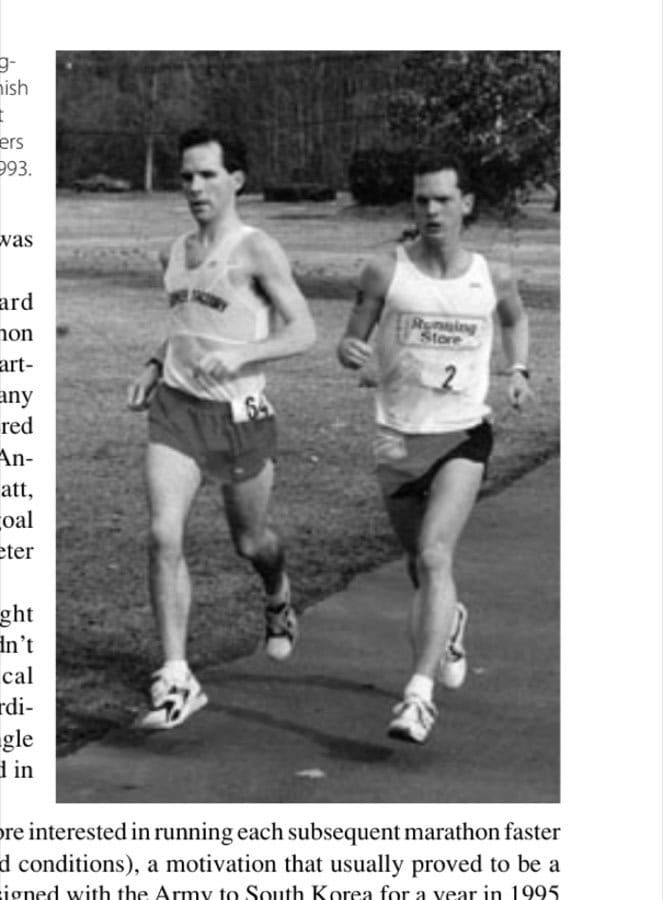
Eddie (number 2) challenging for the lead (he would finish fourth) in his personal best at the Raritan Valley Road Runners Marathon in New Jersey in 1993.
it. However, something was missing. During 1993, I heard about the 50 States Marathon Group from my running partner, Art. I had never met any of that group, but I considered them to be on the fringe. Another running buddy, Matt, told me his long-term goal was to run a five-kilometer race in each state.
At the time, I thought his goal was lofty. I couldn’t conceive of the logistical planning involved in coordinating a trip to every single state, but it planted a seed in the back of my mind. Prior to 1996, I was more interested in running each subsequent marathon faster (relative to the course and conditions), a motivation that usually proved to be a disappointment. I was assigned with the Army to South Korea for a year in 1995 and failed to enter a marathon in that country, which I have always regretted.
When I returned to the United States, I ran the Los Angeles Marathon in 1996 with my Uncle Bob, who had flown in from his home in Fairbanks, Alaska. A conversation with him at a carboloading dinner the night before the race provided the final inspiration and motivation to join the 50 States Marathon Group. Now, instead of observing their weirdness from afar, I was one of them.
I must admit that when my uncle told me he was considering joining the group, I was shocked. He had been a miler in high school before taking a long break from running. He rediscovered running in the late 1980s and became a marathoner in 1990. He had received two Purple Hearts because of wounds from his service on a gunboat in Vietnam and had undergone brain surgery related to injuries in that war. He had also broken both legs in accidents. He was classified by the Navy as a disabled veteran, and it was a miracle he was walking, let alone running marathons. Never underestimate the determination of a guy on a mission.
My uncle’s handicaps and the memory of his brother (my Uncle Don) and my maternal grandfather, both of whom had died, were the final inspiration I needed to run a marathon in all 50 states. If my uncle could run those marathons, so could I. (He has run marathons in 48 states, nearly 100 altogether, despite 40 percent vision in one eye because of an automobile accident.)
ad
A CLUB WITH A LIBERAL VIEW OF FINISHING TIMES The aspect of the club that appealed most to me was that there was no cutoff time for completing each marathon. I could run as slowly as I wanted. (By virtue of a seriously altered training routine due to military field maneuvers, combat-related deployment, and the 13 years of aging since my best marathon, my average time had slowed to about four hours.)
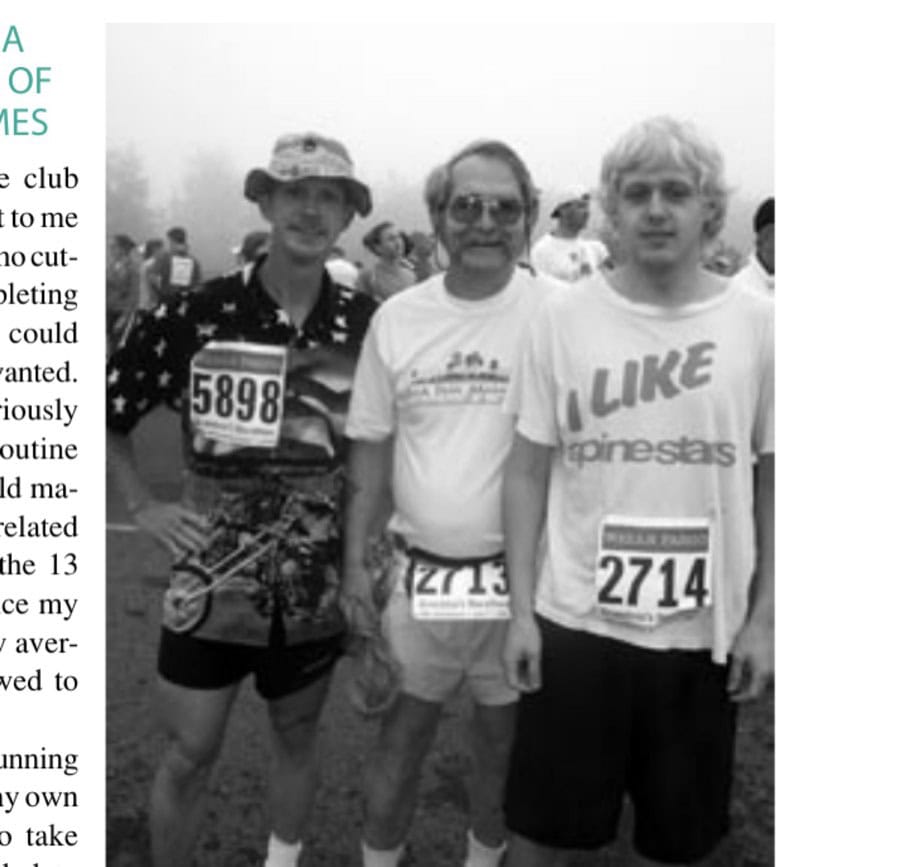
In addition to running the marathons at my own pace, I could also take as long as I needed to run a marathon in all the ▲ Eddie at the 2006 Grandma’s Marathon in Duluth, Minnestates, since there was no sota, with his uncle, Bob Hildebrandt, and his cousin, Dietrick cutoff date. Hildebrandt, who won the Humpy’s Marathon in Anchorage
My first marathon in August. after deciding to join the group (my 14th marathon at the time) was not in a state, but on Cape Sable Island in Nova Scotia, Canada. The beautiful blue waters and tall evergreen trees began an odyssey that has led me to complete 75 marathons in 27 states, two Canadian provinces, the District of Columbia, Israel, and Greece.
I retired from the Army in July 2006 after completing my final combat tour (Operation Iraqi Freedom III in October 2005), and I plan to take on work that has more predictable hours but doesn’t deploy to combat zones. I hope it will provide me more marathoning flexibility.
Continuing to travel gives my Honduran-born wife, Yuri, and our daughter, Samantha, a great opportunity to see America while I complete my remaining 23 states. Thanks to the inspiration provided by my Uncle Bob, we’ll be able to see America up close and personal.
This article originally appeared in Marathon & Beyond, Vol. 11, No. 2 (2007).
← Browse the full M&B ArchiveMore like this
1,000+ stories from 19 years of Marathon & Beyond
The complete archive of the legendary long-distance journal — digitized and free to read.
