

Marine Vets At the MCM
It’s a long way from the battlefields of Fallujah, Iraq, to the Marine Corps Marathon (MCM) in Washington, D.C., but many Marines and soldiers have taken that route. More than 2,541 soldiers have lost their lives during Operation Iraqi Freedom, and Department of Defense statistics indicate that over 10,200 soldiers have been wounded. Some have received bullet wounds and some have had limbs amputated, but all are learning new ways to live very different lives from the ones they had before they left American soil.
Alexander Sargent, 23, was wounded in Iraq in November 2003 during a house-to-house search. While Sargent and his fellow Marines approached what they thought was an empty home, 10 Libyans opened fire, killing Lance Corporals Phillip West and Joseph Welke and Corporal Brad Arms. Sargent survived the firefight, but he suffered several bullet wounds in his arm and leg that grazed the bones.
Sargent was evacuated from Iraq to Germany and then to Andrews Air Force Base in Maryland. He eventually received treatment at Balboa Naval Medical Center in San Diego. Confined to a wheelchair for two months and not able to walk for six months, Sargent took part in extensive physical therapy.
Marine Captain Paola Hayes, a hospital commander at Balboa Naval Hospital, was interested in bringing a group of injured Marines with her to participate in the Marine Corps Marathon. While recruiting Marines for the trip to Washington, Sargent took the goal to heart and decided to begin training. “
You have to transcend self-pity, and you can’t let it get to you,” Sargent said at the prerace expo. “I need to live life to the fullest, and it doesn’t do very much to honor the loss of loved ones if I give up on the things that I am trying to accomplish.”
A CORPSMAN ON A MISSION “Doc” Joseph Worley, a Navy Corpsman, speaking from his home in Washington while a patient at Walter Reed Army Medical Center, was wounded in Fallujah on
September 17, 2004. After being struck by a roadside bomb and shot five times in a firefight, Worley was bleeding profusely from his leg. He tied a tourniquet, helped his fellow wounded Marines, and gave himself a shot of morphine.
Worley’s left leg was eventually amputated above the knee, his right ankle was fused, and his right knee was reconstructed. After months of physical therapy five days a week and with at least six months of treatment still in front of him, Worley had recovered enough to try the MCM. He would use a hand cycle that he practiced with at Walter Reed. “I’m fit and functioning and excited for the race,” Worley said in September 2005.
Corey Webb, 23, was riding in a Humvee on the outskirts of Fallujah when his vehicle hit a tank, flipped eight times, and pinned his left leg. A runner before his accident, Webb could only watch the 2004 MCM while he was in therapy at Walter Reed for eight months learning how to function as an above-knee amputee.
Webb wrestled, played football, and ran a lot for exercise while in high school in Birmingham, Alabama. He hadn’t planned on enlisting in the military, but after 9/11, he “grew a wild hair” and became a Marine.
After he left Walter Reed and moved to Springville, Alabama, the Birmingham Veterans Affairs Medical Center and the Injured Marine Semper Fi Fund (IMSFF) bought Webb a hand cycle. While watching the marathon last year, Webb was inspired.
The IMSFF was established in 2004 when a small group of Marine Corps spouses started providing financial grants and other assistance to Marines who were injured and to their families. The fund has already assisted 1,400 cases and provided more than $2.7 million in grants to wounded heroes and their families.
Besides getting ready for the marathon, Webb also raised more than $2,000 for the IMSFF.
THE ACHILLES TRACK CLUB Dick Traum, 64, a successful businessman and himself an above-knee amputee, founded the Achilles Track Club in New York City in 1983. “The Achilles Track Club (ATC) helps people with all different kinds of disabilities compete in mainstream events like marathons,” Traum said in September 2005 at the ATC office.
Achilles includes people with vision impairment, multiple sclerosis, cancer, traumatic head injury, cerebral palsy, and a variety of other conditions. Traum, who has competed in more than 25 marathons, never imagined the explosive growth that his organization would have.
What started as six members of the ATC competing in the New York City Marathon in 1983 has grown into an organization with 40 chapters in the United States and 110 chapters on six continents.
“Besides being represented at Marine Corps, we’ll have 400 athletes competing in this year’s New York City Marathon,” Traum said while proudly watching over several of his athletes at the prerace expo. “I’ve been to the White House already [the rest of his group was scheduled for a White House visit], but I’ve got lots of work to do, speeches to write, and contacts to make, but I just love it all,” Traum said.
Injured Marines returning home from serving their country, the Semper Fi Fund, and the Achilles Track Club seemed like the perfect ingredients to bring a large contingent of injured athletes to the Marine Corps Marathon.
Mary Bryant, director of the Achilles Freedom Team, helped put everything together. Bryant and Traum were in a whirlwind of activity at the prerace expo with some 30 athletes. “We’re here to show what we can do, not what is broken or missing,” Bryant said as she was busy getting everybody together for a private tour of the White House.
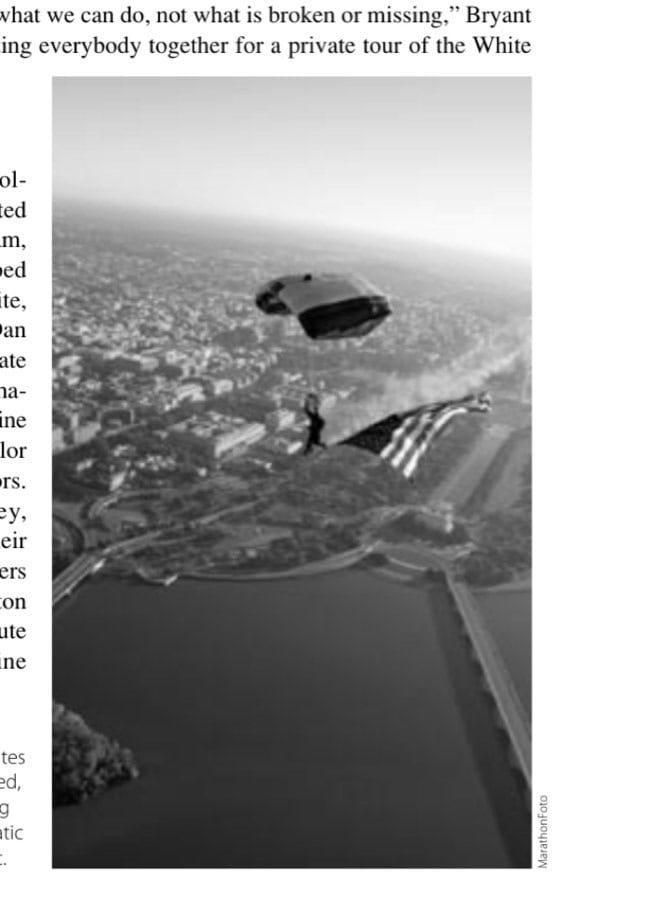
RACE DAY On marathon day the following morning, the United States Navy Parachute Team, the “Leap Frogs,” jumped from the sky with red, white, and blue smoke tails. Dan Clark, a Massachusetts state trooper, bellowed out the national anthem and the Marine Corps Base Quantico Color Guard marched the colors. Sargent, Hayes, Worley, Webb, and Traum took their places among 30,000 runners lined up under the Arlington Memorial Bridge on Route 110 near the U.S. Marine Corps War Memorial.
MarathonFoto
▲
Leap Frogs, the United States Navy Parachute Team, with red, white, and blue smoke trailing them, float down for a dramatic landing at the marathon start.
MarathonFoto
Elizabeth Cline, public relations director for the marathon, was happy to have all of the Marines and members of the ATC participating. “Last year the Marines from Walter Reed watched the marathon,” Cline said. “Unfortunately, as things have proceeded in Afghanistan and Iraq, we are seeing more and more participants from these organizations.” With only 1,175 runners at the first MCM in 1976, this year’s increased participation of 30,000 at the 30th running would be a good test for the organizational
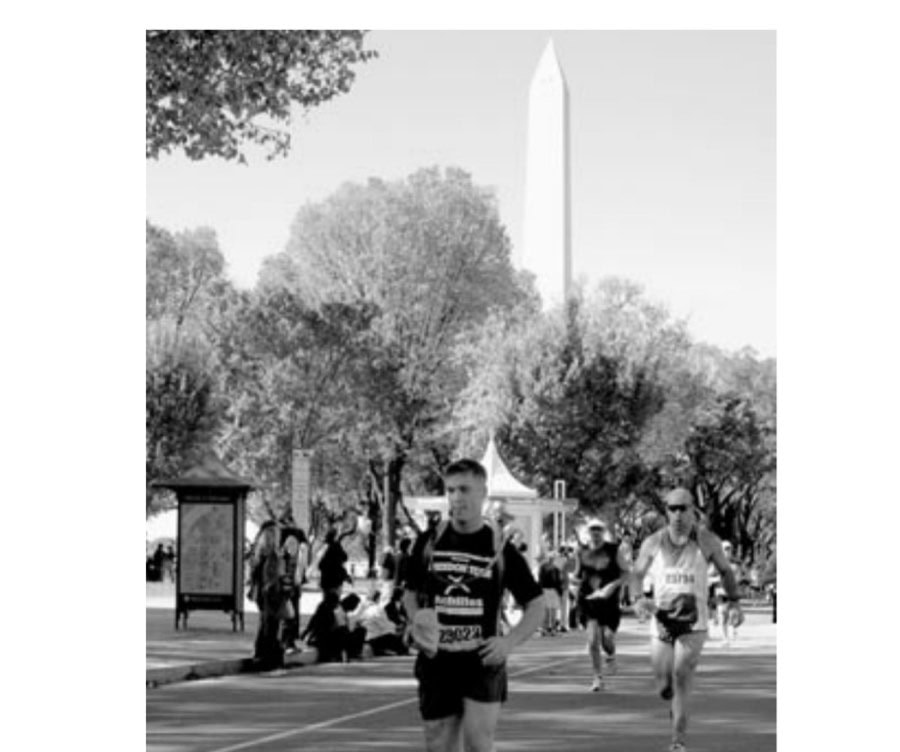
▲ Almost two years after suffering bullet wounds to his arm and leg that left him unable to walk, Alexander Sargent, age 23, completed the 2005 Marine Corps Marathon in 4:32.
skills of the United States Marines Corps, which organizes the race. The race bills itself as “The People’s Marathon,” and citizens from 45 countries and residents of all 50 states compete to enjoy a hard-fought battle for personal satisfaction: there is no prize money.
Sargent ran 15 miles during the weekend before the marathon, and after he arrived in Washington, he was feeling the lingering effects of such an effort. He was also concerned about the poor circulation in his arm and wondered whether he should wear a long-sleeve shirt or some kind of arm warmer on race day. “
I was doing 6:30 miles for the last few during that run, and maybe I pushed too hard,” Sargent said. On race day, Sargent surprised himself and finished the marathon in 4 hours, 32 minutes, and 5 seconds. It was a spectacular effort for someone who could not even walk 1 1/2 years ago. “
The race went awesome,” Sargent said. “It was really surprising that I was able to run the whole way, and I only walked through the aid stations when I was drinking water or eating a PowerBar or something.”
Sargent saw many familiar faces at the marathon, including his battalion commander and intelligence officer. He was also pleased to be in such an encouraging environment and felt that everybody was pulling for him.
DEVIL OR ANGEL? At the halfway mark, Sargent felt both an angel and a devil on his shoulders. “I’ve already gone 13.1 miles, but I’ve still got 13.1 miles to go,” Sargent said. The Friday before the marathon was Sargent’s last day of treatment at Balboa, and the marathon was one of his final acts as a Marine. “
I’m going to sit down and do some planning during the next few weeks, and in January, I’ll probably go to school at the University of Southern Maine, near my Brunswick hometown,” Sargent said. “I’m looking inside myself at what I can do, and if I think I can, I might as well try. I want to know my limits.”
Hayes, although not injured herself, ran the marathon in support of the Marines whom she accompanied from Balboa. She finished in 5:42:37. “It was a good experience, and it’s very motivating to be here with the Marines,” Hayes said. “Running might be a strong word for what I did, but I did get from the start to the finish. All of the Marines that we brought to MCM finished the race, and I think that we’ll go to the New York City Marathon next year.” Worley finished the marathon in 4:40 while using his hand cycle, but he had his share of difficulties during the race. “
My wheel busted early in the race, and I was down for one and a half hours until a bike shop on M Street came over and fixed it,” Worley said. “Still, it was an excellent experience, and I had more fun than anything I’ve done in a long time.”
With the hand cycles starting the race between two other waves, Worley found it difficult to maneuver among the runners. At mile 26, the only things separating runners and the finish line are a short steep hill and two quick turns to the Iwo Jima Monument. “That last hill was so steep, it was ridiculous,” Worley said. In December, Worley was planning a ski trip with Disabled Sports U.S.A. to Colorado. He had never been snow skiing before, but he expected to fare well because his balance was good. “I’d like to try MCM again next year, and I think I can break three hours if things go a little better,” Worley said.
BACK WITH AN OLD FRIEND Using a hand cycle, Webb finished in 3:08:39 after making the trip from Springville, Alabama, and staying at Walter Reed for the weekend. Webb was reunited at Walter Reed with his friend Casey Owens, a fellow Marine who was a patient at Walter Reed during the same time as Webb. Owens was still recovering at Walter Reed but was well enough to race back and forth with Webb during the marathon. “I loved the race and I hope to do it again next year,” Webb said from his home, a week after the marathon. Webb, who had previously visited Washington, was especially thrilled to be able to see all of the monuments and sights close up from his hand cycle.
MarathonFoto
▲
Corey Webb, who lost his left leg in a Humvee accident in Fallujah, was inspired while watching the 2004 Marine Corp Marathon during his rehab at Walter Reed. In 2005 he completed the race using a hand cycle.
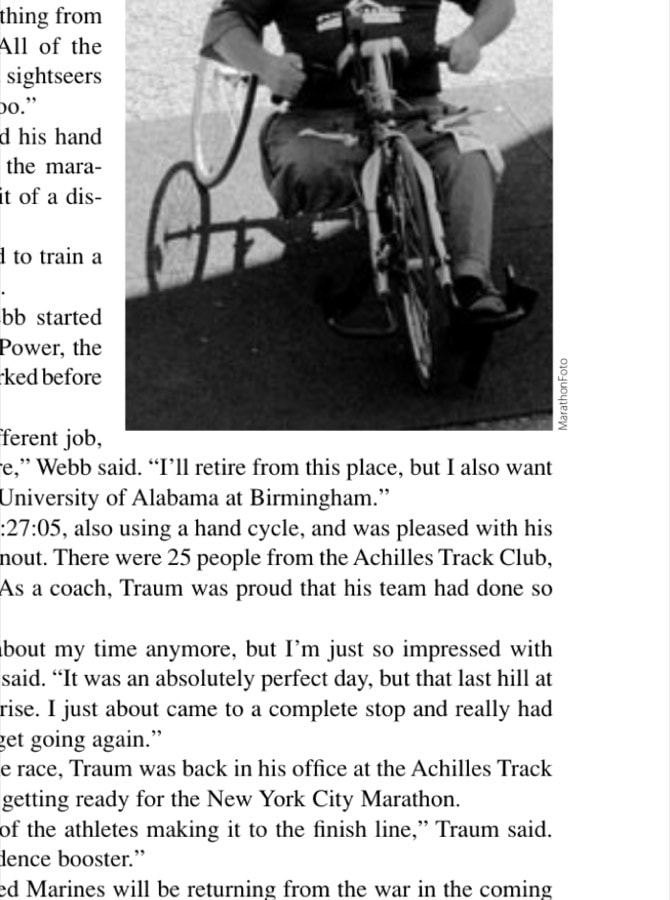
“It’s not every day they shut down the city, and it’s so much nicer than seeing everything from a car,” Webb said. “All of the crowds, spectators, and sightseers really kept me going, too.” Not having received his hand cycle until just before the marathon, Webb was at a bit of a disadvantage. “
I would have liked to train a little more,” Webb said. After the race, Webb started a new job at Alabama Power, the same place where he worked before serving in Iraq. “I had to learn a different job, but I’m happy to be here,” Webb said. “I’ll retire from this place, but I also want to finish college at the University of Alabama at Birmingham.” Traum finished in 2:27:05, also using a hand cycle, and was pleased with his race and his group’s turnout. There were 25 people from the Achilles Track Club, including 15 Marines. As a coach, Traum was proud that his team had done so well. “
It’s not so much about my time anymore, but I’m just so impressed with these Marines,” Traum said. “It was an absolutely perfect day, but that last hill at the end came as a surprise. I just about came to a complete stop and really had to give 100 percent to get going again.”
On Tuesday after the race, Traum was back in his office at the Achilles Track Club, busier than ever, getting ready for the New York City Marathon. “I love helping all of the athletes making it to the finish line,” Traum said. “It’s such a great confidence booster.”
Many more wounded Marines will be returning from the war in the coming months, and possibly years. All will be received with cheers and thanks for serving this country. The marathon remains a good test of fitness and dedication for people from all walks of life and abilities.
MarathonFoto
▲
Achilles Track Club Director Dick Traum finishes the race. The Achilles Track Club helps people with all different kinds of disabilities compete in mainstream events like marathons.
This article originally appeared in Marathon & Beyond, Vol. 10, No. 5 (2006).
← Browse the full M&B ArchiveMore like this
1,000+ stories from 19 years of Marathon & Beyond
The complete archive of the legendary long-distance journal — digitized and free to read.
