

Marriage on the Run
LIKE MOST couples filled with unabashed love, before we got married we promised each other the world. Five years later, through our commitment to running and each other, we’re making our way toward fulfilling that promise.
Our marriage started out on the run . . . literally. We got married April 15, 1996. To most people that’s Tax Day. To most runners, that was the 100th Boston Marathon.
It all started one year earlier. We were running in Indianapolis in the world’s largest half-marathon. The race takes runners from downtown Indy to the Brickyard, home of the Indianapolis 500. Runners do a loop around the track, and then they head back to downtown. The halfway point of the race is the line of bricks inlaid in the race track, which is the start/finish line of the Indy 500. The bricks are remnants of the original “Brickyard” racetrack.
It was at that point, on the yard of bricks, that my boyfriend Ed stopped, stooped down to one knee, pulled a ring out of the little pocket in his running shorts, and popped the question. After checking my split time, I stopped my watch, looked into his eyes, and answered, “Yes!”
We were no longer going to be just running partners but lifelong partners. As runners, it was easy for us to see the parallels between a marriage and a marathon. When you think about it, they’re alike in many ways. They both take strength, time, and commitment. They are both filled with peaks and valleys, struggles and joy.
With the 100th Boston coming up, we knew it would be something very special and memorable, and we wanted to be part of it as we celebrated the beginning of our new life together.
BOSTON, MASSACHUSETTS, 1996
Planning this marathon/marriage wasn’t easy. We knew we wanted the ceremony to take place on the course somewhere near the middle of the marathon. We drove the route and at the 14.6-mile mark stood a lovely, old brownstone building, Wellesley Hills Congregational Church. Then came the tricky part: convincing the minister that we weren’t crazy or making a mockery of marriage but that we were committed to going down that long road together.
With understanding and a hint of amusement, Reverend Craig Davis agreed to perform the ceremony. We gathered in Hopkinton with the other runners, all excited about the big race. Obviously, we were excited, too, but for us, this race took on so much more meaning.
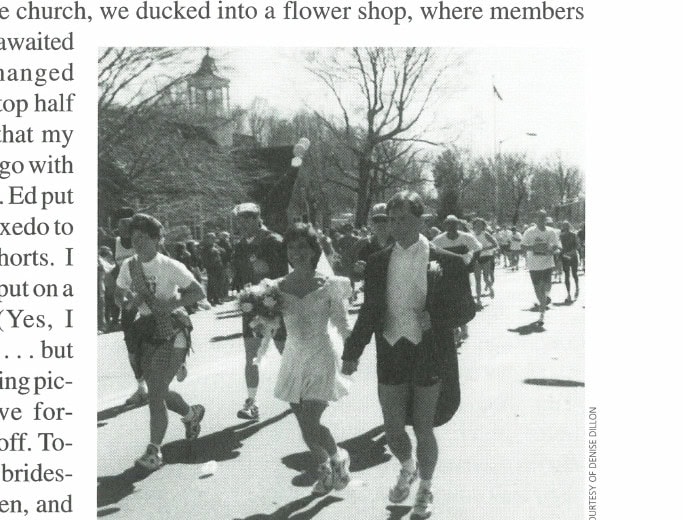
We were both remarkably calm on the run toward Wellesley. I was dressed in a white tennis skirt and white top, Ed in black shorts and a white top. About a half mile before the church, we ducked into a flower shop, where members of our wedding party awaited us. We quickly changed clothes. I put on the top half of a wedding dress that my mom made for me to go with my white tennis skirt. Ed put on the top half of a tuxedo to go with his black shorts. I combed my hair and put on a touch of makeup (Yes, I know. I was running . . . but hey, these were wedding pictures we would have forever!), and we were off. Together Ed and I, our bridesmaids and groomsmen, and my father all ran down Washington Street to the church, where our guests were waiting.
It was a beautiful wedding, with friends, family, and a string quartet—oh, and of course, a bride and groom about to face their first obstacle as man and wife: Heartbreak Hill. We managed to climb that hill together and finish the race. No, it wasn’t a record-breaking time, but it was definitely a personal best as a married couple.
That was just the beginning of going the distance together. After a wedding like that, it was only appropriate that we continue to run together step by step, and we do. Every year we celebrate our wedding anniversary by running a marathon together.
LONDON, UNITED KINGDOM, 1997
What do you do for an encore after tying the knot in the world’s most prestigious marathon?
You go across The Pond to find one of the world’s largest and most entertaining marathons.
Ed and I headed to the United Kingdom for the Flora London Marathon. The trip was filled with many pleasant surprises. First and foremost, the weather—in a normally rain-sodden city in the spring we had a day of cloudless blue skies and temperatures around 60 degrees. We didn’t encounter a single problem in this well-organized race . . . even with more than 25,000 runners filling the streets of London. It was here we decided that there’s no better way to experience a city’s charms than by running through it.
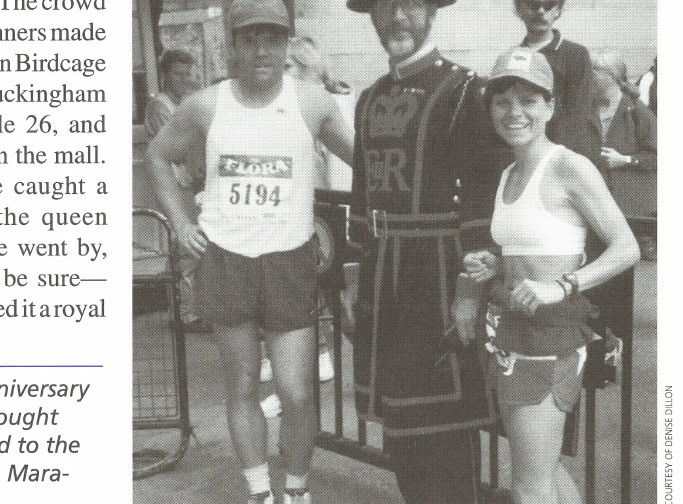
The race began in Greenwich and went by the Woolwich Artillery Barracks and past the famous Cutty Sark. We ran across the Tower Bridge and past the Canary Wharf and Tower of London (where we stopped and had our picture taken with a real-life Beefeater). The course followed the River Thames to Parliament Square. It was like taking one of those big red bus tours, only much, much better. Every step of the way crowds lined the course, and we were entertained by brass bands, bagpipes, and music coming from English pubs.
As much fun as we had during the first 25 miles, taking pictures and playing tourists as we ran, the last mile was sheer excitement. Just after the 25-mile mark we ran past Big Ben and toward the homestretch. The crowd cheered as runners made their way down Birdcage Walk past Buckingham Palace at mile 26, and we finished in the mall. We think we caught a glimpse of the queen waving as we went by, but we can’t be sure—still, we dubbed it a royal finish.
SAN DIEGO, CALIFORNIA, 1998
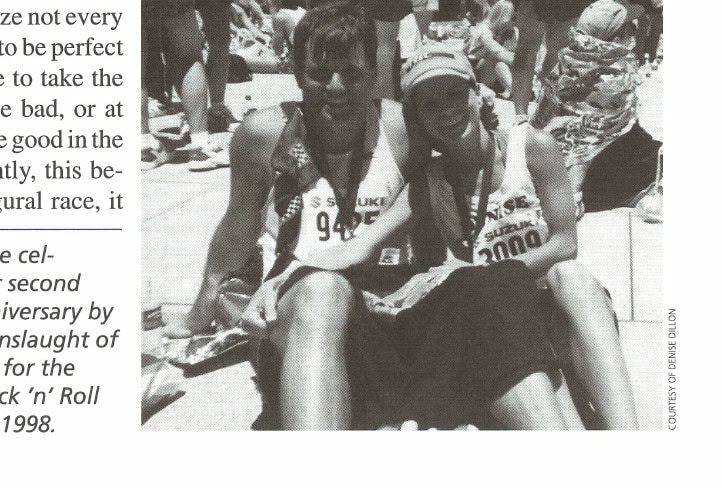
When we started thinking about our second anniversary and which marathon we wanted to run, we learned of the inaugural Rock ‘n’ Roll Marathon. We had always heard about San Diego’s perfect weather, pristine beaches, and superb scenery. In addition, the hype surrounding the marathon of bands along the course was something we couldn’t pass up.
Unfortunately, neither could many, many others. Apparently, race organizers did not realize how good of a job they were doing in the public relations department. In no way were they prepared for the onslaught of marathoners. There were problems from the beginning. We got off to a late start . . . 38 minutes late. Nothing like a crowd of well-hydrated runners corralled up, waiting for a race to start . . . and it’s late. It was a hot day, and they ran out of water fast. Many of those in the four-hour plus category went miles without water. Not a good thing, considering there is very little shade along the course.
While San Diego is an absolutely beautiful city, the course ran along some unspectacular sites, including a typical expressway for several miles. Oh, and as for those bands every mile as promised . . . that didn’t happen. Maybe a band every four miles . . . and even then, sometimes they were on break.
Of course it wasn’t all bad, and it probably wouldn’t have been bad at all if our expectations hadn’t been raised so high by prerace publicity. On a positive note, nearly 6,000 of the runners were members of Team in Training. Together they raised $15,600,000 for the Leukemia Society of America.
After the race, once we were all rested and showered, a huge outdoor concert was held in Balboa Park. It was a very pleasant evening and gave us all a chance to dance (albeit stiffly and cautiously) some of that lactic acid out of our legs. As marathon runners, we realize not every race is going to be perfect and you have to take the good with the bad, or at least see some good in the bad. Apparently, this being the inaugural race, it was a learning year, and we understand that since then the race has improved in every aspect.
BIG SUR, CALIFORNIA, 1999
We had seen pictures of the stunning vistas, not to mention the hills, of the Big Sur International Marathon. For our third anniversary we headed to California and a chance to experience it for ourselves.
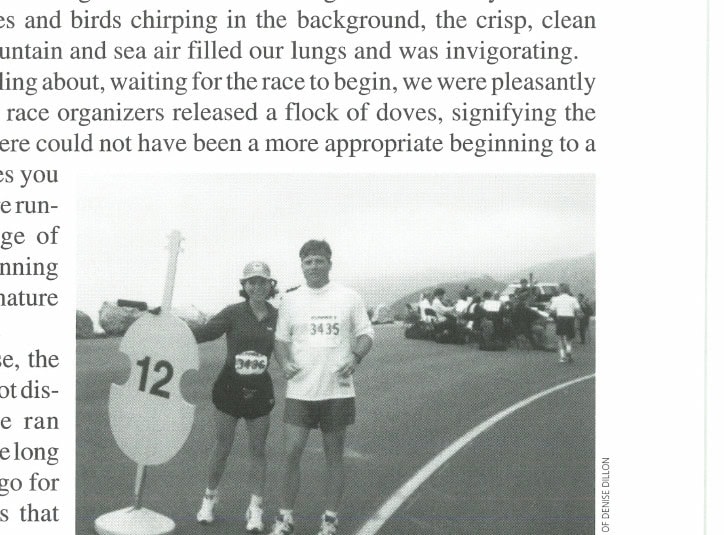
Big Sur is a point-to-point race, so we were bussed from the finish at Carmel to the start. Riding the bus to Big Sur in the predawn hours, we felt lucky that it was too dark to see the huge hills we’d be climbing. Surrounded by redwood and eucalyptus trees and birds chirping in the background, the crisp, clean combination of mountain and sea air filled our lungs and was invigorating.
As we stood milling about, waiting for the race to begin, we were pleasantly surprised when the race organizers released a flock of doves, signifying the start of the race. There could not have been a more appropriate beginning to a marathon that makes you feel as though you’re running along the edge of the Earth while running through and with nature at its most sublime.
Along the course, the promised hills did not disappoint us. As we ran along Highway 1, the long inclines seemed to go for miles. But the hills that hammered away at our weary legs were worth it; the glorious ocean views truly surpassed our expectations. As for crowds, there were virtually none along much of the course, but there was entertainment: every kind of music, from orchestras to children’s groups, helped the miles zip by.
Of course we had to stop at the halfway point for the traditional picture with Jonathan Lee, who plays the grand piano on the fantastic cliffs above the mighty Pacific.
As we got closer to Carmel, the crowds started forming, pushing us to the finish. This marathon is definitely about the great outdoors and all of its majestic beauty. All those pictures you see of the runners making their way up long hills along the edge of the Pacific are true to life—but you have to experience it yourself to make the visions they create come alive.
SYDNEY, AUSTRALIA, 2000
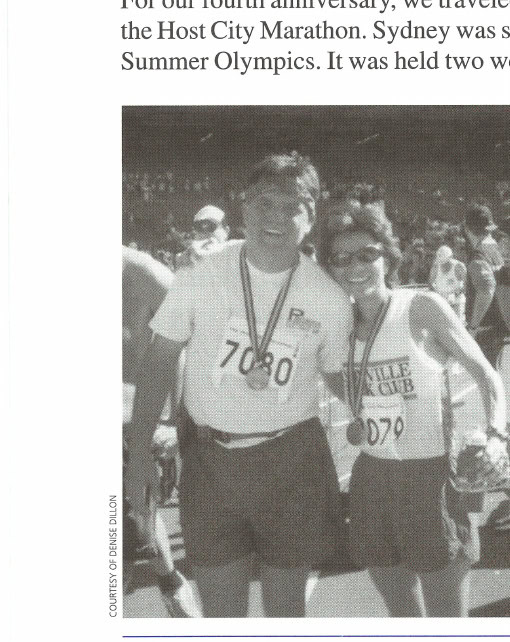
For our fourth anniversary, we traveled Down Under to Sydney, Australia, for the Host City Marathon. Sydney was staging a test marathon for the upcoming Summer Olympics. It was held two weeks before our actual anniversary date, and we just couldn’t pass up the chance to visit Australia and run on what would become the Olympic marathon course.
Roughly 5,500 runners had the same idea of running along the same streets the world’s best marathoners would follow in just five months. The course is point to point, with a very early start. There was no fanfare for the start, just a countdown, and we were off.
A few miles into the race, we ran across Australia’s landmark Harbour Bridge, passing the world-famous Sydney Opera House, which looks like giant shells rising from the water. This was the most famous site on the course.
We then went by the Royal Botanic Gardens, followed by a lap through the beautiful Centennial Park. The first part of the marathon was quite flat and scenic and interesting. Running through Royal Cross (the red light district) at a time of the morning when most people were waking up to their first cup of coffee, we were amazed to see men and women wearing nothing but black leather (and in some cases, very little of it) lining up to go into bars. And we runners often think we’re pretty weird being out on the streets first thing in the morning running in rain, sleet, snow, or hail.
Once we passed the halfway point, it was a whole different race. The flat turned into hills, some of them quite challenging. And the scenery turned rather bland. It was a long stretch of nothingness as we made our way out to the Olympic venues.
But the finish was worth it, lapping around the brand-new Olympic stadium. We looked up and imagined the stands filled with people from around the world watching the track, where some of the best athletes in the world would run in the 2000 Games.
PARIS, FRANCE, 2001
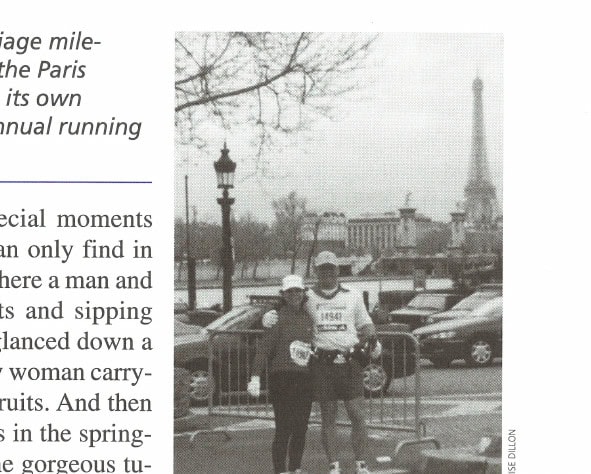
A fifth anniversary is a milestone of sorts, so we wanted to do something special for our fifth anniversary marathon run. As it turned out, our search for a suitable anniversary marathon turned up the fact that the Paris International Marathon had an anniversary of its own to celebrate: the 25th annual running of the marathon through the City of Lights—a city filled with history and soaked in culture. Immediately, we knew this was the race for us.
Being the not so proud owners of a French vocabulary of roughly two dozen words between the two of us, we thought we’d have a tough time getting around Paris, but marathon runners seem to have their own international language and we had no problems at all.
With 25 years of experience at putting on the race, the organizers have the logistics down pretty well. Some 27,000 runners gathered at the Arc de Triomphe on a chilly April morning. We took off en masse (see how good I became at tossing French words into my conversation?) down the Champs Elysees, where spectators lined the entire boulevard. We quickly realized we were using up a lot more time and energy gawking at the architecture than counting the miles. Portions of the course were cobblestone streets—not exactly ideal if you’re hoping for a PR, which we weren’t exactly shooting for.
From start to finish, there is plenty to see along this course. On the grand scale, there was the Guillotine, the Louvre, the Bastille, and Vincennes Park.
But there were also the special moments along the course that you can only find in France. We ran past a cafe where a man and woman sat eating croissants and sipping coffee, oblivious to us. We glanced down a side street and saw an elderly woman carrying a bag full of bread and fruits. And then there were the flowers! Paris in the springtime really does bring out the gorgeous tulips. Vibrant reds, yellows, and pinks seemed to burst through the overcast day and were absolutely stunning.
As we ran along the Seine, crowds of people gathered on the bridges to cheer us on. Running along the river and seeing the Eiffel Tower off in the distance was an experience that will stay with us for a very long time. And at mile 22, when we saw a table set up on the course serving French wine, well, we just had to stop and raise a toast to Paris, to the marathon (and to our fellow marathoners), and to us on our fifth anniversary.
From here, we had just a few miles left to go. We ran through another large park and finished on the Foch Boulevard, not far from where we had started this most memorable of anniversary celebrations.
MORE TO COME
The prospect of a new marathon each year around the time of our anniversary colors the excitement we associate with our wedding anniversary. The training and hours of long runs we spend together give us something even more important: quality time together. Time to discuss our day, work out our problems, and look forward to the future.
Of course, as any marathoner knows, those long runs aren’t always easy, but like our marriage, we are there for each other, lending support and encouragement. Running has given us the opportunity to visit some amazing places. And, year after year, our annual marathon gives us the opportunity to fulfill our promise to give each other the world.
In the late afternoon on June 22, 2002, the Edmonton Festival Marathon Society will host more than 3000 runners from all over the world at the “Race the Twilight” Running Festival. Featuring:
- A new and exciting Marathon course, highlighting Edmonton’s River Valley, which will provide runners an opportunity to witness the beauty of sunset and nightfall on the longest and brightest day
- Half Marathon, which will feature a new course designed to provide challenging opportunities to the many runners favouring this event and great spectator viewing
- Mini Marathon, in which children of all ages will play and enjoy the entertainment and fun of running through the 4.2K course
- “Twilight Festival,” which will present product displays, food concessions, athletic services, children’s activities, entertainment and much more
www.edmonton-marathon.com
This article originally appeared in Marathon & Beyond, Vol. 6, No. 2 (2002).
← Browse the full M&B ArchiveMore like this
1,000+ stories from 19 years of Marathon & Beyond
The complete archive of the legendary long-distance journal — digitized and free to read.
