

Masters of the Ultra
- 1. Experience, experience, experience
- 2. Ability to pace properly
- 3. Patience
- 4. Efficiency
- 5. Tendency to approach races philosophically
- 6. Trust in themselves and their abilities
- 7. Psychological edge from unique nonrunning experiences
an interesting sidebar called “Ultras Won by Over-50 Runners.” Of the 317 ultras UltraRunning tracked for 1996, 20 were won outright by 50+ runners, and in 16 races the women’s winner was 50+.
It appears that masters runners have some unique characteristics that draw them to the ultramarathon and provide them with enough success to make them want to linger in the world of ultrarunning. What follows are my impressions of why masters runners seem to do particularly well in ultramarathons.
EXPERIENCE, EXPERIENCE, EXPERIENCE
Experience is so important for running ultramarathons that perhaps it should be listed as reasons number 1 through 3. The longer the event, the more variables a runner is likely to encounter; the best way to deal with these variables is to experience them and to learn from them. Masters runners typically have a broad repertoire of running experiences from which to draw insight—assuming that they were paying attention as the events unfolded!
For example, most masters have run in all sorts of weather conditions and know how to deal with rain, snow, ice, and heat. They know which running shoes and which socks cause blisters and which do not. They have learned what types of food to eat and which liquids to drink during long events. And they have learned which race strategies are effective for them and which are not.
I probably could go on to list several dozen variables that veteran runners have experienced, but you get the idea. Masters runners need only to log on to the hard drive in their brains to access a wealth of information that can help them analyze the conditions and situations that are present on any given day, at any given event. This ability enables them to respond quickly and effectively to the variables presented. Meanwhile, their younger, inexperienced counterparts are using the trial and error method in an attempt to find solutions to problems that they have never encountered before.
ABILITY TO PACE PROPERLY
Improper pacing will hurt a runner’s time in any event, but starting too fast in ultramarathons can be absolutely devastating. It is one thing for runners to survive the last mile of a 5K after going out too hard, but if they push the envelope in the first 10 miles of a 100-miler, they will be hard-pressed to tough it out for the last 90 miles. Fast starters who acknowledge their mistake early and adjust their pace immediately may be able to recover sufficiently to finish the race; however, it is unlikely that their overall performance will be as good as it could have been with proper pacing throughout the event.
Anyone who has ever watched the kids’ races that are sometimes held in conjunction with 5K or 10K events has probably noticed a common thread. No matter what the distance of the race, all of the boys and girls take off as though they were running a 100-yard dash! Inevitably, they pay for this indiscretion by slowing down dramatically as the race wears on. Since virtually every child does the same thing, I can only assume that the tendency to start too fast in a race must be a genetic flaw in the human race. Homo sapiens, which literally means “wise man,” seem to be anything but wise when it comes to proper pacing.
The more experience runners have, the more likely they will have learned to resist this natural urge to start too fast. This gives the typical masters runner an edge in ultramarathons, where pacing is so critical. Also, most masters runners no longer possess the raw speed that younger runners have in abundance, so they probably have grown accustomed to running in the middle of the pack in 5K and 10K events. The middle of the pack, it just so happens, is an excellent place to be lurking early in an ultramarathon.
Of course, one cannot assume that all masters runners have learned how to pace properly. Some of these men and women (mostly men) have always started races too fast—and they’ll continue to, even when they are competing in the 100 to 109 age group! Chances are, though, that masters runners who seem to be missing the “pacing gene” entirely won’t be doing many ultras, because the events will ultimately prove to be just too painful for them. However, old codgers who have learned to start slowly and finish at full throttle often find great success running ultra distances.
PATIENCE
Patience is an individual thing, but older runners seem to display more of it than the young whippersnappers do. Patience is closely related to proper pacing, but it goes beyond that. When things are not going well, masters runners tend to remember the old ultrarunning proverb: “It doesn’t always keep getting worse!”
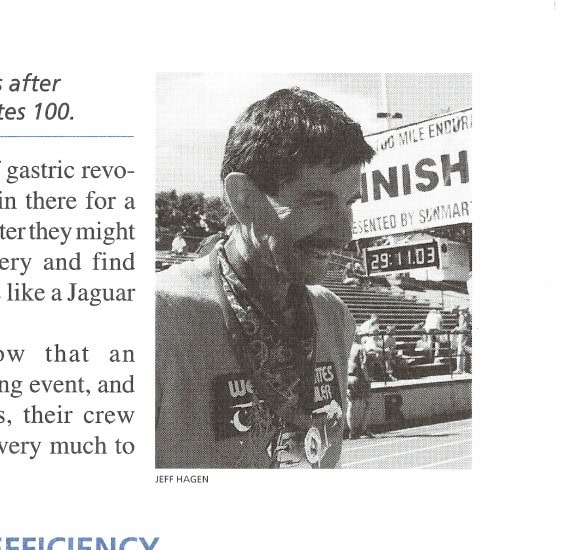
If they are feeling the effects of gastric revolution, they are likely to hang in there for a while, knowing that a half hour later they might experience an amazing recovery and find themselves passing competitors like a Jaguar at a Volkswagen rally.
These old geezers know that an ultramarathon is a very, very long event, and being patient with themselves, their crew members, and race officials is very much to their advantage.
EFFICIENCY
Many masters runners have become experts at making the most of their declining physical abilities. The key is to run as efficiently as possible. Fortunately, for older runners, running efficiently in ultramarathons depends less on aerobic capacity and more on experience. Knowing when to walk, when to run, how fast to run, when to eat, what to eat, how much to eat, and so on, all have an effect on overall efficiency, and masters have had more time to test these factors and to discover what works for them.
Using another automotive analogy, it doesn’t do much good to have a big engine if you let your engine run out of fuel or drive so hard that you burn up your tires. Those with smaller engines who know how to get the most out of their power plants and wheels will come out ahead in the end.
TENDENCY TO APPROACH RACES PHILOSOPHICALLY
Many veteran runners are just glad to be out on the course, still able to run. Granted, some masters runners remain very competitive, but the really competitive ones tend to get weeded out by the “train too hard, get injured, can’t run any more” scenario.
Masters runners whose philosophy is not to win but just to have fun seem to adapt particularly well to the unique demands of ultramarathons. Ironically, many of these masters runners do very well in races. Their laid-back attitude enables them to take care of themselves early in the race, which often results in a good finish. The longer the event, the more important this approach becomes; so it is not unusual for runners in their 40s, or even in their 50s and beyond, to win 24-hour events outright.
TRUST IN THEMSELVES AND THEIR ABILITIES
As time goes on, and runners participate in more and more events, they are apt to develop an increasing amount of trust in their own abilities. Doing well in ultramarathons absolutely requires that runners trust themselves so they can run their own races, even if they find themselves at the back of the pack in the early miles. This trust is based on a strong conviction that they are running exactly as they should, based on their natural ability, age, level of training, and other factors. If they trust themselves enough to stick to the game plan that they’ve perfected over the years, chances are the jackrabbits who are burning up the early miles will end up as roadkill later in the day. The maturity of masters runners gives them an excellent opportunity to develop this trust.
PSYCHOLOGICAL EDGE FROM UNIQUE NONRUNNING EXPERIENCES
Because they have been roaming this planet longer than younger runners, masters runners are almost certain to have had a wider array of nonrunning experiences that can give them a psychological edge during ultramarathons.
Several years ago I began to realize that the unique set of circumstances under which I grew up has been of great value to me in my ultramarathoning career. The farmhouse where I was raised in Minnesota was lacking in some of the amenities that most young people now enjoy as they are growing up. We abandoned our kerosene lamps and installed electrical wiring when I was a young boy, but we did not have indoor plumbing until I was in college. There was no furnace, and the wood stove in the kitchen and the oil-burner in the living room were scarcely sufficient to warm even the main level of the house, which left my upstairs bedroom essentially unheated.
I will never forget my senior year in high school, when we had a particularly bad winter—even by Minnesota standards. It was so cold that all winter long I wore my overcoat to bed, huddled inside my thin Boy Scout sleeping bag with blankets piled on top. One morning the thermometer inside my room read two degrees Fahrenheit! Outside, it was minus 35 degrees, and the path to our unheated outhouse went over the top of a snowdrift that was 20 feet high. Needless to say, all bathroom visits were very brief; taking time for the slightest bit of recreational reading would have resulted in frostbite or hypothermia.
Even fetching our drinking water was a major effort. I would carry a steaming kettle of water about 200 feet to the hand pump in the yard, dump the contents into the top to prime the pump, and then frantically stroke the handle until the water bucket was filled. Then I would race back to the house with kettle in one hand and bucket in the other—which was as close as we came to having running water at our farm.
Summertime brought a different set of challenges. One important midsummer job for the whole family was to walk the soybean fields, pulling weeds and cutting out stray cornstalks. From the time I was eight years old I walked between 10 and 20 miles per day in the soybeans, fighting voracious mosquitoes, persistent deer flies, shoe-sucking mud, high humidity, and temperatures that occasionally exceeded 100 degrees.
My experiences may sound like one of those “I walked six miles every day to school through two feet of snow and it was uphill in both directions” stories that parents like to tell their kids, but, honestly, everything that I have stated is true. Just as there was no need to complain about these conditions when I was a child, there is no need to exaggerate now.
Growing up under such adversity may seem like a nightmare to most people who read this, but at the time it just seemed normal to me. And now, as I look back, I consider myself very fortunate to have had the opportunity to live under these conditions. Indeed, I feel as though it has given me an almost unfair advantage in long, difficult races. I didn’t realize it at the time, but all of these physical hardships served as training, both for my body and for my mind.
When I was running the Old Dominion 100-Mile Endurance Run in 1987, it was very warm and very humid, with an enthusiastic delegation of deer flies that tried to eat me alive when I stopped for even a few seconds. Instead of becoming upset about these adverse conditions, I was able instead to think back to those hot, muggy, bug-filled days in the soybean fields. It was almost like stepping into a time machine and going home for a short time, and I knew that if I could survive those conditions when I was eight years old, it should be no problem to do the same as a physically fit adult. This enabled me to continue and to set my PR for 100-mile trail races.
In contrast, during the 1988 Wasatch Front 100-Miler, an unexpected cold front caught everyone off guard. Instead of temperatures in the 90s, which had been expected, raceday brought cool weather and rain. Then at night the temperature in the high country dropped to well below freezing, with winds gusting to 50 miles per hour. Many of us without crews lacked adequate clothing in our drop sacks. This caused a real predicament, and runner after runner could be seen dropping out of the race.
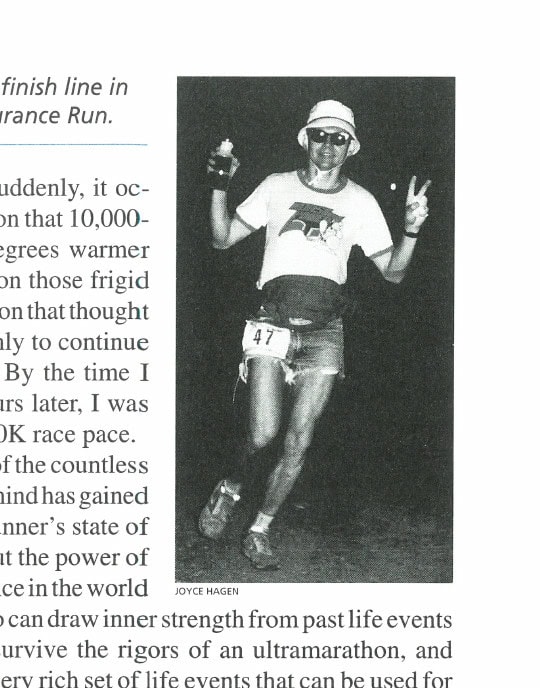
As I struggled up a ridge in the middle of the night, bracing myself against the wind and trying to stay warm in my meager running clothes, my mind began to drift back to my childhood. Suddenly, it occurred to me that as cold as it felt on that 10,000-foot ridge, it was still several degrees warmer than it had been in my bedroom on those frigid mornings in Minnesota. Focusing on that thought gave me the inner strength not only to continue but to pick up the pace as well. By the time I neared the finish line several hours later, I was devouring the miles at close to 10K race pace.
These are only two examples of the countless times during an ultra race that my mind has gained sustenance from past events. A runner’s state of mind is important at any event, but the power of the mind takes on special importance in the world of ultramarathoning. Runners who can draw inner strength from past life events will find that it will help them survive the rigors of an ultramarathon, and masters runners typically have a very rich set of life events that can be used for this purpose.
GOING BACK TO MY ROOTS
The great thing about this concept is that it works both ways. The self-confidence and perseverance that runners develop by successfully completing ultramarathons in turn can be used to deal with other challenges in their lives—at home, at work, or in recreation. I have found that since I started running ultras, my general perception of what is “possible” has changed drastically, and I have talked with many other ultrarunners who feel the same way.
Even the soybean field saga from my childhood has another chapter that demonstrates the converse of the “psychological-edge” concept. Clearly, my training in weeding soybeans has helped me during ultramarathons, but not too long ago I had the opportunity to transfer my ultrarunning experience back to the soybean field.
Walking the soybeans has become a lost art for most modern farm families. Now family members ride on seats attached to the front of a tractor that is also equipped with a tank containing an herbicide. The riders need only to spritz the weeds with a burst of spray from a hand-held metal wand. I have never cared for this innovation, because walking the soybeans was the last vestige of prolonged aerobic exercise that farmers received—everything else already having been mechanized.
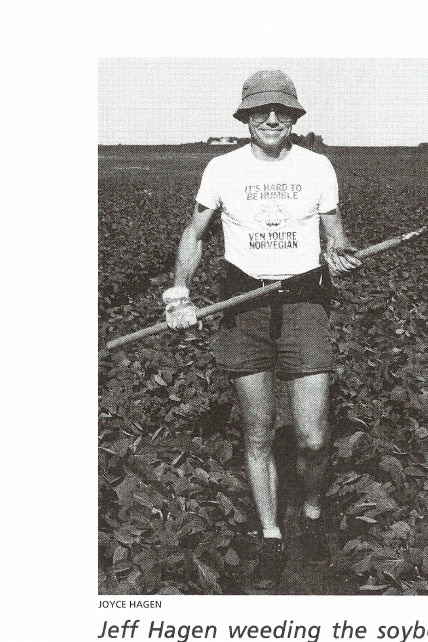
On a visit to Minnesota a few years ago, I asked the farmer who now rents our family farm for permission to walk a section of our soybean field the old-fashioned way. He said that if I was crazy enough to want to do it, it was okay with him. When I asked him how many acres a day a person could cover riding a new-style “bean buggy,” he said that on a good day they could do about 30 to 40 acres per person.
The next morning at 6:00 A.M. I borrowed a garden hoe and started to walk the soybeans. I was wearing light hiking boots, which soon became caked with several inches of mud due to recent rains. All morning hordes of mosquitoes swarmed around my head, waiting to drill me for blood if I stopped long enough to retie a shoelace.
Where the weeds were thick, the going was agonizingly slow. Stray cornstalks could be cut with the hoe, but cockleburs and other weeds had to be pulled one-by-one and laid against the soybean row with their roots in the air. Fortunately, in some areas the weeds were scarce, and I found that I could run those sections of the field at approximately 100-mile trail race pace. I used my standard ultramarathoning strategies for eating and drinking on the run, thanks to the crew support provided by my wife and daughters.
After more than 15 hours of nonstop walking, running, cutting, and pulling, I was forced to stop due to darkness. Identifying weeds with a flashlight is, after all, an inexact science. By day’s end I had thoroughly weeded a total of 50.6 acres of soybeans, which absolutely amazed our renter and the local newspaper editor who stopped by for photos and an interview.
In the process I had walked/run 46 linear miles, not counting the miles covered while stepping back and forth over the eight rows that I was weeding in each pass across the field. And, unlike the legendary John Henry, who did not survive his battle with the steel-driving machine, I felt just fine when the “ordeal” was over.
Even though this event created quite a stir in my old neighborhood, most veteran ultrarunners would have shared my view that it was just another day on the trail, with a slightly different twist. As I met the challenges of the soybean field, I remember being struck by their similarity to the demands of many ultrarunning events in which I had participated. It seems clear to me that as an experienced ultrarunner deals with adversity on and off the running course, the insight gained from each of these sources complements the other in a way that is almost symbiotic.
AN ALTERNATIVE THEORY
Let me offer an alternative theory from the lighter side. Not everyone would agree with the preceding theorems. Certainly there are other theories about why masters runners do so well in ultramarathons.
One hypothesis, which probably came from some fledgling runner who was humiliated by one or more old fogies during an ultramarathon, is the “Dead Brain Cell Theory.” The gist is that as people run more and more ultramarathons, the shortage of oxygen that they experience for hours on end kills a bunch of their brain cells. If they run at altitude or in extreme cold or heat, such as in 100-mile trail races, even more brain cells are lost. The “Catch-22” part of this theory is that the more brain cells these ultrarunners lose, the more they want to run ultras, because they no longer have enough sense not to run them.
This becomes a vicious cycle, progressing from more ultras to fewer brain cells to more ultras. By the time these poor souls become masters runners, all they want to do is run ultras, and they get pretty good at it. I guess this is similar to the “you don’t have to be crazy to run ultramarathons, but it sure helps” school of thought.
Who knows? Maybe the brain cell theory is valid.
MASTERS OF THE ULTRA
If you are a masters runner who is involved in ultramarathons or contemplating your first ultra, I hope these impressions will inspire you to get out there, have some fun, and show the younger ultrarunners how it should be done.
If you have not yet reached the masters age group, rest assured that it will creep up on you sooner than you think. Then you’ll have your chance to be one of the masters of the ultramarathon!
5:00 A.M., Monday, 15 April 1996, Boston Hilton—The affable man from Nagano, Japan, Eiichi Kaneshiro, and I stood in the lobby clutching containers of lukewarm coffee. We were awaiting the arrival of Wim Meijer and Peter Bruinink of the Netherlands, along with Mike Burns, their American colleague, and a couple of other assorted technical types. We had requested the opportunity to tag along and watch Meijer and the others set up the ChampionChip timing system for the “100th” running of the Boston Marathon.
Neither Eiichi nor I had ever seen The Chip in action, though we would soon be responsible for its use in the Olympic Games, I in the upcoming Summer Games in Atlanta and he for the 1998 Winter Games.
The Chip had been invented and developed in Europe by Meijer and Bruinink and was finally making its way to the States. Runners tie The Chip to their shoelace. The Chip is encoded with a runner’s race number, and as the runner strides over rubber mats at start, finish, and intermediate points in the race, electronic sensors wired beneath the mats relay the runner’s number to computers gathered on the sideline. Thus, a runner’s exact start time and finish time is captured electronically, giving him or her the true time it took to run the distance, irrespective of the time it took each to reach the starting line.
Boston Marathon organizers had arranged with Meijer and Bruinink to use the system to time the 38,000 runners in the wildly celebratory running of Boston’s “100th.”
The IAAF, the international federation governing track and field, supported our desire to use the chip system to track the 5K splits in the Olympic women’s and men’s marathons. Start and finish times would be recorded in the Olympic Stadium using equipment used for all the other running events. As director of the marathons, I needed to understand not only how The Chip system worked in practice, but also the vans, volunteers, tables, and other equipment essential for support.
This article originally appeared in Marathon & Beyond, Vol. 2, No. 2 (1998).
← Browse the full M&B ArchiveMore like this
1,000+ stories from 19 years of Marathon & Beyond
The complete archive of the legendary long-distance journal — digitized and free to read.
