

Masters’ Yearly Marathon Best-Time Trends
Upon becoming a master, it is no longer fair to compare yourself against runners many years your junior. Old Father Time ensures that we slow down, as our times for the marathon confirm. In this article, the best modern-day marathon times run each year for each masters age group have been averaged out and plotted on two graphs: men and women. The following study attempts to identify trends by attaching concrete numbers and graphical analysis to the best masters marathoners.
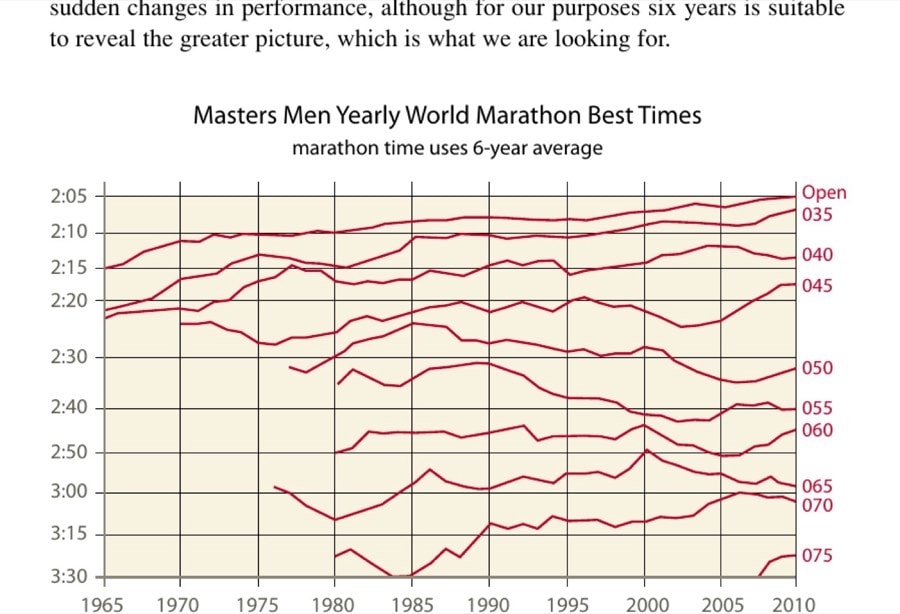
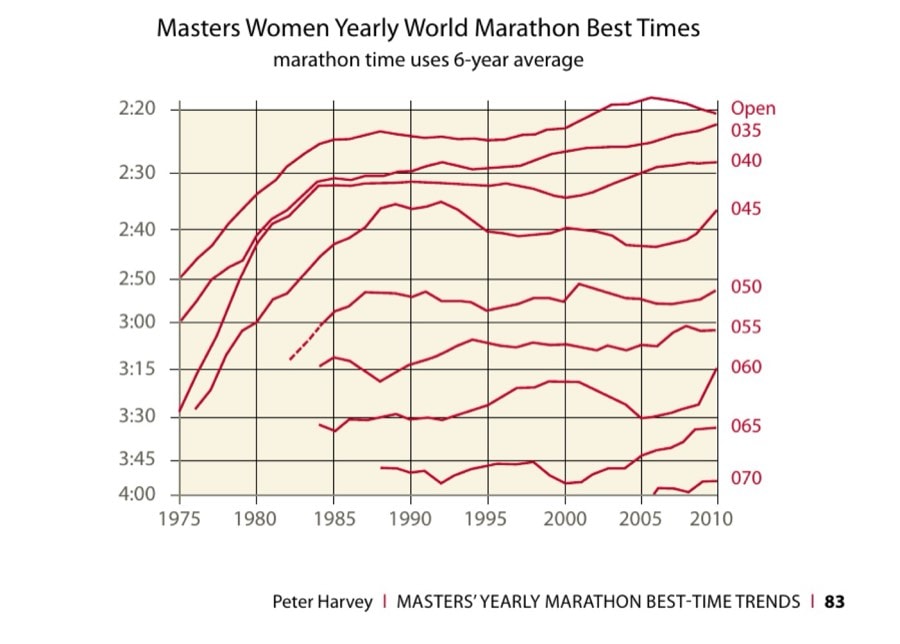
The graphs on the following page chart the averaged-out fastest times run each year for all but the very oldest masters categories. Each plot represents a six-year world-best average for an age category. For example, the six-year worldbest average time for the six years leading up to and including 2007 for the men’s over-40 age division is: 1 2 3 4 5 6
2007 2006 2005 2004 2003 2002 2:14:52 2:12:53 2:14:45 2:11:43 2:08:46 2:11:45 13:14:44 Antoni Mbarak Angelo Andres Andres Joshua Bernado Hussein Carosi Espinosa Espinosa Kipkemboi Andorra USA Italy Mexico Mexico Kenya
World-best six-year average for 2002–2007 = 13:14:44/6 = 2:12:27 Each plot is generated by averaging the best times for each year using the equation above. A six-year average is taken because that is suitable for a trend to be seen. If the world-best times for each age division were used, the resulting plot would be somewhat haphazard trying to account for anomalies. If too many years are used, the plot is overly smoothed and the trends unresponsive or even
lost. That is, it takes too long for the plot to respond to what is actually happening in reality. A six-year average incorporates a few years of lag, be it where there are sudden changes in performance, although for our purposes six years is suitable to reveal the greater picture, which is what we are looking for.
Masters Men Yearly World Marathon Best Times marathon time uses 6-year average Open 035
2:05 2:10
040
2:15
045
2:20 2:30
050
2:40
055 060
2:50
065 070
3:00 3:15 3:30 1965
075
1970
1975
1980
1985
1990
1995
2000
2005
2010
Masters Women Yearly World Marathon Best Times marathon time uses 6-year average 2:20
Open 035 040
2:30
045
2:40 2:50
050
3:00
055
3:15
060
3:30
065
3:45
070
4:00 1975
1980
1985
1990
1995
2000
2005
2010
The men’s graph dates from 1965. Lack of data ensures the older categories cannot be plotted until the late 1970s/early 1980s. Going back before 1965 for the men and 1975 for the women is hardly required to see modern-day trends. In fact, data is practically nonexistent for any women running before 1970, and very few women were running marathons back then. Lack of women’s data that ensures plots begin as late as the mid-1980s for the older categories.
The marathon world-best time differences for the very oldest age groups make most plots very unstable. To visually reduce any unstable plots, the vertical axis of the graph could be compressed, although this would cause a loss of resolution not desired where the plot is stable. Therefore, the graph ends at 3 hours, 30 minutes for men and 4 hours for women, giving more space to the main body of data. This choice means most of the over-75 men and over-70 women onward are not shown, although mention of their trends will be made. Each age category is actually treated as over a certain age rather than between a set of ages. For example, over 40 rather than 40-44.999 is used. This is because sometimes there is a faster time in the age group above the one below, so the time doubles up for its own category and the one below. It is preferable to recognize an older, faster athlete over a slower, younger one, and we will give examples of truly great masters, some of whom are faster than the best athlete even two age divisions below their own.
In previous editions of Marathon & Beyond, the men’s and women’s worldbest plots (and breakdowns by nationality plus more) were communicated. The graphs in this, the masters article, include the open-category world-best plots so that a comparison of the open category can be made to the masters. The over35 semimasters category is also included. Analysis of age-graded performances shows that over-35s run very close to or even faster than open-category younger runners, so technically masters truly begin upon age 40. In Europe, masters are more commonly referred to as veterans. Some bodies refer to veterans as over 50 and masters over 40, plus super vets or seniors over 60. We will predominantly use masters, although nearly all masters before the turn of the millennium were labeled “vets,” “masters” being a modern Americanism. When referring to past masters, out of respect we label them as what they were identified as: vets.
Graphical analysis In previous articles, both the men’s and women’s open-category marathon trend analysis showed a boom in the 1980s, a plateau in the 1990s, and another boom in the 2000s. This can be seen by the uppermost plot on each masters’ graph. The over-35 and over-40 men’s and women’s plots mirror this trend. Conversely, first impressions for the older age categories appear largely sporadic. An attempt will be made later to unscramble what is going on. Some athlete names (and
nationalities) as to who contributed to each plot the most will also be revealed after the graphical analysis. The over-40 category is the cusp for the full master. Winning a prize other than that of overall winner is a possibility. There is not always a prize for the first master over 45 to finish, and so there is reduced incentive. The lack of recognition for the first over 45, 55, 65, and 75 (submaster categories) as opposed to 40, 50, 60, and 70 (major masters categories) does not help documentation and would reduce addition of statistics and thus lower the “5s” plots on the graph. This theory does not appear in practice for the “5s” plots. Often the over-35 rather than over-40 women’s masters category is used; the next prize is usually for the over-45, -55, and -65. Each age category is biased to the youngest in its division. Hence those being 44, 49, 54, and so forth are not truly represented. It would be beneficial to interpolate between age categories so that, for example, the best 43-year-old would be two-fifths of the way above the over-45 plot toward the over-40 plot. Thus the interpolated current (complete year of 2010) 43-year-old averaged out best is about 2:16 for men and 2:34 for women, an 18-minute difference between the sexes.
Vets were recognized in the 1960s and 1970s as over 40 and not much else. Hence the over-45 category plots begin after the start of the graph, and the over50 category plots start many years later. Another reason for the absence of older plots further back on the graphs is the lack of vets competing prior to 1980s. In the last few decades, this has changed. Time has led to the improvement of the over-65 division for women and over-70 for men upward. This mirrors the older generation living a more energetic life, and because humans are living longer, the over-80 category may be recognized in races. The best times by those in their late 40s to early 60s have remained either constant or fallen since their inclusion on the graph. To surpass them today, altitude training or other natural enhancement may be required, as the youngest masters age-category athletes have demonstrated.
The chief database used to generate the writer’s database from which the plots were constructed is American: ARRS. ARRS has lots of data for American runners and does not capture all the best other masters, many coming from Europe. In the last few years, the IAAF’s database has grown, and worldwide statistics for the best masters in the younger categories have become available. This accounts for some of the plots from 2006 onward showing a marked improvement. So we can deduce that sections of the plots for the masters from over 45 and older are understated (over 40 is fast enough to be included in open “top lists” and thus complete). For our analysis, there would be a completely accurate picture of the state of the younger masters categories by 2011 because the relatively new available data via the IAAF (dated back to 2006) would cater for a six-year average. Data outside of America for the other masters categories is somewhat elusive, there being no comprehensive centralized source for all ages and nations.
Over-35 and over-40 Prior to 1980, the men’s open category showed a gradual increase throughout the mid- to late 1970s. Before that the marathon was clearly developing in the mid60s to early 70s. The over-35 men improved in the 1960s and ’70s until 1975. After a decline, this plot improved in the early 1980s and then mirrors the open world-best plot. From 1985 onward, the difference between the open and over-35 athletes holds steady around 2 minutes, 15 seconds. Prior to 1985, the gap was much wider, at least six minutes in the mid- and late 1960s. This is not surprising given the antiquated attitudes to age many decades ago. Once you hit 30, “That’s it, mate, it’s all downhill from here,” so don’t even bother to try to win. And if you were a woman, well, “You should not even be running.” Today (in the West) there is not the stigma of age (or sex), as the raft of age-category prizes confirms. In fact, the master is positively encouraged to give his heart a good workout.
The women were developing the marathon in the 1970s too, and all the women’s age categories plotted in the 1970s show a very rapid improvement. Lack of statistics for women, especially from non-USA marathons, would definitely account for some extra improvement on these plots but not enough to significantly improve the trend of growth stated. The women’s gap from their open category to the over-35 plot may look the same on the graph regardless of time, but it is not. The steepness of the curve (and the linear scale of miles per hour duly compressing the marathon time) causes deception, the gap in the late 1970s being typically nine minutes compared with around 5 1/2 more recently. So, like the men, the over-35 women have improved. It is likely there is also scope for the over-35 women to improve based on the men’s 2 minutes, 15 seconds difference. However, my own (and other) age-graded charts suggest that by the age of 35, women’s performance declines slightly more than men. There is very little difference between an over35-year-old and those in the open category. In fact, the men’s world record was run by a 35-year-old, and the fourth-fastest lady is aged 36.
Notice the women’s over-40 plot gets very close to the over-35 plot from 1980 to 1990. There was a particularly strong group of over-40 women in the late 1970s, all of the 1980s, and up through the mid-1990s. Is this just coincidence, or are mid- to late-30-year-old women not so drawn to compete? The 30s are often reserved for bringing up children, especially for women obliged to take the leading parental role. In the 1970s (and 1980s), women were traditionally cast as housewives and while the husband ran, she ensured he got his pie and his mash with apple crumble dessert was served up on time every night. Social trends obviously have an effect on the participants of the marathon, and the one just mentioned has become somewhat eroded. In the last decade, there has been a steady increase in female runners. This must have helped the open, over-35, and over-40s women’s categories to new highs. Across the board, there has been an increase in masters participation.
The women’s over-40 plot slumped in the late 1990s and bottomed out in 2000. Since then it has been improving. Over-40 women are typically 10 1/2 minutes slower than their open-category counterparts. In 2005 the over-40 men averaged just 6 1/2 minutes shy of the open-category best men. Accounting for the reduced speed of the women, the percentage difference between the open and over-40 category is 5.1 percent for men, and 7.6 percent for women. This suggests that over-40 women have scope for improvement or simply confirms the point about age-grading differences between the sexes. Maintaining power with age is probably easier for men than women. In practice it may simply be the lack of numbers and elite competition in the women’s masters compared with the men accounting for the less than absolute female masters performance that in theory could be achieved. The men’s over-40 plot peaked in 1977. That high was surprisingly not surpassed until the 2000s, but then, as we will note later, there was an outstanding male vet during the mid-1970s. There are also outstanding over-40 vets today, their averaged-out times altogether better than the open-category average throughout the 1970s. The same applies for the over-40 women.
Over-45 We noted the haphazard nature of the older (over-50 upward) age-category plots. The over-45 age category men and women have both elements of the open worldbest trend mixed with the older divisions’ unpredictability. The over-45 women peaked in the late 1980s and early 1990s. They show that a loss of 13 minutes (30 seconds per mile) for the marathon is to be expected compared with the times from open-category runners. The over-45 women’s trend has been generally downward for 16 years until a recent steep rise. The same downward trend was so for the men, who bottomed out in 2002, 18 minutes behind the leader from a high in 1996 of only 11 1/2 minutes off the leaders. Recently the men’s over-45 category has been dramatically improving, surpassing the 1996 high equating to men 10 years their junior in the late 1960s. Over-50 By age 50, the times hardly compare to the open-category winners, although a top over-50 male master could still win a state marathon today running about 2:35 and 2:55 for a top over-50 woman. The lack of data for non-American masters prior to 2006 implies the current over-50 plots could be understated. So the current height that each over-50 (and older) plot has attained is an indication of the best. The men’s over-50 plot shows a decline since 1985. The women’s has largely leveled off since 1987, but notice the size of the gap to the over-45 plot. It is overly large and suggests there is a big drop-off in performance in the late 40s. In reality, we cannot read too much into this statement as the older categories in the graph are subject to lack of data.
Over-55 By 55 we would expect a relaxation of brilliant marathon-running performances; after all, the bastion of excessive training does not necessarily serve the old. There is a lack of strength in depth to the older categories, and that is not just because there is less data available. The over-55 masters men show the greatest decline on the graph. It is as if the over-50 and -55 men mirror the decline in the “big three” (USA, UK&IRE, and AUS&NZL) that was noted in previous marathon-trend articles. Nearly all of the masters statistics for the over-50s and older are from the big three, including Europe. Most of these vets, had they been active as opencategory runners, would have been a part of the original marathon running boom of the late 1970s and early 1980s. The big three are in the marathon doldrums, and that is the case for the midlife western vets. However, recently the over-55 men’s and women’s plots have improved, the latter experiencing a high. Over-60 and beyond The over-60s men’s plot shows a gradual decline but is now finally improving. This is unlike the over-65 men, whose plot has yet to show signs of a recovery. The over-60 and -65 women are improving, although as previously mentioned they are probably simply catching up to the correct level above what has been plotted owing to lack of statistics. This is unlikely for the over-70 men, whose plot is almost certainly reflective of the best possible average for that age. The over-70 men have climbed to hover about a three-hour average, just four minutes behind the over 65s (more likely eight to 10 minutes behind, in reality, due to lack of statistics). The over-75 men are also improving. This supports the notion that humans are able to do more in their latter years compared with a few decades ago. The expected norm is to live longer than 80 years, making about half the population in the West masters. Times posted for over-80 men are improving. The current six-year average for the over-80 men is about 4 1/2 hours, just behind the rapidly improving women’s over-75 age group. Age-category highs The sidebar on page 89 shows the best six-year average for each age category. Here there is a ready comparison between men and women. For example, the over-45 men are comparable to the fastest women. This study will stop short of showing a full comparison, which is a separate study in itself more akin to age grading. Instead, consider the best women of today almost equal to the best male marathon runners in the mid-1960s. Picture Paula Radcliffe transported back in time to 1964 in Tokyo striding into the Olympic Stadium in the mix for medals, dueling it out with Basil Heatley (second in 2:16:19) of England, who famously overtook Kokichi Tsuburaya (third in 2:16:23) of Japan. Or how about visualizing
Best-year masters: six-year average Men open
2:05:59 – 2010
Men over 35
2:06:45 – 2010
Men over 40
2:11:34 – 2004
Men over 45
2:17:33 – 2010
Women open
2:18:05 – 2006
Men over 50
2:23:42 – 1985
Women over 35
2:22:02 – 2010
Women over 40
2:28:10 – 2010
Men over 55
2:30:48 – 1989
Women over 45
2:34:50 – 1992
Men over 60
2:43:31 – 2000
Men over 65
2:49:04 – 2000
Women over 50
2:50:40 – 2001
Men over 70
2:59:58 – 2006
Women over 55
3:01:27 – 2008
Women over 60
3:14:35 – 2010
Men over 75
3:22:29 – 2009
Women over 65
3:33:33 – 2010
Women over 70
3:54:30 – 2010
Men over 80
4:23:54 – 1996
Women over 75
4:19:31 – 2010
Women over 80
4:58:17 – 2007
The men’s over-60 best-average in comparison to the others is a little slow. The women’s over-50 best average could also be readily beaten by posting consistently good times year in, year out. Notice there are many age-category bests in 2010. This shows that certain parts of the masters marathon are positively progressing. In particular, the younger masters categories and older ladies ones are booming.
Ed Whitlock, recent over-75 supervets champion, cross-dressed and materialized back to New York in 1974 to win the women’s marathon? It ain’t gonna happen, but the comparisons stand.
Legendary veterans In this section, the masters athletes who contributed the most to the world-best times for their age groups are highlighted. They also feature in the table starting on page 94. Some of the names here may be relatively unknown. In that respect, they are unsung heroes who reached the pinnacle of marathon achievement accounting for their age. If you were expecting many open category elite marathoners to carry on being the best as a master, think again. Only very few open-category world-best performers still cut the mustard as a top master. There are exceptions, but most only peter out. For example, 1970 world record holder Ron Hill from England (that country was a base for many top veterans in the 1960s, 1970s and 1980s) remained the fastest over-35 in 1973 and 1975 and the top over-40 in 1978 and 1979, but even Ron did not or could not keep going at the very top into his over 45s. The body struggles to manage decades of hard training, the possibility of injury ever increasing or the psyche simply running down a la vets’ burnout.
Ordinarily a top open-category marathon runner’s career lasts about a dozen years. This applies to masters, too, as the statistics suggest. Very few athletes with exceptional marathon longevity remain the top master for their age category for at best a couple of decades. There would surely have to be years (ideally at the older end of each age group) where such masters reduce training and race sparingly. Alternatively, a top marathoner can have a decade or more of relative rest and return as the very best. This is exceptionally rare, although once mid-1980s open-category world record holder Joan Benoit Samuelson shows it is possible, as she has been the fastest woman over 50 in recent years.
Men Consider what happened to the large body of runners who made up the elite running base of the 1980s boom. It is reasonable to suggest they would keep running and fuel the over-40 and -45 masters ranks of the 1990s and then the over-50 and -55 age groups for the 2000s. Such folk tend not to appear in the top masters lists, and as we noted, the big three’s influence has declined. Kjell-Erik Stahl of Sweden is an exception, but then he did not peak until his late 30s during the 1980s boom. He set yearly world bests in the over-35, -40, -45 and -50 categories with age world records over 45. He was the fastest in the world each year for his age category on 10 occasions.
Probably the most prolific athlete of the elite masters corps is another Swede, Erik Ostbye. Erik was a good over-35 man, a top over-40 man in the mid-1960s, and then held world age-best records over 45, 50, 55 and 60 spanning three decades (’60s, ’70s and ’80s). Erik was the fastest man in his age group in the world 15 times. In 1976 his over-55 world record for age of 2:26:35 was faster than all the over-50 and over-45-year-olds for that year.
Jack Foster of New Zealand achieved the world best in his age category on 10 occasions. He did this throughout the 1970s and early 1980s. Jack showed that over-40-year-olds can even set world age-best records for the category below, his 2:11:18 in 1974 as an over-40 vet being the over-35 world record, too. Jack’s over-35 world record for age was beaten by Carlos Lopes of Portugal, who was the fastest in the open category, too. Jack’s rounded-up time (circa 2:13:50) for the over-45 world record run in 1977 is still the fastest time today, just beating Kenyan Jackson Kipnogok’s 2:14:16. Incidentally, the fastest over-40 man is Andres Espinosa from Mexico, who ran 2:08:46 in 2003. There are many over35-year-old Africans competing with the very best, so the over-40 record is likely to be beaten.
Altitude-trained male Africans are populating and pushing up the younger masters categories. In particular, the Kenyans are increasingly having an input. This trend will undoubtedly continue, paralleling the open-category trend that highlighted the rise of Africa. Haile Gebrselassie of Ethiopia is the current open world record holder (for a looped course), running 2:03:58 as a semimaster aged 35 in 2008, mirroring Carlos Lopes, whose open/over-35 record took 23 years to beat (by Haile). Carlos could not remain the best as an official vet over 40, and Haile would do well to be the best over-40-year-old, his reign probably in an Indian summer. Africa has the over-50 record by Titus Mamabolo from South Africa, who ran 2:19:29 in 1991. Piet van Alphen of the Netherlands is worth a mention as a top vet in his 50s during the 1980s European marathon boom years. He holds the oldest record (aside from the rarely contested men’s over-85) on the books, being the current over-55 champion set in 1986, 2:25:56.
America has had many old but gold boys. In the 1960s and 1970s, Monte Montgomery showed that men could run good marathon times over 60, 65, and 70 years old. Clive Davies in the 1970s/80s was the world best for his age group eight years on the trot in the over-60, -65 and -70 categories (all with world age-best records), and add another three as the world best over 60. In 2004 Ed Whitlock of Canada ran five minutes under three hours in the over-70 category and five minutes over three hours in the over 75s three years later. Ed has improved the times on the age world record lists to the extent that it appears that superseniors can go considerably faster in this day and age than before. Ed Benham, another example, is the over-80s record holder. Such revolutionary pensioner power in the West coincides with extended health helping the most-grizzled, wrinkly vets train long and hard.
Women Earlier we noted there were a series of masters women in the 1970s, 1980s, and first half of the 1990s. This began with Michiko Gorman in the mid-1970s setting an open-category world record despite being in the over-35s. Michiko continued to
be the best over-35 and over-40 marathon runner until Joyce Smith from England made her mark from 1979 onward. Joyce was often faster than the category below her age division. In fact, Joyce’s personal best of 2:29:43 was set in the over-45s, helping her to be the best in her age category eight years in a row. In the early 1970s, Ruth Anderson of the USA was probably the prime pioneer for women’s veterans, her age-category world records half an hour slower than Joyce’s.
In the 1980s, Britain’s Priscilla Welch significantly improved the over-40 master’s record, which stood for 21 years. More recently, there are many good European eastern-bloc female runners, especially Russians, who are chiefly responsible for the rising trend of the over-35 and -40 plots. Of these, Constantina Dita (Tomescu) of Romania is a leader. Also in Europe, Paula Radcliffe from England is also contributing.
Like the men, the top women who peak in their 20s and early 30s tend not to be top guns when they become masters. To be a masters champion at 40, the body had best be active in the 20s and specifically trained in earnest during the 30s. Examples of this are Carla Beurskens from the Netherlands and Lorraine Moller from New Zealand, who were close to the best in the world as open-category runners and the actual best when over 40 as masters during the 1990s. Notice the bulge upward around 1990 for the over-45 women. Evy Palm from Sweden caused this, and her 2:31:05 run in 1987 for the fastest over-45 lady was the oldest record on the women’s books until surpassed by America’s (ex-South African) Colleen de Reuck’s 2:30:51 in 2010. A sole individual can influence plots, especially in the older age categories. There are not so many runners in the older categories, so second place can be miles behind first. The official world record for the over-45 and -50 women has not been included in the lists. I excluded from the database (used to generate the graph and lists) the marathon performances of any drug users that could be identified. Also omitted are a few of the official age-category yearly world-best records where the incorrect age for an athlete has been recorded.
In the over-50 age category, Bev Lucas from Australia is queen, her 2:44:12 set in 1997 still the best. At the turn of the millennia, Barbara Miller from the USA peaked as the over-60s champion, her age-group best surpassed in 2007. American ladies typically dominate the older age categories although some Europeans may have run faster, the lack of statistics the reason for any noninclusion.
Today’s most masterful and the future The statistics show that the future of the men’s and women’s over-35, -40, and -45-year-old groups, as previously noted, are looking good. The open-category men’s trend is also likely to keep improving. Top East African male masters are beginning to appear in number. Jaouad Gharib of Morocco and Haile Gebrselassie of Ethiopia have between them the top six times by over-35-year-olds, all run in
the last two years. Japhet Kosgei and John Mutai of Kenya are particularly prolific in the over-40s division. Ruben Chesang of Kenya ran the third-fastest (includes Jack Foster’s unofficial rounded mark) over-45 time in 2009, clocking 2:15:29. Possible lack of African longevity, or the fact that Africa has not had enough years for its recent yesteryear champions to be the fastest vets beyond age 50, could explain why they do not feature further. Bob Schwelm is America’s fastest over-50 man, and Gavin Stevens from New Zealand is another current name that consistently appears among the top over 50s, with many Europeans populating the over 55s. One man that stands out is Yoshihisa Hosaka from Japan who broke the over-60s record in 2009 by running 2:36:30. He ran 2:38:12 in 2010, also claiming the second-fastest over-60 of all time. In 2010 Germans were the fastest in the over-70 and -75 categories.
Currently, there are many Eastern European female masters who make the over35, over-40, and over-45 standards high. Irina Mikitenko representing Germany ran an over-35s record of 2:19:18 in 2008 and continued in 2009 with 2:22:11, both times being the fastest by any woman for those years. Mariya Konovalova from Russia was the fastest over-35 in 2010. Mara Yamauchi is another very fast over-35, and never discount Paula Radcliffe, also from Britain. In the over-40 category, Lyudmila Petrova of Russia ran 2:25:43 in 2008, bettering the previous best set back in 1987. Petrova did 2:27:42 in 2009 and is still the fastest, clocking 2:29:41 in 2010. Other Russians should keep the over-40s strong this year. We noted Colleen de Reuck as the fastest lady ever over-45 and Joan Benoit Samuelson as the current over-50s leader. These women have much competition, including Linda Somers from the USA and Sarah Gee from Great Britain in the over-45s. Great Britain and Ireland have many top lady vets, including Joanna Thompson and Lucy Brennan in the over-50s and Angela Copson in the over-60s. Bernadine Portenski from Australia ran an over-60s record of 3:01:30 in 2010. In 2009, Emmi Luthi from Switzerland ran a record age best of 3:12:56 (more than a mile ahead of the previous best) aged 65. Also in 2009 and an age-category best is American Gwen McFarlan’s 3:57:30 in the over-75s. Gwen was also the fastest in 2010, as was Betty Jean McHugh of Canada in the over-80s, Helen Klein from the USA her predecessor.
Beyond 50 years old, there do not appear to be large groups of top masters training together. This is unlike the young masters Kenyan men and Russian women. One-off wonders crop up from time to time, making trends unpredictable. The older age groups are being more populated as humans live longer, enjoying relatively better health for age than in the past. The last decade saw a surge in women running the marathon. There has also been a drive toward masters taking up long-distance running. In fact, masters make up the majority of the numbers in some races. Expect the elderly to populate the marathon more in the years to come. Retirement facilitates a life of leisure, giving plenty of time to get the
most out of one’s later years. That could mean vast numbers of 60-plus-year-olds marathoning. The question is not if but when—if not already in motion.
Modern-day open and masters world-record progressions The list of records that follows is not official but simply extracted from my own database, an amalgamation of other databases. The data is complete up to the
start of 2011. In the 1960s and 1970s, most marathon courses were probably inaccurate, and even some big marathons in the 1980s, such as New York and Boston were too long or too short, the times run having to be adjusted. Therefore,
the lists may not be exact. Most of note is that some world record holders for the open-category marathon were not recognized until the 1969 Antwerp Marathon course was shown to be 500 meters short over a decade later and that Alberto
Salazar’s false world record in 1981 was on a short course. a approximate distance u corrected up as distance was a few hundred meters short (uu) corrected up as distance was a kilometer or two short
For runners with dual nationalities, the country that the runner did not compete for but is very strongly associated with appears in a parenthesis. I have excluded (be that in the records or article) any athletes or countries having a history of taking performance-enhancing drugs.
Open men (world records) 2:03:02a Geoffrey Mutai KEN
18 Apr 2011
Boston (point to
2:03:58 2:04:26 2:04:55 2:05:37 2:05:42 2:06:05 2:06:50 2:07:12 2:08:05 2:08:18 2:09:01 2:09:05 2:09:12 2:09:28 2:09:36
28 Sep 2008 30 Sep 2007 28 Sep 2003 14 Apr 2002 24 Oct 1999 20 Sep 1998 17 Apr 1988 20 Apr 1985 21 Oct 1984 6 Dec 1981 26 Apr 1980 5 Feb 1978 31 Jan 1974 23 Jul 1970 3 Dec 1967
Berlin over 35 Berlin Berlin London Chicago Berlin Rotterdam Rotterdam Chicago Fukuoka Amsterdam Beppu Christchurch Edinburgh Fukuoka
Haile Gebrselassie ETH Haile Gebrselassie ETH Paul Tergat KEN Khalid Khannouchi USA(MAR) Khalid Khannouchi USA(MAR) Ronaldo da Costa BRA Belayneh Dinsamo ETH Carlos Lopes POR Stephen Jones WAL Rob de Castella AUS Gerard Nijboer NED Shigeru So JAP Ian Thompson ENG Ronald J. Hill ENG Derek Clayton AUS
point wind assisted)
2:12:00 2:12:11
Morio Shigematsu JAP Abebe Bikila ETH
12 Jun 1965 21 Oct 1964
Chiswick Tokyo
2:13:55 2:14:28 2:15:15 2:15:16
Basil Heatley ENG Buddy Edelen USA Toru Terasawa JPN Abebe Bikila ETH
13 Jun 1964 15 Jun 1963 17 Feb 1963 10 Sep 1960
Chiswick Chiswick Beppu Rome
28 Sep 2008 20 Apr 1985 9 Apr 1983 31 Jan 1974 6 Dec 1970 23 Jul 1970 6 Apr 1969 28 Apr 1965
Berlin world record Rotterdam Rotterdam Christchurch over 40 Fukuoka Edinburgh Athens Beijing
28 Sep 2003 8 Apr 2001 16 Apr 1990 31 Jan 1974 4 Feb 1973 10 Sep 1972 7 Aug 1967 13 Jun 1964 10 Sep 1960
Berlin Paris Boston Christchurch Kyoto Munich Olympics Melbourne Kortemark) Rome Olympics
5 Mar 2006 29 Sep 1991 1 Jun 1991 30 Sep 1984 13 Nov 1977 26 Nov 1967 26 Jun 1966 19 Sep 1965 10 Jun 1961
Torreón Berlin Stockholm Glasgow Auckland) Haninge Fontainebleau Vienna Chiswick
Over-35 men 2:03:58 2:07:12 2:08:39 2:11:18 2:12:17 2:14:44 2:15:17 2:16:57
Haile Gebrselassie ETH Carlos Lopes POR Carlos Lopes POR Jack Foster NZL Jack Foster NZL Jack Foster NZL Mamo Wolde ETH Yu-cheng Chang CHN
Over-40 men 2:08:46 Andres Espinosa MEX 2:10:33 Mohamed Ezzher FRA 2:11:04a John Campbell NZL 2:11:18 Jack Foster NZL 2:14:53 Jack Foster NZL 2:15:08 Mamo Wolde ETH 2:19:56 George Perdon AUS (2:19:36uu Adolf Gruber AUT 2:21:40 Franjo Skinjar CRO
Over-45 men 2:14:16 Jackson Kipngok KEN 2:15:51 Kjell-Erik Stahl SWE 2:16:58 Kjell-Erik Stahl SWE 2:19:01 Donald Macgregor SCO (2:13:50uu Jack Foster NZL 2:20:12 Erik Ostbye SWE 2:25:40 Alain Mimoun FRA 2:26:30 Adolf Gruber AUT 2:27:24 Len Jones GBR
Over-50 men 2:19:29 2:20:28 2:24:18 2:25:19
Titus Mamabolo RSA Jack Foster NZL Piet van Alphen NED Erik Ostbye SWE
20 Jul 1991 30 May 1982 13 Sep 1981 N/A Sep 1972
Durban Auckland Eugene Cologne
19 Apr 1986 19 Sep 1976 14 Mar 1976 16 Jun 1963
Rotterdam Goteborg Vällingby Holyoke
1 Feb 2009 28 Jul 1991 19 Jul 1987 21 Nov 1981 9 May 1981 28 Oct 1979 12 Oct 1975 7 Dec 1969 28 Sep 1969
Oita Turku Adelaide Albany Landskrona Portland Medford Culver City Santa Barbara
12 Apr 1992 13 Sep 1981 20 Apr 1981 5 Dec 1971 3 Oct 1971
London Eugene Boston Culver City Santa Barbara
26 Sep 2004 28 Sep 2003 13 May 2001 6 Oct 1996 28 Oct 1990 3 May 1987 6 Oct 1985 16 Oct 1977 15 Aug 1976
Toronto Toronto London St. Paul Chicago Pittsburgh Minneapolis Santa Barbara Coventry
Over-55 men 2:25:56 2:26:35 2:29:32 2:41:12
Piet van Alphen NED Erik Ostbye SWE Erik Ostbye SWE Johnny A. Kelley USA
Over-60 men 2:36:30 2:38:15 2:38:47 2:41:07 2:41:36 2:42:44 2:47:46 2:54:56 2:55:21
Yoshihisa Hosaka JAP Luciano Acquarone ITA Derek Turnbull NZL John Gilmour AUS Erik Ostbye SWE Clive Davies USA Clive Davies USA Monty Montgomery USA Monty Montgomery USA
Over-65 men 2:41:57 2:42:49 2:43:57a 2:53:03 3:07:22
Derek Turnbull NZL Clive Davies USA Clive Davies USA Monty Montgomery USA Monty Montgomery USA
Over-70 men 2:54:48 2:59:09 3:00:23 3:00:58 3:01:14 3:03:05 3:04:16 3:07:26 3:08:45
Ed Whitlock CAN Ed Whitlock CAN Ed Whitlock CAN John Keston USA Warren Utes USA Clive Davies USA Clive Davies USA Monty Montgomery USA Einar Nordin SWE
Over-75 men 3:04:53 3:08:34 3:10:57a 3:18:10 3:23:12a 3:33:27 3:34:09 3:34:42 3:47:20
Ed Whitlock CAN Ed Whitlock CAN Luciano Acquarone ITA Warren Utes USA Gordon Porteous GBR Ed Benham USA Eduardo Astoreka ESP Ed Benham USA Lou Gregory USA
15 Apr 2007 24 Sep 2006 16 Oct 2005 15 Oct 1995 11 Jul 1989 2 Dec 1984 19 Feb 1984 6 Nov 1983 13 Aug 1977
Rotterdam Toronto Carpi Chicago Brugge San Diego Valencia Washington Göteborg
11 Oct 1987 30 May 1987 4 May 1980
St. Paul Stockholm Weott
6 Oct 1984 3 May 1981 1 Jun 1980 4 May 1980
Rodenbach Weott San Mateo Weott
13 Apr 2003 13 Oct 2002 07 Oct 2001 30 Sep 2001 26 Sep 1999 19 Apr 1998 21 Apr 1985 18 Apr 1983 17 Apr 1983 25 Oct 1981 26 Oct 1980 21Oct 1979 22 Oct 1978 10 Sep 1977 1 May 1977 12 Oct 1975 3 May 1975
London Chicago Chicago Berlin Berlin Rotterdam London Boston London New York New York New York New York Berlin Oyarzun Eugene Dulmen
Over-80 men 3:43:27 4:43:02 4:50:00
Ed Benham USA Erik Bergman SWE Paul Spangler USA
Over-85 men 4:47:50 5:40:10 5:55:11 5:57:01
Joseph Galia GER Ivor Welch USA Ivor Welch USA Ivor Welch USA
Open women (world records) 2:15:24 2:17:17 2:18:47 2:19:46 2:20:43 2:20:47 2:21:06 2:22:43a 2:25:28 2:26:00a 2:26:13a 2:28:04a 2:33:06a 2:34:47 2:35:15 2:38:19 2:40:16
Paula Radcliffe ENG Paula Radcliffe ENG Catherine Ndereba KEN Naoko Takahashi JPN Tegla Loroupe KEN Tegla Loroupe KEN Ingrid Kristiansen NOR Joan Benoit USA Grete Waitz NOR Allison Roe NZL Grete Waitz NOR Grete Waitz NOR Grete Waitz NOR Christa Vahlensieck GER Chantal Langlacé FRA Jacqueline Hansen USA Christa Vahlensieck GER
2:42:24a 2:43:54 2:46:24 2:46:37 2:49:40 2:55:22 (2:46:30 3:01:42 3:02:53 3:07:26 3:14:23 (3:19:33 3:27:45
Liane Winter GER Jacqueline Hansen USA Chantal Langlace FRA Michiko Gorman USA(JAP) Cheryl Flanagan USA Elizabeth Bonner USA Adrienne Beames AUS Elizabeth Bonner USA Caroline Walker USA Anni Pede-Erdkamp GER Maureen Wilson CAN Mildred Sampson NZL Dale Greig SCO
21 Apr 1975 Boston 1 Dec 1974 Culver City 27 Oct 1974 Neuf Brisach 2 Dec 1973 Culver City 5 Dec 1971 Culver City 9 Sep 1971 New York 31 Aug 1971 Werribee–time trial) 9 May 1971 Philadelphia 28 Feb 1970 Seaside 16 Sep 1967 Waldniel 6 May 1967 Toronto 21 Jul 1964 Auckland–time trial) 23 May 1964 Ryde
Over-35 women 2:19:18 Irina Mikitenko GER 28 Sep 2008 Berlin 2:21:29 Lyudmila Petrova RUS 23 Apr 2006 London 2:21:30 Constantina Tomescu ROM 9 Oct 2005 Chicago 2:22:50 Constantina Tomescu ROM 17 Apr 2005 London 2:24:35 Katrin Dörre GER 25 Apr 1999 Hamburg 2:25:09 Manuela Machado POR 18 Apr 1999 London 2:25:21 Katrin Dörre GER 19 Apr 1998 Hamburg 2:25:57 Katrin Dörre GER 26 Jan 1997 Osaka 2:26:34 Carla Beurskens NED 15 Nov 1987 Tokyo 2:26:51 Priscilla Welch ENG 10 May 1987 London over 40 2:28:27 Carla Beurskens NED 1 Mar 1987 Nagoya 2:29:43 Joyce Smith ENG 9 May 1982 London over 40 2:29:57 Joyce Smith ENG 29 Mar 1981 London over 40 2:30:27 Joyce Smith ENG 16 Nov 1980 London over 40 2:33:32 Joyce Smith ENG 22 Jun 1980 Sandbach over 40 2:36:27 Joyce Smith ENG 22 Sep 1979 Waldniel over 40 2:39:46u Michiko Gorman USA(JAP) 24 Oct 1976 New York
2:46:37 Michiko Gorman USA(JAP) 2 Dec 1973 Culver City world
record 3:02:35u Sara Berman USA 30 May 1971 Brockton 3:13:58 Mildred Sampson NZL 9 May 1970 Auckland
Over-40 women 2:25:43 2:26:51
Lyudmila Petrova RUS Priscilla Welch ENG
2 Nov 2008 New York 10 May 1987 London
2:29:43 Joyce Smith ENG 2:29:57 Joyce Smith ENG 2:30:27 Joyce Smith ENG 2:33:32 Joyce Smith ENG 2:36:27 Joyce Smith ENG 2:39:46u Michiko Gorman USA(JAP) 2:47:45 Michiko Gorman USA(JAP) 3:12:25 Luanne Kralick USA 3:13:14 Ulla Seger SWE 3:20:18 Ruth Anderson USA 3:20:59 Ruth Anderson USA 3:26:07a Ruth Anderson USA
9 May 1982 London 29 Mar 1981 London 16 Nov 1980 London 22 Jun 1980 Sandbach 22 Sep 1979 Waldniel 24 Oct 1976 New York 7 Dec 1975 Culver City 1 Dec 1974 Culver City 22 Sep 1974 Göteborg 5 May 1974 Weott 10 Feb 1974 San Mateo 21 Dec 1973 Scottsdale
Over-45 women 2:30:51 Colleen de Reuck USA 2:31:05 Evy Palm SWE 2:31:35 Evy Palm SWE 2:32:48a Joyce Smith ENG 2:34:27 Joyce Smith ENG 2:34:39a Joyce Smith ENG 2:38:04 Joyce Smith ENG 2:40:01 Joyce Smith ENG 2:46:13 Maria Pia d’Orlando ITA 2:48:46 Maria Pia d’Orlando ITA 2:49:22 Maria Pia d’Orlando ITA 2:55:38u Maria Pia d’Orlando ITA 2:56:12 Ursula Blaschke GER 2:58:14 Nicki Hobson USA 3:05:49 Ruth Anderson USA 3:10:10 Ruth Anderson USA 3:15:47 Ruth Anderson USA 3:17:34 Ruth Anderson USA 3:17:44 Ruth Anderson USA 3:22:45 Ruth Anderson USA 3:24:54 Eva-Marie Westphal GER 3:36:19 Eve-Maria Westphal GER 3:52:30 Eva-Maria Westphal GER
23 May 2010 23 Apr 1989 17 Apr 1988 5 Aug 1984 7 Aug 1983 5 Jun 1983 24 Apr 1983 30 Jan 1983 9 May 1982 13 Sep 1981 12 Oct 1980 21 Oct 1979 10 Sep 1977 5 Dec 1976 2 May 1976 13 Dec 1975 12 Oct 1975 11 Aug 1975 7 Dec 1974 7 Jul 1974 5 May 1974 10 Oct 1971 11 Oct 1970
Copenhagen London London Los Angeles Olympics Helsinki Los Angeles Rome Osaka Verona Agen Rieti New York Berlin Culver City Weott Livermore Medford Toronto Livermore Portland Wolfsburg over 55 Bräunlingen over 50 Bräunlingen over 50
Over-50 women 2:44:12 2:47:26 2:50:26 2:51:01a 2:52:27 2:59:55 3:02:01 3:18:48 3:24:54 3:36:19 3:52:30
Bev Lucas AUS Bev Lucas AUS Shirley Matson USA Marion Irvine USA Valborg Ostberg NOR Marion Irvine USA Marion Irvine USA Margaret Miller USA Eva-Marie Westphal GER Eve-Maria Westphal GER Eva-Maria Westphal GER
13 Jul 1997 24 Nov 1996 6 Oct 1991 4 Dec 1983 3 Jul 1982 6 Jun 1982 4 May 1980 15 Jan 1977 5 May 1974 10 Oct 1971 11 Oct 1970
Brisbane Taipei St. Paul Sacramento Oslo San Francisco Weott San Diego Wolfsburg over 55 Bräunlingen Bräunlingen
11 Oct 1998 19 Nov 1989 11 Jul 1982 28 Sep 1980 5 May 1974 28 Oct 1973
Chicago Tokyo San Francisco Chicago Wolfsburg Waldniel
4 Jul 2010 25 Nov 2007 27 Oct 2007 17 Apr 2000 11 Dec 1999 28 Sep 1997 21 Oct 1984 7 May 1978
Gold Coast La Rochelle Luzern Boston Huntsville Berlin Chicago Weott
26 Apr 2009 4 Dec 1994 29 Sep 1985 18 Apr 1983 20 Feb 1983
Zurich Sacramento Berlin Boston Phoenix
26 Mar 2006 6 Nov 2005
New York New York
Over-55 women 2:52:14 2:57:55 3:07:21 3:08:48 3:24:54 3:47:34
Rae Baymiller USA Miyo Ishigami JPN Margaret Miller USA Helen Dick USA Eva-Marie Westphal GER Eva-Maria Westphal GER
Over-60 women 3:01:30 3:02:50 3:07:48 3:11:57a 3:14:50 3:14:56 3:15:30 3:26:16
Bernadine Portenski Claudine Marchadier FR Emmi Luthi SUI Barbara Miller USA Barbara Miller USA Christa Wulf GER Helen Dick USA Marcie Trent USA
Over-65 women 3:12:56 3:21:18a 3:28:10 3:47:24a 3:58:37
Emmi Luthi SUI Margaret Miller USA Lieselotte Schultz GER Marcie Trent USA Edna Laflin USA
Over-70 women 3:46:03 Ginette Bedard USA 3:46:34a Ginette Bedard USA
3:48:14 4:09:04 4:11:54a 4:34:08a 4:37:37 4:41:53 4:42:49 4:45:02
Pat Trickett ENG Gerry Davidson USA Marcie Trent USA Mavis Lindgren USA Mavis Lindgren USA Mavis Lindgren USA Mavis Lindgren USA Mavis Lindgren USA
3 Oct 1993 8 Dec 1991 13 Mar 1988 8 Mar 1981 9 Sep 1979 8 Jul 1979 7 May 1978 11 Dec 1977
Stone San Diego Napa Napa Eugene San Francisco Weott Honolulu
3 May 2009 2 Nov 2008 12 Oct 2003 27 Apr 1997 26 Apr 1981
Vancouver New York Victoria Gosport Highland Park
8 Dec 2002 20 Oct 1985 16 Jan 1982
Sacramento Chicago Miami
2 Nov 1986
Washington
Over-75 women 3:57:30 4:08:31 4:08:54 4:21:40 4:41:45a
Gwen McFarlan CAN Ginette Bedard USA Betty Jean McHugh CAN Jose Edith Waller GBR Ida Mintz USA
Over-80 women 4:31:32a Helen Klein USA 5:10:04 Ida Mintz USA 5:28:33 Ruth Rothfarb USA
Over-85 women 5:40:52
Ruth Rothfarb USA
Note: Previous articles highlighted open-category marathon trends by country and race using a six-year average. In 2010 a new (Caucasian) American men’s high was set at 2:09:32 (six-year average) mainly thanks to Ryan Hall. East Africans (assume the open category) raised the bar to 2:04:59. Russia and the Ukraine are experiencing new highs of 2:10:09 and 2:08:47, respectively. Nearly all other nonAfrican nations remain in decline, Italy and Iberia plunging down. Africans have ensured that the average times for the top 10, 25, 50, and so on up to the top 400 (limit of data available) are still rising. The same applies for the women, although there are not as many Africans by proportion. The women’s open category is on a downward trend. In 2010 there were new six-year highs for Germany (2:24:41), Ukraine (2:28:49), France (2:28:52), and various African nations.
The men’s article appeared in the March/April 2009 edition of Marathon & Beyond (Volume 13, Issue 2). The women’s article appeared in the January/ February 2010 edition (Volume 14, Issue 1), with a very brief update/correction on both articles in a later edition.
This article originally appeared in Marathon & Beyond, Vol. 15, No. 4 (2011).
← Browse the full M&B ArchiveMore like this
1,000+ stories from 19 years of Marathon & Beyond
The complete archive of the legendary long-distance journal — digitized and free to read.
