

Meeting Horst Preisler
What do you say to the guy who has run more marathons than anyone else in the world? by Malcolm Anderson
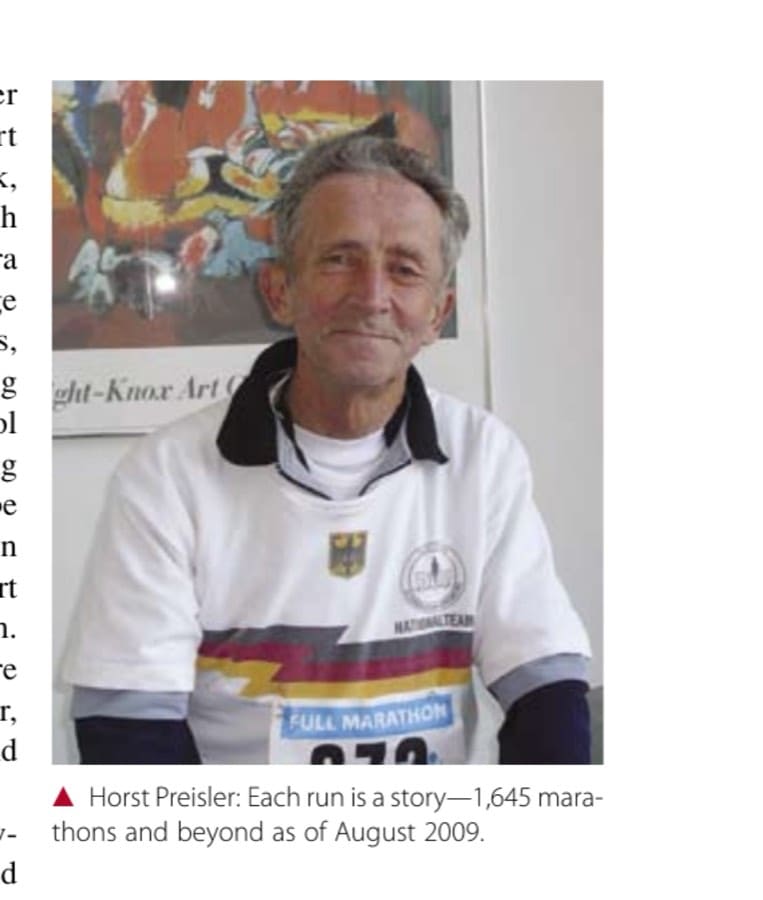
I’m sitting with Horst Preisler inside the Albright-Knox Art Gallery in Buffalo, New York, October 2008. We’re on a bench waiting for the start of the Niagara Falls Marathon. Looking out the large windows and glass door beside us, we see the trees and branches being swirled around by the strong, cool wind, the fall-colored leaves being blown all over. It feels good to be inside. We runners have been given the privilege to look around the art gallery as we wait for the marathon. In the main hallway to our right are dozens of people sitting on the floor, stretching out, relaxing, chatting, and keeping warm. ▲ Horst Preisler: Each run is a story—1,645 mara
Horst sits beside me with his lay- thons and beyond as of August 2009. ers on and with notebook, pen, and camera in hand. Waiting for a marathon to start is not unusual for him; he has been doing it most weekends since 1974. Sitting with the world record holder for the most marathons ever run before the start of the marathon, though, is a new experience for me. This is the third time we’ve met. Each time, I have felt quite privileged to be talking to this very special man. He talks to me in his broken English, and I keep thinking that I wish I knew some German.
The day before, at the Niagara Falls Marathon expo, Horst had been on a panel with four other runners who, collectively, had clocked a few thousand marathons among them over the years; when I saw him, he gave me a big smile and an
embrace. Meeting and renewing contacts and friendships is central to everything that motivates Horst to run marathons. I first met Horst in Hamburg, Germany, in January 2008 when I was there doing research on a book and running in the Elbe River Tunnel Marathon, organized by the German 100 Marathon Club. I had wanted to interview Horst for my book, which is about runners who have run more than 100 marathons. Juergen Kuhlmey, the vice president of the German club, picked me up at the Hamburg airport, and we swung around to get Horst from his home on what was a gray and rainy afternoon. I had just arrived on a red-eye flight from Canada, but I was instantly wide awake upon meeting Juergen and then Horst. We went for dessert at a restaurant in a mall on the outskirts of Hamburg not far from where Horst lives (about 18 kilometers from downtown Hamburg). Germans quite like doing the dessert thing, I found out. We talked about running and everything else for a couple of hours.
Appreciating the physical side of Horst No one else in the mall would have had any idea that Horst was a world record holder, and why would they, since he looks just like you and me? On this occasion, he is also looking quite distinguished, wearing a brown jacket and open shirt. Horst is humble, modest, proud, private, and unassuming all wrapped into one. At 73 years of age, he stands about 5 feet, 10 inches tall, is lean, and looks very fit and healthy. I wonder why?
His world record is almost beyond comprehension. Over dessert, he matterof-factly talks about some of his experiences running 1,535 marathons, including ultras. (When I met him again a few months later at Niagara Falls, his total had climbed to 1,592, including the Biel/Schweiz 100K in June 2008, which he completed in 14:39.) Even if he never runs another marathon, I would need to run a marathon every weekend for almost 30 years to equal Horst’s number— one marathon, every weekend, for 30 years. It’s worth repeating because it’s an astounding figure.
Our restaurant is open plan, situated in the middle of the mall with shoppers going by. I’ve ordered crepes because they are the only thing I recognize on the menu. The coffee is good, although I suspect that having had no sleep on the red-eye has something to do with it. There are smiles all around as we chat, and it’s not just because the desserts taste great. There is a universal, almost-instant, friendship among long-distance runners regardless of nationality, and this is no exception. Horst and Juergen are very kindly speaking English for me. Juergen is tall, thin, and in his late 60s. He is no couch potato either, having run over 300 marathons around the world. I could easily spend an afternoon talking about his experiences, but we save that for another time.
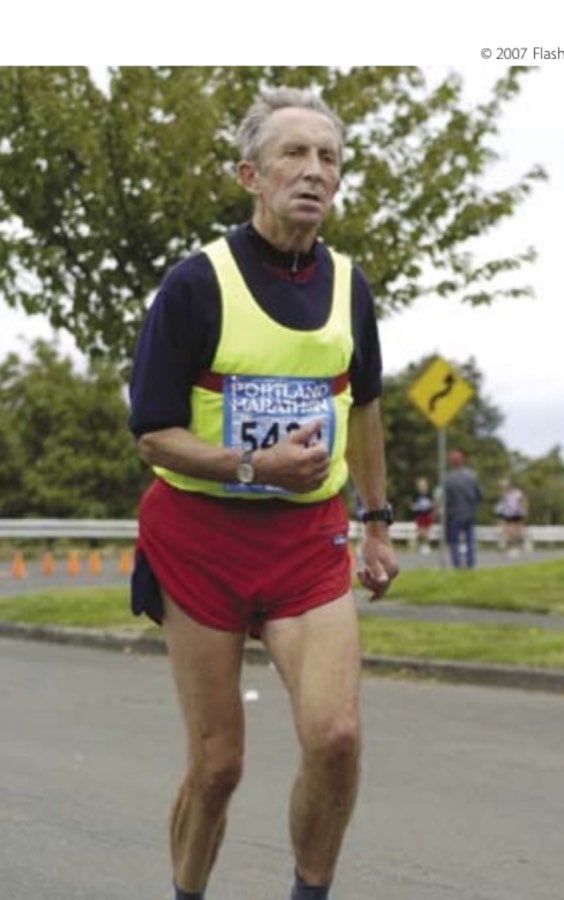
Portland Marathon: Each run is an encounter with a landscape and its people.
▲
© 2007 FlashPro
Horst’s English is not as good as he would like and he apologizes, but Juergen’s English is very good, and at times he takes on a part-time job interpreting for Horst and me. English is the only language other than German
that Horst knows, and he learned that in school decades ago. Horst is flicking through a large binder that details all his running records—races, locations, countries, and times—and giving me some thoughts on his running career
and on marathons in general. No one else in Horst’s family— siblings or parents—was a runner. Running simply wasn’t something he did when he was young or even saw in the activities of others close to him.
Horst said he started running only when his wife, Christa, told him one day that he was “putting on too much weight around the waist.” And so, in 1974, at age 39, he decided to enter his first race—the Unna/Westfalen 100K event—finishing that in a time of 15:48.
Three weeks later he ran his first marathon (Nordholz/Niedersachsen) and managed a time of 4:33. In the following year, he ran just nine distance races (five marathons and four ultras), with a best time of 3:42 for the marathon (at the same Nordholz/Niedersachsen event he had first run in the previous year). Somewhere in the first few runs, he got the bug. Nine races in one year probably sounded like a lot to begin with, and to many of us now it still does, but it paled in comparison to the years that followed.
The number of races just escalated In 1976, he ran 10 long-distance races, and from 1977 to 1979 he averaged 13 races each year. The average number of long-distance races each year increased to 22 in the 1980s. It was in the 1990s, however, that his numbers rose to a new
plateau, with an average of 64 long-distance races each year between 1990 and 1999. Horst has shown no signs of slowing, with an average of 75 races each year between 2000 and 2007. His best time for a marathon is 2:54, which he achieved in the Kandel/Pfalz Marathon in March 1984. His first 200 marathons were run, on average, under 3:30. Horst has completed a staggering 615 marathons under four hours. He has been under five hours 1,100 times. His best time in 2007, at 72 years of age, was 4:11.
Of his 1,645 runs completed as of August 2009, 366 were ultras and the rest marathons. His best time over the 100K distance is 8:15, which he ran in the Rodenbach/Hanau Ultra in April 1986. The following year, in the Biel/Schweiz event, he recorded his best 24-hour race distance of 214.7K. He has run the Spartathlon and several multiday races as well, including a 661K six-day race in France in 1980.
Horst also keeps a record of all his training runs. Combined with his races, as of August 2009, he had run more than 206,000 kilometers, which is roughly the equivalent of running from New York to Los Angeles and back about 25 times.
I’m having trouble with my crepes, not because they’re bad—they’re actually quite good— but because I’m more focused on the magnitude of what Horst has accomplished and the humble way in which he talks about his running. I’m amazed and impressed at all those runners who have run over 100 marathons, a significant feat in itself, but Horst has run the equivalent of more than a marathon every day for about four years.
And these marathons are not just around the same route at his home; these have been run around the world. Horst has run in 50 countries, with most races being in Germany, the Netherlands, Switzerland, Denmark, France, Finland, and Sweden. He has run 14 races in the United States and three in Canada, one of which, in Quebec, was named after him. In 2008, he ran the Niagara Falls Marathon, a race he has wanted to run for a long time.
Even more amazing is that Horst doesn’t drive. When he and Christa, his wife of 50 years, first started talking about raising a family, they felt that they had to choose between having a family or having a car. They chose a family. So his entire running career has been based on public transportation or through rides with family, friends, and other runners.
Horst says the most important race he has ever run was the International Peace Race in Japan in August 1995. He was invited to participate in the event, which commemorated the 50th anniversary of the dropping of the atomic bombs on Hiroshima and Nagasaki. Runners had to run from one city to the next (430K) in the same number of days between the dropping of the first bomb on Hiroshima (August 6) and the second bomb on Nagasaki (August 9). Unfortunately, he had to pull out after 330 kilometers because of stomach cramps.
But for the most part, he has been relatively injury free since he started running at age 39. His lengthiest time away from running marathons was in 1989 when he had an operation on his knee, which prevented him from running for four weeks.
Keeping running simple Horst is not into gadgets, preferring to run simply with a watch and nothing else, opening all his senses to the world around him as he runs the distances. In essence, he is passionate about the simplicity of it all and all the benefits that running provides. One of his favorite runs is the personal run he completed in 1980, where he ran from northern Germany to southern Germany, a distance of about 1,000 kilometers. He used a route map developed by a police officer he knew who had designed the route with safety in mind. His youngest son cycled behind him for the entire distance with the requisite supplies. In some ways, he seems like a machine. It’s difficult to put his numbers into context. Since 1990 he has run, on average, more than a marathon every weekend. It must be a combination of passion and addiction when you factor in travel time, running in 50 different countries, and speaking only German and some broken English. He is relentless, seemingly unstoppable. He will likely have run over 1,650 marathons by the time you read this article. In most ways, however, he is very human and has a simple, underlying philosophy to his running—he enjoys it! Every marathon, Horst says, is a special event. He enjoys meeting people, making new friends, and keeping in touch with the countless friends he has made over the years. Why does he run marathons? The answer to that question is perhaps best summarized in a phrase on his personal business card, one of which he gave me at the end of our dessert session. It’s in German, of course, but it translates into the following: Each run is a story! Each run is an
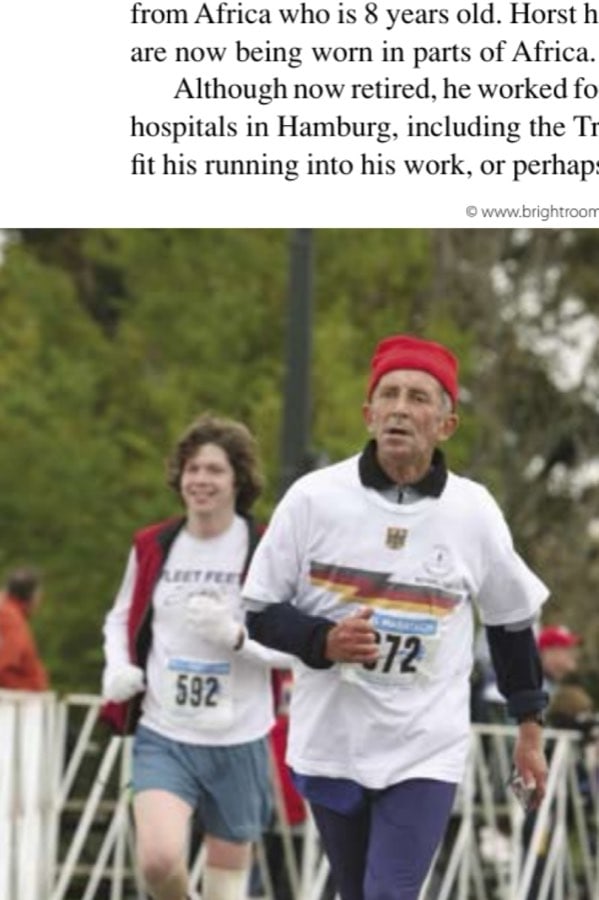
encounter with a landscape and its people! Each run is a meeting of friends! What motivates Horst to run, he says, is the quality of life that it provides. If you run, he explains, you’re healthier than if you don’t. “Quality of life” is a broader concept than physical health. He loves the new experiences that each marathon offers and the new places he visits. Horst firmly believes that running with others helps to break down barriers between nations and cultures, to build relationships, and to build friendships. The big picture is that the world would be a better place if we all took the time to meet and learn from one another. He is
passionate when he talks about this with Juergen and me over dessert and equally passionate when talking as one of the panelists at the Niagara Falls expo.
The expanded family Horst is away most weekends and has been for many years now, which, he admits, often leaves his wife alone. But Christa is also very active, is a gymnast in their local sports club in their neighborhood in Berne, Hamburg, and has other hobbies which, he says, give her fulfillment. He and Christa have raised three children, two boys and a girl. They now have five grandchildren, including an adopted boy from Africa who is 8 years old. Horst has donated hundreds of running shirts that are now being worn in parts of Africa.
Although now retired, he worked for 27 years as human resources manager for hospitals in Hamburg, including the Trauma Hospital of Boberg. He was able to fit his running into his work, or perhaps his work into his running. As Horst said, he “had a really good boss,” who al© www.brightroom.com
lowed him to make up time if he had been training or away at races. Training? Does someone running marathons as continuously as Horst for 30-plus years need to train? We may need to redefine what we mean
by “train.” He tries to get out for a run about five times a week around different routes in Berne. He focuses solely on staying power and is not concerned about pace or time. Horst thinks that focusing on pace and time
would mess up his running. Is running an addiction for Horst? Well, at almost 1,650 marathons, there must be a new name for it. But nothing is readily identifiable or different about Horst. He does not have a special diet, and he tries
to lead a normal life in all respects, which includes volunteer work with a social services organization and ▲
Niagara Falls Marathon: Each run is a meeting of friends.
ad
spending time with his wife, children, grandchildren, and friends. It just so happens that he is able to weave into this social fabric the running of a thousand-plus marathons. As he says, while he is away running, the rest of his family is busy doing other things.
Horst says he will continue running for as long as he enjoys it and for as long as he can. Healthwise, he is still going strong. There doesn’t appear to be anything that will stop him from running at this point; his doctor seldom sees him and has even contacted Horst to ask why he hasn’t come in for a visit. But there will come a day, he knows, when he will no longer be able to run marathons. “If I cannot do it anymore, then I will accept it,” he says.
His advice to those who are just embarking on marathon running is to relax and enjoy it. Don’t be myopic and live only to run, but rather take advantage of everything it provides so you can improve the quality of your life.
Keeping running in its place It seems that Horst has somehow been able to integrate a massive running career into what appears in other respects to be a normal life. And that’s the secret, perhaps. Isn’t that what we all aspire to—not to be a slave to running, but for running to enhance our lives while we make the most of opportunities and find the balance that gives us the quality we want with our own lives and families?
We sat for a couple of hours talking about running and eating desserts in Hamburg; I knew that I was tired, but I was still on some sort of adrenalin high. I was pleased to be in Hamburg and feeling extremely privileged that I had had an opportunity to meet Horst. After a few photographs of Juergen, Horst, and me in the mall, we headed out to the car and into the darkness of the night and the rain. A few minutes later, we dropped Horst off and said our goodbyes. When I first met Horst in Hamburg, I was floored when I looked over his race records in the binder. A few months later at the Niagara Falls Marathon, I’m now looking at Horst’s running career on an Excel spreadsheet in front of me. I realize again how easy it is to overlook the sheer magnitude of his achievements. Many of you reading this have no doubt seen the expression on people’s faces when you tell them how many marathons you have run. When I tell people that I’ve met the world record holder and mention the number of marathons he has completed, it is beyond their comprehension. There is a point in many different aspects of life when large numbers begin to lose all their meaning. I see hundreds upon hundreds of marathons listed row after row after row. Each race is an experience. Each one tells a story. Horst has memories of each one and the notes and the photographs that he has taken. What are the key messages I take away from getting to know Horst? First, he is passionate about running. He believes that it can make the world a better place. He is dedicated to running because he fundamentally believes that it contributes to a better quality of life. He enjoys running because it opens up a world of new experiences, new people, and new friends and places—a new understanding. The world is made smaller and better through the interaction of runners from different cultures and different walks of life. He is a humble and proud yet unassuming man. We’re enjoying our conversation in the art gallery in Buffalo as we wait for the marathon to begin. Despite our experiences of running marathons being different by about 1,600 races, there we are, quietly chatting away and keeping warm. We wish each other all the best for the run—a wonderful run as it turns out, despite the wind at times wanting to sweep us off our feet. Horst finishes in a time of 4:36. At 73 years of age, that’s an impressive time, even more so when you consider the distance those legs and feet have covered since 1974. As we say our goodbyes, I ask him when he is returning to Germany. With a large smile on his face, he says that he will leave in a couple of days, after he has had an opportunity to see the falls and is able to spend some time with his longtime friends. I remember his business card: each run is an
encounter with a landscape and its people. Each run is a meeting of friends. Thanks goes to Karin Lavin of the German Department at Queen’s University for her assistance with translation.
The Raven Run Consistency at any price. by Robert “Raven” Kraft with Christine Light-Whiting
© Priscilla Ferguson
Way back in the ’70s, I was a troubled loner from a broken home, an only child whose mother remarried when I was 15—to a guy I despised. I hardly knew my real father, wore black, didn’t fit in with the high school crowd, and got low grades. But I loved baseball, country-western music, and writing songs, all of which led me to Nashville when I was 19.
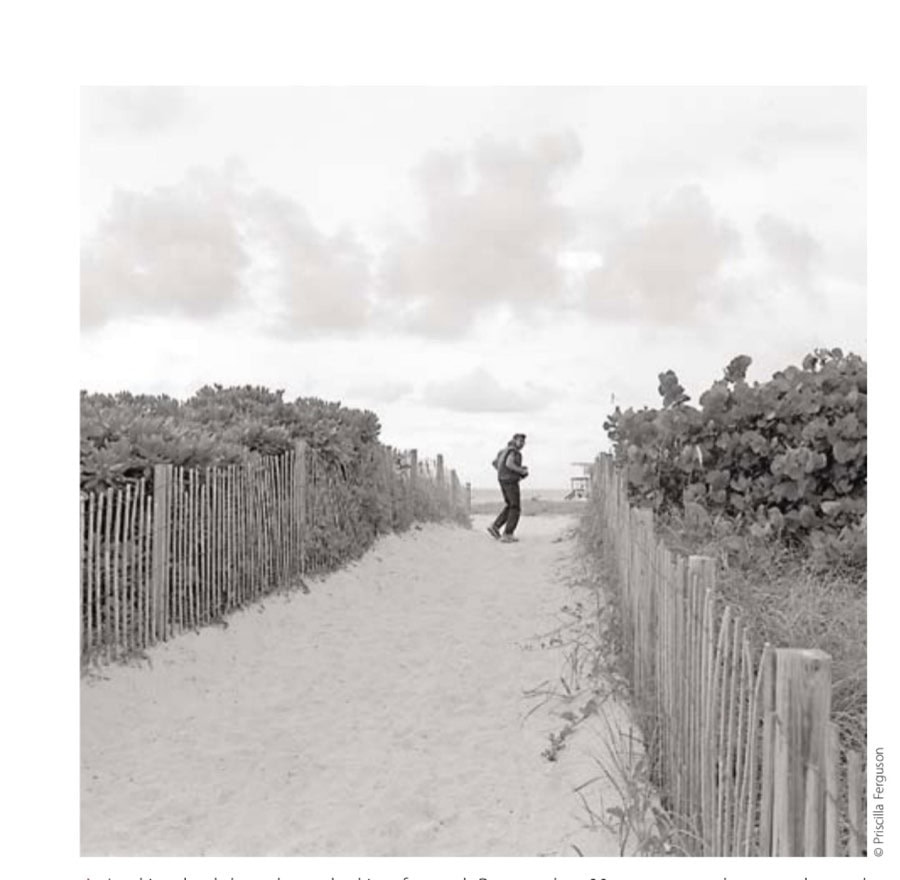
I landed in Nashville! There I met country-western music stars and became friends with Johnny Cash. Naively, I gave some of my unpublished songs on which I ▲ Raven, in a moment of self-reflection had no copyright to one of Johnny Cash’s after a summer run in 1998. songwriter friends to review. One was stolen, and Waylon Jennings had a number five hit with it in 1970. (No, Waylon was not the person who took my song.) I never got a penny, and no credit as the songwriter, either. Disillusioned, I retreated back to Florida and South Beach. True to a song I recorded, I was a “Fugitive on the Run.”
I became friends with a couple of boxers I met on the beach, Dennis “Bulldog” Byrne and Keith “K.O. Killer” Laufenberg, who worked out of the famous Fifth Street Gym and came to the beach to run after sparring. Before long, I would join them. I felt better. I became toned and strong and developed endurance, but best of all, running took the edge off my anger. God and the angels be thanked! I had what I needed. Little did I know that my urgent, solitary, daily pursuit would evolve into the well-publicized South Beach tradition: the Raven Run!
1975 This was the year, January the month, when I began running down South Beach every day—and nothing, not hurricanes, injuries, or ferocious dogs, has ever prevented me from doing my run. Here are the details: while Bulldog and I were jogging, I told him I was going to run every day for a year, 8 miles a day (and I did this despite a bout with pneumonia in December). Was he ever skeptical! He usually quit after a 2 to 3 miles. I was determined to continue, and I’m stubborn.
I really toughed out that first and even the second year of continuous runs because I didn’t have running shoes! First, I ran the daily eight miles on the soft sand of South Beach barefoot. I tried wearing socks, combat boots, and finally, a $2 pair of sneakers that raised blisters on my feet. It was 1977 before I got a pair of Nikes. (Later I had to switch to the New Balance brand because they came in wider widths.)
1976 During this year I stepped on a rusty nail twice, got a tetanus shot, and limped along for two weeks. I was tempted to take a © Priscilla Ferguson break from my running streak to attend the bicentennial exhibition at the downtown Miami train station but found I was unable to do this. Running ruled my life.
1977 This was a year of three firsts. It snowed in South Florida on January 19, 1977! But when I ran that afternoon, it was sunny and the temperature had risen to 46 degrees. During the run, I yanked off my shirt and never again wore one on the run. What I did put on (after discovering it in my path) was a big black glove. I wore it from then on because I decided it would be my magic talisman, a symbol of my ability to continue and never give up. This was also the first year that someone (Paul “Coyote” Harper, ▲
One of many gloves Raven has worn, squeezing out the power.
Robert “Raven” Kraft with Christine Light-Whiting l The Raven Run l 97
a friend and fellow songwriter) ran the entire eight miles with me. I decided that I should keep a list (in my head) of everyone who completed the eight-mile run with me. Little did I know that I had created a monster.
1978 South Beach would offer a firmer running surface by 1981 as a result of the dredging project starting this year that ran from Haulover Beach to the end of South Beach Government Cut. No more running on only soft, drifting sand for me.
I gained a small bit of fame this year. A story titled “The Happy Beachcombers,” supposedly based on my experience meeting women on the beach, appeared in a men’s magazine—illustrated with a drawing of me and a girl standing under the lifeguard stand. I got teased about it.
In November, Miami Beach sponsored its first road race using an eight-mile course, so of course I had to do it—came in 150th out of approximately a thousand runners. Not bad. But running on pavement for this race was very painful. I was used to the soft sand. Never again, I vowed. For the record, I did another eight miles later that afternoon. But on the sand.
I made my first rescue during a run this year, pulling a drowning girl out of the ocean. In my 34 years of running on the beach, I’ve rescued a total of 17 people. Not bad for a below-average swimmer . . . but I do have endurance and I know the ocean.
1979 For the first time, I was seriously injured during the run when I jumped off an eight-foot barrier in my path and landed badly, tearing right calf tendons and ligaments. Stubbornly ignoring warnings of permanent damage, I hobbled down the beach from May through August. I did, however, limit my path between Government Cut and 14th Street—a 3.1-mile loop, which I repeated to get in 8 miles—to avoid the beach-restoration difficulties presented by the longer route. I did run the whole distance of the beach—almost 10 miles—before the dredging. I don’t think it had ever been done before—through pool decks, over walls, fences, and pilings—jetty to jetty, South Beach to Haulover.
1980 Unsavory characters from Cuba infiltrated peaceful South Beach after Castro opened jails and sent the criminals to the United States in what was called the Mariel boat lift. Regular beach people abandoned the area. I became a vigilante, chasing the Marielitos if I caught them trying to steal something. They learned
to steer clear of the crazy guy running down the beach in black shorts and a big black glove. This was the year I suffered the worst man-of-war sting ever: the tentacles were wrapped around my chest, it was difficult to breathe, and the welts lasted for weeks. The lifeguard said it was the worst sting he had ever seen. Luckily, my body wasn’t allergic to the poison, or I would have been hauled off to the hospital. People with sensitive systems have died from man-of-war stings.
1981 I had a scary experience. There were holes in the beach from all the dredging, and during the run, the ground gave way suddenly and I was sucked down very fast—as if I had stumbled into quicksand. My upper body is strong and I was able to pull myself out of the seemingly bottomless pit. I was, however, covered with sand and cement and my shorts and shoes were ruined. Happily, the dredging ended in December so my occasional run north 4 miles each way to 47th Street was no longer an obstacle course.
1982 July, August, and September were eventful months because of three serious health problems that made running difficult: a dog bite, food poisoning, and a head injury. Then, the first newspaper article published about me appeared in September. It did mention my black glove talisman and love of Edgar Allen Poe—guess I’m quirky. But I paid for it in blood—literally. I was at Government Cut, running under the low pier, when someone moved into my path. To avoid a collision, I dodged to the right and smashed my head into the concrete. Lifeguards rushed me to the hospital, doctors closed up my forehead with 18 stitches, and then I was back on the beach to finish the run. The Miami paper decided I was newsworthy. Nothing stops the Raven! was the headline.
1983 February 10 was tough. When I hit the beach, I learned that Bob Romer, my lifeguard friend who had run with me the day before, had blown his brains out that night. I was in no mood to run. It rained hard the day Bob was buried. By this time, I had a few runners with me every day, but I hadn’t written the list and numbers yet—it was all in my head. We ran on soft sand, although occasionally I used the boardwalk, which was built that year, after the dredging, from 21st Street to 47th Street to work on speed.
Robert “Raven” Kraft with Christine Light-Whiting l The Raven Run l 99
1984 On July 4, there were approximately 200,000 people on the beach for the Beach Boys concert, and somehow, Tom Dykas (a guy we called “Zero”) and I managed to dodge through the crowd on the run. Zero actually punched a man on the beach for no reason, and we banned him from the Raven Run. A lifeguard filmed the crowd from his lifeguard stand—including me running around the spectators. It was really cool to see the film 15 years later and myself as a young Raven.
1985 The last day of July was hot! It was the hottest day I’ve ever run. The thermometer on the bank’s clock (which was set 3 degrees low for the tourists) registered 100 degrees in the shade with 100 percent humidity. You know you’re in trouble when you’re pouring sweat and haven’t yet taken a step.
1986 I had to make a choice between my job and my running. Here’s the story. At that time, I worked nights and left at 7:00 a.m. The regular guy went on vacation, the temporary was a no-show, and when I reported it, the office manager told me to either do a double shift or be fired. I collected unemployment after being fired.
Then, for the second time in 1986, I had to give up something important for the running—my girlfriend. She wanted me to go shopping during that special time of day that was always devoted to the Raven Run. She knew what she was asking. Sorry.
Then, on a quiet Wednesday afternoon, September 17 to be exact, I found a $200 cache of money on the beach between Fourth and Fifth streets—the biggest find of my career. There were 10 $10 bills and five $20 bills rolled up and stuffed into the sand, with only a half inch of a single bill showing. Damn, I was happy!
In December, a Doberman bit me in the leg only one-fourth inch from where I had been bitten in 1982—also by a Doberman—and it happened in the same location on the beach. Both times the dogs chased me around a garbage can. Talk about déjà vu. I always swim after the run, and this time I swam close to shore, since I was worried the blood would attract sharks. However, the salt water cleaned the wound and accelerated the healing process.
1987 A minor hurricane struck South Beach on October 12, but my friend Victor “Springman” Kirk and I swam through it. Roughest swim ever, in 55 mile-an-hour winds.
The waves got bigger and stronger; I was tossed about like a piece of paper in a whirlwind and held under until I finally managed to rise to the surface and gulp some air. Springman and I swam close to shore to avoid a roaring rip current that would have taken us out to sea. We survived. I also managed to run almost two miles on the boardwalk in 1987 at what was for me a fast pace: a 6:40 mile. Whew! I’ve never been able to do that again.
1988 South Beach became popular due, I believe, to the TV series Miami Vice, which began in 1986, as well as the fact that women began to appear topless on the sands in the ’80s. I now had so many people running with me that I had to commit my list of running acquaintances to paper.
On a cold, gray, and misty day in November, I ran with Steve Phillips, a fireman, who was in top condition. We ran like hell; then, close to the halfway mark, Steve said he was going to “pick up the pace.” I gasped and let him go—he ran only another mile, and he never did the full eight-mile run. In fact, later on, when he ran with me again, I had to slow down for him. Seventeen years later Steve completed his only Raven Run.
I injured my foot on a run with Steve. By the sixth mile of the eight-mile course, my left foot began to hurt. I had to limp home on that cold, dark night. My foot was swollen and there were lumps on the top, but I didn’t have it treated by a doctor. Later I realized I had developed stress fractures.
There was another problem: a large, painful, disfiguring knot began growing out of the side of my left foot and continued to do so for three years. The pain made it difficult to sleep; I endured the discomfort and finally the pain stopped, but my foot was now gnarled and misshapen. Even running shoes with 4E widths are usually not wide enough. Ten years later, my right foot went through the same painful process. With two misshapen feet, breaking in new shoes creates blisters. Big-time “Ouch!”
1989 Injuring my foot by trying to compete with fleet-footed Steve on the run taught me a lesson and changed my life. Now I just have fun with running and anything else in life—after all, you can’t always be the best or first and beat every runner who edges past you. And you might even see that guy later during your eight-mile run, only this time he’ll be walking instead of running—like Steve. Having fun on the Raven Run gave me more flexibility; I didn’t always have to push myself by running on the soft sand; if someone wanted an easier path, we ran on the hard-packed sand.
On Christmas Eve, the temperature dropped to 42 degrees—the coldest day I ever ran the beach and then swam. It was 39 degrees when I came out of the ocean. Never again would I swim on such a cold day. My hand was shaking so much I almost couldn’t open my front door; it took hours to warm up.
1990 I realized that I had found my niche in life. Through the Raven Run, the poor kid from South Beach had become an inspiration and a motivator. People from all walks of life and from all over the world came to run with me. Interaction with these individuals expanded my horizons and they, in turn, were influenced by my unusually stringent lifestyle—people reconsidered their priorities. Running was our common denominator. In September, a bicycle accident cracked my rib; it hurt to breathe, and sleeping was difficult—I endured eight painful weeks. Undaunted, I did my longest run ever, extending the usual eight-mile round trip by 5.9 extra miles, going to 68th Street. Not wise, but I did it.
1991 The beach was more popular than ever. Often there were professional photographers filming beautiful models every tenth of a mile. When people wanted to know the history of South Beach, I became something of a historian, sharing my knowledge with anyone interested, whether they ran with me or not. Celebrities visited the beach. Lauren Hutton asked me about the Raven Run, Matt Dillon wanted advice on Cuban girls, and former Miami Dolphin Bob Kuechenberg ran with me. Three-time Miami Beach Mayor Alex Daoud did part of the run—it helped him get votes.
1992 At this time, I was having problems with a relationship, and I realized how much the running helped me cope. Yes, I was addicted to running, but it was a positive addiction. On August 23, I made the news. Hurricane Andrew threatened and Miami Beach was being evacuated, but I stayed on. The gusts of wind were already 50 mph when a news reporter asked me why I was not leaving. I told her it was just something I had to do. The same reporter, Susan Candiotti, found me the next morning on Ocean Drive, checking out the damage. When she asked how bad it was, I told her the winds were 110 mph at 5:00 a.m., but that was nothing compared with what happened in South Dade County, where the hurricane actually came ashore. There the cost of the damage was estimated to be some billions of dollars.
Robert “Raven” Kraft with Christine Light-Whiting l The Raven Run l 103
© Priscilla Ferguson
▲ Raven at the southernmost turnaround point on South Beach, with the late Hector “Copyman” Smith, a frequent companion on Raven’s daily run.
The South Beach shore was torn up, debris littered the sand, and there were no lifeguard stands. It was a scene out of Robinson Crusoe. Miami, Miami Beach, and South Dade County resembled a war zone—there were many uprooted trees, damaged buildings with no water or electricity, and armed National Guardsmen in fatigues patrolling the streets to prevent vandalism and looting. People were in shock. It took years to recover from Hurricane Andrew—but the Raven Run continued.
1993 The trees that had been planted on the South Beach dunes in 1989 had grown, and the beach now looked very tropical. Friends and lovers would come and go, but the Raven Run was always there.
1994 I wasn’t happy when the sky turned from gray to black the afternoon of April 24 as I hit the beach. I really didn’t want to run through a storm while I was still suf-
fering the effects of food poisoning. Then, suddenly, to compound my difficulties, a deluge of hail the size of golf balls began falling. I tried to run south from Third Street, made it 50 yards or so, but had to retreat to the safety of the Third Street lifeguard stand. A couple of minutes’ exposure to this bizarre weather raised lumps on my head and bloodied my cheek and shoulders. As I looked around, I saw an amazing sight: every inch of sand was covered with large pieces of ice.
This year, Steve “Vulcan Pilot” Burger was the first person to complete 100 Raven Runs, so I created a certificate for him: a collage of photos, including a shot of him running, and relevant clippings, including his name, dates of his first run, and other pertinent information. It became the blueprint for future Raven Run certificates. Interestingly, other runners were motivated to complete the 800 miles required to earn their folk art Raven Run certificate, suitable for framing.
Toward the end of the year, my back and right leg began protesting the miles traveled during the years, and I was in constant pain. This was the 20th anniversary of the Raven Run, and the lifeguards threw a party for me. One of them said, “I’ll bet you can do another 20!” (He didn’t know about my bad back and leg.) I thought, Yeah, sure, real easy.
1995 This year I appeared on TV for the first time. During the 7:30 show (later known as the Deco Drive show), we discussed my 20 years of running, emphasizing the fact that I don’t give up. Although I seemed to be calm, I was shaking inside. I was eloquent because I was talking about what I know best—running. This TV exposure generated more comments from people on the street and the runners than the articles that had been written about me and the Raven Run. It’s sad— people watch TV instead of reading. The TV exposure gave me a new group of fans—a virtual army of kids.
When I watched the video, I noticed how much I favored my painful right leg. The pain became so intense in August that, for the first time in 20 years and eight months, I was forced to run less than eight miles daily. Over-the-counter painkillers gave some relief. Before this year, I had never taken as much as one aspirin during a run.
This was also the year I completed 60,000 miles of running on the soft sand. My back was hurting, and I was not able to lift weights from the floor. I saw a doctor for the first time since August 1982 when I had a head wound stitched. She and three other doctors told me that I had degenerated lower discs and spinal stenosis. They all told me to stop running. As if I could. There was a silver lining to the dark news: a chiropractor improved my condition significantly using ultrasound and acupuncture treatments. After my October 17 birthday, I was able to run the eight-mile course on most days. It took six months to feel halfway normal. I was
Robert “Raven” Kraft with Christine Light-Whiting l The Raven Run l 105
▲
John “Chapter 11” Parker watches Raven finish his run on TV.
vulnerable—and it was not a good feeling. For a time I thought each day might be my last.
Because I ran less than eight miles for a time, I added partial runs to the Raven Run. To qualify as a Raven Run member, a runner had to complete one eight-mile run. Then, after making the list, the runner could do a run of less than eight miles (there was a three-mile minimum) and choose either two four-mile runs or three three-mile runs. When anyone adhered to the rules and completed runs totaling 800 miles, that person received a Raven Run certificate. The partial runs were popular. People didn’t have to be super athletes after completing their first eight-mile run. After that, they could do partials and still be included.
This year the runners and I decided to have an annual awards banquet to congratulate the runner with the most runs, “Runner of the Year,” and “Most Improved Runner.” Taking a leaf from baseball, the winners were chosen by ballot or on their statistics alone. Everyone was enthusiastic. The Raven Run now had another level of competition, and all you had to do was show up and run. You didn’t have to be the fastest—the slowest was equal to the fastest—but you did have to complete the required number of miles, following the rules for partial runs.
The awards were and are printed on good parchment paper suitable for framing. The ultimate award is the Hall of Fame, and you must be on the list for five years to qualify. The top five runners are selected according to the number of partial runs and swims completed as well as the number of eight-mile runs completed. The Hall of Fame winner is then chosen by ballot—mimicking the way it’s done in the world of baseball.
October brought another TV appearance by yours truly. By now, I was being compared to Forrest Gump, although I would rather it was the other way around. Oh, maybe I’m a little smarter. In December, the 100th runner made the list.
© Priscilla Ferguson
1996
1997 In May, someone from Runner’s World magazine called me to set up an interview. An article about me for the “Human Race” column appeared in the August 1997 issue. The Miami Herald picked up on my story and on the very professional photograph that was taken by Priscilla “Miracle” Ferguson, one of our local runners. The newspaper mentioned me in “The Talk of the Town.” In October, I went to the Florida Marlins’ victory parade celebrating their baseball World Series championship. It was my downfall. I injured my hip jumping 15 feet from a ramp to the grass. Well, all the kids were doing it. For two weeks, I ran at a slow shuffle to compensate for the terrible hip pain.
1998 Runners were now offering to help improve the Raven Run. Lee “The Reverend” Williams typed the list of runners on a computer. Rudy “Taxman” Volenec created certificates and made copies. “Miracle” took professional photographs for a while; her duties were taken over by John “Chapter 11” Parker. Karen “Firecracker” Liecht produced ballots for the Hall of Fame voting. Brian “Square Foot” Eaton created a Web site. The Raven Run was going big time. And later, Carlos “Spinner” Alvarez created ravenrun.net.
1999 Hurricane Irene was scheduled to hit Miami Beach by 7:00 p.m. on October 15, but I thought I could complete the Run before it hit. Wrong! The winds were 70 mph when I started running with “Springman,” “Miracle,” and Tom “Gringo” Longenecker. I was shirtless, sandblasted, and running blind. I could see only a few feet ahead when I peered out from half-closed eyes. The winds reached 86 mph by the time we finished—toughest run ever.
On my birthday (October 17), the Miami Herald gave me a present when it published an article mentioning my songwriting as well as the fact that I’ve been running on the beach for 25 years—racking up more than 65,000 sandy miles. The article also quoted “Miracle” saying: “He needs shoes.” The National Enquirer picked up the story and made a video (never aired) of me running and then swimming during a cold, rainy day. In December, a guy from Sarasota, Steve Schroeer, nicknamed “Journalist,” did the Run and wrote a story on the historic 25th-year Raven Run for his newspaper.
The Miami Herald story caught the interest of a TV news show. That brief bit of publicity induced the New Balance Shoe Company to provide me with running shoes for a year (a new pair every 500 miles) and gave me the first pair
Robert “Raven” Kraft with Christine Light-Whiting l The Raven Run l 107
during a TV interview. I was supposed to get six free pairs of running shoes this year—great way to move into the next century.
2000 New runners showed up as a result of “Miracle’s” Raven Run multimedia show displayed in the windows on Española Way, in South Beach. Nailed to a backdrop and featured were some of my old running shoes—in various stages of deterioration—including those I wore running during hurricanes. The display included an enlarged copy of the list, a photo of the group of runners, photographs of beach characters, items I had found on the run, and a short poetic biography written by “Miracle.”
January 15 found me running a bit earlier than usual through wicked strong winds. I did find about $3.90 in coins half buried in the sand that day. Meanwhile, I wasn’t getting the running shoes promised by New Balance. The Miami Herald reporter called me in April, and when I told him I hadn’t received the shoes, he remedied the problem by running another story. New Balance then directed a local running shop to give me three pairs of shoes in a model and size I requested—and it did. Three cheers for the power of the press.
2001 In May, the New Times, a local paper, published more information on me in its annual “Best of Miami” section—calling me the “best local cult icon.” Then, in July, Runner’s World mentioned that I was “something of a tourist attraction.” Toward the end of the year, I bought 100 index cards, preparing for Raven Run number 10,000, which would take place on May 18, 2002. I planned to give a card to each of my top runners, asking them to choose a number from 9,900 to 9,999—reserving 10,000 for myself. I intended to sign and return the cards as I thanked each runner for joining me on my journey to 10,000 consecutive Raven Runs.
2002 It was April when a freelance photographer persuaded the New Times to do a feature story (using his photographs) on my 10,000 consecutive Raven Runs. The Miami Herald ran the story on page 1, with a picture on page 2, for its May 18 edition—the day of the actual 10,000th run—along with a follow-up story on May 19. That May 18th Raven Run with 30 runners accompanying me was my most memorable. TV crews filmed the run several days before and again on May 18. Various people mentioned the newspaper article, quoting me saying, “I’m train-
© Carlos “Spinner” Alvarez
▲
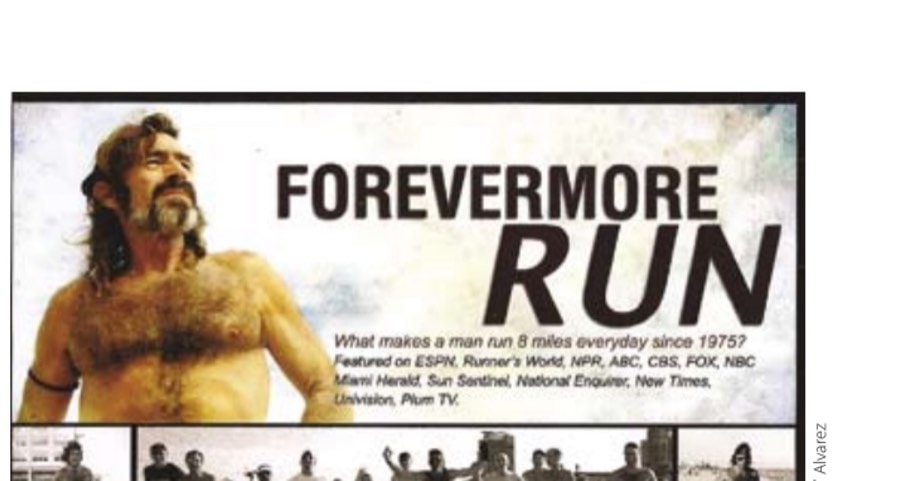
Postcard for the 100,000thmile Forevermore Run, with corner photo (left) from 1977 and corner photo (right) from 1988, and the middle photo from a 55th-birthday run in 2005.
ing to come back tomorrow,” and “It’s a run, not a race.” Must have made an impression. I had become somewhat of a runner’s philosopher. In August, Mike “Flatfoot” Flatley, a professional podiatrist who ran with me, used my photo and endorsement for his New Times advertisement. He promised to make me a pair of orthopedic shoe inserts to help my aching, twisted feet. I would then have a more normal stride, which in turn would ease my sore knees and back. I was skeptical but hoped for the best (and he did make the mold for my feet in November). By that August, I was wearing a knee brace on my right leg. My poor, tired feet.
2003 The night of January 22, my ankle was so sore I couldn’t even bend it, so I dragged my foot on the run, inching along. It was completely dark when I finished. It had taken me three hours and six minutes to cover the eight miles. Even the slowest runner, “Sailor,” seemed to be flying as he ran past me on the soft sand. I was finished as a runner, or so went my dark thoughts.
I made an appointment with “Flatfoot” for the next afternoon. He said my ankle was severely sprained. Anyone else would have given the leg a rest, but the doctor knew I wouldn’t. He prevented the ankle from bending by wrapping it very tightly. My leg was so rigid that it couldn’t get worse, and I didn’t remove the bandage for three days. Swimming was out for those days as well—not a bad thing in the middle of a Florida winter with swarms of man-of-war stinging jellyfish floating through the ocean near shore. Who needs more pain?
Surprisingly, although I was far from healed, I cut an hour and 20 minutes off my time on that day’s run. And “Flatfoot” was concerned enough to come to
Robert “Raven” Kraft with Christine Light-Whiting l The Raven Run l 109
my apartment to wrap my leg again rather than have me visit his office. What a blessing. I was honored and relieved that I had so much help overcoming the obstacles cropping up in my chosen path. Finally, “Flatfoot” gifted me with custom-made orthopedic running-shoe inserts. I quickly became used to wearing them inside my New Balances. Then the miracle occurred: after a few months, I could run pain free at my regular speed. Hah! Who says I’m finished as a runner—I’m as good as new. In fact, during the rest of the year, I did my fastest runs in years. It was great to feel 17 years old again.
2004 In January, I started taking glucosamine chondroitin. This natural product was so effective that I no longer had to wear the knee brace, but I wasn’t 100 percent cured. Problems escalated: back, knee, sciatica—30 years of running does take a toll. It’s one day at a time. But I’m motivated to stay the distance, not only for myself but also for all who look forward to running with me on the beach. For instance, on December 31, no fewer than 33 runners joined me in the pouring rain to complete the run, as I hit 30 years on my streak.
2005 In early January, I got a call from Runner’s World, which wanted to do a profile for its “Real Runners” column. The magazine sent Brian Fisher down to take a picture of me behind the yellow lifeguard stand where I start all my runs. Brian Fisher had done covers for Rolling Stone. The story was short and to the point and brought 13 new runners from all over the country to run with me, but they were primarily runners who were vacationing in South Beach.
Later that summer we had two big hurricane threats, Katrina and Rita. Once again, I had to run in tropical storm conditions of 40 to 50 mph wind. But the worst hurricane that hit us was Wilma on October 24. It had winds of 115 mph, but fortunately I had already done my run that afternoon, and the worst of it didn’t come in until 6:00 to 9:00 that night.
2006 With my 31st year complete, our banquets have become bigger, with many more people and their families. This sometimes creates problems, like people not paying their bill at the restaurant where we met. We ended up $180 short, and we all had to chip in to cover the bills of the deadbeats. Robert “Evil Twin” Ramirez paid most of it; some 10 months later, “Evil Twin” would be dead at 43 from a cocktail of medications.
In March, Court TV came to South Beach to film Beach Patrol, South Beach. A group of us were filmed doing the Raven Run, and we got about two seconds of exposure when the show aired. My birthday run in October brought a record of 46 runners and a new purpose for me: run free. A guy showed up at the start of the run and tried to lure my runners into paying to do a five-mile run in November. I thought it was very rude of this stranger to show up and try to hustle my runners. Running for free has always been good karma for me; I feel God has given me a gift—a gift to share, at no charge to others.
The Miami Herald started a new column at Halloween called “Aging Well” that profiled me. I’m past my mid-50s but still going. Can an article in the AARP magazine be far behind?
2007 In early 2007, I got contacted by Shannon Novak of NPR. She heard about me from three runners she knows, and it led to a story on February 11 that was broadcast nationwide. I was told the show has an audience of 7 million.
On February 7, New Times ran a story tied to the Super Bowl. The story compared local athletes to high-paid millionaire athletes who were playing in the Super Bowl. I was one of four local athletes chosen, and at 56 years old, I was easily the oldest. The story started with an unflattering description of my sun-damaged skin, gray beard, and chest hair, but it got better when the young female writer compared my legs to pistons. Guess when you get older you’ve got to handle unkind comments with grace or else not give interviews. My theory is that any publicity is good—the more you get noticed, the more people are interested in your product, and my product is running and getting people healthy while having fun in the process.
I got a real surprise later in the year when the outgoing mayor had me come down to City Hall on my birthday (October 17) to receive a proclamation heralding the day as Robert “Raven” Kraft day! I was humbled.
2008 Now with 33 years complete, I started the year with over 96,000 miles and 12,053 consecutive days on the books. I hit 99,000 miles on November 24; if my figures are correct, I’ll be hitting the magic 100,000 miles on March 29, 2009. It is fun to play with numbers. I came up with a whole slew of numbers that will be tied in with my 100,000th mile. Here are a few: 20,084.5 hours run. Ran through nine leap years, seven presidents, four times around the world. And get this one: 173,847,300 steps! Robert “Raven” Kraft with Christine Light-Whiting l The Raven Run l 111
2009
© Priscilla Ferguson
Now, at 34 years, I reflect back and look forward to new adventures after my 100,000th mile. The Miami Herald did their first Web story on me in early February 2009. I was then approached as a celebrity guest at a 5K for the homeless in South Beach. ESPN arrived to finish the 100,000th-mile story they had started the previous November. They followed me for four more days, and the Miami Herald did a feature story the day of the 100,000th-mile run. I was presented with the key to Miami Beach before the run, and I read my prepared speech about my journey to this point. It was a cloudy, overcast but humid day, and I kept a faster pace than usual, figuring I didn’t really have to come back the next day. But I did.
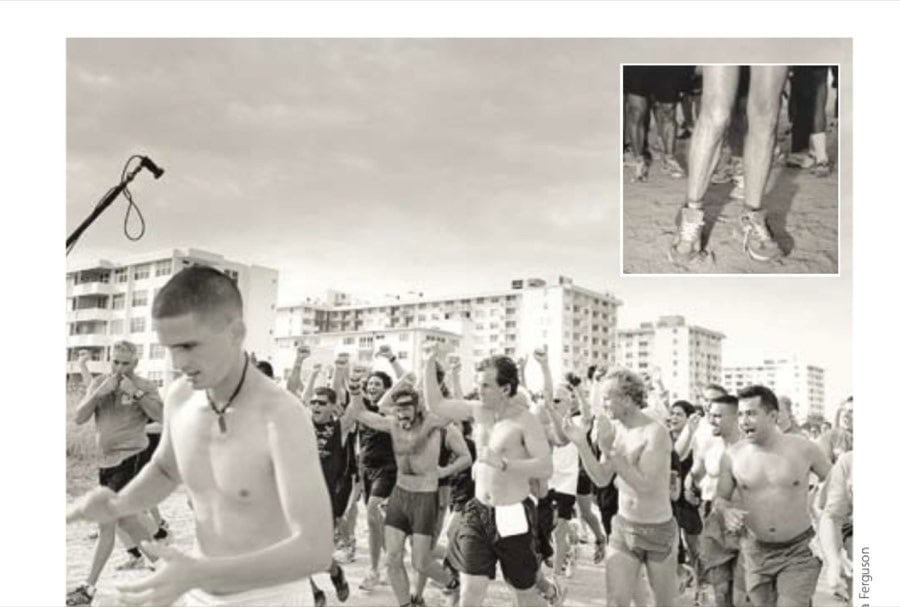
There were volunteers selling the book I wrote the soundtrack for, Lifeguard Murders, and T-shirts. Looking back as I was running, I saw the beach was covered with other runners as far as the eye could see, and I felt an amazing accomplishment. Just as I reached the 100,000th mile at mile marker 2, the sun started shinning. Looking over the dune I saw three satellite trucks from three different local TV stations, and I suddenly felt humbled knowing that they were
▲ Raven crosses the 100,000th-mile mark with close to 300 fellow runners on March 29, 2009. Inset: Raven’s legs moments after completing the 100,000th-mile run.
© Priscilla Ferguson
▲ Looking back but always looking forward, Raven takes 90 steps toward a new day and another run.
there for me. I continued my running streak the next day, as I felt so much love from everyone, and I basically didn’t want to let anyone down. On April 22, 2009, the city honored me at a commission meeting and showed the video from the 100,000th-mile run and used some of my songs that told the story. On May 17, ESPN aired my story on “Outside the Lines.” It was seen by millions, so you can imagine how many new runners I have from all over the world now, countless people who recognize me and ask for a photograph together.
It’s all been very positive and maybe a few opportunities will come my way. If not, I thank God every day to be able to run and feel good. My next goal is a little more modest: reaching 35 years of Raven Runs on December 31, 2009, or just tomorrow, like I’ve always been training for.
Robert “Raven” Kraft with Christine Light-Whiting l The Raven Run l 113
This article originally appeared in Marathon & Beyond, Vol. 13, No. 6 (2009).
← Browse the full M&B ArchiveMore like this
1,000+ stories from 19 years of Marathon & Beyond
The complete archive of the legendary long-distance journal — digitized and free to read.
