

Miracles Happen
THIS ISN’T a miracle of the Lance Armstrong mold. It’s not about rescuing children from a burning building, protecting someone from a deranged killer, or curing a terminal disease. Essentially, all that happened is I ran a marathon.
At 40 years old, overweight, with no prior experience running distance, I trained and succeeded in moving my butt along 26.2 miles of road on my own two feet. And those who know me realize that this indeed is something of a miracle.
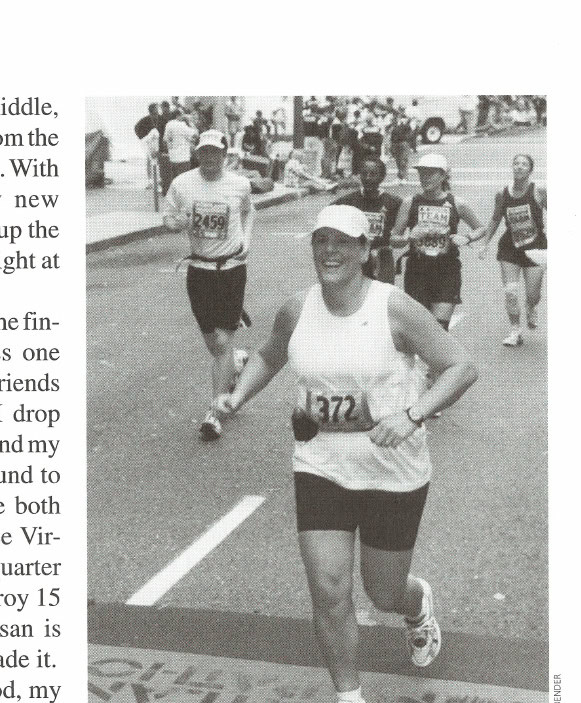
Saturday night, September 30, 2000. I have just returned from picking up my race packet. I laid out my clothes, consumed enough water to float a battleship, and pinned my number (#372—signed up early to get a low number) on my top. I pick up the race booklet and find myself tearing up. I am scared to death.
I am no world-class athlete. I never ran track in school. In fact, it wasn’t until the ’80s that I started running casually. I found people to run with when I recognized that a running buddy can make a huge difference to your perseverance. Usually my dedication would last two to five months. In the early ’90s, I began again. And again. And again. I built to a steady three days a week, running two to four miles. Most weeks, but not all.
Over the years, assorted friends I recruited to keep me company on my runs “trained” with me for goals like the Hood to Coast, a 195-mile relay from Oregon’s Mt. Hood to the town of Seaside at the Pacific Ocean. But I had foot surgery, broke my leg skiing—all sorts of excuses kept surfacing. Still, I kept running and inched my way up to five miles. This was a victory.
By the mid ’90s I broke the six-mile barrier by running to a tavern for beers, burgers, and a ride home. Feeling cocky, Shannon, my most regular running pal, and I tried eight miles on a day that was hot as hell, and I remember thinking, “No one really runs this far on purpose, do they?”
In 1997 I got my first shot at the Hood to Coast. Days afterward, I ran 10 consecutive miles for the first time in my entire life. Talk about a high. I began to think of myself as a runner. Me and my 10- and 11-minute miles.
After reaching 10 miles, 13.1 seemed a logical next step. We found a very flat half-marathon in Centralia, Washington. At the finish, I swore I would never try anything that stupid again. My feet felt as if they had been run over by a dump truck. Really. I couldn’t walk. Aching from head to toe (especially toes, arches, and heels), I just knew I had pushed my body as far as it was ever going to go.
Back to casual running, I banished any thoughts of distance and boisterously dismissed, even condemned, the crazy people who would consider it. Fanatics ran marathons. Marathons were stupid, really. Normal people are not obsessed enough. You have to revolve your whole life around the training, and why would I want to do that? I had a long list of reasons why not.
INSPIRED BY AN IN-LAW
Then, in 1999, I watched my sister-in-law Renee finish the Portland Marathon. It was her first marathon, and watching her, I felt an indescribable shift inside me. I knew I wanted to run a marathon. Maybe I had wanted to all along, but seeing someone real, someone I knew succeed, changed me. From then on, there was no going back.
In January 2000, I had surgery that completely halted my running for eight weeks. But in March, I signed up on the Internet for the 2000 Portland Marathon. I paid the $60 to commit myself and started telling people I was going to run it. As if I believed I really could do it. Fortunately for me, a couple of friends, Susan and Virginia, both veteran marathoners, suggested I sign up for a training program. Through them I found the Portland Fit training program, which is part of the national USAFit program.
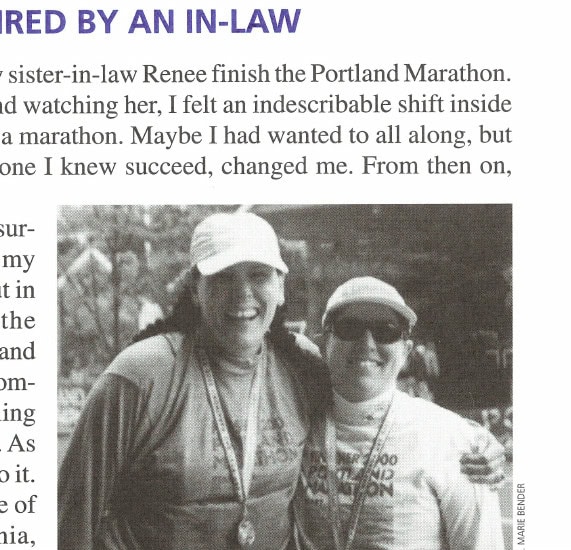
Like hundreds of others, I showed up at a Portland Fit workout on April 1, wondering what kind of joke I was playing on myself. As if I could run 26.2 miles. I was not at my ideal weight, I hadn’t been running because of my surgery, and there was the persistent memory of how wretched I felt after the half-marathon back in 1997. I had turned 40 in March.
But I ran three miles on April Fool’s Day. I followed the Portland Fit schedule. I read the seminars, which were on-line. And soon six months were down to four. I made a point of telling everyone I knew that I intended to run. I felt that I had to make it real somehow, and well, maybe I felt it sort of compelled me to follow through once I told everyone I was doing it.
June 17th was my first major benchmark—a half-marathon. I started psyching myself out. It was difficult to see myself doing it again. It hurt so much the other time I’d done it.
It was more than 80 degrees that June day in Vancouver, Washington, and it took me two hours and 47 minutes to finish the course. Not good for someone hoping to finish 26 miles in under five hours. My husband and a close friend came to see me finish. I earned a medal. I got past the humbling experience of speed walkers sailing by me. And I noticed something good: I could still walk. I had three and a half months to go.
In July we ran 15 miles, which was new territory for me. I made a really basic bad choice and wore a brand new pair of shoes. By the end, I was sore, tired, and semidelirious. Doubts of reaching 26 crept back in and rooted. No matter. I continued to speak confidently to anyone who asked. I acted as if. And I kept running my weekday runs.
My next big benchmark was 18.6 miles. This time my shoes were broken in. But my times weren’t getting any faster. My five-hour goal seemed impossible, so I shifted my intentions. What I really wanted from this marathon was to complete it without losing my desire to ever run again.
Our longest run, 21 miles, was okay until about 16 miles. The rest was simply grueling. From 19 home, I was just keeping my body moving. And 21 miles is not 26.2. Unfortunately, I knew this only too clearly. I had three weeks of taper to the big day. Our final weekend run, a mere seven miles, included conquering a big bad hill we would hit at mile 17 in the race. A glimmer of confidence (or was it hope?) returned.
REVIEWING MY PREPARATIONS
The final week I had trouble staying motivated. I was getting fearful again, especially when short runs seemed difficult. During a 35-minute run that week, I thought about what I had changed in my life to do this. I cut back on coffee and alcohol, not wanting to be dehydrated before long runs. I watched my diet, but I never did lose the extra pounds in spite of all the energy I expended. I bought a couple of pairs of really good running shoes. I learned to tolerate GU (but only one flavor—man, that stuff tastes nasty). And I had committed Saturday mornings to long runs. That meant getting to bed early Friday nights for six months.
Not so bad, really. Not in the grand scheme.
On September 30, my emotions are on a roller coaster. I have family and friends coming to watch and support me. My husband, a Portland motorcycle police officer, is working the race and will find me somewhere on the course. Friends from work are running also. Aside from Troy, one of my training partners, I am the only one I know who will be doing this for their first time. I try not to think about the 21-mile mark.
I call my friends to ask where we’ll meet in the morning. They give me a spot, and if they’re not there, look for the 10-minute-per-mile pace sign. I try to sleep, hoping the sound of the rain will lull me off to sleep and that the rain will go away by race morning. It lulls me, but it doesn’t go away.
Sunday morning I get up at 4:30, braid my hair, get dressed, eat a little. I take a long look in the mirror and ask myself one last time: What do you think you’re doing? How is it you think you can run 26.2 miles? I have no answer. I’ll get back to you on that, I tell my reflection. But I am going to do it, somehow.
Finding parking and a trip to the port-a-potty line out of the way, I am off in search of Troy, Virginia, and Susan. No luck in the enormous crowd, and at 6:30 A.M. the skies burst open, drenching everyone. It rains pretty hard, starts to let up, and then there’s another downpour. I hear a voice say, “Get under here, whoever can fit.” A walker, I think named Linda, has a large green tarp, and suddenly eight of us are huddled inside it. We are all wet, but it is much warmer with the body heat we are generating.
I am the tallest, so I keep checking up front to see if there is any movement yet. The announcer sounds like the teacher from Charlie Brown movies. Wawaawawa wa wawa. We don’t understand a word. We check our watches again and again. I fight away the part of my head asking why I am standing out here with all these runners. Look at them! They are thin and strong; they look confident. Wait, they’re soaked, just like me.
And as I look around, I realize they are young and old. Some thin and some far heavier than me. Some look downright miserable, and a few reflect the same uncertainty I am feeling right now. I want to tell them we will all get through this together. But really, I am starting to understand that we may help each other (like Linda here with the tarp), but we will each get through this alone. That’s what we will have to be proud of at the end.
FINALLY: MOVEMENT!
The front of the crowd is moving. I haven’t found my running partners. It is still raining, though less. The streets have rivers of water crossing them, and the first half mile, maybe longer, the crowd inches forward at a slow jog. Somewhere up in the front, I am sure the fast runners have stretched out and begun to pick up speed; but where I am, the walkers and runners are all mixed together, and I decide it is good to go slow, watch my foot falls, and avoid the really deep water.
My feet stay as dry as can be hoped for. It is getting light. We are moving through the downtown area, all familiar to me. Unbelievably, I have gone five miles. Signs for someone named Leo are everywhere along the way. His supporters are so enthusiastic, I think I should find out who Leo is and just run with him.
I need to stop (girl stuff), so I find a short port-a-potty line around mile 6.5 and wait my turn. Wet Lycra shorts don’t seem to want to adjust back easily, but good news, when I exit the port-a-potty, there’s Susan! We start running together down the long out-and-back in Northwest Portland’s industrial area. I wave at two friends from work about a mile and a half in front of me, headed back as I am still heading out. From mile 7 to 11, with the turnaround just after 9, I start to feel something is wrong.
Susan and I play leapfrog, each taking turns in front. I realize that my shorts have come apart at the inner thigh seam. My legs are starting to chafe. I find a Vaseline person at the next aid station, stop, and dip several fingers into the jar. The quarter-sized glob they have on the wooden tongue depressors just isn’t going to be enough.
Around mile 10, Patrick shows up on his motorcycle. I tell him about my shorts, but I don’t make a big deal of it. I have no idea that within a few miles the chafing will hurt a lot more. He has seen his sister Renee; she is just in front of me. Susan is out in front of me again, and Pat has seen Virginia as well. No sign of Troy, but he is likely ahead of us all. I keep going, the weather has improved, and my mood is pretty good.
By mile 12, 12.5, I am miserable. Frustrated. Concerned. I think my muscles are doing great, but my inner thighs are raw, and bits of the fabric from my shorts are sprinkled down my legs, stuck with Vaseline. I wonder if I can keep running. At mile 13, Pat finds me again. I tell him I am distressed and need to use the rest room, but I am afraid my shorts won’t live through the experience.
He looks at them and then races off to find an open store. I can only hope he succeeds. I try to keep running, but the worst spot is bleeding now, on fire. I walk a ways and realize even walking hurts. Running again, I keep telling myself I have nothing to prove to anyone: this is for me. I wanted to do this thing. I think I even say this out loud to a woman asking how I am doing. At 16.5 miles, at the base of the longest hill on the course, I hear the motorcycle before I see it. Pat is coming toward me, the only kind of motor traffic on the course.
A CHANGING ROOMETTE
I stop in front of a bank of five outhouses, and he pulls out two pairs of shorts for me to choose from. So happy, I feel the tears coming up again. I get in line, no longer caring about time goals, just wanting the pain to end. I am sure the contortions I have to go through in such a confined space in order to change shorts would be funny to watch. I don’t dare take off my shoes, as I’m not going to risk my socks not settling back to where they were. My feet still feel good, and I want to keep them that way.
The new shorts bring instant relief. I am so grateful. Renewed enthusiasm rises up inside me. Pat is off to check on his sister and to find my family and friends waiting ahead a few miles. I won’t be there as soon as I had anticipated, but he can go explain why.
At the top of the beautiful St. Johns Bridge, I can see downtown in the distance: the end. I take account of my body parts. Feet: doing pretty good. Legs: muscles fine, sore spot is down to a barely noticeable irritation. Back and shoulders: surprisingly loose. Neck: a little tense, but okay. My thoughts are what have really improved.
Each slow step I take seems to get a tiny bit easier. Eight miles left. I can go eight miles. I start giving myself credit for doing this at all. My voice clears. About halfway I had begun nodding at the volunteers, and now I am back to voicing my thanks. I lift my arm to wave at spectators. Thanks for being here. It makes a difference. Rows of little kids with their hands out for high-fives; I try not to miss any of them. A band at this corner, belly dancers at the next. Hey, I work with her! I find the energy to yell “Hello!”
At mile 20, I again find Susan. We jog slowly along together. Mile 21. There’s my husband, some friends, my brothers, my mom. They wave and scream and tell me I have lovely shorts. Pat has given them the update. One friend comes out to jog along with me for a couple of blocks.
“All you have to do is keep running,” she tells me, as if that is some simple thing. I think of recently attending the birth of another friend’s son. “You just need to push,” we told her near the finish. She must have felt the way I did right then.
I am running alone again. A woman jogging slowly beside me says, “Hey, it’s you! Thanks!” I ask what for? Miles back, I told her I wasn’t here to prove anything to anyone. I was doing it for myself. She tells me those words got her past feeling as if she was the slowest runner on the course. She quit beating herself up for not running fast enough and began appreciating herself for what she was doing. Running a damned marathon. Photos ahead, the sign reads. Smile, says the next. I check in with my face. Hey, I’m smiling already.
The long downhill arrives, and though my legs are like rubber, I have enough momentum to keep jogging. My body is a miracle. My body is strong. I say these things over and over in my head.
HERE’S A NEW FRIEND
With just over two miles to go, I am getting close to being done. Not just with the race but also with my energy reserve. I have taken GU a few times and need to swallow more even this close to the finish. I have walked through the aid stations, and at this one I keep walking. There is a small rise that takes me to the last bridge. I find myself next to a tall East Indian man who tells me he started too fast. Doing 8- to 9-minute miles, he had died at mile 15. He has been walking on and off since. I ask him how many times he has run 1.75 miles. “Countless,” he tells me in his incredible accent.
“Then run with me to the end. It is right over there,” I tell him.
“You see the end?” he asks.
I show him.
He says, “Yes, but slowly.”
I tell him about my shorts. We laugh, and we begin to jog again.
As we come to the last mile, our steps get lighter. We are thanking each other. “I would be walking if not for you,” I say.
“Me too,” he says.
I point out the fountain where we will turn for the last three blocks. Right before the turn, three motor officers watch the race from a side street. The handsome one in the middle, my hero, breaks away from the others to watch me finish. With two blocks to go, my new friend says, “Let’s pick up the pace a bit.” We do, me right at his heels.
The final left turn is the finish chute, and we cross one after the other. I hear friends yelling out my name, I drop my head for my medal, and my newest friend turns around to shake my hand. We are both grinning like fools. I see Virginia. She finished a quarter of an hour before me. Troy 15 minutes before her. Susan is coming soon. We all made it.
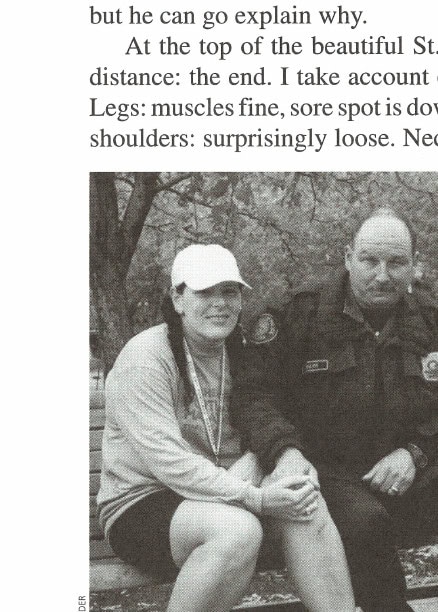
I get a pin, some food, my T-shirt (they make you decide on a color after running that far—what a cruel joke), a rose, a little seedling tree, and for a moment I mingle with the hundreds of other runners still hanging out at the finish. Five hours and 46 minutes. Pretty slow, but I did have to change clothes in the middle.
Besides, I just ran a marathon. Twenty-six-point-two miles. I am in shock. Maybe I’m dreaming. As far as I can tell, I have no injuries or even soreness other than my chafing. I visit with friends, and eventually we drive home. There I celebrate with a single malt Scotch and a long soak in the hot tub. Patrick returns, and we take a nap, and then he treats me to a great dinner.
Three days later, I take my clothes and shoes to work with me again, and at lunch I run three miles. Not fast, but with energy and enthusiasm. Still smiling, I wonder if I could do a marathon in under five hours. I would find out in Vancouver, British Columbia, in May of 2001.
Editor’s note: At the Vancouver International Marathon in May, Marie reached her sub-5:00 goal, with more than seven minutes to spare. “If I continue to improve at this rate, hey, I could be placing in my age group soon,” she reported.
These pages consist entirely of advertisements and contain no article content to extract.
This article originally appeared in Marathon & Beyond, Vol. 5, No. 6 (2001).
← Browse the full M&B ArchiveMore like this
1,000+ stories from 19 years of Marathon & Beyond
The complete archive of the legendary long-distance journal — digitized and free to read.
