

Mixed Metaphors And Tenses
Laban told Isaac’s son, Jacob, to name his terms. “What’ll ya do in exchange for my Rachel?” Jacob promised seven years in service to Laban for Rachel. She was that lovely. Shined like maybe a silver buckle might shine. Probably more even. Still, make a deal with Laban and you better dot your “i”s and cross your “t”s.
Down to just a couple of minutes now; brother Brian and I have used up all our nervous chitchat, and it’s time to go. Time to get up the first mountain. We’re starting at 6,200 feet and going up even from there. It’s dark, and in spite of a forecast calling for triple digits later in the day, we’ll shortly be traipsing across snow at 8,750 feet. I want it behind me, perhaps need it so. I need the whole of the high country at my back, now that I think of it—my head is throbbing with evidence that I’ll do poorly at this altitude. Unlike so many runners here at Squaw Valley this dark morning, I can’t wait for the canyons; they’ve got actual oxygen in them, even if it is a superheated, combustible thing. But first, the start.
Brother is a proud man, but in a discreet and quiet way. He prefers the thing done to the thing talked about, does not like ostentation. The Western States Endurance Run is an event fully aware of its place in the pantheon of endurance events, and he was never too keen on running it for that reason. Being a fan of smaller, lower-profile races, he was mildly scornful of a race vain enough to use a starter’s pistol in lieu of the less formal, “Is Joe back from the bathroom? He is? OK, go.” I see no starter’s pistol, but I do see Dr. Bob Lind nearby with a shotgun. I figure there’s two, maybe three reasons for that: gets us going in the first place; probably, they want to wake up the bears also; but really, I bet Dr. Bob Lind just enjoys pulling the trigger of a shotgun and seeing 399 fools head off up a mountain in the dark because of it. Hell, I would.
We got going, got up that mountain like to bump our heads on the sky. Brother isn’t sentimental so much, more of a shaves-with-broken-glass-and-wipes-hishands-on-nearby-cats sort. I wouldn’t have expected him to stop and admire the
sunrise on the Sierra, but that’s what he did. We moved on, sliding up and down snowy slopes, did some dancing in streams and bogs, surrendered to entirely wet feet. We loped through the rough, new-cut trail of Duncan Canyon, reopened five years after a devastating fire. The dirt seemed to me to still simmer from the heat of it. I embrace heat, love its heavy blanket on my midday runs. Brother trained for it by the mere act of showing up for work—he is a fireman. Before Robinson Flat, we passed a volunteer checking the temperature for posterity’s sake: 95 degrees Fahrenheit. Not yet noon.
Then There’s the Question of Which Chef
Courtesy of Chris O’Connor
Arriving at Robinson Flat (mile 30), we weighed in (down 2 pounds), grabbed a couple of chairs, and set to changing shoes. Our missuses were there, and mine leaned over the yellow tape separating us, said my son’d bumped his head. Thinking she wouldn’t have mentioned this if there weren’t some wrinkle to it, I asked was the lad OK. “Well, yes and no.” Turned out Young Master O’Connor got a nasty lump but had been checked out and declared serviceable in spite of it. For the time being, however, he was displaying some curious behavior. “How curious?” I asked. “Well, as near as we can tell, he thinks he’s that angry chef guy from that angry cooking show. You know, what’s his name.”
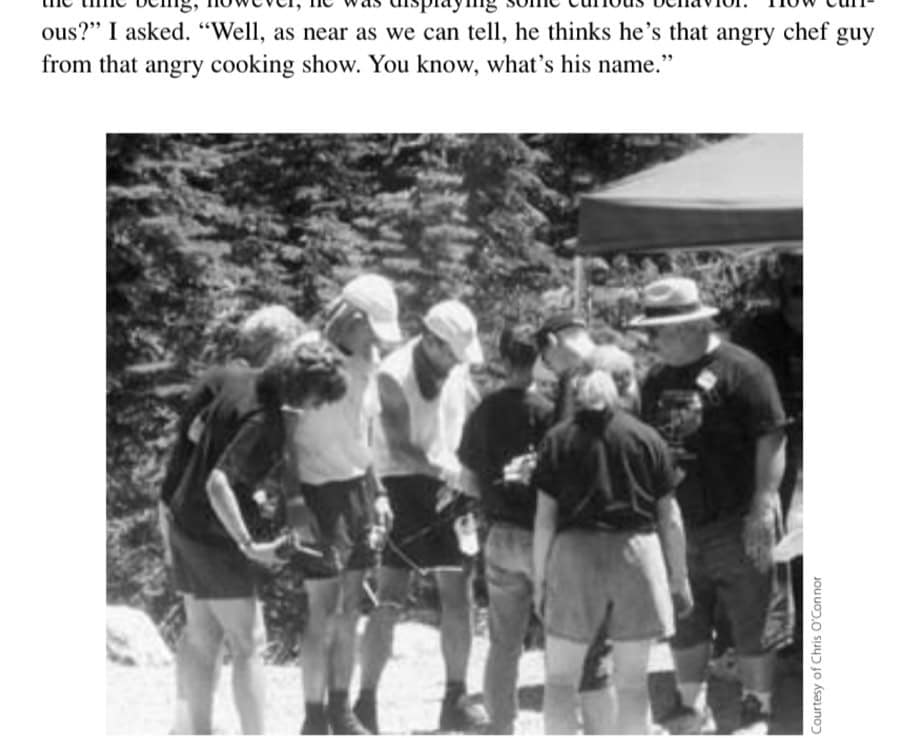
The brothers weigh in at Robinson Flat.
Someone next to her offered up it was Gordon Ramsay, the name she was looking for. The guy on the other side of her joined in, said no, no, no, it was Iron Chef. “Can’t be Iron Chef. He’s Japanese. That kid ain’t Japanese. Besides, how do you explain oeuf?” My son had said this word—French for egg—and if it ever was a thing a Japanese chef’d say, it would only be after dropping a big can of beans on his foot. Or some such. There was some support for this view, and from a few rows back, someone asked wasn’t Gordon Ramsay one of those pretentious bastards inclined to ponce around with a French word when an American one’d do just fine? And having determined he needed an egg, wouldn’t Iron Chef be more likely to point at it with one of those samma . . . sahura . . . ramasari . . . one of those swords, his intention thus mortally obvious? This blew the debate wide open as to which chef currently possessed the body of my 10-year-old son.
While they argued, I heard a commotion over by the aid-station tables. A small, familiar voice was loudly demanding to know how was he ever expected to work in conditions like these, with such simpletons for assistants. He shouted something more about rank amateurs, something about paper plate presentations, then still something else about cilantro and not basil, you wankers. Had to be Gordon Ramsay. I looked over at Missus and she nodded in the direction of the commotion. “He’s preparing omelets.” I wanted to know with what, exactly. “Near as I can tell, GU and watermelon.” Ramsay’s uncle looked at me and said, “You know, I am pretty hungry,” before heading over there. I kissed my wife and apologized in advance for what promised to be a long day with a hypertensive young chef. “Something 14 carat, and if you go much over 24 hours, you can throw in a trip to Paris” was all she said. Well, that and “you ass.”
Off we went, me not realizing that in the commotion, I’d forgotten to grease up my feet, an oversight that would be of some consequence later on. We tumbled on down the trail, my brother carrying a curious-looking omelet on a paper plate, eating as we went. “You know, it’s not half bad, really.”
We noodled around the trail, descending from the high country on the barren side of Little Bald Mountain, and made our way to Miller’s Defeat at mile 34. The mercury was up but good now, though we were moving in a steady rhythm. At Dusty Corners (mile 38), we began a pattern that would repeat itself: one of us would need our feet worked on at one aid station, then the other at the next— leapfrogging like that for the rest of the event as our feet disintegrated in the heat, the sweat, and the dust. Brother had blisters lanced and taped, and we moved on. From here on out, I knew the trail well, and it was some relief to me to be able to call out landmarks before we got to them.
Moments after passing a derelict 50-year-old automobile all shot to hell and rusted, we arrived at Last Chance (mile 43). “Hello, Mr. O’Connor,” came a familiar voice. There sat my friend John, recovering, having retched up near half his body weight onto the trail. It’s a bad day when I catch that guy—he’s fast, and
Courtesy of Chris O’Connor
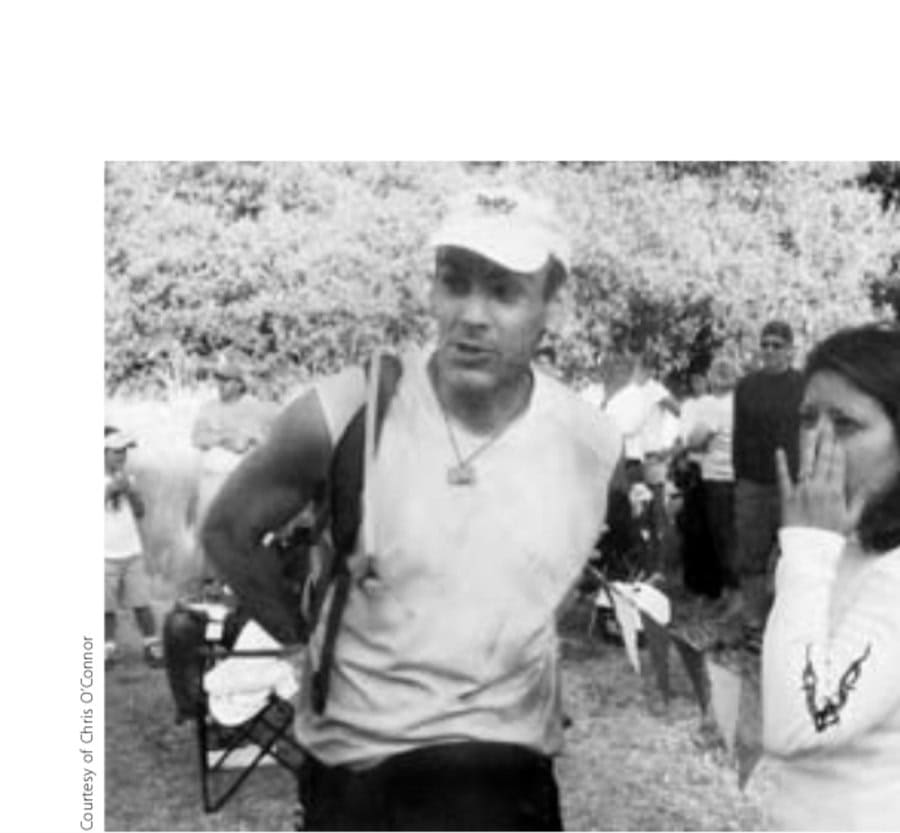
Deanne is not buying Chris’s claim that the 14-carat-Paris thing was “just a metaphor, dear.”
I can’t keep his pace. “Tell me it’s the heat, John. Tell me you didn’t eat one of those GU omelets at Robinson. Please.” He merely burped. Seeing John there, I realized the day had turned into a crapshoot. I was hoping he’d regroup to leave with us. Smart and with a wicked sense of humor, he’d make premium company in the canyons. He needed a few more minutes after we’d left, then somehow wrestled his way to Devil’s Thumb before conceding the day’d got him.
Into the Furnace Out of Last Chance, we tipped ourselves down the throat of the furnace: we’d entered the canyons. The dirt here is just the accreted dust of so many ancient miners’ bones. This place has a weight to it, a gravity all its own. Not far away,
the Donner Party was waylaid trying to get across the Sierra in a blizzard, running out of even GU omelets before finally, famously reconsidering the word “omnivore.” Behind the 24-hour pace, we were hoping to get back in front of it, sweaty
alchemists trying to convert a bronze buckle into a silver one. We set our jaws tight and hammered the first downhill section—owned it, really. Said, “Who’s yer daddy?” to it out loud and with hot blood. Got down to the river and started up
Devil’s Thumb. For comparison, consider the famous L’Alpe d’Huez of the Tour de France: it climbs 3,600 feet in nine miles. At 1,400 feet, Devil’s Thumb climbs less than half that, but it does it in about a mile and a half. It forgives nothing,
overlooks no weakness. Depending on how you count them, there are as many as 36
Courtesy of Chris O’Connor
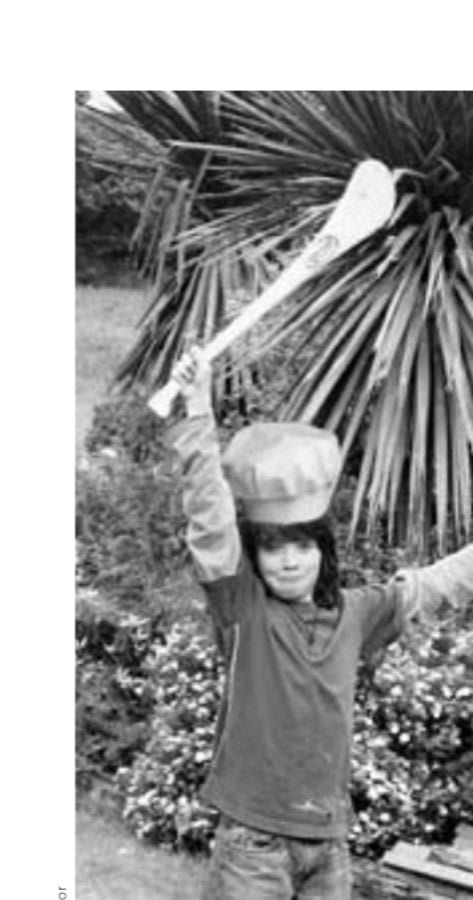
Young Master O’Connor, Wanted in three states for felonious cooking. A good kid, otherwise.
switchbacks. It comes in the heat of the day for most people. I’ve been up it in 45 minutes. I’ve been up it in 35. I gave myself an hour on race day, wanting to crest it with something left. I did not. It took me 75 minutes to get
to the top. I was gassed. Brian got up four minutes quicker, looked fresh as a daisy at the top. Well over 100 degrees Fahrenheit, the heat was wreaking havoc on the runners, evidence of which could be seen in the
carnage lying around in cots and hangdog dejectedness at the top of Devil’s Thumb. The casual eye would look at the human wreckage and assume heat exhaustion. I knew otherwise: this was the work of a 10-year-old
boy making omelets with GU and things that should not ever be mixed with GU—itself, Genghis Khan rendered as paste. If the omelets were not bad enough, he’d begun serving another monstrosity to unsuspecting runners and crew: the Gufflé. I include the
recipe here as warning for the reader, should the thing attack them from the pages of some diabolical cookbook: A Classic Aid-Station Souffle, made with things on hand 1/2 cup powdered energy-drink mix
2 tsp baking powder if available. If not, use something the same color. 1 cup melted jellybeans 4 packets of coffee-flavored GU Miscellaneous items from the table (snot-laced pretzels, candied oranges, nuts, boiled taters, etc.)
Preheat nearby rock to 375F. Beat GU, adding powdered energy-drink mix and baking powder slowly to make roux (foamy and frothy). Slowly add the jellybeans and miscellany, turning with a spatula. Grease a soufflé dish with Vaseline or Bag Balm. Bake on rock at 375F for 30 minutes. Serve. I know it sounds delightful, but it’s hell on the stomach, a gastrointestinal apocalypse. Some dishes, no matter how captivating, are inherently unholy. Race directors should consider a ban for the good of the sport.
The Feet That Failed Me From the Thumb down to El Dorado Creek is fast trail, and we approached it thinking it was an opportunity to regain time lost on the Thumb. For about a mile, that seemed likely, but then the wheels came off my wagon proper. Something snapped—my quads were shot and I felt dizzy, the wild heat of the day had collected in a layer, and I slipped below its surface. I had to stop and sit on a rock for a moment, unbraided, my heart fluttering alarmingly. I waved goodbye to a silver buckle and worried about even a bronze one. After a few moments, I started again, hoping to fall down the trail and into the aid station at the bottom. I was aware I had new blisters on my heels, but they weren’t bothering me until I felt a nauseating rip on a sharp foot strike not far from the creek. The skin of my heel tore from one side of the foot to the other. I limped into the aid station, sat down, and declared to Brother I’d try to recover but he should not wait for me. He headed up to Michigan Bluff to warn our troops that I was at a low point. While I sat there worried about my feet, the aid-station captain was worried about my color. They ordered me to sit, wrapped me in a cold wet towel to bring my temperature down, and told me to eat. After a few minutes, the foot fixer slathered on a half jar of Vaseline and sent me up the hill to quit—I couldn’t drop at El Dorado, he said. The race had swept out from beneath me.
Sporting half a jar of Vaseline on my feet, I slid out of the aid station and began the climb to Michigan Bluff. It’s a dull and seemingly endless thing. About 10 minutes up the trail, a guy turned to me and pointed to my right. “See that?” About 10 to 15 feet to my right was a bear cub, looking mildly distressed. The other guy thought it was cute. I thought it was a bear cub looking distressed, and I was deeply concerned about what I didn’t see, which was mama bear. “We should go now,” I said. I have a highly developed fear of bears. Finely tuned, you might say. Under the best of circumstances, I can string out my death by bear a good 30 to 40 seconds, but there I was, all blistered and 50 hard-miled and generally in poor condition, morbid and morose. I gave myself about five seconds in a tussle with a tired bear, no seconds at all with a fresh one. Let us perhaps away up the hill, you bear cub admirer man.
More Trouble From the Kid A few hundred yards out of Michigan Bluff (mile 55), I saw Brother coming the other way. He came back for me. Typical. He looked concerned. “You need to be careful in the aid station,” he told me. “The kid?” He nodded, then filled me in: angry chef Gordon Ramsay had dwelt in my son’s brain for most of the day, lingered long enough and with enough ferocity that several aid-station volunteers found themselves piling into a car and heading into Foresthill with orders to find some sea bass, and not any of that canned crap, either. The aid-station captain was livid. The people from Zagat Survey were on their way to rate the aid station, and he thought seafood a poor choice in this heat.
Worried that a bad review from Zagat would doom Michigan Bluff aid station, he argued for something more dependable, if less adventurous: Beef Clif Bar Sautés with Peanut Sauce. My son insisted on something bold: Sea Bass Marinated in Mountain Dew, Served on Braised Pretzels with a Payday Candy Bar Garnish. If he pulled it off, he swore business would triple. By the time the Zagat critics sat down for their meal, my son’s curious malady had taken a turn, and the angry chef left the boy’s mind, leaving the aid station with nothing to serve but Pringles and flat, generic cola in Dixie cups. Zagat was offended, and the aid-station captain wanted to know whose kid had let him down so grievously.
Shuffling past spectators, I asked about my son. Brother described having earlier seen the kid running bare chested, wearing a towel like a kilt. His face was painted blue and he was shouting about Michigan Bluff being free. He’d rallied most of the kids in town, and they were all tearing around similarly attired, forming an apparent skirmish line. Hearing this, a spectator commented that it was nice to see a young man leading so capably, reenacting Guy Fawkes’s famous attempt on King James’s life. A woman I guessed to be the man’s wife cuffed his head, called him an idiot, called him a fool, and swore he wouldn’t know Guy Fawkes if Guy Fawkes jumped up out of Guy Fawkes’s grave and bit him in his stupid ass. She smacked him again, said it was obviously a restaging of Pickett’s charge at Antietam. Someone on the other side of the trail said, “Gettysburg,” and that woman said, “What?” glaring. That guy the other side of the trail said again, “Gettysburg,” then added, “Pickett’s charge was at Gettysburg, not Antietam.” Then that woman hit that guy, and just for good measure, her husband, too. Brother said it wasn’t Guy Fawkes or Pickett or Antietam or Gettysburg, neither. The key to it all was my son’s reference to the Zagat food critics as “Longshanks,” and with that bit about freeing Michigan Bluff and the kilts, it narrowed it all down rather handily. “How’s he doing?” I asked. “Pretty well, I think. Looked like he’d flanked the Zagat people and it was just a matter of time before they asked for terms.”
Jacob’s seven years ended, and he must have been nervous or sevenyears’ tired or something, on account of he didn’t notice he married the
older sister, Leah, when he thought he was marrying his Rachel. That Laban was an oily character and swindled Jacob on a technicality. I looked and I can’t see where anybody asked Rachel or Leah about any of this. Anyway, the swindling thing was mentioned a bit to Laban at breakfast, and Laban said he’d give up his Rachel if Jacob’d give him another seven years. Jacob agreed. Jacob’d be awful tired at the end of all this.
Something About a Buckle I had slipped into Michigan Bluff intending to drop there. I’d started the day ready to spend just so much of myself, and when I’d done that, I’d have a buckle. I’d spent that much and then some, and now I wanted my buckle. Gimme my buckle. Here at mile 55. It’s all right, I told them. I’ll explain the whole thing to the race director in an e-mail. They said no, said I had to run to Auburn to get that buckle. I’d been swindled. Bastards. I’d lost 4 pounds since Last Chance, I had to stay put and eat before they’d let me leave. Brother had prepared my family for my mood and they were steeled to it, cajoling me into quitting at the next aid station and not this one. “But that’s what the guy down at the creek said about this one!” I had coffee, a hamburger, and an Ensure. I had a saint of a man lance this and that and apply all manner of ointments and salves and tape and bandages to my mangy swollen paddles. Before I knew it, Brother and I were headed to the one place on earth I did not want to be: the trail to Foresthill. Brother smiled, proud he’d managed to hoodwink me into six more miles at least . . . that is, until he saw my best approximation of a forward gait. We weren’t 20 feet down the trail when he saw that, turned to me and said, “You gotta go back and drop.” He thought I started running to Foresthill for spite, but really, it was to get out of the way of a volley of my son’s archers. They were repelling an unexpected counterattack from Zagat. You take your motivation where you get it, really.
ad
Somehow I managed to recover again, back in the game when we hit pavement above Foresthill (mile 62), and I startled Brother with a hard pace into town. “Dad, I’m leaving with Mutti and Pa,” said a tired but altogether-himself-again 10-year-old. My daughter stuck to her policy: before 30 miles, I get a kiss on the forehead. Here, she shook my hand, gave me a cup of coffee, then departed. We picked up my friend Steve, our pacer. Whereas he’d originally planned on pacing just me, Steve got the two-for-one deal they were having on O’Connors this day. Without comment, he accepted the full freight of the Brothers Dusty. “
All visible objects, man, are but as pasteboard masks. But in each event—in the living act, the undoubted deed—there, some unknown but still reasoning thing puts forth the moldings of its features from behind
the unreasoning mask.” — Captain Ahab, Moby Dick And here, really, is the moment I’ve been waiting for—the reason 100 miles holds such appeal for me. It actually has very little to do with running. You pound out hour after hour under the sun, each mile like a small poison sting adding to a toxic reservoir slowly filling to a paradoxically therapeutic level, anesthetic almost. The magic thing I’ve been waiting for happens: nightfall. All around us, California winds down its circadian gears, and as we push deeper into the night, it settles in, unremarkable and ordinary mostways, but on this night, a fatigued mind can reach down to find the tear in the seam of its soft sheet—the Elysian rip through which all precious things eventually slip and with which the 100-mile runner is granted a brief visit. I spent that gift, spent it well and completely.
I came alive again when it went dark. The burst of energy I had in approaching Foresthill stayed with me for miles yet. But even as my legs faded again, my mind remained engaged, animated. We weren’t about to outrun the short reach of our headlamps, but we managed a workmanlike pace and jabbered away the hours. Running came and went like a bizarre tide. At points, the condition of our feet forced Brother and me to a very slow shuffle. At others, we’d get going at a fair clip. We’d move along like that for an hour or so, and suddenly out of the pitch-black wilderness, lights and happy sounds would announce that an aid station was imminent.
Where Francis Ford Coppola Should Have Filmed It’s 16 soft miles between Foresthill and the river crossing at Rucky Chucky at mile 78. Arriving at the river was like a scene from Apocalypse Now. It seemed a small, manic city had sprung up in the middle of Kurtz’s dark river. High water meant runners were ferried across this year. As we stood on a narrow plank at the river’s edge, waiting our turn, I started to pitch back and forth, dizzy. There was nowhere to sit. I saw the guy counting heads to go across and felt under my
tongue for the coin I half expected to be there. Seeing this, he became irate. He said something about too much Greek mythology crap already and something else about not being named Charon, then he pointed to the river and called it American not Acheron. His helper said something about me mixing my tenses, and then things got ugly. Someone from up the riverbank yelled down that the mixing tenses was bad, yes, but not so bad as the mixed metaphors—hadn’t I been working some cute Old Testament angle for the last 78 miles? Wouldn’t Moses and the Red Sea be more appropriate? I pointed out that Moses came some time after Jacob, really, but got told to shut my pie hole.
The boat guy started up again, mostly just talking to himself, grumbling about having already ferried over two Persephones and three Orpheuses in the last hour as it was, and he was just up to here with the heroes and heroines, and couldn’t ever a damned one of us just be a regular runner in a regular race? The guy up the bank added that Orpheus and Persephone or any of them others never did wear big floaty orange life vests on their journey neither. I got told to get my wobbling, bony ass on the boat already. And with that, we were ferried across to the aid station, where a change of shoes waited. Brother had his feet fixed again. Past repair, I just added another layer of tape to mine. We climbed to Green Gate, saw our wives, carried on, numb at this point, but fixed on Auburn to the west, closer with each slow step.
Somewhere after 90 miles, the sun came up and we switched off our lights. Missus looked tired at the highway crossing (mile 94). With all the driving, shuttling, and hiking, crewing Western States is harder than other hundreds. Brother’s wife, Lori, an accomplished trail runner on fresh legs, joined in as a pacer. My instructions were to go on ahead to the finish and let him come in with Lori. In that twisted, foggy, 90-plus mile logic, he reasoned that her legs were shorter and our curious pace might be in that uncomfortable zone between a walk and a jog for her. I thought she’d manage a 10K quite a bit better than the three of us at that point, and I tried to say as much, but after a long day and night in sadistic temperatures, my brain was as baked as his. What I tried to say was, “She’ll be fine.” What came out was, “Mashed potato the cattle Tuesday.” It made sense to me in that dreamlike way, and him too, apparently: he nodded in agreement. We separated for the final miles. Crossing No Hands Bridge at 97 miles, it began heating up. Steve and I passed the final checkpoint at Robie Point and moved up the hill to where the final paved mile waited.
About That Final Push Damn the disappointment, wherever it is. In some corners of the ultra community, there is criticism for any race strategy that allows for a lung-burning pace at the end of a 100-mile run. I disagree that it is flawed or planned. To me, it is either the anaerobic exclamation point joyfully ending a daylong and serpentine sentence,
Courtesy of Chris O’Connor
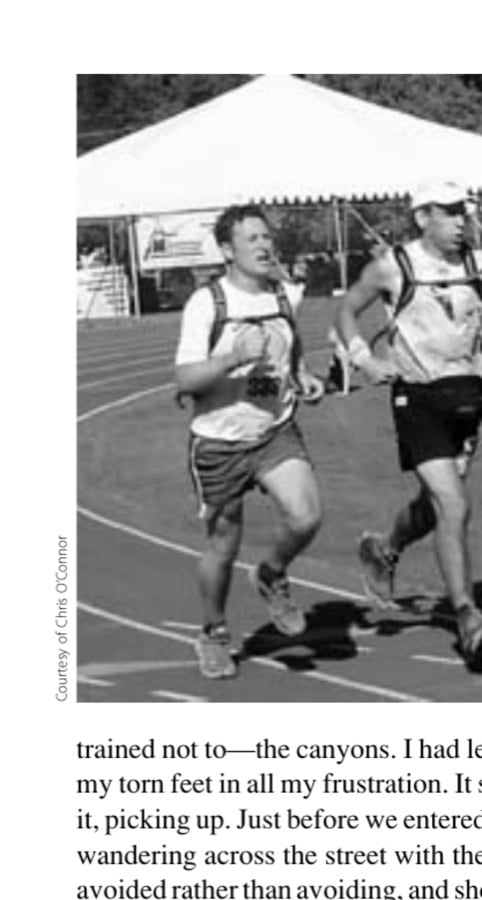
Pacer Steve (left) and his charge, huffing it around the last bend of track at Placer High in Auburn.
or, as it was this day, the angry howl in spite of it. We had one mission left to us, me and Steve. As we were cresting the hill above Robie Point, I told him I needed to run hard. Steve flipped a switch and hurtled
off with me tumbling behind his tracer’s arc with all the grace and malice of an unrifled bullet. This was my anger mile. I missed my silver buckle. I missed my chance to run a well-executed race. I had
broken in the one place I had trained not to—the canyons. I had left only this last raced mile. I kicked at it with my torn feet in all my frustration. It started rough, well below pace, but we kept at
it, picking up. Just before we entered the Placer High track, we startled a spectator wandering across the street with the easy waltz of a person accustomed to being avoided rather than avoiding, and she said something not altogether friendly to our
backs. We hit the track, still pressing; rounded the track, lungs bursting; gasping yes, but now across the finish line. 27:58:38. Brother followed shortly after. Laban ended up getting even a few more years out of Jacob, but Ja
cob finished up there in Haran and left with the gals, only to find Laban chasing after him, all angry and whatnot. Jacob got away, though. He got away after all that. Throughout the previous 28 hours, I’d periodically imagined the finish line,
wondering about the buckle I wanted versus the buckle I’d earn. During Saturday’s daylight hours, the thing was about that buckle. Somewhere in the middle of the night, it ceased to be a matter of a buckle. I love ultramarathoning because it
distills a person to some basic needs. Taxes are a hard thing to worry about when you are having a religious epiphany about a glass of cold water. And as magical as cold water can be, it pales to insignificance next to the sight of the most beauti
ful woman in the world, waiting for me just the other side of the finish line after 100.2 miles. Hell with buckles. That’s the prize, you know. Right there. A woman named Deanne.
This article originally appeared in Marathon & Beyond, Vol. 12, No. 3 (2008).
← Browse the full M&B ArchiveMore like this
1,000+ stories from 19 years of Marathon & Beyond
The complete archive of the legendary long-distance journal — digitized and free to read.
