

Modest Alternative
I’m all for running challenges, be they against the clock, competitors, or distance. In 50 years of running, I have experienced many, from short distances on the track through ultras on the roads and trails. I still jump into races, and the adrenaline flows as much as ever before the starting gun, although at 65 I probably cannot finish a single mile at what had been my average pace for a half-marathon (six minutes per mile) just 10 years ago.
So, although I’ll probably always seek out running challenges, running has increasingly become simply my daily therapy, my recreation—my playtime, if you will. And if a nice long run in a pleasant setting is good, how about stringing together day after day in an idyllic setting? This was my thinking in seeking out long routes that I could cover at my own leisurely pace. I’ll describe four such experiences. If they sound appealing, I would encourage you to seek out your own. Simply tweak the variables to fit your own abilities, interests, and circumstances.
In my case, there were three prerequisites: • A scenic course, free (or relatively free) of traffic • Patience to hold back on days when I felt frisky, always remembering that I wanted to be fresh to start the next day •
A willing, understanding, and loving support person My wife, Nancy, filled the last position. She drove our Sportsmobile van/ camper ahead to meet me at accessible points along the course. A runner herself, she would get in her own, albeit shorter, runs each day along the way.
ALASKA’S DENALI HIGHWAY If you’re looking for something completely different, this one fills the bill. Deep in Alaska’s interior, the Denali Highway is about 135 miles, connecting the small towns of Cantwell (near Denali National Park) and Paxson. Except for a few miles of hard surface at both ends, it is gravel, though there has been talk of paving
it. Depending on maintenance and weather, the gravel can be smooth to tough with potholes and washboard. The highway is open only in the summer months of May through September. The main attraction is the scenery. It offers good views of the Wrangell Mountains and the Alaska Range. There is virtually no traffic, so you are running in a quiet, awesome world. There are several lodges along the way, but if you are in an RV or tenting, you can stop almost anywhere. For this, my first such adventure, I took six consecutive days, averaging about 22 miles a day. The first five days I ran about 14 miles in the morning, took a break of several hours to eat and nap, and then added another eight in the afternoon. The sixth day was rainy and finished with a long downhill, and I was energized at being close to the finish, so I did the entire 22 without a break.
I was also accompanied on portions of the last three days by Doris Heritage, former Olympian, world cross-country champion, and former world record holder for a female debut marathon (2:47:35 in 1976). Doris and I conducted a running camp in Alaska for 10 years. Doris’s husband, Ralph, followed closely that last day because of reports of grizzly bears in the area. (Fortunately, none bothered us.)
Nancy’s typical routine was to drive ahead a couple of miles and wait for me along the side of the road. This means that I didn’t have to carry food, only a single water bottle, and I could discard clothes as the day warmed. Also, in the event of injury, I wouldn’t have too far to walk.
A grizzly bear killed our friends Marci Trent and her son Larry Waldron while they were running on a trail south of Anchorage, so that possibility is ever present in the minds of most Alaska runners—another reason for our “Don’t drive too far ahead” routine.
By the conclusion of this run, I felt exhilarated. Six days of quiet running through spectacular scenery, far from civilization, left me eager to seek out more such adventures.
THE ERIE CANAL Unlike the Denali Highway, everybody has at least heard of the Erie Canal, although today many might not know exactly where it is and why it was built. The 363-mile-long canal was opened in 1825, following eight years of construction. It connects the Hudson River at Albany with Lake Erie at Buffalo. What had been a heavily used wagon route now became a water route between the Atlantic Ocean and the Great Lakes. Westward, it was used to ship manufactured goods and to carry migrants from Europe. Eastward barges were loaded with crops and natural resources. The barges were pulled by teams of mules. For the time, tonnage was tremendous, resulting in the growth of major cities along the route, and the canal played a role in the emergence of New York City as a major world port.
Courtesy of Roy Reisinger
In the early 1900s, a newer, deeper barge canal was constructed. That and the growth of railroads caused the old canal to cease operations by 1918. The newer barge canal is closed to boat traffic in the winter, both by ice and by drainage for repairs; it opens the first week of May, but serious summer recreational traffic
doesn’t show up until after Memorial Day. My interest in running at least a portion of the canal began when friends biked the entire length. The maps they provided showed large portions next to heavily
traveled roads. Eliminating those sections left three portions that were designated as parks, totaling 150 miles. My plan was to run those segments, taking about two weeks. The day before my projected start near Albany, we spent several fruitless and
frustrating hours searching for the canal’s beginning point. While locals might read this and think we were geographically challenged, I can say only that the maps we had were lacking in details we needed, and although we stopped and
asked for directions countless times, the typical response was: “I don’t know. I think it’s over that direction [pointing] somewhere.” We finally decided to bag that entire portion around Albany and Schenectady and move on to the central
section, beginning at Rome and traveling west to Syracuse. This proved somewhat symbolic: the point where I started was the same point where ground was broken on July 4, 1817, for the canal’s construction. What followed was a delightful
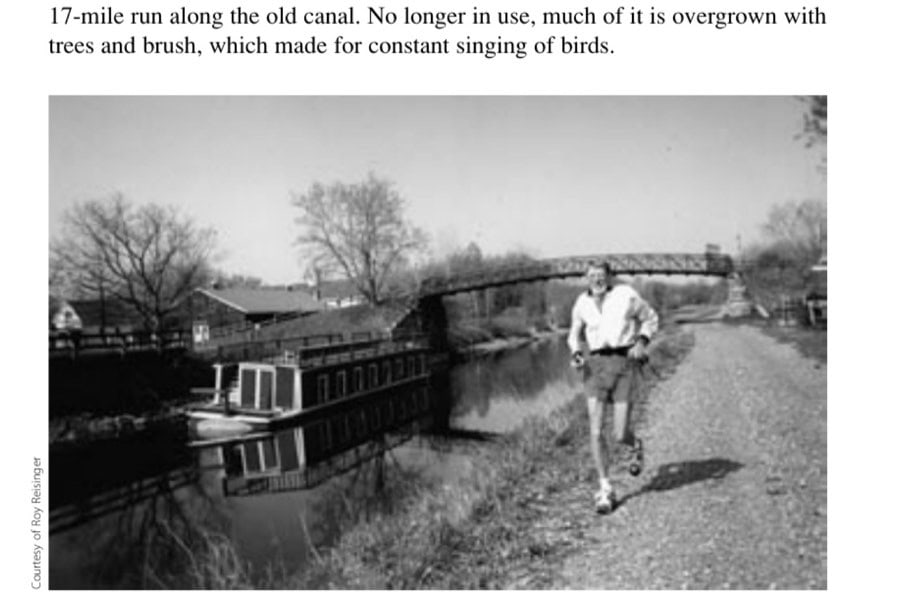
17-mile run along the old canal. No longer in use, much of it is overgrown with trees and brush, which made for constant singing of birds.
▲ The author enjoys a quiet morning along the “old” canal.
The trail itself was smooth dust and gravel, easy on the legs. Unlike my run in Alaska, I didn’t have any concerns about bears, although I carried pepper spray in case I met territorial dogs and in fact used it once for just that purpose. I had to make one backtrack detour for mama and papa Canada geese that wouldn’t let me pass them and their six fuzzy newborns.
The second day I added 17 more miles to reach the outskirts of Syracuse. We then visited the Erie Canal Museum, which gave us a much deeper understanding and appreciation of the land we were traversing.
Following a rest day (which included a seven-mile walk), I put in 16 miles west of Rochester on the new section, which was also made of smooth dust and gravel. It was mostly rural; aside from a lone red fox and another Canada goose confrontation, the scenery was mostly farms and cows. At this point, we had been on the road for almost five months and were missing our daughters and granddaughters back in Oregon. I felt that I had done enough to get a really good feel for the Erie Canal and this area of New York, so I finished off the experience with a five-hour, 27-mile final day. Four days later we were eating dinner with our granddaughters.
This adventure was sort of tacked on to a long trip. Had it been our destination, we would likely have taken more time. Although it was my least favorite of these four, it was still mostly enjoyable and rewarding. We stayed in several beautiful parks along the way.
As I mentioned earlier, the purpose of these runs was to enjoy the scenery and get to know an area. As the experience illustrates, it’s important to remain flexible; by the last day, we had gone from Plan A to probably about Plan J.
JASPER TO BANFF—THE CANADIAN ROCKIES The Icefields Parkway through the Canadian Rockies has to be one of the most scenic roads in North America. From its northern end in the small town of Jasper, Alberta, it proceeds southeast through Jasper and Banff National Parks to the larger resort town of Banff. No matter where you are along the route, the snowcapped Rocky Mountains tower over you on either side of the road. In spring, all that snow melts into gorgeous rivers and emerald-colored lakes along the way. Some of these lakes, such as Lake Louise, are major tourist attractions, as are the famous lodges built by the Canadian National Railroad. I f
irst became familiar with this highway when I ran in the Jasper-to-Banff (J2B) Relay. This event was organized by the Chasquis Running Club of Edmonton and was limited to 125 teams of 17 members, each running one leg averaging 10 miles each. After 25 years, the event was discontinued several years ago because of an increasing number of logistical restrictions. I had befriended Chasquis team members when they had traveled north for the annual Klondike Relay
Courtesy of Roy Reisinger
(from Skagway, Alaska, to Whitehorse, Yukon Territory). When they extended an invitation to join them in the J2B, I eagerly accepted, ultimately running with them for four years. Incidentally, having participated in a number of similar relays in different areas
of the country, I highly recommend this kind of adventure as a way to make new running friends and see different areas of the country. Although I had thus sampled portions of this awesome road, it was sometimes
in the dead of night and always under the competitive pressure of running well for my team. I dearly wanted to soak it all in at my leisure. So early on a May morning, I jogged south out of Jasper. Spring comes late to this area, partly because of the northern latitude but also
because of the altitude, which is mostly between 5,000 and 7,500 feet. Prior to May, it’s essentially Winter (with a capital W), and in the months of June to August, the Jasper-to-Banff road is busy with traffic—cars, tour buses, and rented
motor homes—so May proved to be an ideal time. Mornings were crisp. I began with warm-ups and gloves, which I discarded as the day warmed. As in the Denali Highway run, I ran twice a day for a week, averaging about
24 miles a day. Nancy typically drove ahead about two miles at a time and enjoyed reading at one of the many scenic turnoffs, next to the sound of a river or at a lookout point, with the ever-changing mountain scenery always vying for her at
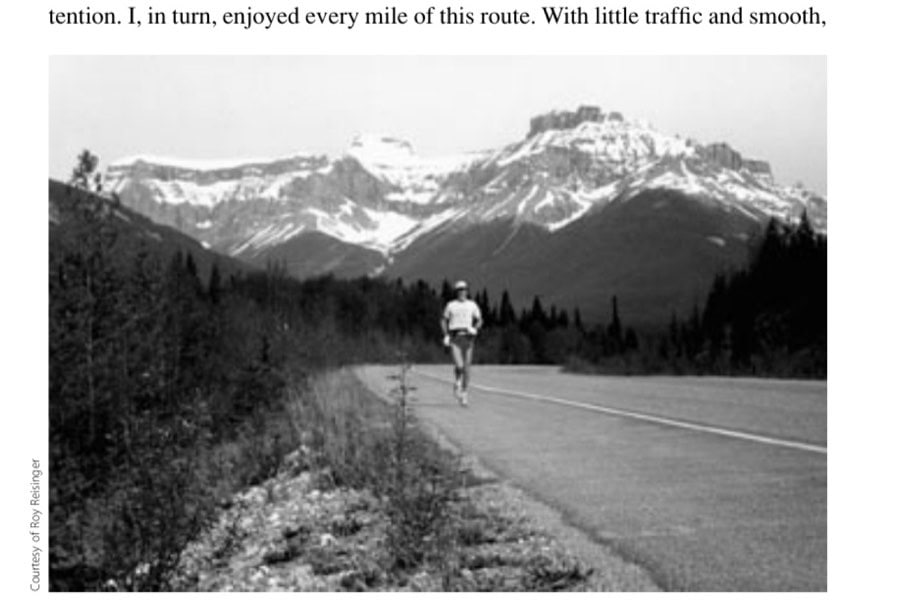
tention. I, in turn, enjoyed every mile of this route. With little traffic and smooth,
▲ A glorious morning run for the author in the Canadian Rockies.
wide shoulders, the road allowed me to gaze continuously at my surroundings. (For those who scoff at the idea of running along a road rather than getting off onto the trails, let me say that I enjoy trail running tremendously and in fact do most of my miles on quiet trails. However, on many trails, especially rocky and root-filled ones, you must keep your eyes down, otherwise face plants and turned ankles are inevitable. The trade-off here is more than fair.)
Although we had seen many bears in this area and had had some tricky encounters over the years in the relay, we had no problems. I saw numerous elk and gave them a wide berth, as park naturalists recommended during birthing season.
There are, of course, the world-famous lodges at either end of the highway and at Lake Louise. Both Jasper and Banff, as tourist destinations, have a wide selection of motels. We stayed in the numerous campgrounds along the way; since it was May, they were almost vacant, whereas during the summer months they fill with hundreds of RVs and tenters. (And bikers; during the summer, these parks and the adjoining Yoho, Kootenay, and Glacier National Parks are popular for long biking tours.)
Running the Jasper-to-Banff Highway allowed us to experience it in a unique way. It is one of our favorite places, to which we return each year.
THE KATY TRAIL As a runner, I’ve sometimes envisioned heaven, if there is such a place, as a long, soft trail meandering endlessly through a tunnel of autumn-hued trees. The Katy Trail in Missouri comes awfully close to matching this vision. “
Who is Katy” you ask, “and why is there a trail named for her?” Railroad buffs will recall the Missouri-Kansas-Texas Railroad (MKT), which was shortened to K-T, then to Katy. When the line ceased operation in 1986, Rails-to-Trails advocates seized the opportunity and, despite opposition from some landowners, eventually won out. If you’re not familiar with Rails-to-Trails Conservancy, it’s a nonprofit group that works to develop abandoned rail corridors into recreational trails. There are now 1,200 or so in the country, at least one in each of the 50 states and an increasing number in other countries. (Friends of ours recently biked a delightful 200-kilometer Rails-to-Trails path north of Montreal, which is now on my someday-soon list.) Chances are that you’ve run on one and not even realized it.
The Katy Trail, at 225 miles, is the longest Rails-to-Trails path in the country. If you begin in St. Charles in the east, at the confluence of the Missouri and Mississippi rivers, the first 150 miles along the Missouri River are also the first miles of the Lewis and Clark Trail. When the river curls to the north, the Katy Trail continues southwest across another 75 miles, most of the way across the state, to the small town of Clinton. My own three-week journey began in Clinton and ran west to east.
Courtesy of Roy Reisinger
The trail itself, usually 12 feet wide, is constructed of chat, which is finely ground limestone. It’s hard enough for comfortable biking, even with skinny tires, but easy on the legs for running. Before starting, we decided that renting a bike would be a good idea so Nancy
could accompany me on longer portions of the trail. The bike-shop owner pointed out that it would be cheaper to buy the bike (a four speed) than to rent it for three weeks and then sell it or keep it as we preferred. This we did, a good idea both logistically and financially.
I decided to run once a day and take some planned rest days. I began with runs of 14 miles, 21, rest, 12, and 23. The miles are marked, and I averaged a nineminute-per-mile pace, plus short walking breaks after each marker. As with other such adventures, the idea was to finish each day feeling fresh for the next day.
From the start, I was struck by the simple beauty of running through an endless tunnel of trees. Although the trail runs through many wooded forests, much is over farmland. The right of way along each side is heavily treed, so even though you might be crossing a field of wheat or corn, the illusion is that you’re crossing
through long woods. My experience was undoubtedly heightened by choosing the month of October, when the leaves were turning to red and gold. Reaching Booneville on the Missouri River, we drove the short hop over to
Kansas City and picked up our twin daughters, Julia and Tracy, who had flown in
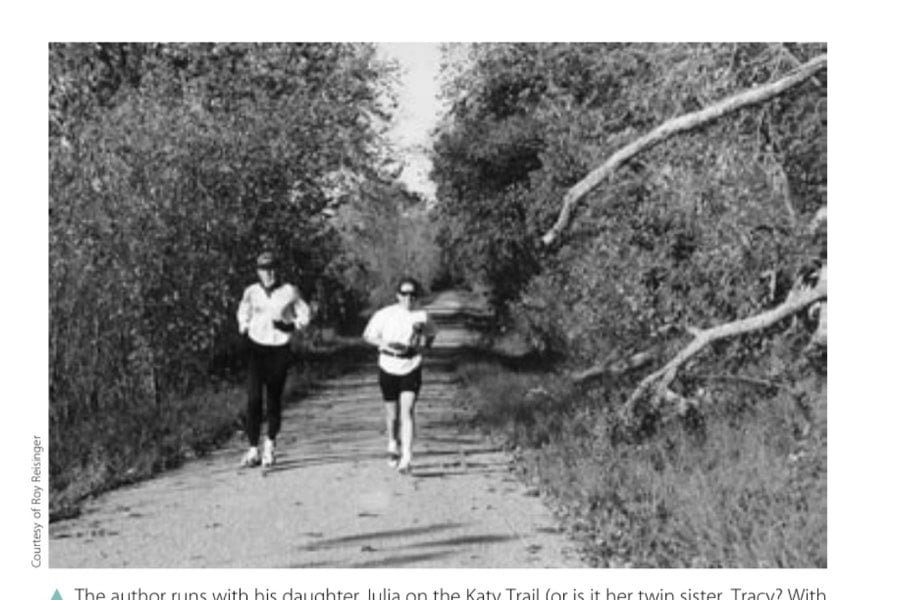
▲ The author runs with his daughter Julia on the Katy Trail (or is it her twin sister, Tracy? With twins you can never be certain.).
from Portland to join us for the last two weeks. Now it became a family affair, which raises further possibilities for this type of adventure. From Booneville to the end of the trail, I ran in almost every conceivable configuration: with both daughters, with one daughter, with the other daughter, with both daughters, with Nancy riding the bicycle, and so forth. In the evenings, we shared the cost of a motel room.
Besides running, we took in many cultural and historical attractions along the way. To begin with, the many small towns the trail passes through were charming. Their existence in most cases was due to the railroad, but they now have their own unique personalities. For example, Booneville hosts a number of festivals, including the Big Muddy Folk Festival in April and the Missouri Festival of the Arts in August. The town of Hermann has German festivals almost every summer weekend and an Octoberfest that drew a big crowd at the time we passed through. Sedalia, which was the end of the famous Texas longhorn cattle drives, is home to the Scott Joplin Ragtime Festival in June and the Missouri State Fair in August. We timed our passing through Hartsburg to coincide with its annual Pumpkin Festival.
Many might not be aware that Daniel Boone came to Missouri in 1799 and lived there until his death in 1820 at the age of 86. We enjoyed a visit to his house and gravesite at Boonesfield Village, near Defiance.
Near Augusta, you might want to visit any of the many fine wineries. They are especially busy on weekends. I enjoyed seeing the many former railroad terminals. Sedalia has a railroad museum, and outside the former MKT depot in Booneville is a neat caboose museum.
And, of course, the Lewis and Clark Trail. During that portion of our trek, we took pleasure in reading of their travels through the same area, and their boats were very much in my mind when I ran next to the Missouri River. A number of sites commemorate their camps, including their start, which was our finish, in St. Charles.
By trip’s end, I had taken 21 days to reach St. Charles, including four rest days. Considering the scenery and all the attractions along the Katy Trail, I have to say that it was my favorite adventure run so far, and one that I wouldn’t mind repeating. If you’re interested in this one, be sure to purchase a copy of Brett Dufur’s excellent Complete Katy Trail Guidebook, which he revises every year (Pebble Publishing, Inc., P.O. Box 2, Rocheport, MO 65279; 800/576-7322; www. pebblepublishing.com).
So there you have it: four distinctly different running adventures in four unique North American localities. I’m always on the lookout for more—so many possibilities, so little time! Seek out your own, and enjoy the world on the run.
This article originally appeared in Marathon & Beyond, Vol. 10, No. 4 (2006).
← Browse the full M&B ArchiveMore like this
1,000+ stories from 19 years of Marathon & Beyond
The complete archive of the legendary long-distance journal — digitized and free to read.
