

More Bang For A Buck!
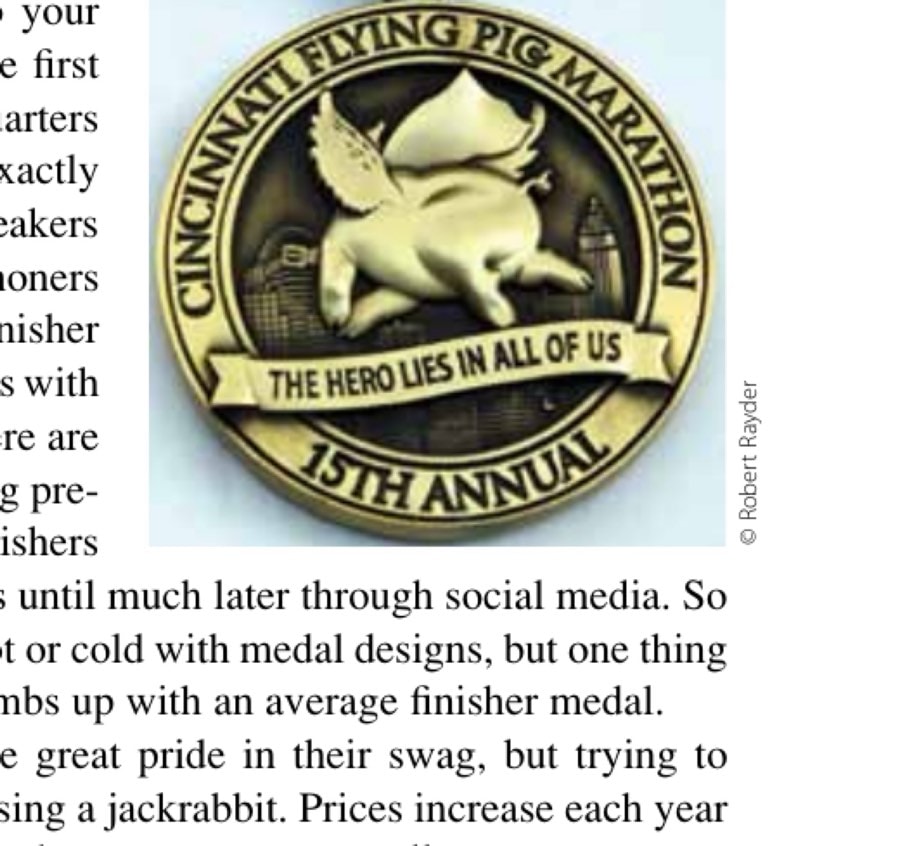
Swine fever Three things brought me to Cincinnati: my childhood love of the “big red machine” (baseball), Skyline Chili, and of course, my highest priority—the Pig finisher
© Robert Rayder
Imagine one morning walking into your den, cup of coffee in hand, and the first sight you behold is a pig’s hind quarters mooning you from your wall. It’s not exactly good motivation for putting on your sneakers for your a.m. run, or is it? Many marathoners have a crazed addiction to collecting finisher medals and are naturally drawn to races with distinctively designed keepsakes. There are several different types of medals being presented at finish lines, yet the tired finishers don’t usually comment on their prizes until much later through social media. So what are runners saying? It’s either hot or cold with medal designs, but one thing is certain: no marathon will get a thumbs up with an average finisher medal.
Most marathon organizations take great pride in their swag, but trying to keep up with a marathoner is like chasing a jackrabbit. Prices increase each year in our technology-driven society. Marathon rates go up as well, so runners want first-class medals in return. But how many race directors (RDs) know that you can produce two-sided medallions for about one dollar more per average-priced medal? Not enough, obviously, or more marathons would likely be jumping on the medallion bandwagon. I scratch my head in bewilderment thinking of the wasted space on the back of medals that cry out for creativity. Those organizations that go the extra mile with well-done medallions will attract new runners who will fly cross-country to run their events. I did just that for the Flying Pig, and most will agree upon one thing: everyone wants to run the Pig!
medal. Why the Flying Pig? Executive director Iris Simpson-Bush elaborates: “In the 1800s Cincinnati had a thriving meatpacking industry. Farmers brought pigs to market, sometimes on riverboats, and literally ran them through the streets to the stockyards. The city was often called ‘Porkopolis.’ We think we’ve had some great themes through the years: ‘Get Jiggy With the Piggy’; ‘Run Amuck’; ‘Wee, Wee, Wee’; ‘Hightailing It’; and this year’s theme was ‘Pigcasso.’ The medal has been two sided since year one, and people have come to expect the ‘big, fat pig butt’ to be prominent and incorporated into every year’s theme.”
Along with Portland and Running for the Bay, the Flying Pig has been in our Top 25 every year, in large part due to the medallion’s two sides. At worst, the cost per participant for a medallion is the price of two small lattes. I looked on the back of my 50 marathon-finisher medals and found that two-thirds of my medals were not maximized to their full potential—half were completely blank and the other half had “finisher” or blank areas for inscribing a name and finishing time.
Les Smith, Portland’s race director, gave his opinion on back-of-medal inscriptions: “In my judgment, seriously, less than 0.01 percent are ever inscribed. I observed a kiosk at the RnR Portland Half-Marathon where inscriptions could be done to a medal for $20. Nobody used it—nobody. Runners don’t carry money for that. Think about it: you are at home after a race, admiring your medal, assuming it is nice and not a piece of junk, and you think, Gee, I should have mine engraved. Where do you go? A jeweler? What will that cost? Send it somewhere? Thinking about all this is a deterrent. So it is a waste of good space to put an area on the back of a medal for engraving.” Smith knows what he is talking about, as Portland had the 2012 number one medal. Medallions are currently few and far between among marathons, but other types of medals are given out to runners. Many have merit and some are just plain funny.
Out of the frying pan and into the fire How many RDs do you know who greet their runners with, “Welcome to COOKeville. I hope your will is in order?” In a normal world, that would be zero, but there is always one odd man out in life. His name is Joshua Hite, RD of the Blister in the Sun Marathon, where misery loves company! Most RDs do not pray that the weather cooperates by reaching 95 degrees with 95 percent humidity or are disappointed when there is cloud cover. Then again, how many registered marathoners receive e-mail updates pointing out their stupidity, addressing them as “Masochists,” or calling them “suckers” if it’s their first marathon, sent and signed by “the Sadist”? Hite is likely the lone wolf here, but he certainly makes it clear that it was a foolish move for runners to register for his race by reminding them that it’s not too late to come to their senses before the torturous August event.
© Robert Rayder © Robert Rayder
Hite doesn’t let runners suffer alone. He has won his race every year with the exception of 2013, when 14-year-old Chris Rayder finished the Blister in first place. His father, Robert, a three-time finisher himself and the photographer of the
M&B medal series, said this about the race: “Together the three Hs (hot, humid, and hilly) make this one of the most insane races yet conceived by the twisted mind of man. Having a race with searing hot industrial roads that have little to
no shade with 4,700 feet of elevation is just plain nuts! There is nothing to look forward to but empty parking lots with zero spectators.” Amazingly, the race has grown steadily each year to nearly 100 per race with only four DNFs in its his
tory. Hite thought: They probably decided to opt out to drink beer and taunt the remaining fools running the five figure-eight loops from Hell. So what’s the reward for bearing the wrath of Hades for 26.2 miles? In keeping
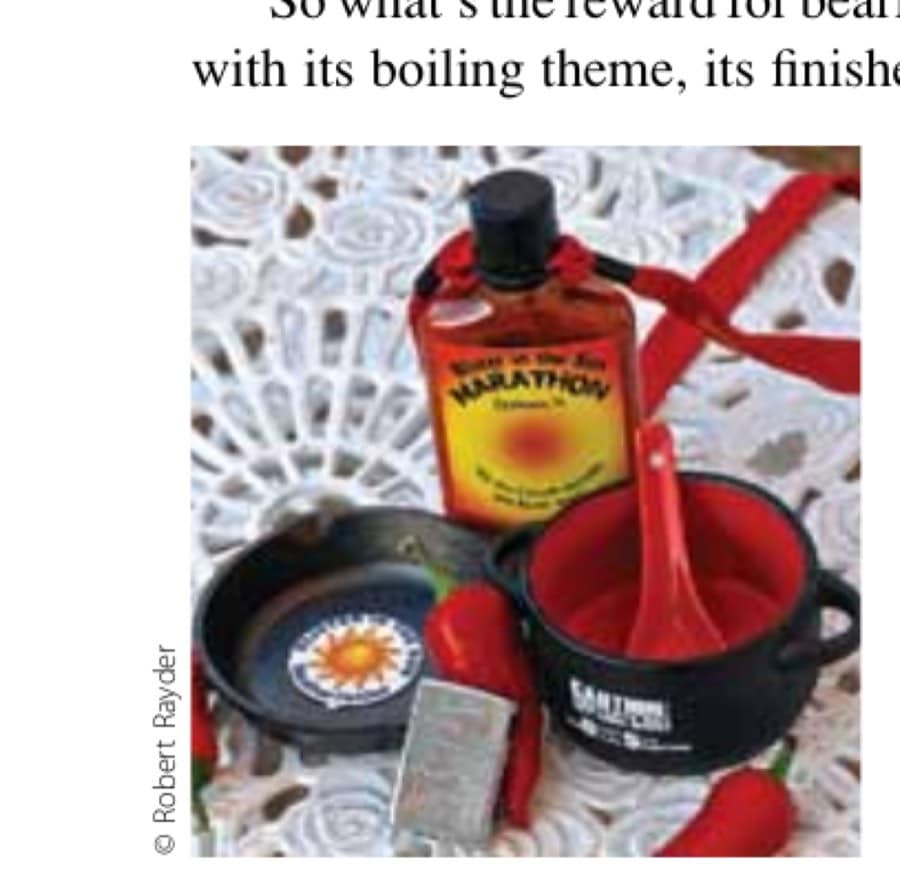
with its boiling theme, its finisher medals have been a Zippo lighter, a cast-iron skillet, hot sauce, and a chili pot. These types of medals can be best described as “eccentric medals,” but in a good way. Hite adds: “I cannot
think of any marathon where finishers can use their medals for something useful, like eating. I didn’t want a medal that was hung up and forgotten about. The only real use the rest of my medals have had was awakening me while
clanging together during an earthquake.” I guess running marathons can prolong your life, if you survive them to begin with! This Tennessee race is a must for someone wanting a challenge, but it’s probably not on the bling checklist of the
average medal chasers, who generally prefer their prizes on hooks in an orderly fashion. The Blister is not the only agonizing marathon with a unique prize. The 7,200-plus-foot elevation Blue Ridge Marathon in Roanoke, Virginia,
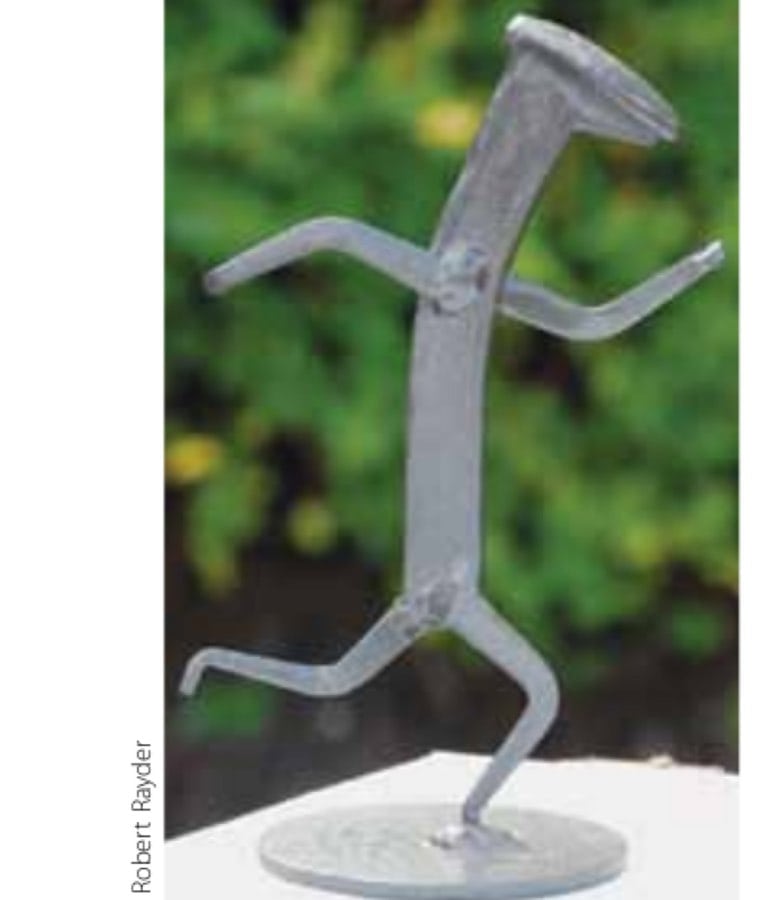
gives out railroad spikes shaped like a runner. Event founder Pete Eshelman explains: “The spikes are recycled from the Norfolk Southern Railroad, and then a local high school welding class actually bends and welds the arms/legs on
as part of a class project. The railroad spike is a nod to our heritage as an old railroad town.” Another marathon that goes against the norm is the Calgary Marathon, which gives out belt buckles, something normally reserved for ultramarathons.
Event director Kirsten Fleming talks about the marathon’s buckle: “They are made from recycled metal and in the true spirit of the Calgary Stampede Cowboy. The buckles were a hit and were spotted everywhere in town. The only complaint: some cowgirls had a hard time keeping their pants from sliding down because they are heavy duty! The 42.2 on the buckle represents kilometers for a marathon, so if you’re wearing this belt buckle and another cowpoke gives you the nod, you know that they are in the know!” You have to love Calgary’s originality in steering away from traditional medals of the past.
When I think of classic radio, I envision the Waltons sitting around in their living room listening to the radio, yet today’s FM stations consider ’70s music classic. Coincidentally, that is when a couple of events started giving out finisher medals. History helps shape the future; the same goes for medal manufacturing. Some event directors do not want to mess with history. If it’s always been done that way, why change things? New York City epitomizes medals that are probably best categorized as “classic” with skylines, bridges, and landscapes adorning its designs.
Fifteen years ago, classic medals were very much the norm. Many marathoners probably have copper or steel medals in their collections, though they probably don’t stand out hanging on a wall anymore. Most marathons now are changing with the times and moving away from the one-dimensional circular or square medals of the past. Upgrading the shape and metal coatings, yet keeping the community images and traditions intact, is now the goal. Some cities, like Toronto, prefer the clean, slick look from yesteryear. Many European and Canadian marathons agree and stay consistent with their designs from the past while tweaking them just a tad. Toronto has stayed old school but does produce a 4.5-inch, 2-pound medal. Its finishers should probably hammer a nail into a load-bearing wall before hanging them up! “Don’t fix what is working” is Detroit’s motto, as it has remained in our top 25 with the same city-icon design each time, changing only the car model each year.
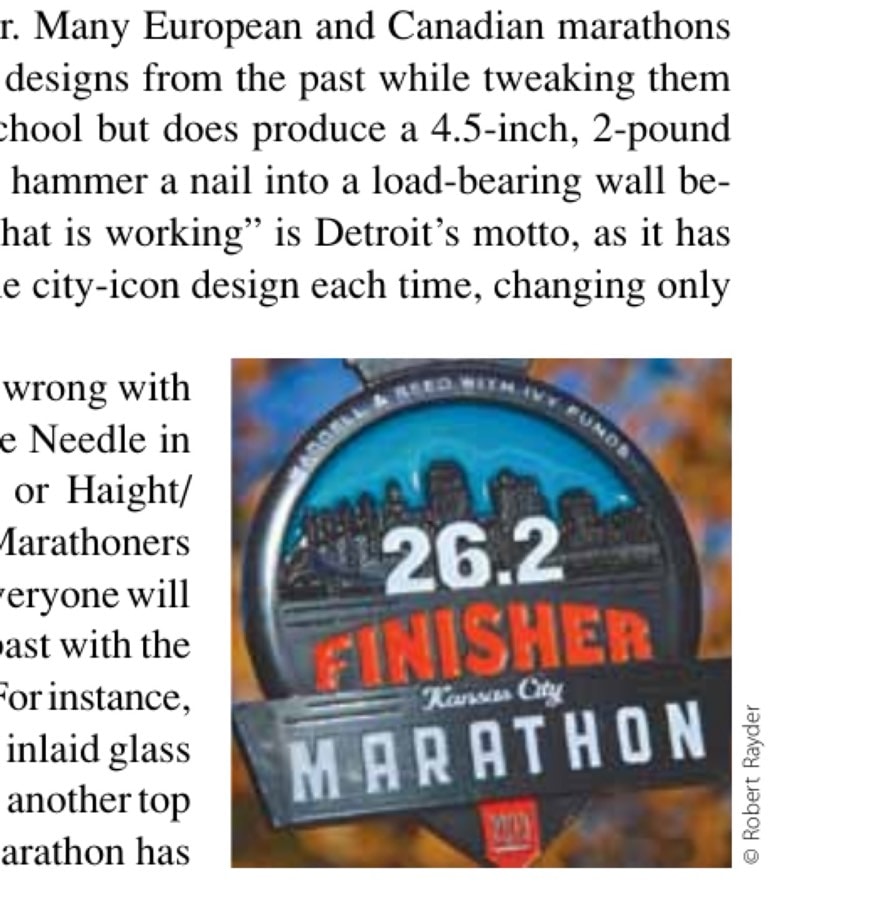
Some RDs feel that you can’t go wrong with recognizable icons such as the Space Needle in Seattle or the Golden Gate Bridge or Haight/ Ashbury Streets in San Francisco. Marathoners can sometimes be fickle, but nearly everyone will be happy if the RDs incorporate the past with the present to get the best of both worlds. For instance, Austin began producing medals with inlaid glass surrounding its city icons and created another top 20 gem in 2013. The Kansas City Marathon has
© Robert Rayder
Playing the oldies
© Robert Rayder
run since the late ’70s and has evolved with the changing times. Finishers were awarded the basic medals of yesterday back then, but the 2013 medal incorporated a sky-blue glass above the cityscape into the design.
Sarah Dee, director of events of the Kansas City Sports Commission and Foundation, adds this: “[Because] we are the City of Fountains, we changed the look each year based on a particular fountain. However, we realized that we
were losing a lot of branding and marketing opportunities. So a few years ago we decided, with the help of our marketing and design firm, to keep our current logo and changed the design and concept of the medal each year instead. It has
really helped us, as we have been able to create a unique and attractive medal. In years to come, we want to use Kansas City as being the barbecue capital of the country. We want our runners to taste, feel, and be enveloped by barbecue.”
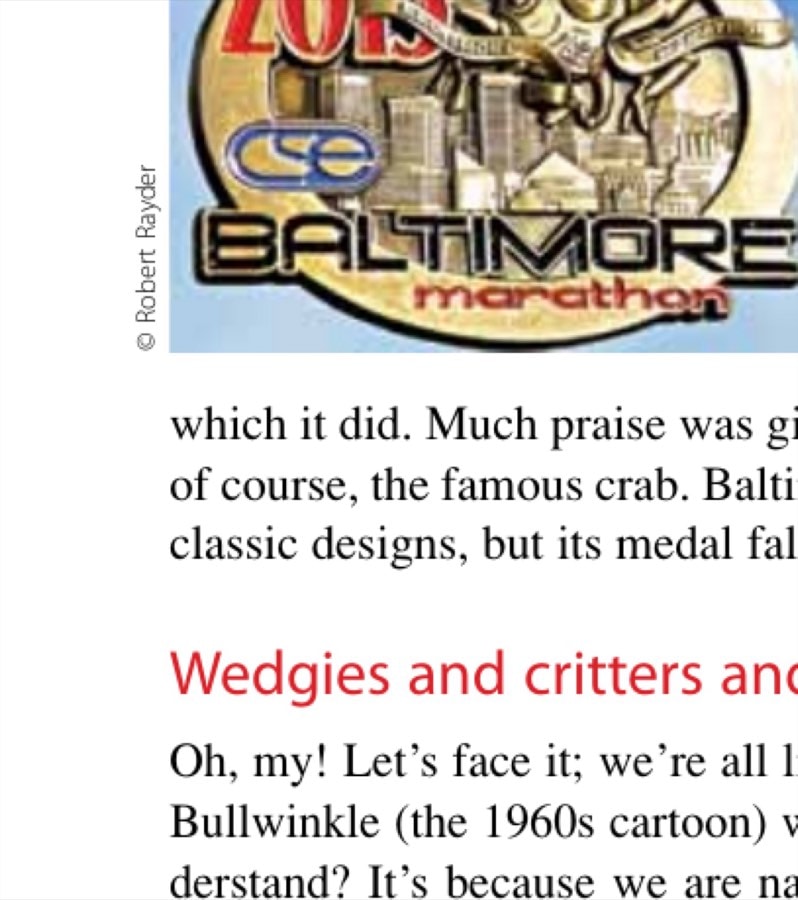
The Baltimore Marathon originated in 2001 with its first medal reflecting that era’s style with two runners, a skyline, and a bridge as its design. Two years later it added “Blue, the Happy Crab” as the marathon mascot to its
design and started producing color medals in 2005. Like many marathons, it used sponsor logos on its medals to help pay for the race and has used a handful of organizations to date. The trick is making the logo unobtrusive,
which it did. Much praise was given to its 2013 medal with the city skyline and, of course, the famous crab. Baltimore has progressed well over the years with its classic designs, but its medal falls into another genre as well: critters.
Wedgies and critters and hares Oh, my! Let’s face it; we’re all little kids at heart. Have you ever wondered why Bullwinkle (the 1960s cartoon) was written with wit that only an adult could understand? It’s because we are naturally drawn toward flying squirrels, pigs, and
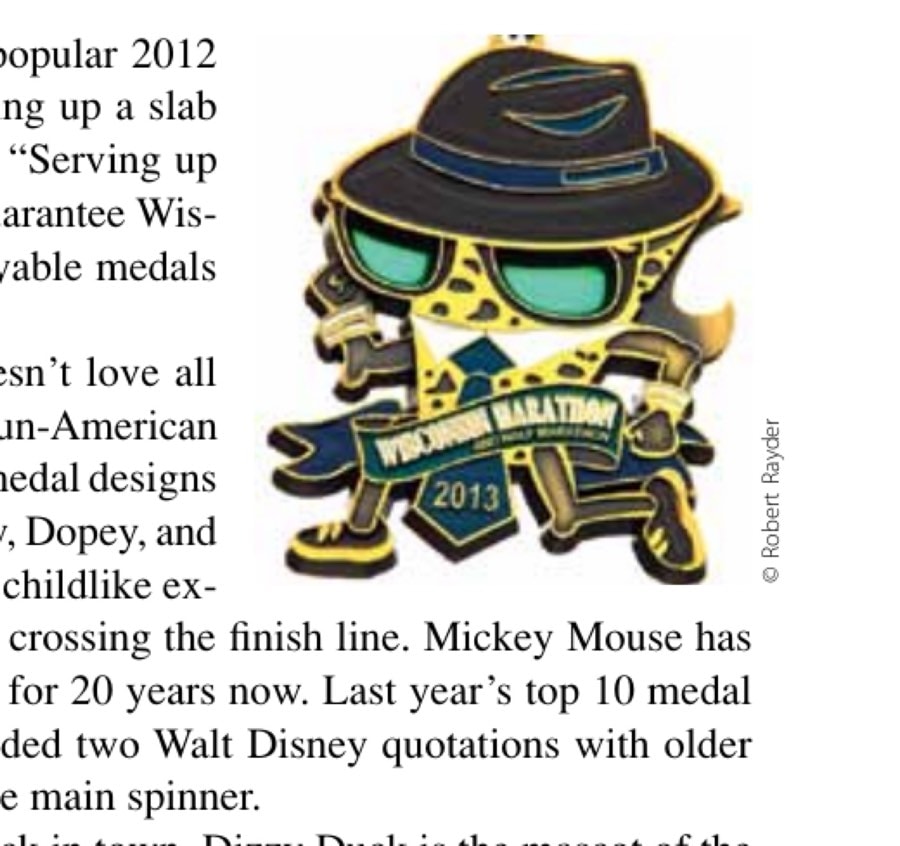
monkeys! The Wisconsin Marathon clearly understands this mentality. The organizers changed its medal from a hunk of cheese to one that is fashioned as a Blues Brother cheese runner nicknamed “Wedgie.” Race director Jonathan Cain says: “We
tried to play up the Blues Brothers theme as much as we could last year. We had a Blues Brothers cover band at the postrace party and Blues Brothers race shirts, and it was a really popular logo among runners.” The medal was a high-quality
design with inlaid green-glass sunshades that could also be used as a bottle opener. Wisconsin purposely combined its cheese theme with creative cartoonish characters, thinking its originality would land its race medal in our top 25. Cain
and company were perceptive as Wisconsin has made our list twice now, even
Theories of “medaltivity” Obviously, we are not splitting atoms here, but genius can be as simple as a belt buckle. Innovation goes a long way toward winning the hearts of runners. A smart
© Robert Rayder
after a complete redesign from its popular 2012 medal, a 1950s-diner waitress holding up a slab of cheese. The theme that year was “Serving up the cheesiest marathon.” You can guarantee Wisconsin will continue to design enjoyable medals in the future.
Speaking of enjoyable, who doesn’t love all things Disney? It would almost seem un-American for a marathoner to neglect earning medal designs featuring Donald Duck, Pluto, Goofy, Dopey, and Minnie Mouse. Its images represent childlike excitement, much like the euphoria of crossing the finish line. Mickey Mouse has been awarded to marathon finishers for 20 years now. Last year’s top 10 medal featured a double spinner that included two Walt Disney quotations with older and newer versions of Mickey on the main spinner.
Disney doesn’t sport the only duck in town. Dizzy Duck is the mascot of the Dizzy Daze 12-hour run that takes place around a 3.2-mile loop of Green Lake Park in Seattle. You have a choice on distance, so you can walk away with its keychain medal after a mere 28.8 miles, which marks the marathon finish. The keychain is multipurpose—you can use its mileage chart on the back, or it can also open up a frosty beverage after the race. Since runners tend to live active, productive lives, the keychain can travel about in pockets and handbags around the world rather than sitting quietly at home.
There are dozens of marathons sporting critters on their medals because, let’s face it, nearly every runner loves a whimsical, colorful memento. Many of us are familiar with Aesop’s fable “The Tortoise and the Hare.” If you want those critters on your medal, you can run the Prairie Fire Marathon, which uses “Sparky the Blazing Rabbit” as its mascot, and the Cayman Islands Marathon, which has a running turtle wearing tennis shoes! The list goes on and on as new marathons pop up every year with cartoonish medals. There is the “Running Chicken of Baton Rouge Beach,” the wooden Flying Monkey medal, Monster Mash’s Frankensteinlike image, and even aliens with the Martian and the E. T. Full Moon Midnight marathons. Other races sport gophers, frogs, harbor seals, groundhogs, lobsters, and roosters. The Top of Utah’s moose has been popular with our panel members for the past two years. If a race wants to attract runners economically, then a clever, multicolored critter medal seems to be a good choice.
© Robert Rayder
idea will remain smart as long as the technology stays current and is improved upon where possible. An unusual idea sparks interest, and avant-garde medals are on the rise. Thinking outside the box can reap great rewards, if the medals are
manufactured correctly. A1A Lauderdale once again is our panel’s winning choice, repeating its 2010 hinged-clam victory with a 2013 sea-horse locket. These, along with its third-place 2011 opening-turtle medal, showed amazing creativity. But
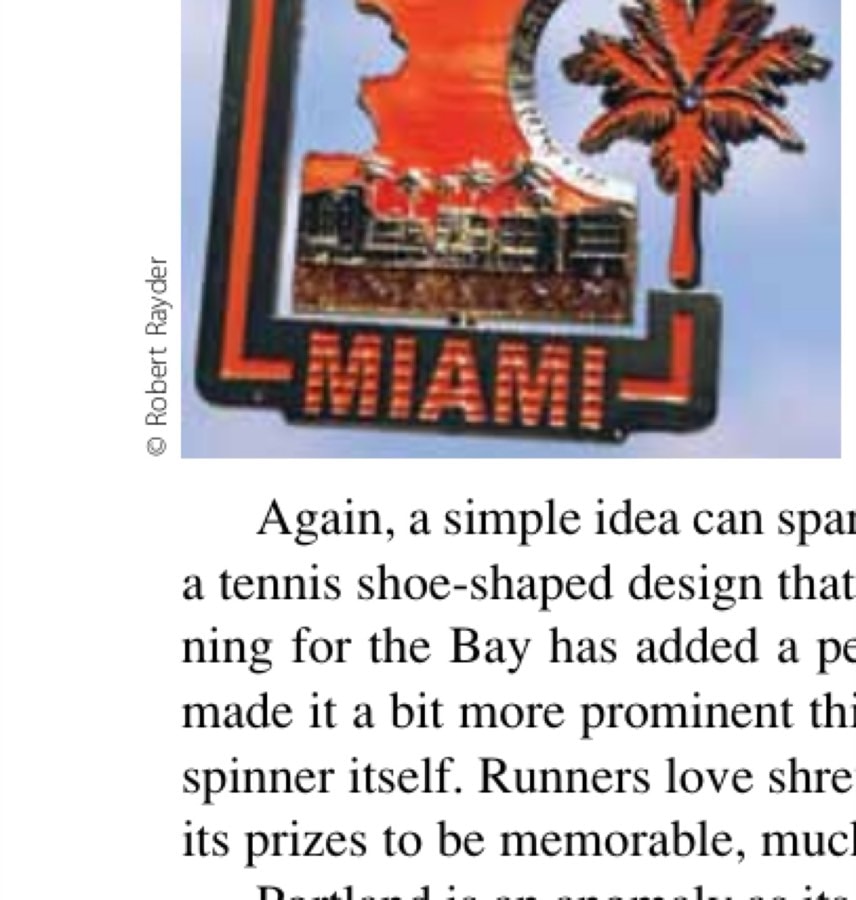
A1A is not alone in being inventive. A decade ago, the Miami Marathon believed they were the first to introduce spinner medals to marathon finishers. These types of designs have been so popular that Miami felt it had to outdo
itself with its 2014 design, which features three spinners that spin three different directions, like a gyroscope. The Miami Marathon, which has been in our top 10 and an honorable mention, continues to tinker to try to stay ahead of the
pack. In 2013 the design was a night-and-day scene spinner that had actual sand incorporated into the medal to represent the beach. Again, a simple idea can spark heavy praise. The Mother Road Marathon has
a tennis shoe-shaped design that used real shoelaces tied onto each medal. Running for the Bay has added a pearl to its medal since its inception in 2010 but made it a bit more prominent this year by putting the pearl inside a clam on the
spinner itself. Runners love shrewd thinking; it tells them that a marathon wants its prizes to be memorable, much like finishing a marathon is. Portland is an anomaly as its medallion could also be considered avant garde
in 2013 due to a major change in design mirroring the Maltese Cross. The four arms of the cross represent prudence, justice, temperance, and fortitude: sounds like a marathon runner to me! It took guts for Portland to change a 30-year tra
dition of coinlike medals, but it clearly demonstrated that a marathon can have fresh ideas and continue to be voted into our top 25. Other bright ideas are the glow-in-the-dark medals from the E. T. Full Moon Midnight Marathon and RnR
Vegas. The idea of blinking LED lights was not a flash-in-the-pan concept for a medal by Quebec City Marathon a few years ago, as Atlantic City has used a similar design that has become popular with its runners. So remember, avant-garde medals work if overthinking isn’t involved.
A stop at Willoughby Have you ever traveled cross-country by train? It’s an exhausting adventure where dreams of arriving at your final destination stay foremost in your mind as
ad
© Robert Rayder
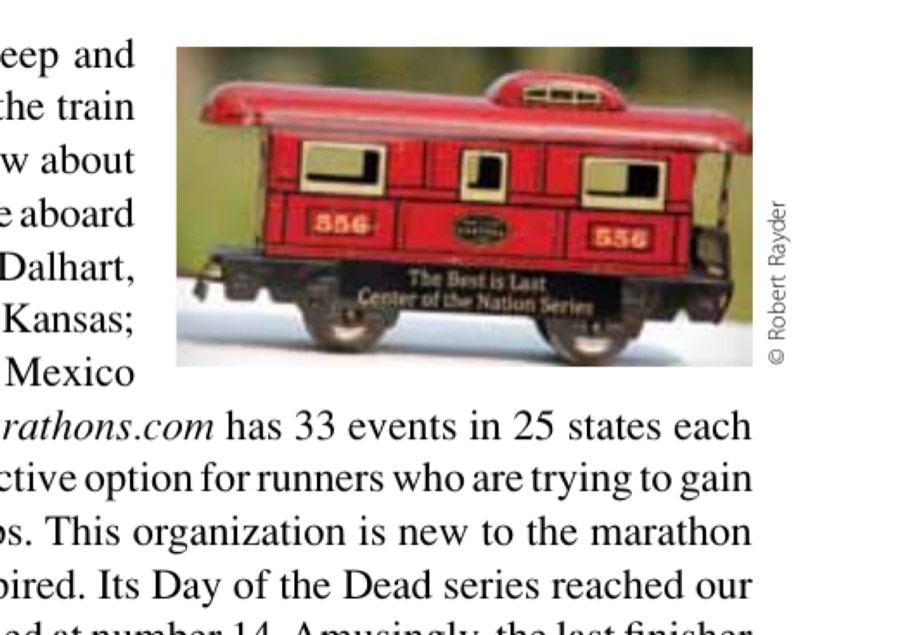
you drift back and forth between sleep and reality. Many riders want to get off the train in each state to stretch their legs. How about running a marathon instead? Welcome aboard the Dust Bowl Series with stops in Dalhart, Texas; Guymon, Oklahoma; Ulysses, Kansas; Lamar, Colorado; and Clayton, New Mexico on five consecutive days. MainlyMarathons.com has 33 events in 25 states each year whose marathons are a cost-effective option for runners who are trying to gain entry into one of the 50-states groups. This organization is new to the marathon world with medals that are truly inspired. Its Day of the Dead series reached our top 10, and the Dust Bowl series landed at number 14. Amusingly, the last finisher of the Dust Bowl or Center of the Universe Marathons receives a train caboose. Dust Bowl race director Clint Burleson adds: “On the first day, one couple was coming in last, and in a great show of sportsmanship, the fellow pushed his girlfriend across the finish line ahead of him so he would win the caboose.”
Series marathons have always been a big attraction for runners. No series is larger than the Rock ’n’ Roll marathons with their multitude of extra medals. But there are many other local series across the United States, such as the Maryland Double, the California Beach Series challenge, or the new Florida Storm series
with its motto “the more you run, the bigger the bling.” It’s a simple formula as several marathons get together and give out a series medal if a runner runs each of its marathons. The Cowtown Marathon had a five-year series plaque from 2009 through 2013 to encourage runners to run every year. Each year a wedge medal was earned that fit snugly into its plaque. For 2014, the organizers continued this idea by creating a spur plaque for finishers with bronze representing the first year, followed by silver in 2015 and gold in 2016. The plaque even has slots at the bottom two corners where wedge medals from 2012 and 2013 can be added. Along the same lines, Space Coast, a top 25 medal for three straight years now, recently started a five-year series with the Columbia Space Shuttle that will continue with Challenger, Discovery, Endeavour, and Atlantis.
End of the line Imagine happily reaching the finish line and then having that smile turn upside down after receiving a miniature medal. Well, that happened to me at a marathon whose medal had been top-notch the previous year. The first thing I told my presenter was: “I think this is the relay medal; I ran the full marathon today.” You could tell by her expression that I was not alone in my surprise that day as she informed me that it was, indeed, the final memento of my 26.2-mile journey. This should never have happened because manufacturers, if time allows, normally send sample medals to RDs, and it would not have cost much extra to increase its size. Finisher medals generally take up a small percentage of the money needed to run a marathon, so if the medal is lacking in any way, RDs should upgrade it.
The bottom line is that the runners deserve memorable keepsakes, and one more dollar can provide spectacular results. We are an ever-changing society, and everyone has personal preferences, so it’s important to listen to the finishers and adapt if need be. The buck stops with the race directors’ choices, whether they be medallions, critters, avant-garde designs, eccentric, classic, stone, glass, wood, or series medals. In a perfect world we would be presented Olympic gold medals, but in reality, we want the next best thing.
This article originally appeared in Marathon & Beyond, Vol. 18, No. 3 (2014).
← Browse the full M&B ArchiveMore like this
1,000+ stories from 19 years of Marathon & Beyond
The complete archive of the legendary long-distance journal — digitized and free to read.
