

There are very few sports that you can both participate in as an athlete and cover as a journalist at the elite level. NFL reporters don’t switch between typing out their reports in the newsroom and tossing a few passes around with their favorite team at practice the next day. And while you might see an Olympic medalist working as a journalist now and again at a world championship or Olympics, it’s a small and very elite class: those lucky few that possess both supreme athletic talent and the journalistic acumen (and for television personalities, the charisma and looks) to excel at the profession after their competitive careers wind down.
That’s why I get such a kick out of covering elite marathons. First, a word of caution as this yarn begins: there is nothing “elite” about my own marathon performances. I’ve finished 14 of them—13 official finishes, with the medal and the T-shirt and the sore legs for a week, and one long-ago stint as a Boston bandit 20 years ago in college. Running was never something I did to win anything, because if that had been the goal, I would have been a colossal failure. Running did not bring medals and titles and scholarships into my life. It was simpler than that. I just liked the feeling of moving through space, of having time to think through life’s knottier issues—and then there were the road races. I run better racing than training, and there’s a very pure appeal in trying to do my best with absolutely no pressure if I failed because absolutely nobody would care either way. No shoe sponsors, no race directors would ever give my agent a call to say I wasn’t good enough to be in their race this year. Call me a classic midpacker.
In journalism, things went a little differently. There’s a certain amount of writing ability in the family. (Dad was a daily news journalist with a yen for classical music criticism; Mom could easily write any book she wanted; and my siblings are talented, funny, engaging writers.) Like athletic talent, writing acumen can run through families, and so it was that one day in the spring of 2000, while living in the great, great marathoning city of Boston, I got up the nerve to ask someone I had met from Runner’s World a year earlier at the Boston Marathon expo if the
magazine might need a fact-checker at the event. (It helped that I had a “real” clip in hand: my very first running-related article, published right here in M&B’s pages a year earlier.) That person, Parker Morse, writes for the IAAF today and remains a good friend. And he did indeed get me in touch with the very best person I could have dreamed of meeting if I wanted to both run marathons and write about them: the great writer and 1968 Boston Marathon champion, Amby Burfoot. His love of the sport and deep humanity were astonishing, as was his willingness to give me, an intrepid youngster with a single clip to my name, a chance. I wrote and wrote and wrote during that marathon weekend. It is my first memory of being paid for a job in my adult life that I can truly say I loved.
Covering the best from a front-row seat Many miles have passed under our feet since then, and I’ve been published in some nifty places like Runner’s World, Sports Illustrated, and the New York Times. But the machinations of covering elite races have stayed amazingly quite the same as they were almost 14 years ago in Boston. The timing chips are better now, and the split times of the top racers get to our desks a little quicker. But it’s still a long, long footrace, and watching it with a front-row seat while analyzing the stories as they unfold is among my favorite ways to spend a day. I’ve covered a bunch of Bostons, a few New York City Marathons, the US women’s marathon Olympic Trials in St. Louis in 2004, the Athens and Beijing Olympics, and four world championships: Paris, Helsinki, Osaka, and this year in Moscow, Russia. That’s a lot of fast feet to cover.
So this year, when the Worlds were in Moscow, it was time to pack my bags once again and watch the best marathoners in the world battle it out on the roads around Red Square. It occurred to me as I prepared for yet another elite marathon that this unique front-row seat provides an opportunity to observe the nuances of the event much more deeply than television coverage of the front-runners will allow. For every gold medalist, there is an astonishingly talented pack of worldclass runners chasing them, giving their best—and sometimes collapsing at the finish line or in the media “mixed zone” where they offer immediate postrace interviews to the international press. That is, if they can stay on their feet.
The marathon is an event that nobody can phone in, not a midpacker and certainly not a world-class racer. It asks everything of us and then asks even more. In my 14 races, I’ve never finished the distance without having had to call on every last bit of energy just to get myself across the finish line. The best racers in the world make it look easy—but at the end of the day, they’re doing the very same thing.
So this is the tale of how we do it: what the marathon looks like from the journalists’ vantage point at these elite events, told from the point of view of one
journalist who went to the Moscow Worlds to watch the best of the best ply their craft on the biggest marathoning stage of the year.
Mile 1: Preparation Who is entered? Who is injured? Who might scratch? How many Kenyans and Ethiopians will be there? Just like logging your miles for race day, these are the journalists’ tools for getting ready to cover a major race. We ask these questions in the weeks leading up to an elite race to begin to think through possible storylines—and there is no point in asking the questions any sooner than that, because the elite racers often don’t declare that they are entering until they’re sure that they’re fit enough to compete well. Once you have a good sense of what the elite field looks like, it’s time to bone up on their histories. Who has the fastest personal best? Who holds the most titles? Is the defending champion in the bunch?
It’s also a time to think pretty seriously about the logistics of getting everywhere we have to go. In St. Louis in 2004, I was fortunate to ride in the truck that carries the race photographers, so we had a true front-row seat for the Deena Kastor-Colleen De Reuck duel as they battled for the Athens team. (Kastor would go on to win bronze in Athens later that year.) So that year I had to find that truck early, and that meant maps and rental cars and sorting out a new city really fast.
There are the mundane issues like hotel rooms, airline reservations, language logistics if we’re traveling overseas, and taking care of our own health while we’re en route. (I never go anywhere without my running shoes now; it’s still my favorite way to tour a new city.) It’s a system, and the more you refine that system—carry-on bags only, all media equipment declared—the easier the logistics become over time.
And there are visa issues to deal with, though the local organizing committees try to make that process as easy as possible for us. In Beijing, our Olympic credentials were our visas; for Moscow, our local Russian consulates in the United States had been instructed to provide us with business visas at no cost, and the process was surprisingly smooth.
Once your bag is packed and your research is safely stored on your laptop and somewhere on a cloud server “just in case,” you’re ready to go. Seattle to Moscow (with a stopover in Paris) is a serious hike. I pack a secret weapon for getting acclimated to the new time zone quickly: Tylenol PM. Two of them knock me out cold until the morning, and things go better at a World Championship marathon when you’ve gotten some rest.
Mile 5: Arrival At the nine-day-long World Championships, held every other year in odd-numbered years, the marathon is but one of many, many events on tap. Sprinters tradition-
© Victah/www.PhotoRun.net
ally take center stage at Worlds, so the marathoners are but one of a multitude of potential stories. But the marathon gets to work early: the women’s race is typically on the first full day of competition, and the men’s race is often held on the last day or very close to it. So if you arrive unprepared and jet-lagged, look out. You’ll be struggling to look up a straggler’s personal best when that runner leads the race for the first 15 miles or so.
Things are a little easier—and far more regal where the marathon is concerned—at a wondrous international marathon like Boston. At these great venues, the marathon is the only game in town. The organizing committee’s knowledge of the race and its history is breathtaking, and the resources given to us—a small press center to use in the days leading up to the race, a much larger press center on race day—are tremendous. In a big-city race like Boston, the entire community rallies around the event, and excitement is in the air. Go for a run along the city streets on a day leading up to the race and you’re likely to run into a group of elites getting ready for the big day. In 2010 a friend and I went running along the Charles River the day before the Boston Marathon, and we ran smack dab into Kenya’s Salina Kosgei, the race’s 2009 champion.
At these top races, we’ve applied for press credentials months in advance. In Moscow I was directed to a building on the vast Luzhniki sports campus to take a digital photo and get my credential printed and processed. The stadium was about a 45-minute metro ride from the journalists’ hotel, and I was happy to pull out my
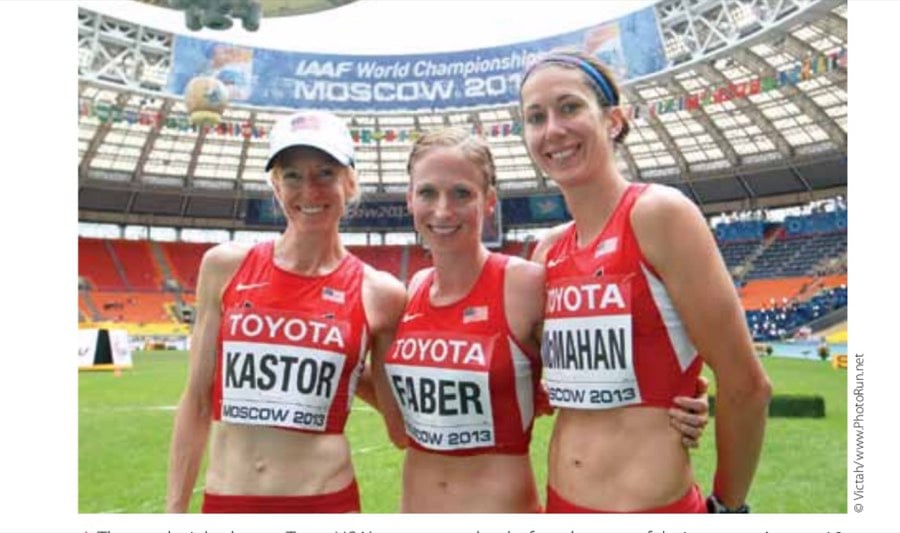
▲ They make it look easy: Team USA’s women gather before the start of their race on August 10.
college Russian to navigate the system. There were buses to bring journalists to the stadium, bypassing the metro system, but I like to live off the land whenever I can at these events, so navigating public transport becomes its own adventure.
Mile 10: Press kit—and swag Every year or two my local Goodwill receives a bag of lightly used backpacks and jackets with marathon insignia from around the world—the race “swag” we receive from the organizing committee. I would love to hang on to everything, but face it: do you really keep every race shirt going back to your college years?
The real value of the swag bag is the press guides: the historical statistics guides that help us recall the name of the third-place finisher from a race 10 years ago when that information suddenly becomes relevant on race day. Those stats books are worth their (very considerable) weight in gold at these events.
The backpacks themselves become our offices. Laptop, cell phone, a camera—we carry everything we need to file our stories ourselves, all day. Just don’t confuse yours with your colleagues’—a luggage tag works magic. Moscow hit the jackpot with its bag this year: light and small, just enough to carry a laptop and a stats guide and perhaps a lunch and water bottle. Perfect.
Mile 15: Prerace interviews It’s not enough to geek out on race statistics prior to the big day. The big marathons like Boston and New York make it easy for us to find the elite athletes prior to the race. Boston’s traditional Friday press conference brings all of the invited athletes to one location for a solid two hours, sitting at tables while we mill around them, asking our questions. Usually this works fairly well, unless there’s a serious translation problem at hand.
At Worlds, though, we’re often on our own. The largest countries hold athlete press conferences in the days leading up to an event, and if you can get on the right invitation lists, event sponsors host press events as well. Working directly with the press officers of the national track and field committees is often the best way to snag a coveted interview, if you can find your way to the athletes’ hotel.
USA Track and Field set up interviews for me with Dot McMahan and Jeannette Faber, two-thirds of the American contingent, the day before the Moscow race. (Ageless Deena Kastor was on this team as well but unavailable for interviews.) Dot, Jeannette, and I sat in the vast Crowne Plaza Hotel lobby on the banks of the Moscow River and chatted about race strategy, running in the heat, and training tactics. I appreciated their time so close to their own race (they admitted a prerace interview takes away from some of the monotony of just resting up at the hotel the day before their event) and marveled at how similar some of our training challenges are, even though my personal best is a solid 80 minutes slower than theirs.
© Victah/www.PhotoRun.net
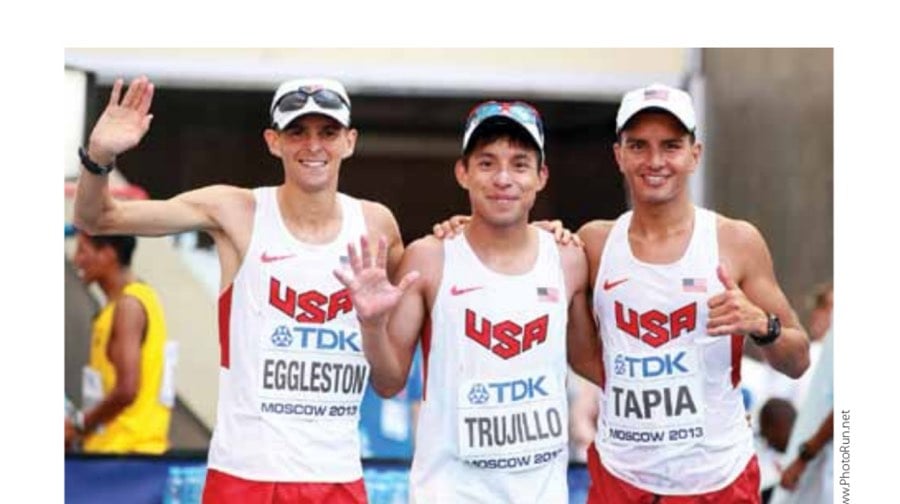
▲ All smiles: The men of Team USA give a wave before lining up next to the best in the world on August 17.
Mile 20: Race day! You have your interviews in hand, key quotes underlined and highlighted, and it’s time to watch the race go off. At Boston, we’re in a grand ballroom in the Copley Plaza Hotel. At Worlds, we’re in the stadium, the traditional start and end point of the race. (Once in a while a World Championship race starts at a different location, like the Athens Olympics, which began in Marathon to commemorate the history of the event.) In Moscow, we had the use of a large press center near the stadium, a smaller work room underneath the stadium, and the commentator’s information systems and personal televisions to watch the raw video feed of the race at our seats inside the main stadium, where we did most of our work.
Here’s how the men’s and women’s races shaped up this year and what we did to cover them.
Women’s race, August 10 In Moscow this year, we knew one story would be the weather. The women’s marathon was the first of the marquee medal events to be contested, and it began at 2:00 p.m. in the heat of the Russian afternoon (the better for television rights for marathon-crazy Japan, went the line in the press room). At the worst time of day to contest a title marathon, with the sun blazing on a loop course that went
back and forth between Red Square and the area near the track stadium on the Moscow River, 70 of the world’s best marathoners lined up at the start. By the end, only 46 would finish on a day when the mercury reached a high of 85 degrees.
With an entrant list that included Olympic champions Tiki Gelana and Mizuki Noguchi, it was the accomplished but less-heralded Valeria Straneo of Italy who jumped out to an early lead—and held it. And held it. And held it. Every marathon journalist worth their laptop knows what comes next: the question of whether that runner can “pull a Joanie”: win a world-level marathon leading wire-to-wire, as Joan Benoit Samuelson did to win the first women’s Olympic gold medal in the marathon in 1984.
As the miles tick off, we’re in the stadium watching the raw video feed. Every five kilometers we receive split times for the leaders, the better to calculate on our makeshift Excel spreadsheets the average pace for the race, whether the leaders are speeding up or slowing down, whether the race is going out tactical or fast. (Hint: it almost always goes out tactical, especially in heat.) We look to see whether the motorcycle cameras, which weave between the racers out on the course, have caught a glimpse of any potential challengers lurking just beyond the lead race vehicle’s sight. In St. Louis at the Olympic Trials, I covered the race from that lead truck, but at Worlds, it’s reserved for photographers only.
Sometimes these glimpses lead us down the wrong path. In one of the few years I haven’t been in Boston for the marathon (2005, when I was living and working in China), I managed to tune in to a local Boston radio station’s live Internet stream of the marathon broadcast. I remember trying gamely to stay up overnight to listen to the broadcast, when a commentator noted that three-time champion Catherine Ndereba was a minute behind the leaders at mile 16 and looked to be out of contention. I smiled and shook my head and wished I could be there. Boston doesn’t start for the elites until the race turns onto Commonwealth Avenue around mile 17 and moves into the Newton hills. That’s where all of the tactics come into play. Catherine was just biding her time, waiting to make her move. Guess who won the 2005 Boston Marathon? Yep, Catherine Ndereba.
Back to Moscow, where Straneo led every single split time from five to 40 kilometers. As we watch these races unfold, we begin, gingerly at first, to draft paragraphs of text that might make it into our final stories. Some paragraphs get tossed after a surprise surge or an unexpected development or a better-thanexpected postrace interview, and some survive the mayhem and get published. Topography wasn’t an issue in Moscow the way it would be at a hillier race like Boston or New York. The course was very flat and, in all fairness to the race organizers, not terribly exciting. By classic marathoning standards, it wasn’t an epic course, but it got the job done.
And on that flat, straightforward course, we could see from the press room that Straneo was being followed. Kenya’s Edna Kiplagat, the defending world
champion, kept Straneo in her sights as the leaders approached Luzhniki Stadium. It wasn’t hard to figure out what was likely to happen: a late-race surge, just enough to secure the gold medal without wilting in the heat. And that was exactly what happened, as Kiplagat ran to consecutive marathon world championship titles. An ebullient Straneo took the silver, while Japan’s Kayoko Fukushi won bronze. That led to the day’s other compelling storyline: three medalists, three continents. In an event that sometimes feels like it’s dominated by Kenyan and Ethiopian athletes, it’s gratifying to see how diverse the sport has become at the World Championship level.
That’s another compelling reason why a World Championship marathon is such a fascinating event to cover. At the big-city marathons, the elite fields are smaller; but at the World Championships, the field is far larger and more diverse because there is a limit to how many athletes each country can enter. The women’s top 10 in Moscow included athletes from Kenya, Italy, Japan, Spain, Mexico, Great Britain, North Korea, and the United States. That’s an impressive array of marathoning talent from many corners of the globe.
Once the race was over, we went to the media “mixed zone” underneath the stadium to get quotes from the athletes as they left the track. All three Americans stopped by, and they all looked exhausted after more than two and a half hours in the heat. Deena Kastor placed ninth, but the Athens Olympic bronze medalist had to take solace in the fact that Gelana and Noguchi, Olympic champions both, didn’t even finish the race. Her teammates Dot McMahan and Jeannette Faber placed 18th and 23rd, respectively. On a day of searing heat, the Americans went three for three: another fine story, and that one made it into our copy.
Men’s race, August 17 What’s worse than starting a World Championship marathon at two in the afternoon? Starting at three-thirty, of course—and that’s what this year’s elite men had to do in Moscow. It makes for great prime-time television viewing in Asia, but, oh, how hard it must be for these athletes. I cringe when the mercury travels north of 60 degrees on race day. August 17 brought slightly cooler conditions to the men’s
© David Monti
▲
The author watches the live feed of the race inside Luzhniki Stadium.
© Jiro Mochizuki/www.PhotoRun.net
marathon than the women had to contend with—the high was 74 degrees—but that’s still a solid 20 degrees warmer than ideal conditions for marathon racing. (“Ideal conditions” for marathons rarely happen during the World Championships, traditionally a summer event, but it’s possible. In Helsinki in 2005, the weather was significantly colder and rainier than it was in Moscow this year.)
The early Moscow storyline was whether Uganda’s Olympic champion Stephen Kiprotich would be able to catch lightning twice by upsetting the favored—and blisteringly fast—Kenyans and Ethiopians in back-to-back championship races. Five Ethiopian athletes—the maximum field for any one country—were entered. And the slowest personal best from that group was Feyisa Lilesa with a 2:04:52. You read that right. Ethiopia entered five sub-2:05 marathoners in Moscow. Kenya’s five-man contingent was slightly less superhuman, with personal bests ranging from 2:04:53 (Bernard Koech) to 2:06:48 (Michael Kipyego). But consider: in order to win gold, Kiprotich would have to contend with 10 athletes, all of whom had performed faster than his own 2:07:20 personal best and all of whom were certainly trained to compete as a group and control a long race tactically.
Sometimes watching an elite race unfold is a surprise from the start. Valeria Straneo’s wire-to-wire run at Worlds this year qualifies as such a moment. And sometimes, a race doesn’t heat up for a very long time after the starter’s gun goes off. Such was this year’s men’s World Championship marathon, where we watched
▲ Biding their time: The men’s leaders ran in a large pack for more than half of this year’s World Championship race.
a pack of no fewer than 23 runners stay together through almost 25 kilometers. By 30 kilometers, the pack had whittled down a bit to 14, but for all intents and purposes, the serious racing had yet to begin. It was a little like watching an hour and a half of previews at a movie theater before getting to the main show and yet another example of how a championship marathon can unfold when weather is a factor and gold medals are on the line.
In the end, Kiprotich did notch the title after some exciting back-and-forth surges in the late miles. And startlingly, considering the talent of the entrants, Kenya’s top finisher was no higher than ninth (Peter Some). Ethiopia’s athletes took second, third, and fourth places, with Boston Marathon champion Lelisa Desisa almost—but not quite—challenging Kiprotich for the title before settling for silver. Tadese Tola took bronze.
Americans finished 13th (Jeff Eggleston), 27th (Daniel Tapia), and 37th (Carlos Trujillo). In my rush to get my story written, as well as knowing the best quotes from the medalists would likely come at the press conference where a skilled Amharic translator was prepared to work with the Ethiopians, I didn’t make it to the mixed zone for this race. Such is the triage we face when we’re on deadline at the World Championships.
Mile 26.2: File your story! The final chapter on race day? Get your stories filed as quickly as possible after the mixed zone and postrace press conferences. In a 24/7 media culture where everything is online quickly, it’s imperative to get copy out as soon as possible. Writing a lively 800-word story (give or take a few words) within an hour of a major event finishing takes practice—the same kind of practice as long runs and track repeats. The task gets easier with time. Pressing that “send” button to an editor waiting for copy back in the United States is a great feeling, not unlike crossing that race finish line ourselves, another competition completed, another task in the “win” column.
I would like to tell you that my own running doesn’t suffer at these events, but I can’t. Those of us who both write and run often have to choose between getting enough sleep and fitting in our own workouts. But in the nine days of the Moscow Worlds, I tied up my running shoes three times and ventured out to Izmailovsky Park, the large urban greenery next to our media hotel, for a 30- to 45-minute jog before my workday began. It wasn’t perfect, but it would have to do for now. There was another race to cover and another story to write. Every race has a finish line, and I was glad after this year’s Worlds that training for my own next marathon— number 15, nine weeks away as I write these words—wasn’t slated to begin until I got back home to Seattle. I began it on schedule, like any dedicated marathoner, after sleeping off the Moscow jet lag for, oh, about a week.
This article originally appeared in Marathon & Beyond, Vol. 18, No. 1 (2014).
← Browse the full M&B ArchiveMore like this
1,000+ stories from 19 years of Marathon & Beyond
The complete archive of the legendary long-distance journal — digitized and free to read.
