

Motor City Marathoning
This year marks the 30th running of the Detroit Free Press International Marathon. In reality, it is the 45th running of this event, which was begun in 1963 by the Michigan Roadrunners Club, now the Motor City Striders Running Club. For 15 years, the event was conducted solely by the Striders with no sponsors or financial aid of any sort. In 1978, the Free Press newspaper contacted the club and became the sponsor, renaming the event the Detroit Free Press International Marathon.
This race is now the 10th longest continuously held marathon in the country. However, it is important and interesting to travel farther back in time and rediscover the beginning of Motor City marathoning. The year was 1920, and according to Spalding’s Official Athletic Almanac, four marathons at distances of 24 miles or more were held in America that year. This was a significant increase from previous years, for only one was held in 1919 and none the year before that. Races were canceled because of World War I, and only Boston held a race at that distance, consisting of a relay competition of 14 teams made up of servicemen.
Marathons in 1920 included the 24th American Marathon (Boston), the fifth (though not annual) Brooklyn-Sea Gate Marathon, the New York Athletic Club Marathon, and the first annual Auto City Marathon in Detroit. All four of these events were used to select the marathon team for the 1920 Olympics in Antwerp. The first marathon run in Detroit, under the auspices of the Irish-American Club, was the Auto City Marathon. Harry M. Jewett, an old-time runner, refereed the event and donated the Harry M. Jewett trophy to the winner. This, one of the country’s earliest successful marathon races, began 58 years before the Free Press event and would continue for the next 10 years.
The Auto City race was a point-to-point event, starting in the city of Pontiac, Michigan, about 25 miles north of downtown Detroit. The actual starting line was at the Pontiac courthouse, and the race proceeded down Woodward Avenue (which is designated in Michigan as Highway 1) and some side streets and finished at Grand Circus Park in downtown Detroit.
A HIGH NOON START The race started at noon, and 32 of the 42 registered runners lined up at the starting line. Newspaper coverage of the event was extensive by today’s standards. Four local papers featured stories the day before, the day of, and the day after the race. One, the Pontiac Daily Press, printed an interesting update the day of the run, Saturday, April 3, telling who was leading at various points in the race. However, deadlines for the evening edition did not allow for the final details to be printed that day.
The race was short of the full marathon distance, although records do not state the exact length. Charles Mellor, of the Logan Square Athletic Club of Chicago, placed first in 2:30:04. His nearest competitor was Willie Kyronen, of the Millrose Athletic Club of New York, who was vying for a berth on the Finnish Olympic team. However, with his finish time of 2:38:07, he did not make it. Two months later, Mellor finished seventh in the New York Marathon in 2:58:57 on a course that was also short of the full marathon distance. At the Olympic marathon in Antwerp, Mellor finished 12th in 2:45:30.
Mitchell Baker, age 47, of the Sinai Social Center of Chicago, finished 20th in this Detroit race and won a special veterans award that was presented to the first finisher age 45 or older. The team championship went to the Gladstone Athletic Club, which placed runners in fifth, 10th, and 16th places. The award went to the team whose first three runners scored the lowest number based on their finish places. Other prizes included nine silver loving cups, a bronze loving cup, shoes, and a silver-and-bronze loving cup. 1920 Results 1. Charles Mellor, Logan A.C., Chicago
2:30:04
2. Willie Kyronen, Millrose A.C., New York 2:38:07 3. Sidney Hatch, Illinois A.C., Chicago
2:40:17
4. Michael Dwyer, Mohawk A.C., New York 2:41:00 5. James Dellow, Gladstone A.C., Toronto
2:42:17
For the second Auto City Marathon, held on April 2, 1921, the Pontiac Daily Press noted the participation of “that old timer here for the marathon.” This “old timer” was Mitchell Baker, of Chicago, who was 48 years old and described as having hair “nearly white.” He was the oldest of the 52 entrants by seven or eight years. Another seasoned veteran competing was 37-year-old Edouard Fabre, of Montreal. Competing for Canada at the 1912 Olympics, he finished 11th at Stockholm in 2:50:36.2, 10 seconds ahead of marathon legend Clarence DeMar. From 1911 through 1914, Fabre placed third, eighth, fifth, and second at the Boston Marathon before winning the event in 1915 with a time of 2:31:41.
In that same month, he also won the Montreal and San Francisco marathons. The 1920 Boston winner, Peter Trivoulidas, a Greek citizen from New York, was also entered; however, it doesn’t appear that he started the race.
A MELLOR/ZUNA RIVALRY At the start of the 1921 Auto City Marathon, about 40 lined up in front of the 2,500 spectators, a number five times the estimated number of spectators at the inaugural race. In this event, Mellor and Frank Zuna, a plumber from New York, ran together for most of the race. Mellor beat Zuna by eight seconds to the tape, finishing in 2:29. Fifteen days later, in Boston, Mellor and Zuna raced again, this time with Zuna taking top honors over second-place Mellor with a time of 2:18:57.
The Boston win was an especially pleasing one for Zuna as it broke Mike Ryan’s 1912 race record, which was also the world record, of 2:21:18 for the then-run 25-mile distance. The year before, Zuna had been one of six Americans selected to travel to Antwerp as a member of the marathon squad. However, at the Games, he was not one of the four selected by Ryan, the coach of the team, to run in the race.
For the second year, Mitchell Baker won the Auto City Veterans Trophy for the oldest finisher and received the most applause from the crowd as he finished in 20th place, the same position as the year before. The team championship went to the Logan Square Athletic Club of Chicago, with finishes of first, fourth, and 14th places for a low score total of 19 points. 1921 Results 1. Charles Mellor, Logan Square A.C.
2:29:00
2. Frank Zuna, Paulist A.C., New York
2:29:08
3. Edouard Fabre, National A.A.A., Montreal
N.T.A. *
4. Schou Christensen, Logan Square A.C., Chicago
N.T.A.
5. Michael Dwyer, Mohawk A.C., New York
N.T.A.
*Despite extensive reporting on all of the Auto City Marathon races, there were many instances where times were reported only for the very top finishers. Where no times were available, N.T.A. has been indicated.
Chilling breezes, icy footing, and a hailstorm were the order of the day for the third running of the Auto City Marathon on April 1, 1922. Twenty-one of the 39 entrants toed the starting line at the usual noon start. Bill Kennedy, of East Port Chester, New York, the 1917 Boston Marathon winner, was also registered. However, it doesn’t appear that he made it to the race. Chuck Mellor, despite not taking the lead at the start, was ahead of the field shortly thereafter and finished about a mile ahead of James Dellow, of Toronto. Their times were 2:33:27.2 to
Dr. Edward H. Kozloff Collection
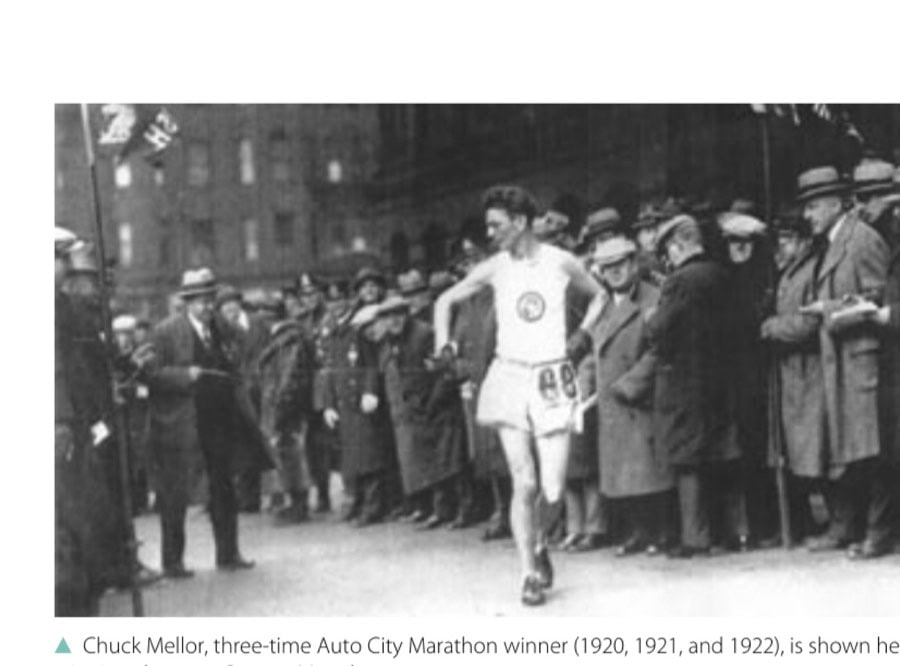
▲ Chuck Mellor, three-time Auto City Marathon winner (1920, 1921, and 1922), is shown here winning the 1925 Boston Marathon.
2:39:57.6. The race for second was much tighter, as Edouard Fabre, of Montreal, was only 25 seconds behind Dellow. Fabre finished in the same position as he had the year before. As it had in 1920, the Gladstone Athletic Club of Toronto took top team honors. 1922 Results 1. Charles Mellor, Unattached, Chicago
2:33:27.2
2. James Dellow, Gladstone A.C., Toronto
2:39:57.6
3. Edouard Fabre, National A.A.A., Montreal
2:40:22.4
4. Sidney Hatch, Unattached, Chicago
2:46:15.6
5. Charles Morton, Hamilton Y, Hamilton
2:47:38.0
The national census was announced just one day before the fourth Auto City Marathon. Detroit, with just under a million population, was the fourth-largest city in the country. Only three cities exceeded the million mark. The fourth marathon was held on April 7, 1923. Mitchell Baker, now 50 years old and still “the oldest marathoner in the U.S.,” was entered, and he claimed that this would be his last marathon race. Three-time winner Mellor was also back. He hoped that this would be his fourth straight victory, which would make him the first person to ever win a marathon race in four consecutive years. Mellor also said he intended to retire if he won. His competition was to be Jimmy Dellow,
who had finished second in this race the year before and had also won the Detroit NewsMasonic Marathon in 1922. Also in contention was Frank Zuna, who had finished second to Mellor in 1921 and had won the Boston Marathon in 1922 in record time.
ZUNA IS BACK—BIG TIME For 18 miles, Zuna, Mellor, and Thomas Ellie, of Hamilton, Ontario, matched strides. However, by mile 19, Zuna’s continued consistent pace forced Mellor and then Ellie back. From that point, it was Zuna alone to the finish. Mellor ended in fourth place, while Ellie dropped to 10th. Dellow, it turned out, never was a contender and finished sixth overall. Second place went to Arne Souminen, of Chicago, with team honors to the Hamilton, Ontario, YMCA. Zuna’s prize was a diamond-studded gold medal. Twelve days later, he raced and finished second at Boston in 2:25:30. 1923 Results 1. Frank Zuna, U.T.A., Newark, N.J.
2:34:00.8
2. Arne Souminen, C.C. of N., Chicago
2:42:00
3. Frank Wendling, Wildon A.C., Buffalo
2:46:00
4. Charles Mellor, I.A.C., Chicago
N.T.A.
5. Charles Morton, YMCA, Hamilton, Ontario
N.T.A.
On March 29, 1924, both Zuna and Mellor again returned, this time for the fifth edition of the Auto City Marathon. (Evidently, Mellor decided that the 1923 race would not be his last.) Zuna, on March 8, broke the U.S. marathon record by running 2:41:39.4 at the Baltimore Marathon for 26 miles, 385 yards. Many so-called marathons of the time, including the Auto City, fell short of this complete distance. Both of these men were hoping for strong performances here to qualify for the year’s Olympic Games, which were to be held in Paris. This was an official Western Olympic tryout and was closed to Canadian entrants, who would have their own trials in Montreal a month later. The final U.S. tryout was in Boston the next month. Weather proved to be less than desirable, with a chilling east wind and freezing rain. Consequently, only 15 of the 41 entrants appeared at the start, which began 15 minutes late and was the first time the full 26 mile, 385 yard distance was run in this race.
Dr. Edward H. Kozloff Collection
▲
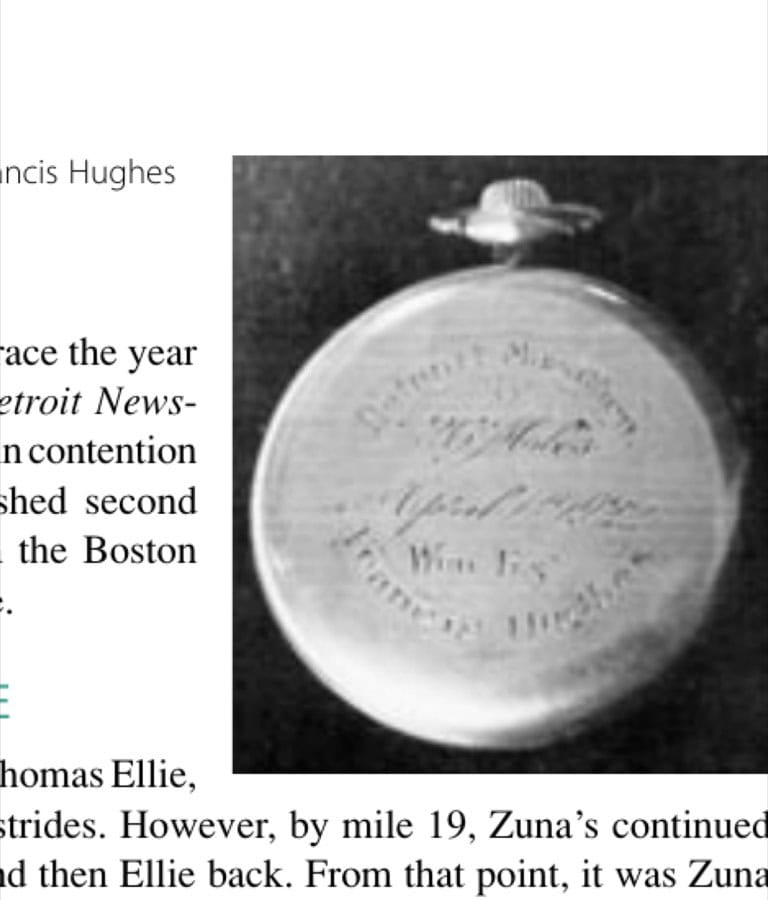
The 10th-place trophy won by Francis Hughes at the 1922 Auto City Marathon.
IT’S ZUNA AGAIN For the first 20 miles, it was a three-man race with Zuna, Mellor, and Charles White, a Detroiter running for the Millett A.C. White led the two through the earlier checkpoints, but the pace brought on a leg cramp that eventually slowed him and resulted in his fifth-place finish. The trio was 30 minutes flat at five miles and 59:40 at 10. Mellor took the lead at 20 miles, with Zuna eventually challenging him, moving to the front and holding his place for a 37-second victory. Times were 2:42:56 to 2:43:32.4, respectively. As Zuna had done the year before, Mellor went to Boston three weeks later and he, like Zuna in 1923, took second in 2:29:40. Both men represented the United States in the Olympic marathon in Paris. There, Zuna finished 18th overall in 3:05:52.2 and Mellor finished 25th in 3:24:07. Clarence DeMar was the top United States entrant, finishing third overall in 2:48:14. The 1924 event was the first Auto City race for Victor Glance, of Saginaw, who finished sixth. He would go on to run numerous races in the Detroit area and become so involved in distance running that, when the Motor City Marathon was first held in 1963, it was named “The Victor Glance Memorial” in his honor. Mitchell Baker, the senior runner who had intended to retire after the 1923 race, changed his mind and won the Veterans Trophy for the fourth time in five years. The Millett Athletic Club won the team trophy. Twelve of the 15 starters finished the race. 1924 Results 1. Frank Zuna, Millrose A.C., New York
2:42:56
2. Charles Mellor, Illinois A.C., Chicago
2:43:32.4
3. E. C. Moran, Millett A.C., Detroit
N.T.A.
4. Arne Souminen, Chicago College of Naprapathy
N.T.A.
5. Charles White, Millett A.C., Chicago
N.T.A.
Canadians returned for the April 4, 1925, Auto City Marathon, having been banned the previous year because the race was an Olympic tryout, open only to American runners. A warm, sunny day made for good racing conditions, although some of the runners might have preferred a more overcast day. However, it turned out to be a disappointing day for Rube Secord, of Detroit, who could not participate because he had to work overtime. This was the first local race in which he failed to compete in 10 years. Mellor, the three-time winner who had finished second the year before, returned to the event for the sixth time and, with the absence of Zuna, who was injured, was the overwhelming favorite. Forty runners registered for the event, and 27 showed up at the starting line. For the first 16 miles, three runners traded leads:
Dr. Edward H. Kozloff Collection
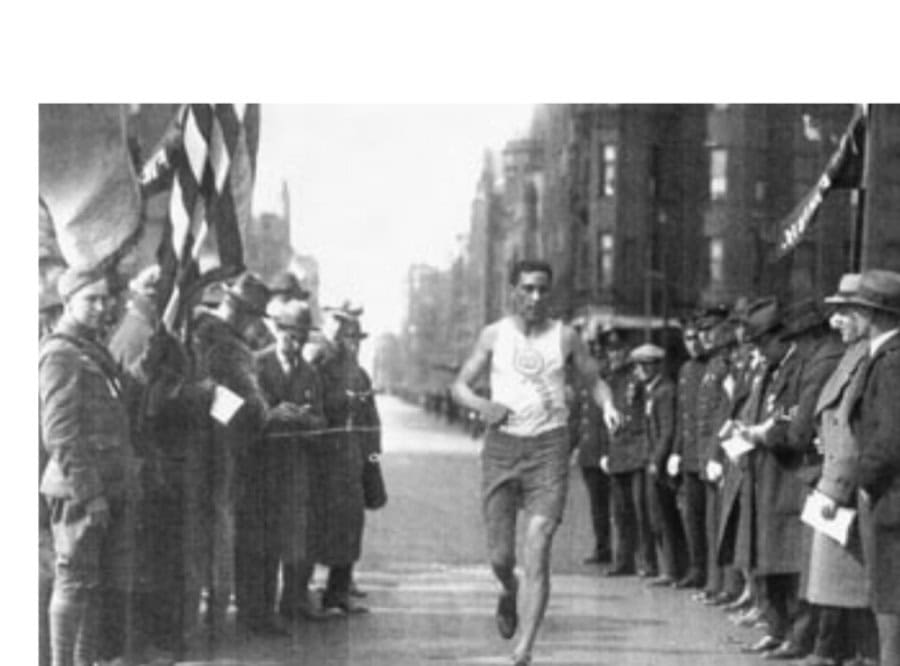
▲ Frank Zuna, three-time Auto City Marathon winner (1923, 1924, and 1927), is shown here winning the 1923 Boston Marathon.
Mellor, Schou Christensen, and Dave Farmer (all three from Chicago). With eight miles to go, Farmer, in third place, developed leg cramps that forced him to stop. He resumed running but dropped out about four miles from the finish, costing the Illinois Athletic Club the team title.
With seven miles left, Mellor’s feet began bothering him and he was forced to shorten his stride. He finished second, though with badly blistered feet. As Mellor slowed his pace, Christensen ran comfortably in the lead and finished in 2:37:45, setting a course record. Christensen had raced successfully in Detroit in the past, twice winning the 10-mile Ferndale to Detroit Race, which followed part of the marathon route. Mellor’s second-place finish of 2:40:45 also beat the old course record of 2:42:56 that had been set by Frank Zuna in 1924. The Millett Athletic Club of Detroit took the team title, and 15 of the 27 starters finished the race. 1925 Results 1. Schou Christensen, Illinois A.C., Chicago
2:37:45
2. Charles Mellor, Illinois A.C., Chicago
2:40:45
3. James Shaw, Monarch A.C., Toronto
2:46:10
4. Charles Morton, Hamilton Y, Hamilton
2:47:00
5. Leo McNeil, Unattached, Chicago
2:47:25
A regular midwinter snowstorm became the background for the seventh Auto City Marathon on April 4, 1926. Wind, sleet, slush, and a foot of snow on the ground made this the worst weather since the inception of the event. Heavy weather hampered traffic and caused the start of the race to be delayed by 45 minutes because several of the runners were tied up in traffic trying to get to the start from downtown Detroit, 26 miles away.
A BAD DAY FOR OFFICIALS Of the 33 runners who had registered for the race, only 14 made it to the starting line. However, the runners fared much better than the 24 officials who were to direct and officiate the start, finish, and points along the course. Of these, only two showed up! Both of these men trudged back and forth on the course, making it to the finish line when the runners arrived.
None of the past favorites—Mellor, Zuna, or Christensen—were entered. This opened the race, allowing Charles Morton, of the Hamilton Y, to assume the favored role. He and fellow Canadian James Shaw, of the Monarch A.C. of Toronto, passed 11 miles in 65 minutes, very fast considering the weather. At 11 1/2 miles, Shaw slipped and fell, causing him to drop out at 13 miles. Morton continued to lead through the 15-mile point in 92 minutes but began to visibly tire afterward. Percy Wyer, of the Monarch A.C., and Arne Souminen, of the Finnish-American A.C., were both finally able to pass him at the 22-mile mark, with Wyer moving into the lead and winning with a time of 2:51:30, a fast time considering the conditions. Ten runners were able to finish the event. At age 40, this was Wyer’s first major marathon victory, although he had beaten Mellor in a shortened marathon the year before at Port Chester, New York. Wyer stood exactly 5 feet tall and weighed in at 98 pounds. Team honors went to Wyer’s Monarch Athletic Club. 1926 Results 1. Percy Wyer, Monarch A.C., Toronto
2:51:30
2. Arne Suominen, Finnish-American A.C., Chicago 2:56:00 3. Charles Morton, Hamilton Y, Hamilton
3:12:00
4. A.W. Strom, Detroit Y, Detroit
3:12:30
5. Robert May, Monarch A.C., Toronto
3:20:00
The weather for the 1926 marathon must have caused the leaders of the IrishAmerican Club to rethink the merits of an early-April race. In the seven-year history of the event, unfavorable weather had hampered the race three times. In 1922, it was a chilling wind and icy footing; in 1924, it was another uncomfortable wind
and freezing rain; and then the 1926 blizzard. Additionally, traffic, which was never halted for the race, was becoming more and more congested. Organizers decided to move the date and site of the eighth annual race to May 29 at the Michigan State Fairgrounds, located on the northern border of the city, about nine miles from downtown Detroit. Additionally, the 1927 race was to be run entirely on the fairgrounds’ one-mile track. It was believed that no outdoor marathon had ever been held on a mile-lap course.
By the time of the 2:30 start, thousands of spectators (who enjoyed free admission) had packed the stands to watch the largest field ever, 44 entrants, line up for the start. Due to heavy rainfall the day before, the mile track was too muddy for the race to be run on it, so a mile course around the fairgrounds was laid out.
The crowd favorite this day was Rube Secord, a 42-year-old member of the Old Timers Athletic Club of Detroit. He took the lead from the start and, in the first 20 miles, lapped more than half of the 44 starters. At 20 1/2 miles, he had nearly a two-minute lead on the field, but his pace was overly ambitious and he dropped out. Taking the lead at that point was Sidney Drury Jr., of Toronto, who had been Secord’s only competition as they exchanged leads from miles 10 through 17, when Secord began pulling away. At 22 miles, Drury relinquished his lead to Frank Zuna, winner of the 1924 race, who ran a comfortable pace and had never been slower than fifth place early in the event.
ZUNA, MAN OF IRON Meanwhile, the previous year’s winner, Percy Wyer, was doing some spectacular running of his own. At 10 miles, he had been lapped by both Secord and Drury, but he was able to pick up the pace to such an extent that he finished less than a minute behind the winner. Zuna must have felt good after the run because that night he left for Buffalo, New York (about 240 miles from Detroit), to run in that city’s Memorial Day marathon the following day. No records could be found to determine how he did. In all, 32 runners crossed the finish line, well in excess of the previous high of 20 finishers in 1920 and 1923. The Gladstone Athletic Club took top club honors. 1927 Results 1. Frank Zuna, Millrose A.C., New York
2:48:00
2. Percy Wyer, Monarch A.C., Toronto
N.T.A.
3. Orville Garbutt, Gladstone A.C., Toronto
N.T.A.
4. Sidney Drury Jr., Gladstone A.C., Toronto
N.T.A.
5. Frank Hughes, Monarch A.C., Toronto
N.T.A.
▲
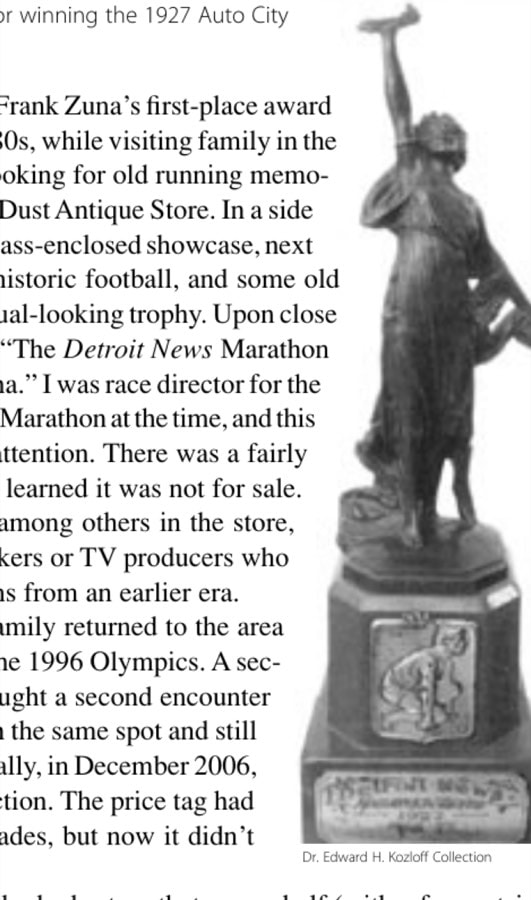
Frank Zuna’s first-place trophy for winning the 1927 Auto City Marathon.
The trophy pictured here is Frank Zuna’s first-place award for the 1927 race. In the late 1980s, while visiting family in the Atlanta, Georgia, area, I was looking for old running memorabilia and visited the Rust and Dust Antique Store. In a side room, on the middle shelf of a glass-enclosed showcase, next to a vintage baseball glove, a historic football, and some old athletic medallions, sat an unusual-looking trophy. Upon close inspection, the engraving read “The Detroit News Marathon Trophy 1927 Won by Frank Zuna.” I was race director for the Detroit Free Press International Marathon at the time, and this unusual find certainly got my attention. There was a fairly high price tag on it; however, I learned it was not for sale. This was one of the antiques, among others in the store, that were rented out to film makers or TV producers who needed to borrow sporting items from an earlier era. About a decade later, my family returned to the area for another visit and to attend the 1996 Olympics. A second trip to the antique row brought a second encounter with the trophy, still standing in the same spot and still sporting the same price tag. Finally, in December 2006, a third reunion was a call for action. The price tag had not changed in nearly two decades, but now it didn’t
Dr. Edward H. Kozloff Collection seem quite so steep. I thought that since the trophy had sat on that same shelf (with a few outside rentals) for such a long time, the owner might be willing to part with it. The shop manager called the owner’s home with no answer and then made a call to her cell phone with no response. I continued to look around the store and was nearly ready to leave when the trophy’s owner was finally reached! The manager relayed my offer, which was 20 percent higher than the price tag. The tone of the conversation wasn’t promising. Surprisingly, though, when the call ended, the manager said that because it was the holiday season my offer had been accepted!
A NEW DATE, A NEW SITE Today, this special award rests in an honored place in my home, which is about three miles from the state fairgrounds site where Zuna was presented the trophy 80 years ago. In 1928, the race date was moved up two weeks earlier to May 12. The race once again started at noon, and the start and finish were moved to the Cadillac
Athletic Club in downtown Detroit because the Cadillac Athletic Club had assumed sponsorship of the event. The new route took the runners west through the city of Dearborn, to Telegraph Road, and back to the start.
This new sponsorship brought added interest to the event, registering 62 entrants—the largest ever to enter a Detroit distance race of any length. The event was also an official Olympic Team tryout for the 1928 Games, which were to be held in Amsterdam. Unlike the 1924 race, Canadian entries were permitted because of a special agreement with the Amateur Athletic Union and the American Olympic Committee. Consequently, 16 Canadians entered the event.
The day was a good one for the run. Although the sun shone brightly, cool temperatures were in the runners’ favor. Despite these promising conditions, only 34 of the 62 entrants lined up at the start. Chuck Mellor, a three-time winner, had signed up but decided not to race. However, Zuna, also a three-time winner, was back to defend his title. At the start, a group of five ran out together into the lead. Victor Glance, of the host Cadillac A.C., gradually took the lead. At the halfway point, he had a three-minute margin on the field. Zuna became ill at the turnaround point and had to stop to recover. By the time he continued the race, however, he had dropped to 14th place, which prevented any chance of his taking a fourth victory in this event.
Glance was running well in the lead until the 20-mile mark, where he began to tire. When he was within five miles of the finish, he encountered a slow-moving freight train passing right across the route. Not willing to stop, he hopped onto a coal car and jumped off onto the other side, twisting his ankle. The ankle bothered him the rest of the race. As the other runners approached the tracks, the last train car was just passing. A slowing Glance continued to hold the lead until the 25mile point, when Frank Hughes, of Hamilton, Ontario, overtook him and went on to win in 2:58:20. Alger Strom, of Detroit, was also able to pass Glance and finished 15 seconds ahead of him. While this was being played out, Zuna was able to recover and moved up from 14th to a fifth-place finish. The team title went to the host Cadillac A.C., which just beat out the Gladstone A.C. by three points.
Before the race, Hughes had been named as a possible marathon representative for the Canadian Olympic team, and his performance in this race solidified that selection. At Amsterdam, he was Canada’s fourth finisher, placing 43rd overall in 2:58:12. Neither Zuna nor Mellor was selected to go to these Games. 1928 Results 1. Francis Hughes, Olympia Club, Hamilton
2:58:20
2. Alger Strom, Suomi A.C., Detroit
2:59:00
3. Victor Glance, Cadillac A.C., Detroit
2:59:15
4. Ben West, Central Y, Cincinnati
N.T.A.
5. Frank Zuna, Millrose A.C., New York
N.T.A.
Both the date and site for the 1929 race were moved substantially for the third straight year. Like the 1927 event, it was back to the state fairgrounds and the 2:30 starting time. The race date was moved to June 30. The new date and time presented a condition that today’s race directors would certainly do everything to avoid.
A MEAGER SHOWING The plan was to again use the fairgrounds mile track, which had been rained out in 1927. In case of rain this year, the event was to be moved indoors to the Coliseum and its 10-lap-per-mile track. Fortunately, that was unnecessary, although rain the night before did make the track muddy. To make things more interesting, a special prize was given to the person who led the most mile laps. The program listed 41 entrants, with 13 from Detroit and 22 from Toronto—demonstrating the continued popularity of this event for Detroit’s Canadian neighbors. Despite this number, only 15 stood at the starting line when the gun sounded.
The race for the lap prize was contested by three runners: Ben West, of Cincinnati, who had finished fourth in the 1928 race; Rube Secord, of Detroit, who led the 1927 race for 20 miles and then dropped out because of his overly aggressive pace; and Donald McDonald, of Detroit. These three pulled ahead of the field a half mile into the race. McDonald led the first two laps and Secord the third. Then McDonald led the next four, taking the field through mile seven. At this point, West moved up to lead the eighth lap and the next 14 as well. By the 15th mile, West had lapped every contestant except Percy Wyer, who was almost a mile behind him. As West approached him, Wyer picked up his pace and—for the next eight miles—kept moving farther away from him. By mile 23, Wyer had reduced the lap he was behind West and had come to within 50 yards of him. In the next mile, he moved ahead of him and increased his lead by over four minutes at the finish. West, finishing second, took the lap-leader award. His team, the Monarch Athletic Club, took the team title. 1929 Results 1. Percy Wyer, Monarch A.C., Toronto
3:07:15
2. Ben West, Cincinnati Y, Cincinnati
3:11:25
3. Donald McDonald, Cadillac A.C., Detroit
3:36:10
4. Rube Secord, Cadillac A.C., Detroit
3:39:00
5. Ezra Lee, Monarch A.C., Toronto
3:43:35
The date for the 11th annual Auto City Marathon was June 28, 1930. While the date was consistent with the 1929 event, the site was moved back to that of the 1928 race, with the start and finish at the Cadillac Athletic Club.
Twenty-nine entrants were registered for the race, with the favorites being the previous year’s winner, Wyer, and the two pacesetters from that race, Donald McDonald and Rube Secord. Albert Michaelson, of the Millrose A.C., was also a contender. He had been the second American finisher in the 1928 Olympic marathon, placing ninth overall in 2:38:56.
Twenty runners toed the start, and like the year before, McDonald and Secord (both Cadillac A.C. team members) set the pace, exchanging leads for more than half the race. At the halfway point, McDonald was in front. Since there was an award for the leader at this point, a race official threw a wreath around his neck! This didn’t seem to have a positive effect on him, however, for Michaelson was only 10 seconds behind. Wearing his wreath, McDonald fell back steadily. At this point, Percy Wyer was 4 minutes, 50 seconds behind the leader. By mile 17, Michaelson had taken the lead and Wyer had moved up to second place, only a minute and a half back. However, the race was almost over for Wyer. As he attempted to avoid a car that was swerving toward him and the motorcycle escort, Wyer was knocked over. Unhurt, he got up immediately and continued the race. Four miles from the finish, the leader—Michaelson—became ill and slowed down. Wyer took the lead from that point to the end of the race, finishing in 2:59. Michaelson was able to hold onto second, finishing in 3:06. The Monarch Athletic Club took the team title for the second straight year. With his two previous wins in 1926 and 1929, Wyer took permanent possession of the Detroit News Cup that was awarded to anyone winning the race three times. Chuck Mellor and Frank Zuna also won this event three times; however the cup had not been instituted when some of their earlier victories occurred.
An interesting sidelight to many early marathons were the prerace physical exams given to the contestants. In this race, the first four finishers each lost 8 pounds during the event. Before the race, 44-year-old Wyer weighed 102 pounds. After the race, he weighed 94 pounds. Michaelson went from 138 to 130 pounds. In third place was 42-year-old Eddie White, who started at 128 1/2 pounds and finished at 120 1/2 pounds. Alec Burnside, in fourth place, went from 108 to 100 pounds. 1930 Results 1. Percy Wyer, 44, Monarch A.C., Toronto
2:59
2. Albert Michaelson, 37, Millrose A.C., N.Y.
3:06
3. Eddie White, 42, Staten Island, N.Y.
3:13
4. Alec Burnside, Monarch A.C., Toronto
3:20
5. Donald McDonald, Cadillac A.C., Detroit
3:32
The 1930s were good to Wyer. In 1930, he won the Canadian National Marathon Championship and was third in 1931 and 1932. He was fourth at the British Empire Games in Hamilton, Ontario, in 1930. At the Boston Marathon, he finished sixth in 1931 and eighth in 1934. At the 1936 Olympic Games, he was 30th. He was also in the 1928 Olympic Games, finishing 45th.
WHERE DID THE RACE GO? After the 11th Auto City Marathon, the race disappears from newspaper pages and the annals of Detroit road racing history. No information could be found of its cancellation, and news of other marathon distance races is equally lacking, with two exceptions. On November 1, 1953, Ford Local Number 600 of the UAWCIO conducted the National Junior AAU Marathon Championship in 60-degree temperatures. A field of 14 started the race, and seven finished. Members of the 1952 Canadian Olympic marathon team that competed in Helsinki took the top two places. The Hamilton Olympic Club took top team honors. The start and finish of the race was at the Fordson High School Stadium in Dearborn, Michigan, a western suburb bordering Detroit. Historically, this school was built in 1928 and was the first American school to cost more than $1 million. (The actual cost came to $2.2 million.) Fordson was also considered the most attractive high school in the country. 1953 Results 1. Barry Lush, Hamilton Olympic Club, Hamilton
2:44:35
2. William Husband, Hamilton Olympic Club, Hamilton
2:44:50
3. Aldo Scandurra, Millrose A.C., N.Y.
2:49:18
4. Wilmer Sheridan, Hamilton Olympic Club, Hamilton
2:54:20
5. Fred Bristow, Gladstone A.C., Toronto
3:02:40
Two years later, on November 13, 1955, the Junior National Marathon Championship returned to the Dearborn site. Ten started the race, and nine finished. An open marathon was also held, with results given only for the first (and possibly only) finisher, George Norman, of Toronto, who finished in 2:45:21. 1955 Results 1. Norman Nielson, Gladstone A.C., Toronto
2:46:02
2. Gonzales Scotto, H.O.B. Club, St. Paul, Minn.
N.T.A.
3. Don Faye, Boston A.A., Boston
N.T.A.
4. Adolf Weinacker, U.S. Air Force, Detroit
N.T.A.
5. Robert Walker, Unattached, Detroit
N.T.A.
In 1959, some of the individuals involved with these two 1950s races, as well as Ernie Smith, who had been active during the 1920s, formed the Michigan Roadrunners Club, which was later to become the Motor City Striders. It was this club that rekindled a regular racing schedule in the city that year and then instituted the first Motor City Marathon (“The Victor Glance Memorial”) in 1963, a race that celebrated its 45th anniversary this year as the Detroit Free Press International Marathon.
This article originally appeared in Marathon & Beyond, Vol. 11, No. 6 (2007).
← Browse the full M&B ArchiveMore like this
1,000+ stories from 19 years of Marathon & Beyond
The complete archive of the legendary long-distance journal — digitized and free to read.
