

Musings From Marathon
The Marathon’s 2,500th Anniversary
Musings From Marathon How the marathon ignited the women’s running revolution and in the process changed world thinking about women. by Kathrine Switzer
In October, I plan to run from Marathon to Athens in commemoration of the 2,500th anniversary of the battle of Marathon. And somehow during those few busy days in Greece, I have vowed also to sit alone for a while on the beach at Marathon. The run will
be the fulfillment of a lifelong dream, and the beach time will be the chance to reflect on another dream, one that has come wonderfully true, even beyond my imagination. It has been 38 years since I last sat on the beach at
Marathon, trying then to make some sense out of my life. And it has been 34 years since I ran my last road marathon. Interestingly, the four years between the two were my most productive running years, and the hard physical training then—as always—was
key in bringing that contemplative time into sharp focus. I had spent six months of 1972 in Europe, ostensibly working first as a journalist at the Munich Olympic Games but also running in as many different events as my wide-ranging rail pass
would allow, introducing the concept of women’s road running to Europe in what was up to then a men’s-only domain. Inevitably, I was welcomed, but each event required a kind of reshuffling of opinions as well as scoring systems to ac
commodate the first woman. We early women runners had already done all this groundbreaking in the late ’60s and early ’70s in the USA, and by April 1972, the Boston Mara18 l MARATHON & BEYOND l Sept/Oct 2010
Kathrine Switzer / Marathon Woman
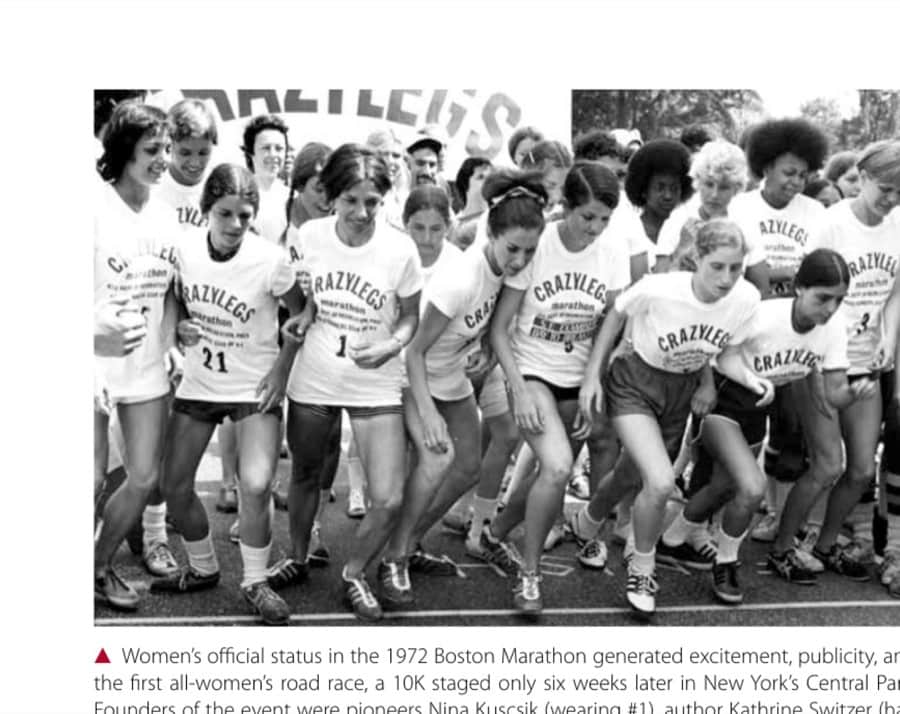
▲ Women’s official status in the 1972 Boston Marathon generated excitement, publicity, and the first all-women’s road race, a 10K staged only six weeks later in New York’s Central Park. Founders of the event were pioneers Nina Kuscsik (wearing #1), author Kathrine Switzer (hair tied up with ribbon), and the legendary Fred Lebow (not shown). The New York Mini Marathon will stage its 40th consecutive run in June 2011.
thon officially admitted us. In June, we staged the first women’s-only road race in Central Park. Word of this progress had reached runners in Europe; they were accepting of us, often eager and delighted—except in Greece.
When I first read of the history of the marathon race, I fell even more in love with the event that had given me so much personal pride. The fabled run of the lonely messenger, carrying the news of a victory that saved a civilization and democracy as we know it today, filled me with the sense of a heroic quest. It gave a higher purpose to hard workouts and made me feel as much a pilgrim as a runner. So naturally when I heard that there was an actual modern-day marathon in Greece—the Athens Marathon—that commemorated the messenger’s run, I wanted to run it. When I read in 1969 of England’s Bill Adcock’s fabulous 2:11 win there, a sensational time on a difficult route, I also had a new modern running hero in my life.
So, in 1972, while I was in Europe, I wrote to SEGAS, the Greek athletic association, for an entry into the race. If women were official and welcome to run at Boston—a race we Americans deemed second only to the Olympic Marathon!—I reasoned that the Athens Marathon would have no reason to deny a woman runner. I was wrong.
SEGAS clearly didn’t know what to do and forwarded my request to the IAAF (the International Amateur Athletics Federation) in London. The IAAF later became a great ally in my life, but in 1972, to its disgrace, it gave SEGAS permission to deny my running in the Marathon-to-Athens event. I wondered briefly if I should just show up and run the race, but it wasn’t ready for me. Contrary to popular belief, I was not an impolite person and I didn’t want to insult the Greek men or their culture. A woman’s welcome would come eventually, but I was in Greece now, feeling sad.
The village of Marathon is not only the starting place of the messenger’s run but also a shrine; it is the resting place of the bones of the Greek heroes from 490 b.c., and as I sat on the gray beach at Marathon looking at the sea, I felt insignificant in their mighty presence. It was late November 1972; in fact, it was Thanksgiving Day in America, and my thoughts drifted to my mother busy in the warm kitchen at home, and I was so homesick I wept. I wept also because this setback with the Marathon-to-Athens race just emphasized that the road ahead for acceptance was still a long one. And finally I wept for the Israeli Olympic athletes who had been massacred in the Games at Munich a few months before. I had kept traveling to put off thinking about that, and now the trauma of it was coming due.
Nothing then, not even sports, seemed simple and pure anymore. The Olympics, despite all the amateur trappings and Greek origins, were above all a commercial and political event. The only people who were amateurs in the 1972 Olympics were the athletes, even those who were getting illegal cash. Women were marginalized the most, both by lack of events and by cultural restriction. We women had the 1,500-meter run for the first time in the 1972 Games—a big breakthrough!—but at this rate it could be 40 years before a women’s marathon was added. Yet all over Europe I was meeting women who were running and wanted to run more. Was I just ahead of my time, or was I crazy? I could also see how to organize women’s running, to make it happen with money, but what sponsor was going to buy into a nonexistent event?
It seemed indeed a long road in 1972 and an almost impossible dream. But from this very spot, that messenger, so named Pheidippides, ran to proclaim victory over enormous odds. I took heart from this old legend, dried my tears, and with huge determination headed home to work on it.
First, I focused most on becoming a better runner myself. I think it is true with all of us: the physical effort, while not easy, is the simplest part of running. In the four years that followed I discovered that hard work brings results, even among those with mediocre ability like me. I went from a 4:20 to a 2:51 marathoner, and this showed me more than anything how much unknown talent existed then in the world of women’s running. I was also awed with the capacity of human achievement; it was this inspiration and knowledge that helped me sort out my thinking. Running is more than an emotional catharsis; it is one of our most creative life
ad
forces. What I was trying to deal with on the beach in 1972 developed into a plan as I churned out the training miles. The next three decades produced one of the most important social revolutions in modern history: the emergence of the woman athlete. And, because of that, we also saw the change in world thinking about women’s capability, the reversal of many medical myths, and the acceptance and increasing admiration for active and accomplished women in our culture. It is running that has led this revolution, it is opportunity that made it happen, and it is the marathon event that was the watershed.
© Jeff Johnson
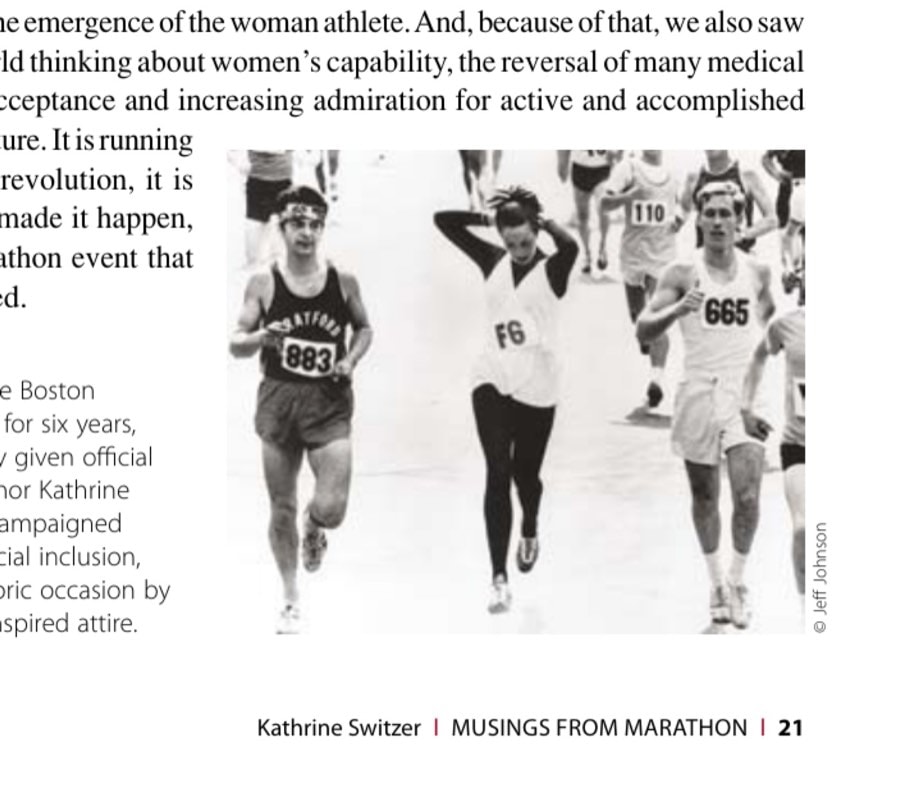
▲
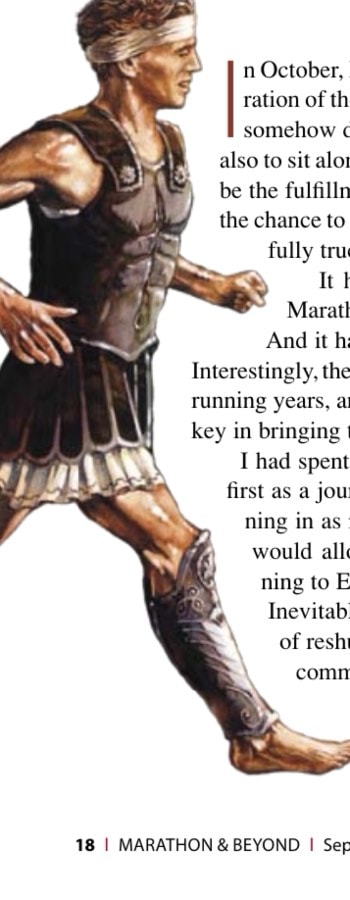
After running the Boston Marathon “illegally” for six years, women were finally given official status in 1972. Author Kathrine Switzer, who had campaigned with others for official inclusion, celebrates the historic occasion by running in Greek-inspired attire.
One of my favorite sayings is that talent is everywhere; it only needs an opportunity. By 1972 it was clear that plenty of women had talent but didn’t even know it. You don’t often know you can do something if the event isn’t there for you to imagine it, much less go for it. It was critical to get a women’s marathon in the Olympic Games if women were to be taken seriously in arduous activity at the highest levels of sport. Several strong women runners were active in different ways to make this happen, but for me the most important thing was to create long-distance road running events all over the world. Only then could women everywhere have the opportunity to experience running in events of different distances and actually feel the power and strength running was giving them.
After writing a lot of proposals seeking sponsors for my idea of a women’sonly global running program that had a truly international women’s-only marathon as an annual culmination, cosmetics giant Avon Products hired me in 1977 to put my dream in action. The huge amount of time and work involved meant the end of my own marathon career, but it was the opportunity of a lifetime.
Within 18 months, the program had been introduced in several countries, each of which had an Olympic committee and federation that now endorsed our women’s running events. Within three years we were closing downtown London streets for the first time in history for a sports event with the third annual Avon International Marathon. The event was significant for several important reasons: •
First, we had women runners from 27 countries and five continents. One of the IOC (International Olympic Committee) requirements for an event to be added to the Olympic Games was for it to be practiced in 25 countries
and three continents. • Second, we had been working assiduously with the now-congenial IAAF, which governed running events and made recommendations to the IOC. London was its headquarters city, and we were right there with the federa
tion involved. • Third, the next Olympics were going to be in Los Angeles, and we were working closely with Los Angeles Olympic Organizing Committee President Peter Ueberroth and his team to press for the inclusion of a women’s
marathon in the LA Games. They liked women’s running and wanted to see the marathon happen, and the Avon International marathons gave them the stats and data they needed to convince other nations. • Fourth, when the USA boycotted the Moscow Olympics in 1980, NBC
TV needed some events to replace that coverage. It sent a team to cover the Avon Marathon in London. BBC and Eurovision did not want to be outdone on their home turf, so they broadcast the event as well. O Globo
came from Brazil. We had massive worldwide publicity; women’s running was truly getting global coverage. • Fifth, Sir Horace Cutler, leader of the Greater London Council, loved the idea of a marathon in downtown London and closed the streets for the women.
The race went on to become what is now the huge London Marathon. • Sixth, although the field was loaded with elite women runners who had won their way to this event, any woman could come on her own and
participate. The event was glamorous, unintimidating, and exciting, and it produced great performances. When the board of directors of the IOC met in a special session in February 1981, it voted to include the women’s marathon in the 1984 Los Angeles Olympic Games. I knew nobody would really understand how important this was until the first woman came out of the tunnel and into the Olympic stadium. That is when the whole world, which knew that 26.2 miles or 42.2K is a long race, would be watching television and would see women running the historic, death-defying, and truly arduous marathon and think Wow! Women can do anything.
To me, getting the marathon in the Olympic Games was the physical equivalent of giving women the right to vote. It was global physical acknowledgment that women were capable of participating in the toughest event in the Olympics and were entitled to do so. It changed world thinking on women’s capability.
So it was with a happy poignancy that the 2004 Olympics in Athens featured the marathon on the fabled Marathon-to-Athens course and that arguably the stars of this show were the women. The four chief protagonists were deservedly storybook perfect: a Japanese and an African, for both of whom the marathon represented the overcoming of thousands of years of cultural and social repression; an upand-coming American with only an outside chance who started slowly behind the ▲
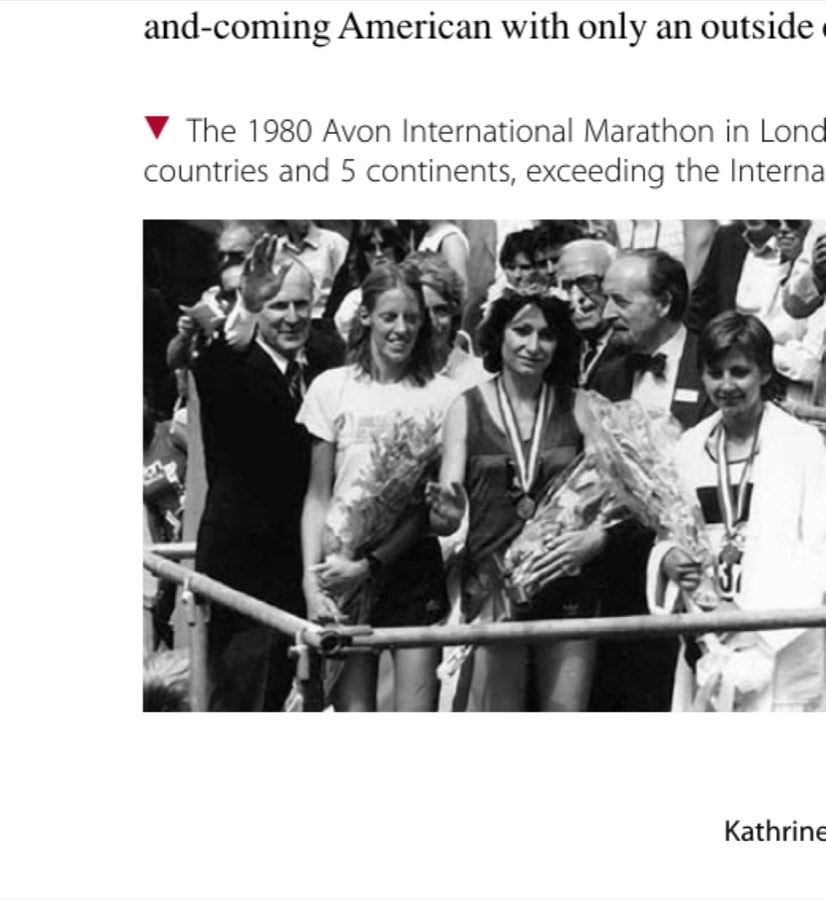
The 1980 Avon International Marathon in London featured top runners from 27 countries and 5 continents, exceeding the International Olympic Committee’s global participation requirement. The speed of these women runners—Lorraine Moller, center, from New Zealand (first); American Nancy Conz, left (second); and Canadian Linda Staudt, right (third)— showed widespread talent. This race led to IOC approval for a women’s marathon in the Olympics in 1984. Kathrine Switzer / Marathon Woman
© Victah / www.PhotoRun.net
▲
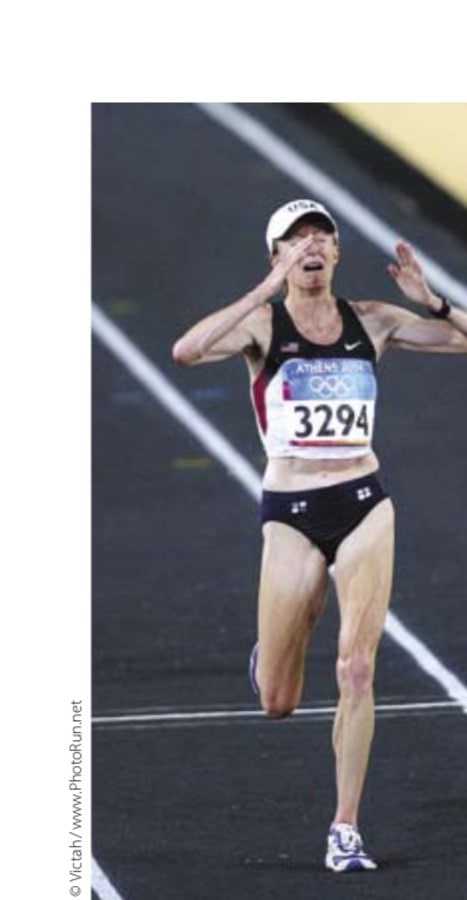
Equal to any Greek drama was the finish of the women’s Olympic marathon in Athens in 2004: American Deena Kastor tearfully won the bronze medal with a perfectly paced, come-from-behind finish where she beat most of the best in the world.
field; and, of course, the English world record holder, the undisputed goddess of the sport and the pride of a nation who had worked since she was a girl to get to this vaunted position. And the race,
as we all know, unfolded with a drama equal to the best of Greek theatre. While it did, I could not help but think also of how 32 years before, I sat musing on the beach only a few steps from this starting line. I wondered: Could
I have imagined this moment then? In seriousness, I had to answer yes . . . but it was a qualified yes. I didn’t imagine that it would occur this soon and with this level of importance. The marathon is astonishing: it has opened the eyes of both sexes to human
capability well beyond a 26.2-mile run. Already we participate in ultras, triathlons, and more, but in time, there will be events we have yet to imagine, events we perhaps will create around our special attributes of strength, power, and
speed (men) and endurance, stamina, and flexibility (women), or combine them as a team. Who knows? We women are only beginning, and—metaphorically speaking—Pheidippides has been running for 2,500 years. So that is why I need
to go back to that beach. Perhaps the gods will grace me again with some inspiration for the next chapter, just as the women themselves have proved to me that all of us have no limits. My own race? As I said before, the physical is the simple part. I’ve done a
lot of four- and five-hour runs this year; I’ve done a 26-mile-plus mountain run. My husband, Roger Robinson (see his article starting on page 26), and I will be speakers for and enjoying the company of 900 other Americans traveling to
Greece with Marathon Tours & Travel. On Sunday, October 31, I’ll be a mere running/walking dot among the 12,000 who will make this special pilgrimage from Marathon to Athens. It won’t be easy; the marathon never is. But it will be fascinating; the marathon always is. Especially this one.
This article originally appeared in Marathon & Beyond, Vol. 14, No. 5 (2010).
← Browse the full M&B ArchiveMore like this
1,000+ stories from 19 years of Marathon & Beyond
The complete archive of the legendary long-distance journal — digitized and free to read.
