

Musings From The Whistlestop Marathon
What is this life if, full of care, We have no time to stand and stare.1
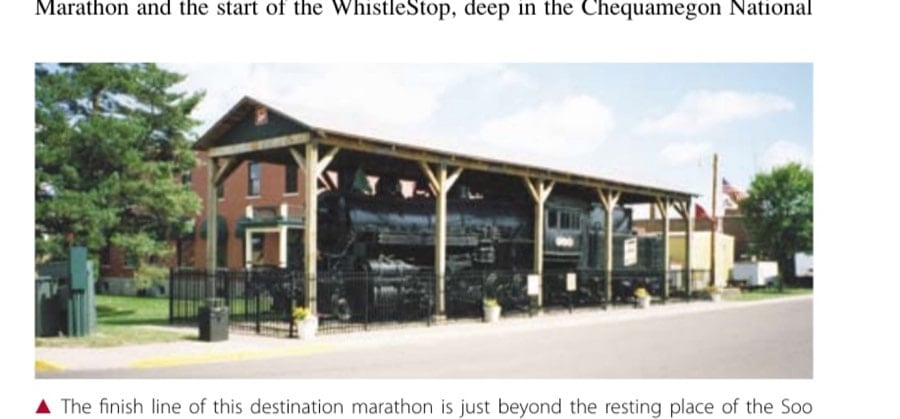
We know why we run, but what would make us stop? This question occurred to me just after finishing the 2008 WhistleStop Marathon in Ashland, Wisconsin. Race day was that perfect combination of weather, course, and fall scenery that makes it easy to justify why we put in all the training hours. Of course, as the day of a big race approaches, we never know if the pace, the course, and the leg muscles will align for a fast and satisfying run. However, this year, while my friends were anxious about crowds and hot weather at the Chicago Marathon, I was 500 miles north of the city and 26 miles west of the 12-wheel, 24-ton steam locomotive (Soo Line #950) that marks the finish line of the WhistleStop. The disparity between the Grant Park start of the Chicago Marathon and the start of the WhistleStop, deep in the Chequamegon National
▲ The finish line of this destination marathon is just beyond the resting place of the Soo Line #950 steam locomotive.
Courtesy of WhistleStop Marathon
Forest, is almost as great as the 40:1 ratio in the number of starters. Nevertheless, the 1,000 or so runners who made the journey up to Ashland for the 11th running of the WhistleStop were just as excited to start running—and not stop—as their big-city comrades.
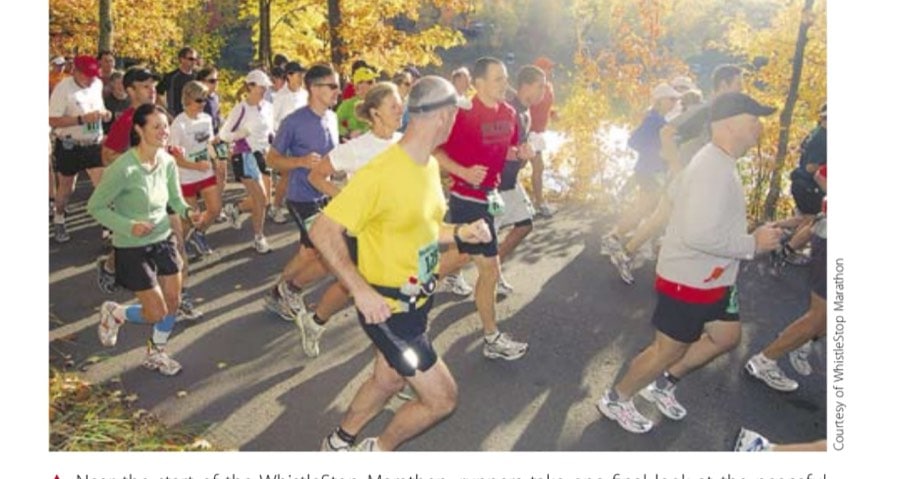
From the moment I climbed off one of the big yellow school buses that ferried us to the start, it was clear that we—as Dorothy said to Toto in The Wizard of Oz—were not in Kansas (or Chicago) anymore. The woods were a kaleidoscope of color and contrast, a light mist blanketed the nearby lake, and the smell of campfires made it clear that the city was far, far away. As runners and weekend campers made preparations for a busy day in the woods, the breeze freshened and the sky brightened on a 54-degree morning. The WhistleStop start was prompt at 9:00 a.m., and then runners undulated south on a narrow asphalt road for a mile or so until turning east toward Ashland on the Tri-County Corridor Trail. The marathon course follows a segment of this multiple-use trail, a rails-to-trails conversion path that travels 60 miles across northern Wisconsin from Superior to Ashland.
Once we are on the soft, crushed-limestone gravel of the trail, the course becomes an arrow-straight path through beautiful rolling farmland. The field thinned out quickly, and most runners were happily in a daze as they cruised along under a canopy of trees—as if on a training run. The surrounding hills were wooded and in full fall splendor with the foreground of this plein-air scene filled
▲ Near the start of the WhistleStop Marathon, runners take one final look at the peaceful lake and the sleeping campers.
with pastures, cows, barns, and silos, all glimpsed fleetingly through the passing trees. Near the halfway mark, the course descends 500 feet and then levels out around mile 20 for a pancake-flat finish going straight into Ashland. During the
last half, the marathon traverses seven former railroad bridges, now planked with a smooth, softwood floor instead of bulky crossties and steel rails. On this day, the 12 water stops popped up regularly and my pace was easy, at least until the
18- to 20-mile mark, where the grind of my old joints and the accumulating miles began to take their usual toll. Several times along the course, the scenery almost stopped me in my tracks as I swiveled my head left and right to take in all the views. Not even the scent
of a skunk around mile nine could dampen the relaxed feeling of being alive and enjoying a great day in the woods. The enthusiastic race volunteers and the occasional hikers along the trail also seemed to be caught up in the special atmo
sphere of this race. In fact, the only marathon experience that I can compare it to was the feeling I got running north along U.S. 1 halfway through the Big Sur Marathon—it was that good. Thinking about this while I ran, I began to wonder
what it would take to divert runners in a race, make them actually stop and smell the roses (the skunk just encouraged me to pick up my pace a little). I was also tempted to stop on one of the high-trestle railroad bridges and take in the view,
and I almost stopped in a glade to let the vivid colors on a far ridge penetrate deeper into my retina. But I did not stop, never once. I slowed for the water stops to hydrate and gel out, but I did not stop. In fact, it was not until after the race when Steve, my
running buddy and son-in-law, and I were standing thigh deep in the 55-degree water of Lake Superior that I did chill out and soak up—so to speak—the beauty of the day and the experience. Maybe it was lake-effect cooling or perhaps the
stimulus of the rich North Coast coffee we were sipping, but we both seemed to mellow out and began to relax with thoughts of heading up the road to visit the apple orchards of nearby Bayfield and then maybe eating a pizza and sipping
Courtesy of WhistleStop Marathon
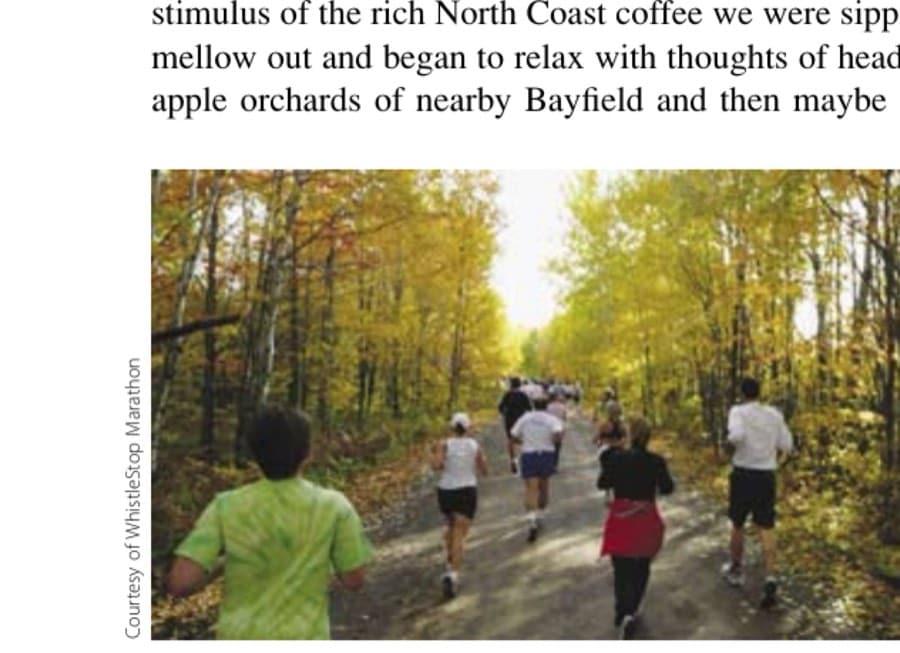
▲
This “rails to trails” marathon course goes due east and straight into Ashland, Wisconsin, for over 20 miles—and most of them under this canopy of fall colors.
some of the local Nut Brown Ale at the South Shore Brewery. There, standing in the lake, I began to think back on the day and, in fact, the whole season of running (for me beginning with the Navarino Trail Run on a cold, windy April day, Grandma’s Marathon in June, the Keweenaw Trail Running Festival in July, and the Hobo 25K at Rock Cut near Rockford, Illinois, in September).
In none of these races had I actually stopped to savor the moment. In fact, I often noticed runners in these races trying to snap photos of the scenes with small cameras or using picture phones without stopping—even when it would just make sense to stop, you would think, to ensure a better picture. Surprisingly, at the recent Aldo Leopold Half-Marathon near Baraboo, Wisconsin (October 25, 2009), all the runners were encouraged to take time to admire the views. Race organizer Jeff Crumbaugh even offered to subtract any time lost from the official race results for those runners stopping to take pictures! But, alas, I did not see any runners stop during the Leopold Half-Marathon to photograph beautiful Devil’s Lake from the bluff, nor for that matter do I remember anyone stopping to take pictures during the marathon at Big Sur, much less stop to listen to Jonathan Lee play his grand piano at mile 13 of the Big Sur Marathon.
When relating this observation to my running friend Karl Rockne, he told me that Big Sur was his very first marathon and that he had stopped atop Hurricane Point, partly to admire the view and partly to congratulate himself for getting that far! But as he told me recently, “Since then, getting a Boston-qualifying time has become an obsession, and stopping is not an option.” Another running friend, Janine Chenoweth, ran trail sweep at the 2008 Aldo Half with her husband, Chris, to get in more high-quality trail time, because, “It had occurred to us that we were running our summers away and we were out in it but that we hadn’t really experienced any of it.”
Later, back at the Super 8 Motel in Washburn, talking about the WhistleStop with my friend Alexandra Baleanu via e-mail (yes, Ashland is far from Chicago,
© Sports In Motion Photography
▲
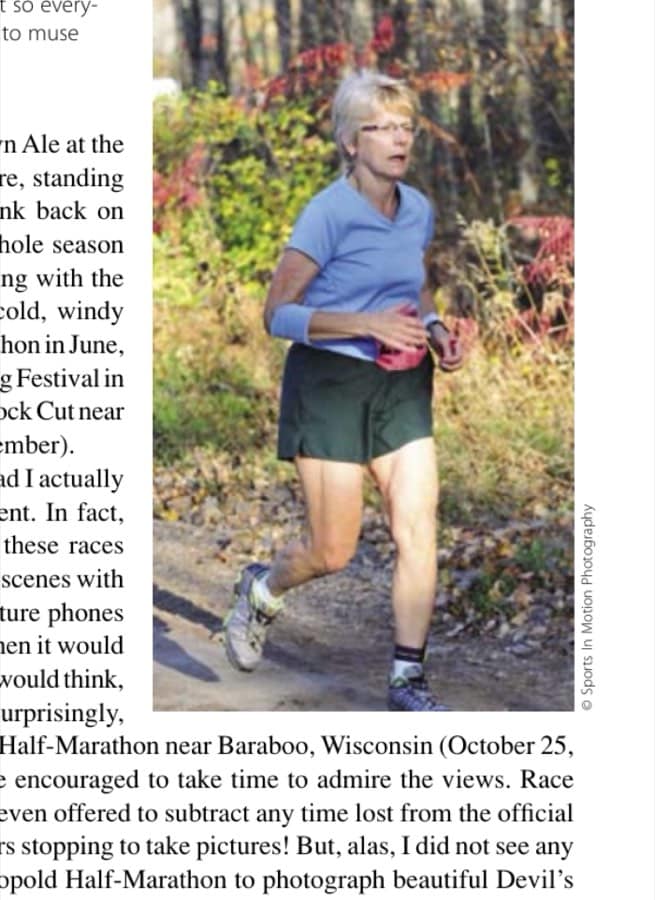
The small field thins out fast so everyone has room to run and time to muse about the day.
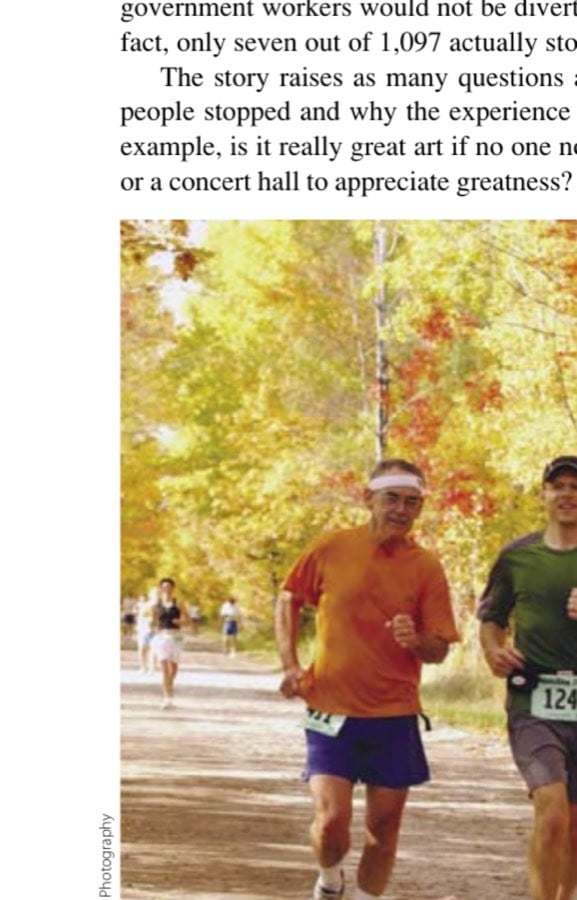
Early in the race, the author (left) tries to keep pace with his son-in-law, Steve Daut.
▲
© Sports In Motion Photography
but not so far that the Internet cannot reach you), she directed me to a 2007 story in the Washington Post that did, figuratively speaking, stop me in my tracks— something that 26 miles of glorious north woods could not do. The story, “Pearls
Before Breakfast,” concerned an experiment in performance art that the newspaper and the National Symphony cooked up to test the theory that great music, played by a great performer, would be sufficient to actually stop people in their tracks in
a train station (the L’Enfant Plaza Station) on the DC Metro’s Orange Line. The plan was to have violin virtuoso Joshua Bell play for an hour one morning during rush hour and to film (and interview) all who stopped and any who did not. The
organizers were curious as to whether such a music performance would attract a crowd. The story (and YouTube video) showed, however, that like runners, government workers would not be diverted from the important tasks at hand. In
fact, only seven out of 1,097 actually stopped. The story raises as many questions as it tries to answer about why so few people stopped and why the experience was so moving for those who did. For example, is it really great art if no one notices? Do you have to be in a museum
or a concert hall to appreciate greatness? And is it really so hard to stop moving? It turned out that of the children who heard the music, all wanted to stop—adults usually had to pull them away. Conversely,
other adults who were in line to use a nearby lottery machine hardly noticed the sound. At first, when I read the story in the Post, I thought that if Joshua Bell were in the woods, Panlike, at the WhistleStop Mara
thon playing beautiful music, runners would certainly stop to listen. But then, after thinking about how through this running season I have done everything I could to keep from stopping, I was not so sure.
At the WhistleStop, it was only after the run, when I stopped to cool down sore muscles, that the reflective mood overcame me; furthermore, it was not until I read the newspaper story that I even thought about why I had not stopped. Stopping in a race, even walking (with the exception of runners following the Galloway run-walk-run method of racing, where you stop to walk for a few minutes every mile), is considered bad form. Even in ultramarathons, the watchword is constant forward motion. Stopping in a training run, however, is a different thing; as my friend Karl says, “A stop here or there to take in the view while running outdoors is always welcome. Without it, you might as well do track work, or run on a treadmill.” After a long Saturday trail run in the Kettle Moraine, in Wisconsin, my friends Janine and Chris will sometimes return on Sunday to walk the same trail!
This is typical, I think, as trail runners will rave about the hills, the views, and the experience in the woods—afterward—but no one really stops during the race to “watch the woods” the way the poet Robert Frost did or the way Coleridge and Wordsworth surely did, often covering 20 or more miles of hilly Lake Country when working. Janine also tells me that while blisters, cold, and knee pain have all called for her to stop in trail races, such as the 2008 Grand Island Marathon, she did not stop to take in the beautiful views but, “I spent most of it looking
ad
at the trail about three feet in front of my feet so I wouldn’t trip and fall down, which I did anyway—twice.” So if not stopping is the norm, perhaps we should examine this question from the opposite direction: when do we stop? Well, in my experience, runners will stop immediately if a runner falls, trips, or seems to be very, very ill. At this year’s Grandma’s Marathon, as I came over a small hill, I noticed a runner stumble and fall in the grass at the side of the road. I, and everyone around me, went to her aid; some ran ahead to find a race official, others called for help on their cell phones, and still others—those trained in first aid—were on their knees beside the fallen runner. When talking about this with my son-in-law, Steve, he noted that, “I don’t know what it would take to make me stop once I got going: an accident or serious injury, surely. But aesthetically, like so much of life, in races we are focused on a clear distinct goal—finishing—rather than the small, fleeting moments that form the bulk of our existence.”
Runners are loyal and attuned to their flock or herd but also so focused on their task that only serious injury to another will slow them down. Often, however, runners will not stop for their own good—which is probably why I get hurt so frequently—and I am afraid that most runners would also fail the music-appreciation test cited above. So as I ran into the town of Ashland at the end of the WhistleStop Marathon, past a few struggling runners and a couple of determined walkers, I voiced an encouraging word each time I went by a runner and usually received a kind “good job” in reply. As marathon finishers, we all were hurting, yet in the shared experience of the moment, we seemed more aware of those around us and appreciative of each individual’s efforts.
While it would not be until later that I reflected on the beauty of the course and the wonder of the day, it was there at the end of the race that I was most fully attuned to the struggles of others and felt the shared support we each needed to succeed. After passing the locomotive and finishing the race, it was while moving with the other runners through the refreshment tent that I realized that although I did not know many of their names, I knew each of them, for over the final miles I had grown familiar with their running styles and had come to appreciate their determined efforts to complete the race. As we all walked to the table where the finisher jackets were being distributed and picked up cups of water, we lingered and seemed to bond a little. In that moment, we were like herd animals that had successfully crossed a dangerous savanna and now gathered near the water hole. We had each succeeded and survived, and along the way we had showed our love for one another, a trait that ultimately seems more important to the species than stopping to enjoy the view. 1
W. H. Davies, 1916 poem, “Leisure” (suggested to me by Laura Shakelton)
This article originally appeared in Marathon & Beyond, Vol. 15, No. 6 (2011).
← Browse the full M&B ArchiveMore like this
1,000+ stories from 19 years of Marathon & Beyond
The complete archive of the legendary long-distance journal — digitized and free to read.
