

Musings Of An Accidental Ultramarathoner
In the late fall of 2012, at the age of 41, I ended up running my first ultramarathon. It was the New York Road Runners 60K contained wholly in Central Park, which translated to running the middle four-mile oval circuit for nine repeat laps. I say “ended up running” because I had not planned on participating in any of the race, let alone the entire 37.2 miles. A friend of mine who had run nine marathons informed me of his midlife quest: he would be turning 50 in 2013 and had gotten it into his mind that it would be a good—no, a great—idea to run a 50-mile race sometime after his birthday. So far, so good. I had no obligation to my friend, and though I thought he may have at some point during one of his longer runs rattled a couple of screws loose, I fully endorsed his decision (at least in his presence) to do 50 at 50.
OK, fair enough. What did this have to do with my “expedition”? It may be easy enough to connect the dots, but the circumstances were more complex than you might suspect, so I’ll give a quick synopsis of what happened.
Like thousands of other runners, I was scheduled to run in the 2012 NYC Marathon. The story of what happened with the race is well known, and I won’t go into it here. Suffice it to say that there was no official marathon due to dire conditions and tensions that flared in the city as a result of Hurricane Sandy. Given the circumstances, I ran in an impromptu, social-media-inspired Central Park Marathon on the traditional marathon Sunday. This turned out to be a great experience. Thousands of runners representing many countries showed up on a blue-sky Sunday to cover the 26.2 miles in the park.
If you do the math, this was exactly 13 days before the NYRR 60K. My friend had already signed up for this event and was treating it as a training run for his 50 at 50 quest. I told him that I would certainly be willing to run a few miles with him, depending on how my recovery from the marathon was going by race day.
Here is where the situation gets fuzzy for me. I’m not really sure how I made the seemingly innocent jump from pacing my buddy and treating this as a long recovery run to signing up for the event and deciding to give it a legitimate go myself. I’m sure the fact that the event listing on the NYRR website indicating that the race was at near capacity just a few days before race day affected my decision to sign up. It triggered one of those irrational “I better sign up for this now as it’s almost full” responses. Somehow, my normal brain circuitry was bypassed by a sign that began to blink: “Near Capacity, Near Capacity, Near Capacity.” I know, it doesn’t make sense, but I still figured that I would just pay the fee, get a T-shirt that said something about a 60K on it, hailing me as some kind of crazed adventure junkie, and then just run a few miles until I inevitably threw in the towel. After all, it wasn’t part of my quest for 50 at 50. I could just treat this as a mildly curious physical venture that would be fun for however many steps I decided to log.
Anything for a T-shirt The place where logic broke down concerned that seemingly innocent “freebie” T-shirt. The problem here was that I would never be able to bring myself to wear an ultramarathon badge of any kind if I hadn’t completed the full distance. Now
ad
this was something that I knew going in, I’ll admit in retrospect, but I had neatly filed it away, or rather crammed it unceremoniously into the recesses of my runner’s prideful mind. But T-shirt or no, I wasn’t planning on running the full distance. I simply was going to go out there and try to lose myself in a meditative reverie in the familiar Zen-like passing images of a most beloved Central Park, known well to this New Yorker: famous last words, perhaps.
Saturday, November 17, 2012, turned out to be a beautiful day, and well, I just couldn’t bring myself to stop running. Actually, that’s not entirely true. I took many breaks and had to stop several times to stave off cramps in my hamstrings. But I found a way to continue. I just couldn’t quit.
The crazy part of running nine loops of anything is that the volunteers and the spectators become a spontaneous network. Those who stood out there on the course for hours upon hours, cheering on the runners with heartfelt enthusiasm, were pure fuel to persevere for any participant in the midst of a tough spot. Lap after lap, I grew used to seeing the same faces smiling and, in turn, extracting a thumbs-up from me each time I passed by. How could I let them down? Weren’t they watching me persist in some kind of existential trial of limitless will and resourcefulness of spirit? Didn’t they have nearly as much invested in my finishing as I did?
Of course, the only person I would be letting down should I not finish would be me. And though I knew this to be true, I still felt somehow mildly responsible for garnering the respect of the volunteers and bystanders. They had given up a great deal of comfort to be there throughout the chilly day, and I wanted to earn the right to be cheered by them.
Surviving the run required a reshuffling of the usual rules and goals of the 60K’s shorter sister races. The race was more of an expedition than a continuous run. It had an extremely pleasant and relaxed atmosphere that lent itself to a state of mind that was both appropriate and necessary to enable completing the full distance. It was, despite the protests and outright rebellion of many muscle groups threatening debilitating cramps, a pleasurable experience. It is true that in the last miles I was forced to slow down to such a degree that you would be hard pressed to distinguish me from a person taking a casual stroll and admiring the autumnal foliage of the park, but I was still moving.
The pause that refreshes I had, after the first 13 miles, adopted the practice of stopping at the top of each four-mile loop to refuel and walk (really the verb should be “shuffle”) for a few precious moments. I would take in a few refreshing gulps of an electrolyte drink and some bites of homemade almond-and-chocolate energy bars and then engage in snippets of encouraging conversation with my buddy’s sister and daughter (who
▲
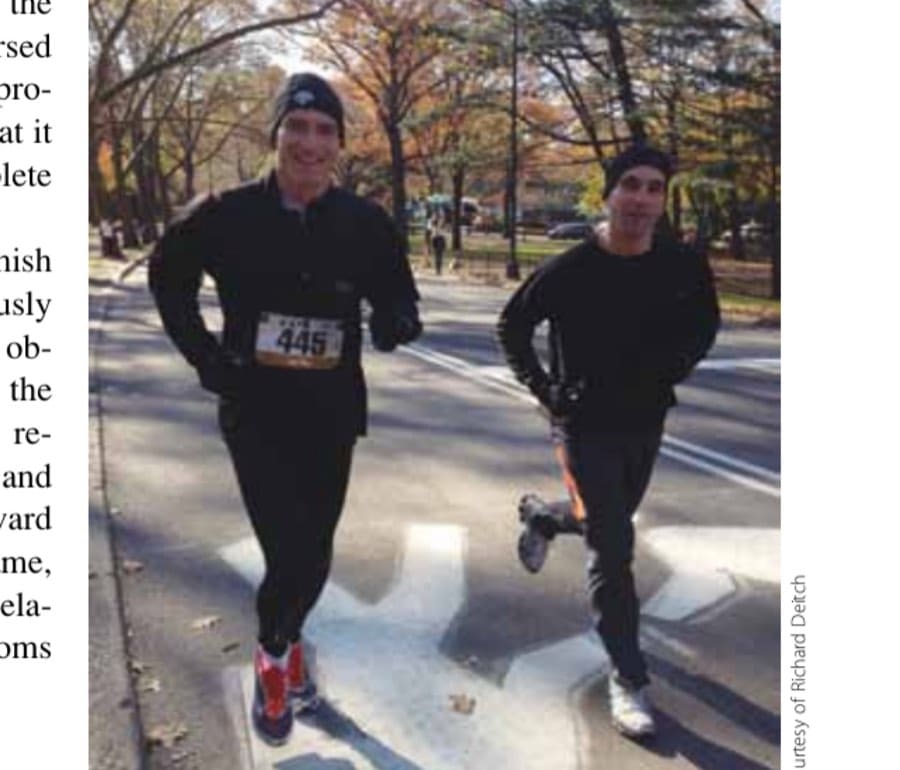
The author (left) and his benevolent brother.
Courtesy of Richard Deitch
had with extreme kindness volunteered to mind our drop bags). This satisfied, for the most part, the demands of my body’s increasingly urgent cries for sugar to hold off the hallucinatory predations of my drained brain. The problem with such an approach in the latter stages of the run was that each time I stopped, it became alarmingly more difficult to coax my legs into moving forward again.
Forget about speed. I had all but given up on finishing with an outstanding time, the kind of fantasy I may have pipe-dreamed while inhaling the pages of the latest ultrarunning book by Scott Jurek. The challenge was to get my lower body to ignore the steadily rising panic signals being sent out by the neural network that was designed to protect and serve my best interests. Besides the ever-present hamstring spasms that had put a lien on my stride and a mortgage on my cadence, there was a newfound jab of grinding pain that had seemingly taken control over the lateral side of my right knee.
Somewhere in the vicinity of mile 28 I began to take notice of this discomfort. As I shuffled off in the prevailing southerly direction toward the by-now overwhelmingly familiar clockwise miles of the east drive in the park, I felt an unsettling stiffness in my tendons. My knee had apparently made a deal with the rest of my body: as long as there were no complaints from the vitals it would be allowed to deliver several excruciatingly stiff strides out of the box and then it must stop pestering and sapping the remaining strands of this runner’s resolve. Once I realized I had no choice in the matter, I eagerly endorsed my body’s decision to protect itself in the hope that it would allow me to complete the race.
It was not easy to finish the run, but it was curiously not an insurmountable obstacle. I found that for the most part, as long as I remained in the moment and did not look too far forward in the count-the-miles game, my body coalesced as a relatively happy group of atoms
and quantum material bouncing steadily forward in a predetermined direction that was merely part of the DNA instruction set to be carried out for that particular day. I had plenty of help along the way. In addition to the aforementioned aid and mental encouragement provided by the volunteers, spectators, and guardians of my supplies, there were two others who deserve special mention. My girlfriend showed up at different turns in the park to run with me for half-mile stretches, always seemingly at the times when I needed the most encouragement. My brother mercifully shepherded me for the final eight miles and then veered off just before the finish.
I finished the expedition in one piece, as did my 49-year-old friend who immediately began looking (as well as including me in the plans) for his goal 50-miler, to be run sometime after St. Patrick’s Day of 2013. About six days after the 60K,
I began to think about taking a relaxed, easy, few-mile jaunt in my local Queens park. I couldn’t help but smile at the illogical sequence of events that brought me past a point in my running life that I formerly only could have dreamed of
approaching. Oft times, the best trip is the unplanned one. Yet the trip, as is sometimes the case, did not end there. For the first few days after the 60K, my knee felt as though a knife had been stuck through
its side every time I bent my leg. As I mentioned, it was hurting during the later miles of the race whenever I would stop and then start up again. It would then warm up or go numb, allowing me to continue. I had
seen others along the course hunched over like me, rubbing stress points on their bodies, and had also seen at least one man who had dropped to the asphalt while two volunteers mercifully stretched his spent legs. I had
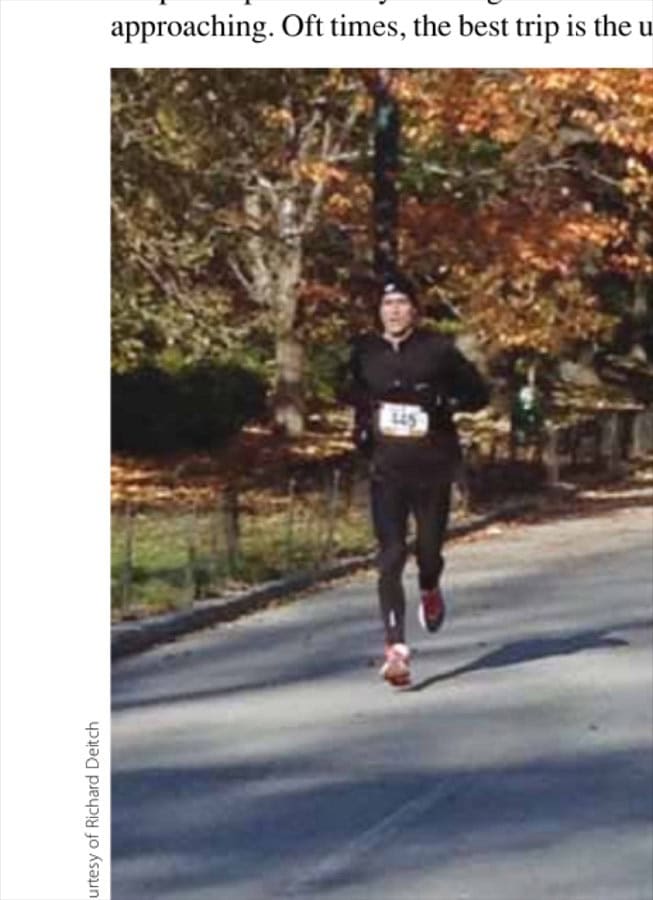
even heard about a runner who The final straightaway to the finish.
▲
Courtesy of Richard Deitch
Success on all sides
ad
had collapsed just past the start/finish line, to be taken away in an ambulance. These scenes are not easy to witness and are even more difficult to be a player in. There is something about an injury that we don’t like to be exposed to. In the days after the race, I watched the movie Serpico. (Spoiler alert: At the end of the film, Serpico, played by Al Pacino, is hobbling on the sidewalk getting into a police car to take him home.) The heroism of the hero looked diminished. Such scenes touch a taut nerve, reverberating through our psyche.
Spectacles of pain ultimately recall primitive, limbic system memories that are perhaps wired into our brains as dimly lit yet stable, nascent bridges to our ancient predecessors. The sight of someone limping activates a pattern of synaptic triggers; a series of gates are opened one by one as if it were an autonomic trip-wired system of nervous dominoes. Ultimately, when the last tile falls to the board, what we are left with is a sinking, helpless, emotional response that nags at our sense of empathy yet leaves us with no way to deal with the situation.
What directs these core ganglia of call and response? Is it really a stretch of the imagination to say it’s a nod to the nomadic lifestyle of our earliest ancestors? In those predominantly fight-or-flight days, if you couldn’t keep up with the group, you were left behind, giving rise to an ancient terror of abandonment. The fear that you would, come nightfall, be at the mercy of the elements as well as all manner of heavily toothed predators is enough to cause a deep sense of angst
and panic. The discomfort we feel at seeing an injured person may be inextricably linked to the fear of being eaten alive. Leave the sick; if you can’t keep up with the group, you will be left behind, abandoned no matter what past deeds or sacrifices the group associates with you. Great accomplishments contributing to the good and advancement of the tribe as a whole are irrelevant when it comes to our most primal survival instincts.
It translates to many animals We see this same pattern in the animal kingdom. For instance, with orangutans one alpha male controls the entire group. As age wears him down, he must deal with more and more challenges to his power and authority. It is not a slow wresting of his power that causes his downfall; rather, like an injury, it is usually a sudden instance of defeat. One moment he is king; the next, after a battle and loss, he is outcast. He must leave his harem and watch from the blinds as the younger usurper couples with his females and relaxes on his lost throne.
Now, it is possible that our former hero might lick his wounds, marshal his strength and mount an eventual counterattack, a bid to regain his lost throne, but the current situation’s message is clear: you are no longer strong enough to keep up with the demands of the job, and you are out! You must live on the outskirts of the group, fend for yourself, or die.
This might be a bit of an extreme example and perhaps a not exactly appropriate analogy to the sore knee of a runner. In today’s modern world things are usually not this bleak—you would hope. As evolved as we may think our society has become, with all of its comforts and conveniences, it remains incapable of changing the fact that injury is a traumatic experience for both the injured and the observer. The nomadic tribal response we feel in an encounter with someone who has been hurt continues to echo from our memory. Triggers of neurons and subtly elegant chemical systems unlock gates and lift trap doors to oft-unused and dimly recalled dark passageways—forgotten locations in our psyche are lit up. We are fearful of a lonely death, the cycle of life coming to an end. Without the ability to hunt and gather and move away from danger on our own, there is only the slow, painful slide into the unknown, incalculable moments leading to starvation and death. Ow!
I apologize for the angst-ridden bluntness. Perhaps I’m selling humanity short on the deal and portraying certain aspects of our nature in a harsher light than is necessary. As far as my experience relating to these issues during the 60K, I observed both the altruistic as well as the reflex-driven response to injury. The race was an incredible experience, and people did help each other. I bore witness to this throughout the expedition. Volunteers stood out on the course for the better part of the day. They cheered and offered encouragement to both the speedy
and the hobbled, regardless of how steadfast or faltering the runner appeared to be. There were spectators doing the same, and fellow runners encouraged their compatriots, even going so far as to pause to stretch other fallen, stricken beings. Many were left to fade on the course as well, but the pursuit of the endeavor, in my mind, is enough to extol those who strove, regardless of the finishing results.
The true race is in the running. The sweetness we derive from such an oftenpainful experience comes from being so focused in the moment that archetypal fears and other distractions are stripped away from our immediate concern. They are filtered out by our need to survive now as each step is taken during the run. The sometimes ecstatic flow that we can achieve by pushing through self-constructed barriers is, to me, the ultimate goal of any great experience. It is a matter of allowing yourself to give rise to your own rebirth on the other side of the pain, as well as the physical and mental fatigue, and pour yourself into the remainder of the expedition like a mythic hero or prodigal son.
Epilogue
Courtesy of Richard Deitch
My friend who turned 50 on St. Patrick’s Day 2013 and who was the chief instigator of my undertaking the 60K successfully completed his 50-mile run in November 2013. He told me afterward that it was the hardest thing he ever did physically. During the course of the day, he turned and sprained both ankles on leaf-covered rocks while trudging through the Appalachian Trail portion of the race. He was close to tears at several points and hallucinated in the final mile, thinking he was running toward a great white tree in the distance, which turned out to be the headlights of an approaching truck. Although I did not run with him, I am proud to have been part of his initial step across the threshold from marathon to ultra. Congrats, my friend. Perhaps we will cross that line again in the future.
▲
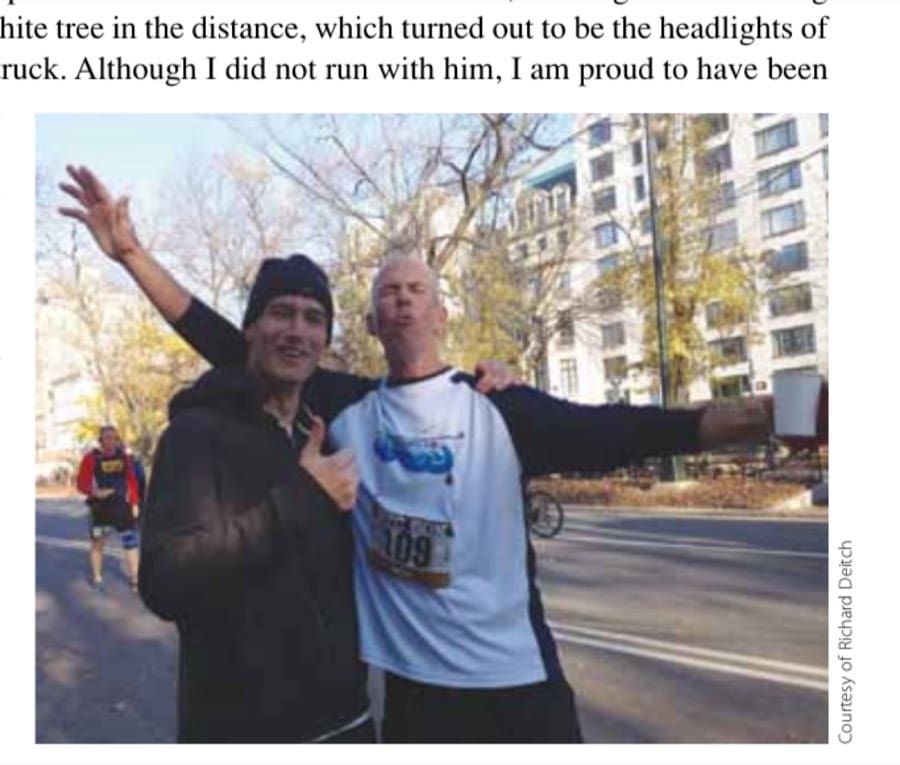
The author (left) and his friend, the 50 at 50 ultra instigator.
This article originally appeared in Marathon & Beyond, Vol. 18, No. 4 (2014).
← Browse the full M&B ArchiveMore like this
1,000+ stories from 19 years of Marathon & Beyond
The complete archive of the legendary long-distance journal — digitized and free to read.
