

My 10 Most Difficult Marathons
Choosing my 10 most difficult marathons required some heavy reflection. I first had to decide what makes a marathon hard. When it is scheduled may make it hard (time of year), weather can make it nasty, and of course the elevation can make it hard. A marathon run in your first running years may seem difficult, but in the light of 10 or more years, it seems like a walk in the park! Your attitude of the moment will make one marathon more difficult than others. How you feel that day, how you rested the night before, what your training was like, how you ate, your age, your experience, and your companions—all of these things may tip the balance to the winner, the most difficult race you’ve done.
First, I went over my list of marathons, and without analyzing why, I chose races that I remembered as particularly hard and that stood out in my mind. The list wasn’t as long as I thought it might be. Second, I remembered what I could of the courses. When the list was over 10, I started to make comparisons. Would I do any of them again? Sure, why not? I made it once, didn’t I? Elevation didn’t seem to be a factor; road races didn’t usually make the list. Rocks, tree limbs, sinkholes, and other common trail elements often did. Here are the results.
Yukon River Marathon
In late 1999 and through most of 2002, I was on course to complete a marathon in each of the provinces and territories in Canada. There were many races on gorgeous and extreme terrain throughout this country. The Yukon River Marathon in Whitehorse, Yukon Territory, stands out among many in great terrain, though. We started out outside of town on a gravel path alongside a park. Suddenly, we began climbing high above the Yukon River on the edge of a . . . cliff? We achieved
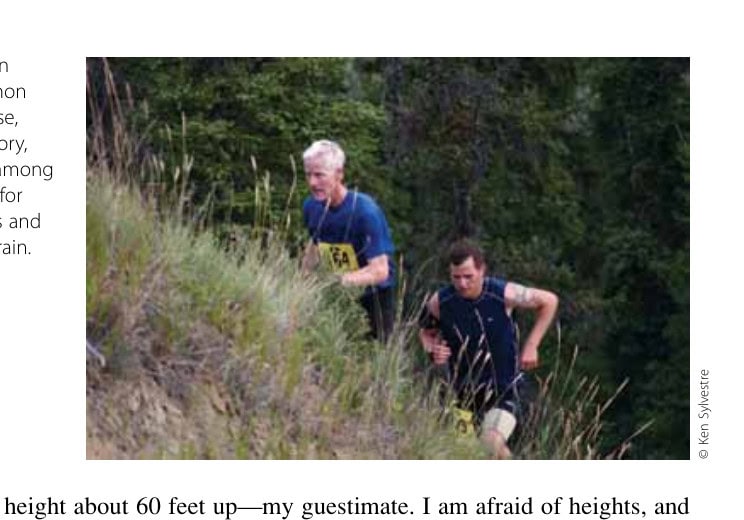
maximum height about 60 feet up—my guestimate. I am afraid of heights, and we were very close to the edge of the cliff, looking down on a bright-turquoise, fast-moving river. The trail occasionally moved inland through forested areas with surfaces of needles. At one point, alone, I moved into a clearing with no evidence of a trail. I stood there, contemplating my choices, when a late starter scrambled past me, straight up the rock—OK, that way. These examples were repeated for 26.2 miles. I believe I came out at 26.2 and in my most pitiful manner asked if I could stop now.
Monster Marathon
The Monster Marathon in New York was one of my early choices, in the mid-’90s. It was an out-and-back course, with the beginning and end along a moderately hilly road. I knew little about the structure of the course (some of the most interesting choices come after minimal thinking). I remember that there were lots of big dogs at the packet pickup in the park. I asked about them and found out that they were rescue dogs. I like animals anyway but made sure to introduce myself to as many of the critters as possible. At that time, I had developed a system to rate my clumsiness on trails. May I say that Monster was at the top of my rating system for years, with a four- to five-fall mark? You left the road to go straight up into a—forest? Jungle? Up rocks, dirt, the usual excess of tree limbs and sinkholes, onto a trail that was sometimes pleasant but usually treacherous. The stones, tree limbs, holes, and branches aimed right at your face were spectacular. For the most part, I was alone, so only the forest heard my opinions of it. When I came out of the woods, my husband was waiting for me at the start/finish/turnaround point. He said, “Are you sure you want to go back?” My unpleasant answer reflected my state of mind: “I didn’t come this far not to finish!” I said and took off back into
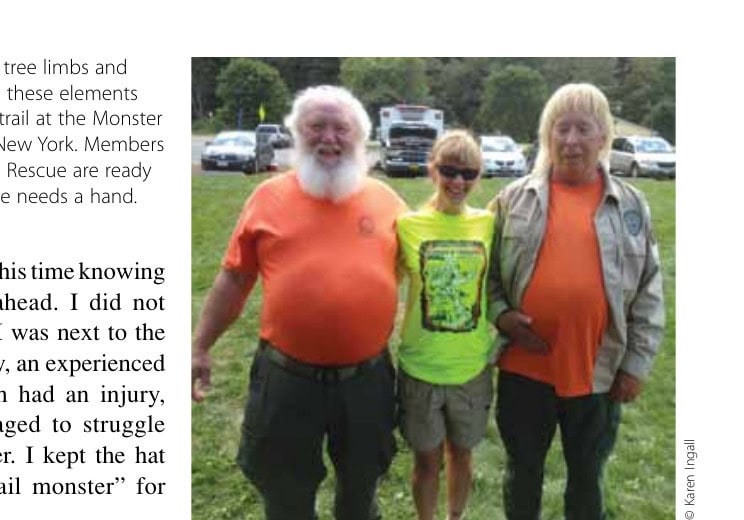
the woods, this time knowing what was ahead. I did not finish last; I was next to the last. Luckily, an experienced trail woman had an injury, and I managed to struggle ahead of her. I kept the hat reading “trail monster” for many years.
Winter Buckeye Trail Marathon
The Winter Buckeye Trail Marathon was near Cleveland, Ohio, and had the same start/finish as the Towpath, a beautiful, flat-as-a-pancake autumn run. I needed a late-winter marathon, and this was a new experience. I was looking for marathons I could drive to from my area (southeastern Michigan). Luckily, I had just discovered crampons. I figured the race was a trail, so it would be good to try them out. A very short jog after the start, when the Towpath would go straight, the WBT took an abrupt left, straight up. And that pretty much described the terrain: severe ups and downs with rocks, tree limbs, the usual, and the added pleasure that most surfaces were covered with all colors of ice, including black. And those surfaces included several uneven stairs designed, I guess, to make it easier for hikers, not necessarily for runners. Bless our crampons. Somehow, I made this one with no falls. One of my musings on the trail was that I was grateful I hadn’t signed up for the 50K.
Mount Lemmon Marathon
Mount Lemmon was a kick! I have family in Tucson, Arizona, and Mount Lemmon presented an extra-special challenge. I pretty much liked the effect it had on people when I told them what I was doing—you know—”Are you nuts? You’re going to do what?” Tucson is something around 3,000 feet elevation. A little higher than that is the bottom of Mount Lemmon. The highest point is over 9,000 feet. The first Mount Lemmon Marathon went straight up from just over 3,000 to around 9,000 feet and then back to 8,000 to the finish. That first year you had 10 hours to complete it. Let me say that this marathon is all road. There were short stretches of road that leveled off slightly, but basically, you go up, and up, and up. This was one of the first times I tried 5-Hour Energy. I consider it only for special occasions but credit it with keeping my energy level stable. Oh, and remember my fear of heights. The scenery was magnificent, but the side glances had to be brief to prevent dizziness. The aid stations were regular and well stocked. I was often alone again. A particularly nasty moment occurred near the top, when you went up to around 9,000 feet and then had to drop down again to 8,000. If I remember correctly, you could see and anticipate what you had to do.
Eco Marathon
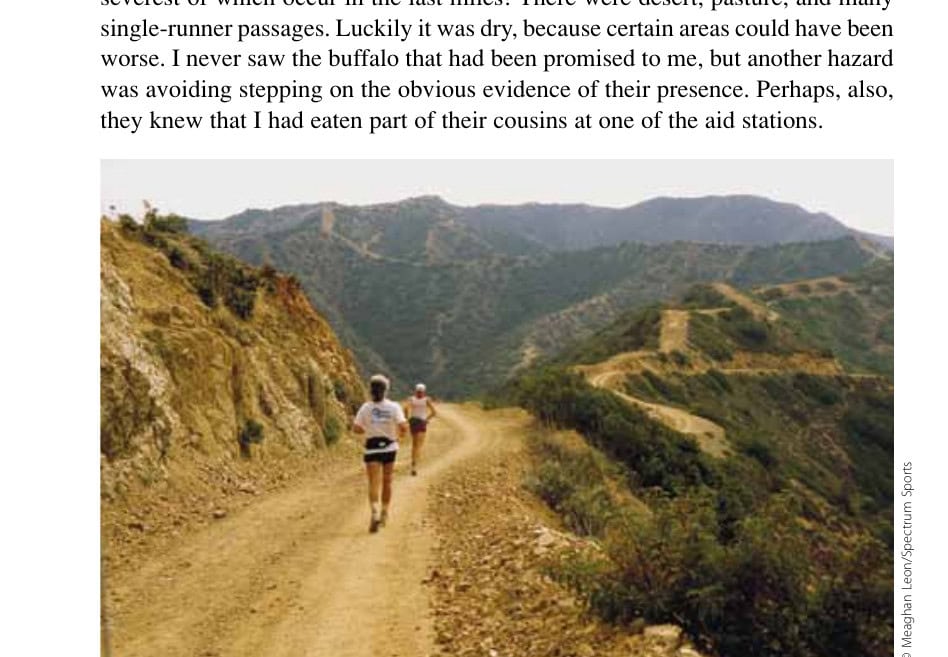
A relatively recent race for me was the Eco Marathon on Catalina Island, “26 miles across the sea” from the coast of Los Angeles, California. Friends helped me make the arrangements for boats and lodging. Out of town, you run up a gradual but long incline that looks deceptively easy and smooth. That’s pretty much as easy as it gets. And then—miles of steep mountain climbs and declines, some of the severest of which occur in the last miles! There were desert, pasture, and many single-runner passages. Luckily it was dry, because certain areas could have been worse. I never saw the buffalo that had been promised to me, but another hazard was avoiding stepping on the obvious evidence of their presence. Perhaps, also, they knew that I had eaten part of their cousins at one of the aid stations.
Old Farts Marathon
Kudos to my own state, Michigan, for providing one of the toughest races I’ve done, now called the Old Farts Marathon and sponsored by the Old Farts Running Club in and around Lowell, Michigan. Coach Droski advertises that if you can complete this marathon, you’ll be allowed to do it, no matter what your time. Each year he has added something nastier to the race, and velocity-challenged marathoners think, How hard could it be? It could be terrible. You can rationalize your previous attempts and do it again, but you’ll be surprised again when Coach and his students do their magic and change the trail. It is a trail-lover’s trail, again with the rocks, tree limbs, sinkholes, climbs, and descents that might not be as severe as some courses but are designed to wear you down. There are pastures with high grass and high sand dunes. There are occasional startled deer running across your path. There are some road sections, but they are steep and unrelentingly hilly, too. The finish last year was in a park with all sorts of food, including homemade snow cones as an apology. The goodies are terrific, too. One year I won grandmaster and got a huge gym bag. When I opened it to put food in for later, it was totally stuffed with clothes, toiletries, and such things as additional prizes. There must be something wrong with me. I ran the inaugural and believe I’ve missed only one year since.
Bataan Memorial Death March Marathon
The Bataan Memorial Death March Marathon commemorates the original Bataan Death March in the Philippines; it starts and ends at White Sands Missile Range, New Mexico. It is an amazing course that combines desert, unrelenting hills, quite a few rocks, and road/trail combinations. The year that I did it, military entrants with backpacks and full military clothing including combat boots started first. The wimp runners, those simply with running clothing and fancy high-tech running shoes, started later and were dodging around these first entrants, many of whom were marching across the breadth of the trail in groups. That of course made the course more difficult to traverse. While it didn’t affect us nonmilitary types physically, I felt a great deal of empathy for the small groups of military personnel stopping every mile, from early on, to remove boots and bandage their feet. This is the best and probably the toughest marathon in New Mexico. It is worth anything you have to put up with on the trail! You listen to survivors tell about their experiences; there is a free movie about the rescue of the survivors, starring, among others, Benjamin Bratt; there is free lodging at the base if you get there in time; and more.
Wild Wild West Marathon
The same friend who lured me into the Eco Marathon on Catalina Island had lured me into another California race called the Wild Wild West Marathon. The start is in the foothills of the Sierra Nevada near Lone Pine, California, and the elevation ranges between 3,700 feet and 6,600 feet; it covers desert, extreme heat, and nasty, rocky, steep climbs and descents. At one point, I remember being alone in the desert without a discernible path in front of me and not much water left. At another point, I was with a friend and we were both lost, but he had radio contact with another friend who directed us back on course. Without the radio, we might have had a really long day. The race website says that the temperature can reach 90 degrees; yup, that’s another difficulty. I remember little if any road. Try it; you’ll like it.
Pikes Peak Marathon
The Pikes Peak Marathon is a legendary event. Friend Cathy and I got online the first second allowable and made it into the pool. Somehow I heard about the $15 home-bound book about Pikes Peak—it’s wonderful. The race starts in the town of Manitou Springs at approximately 7,000 feet, already rarefied air for most of us, and goes up to just over 14,000 feet; at just a little over halfway, you turn around and go mostly straight down. The book covered the history and construction of the trail, what the aid stations consisted of, what you should bring with you, what altitude problems you might experience and how to deal with them, how to train, and more. I didn’t have time to study it but got a good idea of what I would experience. Needless to say, a lot of climbing is involved. Near the top, there were rocks as tall as I was (I am a 4-foot-11-inch giant). The climbs are tough; tough also is the etiquette that requires that you flatten yourself against one side of the trail so faster runners coming down can get past you. I felt a mild headache throughout, which was helped by aspirin. Coming down is even tougher, if possible. In some places you need to brake yourself to avoid falling. There are switchbacks near the bottom that are quite treacherous; I managed to go down twice and trashed friend Ruth’s sunglasses on the way. The last couple of miles are on the road, and if possible, the severity of the downward angle increases. I also managed to get mildly lost on the way down and found my way back with the aid of some picnicking good Samaritans.
Marathon by the Sea
Marathon by the Sea, Saint John, New Brunswick, Canada, was an unremarkable course as I remember it. But these people know weather. We started in the driving rain, and for at least the first two hours of the course, we ran through the same driving rain with the accompaniment of severe thunder and lightning. I have been in the United States for races that were canceled due to the threat of weather. We just kept on going, often wondering if we were on the course. Don McNelly, a megamarathoner when I was a running babe, sent word back to us when we were still on the course that he had gotten miserably lost and had given up and gone home. At least I had a few people to huddle with me under the lightning bolts. Roughly two and one-half hours into the race, the rain slowed, and we found ourselves on the side of an expressway back into town. By then it had gone from chilly to hot. Weather sometimes makes the difference between doable and impossible.
The selections are those of this writer and in no way reflect the opinions of the management! Ask me tomorrow, and I might change my mind. There were runners-up that might have made it on the list. My selections are not in order of toughness, either. These were all joys, and I repeat, I would do them again: maybe I will.
Any top 10 list is potentially controversial, which of course is part of the fun. This assignment was to come up with the 10 most important ultrarunners, not just the 10 with the fastest times or deepest resumes. So, in addition to performance excellence, we’ve added a difficult-to-define factor that measures their influence—the degree to which they have helped shape the sport of ultrarunning and the culture around it. I’m not even going to attempt to list them in order of importance—they are listed in more-or-less chronological order. Let the arguments begin!
Edward Payson Weston
In many respects, the origin of the sport of ultrarunning can be traced to the pedestrian competitions of the 19th century, and by far the most famed pedestrian of that era is Edward Payson Weston. His pedestrian career started when he lost a bet over the 1860 presidential election and walked the 479 miles from his Boston home to Washington, DC, for Lincoln’s inauguration. At first, he walked. But as competitions began to arise, he found he needed to run in order to win. And so he did, and he recorded 550 miles in a six-day competition in London in 1879—a total that would put him among the world’s elite even today. By all accounts, Weston was a flamboyant man with a keen gift for self-promotion. He became friends with P. T. Barnum, who helped promote his events. He was an inveterate gambler, a womanizer, and constantly in debt. He was also a teetotaler and a vegetarian and spent considerable effort promoting a healthy lifestyle. In 1910, at the age of 71, he walked from San Francisco to New York City in 87 days
This article originally appeared in Marathon & Beyond, Vol. 17, No. 4 (2013).
← Browse the full M&B Archive1,000+ stories from 19 years of Marathon & Beyond
The complete archive of the legendary long-distance journal — digitized and free to read.
