

My Awkward Moment Of Glory
In Maine, like many other states, the Olympic marathon is a worthy aspiration. But here in my home state, it is the female Olympic marathon runner in particular who is at the sacred center of that aspiration. It is this way because Joanie Benoit Samuelson made it so when her gold in the 1984 Olympics made hers a household name. That such an athlete could come from my very own home state and go on to win the first women’s marathon in the Olympics was an unimaginable accomplishment and a force that followed me around through most of my adolescence. All of Maine knew of Joanie, and all the young female athletes that I knew wanted to be like her. We admired her from a distance but didn’t hesitate to presume that perhaps our hard, New England-bred discipline would help us too, in our own designs for athletic stardom, just as we assumed it must have helped her.
Indeed, as her legacy has evolved, so too has Maine’s running community and the strength of its runners. A new wave of female marathoners now thrives in the local competition, support, and opportunities—Maine being just a hop, skip, and a jump away from the storied Boston Athletic Association. Many runners are first drawn here by an invitation to compete in the Beach to Beacon, a world-class, late-summer 10K organized by Joanie. The race, and her reputation, regularly draws hundreds of elite runners from all over the world to compete in her hometown along her old training route, an oceanside stretch of rolling hills set against the waves of the Atlantic.
Some elite out-of-towners even decide to relocate here permanently. Weeks ago, when I had arrived at my parents’ home after a sticky, 12-hour drive from Virginia, my mom had handed me a newspaper article that set this whole story in motion. The article profiled a runner new to the Maine scene, recently moved from Minnesota after meeting her current beau at last year’s Beach to Beacon. Among many other accomplishments, in the past year she had qualified for the 2016 Olympic Trials for the marathon and would complete her training hence-
forth from her new residence in Maine. The article had a full-page photo of her, fair skinned and dirty blonde, running rainy intervals on a track, her head bowed down to her watch. I scanned the photo the way you might scan a map of a city you may someday need, hoping I would see her in the neighborhood. * * * A few weeks later, I got my first real chance. As long as there’s no lightning, there is a weekly 5K series held every Wednesday around Baxter Boulevard in Portland, a three-and-one-half mile trail circling the back cove, a western inlet looping around the peninsular downtown Portland to connect to the more expansive Casco Bay. In late afternoon and early evening, when the race is held, the light on the cove is lazy and warm. Small waves dapple the rays in dozens of directions. If there is a wind coming in off the bay, which there often is, its gusts unearth the dirt of the trail into small spirals of dust, and the water froths into feisty whitecaps. The runner’s list for the upcoming Wednesday noted that the woman from Minnesota would be running, along with several other local standouts, probably in training for the upcoming Beach to Beacon. * * * Thirty minutes before the 6:00 p.m. start, runners begin trickling in, coming from work or a day at the beach. At 5:55, 250 of us crowd into the space in front of the starting line, spilling out from the trail onto the tall grass at its sides. The trail itself is only four people wide, and the closeness feels more like competition than camaraderie. Before we’re herded into a mild kind of order, I cast my eyes over the huddle of front-runners. The casual setting is encouraging; I’m sure I could go poke around and see who’s who. But mostly, I just want to see the elites run, to admire their grit and grace from a comfortable distance. So instead, I talk to the red-headed girl next to me, a baker who will go to sleep after the race to wake up at 3:00 a.m. to load loaves of bread and ringed bagels into the oven at her bakery anchored across the bay in South Portland.
It’s not a high-stakes race; in fact, because it happens every Wednesday and the timing and rules are fairly primitive, many might say it’s not a race at all but a friendly neighborhood run. But I’ve got a bib with a number on my shirt, and in my head I hear the voice of my friend John repeating his favorite refrain: “I don’t care if you think you’re just training. If you’re wearing a number, you’re racing.” I didn’t wear my lucky socks or do all the right stretches, but I did rest yesterday and eat oatmeal this morning, in hopes of at least besting my previous 5K time. It’s a distance I’ve raced only twice, and I’m hoping that, since once was good and twice was better, thrice will be best. * * * A half mile in, I catch up to a dark-haired girl with golden, summertime skin and a steady stride. Holding pace beside her is a taller, curly-haired boy, rail thin and wearing no shirt in tonight’s humidity. By now the swarm of runners has dispersed
▲
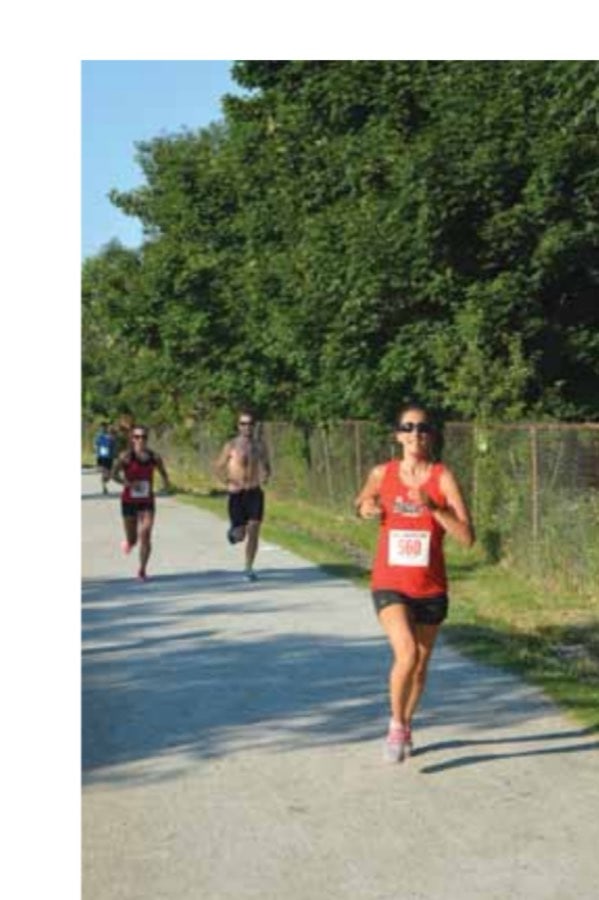
Kicking ahead in the final stretch.
into twos and threes. I decide to try to hang with the suntanned girl and her shirtless companion. My watch buzzes 6:30 for the first mile. Other pedestrians using the trail pass us going in the opposite direc
tion with alternating looks of amusement and respect. On the far end of the cove, closest to where it meets the mightier Casco Bay, the wind picks up, throwing debris in our faces but lacing the air with wafts
of honeysuckle and lilac. The trail ascends listlessly to cross a bridge that connects two corridors of interstate, zooming loud with tourists heading home from the beaches or locals on their way to a cocktail downtown. My watch growls 6:40 for the second mile.
The trail then descends forgivingly down the opposite side of the bridge, but the strides of my partners are increasingly harder to match. The moment to either make an excuse or make haste has arrived. In the first quarter mile, I had looked around and around, trying to spot the backs of one of the elite runners or the Minnesotan woman from the news article. But now, with a third still to go and already feeling the deadening fatigue seeping down my legs, I only have eyes for my tanned and shirtless partners ahead. They will pull me through to a personal best, if only I can just stay with them.
Instead, they slip away a yard ahead of me, and then two, and then a full 10 feet separate us. While my breath comes and goes in ragged hacks of air, she and he maintain the conversation they’ve been having since I first caught up to them. Their strides are more perfect than they were at mile one. But regardless of how hard this isn’t for them, or how casually they’re running, I don’t want to have to e-mail my coach tonight about the time I ran PR splits but finished just slower than fastest. I imagine him here, yelling at me to move my hands, to get up on the balls of my feet. I do, and in doing so I surge past Ms. Suntan and Mr.
Not-an-Inch-of-Body-Fat, beating them both in the final 30-yard homestretch— no matter the near-certain feeling that they could have easily left me in the dust at any point had they decided to ditch their conversation and run as fast as their bodies suggested they could.
I hovered around the finish, stealing glances at the faces of everyone who finished before me. A lean, muscled young woman in a baby-blue sports bra stood apart from the rest of the group, stopped off to the side and looking at her watch, detached and disappointed. She, perhaps, was the Olympic hopeful whom I had come to see. She must have finished at least three minutes ahead of me. Suddenly too intimidated to approach her, I ambled instead over to the bronzed girl I had run with. “
I just wanted to thank you,” I gushed. “You totally pulled me through that! I just tried to hang with you guys . . .” Surprised but amused, she brushes off my gratitude: “Oh, of course! No problem.” I was still talking though: “I could tell you guys could’ve gone much faster; I mean, there I was huffing and puffing, and you two are just casually chatting. But really, thank you!”
After my awkward mix of gushy gratitude and selfdeprecating humor, I scanned the crowd once more for the woman in the light-blue sports bra. I didn’t know what I would say to her if I approached her, but certainly something intelligent would present itself in time.
No such luck. She was nowhere to be seen. So I went home, sad to have missed a conversation with a being of the much-revered Maine-femaleOlympic-marathoner species but happy with the race. Clouds rolled in as I sped along the cove and away from the Portland
▲
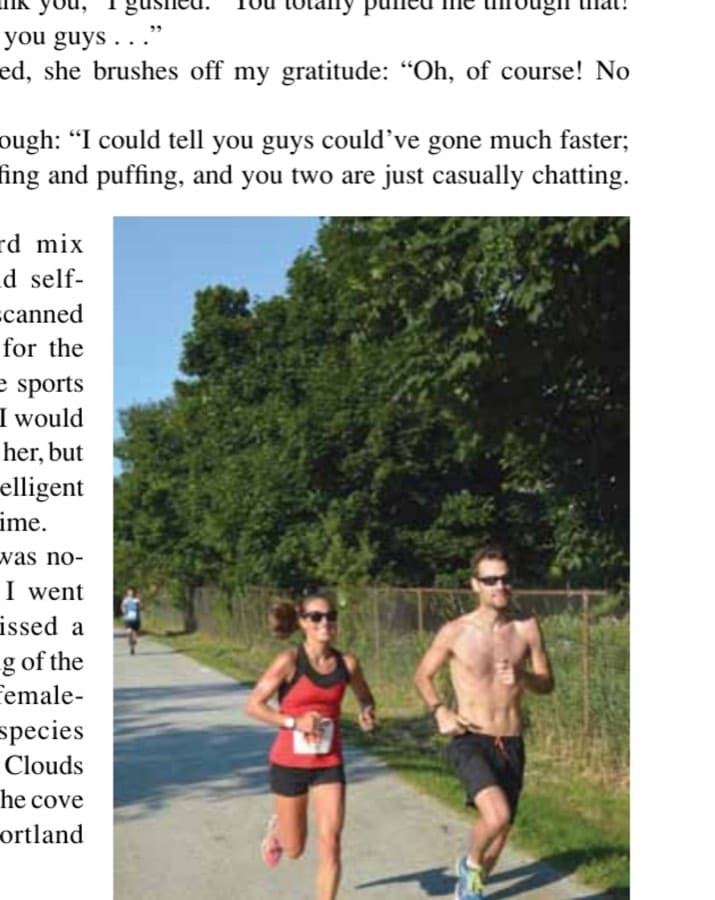
My mysterious race partners, making it look easy.
peninsula, slating the sun in metallic tints of green and yellow. The rain arrived, heady and demanding as I turned into my driveway. * * * The next morning I awoke to anxiously refresh the results page of the race. Midmorning, the times were posted, placing me fourth overall for the women and giving a name to the suntanned woman I had run with: Michelle Lilienthal.
Michelle. Lilienthal? No. It couldn’t be. Quickly, I scrambled downstairs to retrieve that article my mom had given me, with the Minnesotan runner and her pale wintertime complexion. At the top, her name: Michelle Lilienthal.
Oh, my. Oh my, my, my. I had run the entire five kilometers with the very same Michelle Lilienthal: Michelle Lilienthal of the 2:34 marathon time; Michelle Lilienthal of the Astandard qualifying time for the 2016 Olympic Trials; Michelle Lilienthal, who is, without hyperbole, training for a spot on the Olympic team. And like an idiot, I had stared at her suntanned calves for 3.11 miles and not had a clue.
I hate to be trite, but the whole time I had been looking for this woman, she had been right there under my nose. I hadn’t accounted for the possibility of a summertime tan or a new hair color. I had, however, unknowingly run a 5K with an athlete who could run 26 consecutive miles at a pace that I could run one single one.
My mind unraveled in scenes from yesterday’s race, now completely reformatted with this new information in hand. What I had already thought to be a slightly embarrassing exchange of thanks at the end of the race now turned into an awkward, shamefaced streak of red across my memory. First, what a faux pas I had committed, sprinting past her in the final yards, kicking my unworthy dust in her face! And then, to thank her for it, as if we had struggled through it together, as if she had done it on purpose! As if it had required any effort or awareness on her part! She was clearly just running that 5K as a teeny-tiny, almost-incidental part of a longer tempo run. Her fastest 5K time is a full four minutes faster than the 20:40 to which I had kind of thought she had paced me.
I had gone home happy with my time and grateful to the runner who helped me fight through fatigue. She had probably left wondering about that strange, overeager girl who took the race far too seriously and apparently had no idea whom she was running with.
Despite my embarrassment, however, I was glad I didn’t have to write my coach an apologetic e-mail explaining an unsatisfactory performance. Instead, from the page opened with the race results, I opened a tab for Gmail, clicked on the “Compose” button, and filled in the subject line: The (First and Last) Time I Beat an Olympic Marathoner. Bumbling fool that I may be, I wouldn’t be too self-conscious to not celebrate that rare victory.
This article originally appeared in Marathon & Beyond, Vol. 18, No. 6 (2014).
← Browse the full M&B ArchiveMore like this
1,000+ stories from 19 years of Marathon & Beyond
The complete archive of the legendary long-distance journal — digitized and free to read.
