

My Journey To Badwater
My journey to the 2012 Badwater 135 ultramarathon started innocently enough. “Dad, why don’t you run Badwater, so I can be on your crew?” My daughter, Emeline, had just turned 16. From what corner of the adolescent mind had this idea emerged? I had no clue. But I liked it. I thought the experience might help her appreciate some important values, like purpose, strategy, and discipline. She might learn that you can accomplish a really tough task when you set your mind to it. Maybe the experience would give her the confidence to dream up big goals for herself.
Not to say the idea was without risk. National Geographic calls the Badwater 135 the “world’s toughest race” for some good reasons, including the daunting length (135 miles) and the mountain passes. But more than anything else, the race is known for the brutal desert heat, which can reach 130 degrees Fahrenheit.
Whenever I think about the race, I picture 19th-century pioneers crossing the Nevada mountains, their covered wagons creaking slowly across the high desert plateau. Descending through a narrow pass, they discover a basin sunk below sea level, a natural convection oven, where the hot air has no escape. Drinking what little water they can find, they sicken from toxic levels of sulfur and borax. Under the blazing sun, they watch friends and family die. They name the basin “Badwater.” They name the valley “Death Valley.”
I sent in the application and waited to hear whether it would be accepted. * * * Sisyphus was cursed to push a heavy rock up a mountain, and then, when he got to the top, watch it roll all the way back down, forcing him to start over.
To normal people, ultrarunning must seem like the ultimate Sisyphean sport. You run 30, 50, 100 miles, only to end up back where you started with nothing tangible to show for the effort. You catch your breath and sign up for the next race.
Ultrarunners celebrate the effort they expend and the pain and adversity they overcome. But I have a different philosophy. I believe that when you choose the right goals, energy flows naturally. You just have to make some tactical decisions along the way.
Unlike Sisyphus, I picture myself standing at the top of the mountain with a rock that I must roll down to the valley floor. All I have to do is give it a nudge to get it going. The only trick is, which direction to nudge? One path leads straight to the valley floor. A different path dead-ends against the base of a cliff. Unfortunately, the mountain is shrouded in mist. While the choices are clear, the consequences are not.
In this case, however, it was Emeline who had just nudged the rock, and now it was rolling. And I was chasing after it, wondering where it would go. * * * I had run Badwater once before and knew what I was getting into. But that was then, and this was now, and certain things had changed. Specifically, I had switched to a “minimalist” style of running shoe, the kind with little cushion or support. I was rewarded with improved form and faster times. But the transition period was long and painful. I struggled with plantar fasciitis, tendinitis, and other aches and pains.
In late February, I learned that my application to compete in Badwater had been accepted. In early March, I was to head out to California to participate in a 100-mile race—a great way to kick-start my Badwater training, or so I thought, provided the tendinitis did not flare up again.
A few days before the race, I visited my sports doc. He prescribed antiinflammatories and recommended arch supports and then questioned the wisdom of undertaking a race of that distance. Back out of the 100-miler? That would be like stopping the rock once it’s already rolling.
Mindful of the tendinitis, I toed the start line with some trepidation. The race started in the late afternoon, and the first few miles followed a sandy trail along a series of low foothills before heading up into the coastal mountains north of Los Angeles. I reached the summit at nightfall and switched on my headlamp: so far, so good. At mile 50, the faintest of twinges returned. At mile 65, a sharp pain slowed me to a walk. I picked up the pace in the last few miles and ran across the finish. The next morning, the instep was red and warm to the touch. It was March, and Badwater was in July. I would have to heal in a hurry. * * * It seemed sensible to take some time off after the California race. For a week, I did nothing but ice the foot and stretch. A week later, my first training session consisted of a 15-minute walk on the treadmill. The foot felt OK, but I covered less than one mile, not even 1 percent of the 135-mile Badwater course.
Determined not to overdo the running and reinjure the foot, I shifted gears and started heat training. I visited the local gym’s sauna and sat down on the hot wooden planks, armed with a Polar fitness watch to monitor my heart rate. The
watch showed my heart rate creeping up from 50 beats per minute to 70. Standing up for a minute, my heart rate jumped to 90. A fellow in the sauna struck up a conversation. Talking is hard work at 160 degrees Fahrenheit. Glancing down at the watch, I saw it register 120 beats per minute. Gasping for air, I excused myself. The first sauna session had lasted barely 20 minutes. I had a long way to go before I would be ready to cross Death Valley. * * * My second training session was 30 minutes on the treadmill. I went back to the sauna for 30 minutes, careful not to talk or stand. * * * A few days later, I had progressed to 45 minutes on the treadmill with five minutes of slow jogging. I felt some faint twinges in the foot. A few days later I was up to 1:30 on the treadmill with a mix of running and walking. Miraculously, the foot was OK. I headed outdoors for a six-mile loop of Central Park on the unforgiving asphalt. I ran slowly and with some anxiety, but the foot presented no problems.
Sauna sessions were now 45 minutes with a few minutes of easy exercise mixed in, including planks, crunches, squats, and the like. Based on my weight before and after and the volume of water I consumed during each session, I estimated I was losing 50 ounces of sweat per hour. Mental note: during the heat of the day in Death Valley, I would need to drink a lot of water. * * * My training plan focused on the two problems I would confront at Badwater: running long distances on pavement in minimalist shoes and surviving the heat. Figuring out these two variables was like choosing the right path for the rock, the one Emeline had first nudged, which was now hurtling down the mountain slope at an accelerating pace.
The sauna sessions were getting longer, with more exercise and less resting. I would show up at work in button-down shirt and tie, cuffs damp with sweat. On the weekends, the long runs got longer. I tried to have fun with these and left the house at 7:00 a.m., ran for 45 miles, and met up with the family for pizza in a distant village.
My feet seemed fine in minimalist shoes, but I was covering at most one-third the distance of the Badwater course. I set out to run nine loops of Central Park (54 miles) and invited friends to join me for a loop or two. To simulate the heat of Death Valley, I donned a longsleeve T-shirt and fleece vest. I chatted breezily about the race as I kept up with my friends, who were running a little faster than I meant to. I fell behind on water and calories. At mile 48, I collapsed onto a park bench, completely drained, unable to face the final lap. The fleece vest was covered with white swirls where sweat had evaporated, yet I hadn’t covered even half the distance of the Badwater course.
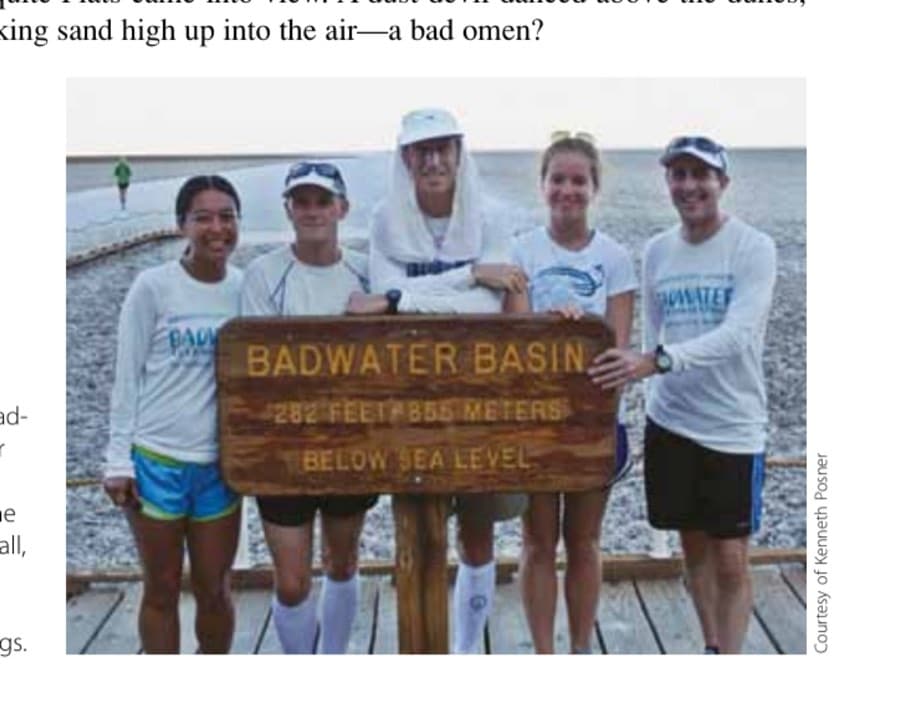
Nonetheless, when my training peaked at 90 miles per week in late June, I felt good. * * * And now the race was two days away. Emeline and I picked up the rest of the crew in Las Vegas. I was fortunate to have recruited capable, experienced runners who would support me during the run, bringing me food and water, taking turns pacing me, watching over me, giving me guidance, keeping my spirits up. Dennis Ball had been on my crew the last time I ran Badwater. Todd Jennings and Elaine Acosta were accomplished runners with positive attitudes and a lot of energy.
Descending from the high desert plateau of western Nevada through a narrow mountain pass, we pulled over at the entrance to Death Valley National Park. We paused to take pictures, laughing and making faces, next to a large sign that warned, “Danger: Extreme Heat.” * * * And now it was race day. We lined up at the start in Badwater basin and, when the horn sounded, headed north along the road. After 45 minutes, the sun peeked above the so-called Funeral Mountains ringing Death Valley to the east. I felt good. Weeks of sauna training had paid off.
The sun rose higher and the temperature with it. Hot winds began to blow off the salt flats, sour with the smell of sun-blasted sage. The high was around 115. I drank a lot: 50, 60, 70 ounces per hour, the crew replenishing my water bottles every couple of miles. Besides a touch of indigestion, I continued to feel good.
About 30 miles into the race, the highway curved to the left, and the sand dunes of Mesquite Flats came into view. A dust devil danced above the dunes, the funnel sucking sand high up into the air—a bad omen?
Courtesy of Kenneth Posner
▲
Standing in Badwater Basin, prior to the start, from left to right, Elaine Acosta, Dennis Ball, Kenneth Posner, Emeline Posner, and Todd Jennings.
* * * At mile 42, the race passes through Stovepipe Wells, which consists of a gas station, general store, and motel. I had run almost continuously from the start, feeling good most of the day. But in the last couple of hours, the indigestion had gotten worse, and I had stopped eating. And the heat had begun to weigh on me. I sat down outside the motel. Elaine brought me an ice-cold towel. I rubbed my head. I tried to eat some solid food.
Someone took a picture of me at this break, staring at the road that leads up to Towne Pass, a 5,000-foot climb out of Death Valley. The last time I ran Badwater, I had struggled with this climb as the heat had finally caught up with me just as I thought I had escaped the valley. I had staggered up that road, plagued with cramps and nausea. I knew that this time, too, the climb would be difficult, and I knew that I was starting to struggle. But in the picture, I look determined. * * * It was time to get going. As I began to march up the pass, the indigestion worsened. Eating was out of the question: the taste of an energy bar sickened me. And now, just as I had feared, the wind was blowing directly in my face. I stumbled forward.
Eventually I reached an altitude of 1,000 feet, as indicated by a roadside sign. I sheltered in the crew vehicle for a moment. The wind intensified, and the vehicle shuddered in the stronger gusts. I emerged from the van and strode into the wind, which was now howling with gale force. I continued forward, almost doubled over. Eventually I reached 2,000 feet.
Another break. Dennis counseled me to eat. Lack of calories can make you feel nauseous, he explained, even though you need more calories desperately. I took in a couple of spoonfuls of soup and headed back out,
one step in front of another. One step in front of another. One step in front of another: 3,000 feet and another break, some more soup. I stretched out in the crew vehicle and closed my eyes for a few minutes, marshaling my fading resources, as the vehicle rocked in the wind. Night fell. I strode forward again and presently reached 4,000 feet.
The reward for surmounting Towne Pass is a 3,000-foot descent at a punishing 9 percent grade. But on the far side of the mountains, the wind was gone. The air was cool. And the soup had restored my energy. I began to trot steadily down the mountain and was suddenly in high spirits. The crew was mystified at the turnaround.
We reached the floor of another desert valley, black in the moonless night. We saw the lights of Panamint Springs, the next checkpoint on the racecourse, on the far side of the valley some 10 miles distant. We could also see a string of lights stretched out across the valley floor, crew vehicles waiting for their runners. More lights hung above the valley, as if suspended in midair, crew vehicles in the mountains beyond. I wondered how far back in the pack I had fallen after
Courtesy of Kenneth Posner
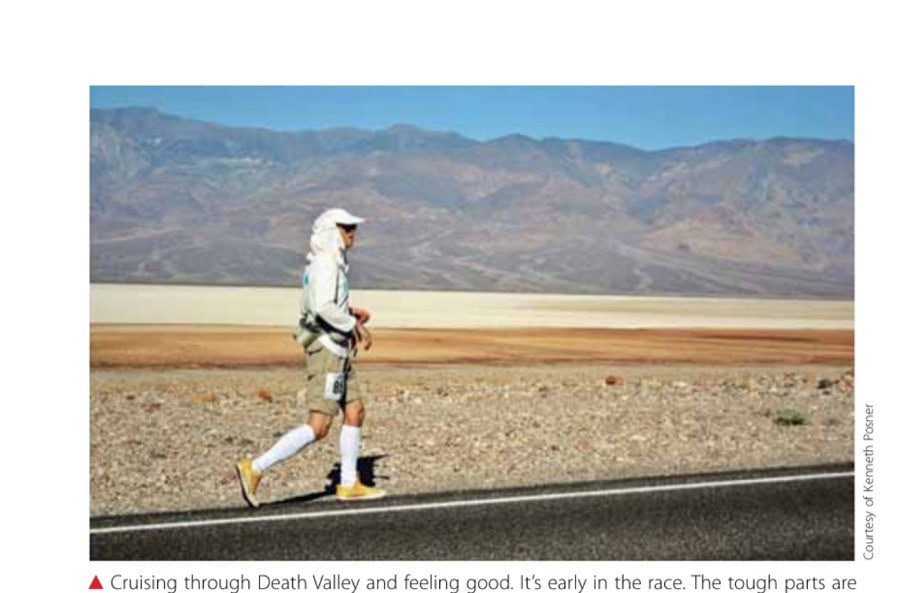
▲ Cruising through Death Valley and feeling good. It’s early in the race. The tough parts are still ahead.
my struggles on Towne Pass. We trotted along at a slow but steady pace, but none of the lights got any closer. In the clear desert air, you can see long distances. After running for some time, we judged that Panamint Springs was just around the corner, about one mile to go. We came to a sign that said “3 miles to Panamint Springs.”
We finally reached Panamint Springs. Then it was time for the next climb, 3,000 feet up to Father Crowley Pass. I started out at a quick walk, and we managed to pass a few runners. Todd was running with me at this point, and in the darkness, we peered nervously into deep crevasses off the side of the narrow mountain road. Todd looked back to see the mountains turning rose in the first light.
We reached Father Crowley Pass in the daylight. We put away reflective vests and flashing lights and retrieved sunglasses, hats, and sunscreen. I moved forward at a slow jog. Running was painful. I spied a runner about a half mile down the road and tried, with limited success, to pick up the pace.
Now we were crossing a vast plateau. A brown plain stretched off into the distance, covered with nothing but scrub brush and an occasional Joshua tree: no signs of humanity, no people, no roads, no buildings, no signs, no telephone lines. No nothing.
We reached the checkpoint at Darwin, an intersection in a featureless gravel field. From here the road begins to drop, and I ran more easily, passing a few more runners. Across the valley, an enormous mountain range was suddenly visible, a dull gray rampart in the morning glare. The race ends at the Whitney
Portal, tucked into a fold somewhere in that gray wall about halfway up Mount Whitney’s 14,494-foot peak. We crossed the 100-mile mark, descending through a narrow canyon with ferrous walls radiating heat. Dennis paced me on the flats: we would run steadily for three-quarters of a mile and then walk for a quarter mile. The miles ticked off slowly. The sun rose in the sky, and it was hot. Sand had accumulated on the road’s shoulder and drifted farther across the pavement when the wind blew.
I felt a pain in my left calf. It was mile 110. Dennis applied some tape to support the muscle. There were still 25 miles to go. I alternated running and walking every 200 yards, conscious of a dull ache.
Through the thin soles of my minimalist shoes, I could feel every bump and wiggle of the asphalt. I focused on form, trying to take some pressure off the calf muscle. On the way in to the town of Lone Pine, I traded places several times with a young Marine. He left me behind while Dennis taped my calf. Then I caught him heading into town. Not wanting him to catch me again, I ran down Main Street at a brisk pace, calf forgotten, and turned onto the road to the portal.
The last 13 miles of the race take you up 4,000 feet to the portal. The road passes piles of jumbled red boulders, known as the Alabama Hills, where countless Westerns were once filmed. I concentrated on catching up to the runners in front of me.
With six miles to the finish, I stopped, ate some soup, and headed out again. The road grew steeper. The sun was setting. I power walked as best I could, swinging my arms. My legs hurt. My focus wavered.
Five miles to go, four miles, three. Someone has miscalculated; it’s still four to go, not three. I trudged on. At two miles left, my daughter will be waiting, I was told, to pace me to the finish. I turned a corner and saw Emeline standing next to the crew vehicle. She was bouncing with excitement as I dragged myself slowly up the road to meet her.
I encouraged Emeline to introduce herself to the race director when we got to the finish and explain why she had wanted to do this. “Dad, be quiet. Just swing your arms and pick up the pace.” The road curved into the portal. We saw pine trees, smelled their needles in the cool air. Recalling the last time I was out here, I explained that the road would soon level off and we would run the rest of the way. But it kept going up.
I explained that the finish was just around the next corner to the left. But the road curved to the right and kept rising. It was quite dark now, and there was no one around. I worried we had taken a wrong turn.
We reached some trees, and Dennis, Todd, and Elaine materialized. They assured me the finish was just ahead. I was suspicious. But we ran like madmen, hooting and screaming, and the race was over. I had finished in 36:51. Emeline
introduced herself to the race director. He gave her an appraising glance. “We’ll see you in about 10 years.” The Marine finished, a US flag across his shoulder, and we congratulated him and his team.
And then we were off. Driving down the mountain, we passed a long line of runners stumbling upward toward the finish. We honked and cheered them on. * * * My time put me at the 42nd percentile of starters. Not bad. Emeline was proud of her dad, but I felt I could have done better.
At the awards ceremony the next day, I learned that a fellow named Art Webb had set a 70-year age-group record, beating my time by over three hours. Art spoke in a deep western drawl. Anyone who might aspire to break his age-group record, he growled, would need to “train hard.” Well, that would be the easy part. Energy flows naturally when you have chosen an important goal.
A thought formed in a corner of my middle-aged mind. Suppose I had trained differently? Suppose I had rolled the rock down a different side of the mountain? I looked up at Mount Whitney and pictured myself standing at the summit. Thousands of feet below, through the mist, I can just barely make out the valley floor.
This article originally appeared in Marathon & Beyond, Vol. 17, No. 6 (2013).
← Browse the full M&B ArchiveMore like this
1,000+ stories from 19 years of Marathon & Beyond
The complete archive of the legendary long-distance journal — digitized and free to read.
