

My Most Unforgettable Ultramarathon
WASATCH MOUNTAINS, UTAH, Sept. 12–13, 1998—Under a canopy of trees, the darkness seems even more stark, changing some 200+ people into one large, gray shadow of unrecognizable shape and hue. The mass begins to move, and formless sounds turn to words. Only one word makes sense—the word “Go!” Slowly, the front of the shadow begins moving forward. In the early morning darkness of the Wasatch Mountains, Paul and I flow into the moving shadow and become one with it—the start of The Wasatch Front 100-Mile Trail Run.
Just like that, and we’re off. The two of us settle in for the long walk uphill on a narrow single-track trail that is both winding and steep and rugged with rocks and roots and overgrown with brush. We’re repeatedly passed on this early climb by more than a few runners in a far bigger hurry than we are. My goal is just to finish. With flashlight in hand, we climb 4,000 feet over the first five miles.
As the dark stays with us for more than an hour, we can’t see how far or how high we’re climbing. We’re also fresh and full of energy. For either reason or both, the climb seems rather easy.
Occasionally, we catch peeks at the Salt Lake City lights below. Inspiring glimpses provide more reasons for being here, now, in the mountains above Salt Lake City. As we approach the five-and-a-half-mile mark, Paul points out the infamous Chin Scraper, now dotted with tiny specks of color, which turn out to be climbers clinging to her face. We come at it through a small bowl, and then we are on it as well, becoming part of the mosaic, climbing slowly. It is not much of a climb, but we do end up on all fours as we near the summit.
Once on top, we revel in the scenery and a chance to finally loosen our legs with some running. The summit yields a few miles of lazy trails around high peaks that treat us to even more spectacular views of Salt Lake City and the Great Salt Lake. At 10 miles, we reach John Grobben’s pickup truck and top off our water from his tailgate. Paul’s buddy, Mike, connects with us at the truck, as does Kevin Sayers. Shortly after, we pass the large radar domes, fondly known as Paul Bunyon’s golf balls. We roll from a jeep road onto a wide, well-groomed dirt road that circles the mountain, beginning a long descent to the first major aid station at Francis Peak (15 miles).
TOE THUMPERS, LUNG SUCKERS, AND BRITISH ELEPHANTS
Joyce and Mitch swarm me like a pair of excited bees on honey. (I learn later that I was a real grump here! I don’t remember being grumpy but defer to the ones not having run yet.) In less than six minutes, they load me up, feed me, water me, and shove me on my way. A swarm of us buzz on down the dirt road together, and in no time at all we’re back on a single-track trail with a long climb up to Bountiful B aid station (20 miles).
Rough dirt roads soon become trails completely hidden by overgrowth so thick that the trails are invisible even as we run on them. The brush scrapes and scratches our legs and knees while unseen rocks and roots attract our vulnerable toes. We run recklessly through this maze of toe thumpers and knee scratchers. Our caravan is rolling merrily along when I feel a big dip in my energy level. This does not bode well. My energy level rises and falls—I live and die so many times in a long run—but I’m surprised that it’s happening already.
I hop off the back of the train as I begin to lag behind. I take a break at Sessions Lift-Off (24 miles) and, soon after, I’m waddling up Lung Sucker Hill. I had been working a decent power walk up the hills to this point, but I find it more difficult right now. My power walk becomes a dying man’s crawl.
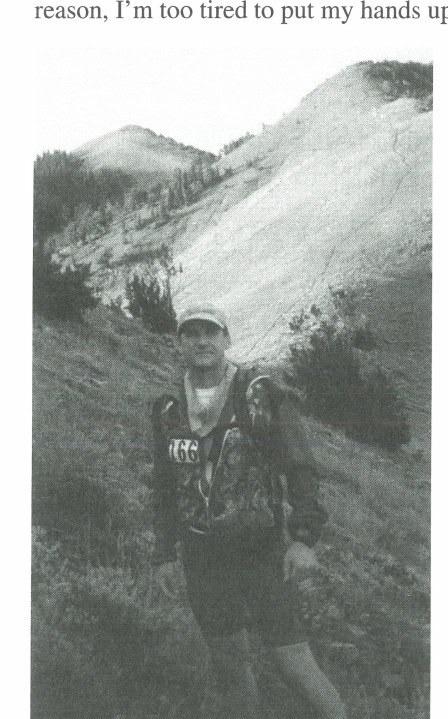
Once on top, I sit down in the shade of a tree and suck down two GU packs and slowly drink a lot of water before continuing. Alone, I enter a barren wilderness of bald ridges, unprotected from the sun. A moonscape of naked beauty. I watch the tiny lines of runners on the next ridge, like army ants marching in formation to disappear into the top of the next mound. I begin to hum the Jungle Book tune where the British elephants march in formation: hup, two, three, four, to a military drill. Up, down, and round we go, tiny ants marching to different drummers. I’m moving so very slowly as the sun roasts my brain that a few folks going by ask if I’m OK.
“It’s just a lull,” I say (although a large one). There’s actually quite a bit of cloud cover, but they must be thin clouds, as I’m being cooked alive. Yessir, I’m way too hot! Descending a long set of switchbacks, I land in a field of weeds tall enough for the buds to whack me in the face as I pass through. For some odd reason, I’m too tired to put my hands up, and I think of Toto in the Wizard of Oz running through a field of poppies. Hmmm, I think: next thing you know, I’ll be seeing winged monkeys!
I’m way past stupid already. My mind is everywhere but here. I’m beginning to dread the downhills, knowing another climb starts at the bottom of each descent. Sure enough, another big climb starts at the bottom, leading me to more terrain like that I just left.
Neil Hewitt passes me with a badly swollen ankle and knee, fighting his own dragons. I limp into Swallow Rocks (32 miles) and am treated to a Popsicle. What a wonderful treat! I enjoy it as long as I can while I slowly walk on down the road. I haven’t noticed until I hear the crack of thunder that some nasty looking black rain clouds are building up and racing toward us with great vigor.
The weather changed so suddenly that I didn’t catch the shift until now that it’s on me. Back home in the flatlands of Texas, you can smell the change long before it happens. Up here in the mountains, it sneaks up on you. I can almost reach up and touch the clouds as they whiz by just above my head. I want to study them more (being one of those hopeless dreamers that spends way too much time looking for interesting shapes in the clouds), but I’ll surely trip and bust my buns if I keep looking up.
At the moment, I need to hurry and get to the next station before the rain hits. Within a short distance I’m on another single-track trail passing through aspen groves leading to an overhang where I can see the next station. It’s still a good ways down and just off a paved road, but I can see it and know I’m close . . . I think! I’m right this time—it is close—but later, at Lamb’s Canyon, I would make the same guess and be very, very wrong. The trail wanders about a bit before becoming a series of switchbacks falling off the side of the mountain in the correct direction. I quickly transport myself down into the Big Mountain aid station (36 miles), just minutes ahead of the rain.
LIVING ‘N’ DYING IN HAILSTORMS AND CELL PHONES
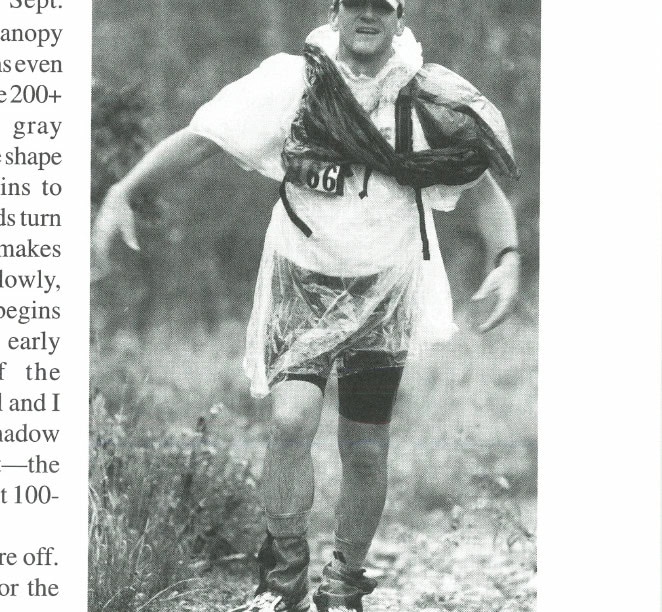
Joyce and Mitch jump into action, trying to get me ready before the rain hits. Too late! I have just pulled off my shoes to treat my feet when the rain pounces. I have to finish the repair job and recharge behind the protection of two port-o-lets as the wind whips the rain into us sideways. Mitch pulls two rain ponchos over my head as I replace my shoes and eat. The rain is freezing cold. I’m going to have a problem unless I get out of here quickly. Mitch walks with me up the trail while I eat, and he hands me more food as we split. (Thanks, Mitch. You da man! Thanks, Joyce. You’re the best!)
I walk uphill in the vicious rain while eating a turkey sandwich and a piece of baked potato; the wind whips the plastic poncho around my face and body . . . . And then it begins to hail! Little pea-sized pellets. I walk with my head down to protect my face, considering my options should the pellets begin to hurt. But it never becomes more than a tickle. I feel a smile creep over my face, and it warms my whole body. I’m actually enjoying this storm. Why? I had been hot when I came into Big Mountain, and the rain has cooled me down. I’m invigorated and once again pushing the pace, power walking the uphills and charging the downhills.
The rain lasts only 30 minutes or so, it seems, but the overcast sky and cooler temperature serve me well. I’m back from the dead—again!
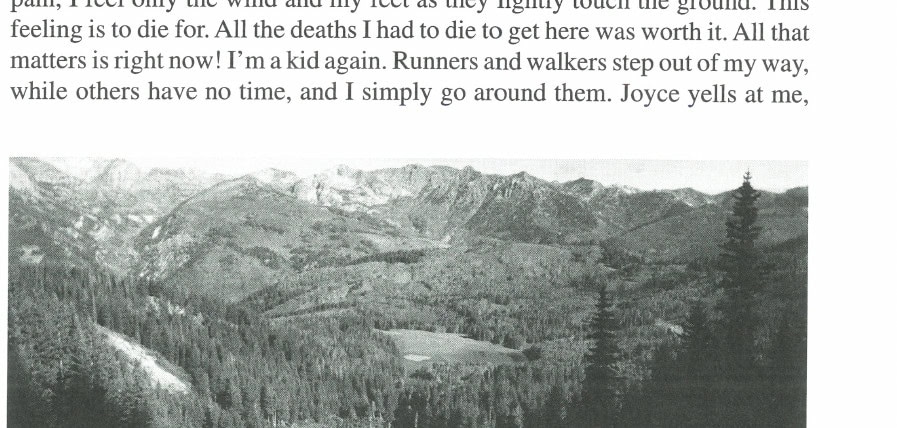
I pass through all sorts of terrain: woods, bald peaks, and lush valleys. By Baugh Bearing Hill, the sky has cleared and the storm departed. All sense of
rain is gone and it’s getting hot again, but my energy level remains high. Alexander Ridge (46 miles) sits in a field of waist-high grass on a low ridge with I-80 in the background. I surge on in, take a short break, and push on, up a five-mile-long, strait-as-an-arrow jeep trail between the hills and away from the highway. It seems to go forever, and the mundane sameness begins to wear on me. My power walk slows some, yet I manage to hold on and stay the course, wanting desperately to reach Lamb’s Canyon before dark. It was a mistake, I realize, not bringing a flashlight with me from the last station, and it begins to worry me.
I’m passed by a gaggle of local college kids running their first ultra. One of them is talking into a cell phone. It seems so out of place. About the same time, we all turn off the road onto a trail, and I pick up my pace, surging past them and charging down the trail, winding round and round the trees, dumping onto a dirt road, and turning right. Within minutes, I can see the Lamb’s Canyon aid station off in the distance. I run toward it and then past it, seeing it way below and to the left. The trail circles a hilltop only to come back at the aid station and pass it again, this time on the right. I can look directly down on top of it. This is getting old. The trail seems to go about a mile or two directly away and then turns back to the aid station one more time. This time we’re really close, and we turn down a short hill to cross a bubbling brook.
It takes me a moment to figure out how to cross the brook, but then I find the flat stones partially submerged in the water. After the beaver dam, I turn left, cross a tiny bridge, and climb a short steep hill into Lamb’s Canyon aid station (51 miles)—at last! As I come in, the sky is misting while the sun shines through the mist. Joyce comes up to me and gives me a light kiss and a large smile. This moment I will remember for a long time. The entire sequence of events has seemed more dreamlike than real. It is 7:00 PM, and I have won my race with the sunset. My first major battle is won.
SANITY, DESIRE, AND THE NATURAL LAW OF BIG BUTTS ROLLING DOWNHILL
Joyce is going to pace me the rest of the way, through 49 miles of mountains and valleys. I’m sorry she has missed what I have already seen and will miss so much more because of darkness. The raw beauty of the Wasatch Mountains is worth seeing.
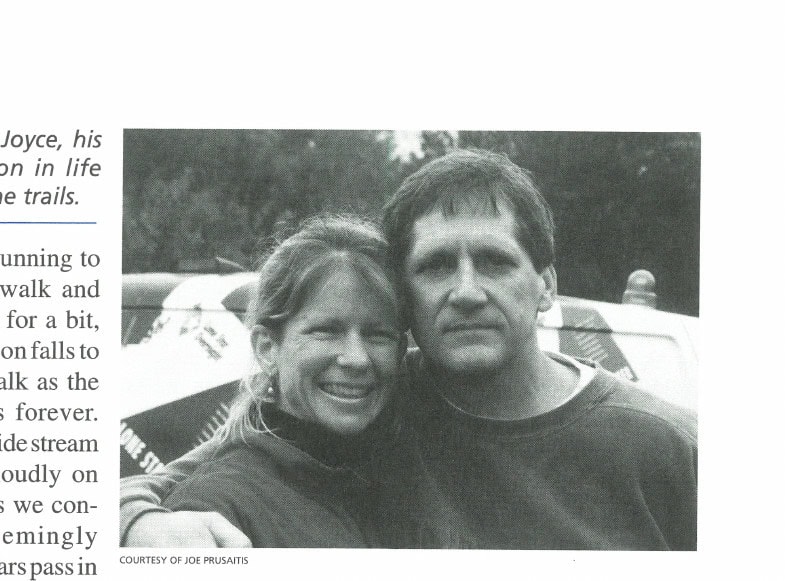
Joyce has paced me in a few 100s already, and I could not ask for a better companion. She knows me so well and can coax and push and talk me through the long night on into the next sunrise.
It will be dark soon and I ready myself for the night: long tights, long-sleeved capilene shirts, gloves, hat, and flashlights. I fix my feet and change shoes again. Joyce is ready, so we walk uphill out of the Lamb’s Canyon aid station ready for the second half. I think I’m in pretty good shape as we walk under I-80 and up the paved road through Lamb’s Canyon. In this narrow valley, darkness comes quickly, while we walk along with Jan from California up to the turnoff, across the stream, and onto a trail. Jan disappears ahead of us as we begin the long climb up to Bear Ass Pass in the dark.
I die so many times on this climb, sitting repeatedly as my head gets dizzy. The dark, the altitude, the exertion, the exhaustion all gang up on me and beat me down. I know Joyce begins to question my ability to continue. My sanity! My desire.
The trail is soft and easy, but I’m done in and losing it badly. Joyce is getting pretty cold just waiting for me. We eventually top out, and after a short break to regain my senses, begin to roll down the backside . . . and I do mean roll! We pick up speed as my big butt follows the natural law of big butts rolling downhill. I go faster and faster, and everyone moves aside as we come at them. We pass Kevin Sayers on this downhill romp and exchange best wishes as our two ships pass in the night: “Joe, you’re back!” and “I’ll see you on the next hill, Kevin!”
We hit the street with a thump and turn up the paved road past the police truck with flashing lights. The road is just a slight uphill tilt for a while. I quickly go from running to a power walk and hold to it for a bit, but this soon falls to a slow walk as the road lasts forever. The roadside stream rumbles loudly on our left as we continue, seemingly forever. Cars pass in both directions and are pretty considerate to our presence; many even switch driving lights to parking lights as they pass. But the road seems to last and last, and then it grows even steeper. It’s getting really cold, so we bundle up. I stop to sit down on the road for a moment, and later I find a concrete embankment over the creek to rest on. Eventually, we splash into the Big Water aid station (59 miles).
LAUGHTER AT DESOLATION LAKE, RUNNING WITH THE MOON, AND FINDING A LONG LOST FRIEND
Man, am I dog tired. I have some soup, ramen, hot chocolate, oranges . . . and then give it all back. I toss the whole load. I should stay a few more minutes to rest and reload, but being rather dense at the moment, I walk out of the station and back onto the trail, and I begin to climb some more. Up and up and up, to Dog Lake and Blunder Fork. What a fitting name for a blundering fool like me to be here at this moment.
On I go, to land at the Desolation Lake aid station (65 miles) after 1:00 AM. Like a beacon in the night, their campfire pulls us in, this friendly and giving group of people with hot chocolate and laughter. They brighten our night. As comfortable as it is here, it’s also cold! They tell me it’s 35 degrees. We need to move on, and quickly, too.
It’s even colder as we cross the basin, pass the lake, and climb a short switchback to Red Lovers Ridge. We lose the trail for a few minutes and drift across the ridge to see the lights from a small town off in the distance—a gorgeous sight.
We see another runner coming and wait to ask him to help us find the trail. It’s not long before we’re redirected over some rocks and upward to the right. The trail is more of a hard-scrabble rock climb.
It’s getting to the wee hours of the morning, and both Joyce and I are beginning to nod off; we’re fortunate to stay on course while our brains nap. We roll along the ridge for a while as a big old fat crescent moon tops out and shines its light on the trail for us. If not for the occasional dips into darkness, we could douse our lights and run with the moon. She peeks between the trees and ridges as we run on toward Scott’s Peak aid station (69 miles).
There we stop to change batteries, and Joyce steps inside a tent to steal some warmth. She finds Paul and Jan sacked out on cots. We meet Pam Reed as well. After a cup of hot chocolate, the entire herd decides to move out. We all slowly walk and roll off the mountain into the Brighton Lodge aid station (73 miles).
M*A*S*H, A SUPREME SUNRISE, ANT KNOLLS, AND THE GRUNT
Our merry band of travelers slides into Brighton Lodge just before 5:00 AM and are greeted with a M*A*S*H-unit atmosphere: bodies are everywhere. People are coming and going, while others are just lying about.
Coming in from the intense quiet of the dark mountain night, the chaos within this room is startling—like stepping through a looking glass with Alice. I find a seat at a picnic table while Joyce collects my dropbag. We take our time repacking gear, getting down some hot soup, hot chocolate, and soda. I regrease my essentials with Vaseline, check my feet, and relax for the first time in 24 hours.
I’m beat, and I feel great. Kevin comes in while we prepare to leave. His wife is crewing for him. Paul’s wife is crewing for Paul. My wife is crewing and
pacing for me. Our many different friends and their families have all become one large, friendly and supportive family. We take longer than we should, but it’s well worth it.
I leave 30 minutes after arriving, much stronger than I came in. And I need the strength for the next climb up to Catherine’s Pass and Point Supreme at 10,400 feet. Our entourage of Paul, Jan, Joyce, Pam, and I climb together, while twilight chases the darkness, and sunrise catches us on top of Point Supreme. Timing is everything! Pam pushes on ahead on the climb and is gone. I see her once more as she moves steadily away from us. Paul, Jan, and I follow Joyce as she leads us to the top and then back down off the very steep and rocky backside. We walk the ascent and continue to walk the descent.
Joyce attempts to push us, but Paul’s legs are shot, and he refuses to be pushed. We hang together, content at the moment with each other’s company and the forward progress as it is. We find the Ant Knolls aid station (78 miles) in good spirits with a wonderful view of the ridges above and valley below. We stay only long enough for a hot chocolate and then quickly push on.
We can see the next climb from the fireside and soon find out why it’s called The Grunt. It’s steep and tough, but it really doesn’t last that long. Cresting the ridge, we’re blinded by the sunlight, and we run blind to the next copse of trees and its shade. We round the hills as we stay under tree cover for the next mile or so on our way down and into Pole Line Pass aid station (81 miles). We pass a fellow on horseback followed by a few lambs as we approach the station, where we smell breakfast in the air.
SHOTGUNS, FULL-TILT BOOGIE, GLORIOUS FACE PLANTS, AND WHAT IS THE MATTER WITH ME?
These folks cook us a breakfast of scrambled eggs, potatoes, and sausage, while Paul shares his orange juice. A new day. Fully fed, changed into lighter and cleaner clothes—T-shirt and shorts again—and unburdened of the heavy nighttime running gear, I feel like a new man.
Jan’s still busy with his gear when we’re ready to pull out and says he’ll follow shortly, so Joyce and I leave with Paul. We had walked most of the last section and now begin to run, and run fast. Paul says he’ll continue to walk but can’t stand it as Joyce and I surge ahead. Each time we slow to power walk an uphill, we find Paul running up behind us. We climb a few very steep but short sections of trail, but mostly it’s fast and easy running, and Paul stays with us through Sandy Baker Pass and Point of Contention. We’re still pretty high up and can see a ways off, riding a trail that hugs the edge, when we suddenly hear a shotgun blast and feel the air move around us. Just above and out of sight, some hunters had shot at something, and the pellets from their shell had hit the grass and trees around us. Paul and Joyce both hit the ground, while I stand there like an idiot, looking in the direction the shot came from. Paul yells, “Hey, there are people down here!” but we push onward and away from this idiocy. Paul falls behind on this ridge, as the trail turns more steeply downhill, and Joyce and I apply my big butt theory to roll on down. We’re cookin’ and rockin’ and rollin’ and churnin’ and burnin’ as we scream all the way down to a sliding stop at Mill Canyon aid station (87 miles), where I suck down a slice of cantaloupe. Then we march slowly down the rolling dirt road.
As the road makes a big U-turn, we slide off the side of it back onto a trail. Not just any trail, but a smooth, slightly rolling, and tilted downhill trail of smooth dirt and a few rocks—the kind of trail a trail runner dreams about.
Joyce picks up the pace, and I follow close behind. She goes faster, and I stay with her. She goes even faster, and I hold on still. Ever since Lamb’s Canyon, she has been urging me to go faster and coaxing me to keep the faith, but now for the first time, she decides she’d best get out of the way. She moves over, and I surge past her, legs flying, arms pumping, smoothly, easily, letting gravity and my momentum push me even faster and faster as I speed down the trail over humps and bumps, picking up more speed as I fall forward, attempting to keep my feet and legs under me.
Joyce holds on for a while, but she eventually loses ground, and then she falls completely off the back of the bus as I hit full-tilt boogie. This feels good. I feel great. I’m feeling one of those feelings that comes over a runner only once in a while—that wild abandon, freedom from distraction, no cares, no fears, no pain, I feel only the wind and my feet as they lightly touch the ground. This feeling is to die for. All the deaths I had to die to get here was worth it. All that matters is right now! I’m a kid again. Runners and walkers step out of my way, while others have no time, and I simply go around them. Joyce yells at me,
“What the hell is the matter with you?” I can barely hear her when I stop to check to see where she is.
I wait a few moments for her to catch up, and then we continue, a little less rapidly but still too fast for the rocks and roots we’re dancing with. Joyce tells me to pick up my feet or I’ll trip. I always seem to run with more of a shuffle, barely clearing the ground, which is none too bright at this pace on this kind of trail. So, yes, I ignore her and continue as always . . . and finally I trip and apply my face to the trail in a most wonderful face-plant. It rates an 8 as far as falls go and leaves a lovely imprint of my face for the runners who follow.
At the bottom, we find a stream of icy cold water. I stop and stand in it for a moment—it feels so good!—before climbing out of the creek bed to push on down a dirt road to the last aid station, a short hill leading us into Cascade Springs (93 miles).
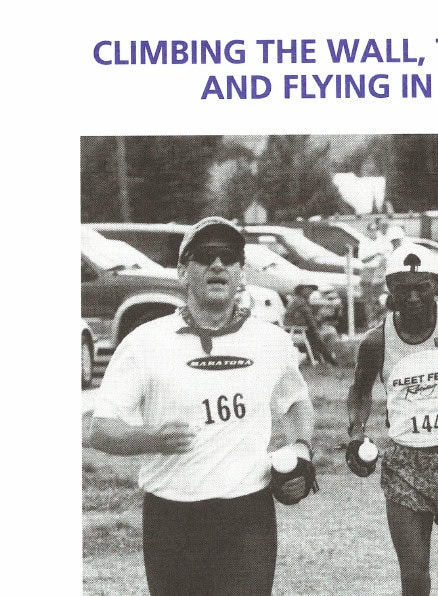
CLIMBING THE WALL, THE BOMBING OF MIDWAY, AND FLYING IN WITH BOTH FEET UP
I stop to change my wet shoes and socks and to check and fix my feet. I have avoided blisters to this point and want to keep it that way. I drop everything and borrow a single hand-held water bottle, filled with ice, for my final plunge. One last climb, and it’s all downhill after that. “The Wall” is just around the corner and not far up a slightly uphill-tilted road that eventually becomes a steep climb of about 500 feet.
We power walk all the way to the top, hugging the shady side of the street. Afterward, the wide dirt road is five miles long and full of rocks and washboard ripples. No shade, no wind, no clouds, and no let up. We run most of it, cutting
the tangents, running corner to corner as we rush down off the top toward Midway.
We make a few detours to avoid cars, but otherwise we make good time. Coming off the hill, we have about 300 yards of flat dirt road before turning left onto pavement. Up this road on the shoulder for more than a mile, then a right. We walk and run now, my energy spent. I surge a hundred yards and then walk a few steps, and repeat. The road bends to the left and then another half mile, followed by a right, and a quick left. One hundred yards up a short hill. I can see the church from here and want to finish with one last surge. A small crowd alongside the road is cheering for me to go, so I do. I’m so easy!
I churn up the hill, make a sharp right, cross the street, jump the curb onto the sidewalk, and push up to the last turn. I make the left in a quick burn and go all out from there toward the finish line banner just 50 yards away. My legs were already warmed up to this kind of running from just a few miles ago, and the pace comes back easily for this one last charge. I pass two runners just before flying under the finish banner with both feet well off the ground. Joyce would have been proud.
And What I Learned From It
Prepare Yourself Physically and Mentally
Physically: Do the proper training (if you can) for the distance, altitude, heat, cold, or whatever it is where you are going. Give yourself enough of a foundation so that you feel confident going in that it can be done.
Mentally: Do as much up-front research about the event as you can. Experience counts for a lot, but experience lacking, ask someone else who has the experience. Learn the course, plan your dropbags, try to know when you’ll need warm- or cold-weather gear, flashlights, supplements, crews. The more you know, the less you’ll be surprised. According to my good friend, David Berdis, “It’s better to be looking at it than looking for it.” I have dropped in at a few events, showing up without knowing much more than how far it was. Sometimes it worked, but usually it could have been better.
Attitude IS Everything
Focus on finding the good in the worst of situations. Getting yourself down doesn’t help you or anyone around you. Your positive attitude will help others, and we can all use any help we can get. A good or bad attitude feeds on itself and grows, so the logical choice is to pick the good one. Makes me think of Henry Ford’s words: “If you think you can or think you can’t, you’re right.” Never give up on yourself. Your limitations should never be self-imposed. Throw away all those great excuses and give it your best shot. Tell yourself to just keep going; remember the ultra credo, Relentless Forward Motion. Physical limitations such as health, weight, or injury may affect you on any given day, but your mind makes the ultimate decision on how to proceed. Another of my favorite quotes: “If you have tried to do something and failed, you’re vastly better off than if you had tried to do nothing and succeeded.”
Enjoy Yourself, Live It, Breathe It, Savor It!
Running is the way I choose to live, and I choose to have fun with it. I carry a camera. There is no way to describe some of the places we run, and I’m compelled to capture some of these views. I meet as many people as I can while I run. People tell me I talk too much while we run, but I like to know who I’m running with. I talk, take pictures, chat with volunteers, cheer on the leaders as they go by. I look for fun races, not fast ones. I love the courses that are different, challenging, and entertaining, and I love the people who run them. A wild, wonderful breed of people participate in ultras. Full of life and energy. No couch potatoes here. These folks have sunk their hearts and souls into these events and breathe life in completely. This is the essence of the knowledge that “I’m only coming through here once, and I’m doing it right this time.” Build a scrapbook, save the pictures, write the stories about what happened, and know that you’re making memories, great memories, and wonderful friends.
This article originally appeared in Marathon & Beyond, Vol. 3, No. 4 (1999).
← Browse the full M&B ArchiveMore like this
1,000+ stories from 19 years of Marathon & Beyond
The complete archive of the legendary long-distance journal — digitized and free to read.
