

My Most Unforgettable Marathon . . .
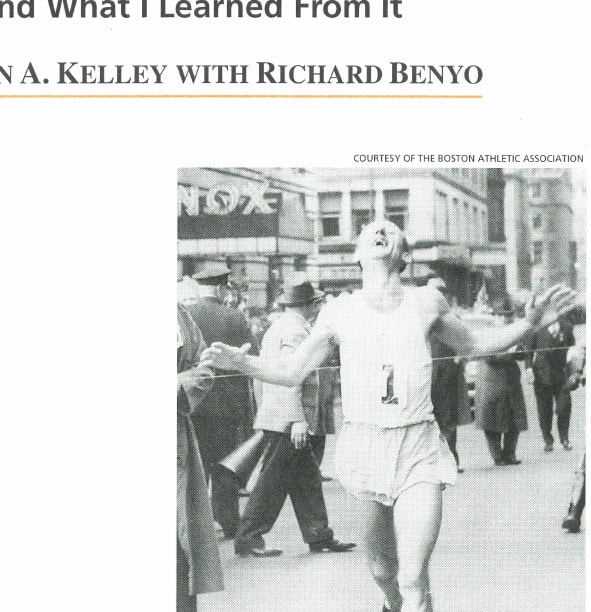
YONKERS, NEW YORK, May 13, 1962—Most marathoners associate me with the Boston Marathon. I must admit that after starting 61 Bostons and finishing 58 of them, I fondly make that association myself. I also won Boston twice, in 1935 (2:32:07) and in 1945 (2:30:40). I also have the dubious distinction of being a “bridesmaid” of record proportions—I took second place seven times. I also finished in the top 10 at Boston some 18 times.
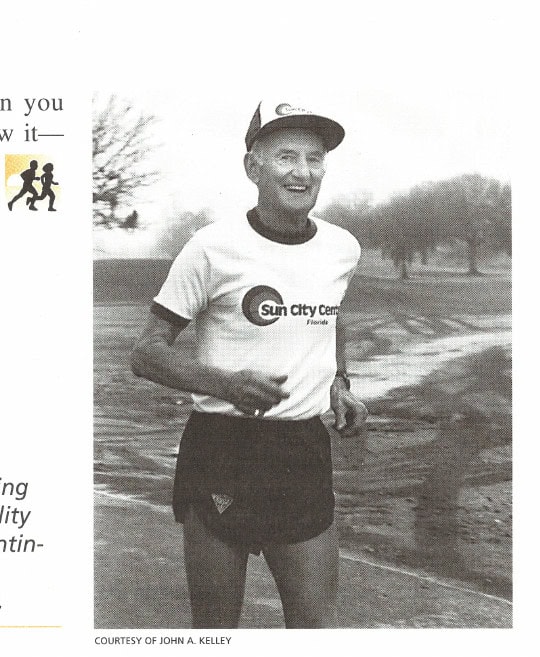
From the hindsight of 88 years on this earth, I look back at my life as a runner and can’t help but feel blessed. I’ve met so many wonderful people through running and have so many fond memories. Of course, like all runners, especially marathoners, I have also experienced my share of crushing defeats. It seems to me that sometimes we learn more by losing than we do by winning—which is fortunate, since only one person wins a race while the rest of us learn our lessons for that day and apply them to the next race.
When the subject of the single most unforgettable marathon in my long running career comes up, I find I must shift gears (for the uphills) and shift states (to New York). My most unforgettable and most satisfying marathon is my 2:37:42 fourth-place finish at the May 13, 1962, Yonkers National Marathon. What makes that race so special to me is the fact that I was 54 years old when I ran it.
In the showers afterwards, Ted Corbitt, one of the great pioneers of our sport, said to me, “You are running better now than when you were champion.” Coming from Ted, that was a mighty compliment and one that I hold dear to this day.
YONKERS NATIONAL MARATHON
Before I tell you about my 1962 Yonkers race, let me tell you about the Yonkers National Marathon, since few people have ever run the race, even though it’s been around in one form or another since Thanksgiving Day 1907.
How can I best summarize Yonkers? It was a darn tough course and became even more so after the date for the race was moved from Thanksgiving to a month after Boston, which placed it in a time of year when the city is traditionally hot and humid. And, like Boston, the race has traditionally had a noon start. The course was also hilly, most of the surface was unforgiving concrete (a marathoner’s worst enemy), there was often a shortage of water on the course, and there was traffic all over the course. Yonkers was run on a course “real” marathoners in those days respected—and feared.
I won Yonkers the first time in 1935, the same year I won my first Boston. But in 1935, Boston was in April and Yonkers on Thanksgiving Day. My win in the 1935 race marked the revival of Yonkers, which was first run in 1907. The 1912 race was skipped, and then the race died on the vine after the 1917 running. When it was revived in 1935, it also became the AAU (Amateur Athletic Union, a forerunner to today’s USATF) championship marathon, a distinction it held until 1966. For a good part of that period, the United States picked its Olympic marathon team by requiring runners to enter Boston in April and Yonkers in May. The AAU then averaged the finishing times of each runner to pick the team that would represent the United States at the Olympics. Running two hard and hilly marathons within five weeks might explain why we didn’t do very well in the Olympic marathon until that system was changed.
During its heyday, the Yonkers National Marathon was run by the Chippewa Democratic Club, which was responsible for raising the race from the ashes in 1935. The Chippewa Club was really something. I guess by today’s standards the club would be considered very politically incorrect—the members were old white men who had fat bellies and smoked cigars, but without them, the race would never have existed.
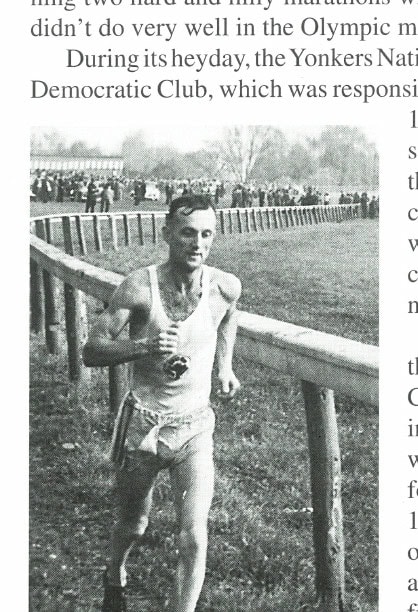
When Yonkers was revived in 1935, the start and finish was on the old Empire City Race Track, which was sandy feeling and hard to run on. We started the race with one mile on the track and ended with four miles on the track. It was horrible. In 1949, I think, the track was being rebuilt or something, and the course was moved away from the track. The race began and finished near the Chippewa Club house, and the date was changed from November to May. In 1950, at age 42, I won the race again, in 2:45:55, on the new course. Along with the win came the AAU Championship. Winning Yonkers 15 years apart remains one of my proudest achievements.
Besides the fact that it is usually hot and humid in May in Yonkers, New York, the Yonkers course is similar to Boston because it saves its worst hills for late in the race when the runners are all worn out. The worst hills begin after 18 miles, out along the Hudson River, and they have been the “graveyard” for many a fine runner.
MY TRAINING
You must remember that most of us who were running competitively in those days held full-time jobs. Clarence DeMar, who won Boston seven times, worked as a printer. John J. Kelley of Groton, Connecticut (no relation to me but a great friend), worked as a schoolteacher. Young John came into the 1962 Yonkers with six straight wins—on his way to eight in a row.
I had what I consider to be a very good work schedule at Boston Edison. I worked every other Sunday as a regularly scheduled day, for which I received a premium in my wages. During these weeks, I had one day off—Saturday. Every other week I had three days off—Friday, Saturday, and Sunday.
I worked 40 hours a week and could have had all the overtime I wanted, but if I had taken that extra work, I wouldn’t be here now. I did a lot of work with asbestos—how I failed to get sick, I’ll never know. The men who worked with me also smoked cigarettes, and they’ve been dead for more than 15 years.
During the weeks with the long weekends, I came home on Thursday night and had a big dinner. I would not run that night. But on Friday, my first day off, around 8:00 or 8:30 A.M., I’d do my long, long run of two to two and a-half hours. I never ran on mileage—only on the watch.
After my long run on Friday, I’d do all my chores and whatever. Saturday morning I might run 45 minutes, and that’s about it. Then Sunday, I’d run an hour and 20 minutes, nice and easy. I packed all my mileage in on Friday, Saturday, and Sunday. Monday to Thursday were rest days.
The following week when I had only one day off, Saturday, I’d just run an hour or an hour and 20 minutes or so. I didn’t run on any of the other days during the weeks when I had only Saturday off.
This training schedule was the secret of my success as far as the Yonkers Marathon goes. I sincerely believe that not running too much during the week brought me into the race rested.
THE 1962 YONKERS RACE
I had run Boston the month before the 1962 Yonkers race, finishing in 25th place with a 2:44:36. I had run almost the same time the year before and placed 17th. The 1962 Boston Marathon had quite a race up front. Finland’s Eino Oksanen won for the second year in a row. He’d had a real duel with Young John Kelley the year before. Another Finn, Paavo Pystynen, took second, and Alex Breckenridge, a U.S. Marine lieutenant, took third, with Young John in fourth.
But back to Yonkers. It rained the day before, but raceday was as nice a day for a race as I can remember. The temperature at the start was in the high 50s. About 150 runners signed up, but only 71 starters lined up. Two years before in this race I had placed 12th, and the previous year I was 10th.
I remember that Harvey Listenstein, who’d won the 1909 Yonkers race, was at the start. He was 71 years old at that time.
I started out conservatively, but pretty soon I began passing people. I was running comfortably with Ed Duncan of the Boston Athletic Association and Jack Rubin. (The BAA would go on to win the team competition that year, taking first, second, and sixth.)
The following is the journal entry made by John J. (Young John) Kelley, whose 1962 win at Yonkers was his seventh out of eight in a row—Ed.
“Noon: Yonkers National Marathon—Won in 2:27:39, over Alex Breckenridge (who finished) 2nd in 2:30:46. Ran hard with Alex over first 10 (miles), pulling away at 11+, then building up substantial lead only to experience deadening in last 5 miles, so that (my) time at 20 (miles), 1:48:58, indicating possible 2:20, proved only (the) slowness of the final 6 (miles). Took oranges and water dousings frequently after 22 miles. George (Terry) (was) 3rd in 2:32, Old John (A. Kelley) 4th, 2:37. Weather fair and mild (75 degrees, south-southeast breeze). Miles run to date this year, 1,467.”
Young John adds: “(Old) John’s performance certainly did—and does—stand out, notwithstanding every competitor’s regard for his seemingly ageless formidability. A curious thing about that regard for him was that, while we ‘young Turks’ never expected him to beat us, we could always come up a bit shocked by how much in the thick of it he kept proving himself. This Yonkers race was an excellent case in point—maybe the best such. I can still remember at the time thinking back to 1950 when he had won the National Championship at Yonkers at age 42!”
Together we went through 10 miles out near Hartsdale in around seventh place with a 57:44. Young John Kelley had gone through a little more than three minutes before us. At 15 miles at Elmsford, I was five minutes behind Young John, but I had moved up to sixth. I kept my pace steady, and little by little I caught two more runners and found myself in fourth place. I couldn’t believe it, yet I could believe it because even at age 54, I felt competitive, and I felt rested—and I knew the course. I remained in fourth, finishing in 2:37:42.
Young John, as he usually did, ran a marvelous race. He was in control the whole way. He ran a 2:27:39, in the process beating BAA teammate Alex Breckenridge (2:30:46), who’d beaten him at Boston. George Terry, Young John’s brother-in-law, took third in 2:32:21.
The training I’d been using all along—with lots of training on three days, then no training but regular work for four days—had worked for me for years, and I guess it really came together on that day in Yonkers.
Even as I approach 90 years of age, I can still vividly remember the 1962 Yonkers race. I love the Boston Marathon, but those of us who used to race marathons regularly back in those days also have a really special place in our hearts for Yonkers. When you raced well there, you knew it—and so did everyone else.
What I Learned . . .
AGING AND DEATH AREN’T THE SAME THING
Just because a runner adds a few years doesn’t mean that he or she is over the hill. There are a lot of good older runners because when you get older, if you’re still out there running and racing, you’ve learned a few things about how to pace yourself. Runners don’t lose that much performance for each year they age. They just have to take better care of themselves, and they need to. . .
REST MORE
I’ve seen my share of very talented runners literally run themselves into the ground by training too much, resting too little, and racing way too often. We need to rest our bodies so they can recover from hard workouts. My job at Boston Edison didn’t give me a lot of options. Oh, I could have gone out in the dark after work and run a few miles during the week, but I was already tired from putting in a long, hard day of work. What my body craved was some nourishing food and some rest so that when the weekend came, I could run strong again. If you overtrain, you can leave your best races on your training courses. Resting at the right time gives you longevity. Trust me on this.—J.K.
This article originally appeared in Marathon & Beyond, Vol. 1, No. 2 (1997).
← Browse the full M&B ArchiveMore like this
1,000+ stories from 19 years of Marathon & Beyond
The complete archive of the legendary long-distance journal — digitized and free to read.
