

My Most Unforgettable Marathon: March/April 2001
SACRAMENTO, CALIFORNIA, December 5, 1997—My most unforgettable marathon is what I refer to as a test of strength, guts, and determination. The race was the California International Marathon: my first international race.
I had competed in a number of local marathons in and around my home in Edmonton, Alberta, Canada, but this was the first time I traveled to an international race. I was entered in the women’s elite field, another first for me, and which intimidated me to some extent, although on all other levels I was ready. I had high expectations for myself, believing I was capable of placing in the top five if I had a good race. But I was to learn a very hard lesson. As Bill Rodgers wrote in the wake of the 1977 Boston Marathon, “the marathon can humble you.”
Let me backtrack several days before the Cal International Marathon. Leading up to the race, my training had gone great. The weather in Edmonton had cooperated, providing me with the rare opportunity to train outside for most of the fall. We usually have two feet of snow on the ground and cold temperatures toward the end of October. I took the weather as a good omen sent by the gods, a sign that things were going to continue well around the corner. Boy, was I naive.
My final workout before flying to Sacramento was on a treadmill in my basement. I loaded a copy of the 1997 New York City Marathon into the VCR and pretended I was running with the lead pack. I mimicked their every move. I visualized myself in Sacramento. I savored the images as I viewed them again and again, visualizing how I was going to run the race. I remember how excited I was that I was going to be going far south, to a warm climate, where I could race in a pair of shorts and feel the sun on my skin.
When my husband John and I arrived in Sacramento—a new city for us both—the weather was great. We took a cab from the airport to our hotel, enjoying the scenery along the way. When we arrived at the host hotel, we saw “Welcome Runners” banners plastered all around. We could feel the excitement. But I began to feel intimidated when I looked around the lobby and the restaurant and saw how fit and fast everyone looked.
We checked into our hotel room and made ourselves comfortable. Then we went down to check out the sports expo; it was extremely convenient to have everything for the race weekend happening in the same hotel. As we wandered the expo, though, I found myself repeating the same refrain: Everyone looks really fit—and fast.
The next day, I concentrated on shifting my focus to the upcoming race. John and I rented a car so we could drive the course and check out the surroundings. This is a process we’ve done many times; it allows me to see the course and get out at various points to familiarize myself with the surroundings and the neighborhoods. Frequently, I’ll get out at the 10-mile mark, the halfway point, and the 20-mile mark so I can further visualize myself coming through those points during the race. I like to also visualize what the time on the clock will be when I hit those points. Although the Cal International course is overall downhill and everyone says it’s fast, it has its share of uphills. I assured myself, after again consulting the course elevation chart, that the hilliness was an optical illusion; the course was overall downhill.
After our drive over the course, we returned to the hotel and jogged over to the finish line. This would constitute my final “workout” before the marathon. It was a light 30-minute run, more to relieve built-up energy than anything else, but I also took the opportunity to visualize my finish, including the time that would be on the clock. I had rehearsed this scene so many times in my mind!
Back at the hotel, we cleaned up, relaxed, and I made sure to hydrate properly. I have found that the day before a marathon goes by very quickly, as though it has its own overdrive gear.
As night approached, we listened to the weather forecasters on the local TV station predict rain for race morning. (What had happened to my positive weather gods?) I tried to dismiss the forecast. How often are weather forecasters correct, anyway? It’s the only job in the world where you can be wrong most of the time and not get fired.
I lay in bed and again visualized my race, concentrating on my splits. During the night my water bottle sat at the nightstand, and every time I opened my eyes to either use the bathroom or look at the clock, I took a drink. Sleep, I assured myself, was most important two nights before a marathon. Nobody sleeps well the night before.
At 4:30 A.M., the alarm rang. I awoke anxiously, ready to face the day. John drew the drapes to see what it was like outside. To my horror, we looked out upon one of the ugliest days I have ever seen for a road race. Conditions were horrendous, like a tropical rainstorm. We were looking out at 70-kilometer head winds, torrential rains, and below freezing weather. In short: cold and miserable.
Panic set in. I scrambled through my luggage looking for warmer clothes. What do you wear on a day like this? John handed me a couple of garbage bags he had tucked in his suitcase. He’s always such a great packer. He smiled and reassured me that once I got going, I’d forget about the rain. I wanted to believe him, but it seemed a stretch.
Time was unrolling very quickly. A line of buses was waiting to pick up runners at 5:00 A.M. to drive us to the start at Folsom Dam. The race was scheduled to start at 7:00.
I quickly downed my token cup of coffee and grabbed my PowerBar for the ride. As John walked me downstairs and outside to the bus, he reassured me once again that the rain would probably stop once I got on the bus and that I had run in conditions like this before. He’s always so positive.
The bus filled up almost immediately and departed. Travel time from the hotel to the race start was roughly 30 minutes, during which time the weather showed no signs of letting up. I stared out the window, praying for the rain to stop. Trying to distract myself from the conditions, I rehearsed every positive phrase I had ever heard. But I hadn’t spent my visualization time visualizing what I saw out the window! As expected, the 30-minute ride felt more like 5 minutes; too soon we were being disgorged at Folsom Dam.
Luckily, when we rolled in, the race officials led some of us to a nearby condo they’d arranged for the elite athletes. I remember how terribly guilty I felt as we made our way to the warm, dry condo, passing other athletes as they stood outside in the pouring rain waiting for the race to start.
Inside the condo, male and female athletes were stretching and making their final preparations for the race. Again, that phrase—elite athletes—popped into my head. Everyone looked so fit, so fast, and they all seemed to know each other. I knew no one. I told myself to relax and focus on my race. They all had to start somewhere and were probably at one time in my shoes, just beginning the process of moving up in the ranks.
One of the female athletes came over to me and asked who I was and what my personal record was. I dreaded that question.
Moments later, we left the condo and proceeded to the starting line. The rain had stopped, and a sigh of relief went up from the assembled field. Suddenly, smiles appeared all around, and I could tell that I wasn’t the only one whose spirits had been dampened by the wet weather. A moment later the gun went off, and the race was under way. At last, the moment I’d planned for was finally here—it was time to run.
During the first few miles, everything went according to plan. I felt light on my feet. I had a couple of girls within striking distance, which is what I wanted. I knew if I lost touch with the lead pack of women, I’d never be able to catch them again.
Then, suddenly, it started to rain again. It escalated to a downpour. The winds picked up. This was Part Two of the storm that had started early that morning. I persevered through the next couple of miles, refusing to let the weather break me.
By mile 10 I felt strong and was running in a pack of men. We ran single-file, each sheltering the other from the elements. We each took our turn in the barrel.
By mile 13, the group I had been running with began to pull away from me and disappeared over the horizon. I was unable to keep pace and felt disappointed at losing the comfort of the pack.
By mile 15, I began what felt like a death march. My legs ached and felt like uncooperative stumps. They had never before betrayed me like this. I knew I was in trouble. My positive spirits vanished; the uplifting self-affirmations I had practiced shattered like china on marble.
By mile 18, I was beginning to notice other runners dropping out. I let the thought of quitting enter my consciousness; for the first time in a race I questioned whether I would be able to finish. I admitted the unthinkable to myself: I wanted to quit. I remember distinctly giving myself permission to drop out of the race: “You can stop. Other elite runners are dropping out.”
I’d never quit a race before and didn’t want to start now, but I’ll admit that I have never hated running so much in my life as I did during that race.
By mile 20, I saw a GU station where they were handing out supplements to help people through or around or over the wall. I had hit the wall, but I was so beat and my focus was so narrow that I didn’t even bother taking GU. All I wanted was to finish.
By mile 22, I was just plain mad. I was not having fun and desperately wanted the race to end. But I pushed on. I felt on familiar ground, as I had jogged this part of the course when John and I went out for our easy jog. I knew the end couldn’t be much farther. I dug down deep within myself, deeper than ever before, and pushed myself to the finish.
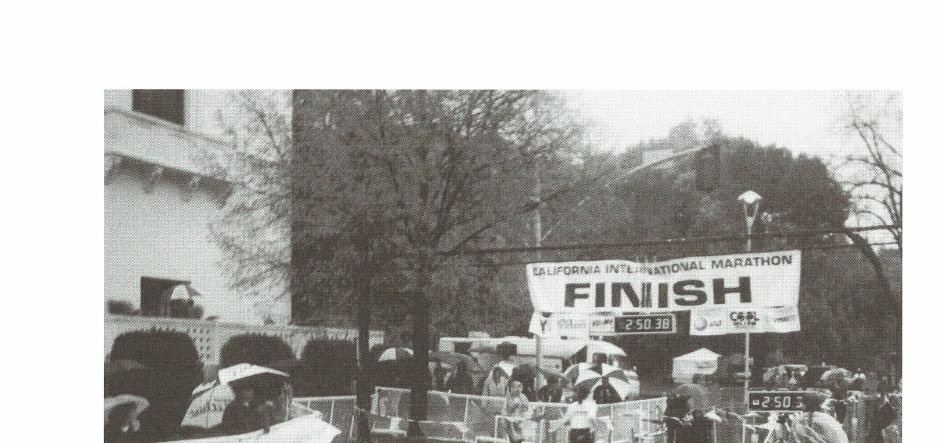
The end result? A time of 2:50:39, and 11th woman. Not what I’d planned, but I’ll never forget crossing the finish line and falling into my husband’s arms crying with pain and fatigue. I was also really mad. Mad at myself and at the weather. I remember telling him that I never wanted to run another marathon. I blubbered out: “I’ve gone through labor and I’ve done the Ironman Canada, and this was the hardest thing I’ve ever done. Never again!”
Sound familiar?
As soon as I crossed the finish line it was as though all my body functions just ceased performing. I stiffened up immediately; it hurt to walk. John tried to distract me as we walked back to the car. He humored me with stories of how the stands at the finish line kept blowing over and how the volunteers kept putting them back up only to see them blow over again. John is good at distracting me from painful things. But somewhere during the last several hours, my sense of humor had taken a hike.
When we got back to the hotel, I immediately filled the tub with hot water and fell in. I enjoyed every drop of hot water as I’d never enjoyed water before. I sat in the tub for a long time. After I was content and finally warmed near my core, I crawled out.
John and I decided to get dressed and go downstairs for something to eat. It’s funny because usually after a marathon I’m not hungry, but after this one I was ravenous. I think it must have had something to do with my body working overtime to keep itself warm. I remember mentally walking my body through simple steps necessary to getting dressed.
As we left our hotel room and waited for the elevator, we peered out the hallway window. Scores of runners who had just finished the marathon were limping painfully into the hotel. Almost everyone who had completed the race shuffled on stick legs.
We attended the awards ceremony later that afternoon. Ironically, as we walked the pedestrian overpass from the hotel to the conference center, the sun appeared. The sky, so ugly just hours before, was now clear. We chuckled as we discussed how the marathon was like Russian roulette.
The next day, as we waited in the airport for our flight back to Edmonton, we read the follow-up marathon articles in the local Sacramento Bee. I took great comfort when I read some of the following elite athletes’ remarks:
Morocco’s Abderazzak Haki, the winner of the race, said: “The conditions were bad. The rain and the wind in front of us, you couldn’t push.” Reno, Nevada’s Miguel Tibaduiza commented, “It wasn’t a good day at all. Very tough out there, windy and raining. After a while you get this hypothermia. You couldn’t hardly even move. The goal today was to finish.”
See, I reassured myself: It wasn’t just me.
In the end, it took me the good part of a month to digest this race. I was so deeply disappointed. I kept beating myself up over and over again because of how hard I’d trained for the race. I felt my training was at a point where I could target a 2:42 performance. Instead, I produced a 2:50:39.
John kept telling me that this was my best performance yet. He explained that I have a natural gift to run fast, so I have never had to push myself to the limit. This was the first time I had pushed myself beyond a limit I had not previously explored. He was right. This experience opened a door to a new level of inner strength, so it made sense that it hurt like hell to open it.
This race tested my limits and renewed the depth of my passion, desire, and commitment to this sport.
The California International Marathon was the best thing that has ever happened to me. It’s the race I reflect on whenever I’m experiencing difficulty. I know now what I’m capable of when I dig deep within myself. I experienced and learned a tremendous amount from my most unforgettable marathon, and I’d like to share some of it.
Sometimes it’s the effort we need to focus on, not the time. Don’t worry about what others think. No one knows what you went through during a race. If you can look in the mirror at the end of the day and say that you gave it everything you had, be proud of your efforts and feel no regrets.
If you find yourself beating yourself up after a race, allow yourself one or two days to grieve, then get on with life. Remember why you run and why you challenge yourself: because you love to.
After finishing this race, I know that I can persevere through anything. When I pull up the weather report for an upcoming race or hear that it’s going to rain or whatever, I always know that nothing will compare to the California International Marathon, and that I’m going to be okay. You learn more through adversity than you do through success. Successes feel better on the ego, but challenges build character, and character is what makes a competitor.
When you feel yourself becoming uptight about your performance during a race, relax. Fighting yourself is negative and works against you. Remember to dance out there and have fun.
When you’re preparing for your big day, remember that it’s the journey that’s to be enjoyed, not the destination.
This article originally appeared in Marathon & Beyond, Vol. 5, No. 2 (2001).
← Browse the full M&B Archive1,000+ stories from 19 years of Marathon & Beyond
The complete archive of the legendary long-distance journal — digitized and free to read.
