

My Most Unforgettable Marathon
BRIDGEWATER, MASSACHUSETTS, November 17, 1990—Bridgewater, Massachusetts, is in a region of small towns south of Boston and west of Plymouth, home of The Rock. Old Colony Correctional Center is located in Bridgewater and is home to the Chain Gang Runner’s Club.
For me and a few others, on a day in November 1990, it was the location of a truly unforgettable marathon experience.
The credo of the Chain Gang Runner’s Club is this: “The Chain Gang Runner’s Club was founded and continues to be a program coordinated by inmates of the Old Colony Correctional Center at Bridgewater, Massachusetts. The purpose of the organization is to promote and enhance the sport of competitive running from within the prison. In addition it is our hope to interest folks from the running community to come in and join us for our monthly events as well as our charity runs conducted for the benefit of nonprofit children’s organizations. In the spirit of running we hope to turn what could be a negative experience into a positive one.”
This statement of purpose is noble and true. However, it didn’t alter the fact that I was in prison, if only for the day.
I had moved to the Boston area in 1989. Having previously run the famous spring marathon in our national bicentennial year of 1976, and disliking crowds, I was intrigued by the opportunity to experience something new. It sounded unique: a marathon run inside the prison walls, which would count as a Boston qualifier—for those who meet the Boston standards and are not still incarcerated when Patriots’ Day rolls around, that is.
Naturally, the most unforgettable aspect of marathon day was the setting. I actually ran well, but as you shall see, the race itself was easy to sum up.
I’m happy to admit that I have no great knowledge of prison facilities, other than what I’ve learned from the movies, so I’ll call Bridgewater a medium-security facility. It was no low-key house of detention where white-collar scoundrels monitor their stocks by laptop and cell phone, but neither were the residents entirely isolated from each other or deprived of all opportunity. I will observe that getting in seemed almost as difficult as getting out would have been.
We visiting runners gathered at the appointed hour, at the appointed place, where we were greeted by several men dressed in casual civilian clothes. Some guards were in uniform but not overly militaristic, and no one wore stripes or leg irons. I couldn’t help playing the game of trying to figure out who might be employees and who might be prisoners. We had been instructed to wear only our running clothes and to leave all else in our cars. Consequently, we stood out as if we were the segregated group.
THE UNFORGETTABLE
Metal detectors were applied to us much more diligently than at your average big-city airport (pre-September 11). Patdowns were given everyone in varying degrees, and if the guards had any concerns at all, you were escorted to a secure area for further attention. Every carry-in item of sweats was turned inside out, and snacks were not allowed.
I should mention that there were also a few women in our group of visitors. I was tempted to ask them why they had come to an all-male corrections environment. The women were scrutinized as closely as the male visitors, although more discreetly.
I quickly came to appreciate the ominous feeling when the door behind you is closed before the next door in front of you is opened. The building we went through was relatively new and looked much like your standard-issue industrial building. It was freshly painted concrete and steel: strong, functional, built to last, and without a shred of comfort or humanity about it.
In our journey through the main building, we paused in the visitors’ lounge for a briefing. The lounge was a large, windowed room with motel decor tables and chairs to facilitate small groups. There were families spending time together and children fussing and squirming the way kids do. It might have been a pleasant scene, except for the realization that Dad or Brother wasn’t going home with the family and the big man standing near the column was watching and overhearing everything. I’ve been in the military, and I can handle an impersonal environment, but impersonal combined with distrustful equals uncomfortable.
During the briefing we were introduced to our “counters.” Each “outsider” was assigned an “insider” who would keep tabs on our race. Most seemed to be young men dressed in casual clothing, eager to talk. We were obviously a welcome break in their routine.
Another recreation area that we visited briefly was the weight room. It seemed to be well used. As is typical of such places, there were more men standing around than there were men lifting at any one time. I guess standing around becomes part of one’s life at Bridgewater—just like in a gym.
At one point, one of the insiders commented on a room filled with computers that weren’t being used because there was no instructor, which seemed unfair and frustrating to him.
The race itself would be conducted in the yard. The yard was a fairly large, grassed recreation area, complete with a cinder trail that followed the wall around the perimeter. “Large,” however, is a relative term. A football field is large, except when you want to run a marathon. The Bridgewater yard is larger than that but still less than a half mile in circumference. The track is 0.4477272 mile long according to the official handout. That calculates to 58.559645 laps to a marathon.
A counter recorded the splits for every runner. The splits were available to each runner afterwards, and they provided a valuable record of one’s performance—or lack thereof. By consulting the splits after the race, I could tell exactly the location of my personal Wall.
My counter was a likeable enough guy, who wanted to talk more than I did. I had my race face on and was also unsure of just how much we might have in common. I did learn that following his return from Vietnam and release from the military “They put me in here!” He had already done 17 years. That was a sobering thought. I don’t recall that he ever said why he was in, and I wasn’t inclined to pry.
To increase interest in running, both for insiders and outsiders, Chain Gang hosted several events simultaneously. Races of 10K, half-marathon, 30K, and the full marathon were run together. As you can imagine, this resulted in runners of various levels of skill going off at different paces. Lapping was frequent. I tried to keep track of my own laps in my head but couldn’t do it. Didn’t I trust my counter? I won’t answer that. However, we all become a little paranoid when it comes to believing race times or distances.
THE MARATHON
As you might have guessed, the race itself had few surprises. The track was good, neither hard nor soft, and made one detour around the tower. We ran in the traditional counterclockwise direction, and after just a few laps I had it down. Since I was running well that day, I never felt bored. I really got into the running, and the environment was no longer a factor. Perhaps it’s that way on 24-hour track runs as well, but I have no immediate plans to find out.
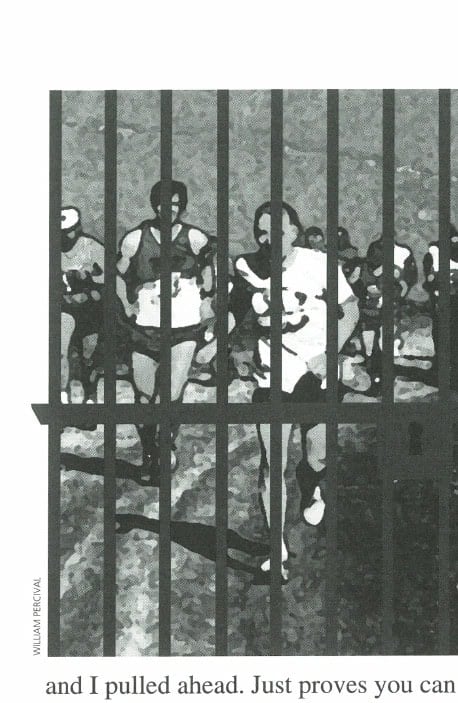
Initially, there was a lot of passing and talking, but the field thinned out considerably as the day wore on, and I retreated inside myself. My counter faithfully called out each lap as I worked them off.
I shared the middle half of the race with a visiting professor of chemistry from the Netherlands who was teaching at the University of Massachusetts, Amherst. He had done the Western States 100, which intimidated me at first, but on this particular day he began to lag and I pulled ahead. Just proves you can meet all sorts of people in prison.
Water and hard candy were reliably available at least once every circuit. I noted that the young men handing out water wore rubber gloves. First and last time I’ve seen that, and I really didn’t want to know the reason; but let’s just assume it had to do with sanitation.
Invariably during the day, as I pursued another runner, I would come back to the thought “Is he one of them—or one of us?” I realize that sounds prejudiced, but society had already judged these men and found them unfit to mix with us freely. So I decided that anyone with bulked-up shoulders was one of them. A heavy upper body would be the result of too much free time and access to the weight room.
Another riddle that occupied my mind was why the women chose to run here. They must have felt very much on display—and vulnerable.
One might argue that to experience the marathon race, it should be run in a sterile, perhaps boring environment. All else is a distraction from the basic task of putting one foot in front of the other at the maximum sustainable rate for a distance of 26.2 miles. Big Sur is an outstanding coastline along which a marathon is run; Heartbreak Hill is one point in the course of Boston. These locations are not the marathon. They can even distract a runner if the objective is to run rather than to sightsee.
There were about 30 entrants in the marathon and that many in the shorter events. The winning time was 2:55. My 3:19 was satisfying and so was the
opportunity to leave the prison after the race was over. The entire experience was worthwhile—so much so that I went back the following year.
FOR THE RECORD
I started running in high school in New York City more than 40 years ago. My first marathon was in Missouri in 1969, and I’ve done more than 40 marathons and ultras since then. The list includes the course of the old Yonkers Olympic qualifier, New York City when it was still held in Central Park, a PR of 2:38 in Oak Ridge, Tennessee, and the first marathon run in the streets of Riyadh, Saudi Arabia, in 1982. I always raced my marathons. Just finishing a marathon is a much more recent concept. Even though “My Most Unforgettable” was run more than 10 years ago, my best times were already behind me.
Several dog-eared scrapbooks chronicle it all and allowed me to pull out the few statistics I’ve provided. The rest is unforgettable memories shaded by time.
My work in construction causes me to relocate frequently, which has given me the opportunity to race in many states and some overseas locations. I’ve never traveled any great distance just to race.
I had even run a previous prison event: the Los Lunas half-marathon at the Central New Mexico Correctional Facility in 1988. That was a very different situation. Because of the flat, lunar environment of New Mexico, the mixed field of inmates and visitors simply ran out the prison gate and down the road. No one was going to suddenly disappear from view.
Since my aged knees will no longer allow me to hammer my marathons, I have recently been doing primarily trail runs and trail 50Ks.
And What I Learned From It
Running IS universal. Inside the walls, outside the walls, on this side of the world, on the other, running is a basic human activity. The astronauts even ran on the moon, although it looked more like skipping than running. Running is simple. Running is special. Running is simply special.
In a constructive setting, people are just people. The prison environment did shade our experience but more so in the trip from the outside to get to the cinder track. Once we began running, we were all runners, not insiders and outsiders.
In some other situations or under different circumstances, people can apparently be very different. I won’t explain that one. But visit a prison and you’ll understand.
It was nice to visit, but I wouldn’t want to live there. ‘Nuff said.
This article originally appeared in Marathon & Beyond, Vol. 6, No. 4 (2002).
← Browse the full M&B Archive1,000+ stories from 19 years of Marathon & Beyond
The complete archive of the legendary long-distance journal — digitized and free to read.
