

My Most Unforgettable Marathons
RIVERVIEW, MICHIGAN, January 2, 2013—When do you have a learning experience? I have been running for 34 years; regarding running, I have been learning for 34 years. Twenty-two of those 34 years have been marathoning years. Each time I go through the process of choosing, signing up, traveling, running, and crossing the finish line, I find out something about myself that I didn’t know before. When people find out you run marathons, the favorite question you get is: “So which is your favorite?” Although I admit to mentioning my two home races, the Detroit Free Press/Talmer Bank Marathon and the Medical Mutual Glass City Marathon, the years keep adding to my favorites. The scenery and challenges are new each race. I have been through all 50 states, all Canadian provinces and territories, and a couple of foreign countries. Choosing a favorite is probably similar to choosing your favorite child. So this article is a compendium of “most unforgettables” and covers a few major learning experiences from them.
In the evening of October 26, 1978, I took off from my front door in jeans, regular street shoes and . . . I was probably wearing a watch. I made it a mile, and back at my door, I felt pretty good. The next morning, I remembered that that jaunt felt worthwhile, and I was still mad. Off I went, out the front door, in the same outfit; I made it about 1 1/2 miles. I learned that this was something even a lifelong nerd could enjoy. A month later, my mother bought me a red sweat suit, and I bought a pair of discount-store tennis shoes (shoes were pretty generic in the olden days). The sweatshirt and shoes lasted about a month, because this new thing (running, jogging, whatever; I was never very fast) was pretty much happening every day. I made the big move toward permanence and purchased a pair of Brooks Huggers. Within six months, I was running 10 miles a day, six days a week, sometimes seven. (I didn’t know I was supposed to take a day off once in a while.) I learned a lot that year: how strong I could be and how much physical effort I could tolerate, among other things.
Keep moving up
▲
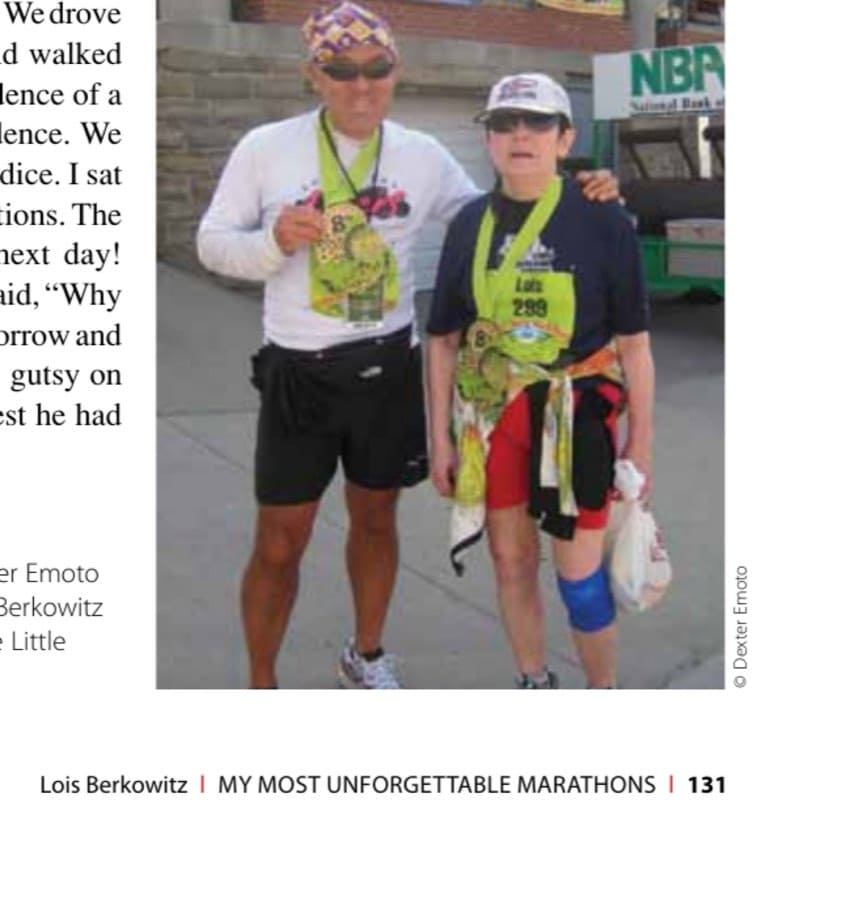
Avid photographer Dexter Emoto and wounded warrior Lois Berkowitz pose after their finish at the Little Rock Marathon.
© Dexter Emoto
This continued, on the same schedule, for several years. I had married, moved to a house in a different city, and started trotting through my neighborhood on long runs. I read Jeff Galloway’s first book on running and learned a few basics. My employer in the early ’80s bonded with another hospital over a 10K run. On a whim, I signed up for my first race! Sorry, this wasn’t a marathon, but I learned lesson number one: don’t start at the front of the pack if you lack fast-twitch muscle fibers and hate speed work! I heard a noise and felt a rush of air all around me: whoa! Sum of lesson one: start with your kind of people, in the middle of the back of the pack! I also decided that I did not enjoy being passed, so one stable precept for me is that I head to the back of the pack to start. Sometimes I stay there, and sometimes I get lucky, but I always start there.
A few years later, at work at the first Mazda plant in the United States, I was signing up for occasional short races; each one was an experiment. Could I complete it? But I was also running at least six times a week in my neighborhood and up to five or so hours a session on the weekends. I met Rick Guardiola at a couple of races. Rick was full of fast-twitch muscle fibers and had run quite a few marathons. He was very positive about the whole marathon thing and kept telling me I could do it. I expressed disbelief, but longing. Another gentleman, Jim Westropp, was not a long-distance runner—in fact, not much of a runner at all. He was much younger than me but about my speed. He thought that I could run a marathon, too. One day he suggested that since I was born and raised in Toledo, I should go down with him and volunteer at the Glass City Marathon. We drove to downtown Toledo and walked around, looking for evidence of a race. There was no evidence. We asked a policeman—no dice. I sat down and read my directions. The race was Sunday, the next day! Jim, always the leader, said, “Why don’t we come back tomorrow and run it?” This was pretty gutsy on his part, since the farthest he had
run was six miles at a time. I was a little better off, having run up to 20 miles a session on the weekend. The next day, a clear and cool Sunday in April 1990, we showed up downtown and registered for the race. I watched Jim eat a huge breakfast within 30 minutes of race start. This was a beautiful, small marathon through the heart of four cities: Toledo, Rossford, Maumee, and Perrysburg, Ohio. What a wonderful day! I usually ran alone, and that day I talked with fellow runners. An experienced runner told me that when you get to miles 15-17, you’ll see people walking. Don’t pay attention to them; do your own thing. Lesson learned. Around mile 13, the road led us along the Maumee River, and I saw a long line of fishermen arranged in a curve like an S as they stood in the water (the better to trap the fish in the shallow areas). Another thing I remember is that as I ran through the finish line, I felt amazing: not tired, not sore! And there were people to take care of me and feed me more than any one person should be eating! I looked for Jim; I had left him at about mile nine when he told me to go on. About an hour later, I had started to worry when Jim, a very calm man, slugged across the finish line. I cheered wildly—his response was—“Gimme aspirin!” Another lesson learned: it is good to run long distances in training if you want to keep finishing long distances during a race. The other lesson I learned is that this marathon thing was hot stuff, and that I could do it. People made a fuss over you; gave you medals, Mylar blankets, and extra food; and cheered for you. So I signed up for three more marathons that year. The next year, I signed up for 11 marathons; then I stabilized at around 14 to 16 marathons or 50Ks a year for my working years.
Try new things; challenge your status quo Try new things; some of them may be harder than you’ve experienced; that’s OK. I’ll start skipping around in time now. Over the years, I’ve signed up for a few trail marathons. My first trail marathon occurred before I had run any short trail races. One of my first was the Michigan Trail Marathon, also known locally as the Potawatomi Trail. On trails, you need to be more independent and to take care of yourself more than in a road marathon. They put rocks, tree roots, all manner of hills on the trails. And there is a special etiquette to trails: stand aside and let the fast guys pass; if your fellow runner falls, stop and help. I enjoyed the rocks, hills, and scenery. I was never bored because I needed to be constantly alert.
For many trails, I would experience at least one fall per trail. In fact, I started to judge the trail difficulty by the number of times I went down. For a long time, my top trail in difficulty was one called the Monster in upstate New York. It was a two-loop course, and I went down four times, once down a rocky slope in front of a group of runners. Lessons learned: falling is not a reason to quit; and if you’re going to be embarrassed by falls, you shouldn’t be on a trail. I learned
that each trail is different; few good trails would be considered easy, but all are wonderful adventures. I’ve rarely gone back to a trail race, but then again—there’s always an exception. I have several HUFFs (Huntington Ultra Frigid 50s) in my repertoire, and I’ll happily go back any time they’ll have me. Northern Indiana in December is always a surprise. I have to say the homemade hot soups at the start/finish are a big draw, too.
Don’t get cocky Don’t get cocky, but don’t let it stop you. I had on a whim, with encouragement from an LA-area runner, Tom O’Hara, signed up for the Catalina Island 50 and completed it successfully—well, 12 hours and 13 minutes. I thought, Let’s do this some more; they give you better things than medals. I signed up for the Ice Age Trail in Wisconsin; it had to be easier than Catalina Island, right? I took my time and carefully navigated the brush, rocks, tree limbs, and climbs only to get cut at approximately mile 33. I was about 20 minutes over the time cutoff for that point. So I learned about time limits and Lois limits. I believe this was one of my first DNFs.
This happened at other races. At the Athens, Ohio, marathon, the course flooded due to about two days of heavy rainfall, and the slower runners were halted and
ad
bused to the finish after 20 miles. Rats. Friend Cathy Troisi talked me into the Finger Lakes 50K, a run in the Finger Lakes area of New York State. Treats included schmoozing with cows as you trotted through their territory, climbing onto a strategically placed table to get over a high fence, and experiencing cow barriers for the first time. I passed Cathy and another friend who were safely chugging along, and I was feeling pretty good about that. At approximately mile 22, on a relatively flat dirt road that had been churned up by horses and cows, I went down. Something didn’t feel right; I couldn’t put pressure on my right arm. A man running the 50-miler asked me if everything was OK, and I said it was not. He helped me up and told me about an aid station two miles ahead and reminded me of one three-tenths of a mile in back of me. I went back and got fussed over by EMTs and taken to a hospital in Ithaca. They were not making judgments, but I knew instinctively that the arm was broken.
Another new experience was driving back the next day one-armed through New York State and Canada back to Detroit. I was sidelined for a while but ran the Glass City Marathon five weeks later, slowly, and coddling the right arm, which was still in a cast. Lesson learned: don’t get cocky if you are not built for racing—at least, not on a trail. Tom was also responsible for my completing the Great Wall of China Marathon; the Wild, Wild West (California); and most recently, the Eco Marathon on Catalina Island.
Don’t get cocky II One of my favorite road marathons is in Little Rock, Arkansas. These people put on a terrific race, well managed and with lots of amenities for the runners. A few years ago we had our second 50 States Marathon Club reunion there. I’ve found that it’s pretty hard to go to a race where I won’t know anyone, but thanks to the 50 States Marathon Club, we had a larger gathering than usual at Little Rock that year. I was having a great race. Little Rock is my kind of course: rolling hills throughout until almost mile 19, where the course flattens out from there to the end. I was moving smoothly, very quickly. I was sure that I was on a PR course for the year! I was seeing my friends and passing a few! What a rush!
Then came the wake-up call, on the flat section of the course. I went down at mile 19, landing on both knees and punching myself in the chest on the way down. There were no rocks, no hills, just broken pavement. I lay there for a second, assessing the damage. That second was enough to bring the EMTs and also a few other runners, one of whom, Dexter Emoto, decided I was a great photo op. The EMTs and I had a discussion about quitting. I decided that that was not a good idea. They cleaned up the wound in my knee and tried unsuccessfully to take the pavement souvenirs out of the wound. When they weren’t looking, I reached in and removed
▲
Top: EMTs at Little Rock prepare to check out the wounded—author Lois Berkowitz. Bottom: The author discusses with EMTs how fast she can get back to her main business—finishing the Little Rock Marathon.
souvenirs. They helped me up. I found that running was an impossibility. But I was able to make an energetic race walk, enough to complete the last 7.2 miles within the race time limits. Friend Beth Davenport, now my part-time ambulance driver, helped me get food and took me to the nearest hospital. The wait was not very long for an ER, and we had time to go to the end of the after-race party, stuff ourselves, and dance. There are a couple of lessons here, but the main one is to pay attention to the road and not to overreach.
Your life or a DNF? I have to put out another philosophy here. If you are in a treacherous spot, injured, or severely worn down, the better part of valor may be to quit the race. I hear people brag regularly about never having DNF’d, as if quitting would have been a serious failure on their part. I have to date completed over 300 marathons and ultras. If I included all races attempted, the total would be higher. I have been cut for time, fallen and broken body parts, and more. I have learned something from each DNF. In most cases, I DNF’d because “my reach was exceeding my grasp,” as the saying goes. In a majority of the cases, I made it! But I never regretted trying and exceeding my grasp. Each time, I learned something about my
capacity and its limits. Many times, I succeeded and raised my expectations. My philosophy goes something like this: If you’ve never DNF’d or failed, then you probably aren’t risking anything. That has been learned over the years.
At the Day After the End of the World Marathon in Houston, Texas, this past December 21, 2012, I decided it would be more interesting to volunteer near the finish line and wait for my friend rather than doing a double: two races on a weekend. I had completed the End of the World Marathon in the same location on the same course the day before and was . . . tired. I had fun volunteering. A young woman dropped out that day, early. She had run a 4:00-plus-hour race the day before on a trail, with considerable rough patches, climbs, and midday heat. She had not kept anything down for 24 hours, had not been able to urinate in the same length of time, and was generally miserable. It took a while for me, using my best logic and feeding her orange slices, to convince her that it was all right not to complete the second day. If it’s a choice between a DNF or severe illness upon completion, I will choose a DNF.
Analysis paralysis can prevent higher achievement Another lesson: don’t think too hard about things! A friend talked with me about running the 50th-anniversary Pikes Peak Marathon. Whoa—Pikes
Peak! OK. We signed up for the Tahoe Rim Trail 50K three weeks before as a test. One thing you need to know is that I am afraid of heights. I worried about how close to the edge of the mountain we would be. I worried about the elevation. I worried about the difficulty of the course; it is, of course, reputed to be one of the most difficult marathons in the world. I purchased the book put out by two experienced PPers. I read as much as I could, but I didn’t study it very hard; I was too busy marathoning. Cathy and I experienced everything we could about the Pikes Peak area and the town where it is located, Manitou Springs. We went to the Peak Busters’ dinner (women who have completed the race or who are going to attempt it). Sister Marion Irvine, one of the speakers, talked about elevation problems. Her advice was that when we reached the top, we shouldn’t admire the view and linger, we should grab a piece of fruit and start trotting down.
Then race day arrived. The sum of my story is that I moved as fast as I could up, grabbed my piece of fruit, and started trotting down. When near the edge, which wasn’t that often, I concentrated on my feet—very intensely! I fell twice on the switchbacks near the bottom. There were extremely difficult points. I remember on the upward climb coming to a rock that at first appearance was bigger than I was, and it sat in the middle of the path. I was considering panicking as an alternative when a couple passed me. The guy put out a hand and dragged me over the rock. I also got lost once on the second (downhill) half (yes, it is possible) and found a group of people seated around a picnic table in the woods. One of the men led me back to the trail. The last section of the course on the road is very steep. People were yelling, “You’ve got five minutes!” I concentrated on the road ahead. I finished in 9:58, with two minutes to spare. I had learned enough from the book and from friends to educate myself but not so much as to scare myself off. What a rush! There is something about living in the moment on a racecourse.
When I first started marathoning, I believed wholeheartedly in negative splits, heel-to-toe foot strikes, and studying the racecourse and surrounding events meticulously. Now, I look at the moment and make a judgment based on it; there are no absolutes in life.
And what I learned from them So that’s a part of my story. I just turned 64 years old, and I am still learning. Every few races, I get cocky and the world presents me with a painful learning experience. And every race is a new experience in one way or another. I learn avidly, meeting each new race with passion. Here’s to another 30 or so years of new experiences.
This article originally appeared in Marathon & Beyond, Vol. 17, No. 3 (2013).
← Browse the full M&B ArchiveMore like this
1,000+ stories from 19 years of Marathon & Beyond
The complete archive of the legendary long-distance journal — digitized and free to read.
