

My Most Unforgettable Not-Quite Marathon
INDIANAPOLIS, INDIANA, OneAmerica 500 Festival Mini-Marathon, May 3, 2008— My journey back to the starting line of road racing began with a different sport, atop an icy summit. It was me and the guys, February 2007. The howling wind bit into our skin, and as the sun moved lower on the horizon, conditions were treacherous.
But those of us who love extreme winter sports shrug off cold and danger. This particular X-sport is similar to luge but more dangerous. Athletes go headfirst on an uneven surface, complete with obstacles and unpredictable degrees of drop. There are no helmets, no brakes, almost no steering. It’s raw human effort versus the deadly elements of nature.
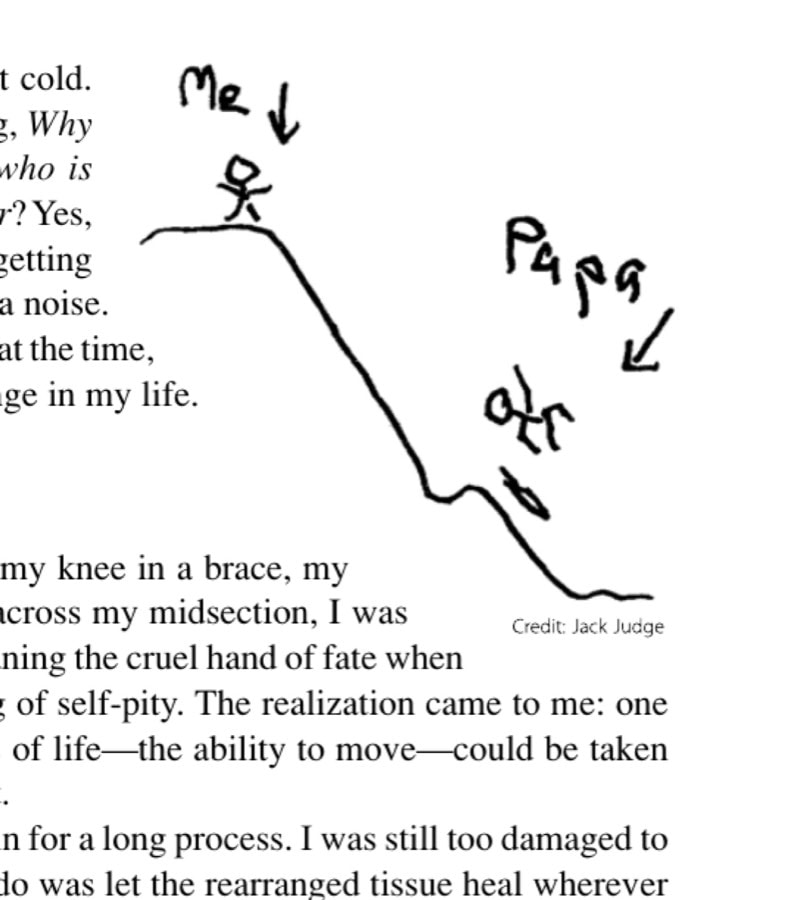
It’s called sledding. “See if you can hit that jump, Papa,” said my son, Jack. I gave him my best James Bond look, nodded in slow motion, adjusted my sunglasses for no reason, and knelt on the foam-rubber thingie that looked like a boogie board with handles. I aimed for the steepest part of the hill, which had a jump at the bottom, grabbed the handles, and shoved off.
The snow, it turns out, had become ice after many trips by sledders and by the shadows cast by the setting sun. The last thing I remember before the lights went out was thinking, I have never gone this fast on a sled in my life. Whoosh. Boom.
I hit the jump at the bottom a little sideways, flew off the sled, and landed on the solid-packed surface, crumpling my right side like aluminum foil. My orthopedist later said it was like hitting a parking lot at 25 miles an hour.
Muscle damage all over my upper right side. Hairline fracture of the right kneecap. Separated shoulder. Badly torn triceps. Shattered collarbone. Severe concussion. Severe concussion. Severe concussion. Broken inner-ear bones that
later led to hearing loss. I was out cold. As I came to, I remember thinking, Why do I have snow in my eyes, and who is blowing that car horn in my right ear? Yes, Virginia, when people talk about getting their bell rung, it really can make a noise. And although I did not know it at the time, that ringing sound signaled a change in my life.
Reality intrudes In May 2007, three months later, my knee in a brace, my right arm still strapped uselessly across my midsection, I was snacking on painkillers and bemoaning the cruel hand of fate when an arrow of clarity pierced the fog of self-pity. The realization came to me: one of the most fundamental elements of life—the ability to move—could be taken away from anyone at any moment.
There was no doubt that I was in for a long process. I was still too damaged to start physical therapy; all I could do was let the rearranged tissue heal wherever it landed, knowing that I would eventually have to go to therapy and tear all of this freelance healing apart so I could function again. The pain was brutal and relentless. I had to ask for help with easy tasks. It was hard to drive, because I could barely turn my head due to neck-muscle damage. I am a social creature, but for the first time in my life I was afraid of crowds, since even brushing people with my right side created shock waves of pain. I had been banished to the guest room because I kept my wife awake with my nighttime grunting and shifting.
Even worse, I had to shave with my left hand and sometimes shoved shaving cream up my nose. But I realized I was very fortunate. I have never sorted out the theology of guardian angels, but on that epiphanic afternoon, I had a new awareness that I had come away from my sledding episode with comparatively minor injuries. Had I landed at a slightly different angle, I could have snapped my spine. Another fractional turn, and instead of a crushing landing on my shoulder, it would have been my neck. Had I even survived such a landing on my neck . . . I didn’t care to let my mind go there.
Suddenly, the whole thing seemed more like a nuisance than a calamity. I was 45, otherwise in reasonable shape, and I never again wanted to take for granted the gift of movement. I slammed my good hand on the table, scaring the dog and making the Darvocet hop like jumping beans. I resolved to run the Mini-Marathon in May of the next year.
▲
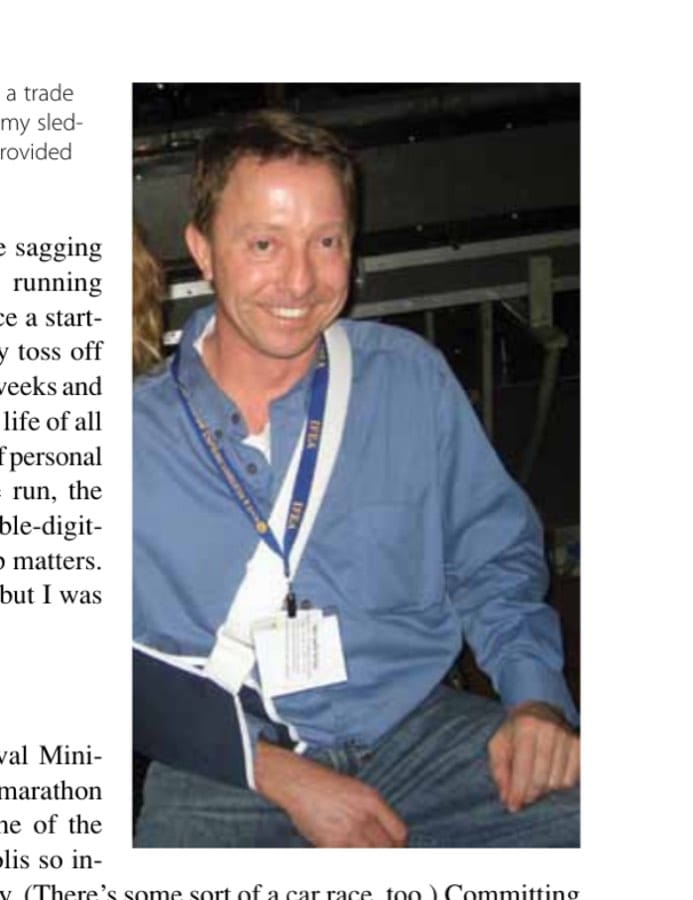
Here I am, heavily drugged at a trade show in Nashville not long after my sledding accident. This photo later provided me with proof that I was there.
Runners whose walls are sagging with medals from distance running can forget that there was once a starting point. While we casually toss off stats about 60-mile training weeks and 30-mile races, there is, in the life of all distance runners, a staircase of personal triumphs: the first five-mile run, the first 10K race, the first double-digitmiles training run. Each step matters. I didn’t know it at the time, but I was approaching the first step.
A solid goal The OneAmerica 500 Festival MiniMarathon is the largest half-marathon in North America and is one of the events that makes Indianapolis so interesting in the month of May. (There’s some sort of a car race, too.) Committing to a 13.1-mile race while bound in braces and slings was a step of faith. But the x on the calendar a year ahead gave me a focus for recovery. I now had a goal, and it left me no time to feel sorry for myself.
Physical therapy with Erin Wallace, the genie from the therapy bottle, started in June and stretched into December 2007. My knee was fine, I had much of my range of motion back, the pain was mostly gone, and as the end of the year approached, I knew it was time. I started running.
OK, running is generous. I began a form of propulsion that was faster than walking. I was still drifting slightly to starboard when in motion, but I didn’t care. The first time out, I went about a mile. Then a mile and three driveways. I blew a cloud of dust off the stationary bike in the basement and went to bike workouts when the winter weather kept me from running.
January 2008 came around, and I knew it was time to get real. The Mini was four months off. My main objective at that point was to avoid being the guy carried off the course on the evening news. (Hey, Tessa, isn’t that your dad?)
I set up an online account to track my training. It helped to document the miles, and the little bar graphs were neat-o. I made it a point to accidentally have
my mileage graph open on the computer screen whenever someone walked by. If they didn’t notice, I would keep clearing my throat and refreshing the screen until they did. But beyond the injuries, I was uncertain of my abilities. The 2008 Mini was to be my first road race in 28 years. I don’t like to crowd my schedule.
My last race had been a half-marathon I ran when I was 18, finishing somewhere around 1:20 (the records were lost when the Great Library of Alexandria was destroyed by fire). It’s a time that seemed slow then but leaves me astonished now. Over the years I had jogged on occasion and done a couple of fun runs and even an intramural race or two in college but nothing that required real training. This didn’t stop me from referring to myself as a runner because, in my ongoing delusion, I was.
But I was careful not to reach for the glory of yore too soon. I slowly added miles, got good running shoes, stretched a lot, and packed my running stuff on my frequent business travels.
Revitalized muscles I started to feel like a real runner again. I added core workouts after learning that I had a core. The home exercises for my smashed shoulder morphed into
ad
upper-body workouts, and the atrophied arm and shoulder muscles started showing definition for the first time in a year. By mid-February, I increased to about 18 miles a week and then to 25 miles a week by mid-March. My four- to six-mile runs were now easy, and I added longer runs.
I felt like I needed a test drive, but there wasn’t much to choose from. Race organizers in Indiana know better than to schedule a race in March. Fortunately, trail runners didn’t get the memo on this. The DINO Trail Run Series was the only group putting on races that time of year, so two weeks before the Mini, I ran one of its 5K trail races. It was 40 degrees and drizzling, the mud was thick and cold, the creek was raging, and the trail at one point was so steep we had to do a Spider-Man thing with tree roots to keep moving up the hill. It was a thorough trial of all of the healing and therapy I had been through.
I won my age group. I was stunned. The Kid was back. Now I looked at the Mini through different eyes. This was no longer a question of surviving the half-marathon but of accomplishment. I set out to break two hours.
On May 3, 2008, one year, two months, and 19 days after my sledding crash, there I was. The atmosphere at the starting line of the Mini was more like a giant party than an athletic event. I didn’t care that I was starting in the middle. I could move all of my limbs. I could stand up straight. I could raise both arms if I felt like it. This was so cool.
I went out too slowly. By the time we did the loop at the Indianapolis Motor Speedway—the halfway point of the race—I was just getting warmed up. It was both amazing to actually be running on the famed oval of the Indianapolis 500 and a little disheartening to look up at the Speedway Jumbotrons and see that the race winners had already crossed the finish line six miles away.
I worked my way through the crowd faster, bumping and jostling. I thought about how, just a year earlier, I had been so afraid of crowds that I was almost reclusive. I thought about the wheelchair athletes as I passed them and knew that, but for an infinitesimal change in how I landed on the sledding hill, that was me. It was anyone.
I continued to pick up speed, and it only felt better as I went. The teenage rock bands and the solo guy belting out country songs and the lady in the nice dress doing scat singing and the street preachers, it all blurred and blended and made me look down the road to see what was coming up next. The laughing and chatter were gone by mile 10, but there was colliding and sorrys and thumps on the back and you-go-aheads and encouragement from strangers. We were all driven by the same unseen force, 35,000 individuals running a solo race together. I loved every step.
Goal realized
▲
On the track at the Indianapolis Motor Speedway, I am at the halfway point of the 500 Festival Mini-Marathon.
© brightroom.com
The controversial dead-heat finish of the 2008 Mini-Marathon was so close that it ended in a tie for first between Lamech Mokono and Valentine Orare. I finished 5,312th, which to date has not been disputed. My time of 1:53 put me well within my two-hour window, and I know from my starting place to my finish place that I passed more than 10,000 runners.
Impressive? Of course not. The wheelchair racers, the 60-somethings who set personal records, the former smokers, the people who drop 100 pounds to remake themselves into ultramarathoners—that’s impressive. I was just another middle-aged guy in the middle of the pack.
But I know whence I came. I remember the agony, the maddening immobility on my right side, and the inability to find any position that was not painful. I vaguely remember the blurry two-month headache that followed the crash. I remember the blend of the severe concussion and certain painkillers that led to 3-D hallucinations during the day and terrible nightmares at night. I remember the inability to stand straight and the fear of leaving the house because of the lightning bolts of pain that came from bumping into people. I remember the mounting depression and the feeling that this would never end.
In following that tough chapter of my life by running a half-marathon, I peeled off my predictable outer layer and found something adventurous underneath. Now I have no time to fret over circumstance or to see myself as a victim. Whatever comes my way is opportunity.
Running has changed everything, and I now sign up for road races every couple of months. In November 2011, at age 49, I ran my first full marathon, the Williams Route 66 Marathon in Tulsa, with a goal of breaking four hours.
I learned—while driving into Tulsa—that Tulsa is hilly. (Going through my head was the refrain from O . . . klahoma, where the wind comes sweeping down the plain. There must be another Oklahoma. No plains in Tulsa, just lots of hills.) The staff and volunteers at the Route 66 were great, the locals were friendly and welcoming, it was just a short walk from my hotel to the starting line, and I knew that the young woman at about mile four holding up a big sign that said “Go Random Stranger” was there for me. All of that helped.
Combine hills and gusty winds and a misbehaving left IT band, and I was OK with 4:14 for my first marathon. And again, as I do at the end of every race, I stood there with a silly grin and thanked God that I could even do this.
No shortage of new goals The door is open for the next conquest. I am eyeing the Louisiana Marathon because it’s flat and fast and I can work on my PR; and the San Luis Obispo Marathon because it is still a new event and not overcrowded; and the Omaha Marathon because I met Susie Smisek, the race director, and she is just cool. To test my limits, I’m planning to take on the Miracle Match Marathon in Waco, which is reported to be so tough that it feels like an ultra, just at 26.2 miles. Plus Nancy Goodnight, the Waco race director, is a kick, and rumor is she provides a lot of free beer at the end.
A friend who also just turned 50 suggested we should do a 50-miler to celebrate having survived the perils of life this long. Fifty at 50. That seems like a great idea. I may not be ready for this before turning 51, but so what? The stairs on my staircase are my own. I’ll get to the next one when I do.
Author John Gardner observed, “History never looks like history when you are living through it.” That was the case on Valentine’s Day 2007, when I asked the kids if they wanted to go sledding. That was the case in May 2007, when I slapped my hand on the table and changed the course of my life. The decision to overcome my injuries by running the half-marathon—my most memorable race—was one of those watershed moments that becomes obvious only later.
At a time when people my age are settling into empty-nester routines and starting to waddle when they walk, I’m doing the opposite. Nothing seems out of reach any more, and I know there is an ultramarathon in my future. I think about where I have been, look at what I am now, and feel like I can do anything. Except sledding.
And what I learned from it 1. Putting on socks with one hand takes forever. 2. Self-pity is the most idiotic of human emotions. If circumstances aren’t right, change whatever is in your power to change. Today.
Slam your hand on the table if it helps you start. 3. Guys, you cannot impress the chicks by telling them you got hurt sledding. This doesn’t apply to me, of course, since I’m married. Just FYI. 4. The world is designed for right-handed people in a thousand subtle
ways. Right-handed people will never know this until forced to use their left for an extended period. 5. No one has any guarantee of being physically intact at this time tomorrow. So whining about a run is like whining about having too
much money. Every drop of sweat from every run is a gift. Never complain about running. 6. In a race, when you go by the hydration stations for water, it’s OK to keep moving while drinking water, because the water that sloshes
out feels good. 7. When you get Gatorade, you have to stop and walk, because Gatorade also sloshes out and you feel like a sticky little kid. 8. Any time there are ladies with matching shirts ahead on the course,
you have to find a route around them, because these ladies are running together and there is no way on God’s green earth that anyone is going to squeeze between them.
M&B e-Newsletter Stay connected with Marathon & Beyond between our regular issues. Go to our website and sign up for our monthly e-newsletter, Marathon & Beyond e-XTRA! Read bonus material and excerpts, short subscriber features, “behind the scenes” interviews with authors and runners, and additional mini race profiles. Also, join the conversation on Facebook.
This article originally appeared in Marathon & Beyond, Vol. 17, No. 1 (2013).
← Browse the full M&B ArchiveMore like this
1,000+ stories from 19 years of Marathon & Beyond
The complete archive of the legendary long-distance journal — digitized and free to read.
