

My Most Unforgettable Ultramarathon
SAN FRANCISCO, CALIFORNIA, December 26, 1976—So often, first-time experiences are quite memorable. For runners, it could be the first race, the first marathon, the first international competition, or, for me, the challenge of the 100K distance. This experience lodged itself in my memory, safely resisting being pried loose by more recent, “worthy” memories.
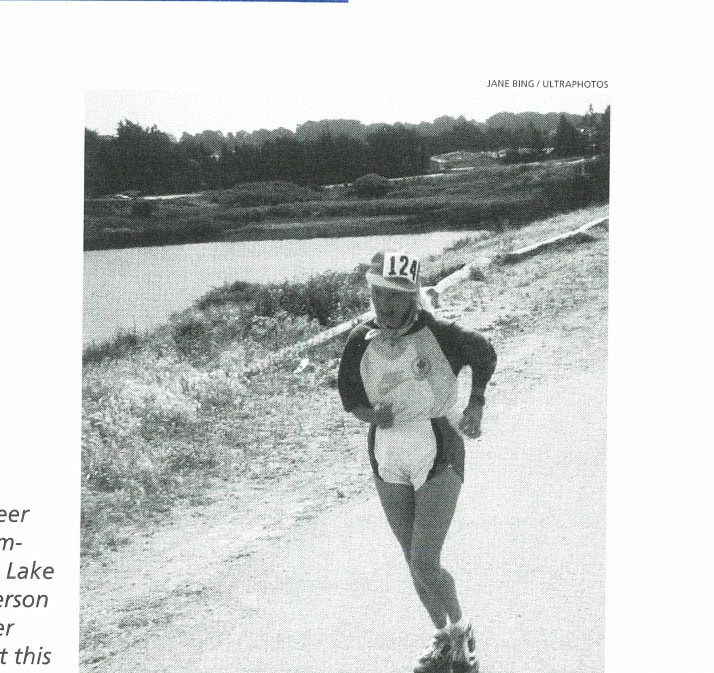
One of my most vivid memories was the pioneering opportunity to run in the 1976 100K Pacific Association AAU [Amateur Athletic Union, forerunner of the TAC, now the USATF] Championship that was scheduled to circle San Francisco’s Lake Merced a dozen times.
Although women running in ultramarathons today seems pretty old hat, in 1976 there were very few ultras and fewer still the women ready and willing to step up to the distance. Those of us on either the west coast or east coast of the United States were somewhat spoiled in that there actually were several ultras from which to choose, and even a fledgling ultra community. Most of the men involved in long-distance running were very supportive of women’s running—a refreshing difference from other sports that were effectively closed to women.
Our local Pacific Association of the AAU had a very active long-distance arm and a hard-core group of female runners, including Dr. Joan Ullyot, author of Women’s Running; Dr. Frances Conley; 1972 Boston Marathon runner up Elaine Pedersen; and Penny DeMoss, who in 1978 would take second at Boston. Penny’s husband Harold put on the excellent 50K championship, which I had run in March of 1976—my first ultra. The association had also been putting on a women-only cross-country series since 1974.
Lake Merced is a running mecca within the bigger mecca of the San Francisco Bay Area, a beautiful sheltered lake nestled not far from Ocean Beach along San Francisco’s west end. It adjoins the famed Olympic Country Club, site of many golf championships.
A rolling asphalt footpath circles the peaceful lake. If a runner makes a little out-and-back from the footpath to the boat house and back on each lap, the loop is 4.95 miles. An out-and-back “keyhole” to Sunset Boulevard was added to nudge the total distance to the required 100K.
THE BEST-LAID PLANS
The sequence of events that led up to my taking part in this race can only be described as success in spite of a spate of bad luck, or the pitfalls of what can happen to the “best-laid plans.” I had fractured my fifth metatarsal in mid-September while competing in the Dolphin South End (a local running club) Double Dipsea race. (Double Dipsea is an out-and-back edition of the famed and long-running Dipsea race from Mill Valley, over the shoulder of Mt. Tamalpias, to the ocean at Stinson Beach.) After six weeks of relative debilitation, the bone had healed well enough that I could ease just out of bike-riding mode and get into gentle “real training” on my own two feet.
In November I was able to log 40- to 50-mile weeks, survive two AAU 10K cross-country races, as well as compete in the Pepsi 20-Miler, albeit at a slow time of 2:30:37. The Honolulu Marathon, scheduled for December 12, would be my real test of the foot’s condition as well as of my overall conditioning. My 3:18:17 finish as first masters woman was certainly a confidence-builder. There was also the nice reward of becoming the 1976 AAU Masters National Marathon Champion, the first time the award was offered to women masters. I had done all I could in the time I had left before the 100K.
The Lake Merced 100K was “only” the AAU’s Pacific Association Championship (Northern California and Western Nevada), and although extremely well organized, it was a relatively low-key affair. Scheduled for the day after Christmas, I was more than carbo-loaded from a Holiday Season of enjoying the spirit of the season.
THE START OF SOMETHING BIG
As I stood shivering at the foggy predawn starting line, I couldn’t help comparing it with the pitch black start of the Honolulu Marathon, where instead of shivering, we were glad it wasn’t any warmer than it was. There had been an incredible 1,600 starters in Hawaii, whereas only 21 of us were brave enough to line up at the start in San Francisco.
Most planned to run the concurrent 50-mile race called the Christmas 50 organized by the Pamakid Runners Club. (Perhaps this 50-miler was the precursor to Joe Oakes’s soon-to-be-infamous “Fat Ass 50,” which is usually scheduled within days after Christmas as a penance for having over-indulged.) When the race was finished and the results tabulated, all 21 runners were given their recorded mileages—whether they finished or not—a feature only seen in subsequent timed events such as the 12-hour or 24-hour run.
The first lap quickly separated the participants into small clumps of two or three runners, which were out of sight of each other before long, both because of the opening distance and because it was still dark. It was a very strange feeling to hear a group in front or behind conversing as they ran, the conversation becoming fainter and fainter until they just sort of vanished totally.
I was very grateful for the company of my good friend, Barbara Carlson, and Bill Divita. Bill seemed to know how to pace himself in an ultra. Bill would ultimately take first place in the 50-miler. If I had known that was going to happen, I might have suspected that my 37-minute first lap was a bit too fast for me. In fact, it was way too fast. I felt confident I could cover the distance, but I didn’t expect I could do the entire 62 miles at just over a seven-minute-per-mile pace.
My next two laps went even faster, surprisingly comfortable at the time. I really had no concept of pacing. I just ran as fast as my body would take me, more on “effort level” than rate. I had hoped to run the distance in under 12 hours, which meant I only needed just under an hour per lap to meet my goal.
I credit this early pace to famed Bay Area blind runner Harry Cordellos (who a few years later would break 3 hours at Boston) and his running companion Bruce Dingwall. They were out doing their regular training run around the lake, as were quite a few of the Pamakid Runners, between stints of helping to put on the 50-miler.
Harry’s continuous chatter greatly helped the miles go by. He amazed me with his knowledge of exactly where we were. “We will be passing the green fence just around the corner,” he’d say even before we could see it. Actually, Harry had something of an advantage as far as “seeing” things on the course went. Because of the start in the dark, I hadn’t been able to see much scenery other than that illuminated by street lamps until well into my third lap, while Harry could “see” just fine in abject darkness. A whole new course seemed to open up before me with the coming of daylight and the lifting of the fog.
By allowing myself to be “pulled along” by hanging with other runners, I had somehow gotten ahead of Bill Divita after five laps, which I completed in 3:25:45, which was only eight minutes slower for 25 miles than I had run at Honolulu for 26.2 miles. The realization that I was ahead of the guy leading the 50-mile race forced me to slow my pace. Pacing at these ultradistance events was a whole lot different from pacing at a marathon; everything becomes so exaggerated, including how slow you seem to be going.
I was also beginning to enjoy our sustenance sessions at our blue
van. My husband John and daughter Rachel were waiting at the start/finish line by the golf course with my pitstop supplies. It was a most welcome oasis in the “desert,” as no aid stations were on the course, besides a very rudimentary one at the start/finish area, and I had not yet learned to carry bottles with me. Ultrarunning in the United States was very much in its infancy, and we still had a lot to learn.
SECRET POTIONS
I was drinking a formula of hot tea with lemon mixed with Body Punch (a sort of Gatorade-like drink marketed by Runner’s World in the late ’70s and early ’80s), to which we added extra sugar.
The weather stayed quite cool, even when the sun came out, so I never felt overheated. John had also brought along a “secret weapon”—a bottle of oxygen that I could sniff during my pit stops.
I did change into dry clothes after five laps and noted in my running diary that I had changed shoes three times, although I don’t rightly know exactly when I did that. The pitstop routine also involved a stop at the boat house restroom and a stiff-legged return to running.
When I passed the 50K distance, I experienced a real feeling of encouragement: the halfway mark was “magic.” Additionally, the arrival of knots of spectators who cheered us on helped. Even better for my motivation—and to distract me from the work at hand—was the opportunity for the company of Otto Sommerauer for three laps. His descriptions of ultra races in his native Switzerland were a wonderful distraction from the increasing tiredness I was experiencing. I typically don’t talk a great deal when I run; I’ll answer a question if spoken to, but I don’t hold long conversations. I didn’t need to with Otto along. He did all the talking. He told me about 100Ks with more entrants than our marathons boasted. I could hardly imagine a 100K with thousands participating and as many spectators watching and cheering along the course as the race wound from picturesque village to lovely village.
He supplied wonderful material for a most pleasant fantasy later in the race: as I became increasingly tired, I could “visualize” running through alpine meadows, pine forests, or along trails that skirted little bubbling streams, with the gorgeous mountains in the background. Every little village—no matter how small—was charming, and the fact that there were always other runners in sight added to the feeling of being involved in a movement greater than my own race. It was so appealing.
The rifle range near the lake always interrupted such daydreaming. As practice shots were fired at targets, I felt as though I should “pick it up” through that section, as if fleeing from a potentially dangerous situation.
Certainly boredom was never a problem. There was always something going on, something new to see during the day. In fact, a familiar sight like Harry’s green fence with the 4-Mile marker on the path helped me past what I might perceive as bad spots on to spots that were not quite as bad. A flat course would have been far more “boring” and even tiring for me. The changing slope of my foot-plants up and down grades helped keep my tendons at least “happy.” I did develop one black toenail, which I might have avoided if I hadn’t used the New Balance 320s and stuck to my two pair of Nike Waffle Trainers.
THE 50-MILE MARK
Just past the 10th lap, I finally reached 50 miles. It took me 8:30:01. Only one of the five runners finishing the 50-miler had not lapped me. He was the race director, Jack Wiley, who was 19 years old; he finished his own race in 9:40:27. Jack’s organizing skills were very impressive for one so young. His attention to detail was outstanding.
Divita’s winning time for 50 miles was 6:44:27, followed closely by Ed Jerome in 6:46:00. When Ed lapped me, he was not accompanied by his soon-to-be-famous, faithful dog Shelly. She was just a puppy, but she did do one 5-mile lap with him. Shelly broke 4 minutes in the mile in the 1977 Livermore Marathon. (Tragically, both were killed in the ’80s in separate traffic incidents after Ed and Shelly moved to Southern California.)
As far as the 100K went, the ultra-mailman and pioneer of Bay Area ultrarunning, Don Choi, finished three-and-a-half hours in front of me. I really appreciated his kind words of encouragement when he passed me, which was quite a few times. His 7:44:42 finish turned out to be the third fastest 100K in 1976; in the process, he also beat three of the 50-mile runners to their finish.
The only other runners still with me in the 100K race were Harry Siitonen and Len Wallach. They had begun taking sleeping rest stops some time after passing the 50K mark, so even I was able to lap them. I was fascinated to see them in sleeping bags in a quiet grassy area near the boat house. Harry told me afterwards that they usually only stopped for 15 to 20 minutes, but after 50 miles, Len went home to take a shower. Harry continued the routine, so he was able to finish in 16:24:35. Len returned two hours later, but was able to continue and finish in 21:30:19. I have absolutely no idea which official could have been left by then to score him, but someone was, thanks to the conscientious race director.
Even for me the last 2.2 miles would have been very lonely had not my dedicated spouse Johnny, the Scannels, and Bruce Dingwell (with his flickering flashlight—it was pitch dark again) accompanied me. Without all the wonderful support, I’m not sure whether I could have accomplished this great first-time achievement of 11:22:46 for 100K, which I was told was an American record.
| MILES | 1. Don Choi (28) | 2. Ruth Anderson (47) | 3. Harry Siitonen (50) | 4. Len Wallach (49) |
|---|---|---|---|---|
| 4.95 | 32:10 | 37:00 | 63:00 | 63:00 |
| 9.9 | 65:50 | 1:15:45 | 2:14:10 | 2:14:10 |
| 14.85 | 1:37:10 | 1:50:05 | 3:27:05 | 3:27:05 |
| 19.8 | 2:09:05 | 2:39:20 | 4:41:55 | 4:41:55 |
| 24.75 | 2:43:45 | 3:25:45 | 6:08:08 | 6:08:08 |
| 29.7 | 3:17:00 | 4:30:10 | 7:21:40 | 7:21:40 |
| 34.65 | 3:53:20 | 5:27:00 | 8:48:00 | 8:48:00 |
| 39.6 | 4:32:15 | 6:23:08 | 10:09:50 | 10:09:50 |
| 44.55 | 5:13:30 | 7:21:25 | 11:29:00 | |
| 49.49 | 5:54:32 | 8:24:49 | ||
| 50.0 | 5:58:50 | 8:30:01 | 12:50:21 | 12:53:54 |
| 54.95 | 6:43:10 | 9:39:47 | 14:19:30 | |
| 59.9 | 7:21:05 | 10:48:30 | 15:48:36 | |
| 62.137 | 7:44:42 | 11:22:46 | 16:24:35 | 21:30:19 |
What I Learned. . .
A great deal of what I learned was obvious to me right away, but over the years I have realized there was a lot more.
IGNORE THE CONCEPT OF “LIMITS”
That I could meet such a challenge as this 100K made me realize there doesn’t have to be preconceived “limits” on what one can achieve. They say ignorance is bliss, and I guess I’d have to agree because based on my other races up to that point, I never entertained the idea that I wouldn’t finish my first 100K race.
GOAL-SETTING IS IMPORTANT
I had set a 12-hour time limit, after assuming I would finish. It stimulated my appetite to meet more challenges. In fact, soon afterwards I became interested in trying a 50-miler for time, as my 8:30 was slow by European standards—Edith Holdener had run 8:50 for 100K early in 1976. I did learn the importance of proper training (55- to 60-mile weeks helped), and on February 27, 1977, I was able to run the Pine Grove-to-Sacramento 50-miler in 7:35:40. I enjoyed the ultra scene so much that I decided I wanted someday to do the famed London-to-Brighton ultra, which was closed to women. With the support for the Road Runners Club, both in the United States and England, and by getting the nod from the head of women’s athletics in Britain, I was able to run that famous race in 1979.
BE CERTAIN THE PAPERWORK IS DONE CORRECTLY
A sad truth about my 100K race is that my time of 11:22 failed to be recognized as an American record. This incident showed how difficult it can be to get performances recognized. Even though my time was two hours better than the listed 13:22 of Sharon Horner (21 years old, PA), it was not ratified. The Lake Merced course had been certified by Sheldon Gersh (following Ted Corbitt’s rules) and duly sent to the Running Data Center of Ken Young. I never did learn what was missing. I didn’t run another 100K until 1986 when my club, the Bay Area Ultra Runners, initiated the 100K around Lake Merced and named it after me to honor that 1976 “record” run. However, I did run my 100-mile track time of 16:50:47, with a recorded time of 9:57:30 for 100K. Neither of these would-be records could be ratified either because the race director had “lost the lap sheets!” Jack Wiley had really tried in 1976 to work his way through the paperwork mess, but not all race directors will fight the paper battles for the athletes.
FIND A GOOD CREW
My last but far from least most important observation is this: a good crew is essential to success!
This article originally appeared in Marathon & Beyond, Vol. 2, No. 6 (1998).
← Browse the full M&B ArchiveMore like this
1,000+ stories from 19 years of Marathon & Beyond
The complete archive of the legendary long-distance journal — digitized and free to read.
