

My Most Unforgettable Ultramarathon (Vol. 18, No. 1)
It takes a leap of faith to get things going It takes a leap of faith—you gotta show some guts It takes a leap of faith to get things going In your heart you must trust. —Bruce Springsteen, “Leap of Faith”
FENTON, MISSOURI, September 2, 2012—Even though ultramarathons are becoming more prevalent in this country, probably many runners who have completed standard marathons hesitate to cross the line that divides the 26.2mile strolls from the less-conventional and less-understood world of ultras. It’s as if the tentative ones believe the running world is flat and that stepping beyond the edge of marathons will cause them to fall into a deep chasm, never to return to marathons, families, and friends.
I was one of those tentative ones, wondering whether I could complete an ultra without having some sort of disaster leap upon me without warning. The curious interest was there, but I kept putting off a commitment to try one, too busy with family and career and the belief that I wasn’t ultrarunning material. I run as fast as a miniature plow horse and subsequently thought that I didn’t have the right stuff to venture into what some may consider the twilight zone of long-distance running.
However, when the approach of 50 years of age is the next exit ahead on the interstate highway of life, people like me take stock in what they have and haven’t accomplished. And if a person is a card-carrying devout masochist like me, the urge to take a leap of faith into the unknown eventually erodes the firewall of caution that had stood steadfast and unmovable. So like the lyrics to Springsteen’s “Leap of Faith,” I developed the guts to try my first ultra, and I trusted that the information I learned and the training that I executed would help make my leap a successful one. I am happy to say that I was rewarded for my trust—I was able to
© Shannon Drohan
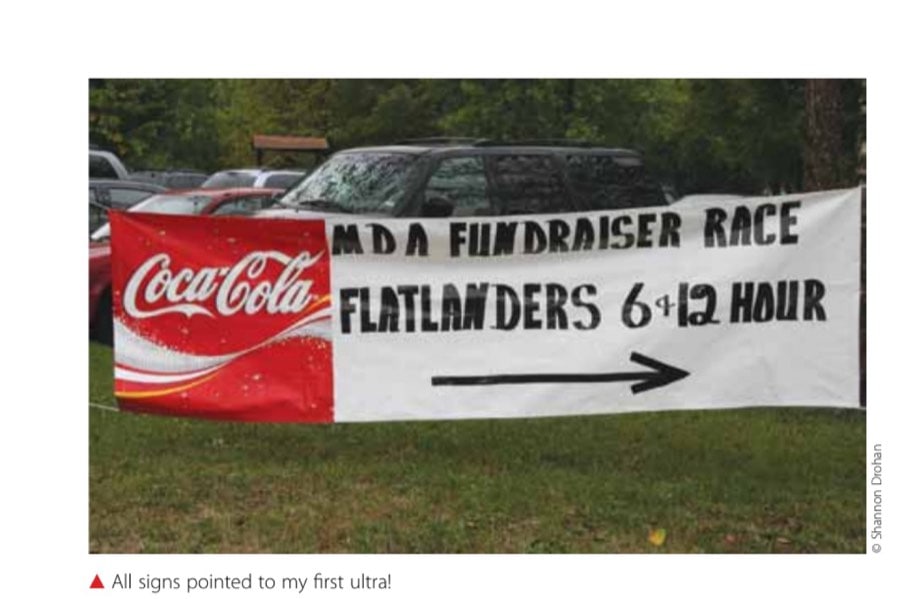
▲ All signs pointed to my first ultra!
complete my first ultramarathon without any adverse effects. You can, too, if you take similar steps before you make your leap of faith from marathons to ultras. The first few strides toward my leap of faith occurred after I completed the 2011 St. Louis Rock ’n’ Roll Marathon. It was my sixth marathon, and I was feeling very jaded afterward. Maybe I had started to develop an acute case of the “been there, done that” attitude; maybe I was wondering whether I wanted to continue running marathons while shelling out $100 or more for entry fees.
All of those thoughts were swirling about in my mind as I pondered my next running challenge. I sought out a late-summer or fall marathon that would be bargain priced and fairly close to my St. Charles, Missouri, home. The only event that met both criteria was the Flatlanders 6-Hour and 12-Hour Runs. They were less than a half hour away from home, in the south St. Louis County town of Fenton, and had a nice price of $40 for an entry fee. My initial impulse was to choose the six-hour version, which would probably get me to official marathon distance. But every time I rationally told myself to choose the six-hour run, the adventurer in me kept whispering for the 12-hour option.
No stranger to the concept of ultras I had been interested in doing an ultramarathon for quite some time. Reading accounts from books written by James Shapiro about the variety of ultras was fascinating, especially the 12-hour, 24-hour, and multiday events of the past and present. My appetite was whetted by having used the Cornbelt 24-Hour Run in
© Shannon Drohan
Davenport, Iowa, as the basis of a documentary that I filmed as a graduate student at Lindenwood University in the early 1990s. I also got a taste of what an ultra might feel like by being a one-man team in a trio of American Cancer Society Relay for Life events, walking for a little more than 20 miles each time. So the idea of running an ultra was not totally foreign to me. It would be a matter of whether I wanted to commit mind, body, and soul to such an endeavor.
It didn’t take long to make a decision. With a nod to B. B. King, the thrill was gone regarding marathon training. I knew then that I needed a new challenge. As I mulled over the prospect, I read about the much-heralded Comrades Marathon, a 56-mile run that the entire country of South Africa supports and celebrates, capped with wall-to-wall TV coverage. That sounded like a lot of fun to me. But if I was going to try to qualify for that celebration, I needed to see whether I could first complete something that approximated Comrades. The Flatlanders 12-Hour Run would fill that bill, so I decided to run that event instead of my usual fall marathon.
The first step was to figure out how to chart a course that would produce a positive result. It was kind of like what Christopher Columbus and his explorer peers of the 15th and 16th centuries had to face, albeit on a much smaller geographical scale. How do I plot the steps that will lead me through unfamiliar waters to my desired destination?
I needed to conduct research to learn as much as I could about the specific physical and mental demands of an ultra. I have run marathons with minimal
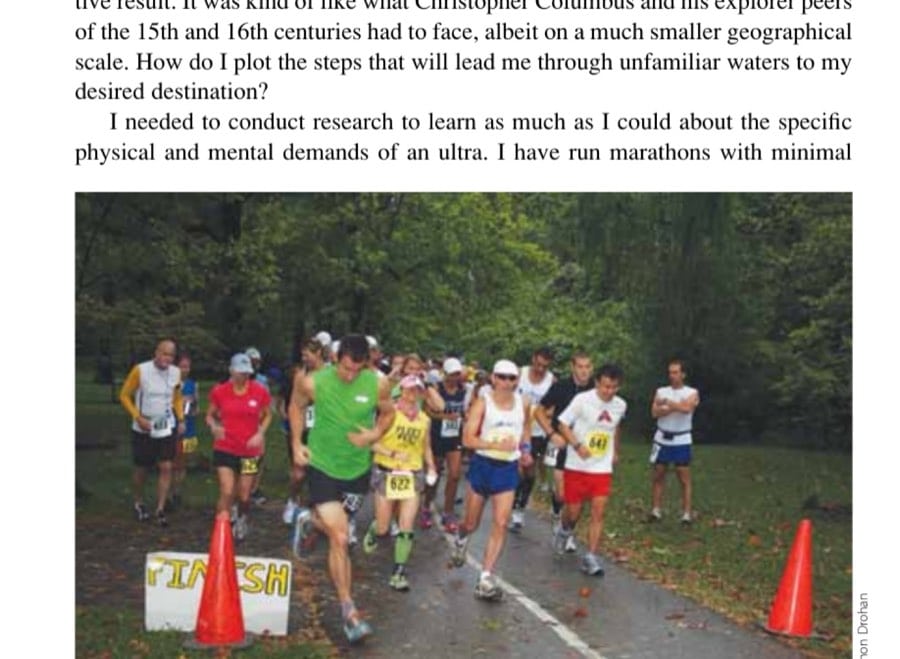
▲ Even in ultras, I discovered that fast people start in front of the pack, and slow ones are in the back. I’m in the back.
training, and my legs protested loudly for several days afterward. I was not interested in multiplying that side effect by a factor of two or three by preparing for an ultra in a cavalier manner. Information is becoming readily available as more people attempt ultras, so it wasn’t difficult to find mother lodes of tips and advice. I began by poring over articles in all the prominent running magazines. Much of the information in those articles seemed to be geared toward trail running, which I wasn’t interested in—especially when reading about expecting things to go awry, which included the possibility of stepping on a rattlesnake. If there is one thing that I share with Indiana Jones, it is an acute dislike of snakes. Therefore, I decided that there would be no trail running for me in the foreseeable future.
I did file away to memory items like the value of PBJs, of expecting challenging situations and planning how to react to them, of breaking the distance and time into manageable blocks, of the value of walking and relentless forward motion, of how to extend long runs to train for an ultra, of what food and drink items to choose at an aid station during the race, of how to determine whether I was overhydrated, and of having a plan to implement during the ultra. Those items would prove to be very valuable in my training.
Finding the right training plan I consulted running websites, along with a copy of Tim Noakes’s book The Lore of Running, which I had bought a year or so earlier to sample its marathon training ideas and research. I was delighted to see that it also had a detailed chapter on ultras—not only an account of the sport’s history but a detailed look at the regimen of nine-time Comrades Marathon champion Bruce Fordyce and a handful of sample training schedules that had been tried and tested. I chose to adopt and adapt a 22-week ultramarathon training schedule in the book that geared toward an effort between 80 and 100 kilometers (50-62 miles). It was not complicated, and it also had the flexibility to put in four or five training days per week, with a peak weekly mileage in the low 50s and peak long run of 30 miles. I could make adjustments based on the family’s work and school schedules without feeling that I was sabotaging my efforts.
Next I needed to establish a goal—how many miles would I want to cover? If I bit off too much, it might sour my views on running ultras before giving the sport a fair chance. The Flatlanders course was an asphalt bike-path circuit of 1.4 miles, so I began to do some math.
To achieve 50 miles would require 36 laps, or three laps per hour. My usual rate of jogging is a pace of 12 minutes per mile. I didn’t think I could be a metronome and maintain that for 12 hours, so I looked for a more modest goal. I did think that I would be capable of completing an average of two laps per hour, which would
result in 24 laps and 33.6 miles, but I didn’t have a great foundation before training was scheduled to begin. I was doing well to get 20 miles or more in a week outside of race training, so it was best to lower the goal a bit further. I settled on a modest goal of covering 50K (31 miles), which would require completing between 22 and 23 laps. If I could average two laps per hour or a bit less, I would get to my goal even if I had to walk a lot during the event. I was in much better shape and about 30 pounds lighter than I had been for the Relay for Life walks, so I was very confident of getting past the standard marathon distance. My hope was to avoid injury and extreme heat—those factors seemed to be the biggest threats to maintaining the newly learned “relentless forward motion.”
The prospect of enduring the heat became an obsession, all the way up to the final week of training. But it was the figurative 800-pound gorilla in the room that wasn’t going away, so I had to resign myself to acclimating my mind and body to what would become the hottest summer in recorded history in St. Louis.
Adapting training to the relentless sun Since I didn’t have a deep base of training before starting my Flatlanders schedule on May 14, I kept my training runs in the heat of the day to an hour or less, with walking breaks when I began to get close to the line between being lucid and being loopy. I also discovered that sunlit heat is my kryptonite. I can run for over an hour during hot and humid evenings without a problem, but the high-in-the-sky sun combined with high heat rapidly taxes my thermostat and drains my energy and will. I took great care in determining when I could keep pushing and when to back off to avoid heat exhaustion and heat stroke. Walking helped extend the number of miles that I covered, something that I had thumbed my nose at during training for marathons.
I discovered that revelation during a visit to Baltimore in July, which I had hoped would be a respite from the blast-furnace heat of St. Louis. Unfortunately, the heat followed me. I was able to alternate jogging and walking in an hour to cover five miles in 100-degree heat upon my arrival. And after a morning session with Sandra Turner’s Annapolis Boot Camp on day two, I successfully covered seven miles in 90-degree morning heat on day three. Near the end, I alternated jogging and walking from song to song on my iPod Shuffle. After those brickoven jaunts, I became much more confident about tackling similar heat during the Flatlanders ultra. My tolerance to heat became the best that it had ever been, allowing me to do outdoor work or go on family outings without feeling that I was being dragged over 40 miles of bad road.
Since I was making progress in conquering the heat, I had to train my mind to withstand the challenge of making two dozen or more circuits of the same course for half a day. I determined from my research that my training runs should
closely mimic the monotonous nature of the race. I was able to achieve that in a number of ways. First, I regularly run a two-mile loop in my subdivision—so I just endlessly used the loop to complete several long runs that I would otherwise have completed on out-and-back courses. Second, when I needed to do long runs while my wife worked her overnight shifts at a hospital, I resorted to using our treadmill so I could still be in the house while my kids slept. It was very difficult at first to spend more than an hour on the treadmill without feeling that I was losing my mind. With the use of my iPod and taped TV sports fare, I was able to break through that initial boredom to tally up to three hours on treadmill long runs. Third, I incorporated a new indoor track at nearby Lindenwood University into my training. It is a tight oval, 11 or 12 laps to the mile, and I built up my tolerance to a point where I ran 156 laps one afternoon—13 or 14 miles. After a summer of those methods, my mind was steeled to the task of circling laps for hours without end.
My longest run was only 20 miles, in 5:01:36, but I had completed a few backto-back long runs of one to three hours that helped build enough endurance to get me through a half day of jogging and walking. Finally, near the end of August, it was time to begin tapering toward the 12-hour run on September 2.
Attention to ingestion I occupied myself with making plans like a general preparing to lead his troops into battle. I would start with jogging the first 55 minutes of each hour and walking the final five minutes before jogging again at the top of each hour. Then, as fatigue crept in, I would increase the amount of walking per hour as needed so I would have strong-enough legs to finish the ultra without hobbling or crawling. I decided to also try taking several long pulls after each lap from a stationary water bottle filled with Nuun electrolyte sports drink. I thought that carrying a bottle, no matter how small, would become an irritant as the hours ticked away. I bought six Clif bars and would eat one every two hours. They sat well in my stomach during training, so there was no need to try anything different during a long race day. I considered buying some electrolyte capsules to maintain my mineral balance, but I wasn’t able to practice with them before game day so I decided to eat some salty snacks provided by race officials when I felt the need.
After cementing my strategy for eating, drinking, running, and walking, I turned my attention to the weather. However, due to an act of divine intervention, I didn’t have to worry much about the heat.
Hurricane Isaac would end up obliging my hopes of having a cooler backdrop for the ultra, thankfully expending most of its power before arriving in the St. Louis area as remnants of its formerly dangerous self. And I couldn’t believe my good fortune when I learned that there would still be ample cloud cover and
© Shannon Drohan
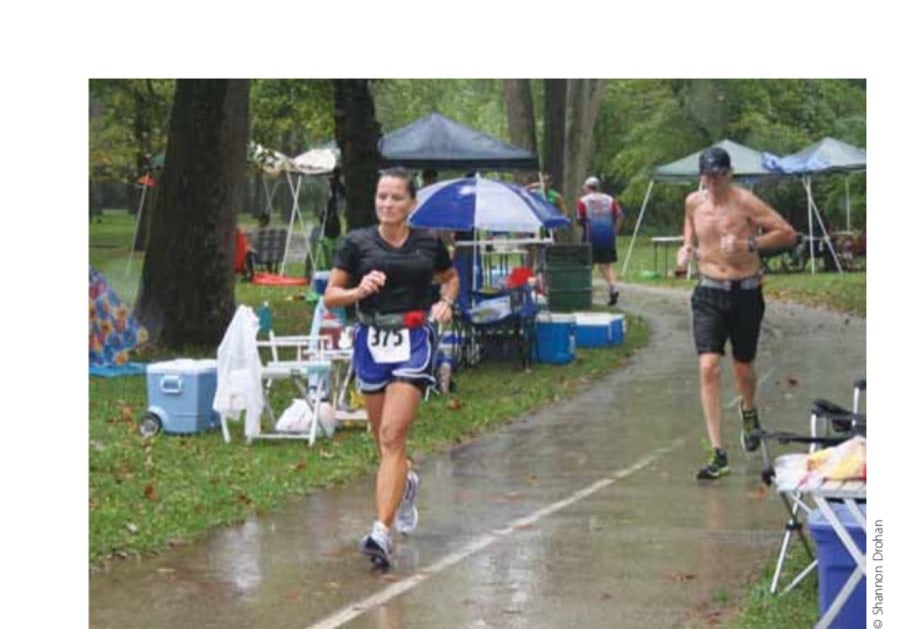
▲ Gentle remnants of Hurricane Isaac kept runners cool throughout most of the ultra. My thermostat thanked Isaac frequently.
periodic showers throughout race day. I had to hope that Isaac wouldn’t decide to leave too soon, because there were high temperatures above 90 degrees just to the west of St. Louis, beyond the reach of the deteriorating storm. As it turned out, Isaac extended his stay, drenching us in the first couple of hours of the Flatlanders run and keeping his cloud cover and periodic showers intact through the first six hours of the 12-hour run.
I covered 12 miles in the first three hours and 18 miles in five hours, and I reached the halfway point of the 12-hour run with 22 miles logged. After four hours, I had to do quite a bit more walking, so I chose to drink my first Amp energy drink. I don’t think energy drinks have been universally endorsed as training or performance aids, but I was very glad that I decided on a whim to buy two Amps on the way to the event. Did they ever taste great! They provided a very pleasant and vividly tasty change of pace, and as a growing achy fatigue seeped into my legs, knees, and feet, the Amps were great boosts that lasted an hour or two after drinking them. I drank them at the four-hour and eight-hour points of the race.
In the eighth hour, I shuffled past the standard marathon distance of 26.2 miles and into the new world of ultramarathon running. I paused, grinned, and quietly exclaimed a Marv Albert-like “Yes!” upon reaching the new milestone of my running experience. I was reduced to a shuffle that was probably slower than a brisk
walk, but walking was surprisingly more uncomfortable for my knees and hips. I was having fun knowing that I was well on my way toward finishing my first ultra!
Trying to avoid defeat
© Shannon Drohan
When I reached the ninth hour, I had logged 30 miles and was in the enviable position of needing only one more mile in the last three hours to reach my goal. I kept waiting for something ominous that would thwart my efforts just before
reaching my particular holy grail of 31 miles, but there were no signs of dread on the horizon. My biggest physical problem was my feet. Although not diagnosed by a doctor, I suffer from some sort of neuropathy that sometimes plagues my
feet with painful tingling and burning sensations in the soles. The sensations become so pronounced that even wearing spongy Crocs can be uncomfortable. Multiply the effects of jogging and walking for several hours, and my feet felt
like they were walking on hot coals with thumbtacks thrown in to heighten the effect. Here was my obstacle that the sage runners said happens to everyone at some point in an ultra. By the 11th hour, I was ready to end my shuffling. I had surpassed my goal of
31 miles, nearly shedding a tear of joy upon doing so because I had accomplished what I had worked so hard to achieve—and there are many areas of my life in which hard work hasn’t produced the desired payoff. I was willing to
step off the course once and for all so I could bask in the sublime feeling of achievement while others finished their individual journeys. However, the race officials at the scorers’ table would have none of it—practically
refusing to grant my wish and strongly urging me to return to the run for the final hour in a manner that challenged
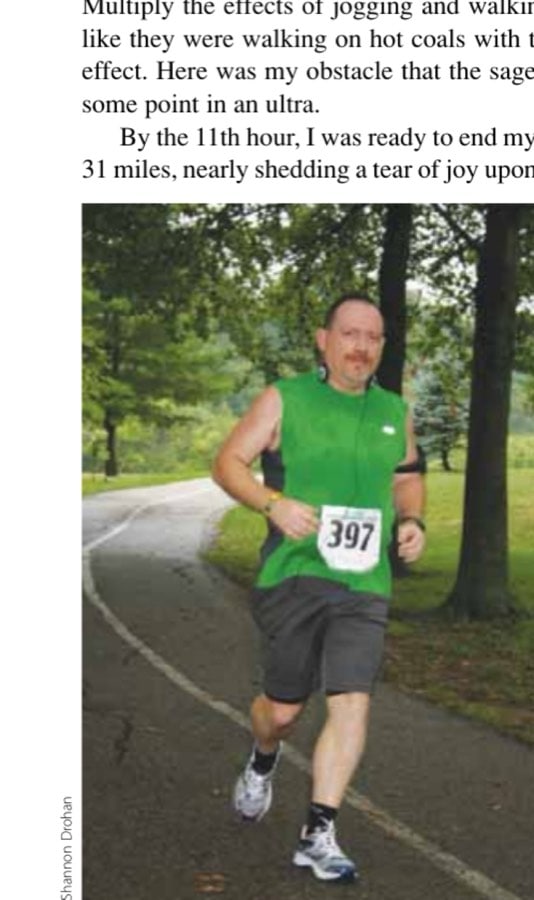
▲
That’s me, on cruise-control early in the 12-hour ultra, wondering how far I would cruise by nightfall.
my manhood. Not expecting that, I was getting ready to drop the gloves like a hockey player in response to that challenge. Instead, I redirected my anger into shuffling away on painful feet, somewhat hoping that they would become chronically injured so I could sue the aid-station worker who got fully under my skin. But the feet were OK after I used the grass and dirt alongside the paved path to spare them any more pain.
As the horn went off to end my first ultra, the extreme soreness that I had been able to keep away from my legs with adrenaline and mental determination now flooded into my thighs, hamstrings, knees, and hips. That elicited a few yelps with each painful step, since it felt like someone was trying to pull my muscle fibers and joints apart like I was a fast-food chicken wing. But that increasing pain was balanced by the immense feeling of satisfaction—that I had persevered through the heat of the summer and the stress of everyday life to cover over 31 miles in 12 hours!
Something to wallow in To my great surprise and enjoyment, I officially accumulated 39.84 miles—far more than my goal of 31 miles! I finished 22nd out of 35 runners, and I was grateful to receive congratulations and compliments from the top finishers, who were impressed that I had kept moving without a lengthy break throughout the entire 12 hours in my first ultra. So as I made the walk to the van to drive home, I basked in a warm glow even though it was pitch dark and heading toward 9:00 p.m. on my watch.
Since my ultramarathon debut was overwhelmingly positive, I was hoping to repeat my experience in the same Flatlanders 12-Hour Run in 2013. However, there must have been an overwhelming wave of word-of-mouth advertising regarding that event because it sold out before July 1 and before I got around to registering for it! The event is limited to 75 runners, split between the six-hour and 12-hour versions. It didn’t take long to reach that limit, needless to say!
My relative success from my first ultra has rekindled my interest in running a marathon, while still focusing on a future ultra—only now I’m pointing to the GO! St. Louis Marathon in April 2014 to see whether I can run it in under five hours and qualify for the Comrades Marathon. I will have to be in the best shape of my life, since it has been a couple of decades since I have been under five hours for a 26.2-mile endeavor. But I have joined a Gold’s Gym with the plan of doing lots of bicycle-spinning classes to build endurance (just like Comrades great Bruce Fordyce as he aged) while limiting the load-bearing wear and tear of running on roads and sidewalks. I will also need to do a lot of hill training to match the rolling nature of that marathon. I have a plan that weaves all of those elements together, and time will tell whether I’m successful.
And what I learned from it • If you are not hearing a “field of dreams” voice frequently telling you to go the distance and do an ultra, it’s best to wait before tackling one. You will have to invest more time in training for an ultra than
you would for a marathon. Attempting that quest without zest will lead to disappointment and perhaps injury. • Start with a short ultra, perhaps a 50K or a 12-hour event with 50K as a goal. That distance isn’t much farther than a marathon, so the
increase in time spent training and accruing the needed number of miles will be a manageable step forward and not an overwhelming quantum leap. • Choose an ultra that has a lower degree of difficulty in its terrain and
elevation change. If I had chosen the mountainous Western States 100 as my first ultra, my carcass would still be in the wilderness because my training base was woefully deficient for such a challenging event.
And you have to run a qualifying ultra to even apply for WS100. • Choose convenience. Pick an ultra that won’t be a burden on your family, one that is close to home and requires no help from family members. If they volunteer, great! Otherwise, be as self-sufficient as
possible so your favorite fans can focus on cheering for you instead of doing various forms of manual labor or trekking supplies to the next aid station. • Most important, during the ultra, stay focused in the moment. Don’t
let your mind drift toward how many more hours are left in the race or allow self-doubt to create energy-sapping anxiety over how many more miles you need to reach your goal. Talk with your fellow run
ners and aid-station personnel and with yourself if necessary. Think about other crossroads moments that you have had in your life and how you handled them. Watch a youth soccer game unfolding on a nearby field as you complete a lap. Dedicate each lap to the memory
of someone or to a past event that shaped who you have become. Just don’t fixate on what seems to be an impossible amount of time and number of miles left in the race! Good luck! I hope that your first ultra will be as satisfying as mine!
This article originally appeared in Marathon & Beyond, Vol. 18, No. 1 (2014).
← Browse the full M&B ArchiveMore like this
1,000+ stories from 19 years of Marathon & Beyond
The complete archive of the legendary long-distance journal — digitized and free to read.
