

My Most Unforgettable Western States 100
SQUAW VALLEY, CALIFORNIA, June 24, 1995—”Depart not from the path which fate has you assigned.” This fortune cookie admonition concluded our dinner in Oakland in late June 1995. The next day my wife Kathy and I drove to our Squaw Valley destination. By week’s end we would know if I could fulfill that mandate in the greatest challenge of my running career: to beat the extremes of ice and fire on foot between Squaw Valley and Auburn and finish the toughest Western States 100-Mile Endurance Run in the event’s then 22-year history.
Because of our aspirations to begin a family, I had resolved that the 1995 Western States 100 would be my last. Naturally, I wanted very badly to retire a finisher, not a DNFer. But the forces of nature refused to make the task routine, even out of kindness to a five-time Western States finisher.
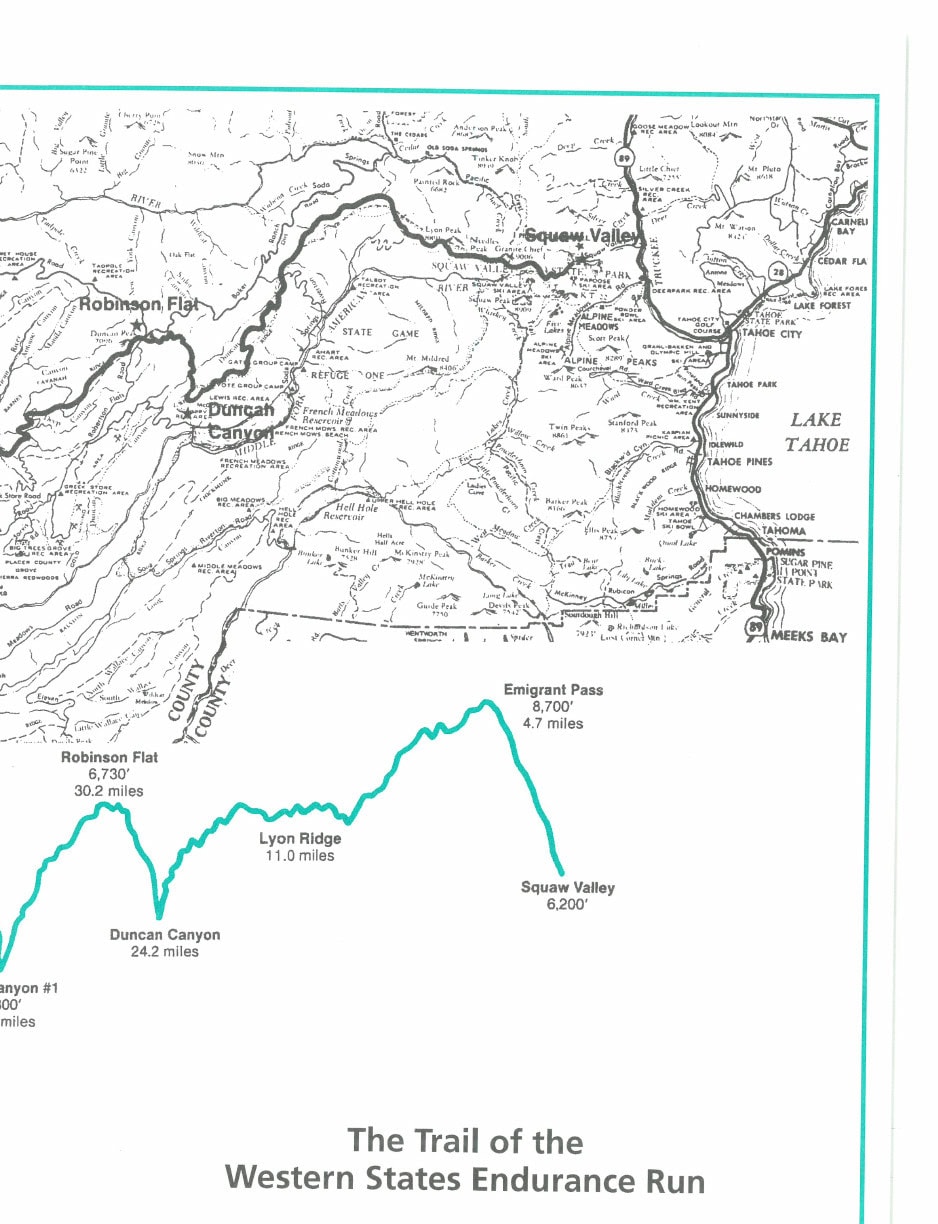
The winter of 1994–95 produced more snowfall in the upper American River watershed than any year in recorded history: 836 inches at Emigrant Monument, almost 50 inches more than the previous record, which left the 10-foot monument under at least that much snow at the summer solstice. While an average year may produce several hundred yards of snow-covered trail in the course’s early going in the Granite Chief Wilderness—and more often than not no snow at all by race weekend—in 1995 the trail was completely blanketed in white for 22 miles. Between the Squaw Valley starting line and the Duncan Canyon aid station (24.2 miles), only the first and last mile would be on visible dirt trail.
That was the “ice” half of the equation. As for the “fire” side, it turned out that the two hottest days recorded in Auburn in 1995 were the Saturday (105 degrees) and Sunday (107 degrees) of race weekend! For those of us running in 1995, that meant we went from a near-marathon of frigid, slippery terrain to a marathon-plus of bake-oven hell.
The results were just about what race director Norm Klein predicted: 376 of us started, only 36 finished in under 24 hours, and another 134 under 30 hours. The numbers constituted the lowest finishing percentages in Western States history.
Though our race trustees had initially balked at Norm’s suggestion to acknowledge the extreme conditions and keep the finish line open an extra two hours, after we took that vote, Norm told me, “You’ll need it. I guarantee it will take you two hours more this year.” Since all my finishes on the present course had been in the 28-hour range, Norm meant it; I might cross the finish line before the course was closed, but I would receive no buckle award.
That was not how I wanted to go out of Western States. The question, then, was whether preparation and resolve would combine to give me the prized result—not just to finish the race, but to leave it in peace.
PREPARATION
Aspirations other than Western States drove my initial preparations. Just before the 1994 World Cup soccer matches at Stanford, I had earned my U.S. Soccer Federation state referee badge. Watching those games at the stadium or on television, I was keenly aware of referee performance. When I later learned that a few men selected by their national federations as World Cup referees had been disqualified for failure to meet the endurance and speed tests, I resolved to pass my own test not by the modest criteria for an over-45 state referee but instead by the highest FIFA standards. To do this, I returned, for the first time in 15 years, to the track for speedwork. This training worked, and in my fall 1994 ref test I covered the 12-minute distance of 2700 meters with 200 yards to spare.
Next the “100th” Boston Marathon beckoned. Not surprisingly, when I took up ultras in 1984, I stopped qualifying for Boston. For their centennial race in 1996, I needed to run a sub-3:30 in 1995. So I continued my speedwork into early 1995, and I even raced at the 10K and 10-mile distances for the first time in a decade. More than that, for Lent I gave up beer and desserts. The final exam came in March 1995 at the Napa Valley Marathon where I ran 3:24, my best effort in seven years. So I had earned a trip to Boston the following year. But in qualifying, had I sacrificed the ultrarunner’s staple, the long, slow distance?
My usual trail running buddies wanted nothing to do with my road and speedwork, and by the time I hit the trails in late winter, they were far gone. Work, teaching, and family commitments foreclosed the long weekends on the Western States Trail or at the usual trail ultras. Out of necessity, I had to create a long trail run from my front door: up the Berkeley Hills, along the East Bay reservoirs and park preserves to the Lafayette BART station: five to six hours out, then 10 minutes back on the train. Those were messy runs as well as usually lonely ones. In all of them, halfway through, the heavens would open and make the last hours a hell of slick mud. Little did I realize then that learning to counter this slipping and sliding, much like practicing the lateral movements of a soccer referee, would pay dividends in Granite Chief and on Red Star Ridge.
In past years I had preceded Western States with at least three 50-mile races in April and May. In 1995, however, a bad flu kept me from doing the American River 50, and I could only fit in one other race, the tough Quicksilver 50 in mid-May near San Jose. The Bay Area’s continuing rains had made a mess of this usually muddy course, and for that reason many colleagues decided to forego the race or limit their effort to the 50K alternative. A critical point in my Western States training came at that 50K mark when the temptation to quit was overcome by the sheer need to push for mileage. Finishing the full 50-mile distance in one of my best Quicksilver times provided a big confidence-builder, validating my unavoidable practice in 1995 of training fewer but better miles.
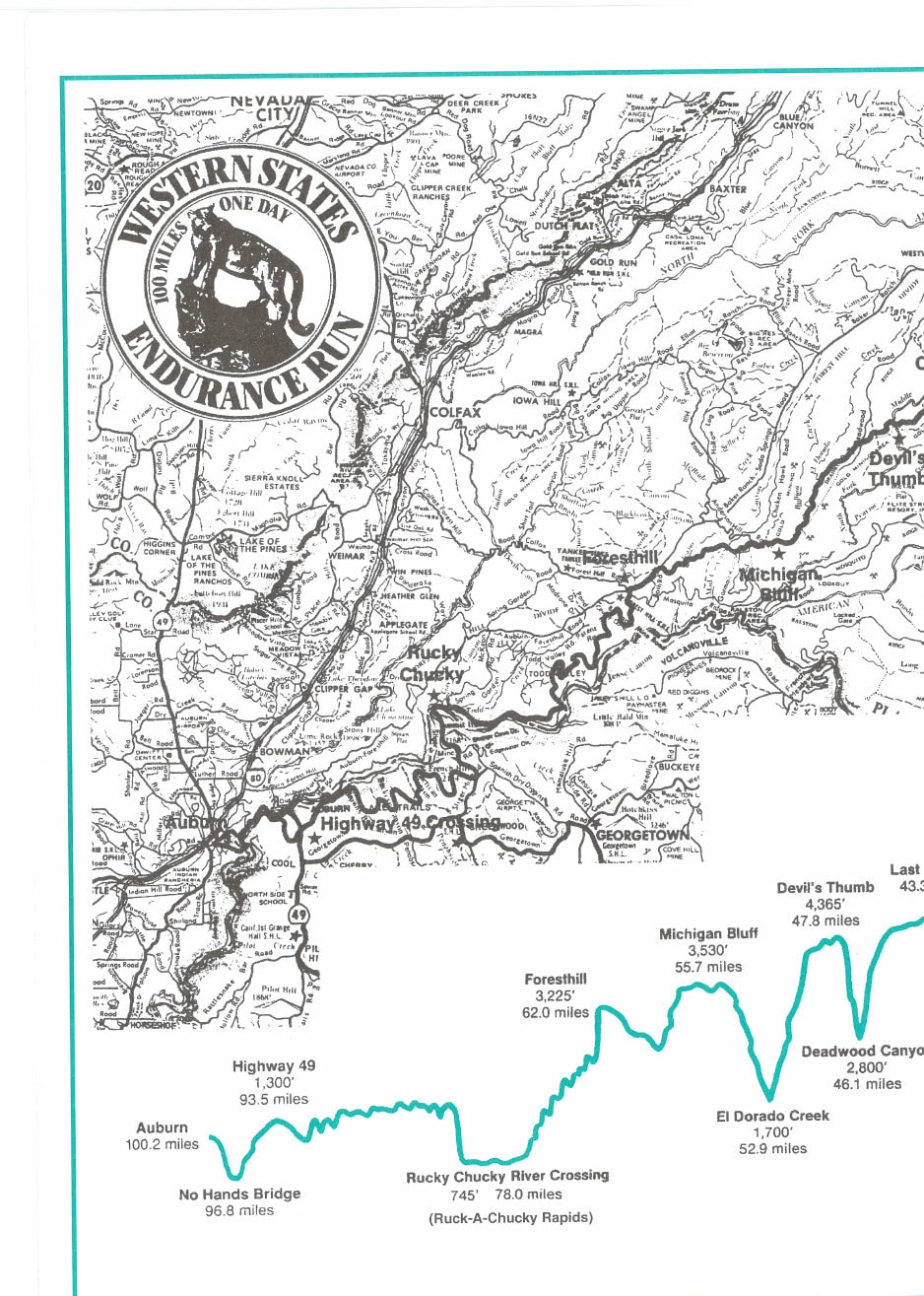
Memorial Day weekend and its annual training events at “Camp Klein” (three days of training on portions of the Western States course) in Foresthill provided the final major preparation. On this weekend, I followed the first two pieces of advice given to me by our founder, Gordy Ainsleigh: instead of doing 25 miles each on Saturday and Sunday, try to go from Robinson Flat to the river (nearly 48 miles) in a one-day effort. Gordy’s advice was impossible to carry out in 1995, because Robinson Flat remained under 12 feet of snow, so our official training route was out and back from Foresthill to Devil’s Thumb (14+ miles each way).
Instead of confining myself to four descents and four ascents of Volcano and El Dorado Canyons, I pushed on beyond the organized distance to Last Chance and Dusty Corners, adding the toughest North Fork Canyon to produce six ascents and six descents, which got me closer to the 48-mile distance on the toughest segment of the Western States Trail. The following weekend I went out from Foresthill to Michigan Bluff, back to the river crossing, and up to Driver’s Flat (33 miles). When I finished only five minutes behind Western
States veteran Errol “Rocket” Jones on this piece, I finally began to feel prepared.
My last training run came the morning of the Chinese dinner where I opened the fortune cookie: 330-yard repeats on the Berkeley track, to simulate entering the Placer High stadium with two minutes left on the clock.
ANTICIPATION
Knowing that the 1995 race would be my last Western States, I spent a lot of time mentally preparing to accept as final whatever result I obtained. I had DNFed enough at States, even when perfectly prepared physically, to recognize that one great distinction of our race remains the degree to which you cannot control the outcome. Luck and unexplainable factors are at work here, and one has to accept what ostensibly looks like “failure” as something other than failure.
But I also knew that calm confidence in one’s ability to finish forms the first prerequisite to getting there. So I visualized every segment of the race many times over, especially the finish. I knew that even if things went perfectly, I would be arriving at Duncan Canyon almost two hours later than I ever had before; but also that in other years I had seen runners leave Foresthill two hours later than I ever had and still beat the 30-hour clock in Auburn. In sum, I reconstituted the Run’s “official” time profile for the nominal 30-hour finisher to produce a time line that could work for me—not one that would work, because neither I nor anyone else had tested it in the anticipated conditions, but one that had to work if I were to earn a brass buckle.
The day before the race was filled with the usual anxiety, coupled with my responsibilities as president of the Run. My booster shot of confidence came at the weigh-in. Not being one to hit the scales regularly, I was stunned to record 170 pounds in full gear, lower by 5 pounds than in any of my previous 10 Western States starts.
At the afternoon briefing, the board of trustees surprised me with a “small cougar” award for service to the race. I could have thought, “Well, at least I got one piece of hardware,” but I didn’t. My focus remained on securing the second.
EXECUTION
Despite my focussed preparations, in one important respect, raceday would bring a totally new experience: actually running through 22 miles of snow, and running for the first time that year at altitudes above 4,000 feet.
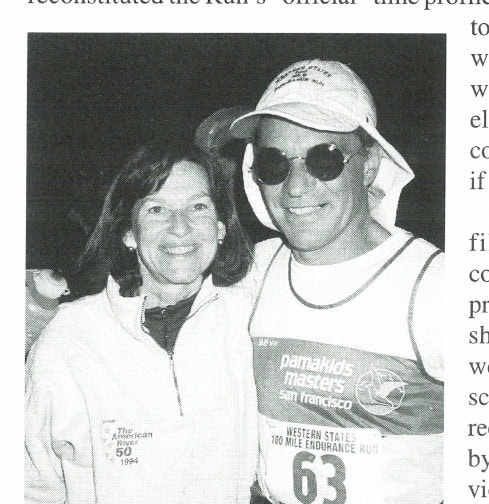
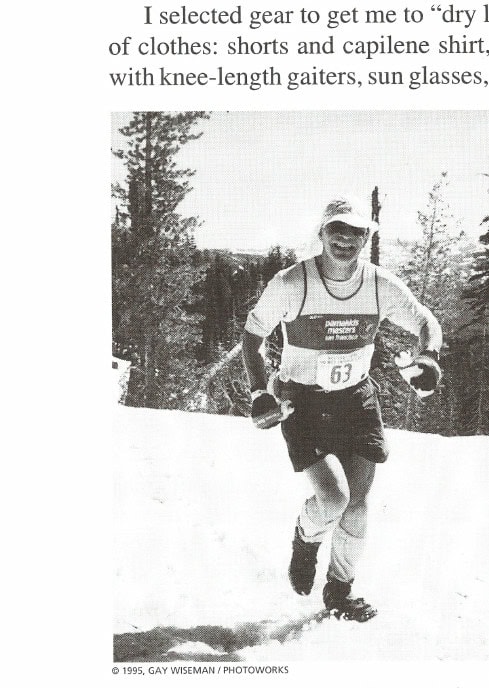
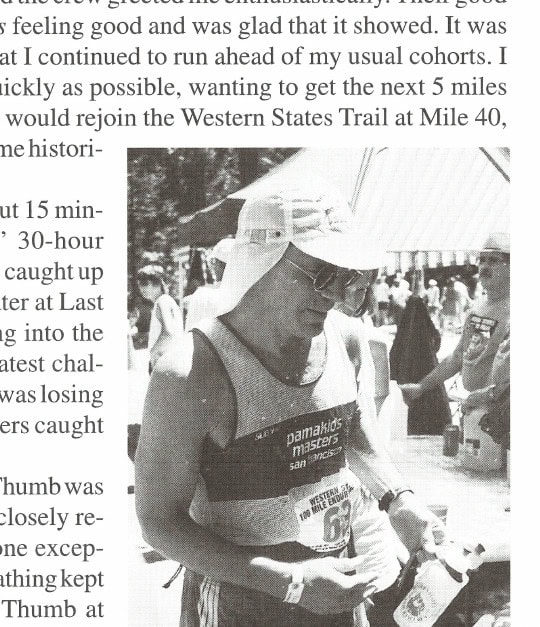
I selected gear to get me to “dry land” at Duncan Canyon with no change of clothes: shorts and capilene shirt, knee-length wool-blend socks covered with knee-length gaiters, sun glasses, floppy hat, and the heaviest trail running shoes possible. (I had considered soccer shoes for the snow section, rejected the idea as untested and potentially painful on any bare spots along the way, but later learned the Tarahumara Indians had successfully made this choice.) In my starting line photos I look like a cross between Lawrence of Arabia and Admiral Peary.
Bob Lind’s shotgun blast precisely timed at 5:00 A.M. (in his words) to “Greenwich Mean Time” at once released the months of anxiety and preparation in the 376 of us. Our long column hit the snow soon enough, and the novelty of the challenge to climb three miles through it made for good spirits all around.
I crested Emigrant Pass, with the monument many feet of snow beneath me, about 15 minutes later than my normal 1:10 for this initial segment and resolved to make no more glances at the watch until Duncan Canyon.
Once across the top at 8,800 feet, the first real test began, for up to now nothing resembling “running” had occurred. Two encouraging feelings set in in the first several hundred yards downslope: I was not feeling the altitude, and the snow was near perfect for running, soft enough to give reasonable traction, but hard enough to support my weight. Easier than muddy trails or soccer fields!
The mood for the day was set: enjoy Granite Chief in its white splendor and recognize that the demands of cross-county snow running were offset by avoiding the ups and downs of the dirt trail for these five miles of wilderness. The same thoughts prevailed at Red Star Ridge, miles 10 to 20 in the race, where once or twice I forced myself to a complete stop to appreciate the “winter wonderland” of a late June morning and again to celebrate the advantage of snow: some new muscles might be working out, but there would be no tripping over the roots and rocks that usually prevail on this highline ridge. The most indelible vision of the entire 100 miles came at about 13 miles, where the trail ahead crested an overhanging snow cornice, and the runners ascending it seemed like mountaineers on the west ridge of Everest.
My choice of gear proved sound. I never felt chilly on the initial ascent, but even as morning matured into midday, the snow underneath kept me from feeling hot. The only overkill was the knee-top socks and leggings; never once did I fall down or through the snow, but of course I had no way of knowing at the outset that we’d be blessed with a solid if slippery running surface.
TO DUNCAN CANYON
At last, with no knowledge of but a good sense about the time (my trail companions here were those who consistently finish ahead of me), we began our descent through the cedar and pine forest that signaled the approach to Duncan Canyon. The trail did not relinquish its snow cover until we were nearly out of the pines and into the manzanita at 6,000 feet. Before the Duncan Canyon checkpoint, one mile of actual trail running required me to master a new technique: running on a non-snow surface!
I collected my drop bag and sat down to shed the snow gear. I felt I had now earned the “right” to check my watch: it was 11:45 A.M.—15 minutes ahead of my target time of high noon! My spirits were lifted at having crossed the first of the day’s three Rubicons. No crew was here to help me, and just as well. I treated myself to 15 minutes to make the change, to be sure my feet were dry, and to eat a varied lunch.
The next 10 miles would be uncharacteristic pavement—the Mosquito Ridge Road to which we were forced to relocate the course because of inaccessibility to Robinson Flat and the dangerously-swollen Duncan Creek crossing.
But don’t think this was a piece of cake! For starters, not more than 100 yards onto the road, my efforts to continue “snow running” landed me on my butt twice, producing a juicy bruise. Fortunately, the fall woke me up for the
long stretch ahead, where elevation and temperature both climbed steadily.
When I arrived at 2:20 P.M. in the makeshift aid station at the forest-road intersection that substituted for Robinson Flat (my usual time into Robinson Flat is about noon), Kathy and the crew greeted me enthusiastically. Their good cheer built confidence. I was feeling good and was glad that it showed. It was also a confidence booster that I continued to run ahead of my usual cohorts. I was out of “N33/N44” as quickly as possible, wanting to get the next 5 miles to Dusty Corners, where we would rejoin the Western States Trail at Mile 40, and cutoff times would become historically accurate.
My arrival there was about 15 minutes behind the “nominal” 30-hour finisher’s time, and I quickly caught up to that benchmark 3 miles later at Last Chance. But then descending into the first canyon, I faced the greatest challenge of the day: in the heat I was losing steam and enthusiasm as others caught up to me.
The climb out of Devil’s Thumb was a death march, one that too closely resembled prior DNFs, with one exception. This time controlled breathing kept me intact. I arrived at The Thumb at 5:40 P.M., and Linda Moise’s traditional soup went to work as the 30-hour cutoff time arrived 10 minutes later. Even though 30 runners had passed me since Last Chance, I didn’t panic. I was feeling miserable but confident.
At this point the will to finish took over. I couldn’t afford a comfortable recovery and just had to pull myself together and start walking. My only counselor was myself. No crew here, and Linda Moise and her crew had others to take care of. At exactly 6:00 P.M. I pulled myself out of the chair and told myself that for my final Western States, this was my personal “Last Chance.”
Running with a V8
I didn’t know it then, but at that very moment I had crossed the second Rubicon. I was able to jog Deadwood Ridge, and then pick up the pace into El Dorado Canyon. My legs turned over their rebellious duties to my stomach, but at the bottom of the canyon Gordy Ainsleigh’s second piece of advice became relevant: When you can’t stomach any more high-tech energy bars or fluids, it’s time for a can of V8. Two small cans of that potion worked their magic, and despite the lengthening shadows of very late afternoon, I climbed resolutely toward Michigan Bluff.
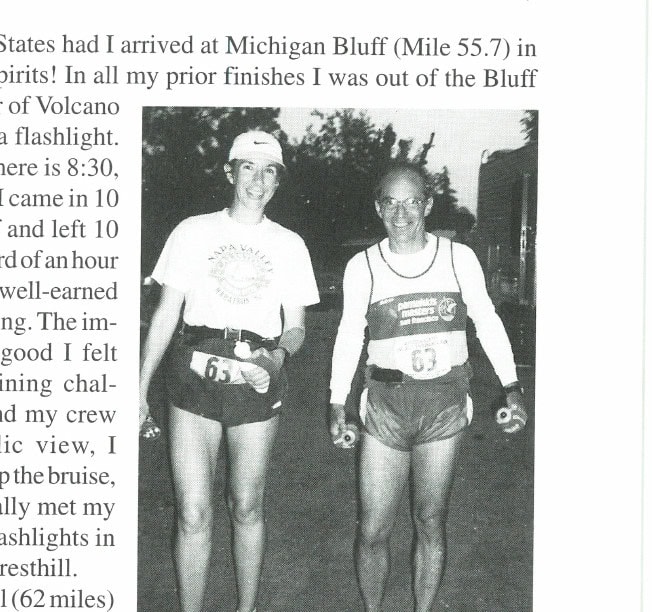
Never in 11 Western States had I arrived at Michigan Bluff (Mile 55.7) in near dark in such good spirits! In all my prior finishes I was out of the Bluff before 8:00 P.M. and clear of Volcano Canyon before I needed a flashlight. The 30-hour benchmark here is 8:30, and as at Devil’s Thumb, I came in 10 minutes before the cutoff and left 10 minutes after. That one-third of an hour with the crew was a luxury well-earned and an investment in healing. The important factor was how good I felt about running the remaining challenge. So while Kathy and my crew shielded me from public view, I changed clothes, cleaned up the bruise, and most importantly finally met my pacer, Celeste Langan. Flashlights in hand, we moved on to Foresthill.
We arrived in Foresthill (62 miles) two minutes ahead of the 10:30 P.M. 30-hour benchmark, and 2 hours later than I usually like to get there. That meant no room for error or delay for the next 38 miles, including the most remote and challenging 16 miles to the river. Here the experience of my prior DNFs paid off. After dropping out in past years, I had seen spirited runners leave Foresthill after 11:00 P.M. and still make it to the finish in time. As that hour approached, feeling that spirit within erased my doubts. Tonight Foresthill would not be our “wall.”
Celeste teaches English literature at Berkeley, and since I lecture at the law school there, we filled the first miles of the “California Street Trail” poking fun at university politics. Since Celeste was coming up for tenure, to her this matter was not entirely light stuff, but her companionship took my mind off the usual drudgery of this loneliest segment of the race. By the time we got to the Peachstone aid station eight miles later, 10 minutes ahead of the 1:10 A.M. cutoff, I knew we had crossed our last Rubicon. Elliott Eisenbud’s famed tomato soup provided the fuel, and we picked up the pace into the canyon. Enough Rubicons, already! We crossed our first real river—the American—a full hour before the 4:30 A.M. cutoff, for the first time in 78 miles assured of the finish.
We toughed out the 15 miles to Highway 49, losing a little ground but arriving in the warmth of a new day at 8:00 A.M., half an hour ahead of the cutoff. With Kathy waiting to pace me the remaining seven miles to the finish, the celebration began. Fred Hornbruch and Dot Helling, who had faithfully accompanied Kathy all day and night, pulled the Suburban right up to the highway crossing so they could blare the World Cup music, “Bound for Glory Land,” at me as I crossed.
In the last descent to the river through Pointed Rocks, I usually tear down the slope, leaving pacers behind. This time Kathy had no trouble keeping up with me, evidence that I had really given my all with nothing to spare in the first 95 miles.
We relished those final miles together, and we shared Dale Boothby’s greetings at No Hands Bridge and (ascending the last climb) the manifestations of Auburn’s hottest day. Coming off the trail at Robie Point, I felt as sleek and determined as our symbolic cougar. With the morning clock now at 10:20, I enjoyed the luxury of drenching myself with water before hitting the pavement.
The final lap on the cinder track at Placer High School became the dream realized. Hand-in-hand with Kathy, I wanted to run as fast as I could but really in slow motion, to the strains of “Lohengrin,” so the moment would last forever. In truth, we did run fast to get the job done. We approached the finish as the clock turned to 29 hours, 34 minutes, the goal obtained in style and substance. My worst finish at Western States had become my best.
Only Norm Klein could bring me back to earth so quickly with his straight-faced greeting: “What took you so long?”
Celebration
“Gentlemen abed in England shall hold themselves accursed they were not here.” But like Henry V, I will also never forget those who were—Kathy, Norm, Celeste, Fred Hornbruch and Kathi Gwynn, Dot Helling, Mo and Nori Livermore, Walt and Ruth Ann Bortz, Bob Lind, and the other Western States trustees. For those yet to taste it, there are few elixirs in life as precious as the relaxed exhilaration in the stadium infield 100 miles after the start. Of my six such moments, and others in Leadville and Vermont, none tasted as sweet as this one.
We didn’t have much time to drink from that cup, as I had to get cleaned up and shortly call to the awards stand the names of the 36 sub-24-hour buckle winners and the 134 sub-30-hour finishers, plus the 28 other finishers recorded under 32 hours. Presenting these awards were the first sub-30-hour finishers recorded at Western States, in 1977—Ralph Paffenbarger and Peter Mattei. Never had the task of calling the finishers’ names (except for my own, which I deferred to Norm, who instead called his own as a joke) been so joyful; never had the privilege of receiving the buckle from other than Peter and Ralph been higher.
But even then our duties were not done. The next day, Monday, June 26, marked the 50th anniversary of the U.N. Charter’s signing at the San Francisco Opera House, and Kathy and I were instructed to be present at 8:30 A.M. to clear security.
We arrived home in Oakland shortly before 1:00 A.M. and were up five hours later. We did not fall asleep during President Clinton’s address or while hosting the Canadian and Cambodian U.N. ambassadors at lunch. (Fortunately, the Canadian ambassador turned out to be an expert whitewater kayaker and appreciative of a shiny new Western States buckle on my dark blue business suit.)
Finally, at about 4:00 P.M., 60 hours after waking up for the Squaw Valley start, Kathy and I could completely relax, deeply snoozing on the BART train ride home but not before acknowledging that those 60 hours and the day before would not and need not be matched in our lifetimes.
Epilogue
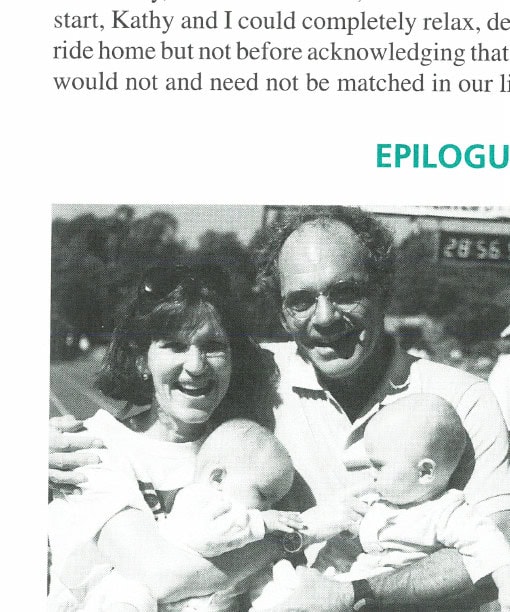
Several weeks after the 1995 Western States, Celeste Langan received tenure at U.C. Berkeley. At the 1996 Western States, Kathy was five months pregnant with our expected twins. At the 1997 Western States, Molly and Alice (with their parents) hiked to the top of Emigrant Pass for the first time. Dreams, even the most fantastic, do come true!
Prepare for Anticipated Conditions
To prepare for snow conditions, cross-train in sports that build lateral balance (such as skiing and soccer) and welcome the opportunity at sea level to run muddy trails.
Speed Counts
Even for trail 100-milers, speedwork can translate to better performances. The 440 and one-mile repeats will help get you out of the canyons intact.
Cut Back on Alcohol
Your college coach was right about alcohol. Laying off will cut 5 to 10 pounds and make the difference in a close race.
Quality over Quantity
When forced to make a choice, quality in training counts for a lot more than quantity. A month before the race, on limited training, better to do a demanding 50- or 60-miler than a pair of 30-milers.
Don’t Hesitate to Train Solo
If forced to train on your own, be creative and have confidence in your plan. For the 1988 Western States, our first Japanese finisher prepared by repeating 40 urban miles from home to his University of Tokyo laboratory! Home to the Lafayette BART station worked for me in 1995.
Learn from Others
Observe the successes of others in your peer group. In past years seeing runners leave Foresthill at 11:00 P.M. and still finish convinced me I could do it, too.
Prepare Mentally for Change
Invest as heavily in preparing mentally to make the race your last, as we all do in preparing to make a race our first. With peace of mind, move on joyfully to the next challenge in life.
Dream the Dream
With preparation, healthy anticipation, and good fortune, even in this cynical and prosaic age, dreams still come true—even your most fantastic ones!
This article originally appeared in Marathon & Beyond, Vol. 2, No. 3 (1998).
← Browse the full M&B ArchiveMore like this
1,000+ stories from 19 years of Marathon & Beyond
The complete archive of the legendary long-distance journal — digitized and free to read.
