

New York 2001
WHEN MY running buddy Gif Thornton’s fourth child arrived, he and his wife decided he would not run New York in 2001. I also decided to defer for a year. Then came September 11.
That morning a friend told me to turn on the television, and I watched as the second jetliner crashed into the World Trade Center. Like millions around the world, I was stunned. With three young sons, my wife and I strictly limit television time. But on September 11 and for several days following, the television stayed on almost constantly.
Like many, I thought the New York City Marathon might be canceled. But when plans for the marathon went forward, I felt I had to go. As much as the terrorists’ acts and the media coverage had affected my children, shouldn’t I show our sons we were not giving in to the terrorists or to our own fears?
THE DAY BEFORE
The day before the race, my 11-year-old son Rick and I go to the race expo at the Jacob Javits Convention Center to pick up my number, chip, and race packet. The very location reminds us of September 11 since Pier 94, where the expo was previously scheduled, now served as a temporary morgue.
Security requirements include a photo ID just to get into the expo. I pick up my number, my chip, and my race packet. But just as importantly and more ominously, each of us is given a special bag for race-day gear. The bags are clear so that police and security personnel can easily examine the contents.
After the expo, Rick wants to visit chess shops he has read about in A Kid’s Guide to New York City. We go to Greenwich Village where he finds the Chess Forum, then the Village Chess Shop Ltd. We sit down and battle to several draws.
Afterwards, at nearby Washington Square, Rick spots a touch football game, and soon he is more than happy. I decline an invitation to play, explaining that in not too many hours I will be running a marathon and I need to rest.
RACE MORNING
Early on race morning, I kiss Rick and leave him asleep at our friends’ Manhattan apartment. Matt and Lisa Wiltshire will come with Rick to the race. I walk over to catch one of the buses to travel down to Staten Island. An army of us wait in line, yet I encounter a marathoner friend from Tennessee. Jane Alvis and I have worked together at the Tennessee Legislature in some interesting times, but we agree that neither of us has experienced anything similar to New York City post–September 11. Everyone is anxious, not only about the race, but about security. The tension is not lessened when some guy tries to get on the bus with an equipment bag that is anything but clear. Worse yet, when he opens the bag for security, he has several opaque plastic bottles. They look like water bottles, but there are more of them than any marathoner would need. Police wearing bulletproof vests are all over him.
The bus finally departs, and we roll through a Manhattan that is enjoying a beautiful day; the city appears peaceful.
We finally cross the bridge onto the island. I worked in New York City one summer in Hell’s Kitchen, but I never made it to Staten Island. The buses are backed up, so we creep forward and sit, over and over. Finally, we are allowed off the bus. We go past more security and eventually join thousands of other runners.
I find the worship service in a tent, but it is almost over by the time I arrive. I sit on the grass in the back to stretch and rest, and worship privately. I recall that line about there being no atheists in foxholes. Today it seems appropriate.
9:48 A.M. An hour before the race is to begin. I find water and orange juice. I even find where those of us who are designated “green” are supposed to line up. A garbage bag holds in some body heat. My friend Sergeant Major Homer Irvin showed me the garbage bag trick before my first marathon in Chicago. He had run with me for years until finally he made a marathoner out of me. Just thinking about Homer makes me smile.
I lie on my back on some grass and look up at the beautiful blue sky. The temperature, I’m told, is mid-50s. It will be warm during the race, maybe even hot. As I gaze upward, I look at the top of the suspension bridge. Eventually I realize the little specks on top of the bridge tower are three people. They are wearing dark blue. Police sharpshooters.
THE MAYOR VISITS STATEN ISLAND
The public address announcer tells us Mayor Giuliani flew to Arizona yesterday for the World Series game between the Diamondbacks and the Yankees, then came back in the wee hours this morning to be with us. I wonder whether, in the wake of the Yankees’ 15-2 defeat, the team ran the mayor off.
9:50 A.M. I hear applause, wonder what is going on, then see the wheelchair athletes starting up the bridge. I join in the applause.
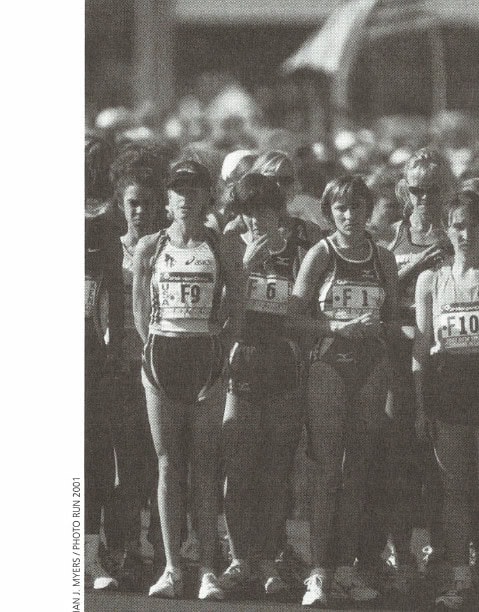
One loudspeaker announcer is urging us to go to the stage to see the mayor and another is saying to go to our places to line up for the race. About 10:00 A.M., a woman begins to sing “America the Beautiful.” Many, perhaps most of us, rise and stand in respect.
I have not seen so many American flags since the Democratic National Convention a little over a year earlier. And I’ve never seen so many variations of the flag worn in so many ways.
Like hundreds or thousands, I had accepted a red, white, and blue nasal strip to show the colors.
Mayor Giuliani is announced and there is the loudest applause of the morning, even more than for “America the Beautiful.”
I lie on my back again, watching two helicopters circle and jets fly over. The sunshine feels wonderful.
Music is playing on the loudspeakers at the bridge while the mayor tries to speak over the loudspeakers at the PowerBar stage. I cannot understand much of what he is saying. Besides the other distractions, the helicopters are adding to the cacophony. Perhaps I’ve listened to too many elected officials to listen too carefully.
To save energy, I try not to shake, stretch, or move too much.
The mayor concludes, “God bless all of you, God bless your marathon, and God bless America!”
10:15 A.M. I listen to the recorded music. People are starting to rock to “I Can’t Get Enough of Your Love” by someone who I think sounds like Isaac Hayes. (Later I am told that Barry White recorded the song.)
To my left stands a woman with a flag bandanna over her two braids. She has on blue shorts and blue shirt over a white long-sleeve shirt. The blue shirt says “Carrie,” and she has a flag on it right below her name. It looks very patriotic.
Walking nearby is another woman runner, Lady Liberty, complete with a Statue of Liberty headpiece.
More runners are in more red, white, and blue than you can believe.
Someone walks by sporting a shirt that advocates saving a whale or a seal or some other critter. Many others are dressed less patriotically, at least for the moment, in garbage bags.
10:19 A.M. The theme from Rocky is playing. Then it is abruptly cut off. Maybe they’re afraid it will get us too pumped too soon?
Many runners are standing in the starting chutes. And lots of us are still lying and sitting on the sides of the access road.
Suddenly I realize the starting chutes are moving. People are walking up to the bridge. I think seriously about continuing to lie there, but I do not want to get too far in the back and have to struggle through too many people. I join the masses moving up the hill and onto the access ramp to the bridge.
A HIKE TO THE START
When we stop, I am a long way from the starting line. To my right are Leah and Emma Katznelson and Josh Ingals. Leah and Emma are twins and Josh is Leah’s boyfriend. Emma is a first-time marathoner. The twins are students at Columbia, one in architecture, the other in sociology. Leah’s boyfriend manages two restaurants that serve Asian food. Someone mentions how hard it is to find time to run. I promise to send them copies of my M&B story, “Time to Run,” which ran in the September/October 2001 issue.
Someone sings “The Star-Spangled Banner.” Many of us join in. Then Danny Rodriguez of the New York Police Department sings “God Bless America.”
Four helicopters are circling. No. Make that six. White doves released behind us swirl up and away.
Suddenly a cannon goes off and we start slowly trying to walk forward, listening to loudspeakers blaring “New York, New York.”
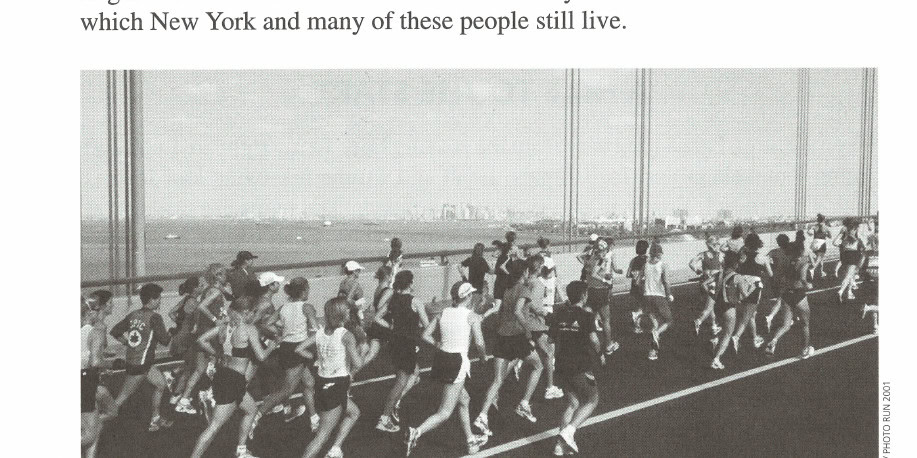
Five minutes after crossing the starting line, I’m on the bridge but underneath with another span on top. If I recall correctly from photos from past years, the top span has both sides filled with runners. Our lower level has the north side full of three lanes of runners, while the other side is reserved for the very few race-related vehicles.
The twins pass me, weaving their way through the crowd, the veteran sister reaching back, her fingers intertwined with the fingers of her rookie sister. This twin thing is so extraordinary. I think about my own twin boys and their brother who is four years younger but who would very much like to be their triplet.
To the left toward Manhattan, a Coast Guard ship protects us. A fireboat shoots water high into the blue sky with a beautiful rainbow spreading out south of it. There are at least six different strands of water, one red and one blue and the others white, all coming out of the white and red boat. I’ve never seen anything like it.
I run beside Rob; he’s carrying an American flag. When I point to the boat spouting red, white, and blue water, Rob says, “It’s beautiful. It’s the same every year.” Pause, then he adds, “But I miss our two buildings. That’s not the same this year.”
We look out over the fireboat at the southern edge of Manhattan where the Twin Towers stand no more. I don’t know what to say, so I just run silently and try not to cry.
Under the bridge, we are in shadow, but everywhere else around us sunshine reigns. The shadows in which we run seem symbolic of the shadow under which New York and many of these people still live.
Fifteen minutes into the run we come off the far side of the bridge. After the first mile, I was a little over a minute off my goal pace measured by the chip and two minutes slow by the clock. I’m further off now. The crowd’s too thick and I’m too far back to run any faster.
I am passed by a fellow with Peru on his shirt, then by a guy with Argentina on his.
I’m discovering that the case I have hooked to my shorts for carrying my tape recorder might not survive the marathon. It is tending to pull and tug at my shorts.
Many runners are standing along the edge of the bridge, dehydrating over the side.
Past two miles. Forty-five seconds to a minute off goal pace.
AN INTERNATIONAL GATHERING
I talk with and then leave behind a fellow originally from Mexico who is now living in France and Britain.
I read the names on the shirts and singlets that sport flags:
- Mike with the Union Jack.
- Carl from Sweden.
- Another fellow from Mexico.
- Santiago runners.
Off the bridges and now we can see some serious crowds. Near 78th Street, the first water station. I run to the far end of the line of tables, hoping to avoid the crush. I grab two cups and walk long enough to dump them into my mouth.
Spectators are out in wheelchairs. Babies are covered with Italian flags and American flags. In front of Bayridge United Church stands the choir in their bright robes. They are looking and sounding good.
I check my time at 5K Green. About 25 minutes. So many people, so hard to move ahead, so I just flow with the masses.
At the Lutheran Church of the Good Shepherd, our green-coded group merges into another group of runners. A virtual sea of runners.
And now the crowds are really thick and loud.
I’m behind a guy in a red shirt with an American flag and the white letters “Dakota Beef Builds a Better Body.” Looks like it works for him. I start to tell him about the beef cattle on our farm, but someone gets between us. On my left a little young woman races past in a “Skip Barber Racing School” shirt.
On my right some guy suddenly stops running and swerves out of our crowd. He grabs and hugs a woman in a choir robe at the Fourth Avenue Presbyterian Church. She is laughing so loudly I can hear her over the crowd.
A lot of music at the Tiger Mart.
In front of the “Italian Eatery” are bagpipers with snare drums accompanying. I wonder what my friends in Scotland would say about bagpipers hanging out at Italian restaurants.
About 58th Street, I slowly realize we are in a predominantly Hispanic-looking community. For the most part, the crowd is quieter, but there are still lots of people watching us flow by. I feel as though I’m in a boat on a river watching the people standing on the banks.
Kids are holding out their hands to be slapped. Lots and lots of kids are doing that. I slap some, trying to get the hands others in front of me miss.
There are lots of American flags. Some fellow running to my right is shouting in Spanish about Mexico (pronounced Me-he-ko) to the crowd in hopes of drawing cheers. He gets a few.
Just before 53rd Street, a spectator is pointing toward a subway stop and looking down, like we could duck onto the subway. It looks like a brilliant idea, but I’m already past him before I quite catch on. “Who was that woman who cheated to ‘win’ at Boston?” I try to recall. “Rosie something?”
At 51st Street, some guy calls out the countries of the runners. In the seconds I run past him I hear him say:
- “Jamaica.”
- “Great Britain.”
- “Me-he-ko.”
STILL BEHIND THE CURVE FOR BOSTON
Near 41st Street, I find the five-mile marker. I am two minutes, seven seconds off Boston qualifying pace. The crowd ahead is so thick that there is no way to pick up speed without weaving like the Roadrunner cartoon character. I decide to lay back and flow with it. “Forget qualifying,” I think. “And save it for next month at Rocket City in Huntsville.” I plan to help a running buddy qualify for Boston at that race any way.
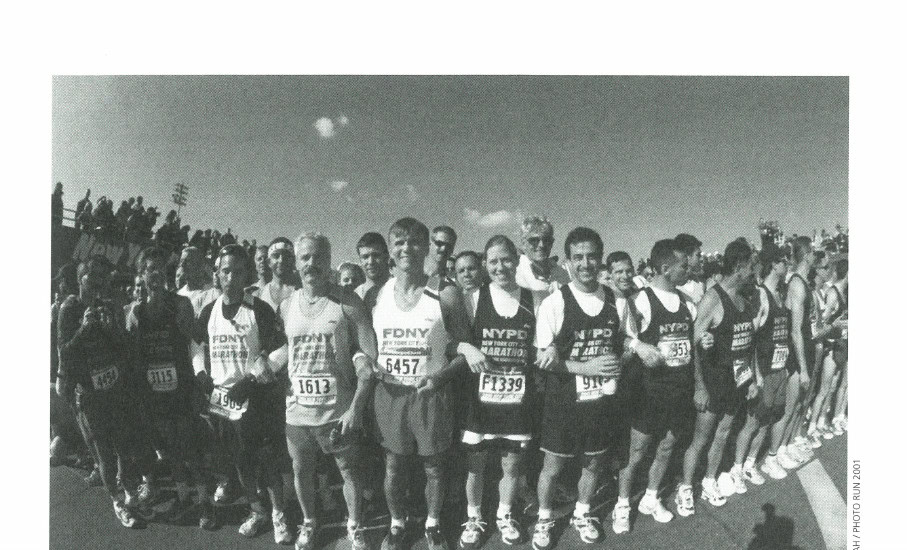
A runner has a firefighter’s photo silk-screened on the back of his singlet.
I pull up behind a woman named Gia Boulous whose white letters on a red shirt read: “This run for George Cain, FDNY, Ladder 7, gave his life 9 11 01.” I ask Gia about George Cain, and she explains that his father lived next door to her and the Cains used to spend holidays with Gia and her family.
Gia says Cain’s father was a firefighter for 31 years. After his son went to Colorado, he tried to get his son to stay there and not come back and be a firefighter. The father sat the son down and told him all the horror stories. But George Cain said, “Dad, I’m going to do it your way.” And he came back and worked as a firefighter.
Recently, George Cain and his girlfriend bought a house in Colorado, and they were going to move out there soon. But on September 11, when Cain finished working the night before, his boss asked if he wanted some overtime. George Cain responded: “Sure. Where the heck do I have to go?”
The last they heard from him, Gia says, Cain and his team were on the 26th floor of the World Trade Center.
Gia explains that George had run this marathon for the first time two years ago, then ran it again last year, and he was going to run it again this year. He had already registered.
We run together in silence, then I thank Gia, and finally I move on.
At mile eight, all runners merge for the first time since the cannon went off at the start. We create another still larger sea of bobbing heads.
At an intersection, to my right in the cross street, firefighters stand and sit on a fire truck. They have erected a tie-dyed bedsheet bearing these words:
- We will
- never forget
- our brothers.
Somewhere after mile eight or nine, a high school band plays what might have been “Rocky’s Theme” but also might not have been. The crowd noise is so loud everything is distorted.
My starting line friend, Josh, comes up and runs beside me. I ask if his girlfriend and her twin sister were ahead or behind us. He laughs that they had better be behind us or else their father would give him a real hard time.
In front of some brownstones, an African American woman is making a huge noise by flailing a spoon against a pot lid.
Shortly past her, another guy with a whistle is blowing it nonstop.
The crowd is unbelievable. I had been told how huge the crowds are, but I am still surprised.
At the water stops, the kids handing us cups have on bright yellow plastic “Asics New York Marathon” raincoats.
RUNNING FOR CAUSES
I come upon a fellow in a purple singlet with “Fred’s Team USA” on the back. At the bottom are the words “Memorial Sloan-Kettering Cancer Center.” A piece of paper pinned to the singlet reads, “I am running for Mark Rosen. Memorial Sloan-Kettering Cancer Center.” That cancer center is where my late uncle practiced medicine.
As I run, I think about following my uncle to New York from the same house where he and I both grew up and from the same university where he went to medical school and I went to law and divinity schools. He has been gone a long time, an oncologist killed by cancer. But I keep remembering him, keep finding traces.
Sitting on apartment steps are three small children. They are black, but I realize I do not know whether they are African Americans. Each of the three has a single drumstick, but they share their drums: two five-gallon plastic containers.
After a water stop, some guy drinking water decides to walk, and I almost run up his back.
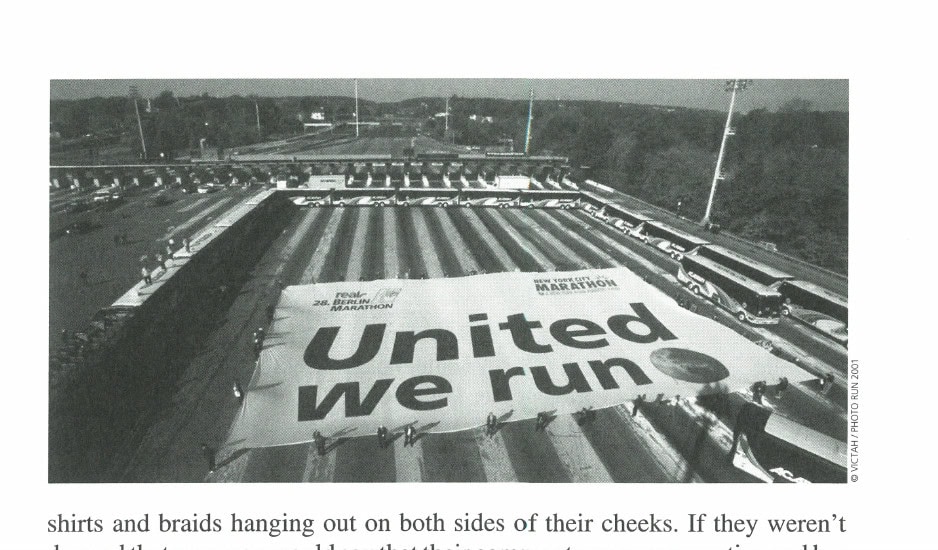
“United We Run” is on shirt after shirt. Sometimes it’s “United We Stand.” More often on the runners, however, it is the race theme, “United We Run.”
An African American gentleman passes me. He has a big “4” on the left of his jersey and then on the right are these words, “Mom, Life, USA.” As in “For Mom, For Life, For USA.” At the bottom of his shirt, again I read, “United We Run.”
Around Pennsylvania and Bedford we pass through a Hassidic community. Now I am behind a woman in white tights with a pink top, pink ballerina skirt, pink wings, pink bug ears, and something pink holding her hair in a ponytail. She gets a lot of stares from the children. The woman in pink has “Lucy” on the front of her outfit. I know because she draws a lot of comments, even, and especially, from a group of guys with black hats and black overcoats and white shirts and braids hanging out on both sides of their cheeks. If they weren’t dressed that way, you would say that their comments were provocative and her name was called almost as a catcall.
People are shouting at us, depending on what they see on our shirts:
“Go USA!”
“Vive La France!”
Near Fourth Street and Bedford, an Italian flag, a Mexican flag, and a bagpiper are all together on a corner.
A sign over the front of a law office reads something like, “Maluski, Maluski & Boccio.” Not a typical law firm name in my hometown.
Around mile 13 we start up Pulaski Bridge to cross to Manhattan. Good crowd. It is quite something to see a bridge on one side totally filled with people.
ELVIS HAS ENTERED THE RACE
I keep hearing people yell for Elvis. Finally I spot him as he has moved slightly ahead of me. He is wearing a white stole and white pants with flared legs, and he is looking good. I laugh out loud as I recall running the Memphis Marathon and thanking cheering spectators in my deepest voice, “Thank you. Thank you very much.” The Memphians all knew whom I was trying to sound like and invariably they would laugh. Apparently many New Yorkers also know the King.
On the far side of the bridge but still on it, I come up behind a young woman in a white shirt with these words in black on the back: “More than a conqueror through Christ.” As I come beside her, I say, “More than a conqueror . . . ” She responds, “. . . through Christ.” I ask and she says she’s from New Jersey. I say I’m from Tennessee. Before I move on, I say to her, “Blessings.”
“God bless you, too,” she says.
Between 4th Avenue and 21st Street, a little boy of about two sits on his father’s shoulders. Each hand grasps an American flag. The red, white, and blue flies just above his dad’s ears.
I come upon a woman from a French jogging school or tour group. None of her teammates or classmates are near her. At my request, she tells me where she is from and I tell her I’m from Tennessee. She seems to recognize the state’s name but little more.
We pass a hard rock band, then taped music of “The Battle Hymn of the Republic” with its “Glory! Glory! Hallelujah!” That’s followed by a band playing marimbas and various other Latin beats.
About mile 14 or a little past, someone who has run up beside me calls my name. It’s my friend Joe Kennedy from Franklin, Tennessee. I haven’t seen him in months since we ran long together in his home county. What a pleasant surprise. We talk nonstop, catching up with each other.
We cross the bridge and have an incredible view from underneath. Once we are over the bridge, the crowd in Manhattan is phenomenal.
As we move up First Avenue, the crowd becomes simply amazing.
Joe hears someone yelling, “Roy!” I turn to the left and look all the way across First Avenue. My son Rick sits on Matt Wiltshire’s shoulders holding a patriotically painted sign that says simply, “Roy.” I wave and wave. As I run on, I remember Fourth of July celebrations at Matt’s family’s farm when I carried Matt and his sister, Carrie, on my shoulders. Now he’s an Ivy League grad doing investment banking and things financial well beyond my reckoning.
At about 118th and 1st Avenue at Oliver’s Dog and Cat Clinic is another Latin-sounding band.
Joe asks whether I knew a fellow who ran in Nashville who recently collapsed and died. I did not know the gentleman. Even so, I question Joe’s timing of bringing that to my attention. Is he warning me based on what I look like after 17 or 18 miles?
THE FINISH
Over a bridge and into the Bronx. I think. Joe is opening a bit of a lead on the hill. On the flat at the top of the hill, I decide to try to catch him.
Somewhere around mile 20 or 21, Joe and I hear through a loudspeaker that there is a new New York City Marathon course record. Neither of us gets the name or nationality of the new record holder. (Actually, by this time there are new records for both men and women.)
On a downhill I catch Joe. He is nice enough to let me pull on his coattails.
I hear the old song “Wooly Bully.”
In Harlem I hear what I call blues and Motown sounds. One song is “Ain’t No Stopping Us Now!” I hope that is right. And I know it is, though I have slowed and Joe has gone ahead.
Meagen from New Zealand and I pass and re-pass each other.
We run down beside Central Park. The sun breaks through the trees in spots, yet much of the time we enjoy shade. I wonder why I am slowing so, particularly since I have taken it pretty easy along the way. “Maybe,” I wonder, “maybe running 26.2 miles is just hard on you, even when you are not racing it.”
We turn into Central Park and I know the end is near. The crowds in the park are awesome and right on top of us. About mile 24 or 25 I hear Matthew and his wife, Lisa, and sister Carrie and my son Rick calling my name again. I look back to my left, and there is Rick in his orange University of Tennessee jacket once again on top of Matthew’s shoulders. I give them a big wave and smile while trying to avoid tripping over anyone.
In the last mile or so I spot a racewalker. I do not know if he has done the flying shuffle the whole way, but if so then he is one fast race-walker. In any event, I use him for motivation. I simply do not want to let some guy walking beat me.
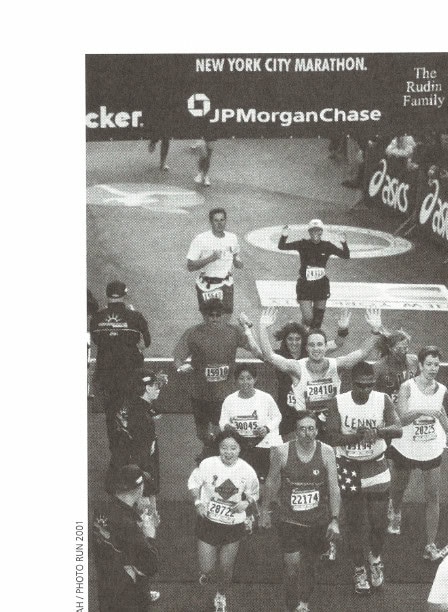
I pick it up and pass him. Then I kick a bit the last half mile, trying to pass some of the hundreds around us, and finish in no more than 3:45, my slowest
of more than a dozen marathons. But the fastest, I rationalize, while trying to dictate a race report.
I kick harder and pass several more runners. And then it is over.
No explosions. No one harmed, so far as I know. People are not acting like anything bad has happened. Still, it is not over yet, I think. But I do not think the terrorists have chosen to take us on this day.
God bless runners, marathoners, New York City, and God bless America. And God bless all the people from all over the world who chose to be New York City marathoners. United We Run.
This article originally appeared in Marathon & Beyond, Vol. 6, No. 5 (2002).
← Browse the full M&B ArchiveMore like this
1,000+ stories from 19 years of Marathon & Beyond
The complete archive of the legendary long-distance journal — digitized and free to read.
