

Not So Bright Onthehtc
Iwas lying on a floor mat in a high school gym in the small Oregon town of St. Helens, trying to get some much-needed shut-eye. At least 100 other people, including my teammates Linda, Dave, Erin, Rayne, Tom, and Francesco, were sleeping nearby. It was remarkably quiet, but every few minutes, the silence was broken by the muted piping of a wrist alarm. A groggy head would arise and murmur to teammates, and another group would gather its sleeping bags and pad into the night, soon to be replaced by the next batch of newcomers.
We were two-thirds of the way through Oregon’s Hood to Coast Relay Race. Even though everyone in the gym had already run nine to 12 miles, the collective adrenaline was almost palpable. In a few more hours, we would be on the beach, having finished a race that generates nearly as much excitement as the Boston or New York City marathons but which is so long that even the winning teams take the better part of a day to complete it. My own team was well ahead of schedule, but we still expected to spend 28 or 29 hours on the course.
The Hood to Coast is the world’s largest relay. Held annually since 1982 in late August, it draws more than 1,000 teams. Even so, slots fill quickly; this year the organizers turned away 700 teams. As the name indicates, the race (lovingly dubbed “HTC” by its fans) begins at the tree line on 11,200-foot Mount Hood and ends on the beach at the coastal community of Seaside. En route, it traverses 197 miles of alpine splendor, oldgrowth forest, and coastal hill country. It also runs directly along Portland’s waterfront and spends 20 miles following the Columbia River to St. Helens and its school gym.
Teams are comprised of 12 runners and two drivers, although in a pinch, runners can serve as their own drivers. To reduce congestion, teams start every 15 minutes in batches of 20 to 25 teams. That spreads the start across an entire day,
with the fastest teams leaving late but finishing first. Each runner does three legs totaling about 16.5 miles; individual segments range from four to eight miles. It’s a concept that easily lends itself to riddles and guessing games. What has 36 legs but only 24 feet? A Hood to Coast team! How many portable toilets are needed for an all-day event with 12,000 runners? If you have the energy to count, you are not running hard enough!
Blood and Guts at the Front At the front of the pack, the HTC is extremely competitive, drawing teams from all over the nation. A few hours after I left St. Helens, the Foot Locker Elite team from Portland would upset the Bucknell University Alumni team (from Pennsylvania), winning by a scant five minutes at an average pace of 5:10 per mile. The winning women’s team, from Princeton, New Jersey, would average 6:21 per mile.
Upsets are an important part of Hood to Coast history. The most famous, in 1986, helped draw the media attention that has converted the race into one of the Pacific Northwest’s most prestigious events. That year, shoe-manufacturer Nike fielded two teams, unimaginatively named Nike A and Nike B. The A team was stacked with the best runners Nike could find; the B team got the also-rans.
Nobody minds being an underdog. But being relegated to the B team felt like being one of the last kids chosen for sandlot baseball, says B-team member Paul Mattson. He and his teammates were determined to prove that they were every bit as deserving as their A-team counterparts. Calling themselves the Killer Bs (because they were going to kill the As), they not only met their goal—they won the race. The following year, they were back, proving that their first win wasn’t a fluke.
For most teams, simply finishing is victory enough. Only one of my teammates had ever completed the HTC before, and most had never run a race of any length. Former marathon great Alberto Salazar, who was on the winning team in 1993, 1994 and 1995, estimates that giving the HTC an all-out effort is roughly comparable to going all out on a half-marathon (13.1 miles). The legs are shorter, but on a fast team, you are running every four or five hours. By the third leg, Salazar says, you are stiff and tired before you start.
Back in the pack, it’s considerably easier. Many people do the HTC on about 20 miles a week of training, at speeds not much faster than their normal training runs. Nobody on my team cared whether I ran 6:30s, 7:30s, 8:30s, or a good deal slower. “The slower you go, the longer we get to rest!” our captain, Erin, said in a tone that was only half-joking.
Even so, as the appointed time neared and Rayne, our leadoff runner, headed for the start, our entire team was energized.
Falling Off Mount Hood Although most HTC newcomers find it hard to believe, Rayne’s leadoff slot is the race’s most challenging assignment. Misguided beginners often expect it to be easy because it drops 2,000 feet in five miles. Rayne, our HTC veteran, knew better. The constant need to put on the brakes beats up the quads and the knees, making leg 1 far more grueling than it sounds. Elite teams either recruit downhill specialists or give leg 1 to sacrificial lambs who trash their legs in exchange for the honor of being on the team. Or the captain just drafts some poor soul, not telling him until an “oh, by the way” team meeting shortly before the race.
Rayne, however, volunteered because she wanted the challenge. Also, the vistas toward the wilderness of peaks south from Mount Hood make this leg one of the more scenic. We cheered and yelled as Rayne’s group moved out of the start, then we piled into our van to stop at pullouts every two miles, applauding not only our own teammate but everyone else’s. Then reality set in: for the next several hours, our job was to make sure that we were ready to rotate runners every 30 to 60 minutes.
Running is a sport dominated by rhythm: the quick cadences of pace, heartbeat, and breathing contrasting with the slow-changing backdrop of scenery. A large relay simply adds new levels of rhythm. First, there is the need to keep the van leapfrogging ahead of the runners. Superimposed on that, however, runners need time to cool down after their legs. But they can’t relax so long that they prevent the van from offering water to the runner currently on the course (water stations aren’t provided by the race officials) or delay the van from reaching the next exchange point in time for the next runner to have a few minutes’ warm-up.
Except when you are running your own leg, the day soon evolves into a long, slow cycle: drive, cheer; drive, cheer; drive, cheer. About the time that you have nearly forgotten why you are doing this, a new rhythm interrupts: the next of five van exchanges.
Teams are assigned to vans in the sequence in which they run. The first six runners are in van 1; the next six are in van 2. That way, every six legs, you get a chance for a longer rest—or even a few hours’ nap in designated sleeping areas such as the St. Helens school. But in the race’s big picture, the van exchanges are simply another layer of rhythm, a second pattern of leapfrogging that periodically supplants the basic rhythm of run, drive, cheer.
The Most Important Team Member Is Our Driver Our driver, Tom, was by far the most-appreciated person in our van. His duties included not only getting the van to the exchange points in time, but also keeping us on course, keeping track of runners’ times on each leg, and supplying us with reflective vests and flashlights for the nighttime legs. When possible, he
John Kaiser
also checked in by cell phone with the other van, and he knew where to go for food, showers, and sleeping-bag space during the three longer breaks when van 2’s runners were on the course. Teams can compete without designated drivers, but a good driver is vital to overall peace of mind.
Prior to race day, I had never met Tom, Rayne, Erin, or any of the others except Linda, who was an old friend and training partner. That is because there are two ways to enter HTC. One is to form a team and register months in advance, before the 1,000 openings have been booked. The other is to post your name on the HTC Web site as someone willing to be a last-minute replacement.
The latter is how Linda and I got into the race. She had started looking for a team about a month in advance, but I had not planned to run. Then, two days before the event, when I had just returned from a hiking vacation in Iceland, she called to tell me that her mixed male/female team had lost another runner and needed a man. “Can you do it?” she asked. “We’ll even be on the same van!”
I had not run for three weeks and had been suffering from sore Achilles tendon maladies off and on all summer. That and the trip to Iceland were why I had originally declined to be part of Linda’s hunt for a team. But Linda is one of those people whose enthusiasm has often lured me into impulsive adventures, and
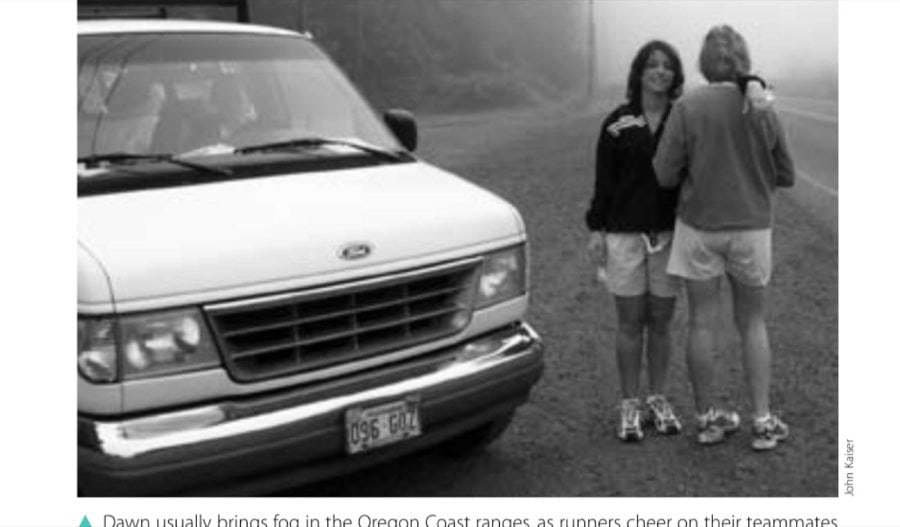
Dawn usually brings fog in the Oregon Coast ranges, as runners cheer on their teammates or supply water along the roadside of each leg.
a three-week change in activities had done wonders for my tendons. Why not? I thought. Exercise and sleep deprivation—the perfect cures for jet lag. Our team was sponsored by Erin’s employer, Bright Wood, Inc., a specialty wood products company from central Oregon. Faced with a stiff entry fee, many teams are corporate sponsored; in addition to paying our fee, Bright Wood also provided team T-shirts.
There is no official competition for the best team name, but the naming of teams has become an important feature in the relay, as has the effort lavished on the decoration of vans. My favorites were the Half-Naked Mole Rats, whose van sported an enormous green tail; the Huffin Puffins; 11 Mad Dogs and an Englishman; the Artful Codgers; the Dead Cheetahs; and Girls with Cookies, who reportedly did enough baking to provide snacks for every HTC participant (I got a snickerdoodle). We were team Not So Bright (But Headed in the Right Direction). But after the first leg, when confusion over a course change from last year sent Rayne on an unnecessary side trip, some wit substituted “wrong” for “right” on the pasteboard sign hanging in our van window.
Everyone Gets Into the Act The Hood to Coast is an event that showcases Oregon and Oregonians at their best. When one team’s van was sideswiped by a drunk driver (thankfully, resulting in no injuries), a passing motorist recognized the team’s plight and filled in as shuttle driver. Nearby homeowners swept away broken glass, produced duct tape and heavy-duty plastic, and patched up the van’s broken window. Thanks to all of these good Samaritans, the team finished the race.
Hood to Coast’s biggest problem is van congestion on the last third of the course. Shortly after St. Helens High School, the course leaves the main roads and dives into the Coast Ranges via winding two-lanes that thread forest and hayfield.
For the runners, it’s a delightful section, passing at dawn through the aptly named towns of Jewel and Mist. For the van drivers, it’s not so idyllic; the road wasn’t made to handle this kind of traffic, and parking areas at the exchange points are lumpy pastures where traffic flow has to be carefully regulated to prevent enormous traffic jams.
But the same community spirit that helped get the sideswiped van back onto the course is at work here, too. Although HTC is a large-budget event with a well-paid professional staff, it couldn’t be conducted without thousands of volunteers. In fact, every team with a member residing within 50 miles of Portland is required to provide three.
These volunteers, however, weren’t at work simply because they had been drafted by friends or family. Even those who had to drive two hours into the countryside to direct traffic at 2:00 a.m. worked with gusto that always gave us a boost, even 24 hours into the race.
Eventually, we reached the last van exchange. Although we all knew it was the final leg, the end still took me by surprise. Suddenly, there were no more exchanges, no more of the drive-cheer, drivecheer, drive-cheer rhythm that had sustained us for 24 hours. Van 2 was still on the course, but we were done. Earlier, when Rayne had completed her third leg, she had been relieved. The big downgrade at the start had taken its toll, and she was more than ready to be done. “It feels so great to be finished!” she said with a high five to the rest of us. Her grin turned mischievous: “Of course, you guys aren’t there yet, are you?”
The Last Mile Went On Forever Linda, who ran the leg after mine and who chases all other runners with great determination, was equally happy when she finished. “That last leg was sooooo long,” she exclaimed. “I picked up the pace when I thought I had one mile to go, only it was longer than that, and there was this guy I wanted to beat, and this hill went on and on and on.”
My experience had been different. Not having trained for three weeks and concerned about not getting reinjured, I had run very conservatively. The last leg, on a quiet road at 7:00 a.m., had been nearly ethereal, and I would have happily run several miles farther. (Linda had felt the same on her second leg, running at night on a wide road shoulder with stars spangling the heavens above her.)
Soon, though, I began to feel the cumulative impact of 16.5 miles as my quads stiffened with the first signs of what would become a glorious set of sore muscles. That evening in Seaside, it immediately would be obvious who were the drivers and who were the runners or spectators. The runners were those who, when faced with a flight of stairs, tried to figure out ways to go down without bending their knees. Nonrunners were those who stood nearby and grinned.
John Kaiser
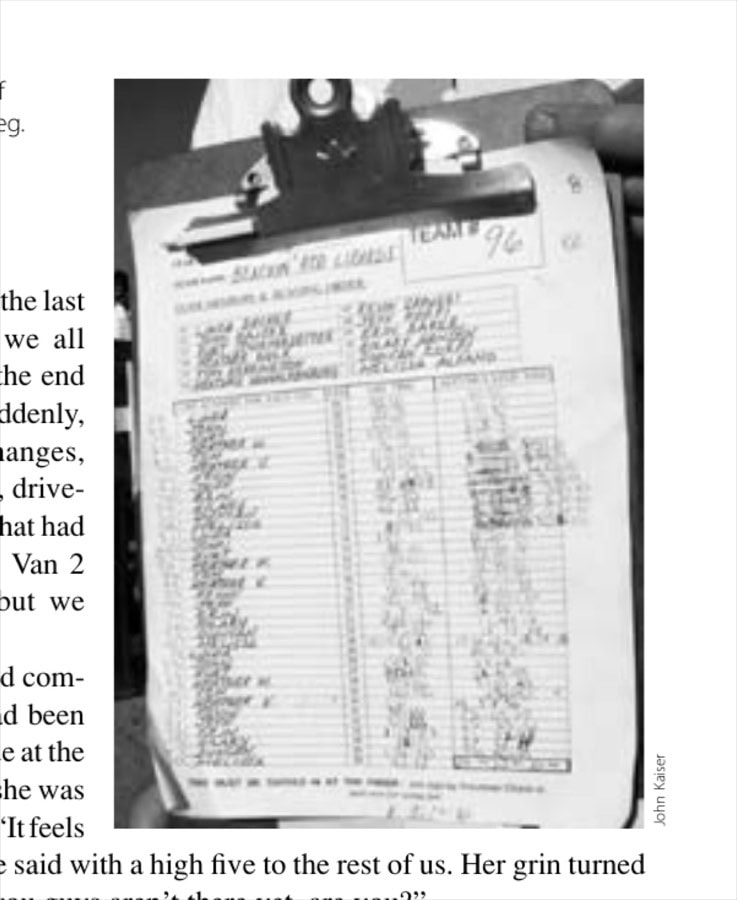
Team captains keep track of runners’ performances, leg by leg.
As van 2 headed out on its last leg, however, the beach was still several hours away, and my companions and I suddenly found ourselves with nothing urgent to do. We looked at each other, silently asking What do we do now? “Pancakes,” someone said. “Shower,” someone else said. Tom started the engine. “I know where we can do both,” he said, to nobody’s great surprise.
Anything but Anticlimactic The end of some long-distance events is anticlimactic. After miles of effort, the finish appears, you cross it, and everyone packs their bags and goes home. Not so with the Hood to Coast. Our last task was to meet the van 2 runners at the finish so that, in a long-standing HTC tradition, the entire team could jog the last 100 yards together.
We had expected to make contact by cell phone, but that proved impossible. With 2,000 other vans attempting the same thing and countless runners dialing home with joyous “We made it!” messages, the result was predictable: a total overload of the tiny town’s cell phone lines.
But HTC has been running since before there were cell phones, and its organizers knew how to function without them. We were herded into a cordoned-off area where the crew from van 2 found us easily enough. Here, we listened to an announcer who was in walkie-talkie communication with a spotter a few hundred yards down the boardwalk. “
Team 375, your runner is approaching,” he would call. “Team 375, get ready.” Soon enough, our number came up: “Team 150,” the announcer called. “Team 150.” “That’s us,” someone told him, and a volunteer ushered us into a fenced-off area that resembled a large cattle chute on the sand. When our turn came, we found energy in our stiffening legs and hoarse vocal cords for a final, whooping 100-yard jog. Then we were across the finish, where there were medals for all, photos, hugs, and a sea of humanity preparing for the real finale: Oregon’s largest beach party. For the next several hours, 12,000 runners and thousands of other people would stroll the sand, listen to music, sip beer, search for friends from other teams, and watch the sun dip toward the horizon on a day that provided the perfect end to the race—one of those rare, cloudless, calm evenings that earn the Oregon coast its reputation as one of the most sought-after vacation destinations in the world, when even nature seemed to pause to congratulate us.
Between visits to the party, runners prowled the streets of Seaside in search of whatever sedentary fantasies had occupied their minds during the last few hours of the race. For some, that meant food that didn’t have to be eaten on the
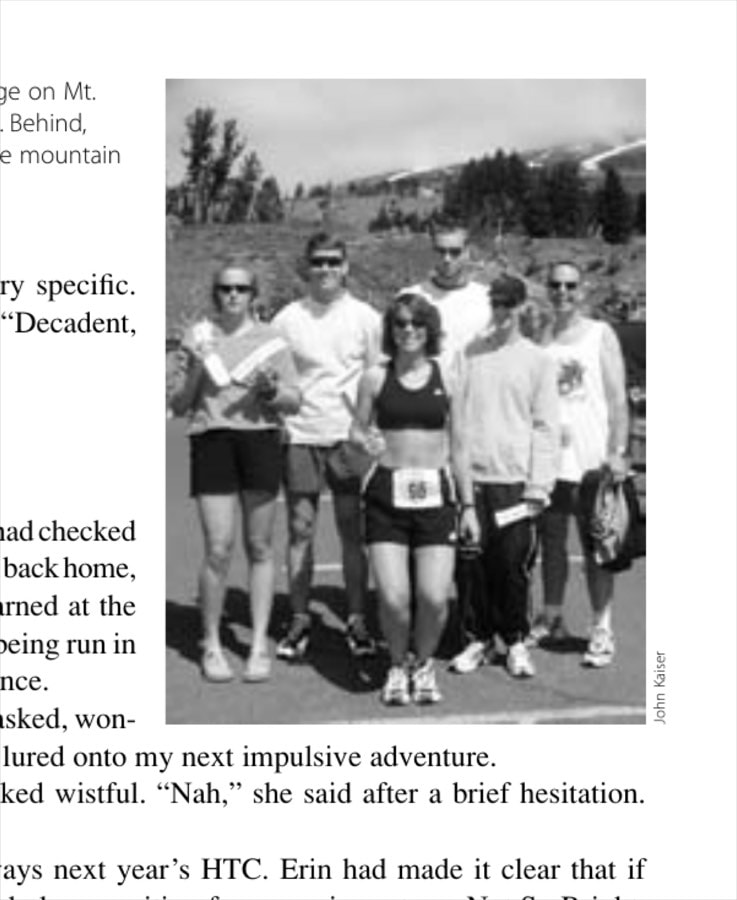
The start at Timberline Lodge on Mt. Hood really is at the timberline. Behind, there’s still enough snow on the mountain for August skiing.
move. For Erin, it was very specific. “Chocolate,” she muttered. “Decadent, rich chocolate.”
The next morning, after we had checked out of our motel for the drive back home, Linda said that she had learned at the party about a similar relay being run in California, a few weeks hence. “You going to do it?” I asked, wondering if I was about to be lured onto my next impulsive adventure.
For a moment, she looked wistful. “Nah,” she said after a brief hesitation. “Too far away.” Besides, there was always next year’s HTC. Erin had made it clear that if we wanted them, we all had places waiting for us again on team Not So Bright. Tellingly, everyone was enthused about the prospect, and some of us were even speculating on how far we could advance our 28:35:52, 775th-place finish.
It was proof, some cynics might say, that the team name had been well chosen. In our next issue, Paul Christman takes us to the famed 1993 HTC.
John Kaiser
There Is Always Another Relay
This article originally appeared in Marathon & Beyond, Vol. 12, No. 4 (2008).
← Browse the full M&B ArchiveMore like this
1,000+ stories from 19 years of Marathon & Beyond
The complete archive of the legendary long-distance journal — digitized and free to read.
