

Not Your Grandfather’s Snowshoes
There comes a point in most races when I wonder why, every few weeks, I insist on punishing myself this way—again and again and again. I never have an answer, but neither do I stop to ponder. Later, I think. But as soon as the race is over, I’m plotting the next one. I’ve come to take that as normal. All-out races hurt. You wonder why, think vague thoughts of what people in other sports sometimes say (“Because it’s there”), then shrug it off and go back to the serious business of making yourself hurt. Only once in my road racing career have I finished a race still wondering why . . . and that was an Ironman-length triathlon at 104 degrees and Midwestern humidity and no support worthy of the name. Almost everyone dropped out, but I insisted on finishing . . . and never did a long triathlon again.
Then I tried snowshoe racing. For years, club mates had been after me to give it a go, but I had declined. A decade earlier, I had rented giant, heavy snowshoes for a hike and found them to be a difficult, inelegant way to go slowly over terrain I could cross much more quickly and elegantly on cross-country skis. It was my second “never again” moment, and I thought I meant it every bit as much as the no-more-triathlons vow. But suddenly, there I was, planning to run on the things.
I think I succumbed because I found myself awake early on race morning, with nothing better to do. Early enough to be able to hit a mountain shop and (barely) make it to the start. The strangest decisions can stem from the inability to come up with a good excuse to sleep in. * * * I was half-hoping I would be late. But traffic was light, and 60 miles later I was in a snow park on the flanks of Oregon’s 11,325-foot Mount Hood. I more or less threw $20 at the race director, scribbled my name on an entry form, and with only minutes separating me from the start, set about figuring out how to put on the shoes.
© Holly Hight
Luckily, it wasn’t all that difficult. Modern snowshoes aren’t the wicker-basket affairs once associated with fur trappers and mountain-man hermits. They’re aluminum-and-fabric contraptions that strap onto your favorite running shoes.
Top racers do away with the straps and bolt their running shoes directly in place, thereby saving a few grams. I would have liked to get rid of more weight than that. In the rental shop, when I had told the owner I was going to the race, she
had scrounged up the lightest pair she could find, “for petite women”—though she added, “they’re still backcountry shoes.” They weighed about 2 tons. Apiece. OK, it was only 2 or 3 pounds, but on top of your normal running shoe, that’s a lot.
Having mastered the binding, I walked around, trying to figure out if the snowshoes were going to fall off the moment I attempted to run—though in point of fact, running seemed incomprehensible. The whole endeavor looked like idiocy.
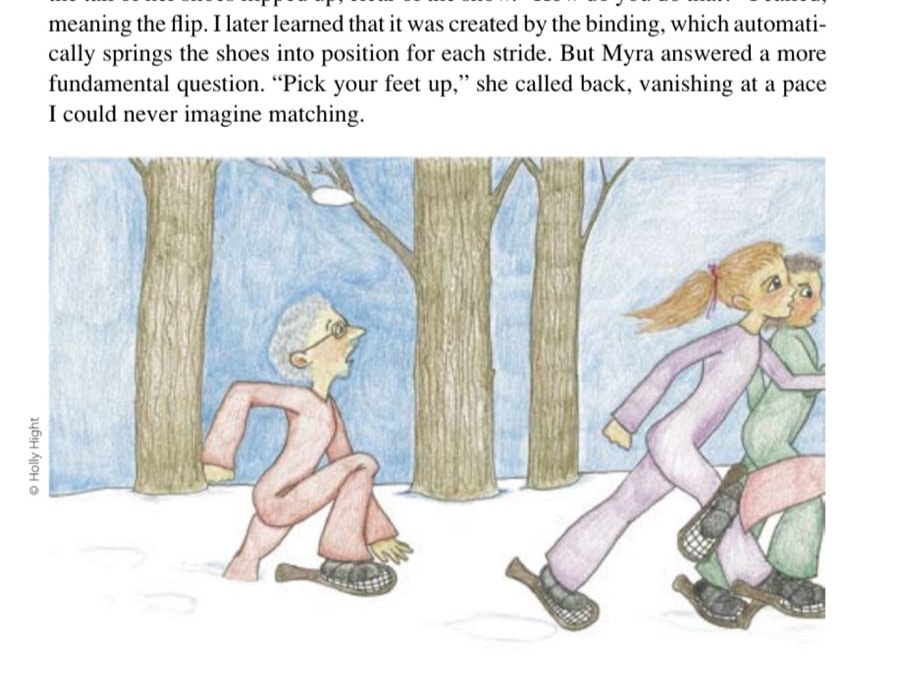
About that time, a woman named Myra ran by, not just jogging, but doing full-fledged warm-up strides. Myra’s an old friend—probably the first person I got to know at local road races. She’s fast, with a 2:49 marathon PR, and better yet
on snowshoes: now in her mid 40s, she was still the dominant female snowshoer in the Pacific Northwest. She made it look easy. I was particularly impressed by how with each step, the tail of her shoes flipped up, clear of the snow. “How do you do that?” I called,
meaning the flip. I later learned that it was created by the binding, which automatically springs the shoes into position for each stride. But Myra answered a more fundamental question. “Pick your feet up,” she called back, vanishing at a pace I could never imagine matching.
Then the race was off. It was out-and-back on a snow-covered road where hikers, skiers, and prior snowshoers had beaten a fairly decent, double-width path. Not a groomed trail, but the next best thing. I started conservatively, but within 400 meters I was in trouble. It felt like half the world was running away from me, but the surface was all lumps and I kept stumbling. Worse, the rental shoes had wicked-looking crampons on the base, with teeth poking forward, perfect for tripping over every time I tried to catch my balance after one of those stumbles. My shins were screaming from trying to run with all that unaccustomed weight.
Relearning how to stride Pick your feet up. Fat chance. The race was only 8K, but in a sport where 10minute miles are fast, that’s longer than it sounds. I was sure I would be crippled with shin splints. Not to mention dead last.
Somehow, I adjusted my stride, probably by actually doing a better job of picking up my feet. Amazingly, the pain abated. Now I faced another problem: I was running through snow, at elevation, with 2-ton weights on my feet. The course was 4K downhill, then a 180-degree turn around a cone, and . . . 4K back up. It wasn’t supersteep, but it was relentless.
I will not walk, I vowed. Downhill was bad enough. I will not walk. Others were fading, and I was beginning to reel in some who had dashed away at the start. I reached the turn and reversed course. I will not walk.
I didn’t exactly sprint, but neither did I walk. Gradually, I became aware that I was chasing, and catching, people I had never caught in road races. Some probably had 3-ton shoes, but at least one had “racing” snowshoes, whatever that meant. I will not walk.
At last the end was in sight, and although I would like to say I kicked in hard, it was more like not walking at a slightly brisker pace. Still, the other racers seemed impressed—except the guy with the racing snowshoes, who, as soon as he crossed the finish, yanked them off, threw them down, and offered some choice words about how they had not been doing whatever it was they were supposed to do.
More surprisingly, I was second in my age group—a finish that would have qualified me for the U.S. national championships, had I chosen to declare my interest before the start of the race. Never before had I come close to qualifying for a national championship. Of course, snowshoe racing is a small sport, and I was in the 50–54 division, which isn’t the largest. But still . . . Not that it mattered. I was deep in “never again” territory. Totally wiped out barely begins to describe it. But I hadn’t walked.
* * * Fast-forward 26 months. It’s March, again on the flanks of Mount Hood, where a very unspringlike wind scuds mushy-looking clouds through a wintery sky. Dozens of people sit in cars, engines idling. Others stamp their feet or jog around, trying to assess the ramifications of “24 degrees” and “up to 18 inches of fresh powder” on their ability to move quickly on snowshoes.
It’s the 2009 U.S. Snowshoe Association National Championship, and nobody is sure what to make of these conditions. Many of the easterners are used to groomed trails, which aren’t permitted here on the edge of the wilderness. Pacific Northwesterners, on the other hand, don’t usually get this type of snow. We’re accustomed to a mix jokingly referred to as Cascade Concrete. It’s a bit like California’s Sierra Cement: it comes down wet and heavy and either freezes solid or forms a big wet mush. “Good base,” is what skiers tend to say, which means you’re not usually worried about sinking too far into it. By contrast, these conditions were positively Minnesotan. They also raised memories of the last time it had happened, at a place called Frog Lake, where I had done a race in 2008. That time, a weeklong cold snap had dumped 6 feet of fresh snow, half of it in the 24 hours before the start. Groomed or even well-broken trail was simply not on the agenda—the path was a hip-deep groove: a v tramped out to snowshoe width, where passing was impossible unless the person ahead of you yielded. “
Don’t worry; it’s not as bad as Frog Lake,” someone assured us. Not that this was all that assuring. Racing of any type is always subject to the vagaries of nature, but snowshoeing is particularly vulnerable. For serious competition, Frog Lake had been as close to impossible as anything I had ever seen. * * * My “never again” snowshoeing vow had lasted a little less than 12 months. That was when another group of friends invited me out again. “Sure,” I said, mostly because I enjoyed their company. Suffering? What was that? Besides, it was just a hike.
But my friends were marathoners, so of course we had to try running. And while it was still hard work, it wasn’t quite as horrible as I had remembered. On the way home, returning my rental shoes, I discovered a pair of “running” snowshoes on discount. They weren’t quite as light as the racing variety but were still a lot lighter than anything I had tried before. Impulsively, I bought them. What’s $149 for a sport you said you would never do again, especially when the equipment is on sale?
Having bought the shoes, I was obliged to race. The strangest decisions can be made incrementally. * * * Snowshoeing is a small sport, so getting into the nationals is relatively easy. First, you join the U.S. Snowshoe Association. Then you run any of a dozen or
so qualifying races. In each qualifier, the top-10 association members (male and female) win berths in the nationals. So do the top-five association members in each age group. If that doesn’t do the trick, you can get in by being no more than 30 percent slower than the age-group winner.
Back East or in Colorado, the competition is deeper, but in Oregon, there are unlikely to be 10 association members in any given race, so most people can qualify simply by getting around the course. And my age-group competition was particularly light. Of course, not walking helps. * * * Time passes, but the parking lot gets no warmer: the conditions are, if anything, colder than the year before, when the nationals were at 6,800 feet in Utah.
I had qualified for the Utah race on Mount Hood, a couple of weeks after buying my running snowshoes. I would like to say I was faster than the year before, but there was no way to compare because the 2008 race was on a tougher course. Gone was the long road. Rather, we ran up a backcountry canyon on single track. There wasn’t a lot of loose snow, but if you wanted to pass, you had to step out into the rough.
The first half had been uphill, sometimes steep. That’s my forte. If races ran uphill only, I could score top-10 finishes simply by not walking. But descending, especially on single track, requires balance and a kamikaze attitude. I have neither. As a child, I had sprained one ankle more times than I can count. The other I had broken as an adult, trail running. A lot of the people I pass on upgrades take me back on descents.
As a child, I had always been the smallest in my class. Even in high school, I had been a shrimp: my first driver’s license described me as 5 feet 1 inch, 103 pounds. I was useless at football and not much better at basketball—the only sports that seemed to matter. When I later discovered running, I spent years wanting to shove each finisher’s medal or age-group prize under my PE teacher’s nose and shout, “See, I am not a wimp!”
Winning a trip to a national championship, even in a sport where pretty much anyone who wants to can qualify, was another form of not being a wimp. But it was meaningless if I got clobbered by the entire field. I didn’t need to win, but I very much wanted to prove I belonged.
The race was 10K on a mix of groomed cross-country ski trails and single track. Deep powder wasn’t a problem. Instead there was ice, enough that there was no way I could avoid walking the single-track descents—not unless I wanted to break my tailbone as well as an ankle.
Luckily there were some extended upgrades, including one at the end, where I ran down three other competitors. I wound up fifth in my age group, far out of medal contention, but not last. And in a wind-burned, frozen, why-isn’t-there-anyoxygen-up-here kind of way, it had been fun. When the race director told me the
next year’s championships would probably be in Oregon, I didn’t even hesitate. “Great,” I said. “I’ll be there.” * * * On race day, though, I’m not really thinking about my own race. I’m more interested in the women’s race, where Christy Runde has dreams of becoming the first masters woman in two years to make the U.S. national team. I had gotten to know her 15 months earlier, when she approached me at a Christmas party, asking me to be her running coach. She had just come off a six-week layoff from emergency abdominal surgery and had four months to prep for the Boston Marathon, where she held a 3:05 qualifying time.
She ran her first snowshoe race a month into her comeback, mostly as a lark. It was also a good way to build strength, and the recovery was as good a time as any to try something new. The race was the 2008 nationals qualifier, which I had run on my new, lightweight snowshoes. Christy had been somewhere behind me: 16th woman, 50th overall. A month later, she had done Frog Lake, the year of the deep snow. That race also starts with a long hill: 1,300 feet in 2 1/2 miles. She had run up it, right on my heels, helping clear the path of slower runners. “You could go a little faster up there,” she would call when we would catch a guy who was fading but refusing to step aside. Even the most competitive male, when he hears a woman’s voice in such circumstances, has no option but to speed up or yield.
On the descent, I had given her the lead, and moments later she went blasting off, out of sight: second woman this time, 13th overall. A major improvement, but more than four minutes behind Myra. No sign yet of a budding champion. * * * In the cold and wind, her concerns are mostly technical. Where should she position herself at the start? How hard will it be to pass other racers in the deeper powder, higher up? A late rule change requires slower runners to yield the trail when being passed. But will they?
Then there were the equipment questions. Should she wear gaiters, or will they simply ball up with snow and add weight to her feet? Not to mention the unexpectedly difficult task of figuring out left from right on the pair of superlight racing snowshoes lent her a few minutes earlier by Atlas Snow-Shoe Company, which thinks she might be this year’s dark horse. “Not to put any pressure on you!” the company rep says with a grin.
For a year now, Christy has been on a roll. She had run 3:06:55 at Boston, won a half-marathon, then capped it in December with a 2:56:21 at the California International Marathon. Then both of us had done the 2009 Mount Hood snowshoe race. My goal had simply been to secure a berth in the nationals. Christy’s had supposedly been the same. Instead, she had won. Still running on heavy rental shoes, she ripped through the course like she was on a mission, beating Myra by
two minutes. A few weeks later she did it again in a 3K. “I actually apologized,” she told me afterward. “But [Myra] was gracious. ‘It’s your time,’ she said.” Suddenly, Christy was the top female in the West. Equally suddenly, I was a snowshoe coach. * * * There isn’t a lot of literature on snowshoe training. If you live in Vermont or Minnesota, you probably work out on snow several times a week, but Christy lived near Vancouver, Washington, where the snow is usually 90 minutes away. So we borrowed protocols from cross-country running and road racing: long runs, speed work on the track, and some tough surge-and-recovery workouts designed to mimic the demands of rolling terrain. Once, she ran 12 miles on snow. A couple of other times, she went to the mountain and did hill repeats.
I wasn’t that serious about my own training. Partly, it was because I knew I was a no-hoper for a medal. Partly, it was because coaching immerses you in the other person’s race and makes your own seem less important. My goal was simply to have fun. Officially, Christy’s was to win her age group. Unofficially, we had our sights set higher. In snowshoeing, the top five make the U.S. team (though athletes have to pay their own way to the competition). Even before the Atlas rep had put voice to it, Christy had been looking more and more like a candidate for the national team.
We opted to go without the gaiters. Good move, it turned out. The loaner snowshoes were fast and light and going without gaiters kept them that way. We also decided to have her line up slightly back, avoiding being drawn out too fast if there were rabbits, and trusting to the passing rules to let her make a move when the time came.
As it turned out, that time came soon. The top contenders quickly took the lead, and within 200 meters, four started pulling away, with Christy among them. A quarter mile later, one of the four broke away on her own. But the others didn’t slow down, continuing to distance themselves from the rest of the pack as they crested a ridge and disappeared from sight.
Christy’s husband was standing with me, watching her go. “Looks good,” I said. * * * The course was two laps, with the men’s race starting 45 minutes after the women’s. The first woman finished her first lap in well under half an hour, then came a group of three, one of whom was Christy. I shouted encouragement and advice but mostly grinned. This was looking better all the time.
My own race was loaded with rabbits. I’m probably a traitor to my sex, but I’ve always thought testosterone makes men stupid—though in snowshoeing it’s particularly easy to go out too fast because what feels like a slow jog is a lot harder than you would think. The trick is to monitor your breathing. If it feels like you’re doing the equivalent of a fast 800 on the track . . . you are.
© Holly Hight
What this means is that best intentions to the contrary, I got dragged too fast for the first 100 meters. But a lot of others had bolted out even faster, and even as I was still settling into my pace, I began catching them.
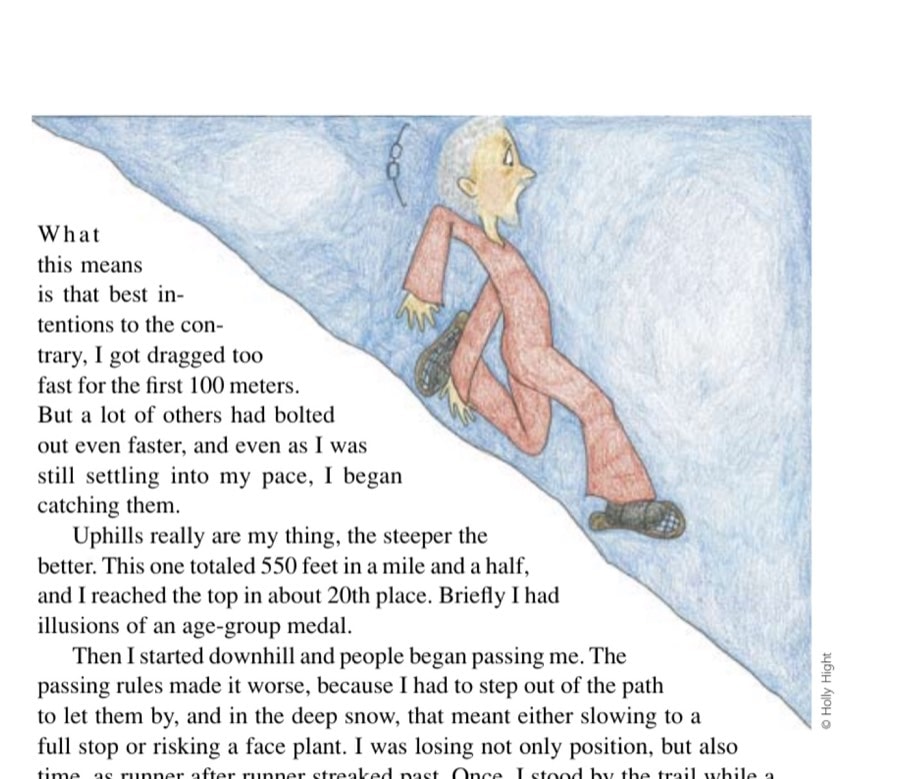
Uphills really are my thing, the steeper the better. This one totaled 550 feet in a mile and a half, and I reached the top in about 20th place. Briefly I had illusions of an age-group medal. Then I started downhill and people began passing me. The passing rules made it worse, because I had to step out of the path to let them by, and in the deep snow, that meant either slowing to a full stop or risking a face plant. I was losing not only position, but also time, as runner after runner streaked past. Once, I stood by the trail while a whole string of guys went by, about five seconds apart.
The downhill seemed endless, but eventually I was on the way back up. One lap down. One to go. Christy was at the halfway mark. “I was fourth!” she called. I later learned she had been only 20 seconds out of second.
My own race also evolved into a kick finish. On lap two, I again passed people on the big uphill, although not as many as had passed me on the descent. Then the ones I had retaken passed me all over again. It was frustrating, though I had always known that when the Good Lord handed out balance, I had been AWOL.
Near the bottom of the hill, a big group came up from behind and I moved over to let them by . . . one, two, three, four, five, six. A hundred meters later, the course rounded a bend, and the finish was in sight, at the top of a rise. If I had been only a few seconds faster on the descent, I could have held off the whole group. As it was, yelling “track” in the final tenth of a mile seemed tacky. Thanks to all that powder, the officials hadn’t had time to tromp out a wide zone at the end suitable for close finishes.
I caught two of the other racers anyway, but I just couldn’t find a clear line around the next. Then it was over, with seven of us—a tenth of the entire field— finishing in a 34-second window.
I was 10:01 faster than the year before (again fifth in my division), on a course in which most finishing times were only slightly faster. I had also coached the masters champion—who indeed made the U.S. national team. (“I think she just won us an expensive vacation,” her husband commented.) I was, in a nutshell, pleased. Maybe someday I’ll figure out how to run downhill. Or maybe I won’t. The only thing I’m sure of is that “never again” isn’t a phrase I should believe when I hear myself utter it.
This article originally appeared in Marathon & Beyond, Vol. 15, No. 1 (2011).
← Browse the full M&B ArchiveMore like this
1,000+ stories from 19 years of Marathon & Beyond
The complete archive of the legendary long-distance journal — digitized and free to read.
