

On The Road With Joe LeMay
MOVING UP TO ULTRAS
Lately, with all the physical ailments I’ve been suffering, thanks largely to about 12 years of 100-plus-mile weeks, I’ve been doing a lot of skiing. No, not the aerobically beneficial Nordic type (i.e., cross-country) that I’m sure all you nerdy runners have tried at least once and failed miserably at, but rather the Alpine type, where you drive for hours and pay a small fortune for a lift ticket to hang out on a mountain populated with foul-mouthed, spoiled teenagers like my best friend’s younger brother when he was 14.
I can’t begin to tell you how much fun it’s been. I see myself trying many new sports as I grow older for the simple truth that you’re always going to improve when you’re new at something.
Running ain’t like that for me anymore. I skied a bunch of times when I was a kid but dropped the sport because I didn’t want to break a leg and I couldn’t afford it. Now that I have some time and a decent pair of skis, I love it.
But back to running.
Recently my friend Dan Held, whom I mentioned in another edition of this column, has taken up a new sport of sorts—he is running ultras now. And he’s pretty good at it, having finished fourth in the 2000 100K World Challenge. I asked him to take some time from his busy schedule to talk to me about the change.
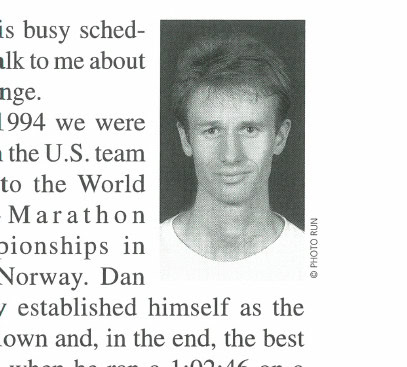
In 1994 we were both on the U.S. team going to the World Half-Marathon Championships in Oslo, Norway. Dan quickly established himself as the team clown and, in the end, the best runner, when he ran a 1:02:46 on a course that was either going uphill or downhill or making some kind of weird turn. I think “undulating” and “rolling” are the words people use to describe such courses, but we all know they really mean, “You’re probably not going to get a real fast time here.” Dan’s time was way faster than the rest of the U.S. team (I ran 1:04:03, second U.S. finisher), though, and was an excellent time. This was during the period from 1994 to 1996, when Dan was at his fastest.
Dan lives in Wisconsin, about 30 minutes west of Milwaukee, where he works full-time in risk management for the county of Waukesha. He’s the father of two daughters, ages two and five, and is about as bald as they come. I once told him I thought he shaved his head. “No. I’m bald,” he replied. “I just want people to think I shave my head.” Well, he fooled me.
WAKE-UP CALL
Dan wakes up just before 5:00 A.M. on most days to run, and he keeps a rigid schedule. He gets in about 80 miles a week these days, down from the 120 he ran a few years ago. Getting close to the 1996 Olympic Trials Marathon, he approached 170 miles a week. About the only thing that’s easy on him is his commute to work—he drives about a mile and can drop his kids off at day care along the way.
Going back a bit, Dan was born on October 15, 1965. In high school, he ran 9:50 for two miles and 4:30 for the mile. He went to college at Wisconsin Eau Claire, an NCAA Division III school, and posted times of 14:27 for 5,000 meters and 30:18 for 10,000. Those are good times but not quite enough to make any national teams.
Keeping at it and moving up in distance, Dan posted a 2:13:50 in the windy 1994 Boston Marathon. He then went on a tear that had a lot of people speculating that he might have a shot at the 1996 Olympic Marathon team. Not known for his speed, he posted a PR 13:41 for 5K on the track in 1995 and made the 1996 World Cross-Country team (which was selected from the 1995 National Cross-Country Championships in Boston). Dan ran 2:14:50 for seventh place in the ’96 Marathon Trials and, thanks to that 5K PR, was able to attend the track trials as well, where he made the final and finished 13th. He managed a 10,000-meter PR of 28:46 in 1998, relatively late in his career. I vividly remember going to the USATF championships that year and not seeing him in the field. When I asked him why he didn’t run—considering his great PR and that this was probably one of his last chances—he said, “I’m not sure. That’s a good question. What was I doing?” As it turns out, the answer was money. Even for a 28:46 guy, sponsorship isn’t easy to get in a non-Olympic year, and a trip to New Orleans isn’t cheap.
Late in 1998 Dan talked about retiring, and a couple of bad marathon days kept him from qualifying for the 2000 Olympic Trials Marathon. You’d think after all the heartbreak (along with his success), walking away from the sport would be a welcome change, but he didn’t stay away long. In 2000 Dan entered, and won, a 50-mile trail run in LaGrange, Wisconsin. He ran 5:54 on a course that runs along the Ice Age Trail; the course record was 5:53. He said he “wasn’t really concerned with any course records” but wanted to see what he could do. Trail races remain his current favorite and are really the only reason he considered moving to the longer distances. He has no interest in running the 100-mile distance. He did indicate that Comrades is a possibility for 2002 if he can arrange for someone to pick up the airfare. He modified his regular marathon training only slightly by doing two runs with ultrarunner Kevin Setnes. One was 28 miles, and the other was 35 miles. He found it easy going seven minutes per mile.
ON TO THE 100K
Selection to the World Championships 100K team is not without its politics. Normally, you would have to run the National 100K Championships in March to make the September trip, but the selection process is flexible enough that when a proven talent like Dan comes along, everyone is happy he’s ready to make the trip. He was added to the World 100K team based on that one 50-miler, and he went to The Netherlands in September 2000 for that event.
He describes the start of a 100K: “The gun goes off, and you start running six-minute pace. You really have to hold back the whole time. It requires more patience than a marathon. It’s not until about 80K that you can start to think about racing it in.”
Unaccustomed to the pit stops that go hand in hand with running a race that takes over six hours, Dan didn’t stop at all during the first 50K (split in 3:11), and unlike some of his competitors, he never changed shoes. “Every athlete has it set up a little different. That guy [U.S. 100K runner], Jim Garcia, has got all his breaks set up like an Indy 500 pit stop: one person to help change his shoes, another to get him food and water. I think they must rehearse the whole operation.” Dan remained in the lead pack for the first 30K. Uncomfortable with the pace, he dropped back. He was smart to avoid all the back-and-forth pacing going on.
He figured a split of 3:10 would allow him to follow with a 3:20 and bring him to the finish in around 6:30. He got to see some of the people from that lead pack again as he moved from about 10th to 4th over the final 30K.
Usually running a come-from-behind race, where you pass a lot of runners in the final miles, is uplifting, but the only thought he had during that time, and in the finish line chute, was “never again.”
Soon enough, he changed his mind. “I probably will do another,” he wrote in an e-mail two weeks later. The 2001 World Championship 100K is already on his calendar, along with a 50-mile trail run in the Seattle area this July. No wonder he wants to continue with the ultras, as he’s damn good at them. In 2000, he received the USATF Ted Corbitt Award, given annually to the nation’s best ultrarunner.
A 50K IN APRIL
Dan and another new American ultrarunner, Dave Dunham, plan on going after the American road record for 50K of 3:00:00, set by Jeff Wall in 1982. A handful of Americans, including Barney Klecker, Don Paul, Bruce Mortenson, and Tom Fleming, have actually run faster for the distance, but for some reason the official AR remains at that three-hour mark. The race is called the Chicago Lakefront 50K [see Marathon & Beyond, March/April 2001, pp. 109–117], and by the time you read this, we’ll know the results.
Dave Dunham is known as one of the more prolific runners in New England. He works full-time as a financial assistant for the IRS and lives in Bradford, Massachusetts. He ran 9:10 for two miles and 4:28 for the mile in high school. He attended the University of Massachusetts/Lowell, where he ran 29:17 for 10,000 and 14:03 for 5,000. His best marathon time is 2:19:28. He’s 36 and wears his hair in a thin ponytail (not unlike American marathoner Jerry Lawson’s ponytail). He races all the time, never doing any speedwork when he trains but rather racing himself into shape. “I’ve run 12 races in eight weeks this year,” he told me at the end of March.
HE’LL RUN ANYTHING
Dave Dunham will run almost any race that comes along. He was National Snowshoe Champion this year (championships were held in Plattsburgh, New York). He’s also a three-time Mt. Washington Road Race winner. The famous 7.6-mile all-uphill run to the top is his favorite race, and he makes a point of running it every year. He doesn’t do any hill training to get ready for it. He says you just have to be in good condition, as you would for any other type of distance race.
Lest you think Dan Held gets up early, Dave goes to bed at 7:30 P.M. and gets up at 4:30 A.M. for his morning run of four to five miles; this allows him to get to work at 6:00. This schedule is part of a three-times-a-day program that has him doing about 110 miles a week right now, which is an increase from 1999 and 2000, when he was sidelined by an ankle injury incurred during a mountain race.
For his first ultra, Dave ran the Chancellor Challenge 100K in Boston in October 2000. This course is composed of ten 10K loops on the flat surface of Boston’s well-known esplanade. (If you ever go to Boston to run the marathon and stay in a hotel in town, this is where you’ll end up doing your morning runs.) The only obstacle, other than the distance itself, is the wind, which can get pretty strong on the Charles River. Dave decided to train for and run this race only a month before the race date, and he ended up running a steady come-from-behind race to win, with a course record of 6:46:39. The race is only in its second year, and the prize money is exceptional for an ultra ($3,000 for the win should attract a lot of talent), so that record will probably be challenged soon enough.
Dave hopes to go through the marathon in the 2:27 to 2:28 range to hold on for the AR at 50K. “My guess is I’ll set the American record, but I’ll get second,” he said of his upcoming 50K, referring to the presence of Dan Held in the field.
Postscript: Dave Dunham won the Chicago Lakefront 50K in 2:57:29, setting a new American record for 50K. Dan Held dropped out at 21 miles, vowing to go after Dave’s record this November in the fall version of the same race.
This article originally appeared in Marathon & Beyond, Vol. 5, No. 4 (2001).
← Browse the full M&B ArchiveMore like this
1,000+ stories from 19 years of Marathon & Beyond
The complete archive of the legendary long-distance journal — digitized and free to read.
