

One From the Heart
THE LOBBY of the Campus Inn in Columbia, Missouri, was jammed to capacity on Sunday of the Labor Day weekend when Steve Kearney and I arrived. Maybe a dozen runners stood around chatting while picking up packets for Monday’s Heart of America Marathon. Race director Joe Duncan suggested that with 175 preregistered, there might be a record entry. Duncan wouldn’t know for sure until the gun sounded at 6:00 A.M. the next day. Walk up at that time with $20 and you still could start.
A runner appeared wearing a propeller cap and a smiley-face racing uniform. He had run the Tupelo (Mississippi) Marathon earlier that day and then had driven to Columbia. His plan, he informed us, was to run 100 marathons in his first two years of running. I told Steve: “This is definitely the Far Side of marathon running.”
Earlier in the weekend, I had visited Virginia Beach, Virginia, for the Rock ‘n’ Roll Half-Marathon, which attracted 15,000 runners in its first year. In October I would run the LaSalle Bank Chicago Marathon, with more than 30,000 expected. Many in both races had prepared using my Virtual Training, which offers online schedules.
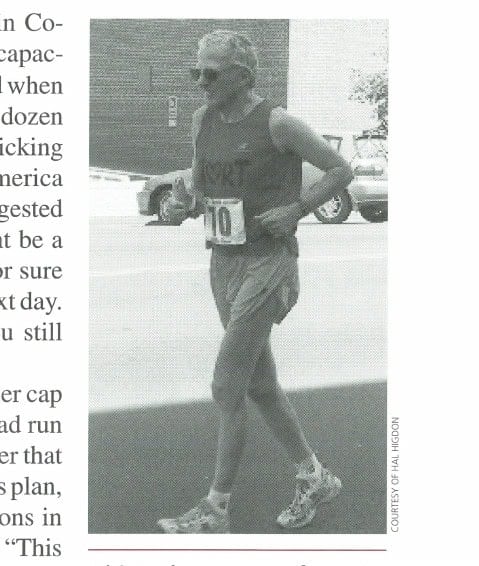
I have a happy relationship with people who train using my program, my “V-Team.” Yet few V-Teamers had made it to Columbia, despite its status as America’s fourth-oldest marathon. Only Boston, Yonkers (New York), and Western Hemisphere (Culver City, California) have been around longer. Heart of America attracts only a handful of crazies—including me. I wasn’t wearing a propeller, but I was running seven marathons in seven months to celebrate my 70th birthday and to help raise $700,000 for seven separate charities. That definitely positioned me on the Far Side too.
Assisting me in this third of my 7-7-70 marathons was Steve Kearney, a coach and teacher from Chesterton High School in Indiana. Steve and I once ran the length of Indiana: 350 miles in 10 days, a stunt memorialized in the book And Then the Vulture Eats You (edited by John Parker). Steve agreed to pace me at Heart of America, partly out of a sense of tradition and partly out of curiosity about whether the Columbia race was as tough as I had boasted all these years since I first ran it more than three decades ago.
A DEDICATED FEW
Heart of America features six significant hills, as well as guaranteed hot and humid weather. Plus, Columbia is hardly a hub city. If you fly into St. Louis, you still have to drive two hours, as I did, to get there. Little wonder only a dedicated few appear to run it each year. I might have been wise to leave Heart of America off my 7-7-70 schedule, except I won the race in 1968. Plus, it offered a logical connection to the American Heart Association when it came time to link charities and marathons.
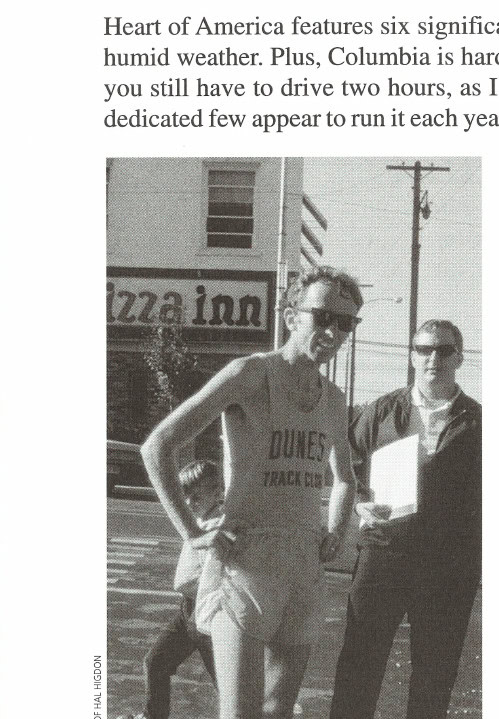
My first appearance at Heart of America occurred almost by accident. On Labor Day of 1968 my wife and I, accompanied by our three children, were en route home to Indiana after a month-long trip west, during which I had competed in the Olympic Marathon Trials in Alamosa, Colorado. Up with the leaders at 10 miles, I had quit at 20 from a combination of heat, altitude, and insufficient training.
But the trip had more pleasant aspects: we had hiked the Grand Canyon, explored Carlsbad Caverns, and gone float boat fishing in Arkansas. Finally, we stopped in Columbia, more as an afterthought on the final leg of our journey, so I could partially redeem myself for my failure at the trials.
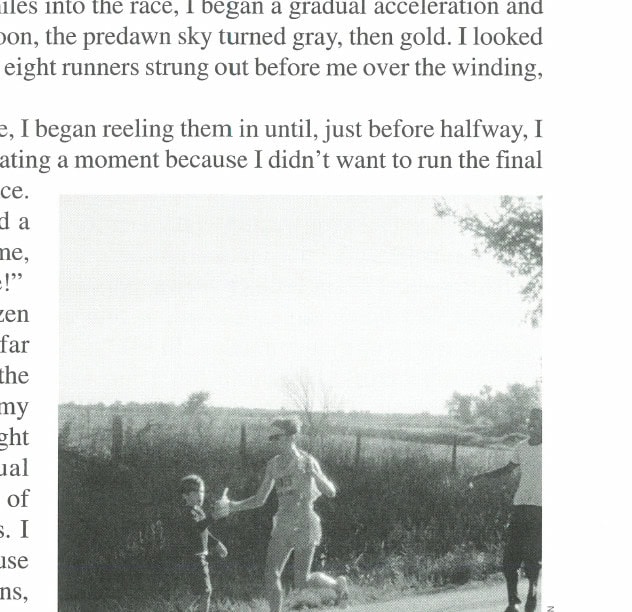
Heart of America started before dawn: 6:00 A.M. That was to compensate for the anticipated hot and humid weather. Years later, I relished retelling the story of how I began slowly, permitting many of the 42 other entrants to rush ahead into darkness. Several miles into the race, I began a gradual acceleration and started to pass people. Soon, the predawn sky turned gray, then gold. I looked ahead and counted six or eight runners strung out before me over the winding, roller-coaster road.
Gradually, one by one, I began reeling them in until, just before halfway, I passed the last one, hesitating a moment because I didn’t want to run the final 13 miles alone in first place.
At that point I passed a race official, who told me, “You’re in seventh place!”
In the dark, a half-dozen runners had gotten so far ahead that by the time the sun rose they were out of my sight. Nevertheless, I caught them, passing the actual leader, Carl Owczarzak of Kansas City, at 24 miles. I finished in 2:41:45. Because of the course and conditions, that was a performance much better than it seems today. Returning now, 33 years later at the age of 70, there was no chance of running anywhere near that time. My goal was only to finish, raise a few dollars for the American Heart Association, and then move on to the next of my 7-7-70 marathons, five weeks later in Chicago.
DESIGNED BY THE DEVIL
Sunday night before going to bed, I had laid out my uniform, including a red singlet on which I had hand-lettered “Heart of America” on the front and “7-7-70” on the back. (When you’re running on the Far Side, you don’t dress like normal runners.)
I awakened briefly around 3:00 A.M. and downed a Gatorade energy bar and some Gatorade Frost before falling back to sleep. The alarm sounded at 5:15 A.M. About 10 minutes before the start, Steve and I walked the short distance to the starting line on a highway near the University of Missouri football stadium. Joe Duncan announced two minutes, one minute, and 30 seconds to go, then off we ran into the dark, our way illuminated by streetlights and a full moon. The highway was four lanes wide, divided, so we ran mostly on the shoulder or just on the pavement when cars weren’t approaching. The shoulder was pocked with potholes, but it was relatively easy to dodge around them, even in the dark.
Ahead of us were those six significant hills, not to mention numerous other inclines up and down to nibble at leg strength. Add to that four miles of gravel, which, depending upon weather conditions, causes runners either to choke with dust or sink in mud. “It’s a race with character,” says Joe Duncan.
The course I ran in 1968 crossed a railroad track midway where, one year, after the first three runners passed, a slow freight train forced the next 10 runners to wait up to four minutes. In 1984, when I returned on the race’s 25th anniversary, I crossed the tracks just before a train, but several runners behind me had to wait. The race seemed designed by the devil to discourage the undisciplined.
In the 1980s, local doctors convinced the Columbia Track Club to move its marathon into mid-October to ameliorate the dangers of heat and humidity. At the time of my second appearance, Joe Duncan apologized for the date change. “I hate to turn this into a race for the faint-hearted,” he said. Several years later, when the doctors weren’t paying attention, he returned Heart of America to its traditional Labor Day date.
Race founder Bill Clark, a baseball scout, recalls that the race began in 1960 as a challenge between the town’s runners and a group of boxers who did regular road work. To see who was better, they decided to race from Columbia to Fulton, Missouri. Race morning, however, no boxers showed. “I went around banging on doors,” said Clark, “but couldn’t get any boxers out of bed.”
Only six runners appeared, one of them Joe Schroeder, a cross-country runner from the University of Missouri, who had never raced longer than four miles and whose longest training run that summer had been six.
Schroeder didn’t even own running flats, so he taped over the spikes of his track shoes for the paved start on Columbia’s main street. Once outside the city, he removed the tape and shifted to the dirt shoulder. Schroeder ran with Morris “Red Dog” Patterson, a teammate from MU. They ran their first half-dozen miles at faster than 6:00 pace but soon were reduced to a slow, survival stride.
If one stopped for water or had to walk, the other would wait. Eventually, Schroeder crossed the finish line 20 minutes ahead of Patterson with a time of 3:57:00. Nobody else finished the distance.
“I had alerted the Associated Press about our marathon,” recalls Clark, “so I called and gave them the names of the first two finishers, adding, ‘Everybody else is still out on the course.'”
Within a few years, Heart of America began attracting more talented runners, there being so few marathons in this pre-Boom era. Among the list of early winners, Bill Silverberg, Barry Rose, and Tom Hoffman were all nationally prominent. Ron Daws, a 1968 Olympic marathoner, won twice. Later victors included Tony Rodiez and Steve Fisher, both qualifiers for the 1968 Olympic Trials.
Despite this array of talent, the course record remains 2:29:15, set by Dennis Hinkamp in 1977. Although my winning time from 1968 of 2:41:45 seems puny by today’s standards, it would have been good enough to win all but two of the first 15 races. Remarkably, the median time for all finishers has been faster than four hours in all but seven of the Heart of America’s 42 years, much faster than most major marathons, underlining the fact that the race attracts more serious runners who embrace the hills and humidity as part of the challenge.
OUT OF REACH
Sub-four-hour times are out of my reach these days. With seven marathons in seven months on my agenda, I didn’t want to push too hard in any of them for fear that I might not finish or—just as bad—injure myself and not be able to continue to my ultimate goal. Heart of America also came right in the middle of the hay fever season, and 2001 proved to be a bad year for those of us with allergies. I had trouble breathing in the first few miles, but after a while things smoothed out.
For the early miles, I ran near racewalker Jean Bocci of Detroit and several other runners, but even though I picked up the pace, they picked it up more. Soon Steve and I were running alone with only my cellular phone to connect us to the outside world. My wife, Rose, had stayed home, but we planned to chat every hour so that I could assure her that I was still moving forward. I also had posted my cell phone number on one of the bulletin boards of my Virtual Training, in case anyone wanted to reach out and say “Hello.”
The first V-Teamer to call was Father Marty Goetz of Iowa. A number of others called over the next several hours, including Holly Campbell, who promised she would be waiting at the 24-mile mark to cheer for me. She and her husband, John, had driven down from St. Louis to serve as spectators. I also received a call from Yolanda Holmes, who had been one of my daughter Laura’s best friends in high school. She lives now in Columbia and promised to come out and cheer and bring an ice bottle.
“Ice bottle?” I asked Steve after I hung up. “What’s an ice bottle?” He didn’t know either, so we would have to wait until we saw Yolanda farther along on the course.
We were now on one of the prettier parts of the course, which moved from Old Plank to Smith Feed Mill Road. How can you not enjoy running on roads so named? I swiveled my head constantly to gaze over a broad panorama of rolling woods and farmland. Some fields were green, others freshly plowed following the harvest. I passed chicken farms and pig farms, malodorous but somewhat inoffensive. The paved road ended, becoming gravel.
It seemed to me that, in my earlier Heart of America runs, I had encountered more gravel, that it had begun as soon as we had turned off the main highway. I commented on this to Steve: “They must have paved some of this road.”
“Sure, and they bulldozed the tops off all the hills,” he countered. Things were always tougher in the old days.
Fortunately, only a few cars passed to stir the dust. Judging from bikes on the back, they were driven by cyclists. Respectful of our efforts, they slowed and waved. V-Teamer Michael Sykuta surfaced on a bike around this point, and we talked briefly. Running on the gravel, Steve moved ahead. The best run usually shifts from one side of the road to the other, so I simply followed Steve’s lead in changing ruts.
At 11 miles, we dipped down to the Missouri River. Driving the course the day before, I had discovered that the railroad tracks paralleling the river were gone, replaced by a bike trail that goes the length of the state, 270 miles. We ran only a mile on the trail, however, then had to face Easley Hill, which crests near the 13-mile mark.
A HILL WITH A NAME
Easley is one reason why Heart of America mostly attracts Far-Siders. Coming after a flat stretch beside the Missouri River, Easley climbs 240 feet in less than a mile. In comparison, the Boston Marathon course rises 187 feet through Newton over five miles, culminating in Heartbreak Hill. You know a hill is tough when they give it its own name.
Some years ago I had included Easley in an article about the 10 toughest hills in road racing. It gets its name from Easley General Store at the bottom. “Most runners go into what we call the Easley Hill Shuffle,” Joe Duncan claims, “somewhat, but not much, faster than a slow walk.”
Cresting Easley Hill, I looked at my watch and noted that I was already slower than my finishing time from 1968 and was only halfway home! At that moment, Scott Kent, a Federal Express employee, was nearing the finish line. Kent led all the way to win in 2:44:55. Michelle Schuster, a student at MU, would win the women’s race in 3:55:40.
I still had several hours to run, a problem because I now had to contend with a road with little shade, a glowering sun in a cloudless sky, and almost no other runners to key on other than Steve, my pacer. The temperature was 88. A scattering of homeowners had positioned chairs on the front lawns of their farmhouses to witness our rites of passage. Not like the throngs along Wells Street in Chicago, just occasional farm folk sitting in a lawn chair, glancing up from reading the paper in time to wave or offer a word of encouragement.
Another descent and ascent through a valley threw me further off pace. Steve had moved ahead, circling back now and then to cheer me. I got rid of my water belt at an aid station and also handed the cellular phone to Steve so that he could answer phone calls and announce that I was still alive.
At 20 miles, even that was in doubt. I sat down on a stone fence wondering whether I could continue. Steve moved between me and the sun to offer shade. Heart of America had defeated many runners, including one who covered its full 26 miles. Ultramarathoner Aldo Scandurra from New York appeared one year, planning to run the course not once but twice. “We had made plans to keep the water stations open,” explained Duncan. “Aldo was going to complete the regular race, then turn around, and run the course in reverse.”
As Scandurra crossed the finish line, Joe began to direct him back onto the course, but Scandurra groaned and held up his hands: “Once is enough!”
At one point I thought the same. Bill Clark insists that after my 1968 victory, I had sat on the curb near the finish line, chugging one soft drink after another, and groaning, “This course is too tough. I’m never coming back.”
Still seated on the stone fence, I began to doubt the wisdom of returning to this killer course at the age of 70. But too many people had pledged too much money for me to quit. I got up and started to walk.
QUIET ANGEL
Only a few minutes later, I spotted Yolanda Holmes, who had puzzled me with her promise of an ice bottle. Yolanda held a “Go Hal Higdon” sign in one hand, a bottle of frozen water in the other. Aha! That’s what she meant by an ice bottle. I grabbed it eagerly and began to apply it to the back of my neck and under my armpits. Earlier that week, my daughter had sent me a prayer: “I believe that friends are quiet angels who lift us to our feet when our wings have trouble remembering how to fly.” I began to run again.
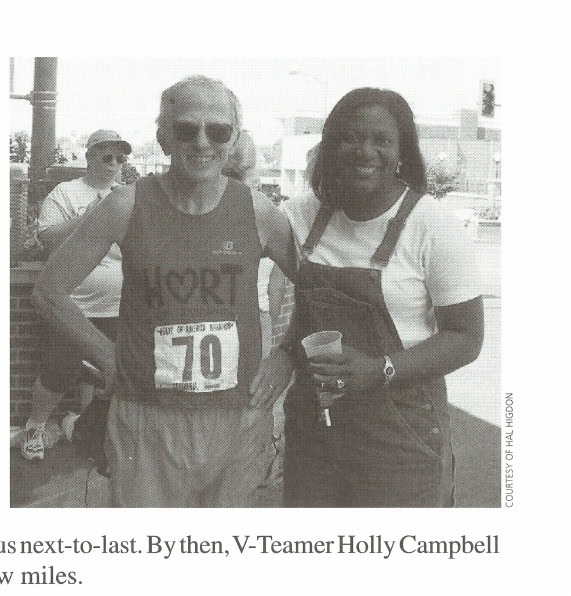
Near 22 miles, I overheard a woman in a car tell a course official, “He’s the last runner.” The irony of being recorded as finishing both first and last in the same marathon intrigued me. Alas, at 25 miles I passed another runner, thereby moving into a more anonymous next-to-last. By then, V-Teamer Holly Campbell had joined me for the last few miles.
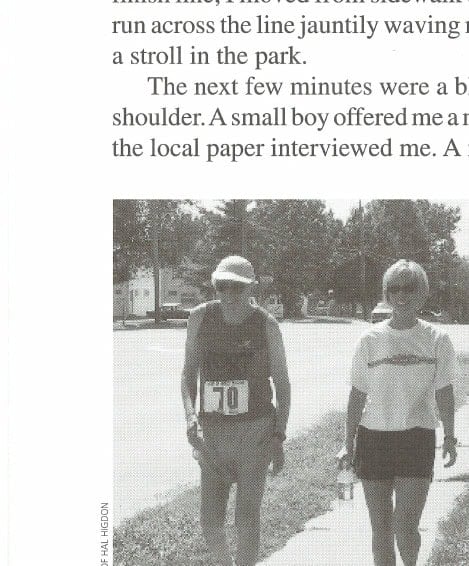
The last half mile was up the main street. About a hundred meters from the finish line, I moved from sidewalk to road, and Holly peeled off so that I could run across the line jauntily waving my hat and pretending like this was just like a stroll in the park.
The next few minutes were a blur. Someone draped a cold towel over my shoulder. A small boy offered me a medal, still in its plastic bag. A reporter from the local paper interviewed me. A number of other V-Teamers stopped to say hello.
My time in 126th place was 6:22:05, a Personal Worst by nearly an hour. Because of the time in the sun, it’s much tougher to run six-hours-plus than two-hours-plus. Joe Duncan said afterwards that the race had fallen short of its record entry, but there’s always next year. As my 7-7-70 quest continued, I had five weeks to prepare for Chicago and the anonymity of a larger pack. Despite my visit to the Far Side, I would not be wearing a propeller.
No article content found. Both pages are advertisements (Walt Disney World Marathon Weekend and Durango Marathon) and do not constitute an editorial article.
This article originally appeared in Marathon & Beyond, Vol. 6, No. 3 (2002).
← Browse the full M&B ArchiveMore like this
1,000+ stories from 19 years of Marathon & Beyond
The complete archive of the legendary long-distance journal — digitized and free to read.
