

One Jot Day At The Javelina Jundred
For more than a decade, I had wondered what my running limits were—marathons, two marathons a week apart, 30 miles, 50 miles, 75 miles. How much farther could I go? And each race went well, or not. Still, none had really tested my limits. And in that spirit, that foolish and naive “How bad could it be?” spirit, I entered my first 100-miler. The race that I chose for my first hundred was the 2005 Javelina Jundred in McDowell Mountain Park near Phoenix, Arizona. The pictures on the Web site were arresting—red dirt against deep blue skies, exotic cacti. I was enticed by the saturated colors and simple beauty of the desert. And if any 100-mile race could be fun, this would be it! The Web site advertised a 100-mile trail-running party with a costume contest and a “Best Ass” award to be determined by mooning the judges. And I really liked the spelling protocol that the Web site adopted. Of course there was the “Javelina Jundred” as well as “Jowdy Javelinas” and “Javelina Jeadquarters.” It all just seemed too cool two months before race time.
A friend of mine told me that, as a teenager, she had invented her own holiday—Hubris Day. To her, it was a day of being proud to be a nerd and a chance for her gang to celebrate its own quirky individuality. To Webster’s Dictionary, however, it meant a day of “excessive pride or arrogance.” As I anticipated the day of the race, I began to think that I was indeed guilty of hubris. But in the spirit of the Javelina Jundred, then, so be it—I would celebrate “Jubris Day.”
THE START In the Javelina Jundred, runners do six laps of the 15.4-mile Pemberton Trail and a final 10-mile loop. As the race director Geri Kilgariff says, the race is slightly over 101 miles long, because Javelinas can’t count! The race begins at 6:00 A.M., just as dawn overcomes the nighttime sky. With a “Ready, and Go,” 101 runners hustle off down the trail. The first part of the trail is soft and forgiving—hard-packed dirt. We soon start a gradual uphill, ascending the only elevated part of the course. All the runners
begin walking. We enter the rocky part of the trail, which would last about five miles, off and on. My feet slide around a bit inside my shoes as they jostle around the rocks on the trail. At this point, however, there are no worries. I meet Randy, who had completed the Badwater Ultramarathon, and run with Kevin Sayers, the Web master of one of the best sources of ultrarunning info (www.ultrunr.com). We pass through the two aid stations on the course—Coyote Camp at five miles and Jackass Junction at 10 miles—and cruise back into Javelina Jeadquarters.
My own personal sherpa, husband Mike, is waiting with a big grin and his ever-present camera. In addition to Mike, three aid-station volunteers offer to fill my CamelBak, slather me with sunscreen, spray my legs, fetch me food. This is living!
TEMPERATURES CLIMBING
Mike Renouf
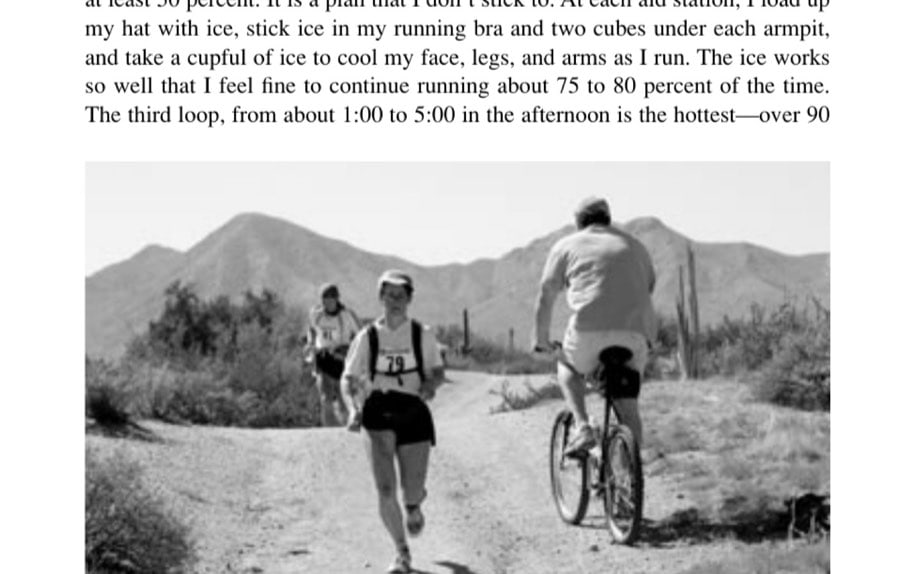
The second loop ups the ante. It is about 9:30 in the morning, and temperatures are climbing up into the 80s. My original race plan was to walk 12 minutes every hour, plus all uphills, until it got hot. At that point, I told myself, I should walk at least 50 percent. It is a plan that I don’t stick to. At each aid station, I load up my hat with ice, stick ice in my running bra and two cubes under each armpit, and take a cupful of ice to cool my face, legs, and arms as I run. The ice works so well that I feel fine to continue running about 75 to 80 percent of the time. The third loop, from about 1:00 to 5:00 in the afternoon is the hottest—over 90
▲ The author is feeling good at 30 miles.
degrees. I no longer feel great, but not really sick either. All the water and the two Succeed capsules every hour must be doing the trick. I feel that I have passed the test—I’ve made it through the hottest part of the day and can now look forward to cooler temperatures. It will all be downhill, so to speak, from here.
If only I had studied the laws of physics more thoroughly. For every action, there is a reaction; what goes up must come down; the heat that you store during the day will come back to haunt you during the nighttime. It is the fourth lap; I am past the halfway point, the temperatures are back into the 80s, but my race starts to deteriorate. We’ve passed the hottest part of the day, but my body will not cool down. If I run for more than five minutes at a stretch, I begin to feel like an overworked engine. If I had a tachometer attached to my head, it would show that the needle is hitting the red line very quickly now. I fall in with three other runners, Paul, Paul, and Kevin, all of whom are feeling nauseated like me. Talking with Kevin, a 100-mile guru, is especially enlightening. I learn that experienced 100-mile runners don’t whine about the conditions or how they are feeling. They figure out what their problem is and solve it as best as they can.
Kevin: “So, how are you feeling, Gay?” Gay: “Ooh, not so good. Sick stomach. Hot, really hot.” Kevin: “What do you think it’s from?” Gay: “Well, I’ve been drinking a lot, so I think it’s salt. At first, I thought it was not enough salt, but now I think it might actually be too much salt. I’ve been eating a lot of salty stuff, plus taking two Succeeds an hour, and that might be high for someone my size (110 pounds). Every time I wash down another Succeed, that’s when I feel worst.”
Kevin: “Well, what are you doing about it?” My conversation with Kevin is a turning point in learning how to run such a long race. What am I going to do about it? Things might be bad now, but they will improve. This is a chance to solve my problem. So I start walking much more (about 50 percent), reduce the Succeeds to one an hour, and take a piece of ginger. By the time I get to the next aid station, it is almost dark, and I’m feeling pretty good. That’s the secret, I figure. Get through the bad spots as best as I can by reasoning and fixing the problem, and eventually, eventually, a good spot will come. I am also cheered, as I will be many more times that night, by the voice in the darkness coming out of Coyote Camp, “Ath-a-letes comin’ in. Eeee-lite ath-a-letes comin’ in.” Well, elite we aren’t, but, yes, we are comin’ in.
GETTING TO KNOW AN OCOTILLO Up and down, nauseated and better, hot and cold: the fifth loop is much the same as the fourth until I hit my worst patch yet, just after going through Coyote Camp again. I sit and drink three cups of chicken bouillon and still feel queasy. Paul asks
Mike Renouf
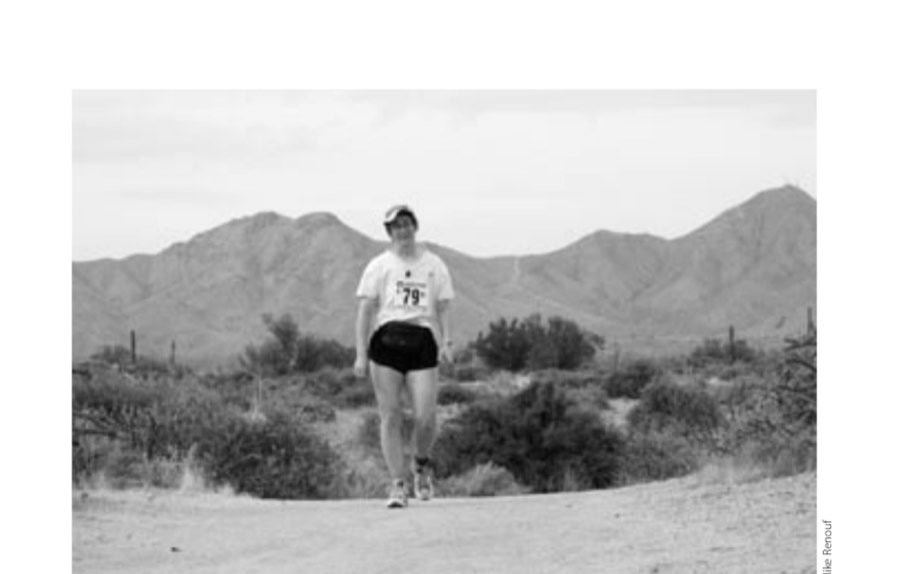
▲ The author hits a low point. She’s discouraged but not out.
me if I want to try a Pepto-Bismol tablet. I had never tested one in training, but I probably couldn’t feel worse. I swallow his last pink pill and walk off down the trail, but before I get even 100 yards down the trail, something very weird happens. I kneel down to throw up, and then, I suppose, I black out and then come to, with my torso and neck spasming as if I’m doing sit-ups. My glasses are in one spot, my headlamp in another, and my face is well scratched from landing in an ocotillo bush. Oh, this is bad, very bad. I slowly walk back to Coyote Camp and tell the medic there about passing out and having seizures.
You’re probably thinking now that this is where I quit the race, and it certainly is where I should have. After the race, I will wrestle with my race decisions. I will feel half-ashamed—I certainly won’t want to tell my mother or kids about how foolish I was. But I have to admit that I will feel perversely proud too, because, what I do is . . . I continue. I sit in the chair at Coyote Camp for a good long while and I feel better, in fact, much better. I eat and drink and know that I could walk, so I decide I would walk, only walk, to Jackass Junction. I walk for over an hour and feel so good, so very normal, that I begin to throw in a few minutes of running here and there. After passing through Jackass Junction, I feel better than I had since early that morning. I am running now, and running well. I haven’t decided definitively to continue, but I will gauge my decision by my husband’s reaction. If he looks at me as though I am nuts and announces, “No way, we are going to the hospital,” I will give in. But of course, Mike doesn’t realize he has
that responsibility. I am cheerful, completely lucid, and so he doesn’t mention that perhaps it isn’t the smartest decision to run another 25 miles. The only sensible part of my decision to continue is that Mike will be pacing me, and after all, he will be there to catch me and get help if I happen to pass out again.
LAST STAGES What I remember from the last full loop and the final small loop is the tally of pain. The soles of my feet feel bruised; perhaps all the blood in my body now resides in my feet! Each trip through the rocky section is torture—more slipping around in my shoes. Occasionally, I kick a rock and want to howl—something is wrong with my big toe. (It turns out that the nail is hanging on by only two shreds of flesh.) Each trip behind a cactus to pee is agony. I am chafing in parts better left unspecified, and when the salty urine contacts raw flesh, well, that makes me forget all about my feet. The last five miles are very slow. There are no bouts of running now. It’s a heads-down death march to the finish. The sun has risen again, and I can feel the heat once more. There’s that tachometer feeling again. Although my legs are comparatively good, I cannot run more than 20 or 30 steps without feeling that I’m redlining it. Two hundred yards to the finish, and I still can’t run the rest of
ad
Mike Renouf
▲ Elated, the author crosses the finish line.
the way in. I stop twice to walk, and even to drink, and finally, finally cross the line the last time. Earlier in the night, a volunteer helping me disinfect my facial scratches had asked me, had I cried? It was so ludicrous that I almost laughed at her. But I am crying now. Not an exultant “I’m the queen of the world” cry, not a relief cry or emotional cry. I just can’t believe how hard running 100 miles is and how much it has beaten me down. A photographer, Larry Gassen, invites me over for a finish line photograph, and Mike explains to me that Larry is creating a body of portraits of 100-mile finishers. He had told Mike that running 100 miles strips the runners down to their bare, essential spirit. I am certainly down to that now. I started the race thinking that it was my own personal Hubris Day, and I finish by staring into the camera, a little hopeful, a little tearful, knowing how very vulnerable I am. Like all the other runners that day, I could not have finished this event without the community around me—Mike; the incredible volunteers; my friends and family, half a continent away, thinking of me. I am reduced to my elemental spirit, but I am not alone. I f
inished in 27:25:33, in 30th place. Only 47 of the 101 starters finished the 100 miles.
This article originally appeared in Marathon & Beyond, Vol. 11, No. 3 (2007).
← Browse the full M&B ArchiveMore like this
1,000+ stories from 19 years of Marathon & Beyond
The complete archive of the legendary long-distance journal — digitized and free to read.
