

One World, Many Dreams
Running the World
One World, Many Dreams The walls in our lives are placed there to be surmounted. by Rebecca Byerly
“The brick walls are there for a reason. The brick walls are not there to keep us out. The brick walls are there to give us a chance to show how badly we want something. Because the brick walls are there to stop the people who don’t want it badly enough. They’re there to stop the other people.” Randy Pausch
For years, on hundreds of runs over thousands of miles, I had often heard an inner voice. The voice was telling me to write the stories of people who could not vocalize their own circumstances but who offered hope. I had been blessed to encounter many people, often while running in various parts of the world. But I was too haunted by my inaction and fear of failure to even attempt to write their stories. In April 2008, I finally summoned the courage to surmount my “wall.” Thus, while the world followed the Olympic torch last summer, I lit my own flame. As I documented the stories of the summer’s most extraordinary athletes—from a Tibetan monk in India and the oldest woman ever to run the Great Wall in China to a singing child jockey in Mongolia and a Cambodian Olympic marathoner—I learned that their heroism and the walls they overcame to compete speak to the indomitable spirit of the athlete. That spirit is one of the most powerful global connections.
The motivation to run the Great Wall Marathon in China and to document the summer’s stories was sparked by a speech by Randy Pausch, a college professor
diagnosed with pancreatic cancer in September 2006 and given a short time to live. He shared his wisdom with the world before he passed away on July 25, 2008. In his now-famous “last lecture” to students and faculty at Carnegie Mellon University, he talked about living his childhood dreams and overcoming obstacles. His words resonated with my soul. Their power reached a place that 10 months of living in India had drained. There are times in life when we realize that every detail of our journey has led us to this point, and we must listen to our intuition or remain secretly miserable. Like most important decisions in life, the most difficult part was simply showing up. Randy’s words tied my shoes so that I could finally step out into a larger world.
While in India, I remembered a Washington Post article that I had read in 2006 about the Great Wall Marathon in China. The picture with the story showed a runner barreling up the Great Wall. Now that is a life goal, I thought. That Christmas I sent a copy of the article to my running buddies and then, like a New Year’s resolution in May, forgot about the idea. Nearly two years would pass before the thought resurfaced. This time there was no backing out. My goal, however, was not just to run the wall but to tell the stories of struggle behind the marathon. Though I pitched my idea to dozens of publications, it was CNN that gave me a chance.
A shift of location, a change in goals The thing about overcoming walls is that others often fuel you. Though I was an experienced distance runner, I struggled to survive in the harsh conditions of New Delhi, and after almost a year in the polluted city, I was way out of marathonrunning shape. Thus, I headed to McLeod Ganj, India—the home of the Dalai Lama, Tibet’s exiled leader—to train and by chance met the Tibetan Olympic team. The team’s tenacity taught me that some walls are overcome by having the courage to make it there in the first place.
Early on in my stay in India, I found that McLeod Ganj was my refuge. Much cooler and cleaner than Delhi, the peaceful atmosphere provided the spiritual healing that I needed. Situated at the base of the Himalayas, it was an ideal place to train. But when I arrived in McLeod Ganj in early April, the environment had changed. Tibetans took to the streets in protest, held candlelight vigils and hunger strikes, and prayed for the unknown numbers of their people who had recently been killed, were missing, or had been beaten by the Chinese in their homeland. Media organizations flocked to the mountain town, and even Nancy Pelosi, the Speaker of the U.S. House of Representatives, came to show her solidarity. Eventually the media frenzy ended as hopes were dashed that the situation might change in Tibet. Staying on to train, I was privy to a very interesting yet virtually unreported story about the Tibetan Olympics. Thus, in the weeks leading up to
© JaysonCarpenter.com
the Tibetan Olympics and my trip to China, I had the opportunity to train with a few of these remarkable athletes. Thousands of miles from the Olympic Games that were to be held in Beijing, Lobsang Wangyal, a 38-year-old Tibetan from Dharamsala, arranged for 23 athletes to have their own version of the Olympics in early May. Sporting a hotpink suit and a long ponytail, Lobsang looked more like a Las Vegas late-night performer than the director of the 2008 Tibetan Olympics. He certainly stood out in the traditional mountain town. Though his fashion sense may have been a bit flamboyant, his passion for his people was clear. “The Tibetan Olympics are a platform for young Tibetans to celebrate the global spirit of the Olympic Games,” Lobsang told me. “In a way, we support the Olympics in Beijing. The Olympics should be a game for the people and not about politics.” He saw the Games as an opportunity for Tibetans who would rarely step out of the realm of their daily lives to try something different.
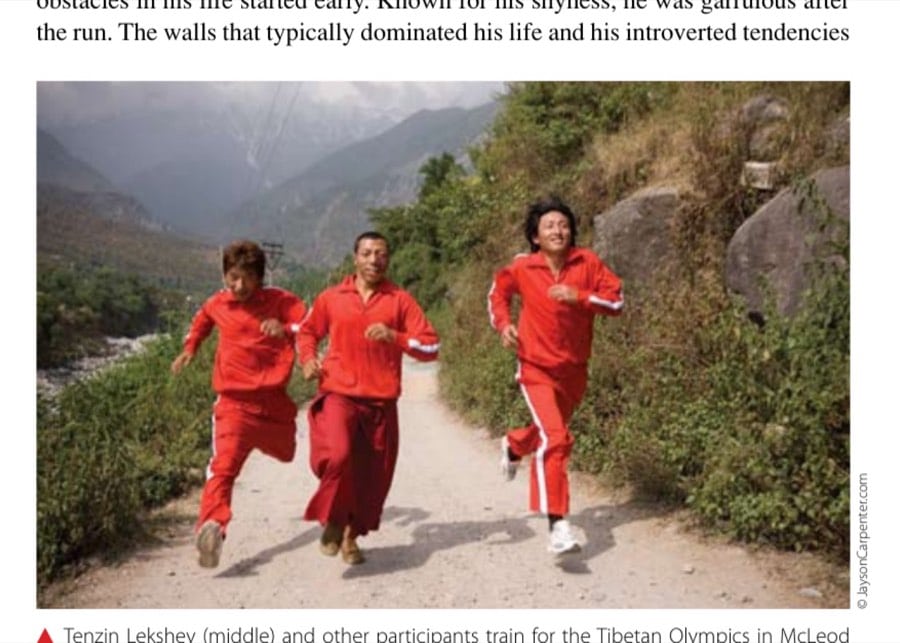
One of the athletes whom I was particularly fond of was Tenzin Lekshey, a 25-year-old Tibetan monk. As Tenzin sprinted by two of his competitors in a training session, even his monk’s robes and leather sandals could not hold him back. Crossing the finish line—a strand of Tibetan prayer flags—Tenzin flashed his crooked grin. He was born with a disfiguring skin condition, so the unspoken obstacles in his life started early. Known for his shyness, he was garrulous after the run. The walls that typically dominated his life and his introverted tendencies
▲ Tenzin Lekshey (middle) and other participants train for the Tibetan Olympics in McLeod Ganj, India.
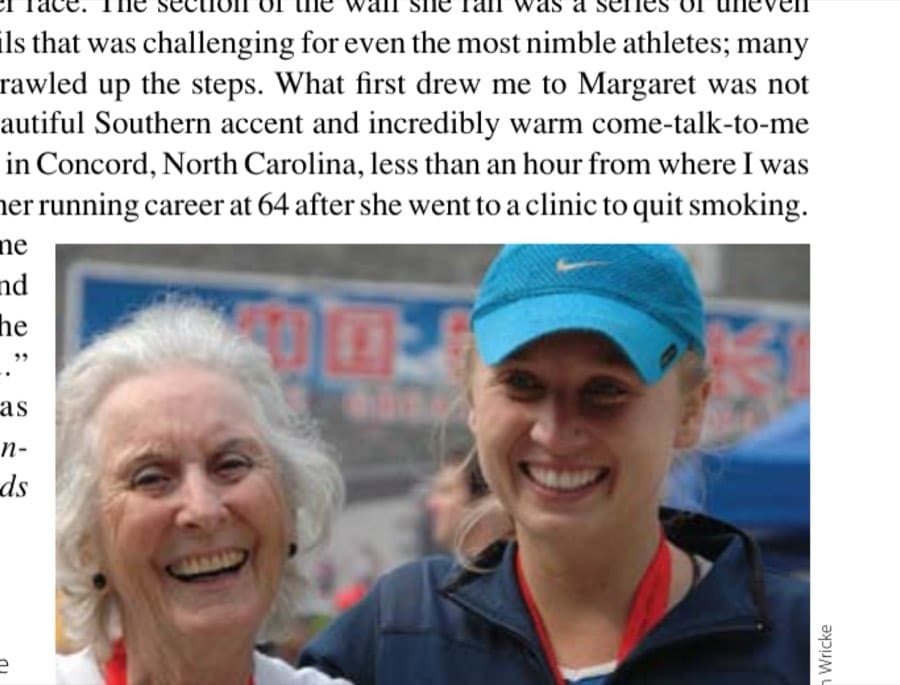
▲
Margaret Hagerty and the author at the Great Wall Marathon in Tianjin, China.
© Achim Wricke
vanished. At this moment, his whole world revolved around the attention he was getting for his running efforts. Thus, while he trained for the Tibetan Olympics in McLeod Ganj, I trained for the Great Wall Marathon, which is run through a remote village in Tianjin, an industrial town three hours from Beijing. Tenzin told me “I used to run the 100-meter dash and longer distances in school. Now I mostly play soccer with the other monks at my monastery. I am looking forward to the Tibetan Olympics and wanted to sign up as soon as I heard about them.”
To me, Tenzin was living Randy’s words. He had overcome many barriers to be training here, and by that had inspired me to keep running toward my own great wall. Training with Tibetans was ironic because I was preparing to run in China, the country responsible for countless human rights violations against the Tibetan people. By the time I left for China on May 13, I was filled with apprehension about the people behind the Red Curtain. The horrific stories that Tibetans told me about the torture the Chinese inflicted on their people, combined with the growing restrictions on traveling to the country and intense media coverage of the various human rights abuses, had led me to accept quite a few stereotypes. I sought to overcome these misgivings by talking with as many people as I could and in the process learning more about the Chinese people and their country. Once in China, I not only gleaned a much deeper perspective of its people but also discovered the summer’s next courageous athlete.
For me, the story of the Great Wall Marathon was about Margaret Hagerty. At 85, she was the oldest recorded person to run the Great Wall when she competed in the 10-kilometer race. The section of the wall she ran was a series of uneven steps and steep trails that was challenging for even the most nimble athletes; many runners literally crawled up the steps. What first drew me to Margaret was not her age but her beautiful Southern accent and incredibly warm come-talk-to-me persona. She lived in Concord, North Carolina, less than an hour from where I was raised. She began her running career at 64 after she went to a clinic to quit smoking. “The doctor told me to stop smoking and start moving,” she said. “So, I did.” In 2007, she was listed in the Guinness World Records
as the oldest woman to run a marathon on every continent, including Antarctica. This woman, more than three times my age, did not start running or traveling until she was in her sixties, and now in her mid-eighties, she had no intention of slowing down. In fact, when I asked her what she plans to do when she can no longer run, she replied, “I am going to learn to play the piano.” She showed that age was only another wall to be bounded over and left no excuse for the rest of us to sit here passively contemplating our own walls.
Removing one brick at a time The Great Wall Marathon also offered the opportunity to remove a few more bricks from my own wall. The day before the race, I purchased a camera. Although far from being a photographer, I learned that I could run a marathon while taking pictures and then write about the adventure. Thus, my first story for CNN.com was published a few days after the race, and by that process, a section of my wall was removed. The time in Beijing also provided me with the opportunity to learn more about the Chinese people and to witness the spectacle that was unfolding in the capital city.
If India was pulsating with cows, cars, and people, China was more like a Chia Pet; you could literally watch the city grow. Whole forests were planted on the side of the road while outdated buildings were torn down and rebuilt in just a few weeks. Every day I would get lost in the historic winding alleyways called houtongs while trying to find my hostel. I realized that it was because the storefronts and roads that I had passed in the morning had changed by the time I wandered home in the evenings. Everyone took part in the construction. One could literally watch Chinese restaurant owners fry bread dough with one hand and paint the outside of their newly constructed stores with the other. There was an incredible buzz in the city because no one knew what to expect. Chinese people would approach me on the streets and practice their English in preparation for the Games. Unfortunately, many people were adversely affected by all the preparations. Peng, a tailor and friend, said her rent tripled in the months before the Olympics, and she could not leave Beijing to see her family in the countryside because she would not be able to get back into the city until the Olympics were over. There were countless stories of people like Peng—everyday workers who lost months of their salaries because they were booted out of Beijing or had to endure ridiculously high rent and higher taxes on everything from petrol to flour. Now, nearly six months after the Games, I wonder whether these people have recovered.
One of the stereotypes I had of the Chinese people was that they were devoid of emotion. This image was due to the stoic images of Mao and the various stories I had heard about his tyrannical command that people not show emotion, listen to music, or read books outside of those he selected. I assumed, incorrectly, that the
aging Chinese, who grew up under these strict rules during the Cultural Revolution, still followed the tenets of Mao’s teachings.Thus, I was surprised to learn how entrenched dancing, singing, and laughter are in their lives today.
Before the sun has fully risen, one can already hear booming music reverberating from the parks scattered through Beijing and other cities in China. A haven for the aging Chinese, the sports divas belted opera at the top of their lungs, salsa danced, and clipped along to the fox trot. They played table tennis, raced each other in writing Chinese characters with giant paintbrushes, and even engaged in rhythmic sword fights. This was a side of China that never made the headlines during the Olympics.
The day I left Beijing for my next story, I was in a taxicab in front of Tiananmen Square when suddenly everything in the city stopped. At first, I thought there must be a horrific accident. Why else would traffic be at a standstill? However, when I saw the faces of the people who stepped out of their cars and quietly wiped tears from their eyes, I realized the meaning of the event. A week after the May 12 Sichuan earthquake, one of China’s worst natural disasters, the government had arranged for three minutes of silence to remember the nearly 90,000 people who were dead or missing. As I watched tears stream down their faces, I looked into my own misgivings and saw a softer side to the people behind the Red Curtain.
The truth about Uighurs In late May, I boarded a plane to Urumqi, the far-distant capital of the Xinjiang Uighur Autonomous Region in northwestern China. The city stood in stark contrast to Beijing. All signs are written in three languages—Uighur (which uses Arabic script), Russian, and Chinese. Since the 1950s, the Chinese government has promoted development in the region and has enticed millions of Han Chinese with economic incentives to come to this remote province. As a result, the Uighur population, which is ethnically Kirghiz and predominantly Muslim, dropped from 90 percent to less than 50 percent. I had done some research on the area and learned that the city was home to the Xinjiang Flying Tigers basketball team. I had planned to write a story about the challenges the Chinese team faced in the Uighur region. Once in Urumqi, however, I learned that few people attended the games because the basketball team had not had a successful season and no one was particularly interested in talking about the team. Disheartened, I went to Fubar for a drink. Fubar is the only joint in town for expatriates. The modern bar offered everything from pizza with horsemeat to any kind of beer or liquor you could desire. I took a seat at the bar. Though I told no one that I was a journalist, the owner/bartender, a New Zealander in his mid-30s, took one look at me and pegged me as such. When he found out that I wrote for CNN, he nearly kicked me out of the bar. He was worried about the growing security measures in the area and
did not want to be associated with any media. This particular area of China was under high security because of recent uprisings among the Uighur people. Every day, tighter security measures were being introduced as people prepared for the Olympic torch to go through the city. The bartender said that he could not wait for the “Godforsaken Games” to be over so he could return to business as usual. After a few beers, our conversation flowed easier, and mutual respect developed as we learned that we were both runners. Thus, my next story idea was born in conversation over a beer. “
You are a runner?” he asked. “Yes,” I replied. “Do you know there is a 250-kilometer race outside of Kashgar next week?” “What?” I asked, suddenly excited. “Yeah, it’s a real tough six-day stage race,” he replied. “It’s put on by RacingThePlanet, an elite running organization that puts on these types of races all over the world. It costs a fortune to participate. You have to have your own supplies and be in really good shape.”
I felt that I had a lead on a really good story. I had to make this happen. What a perfect opportunity. I immediately looked up RacingThePlanet and e-mailed the race director and then my editor at CNN. A few days later, I was in the race, the Gobi March, covering the story for CNN. I found myself running around Urumqi trying to get supplies. Finding a size 12 running shoe in China is grounds for a sitcom; no one believed it was possible for a woman to wear a shoe that large. (My feet are really not that big, but I had to get a shoe that was a size and a half bigger than I would normally wear because my feet would undoubtedly swell during the race.) I must have looked totally distraught and completely lost because a teenage Chinese girl approached me on the street. She asked in nearly perfect English whether she could help me with something.
ad
A home away from home
© Wouter Kingma/RacingThePlanet Limited
Yes,” I replied and asked where the shoe store was. She not only showed me but also explained to the clerk why I needed the biggest shoes in the store. She then invited me to dinner with her family. This random act of kindness was part of
the endless generosity of traveling that never ceased to amaze me. Those simple gestures of selfless humanity leave an indelible impression. Her kindness was a reminder that whenever we have the opportunity to open our doors to another, we
should. Her parents, part of the growing middle class in China, went out of their way to make me feel comfortable. We ate watermelon over plastic buckets while watching the Chinese version of American Idol on the television in the living room.
We then dined on several delicious dishes for dinner. They asked a few questions about America, but they mostly wanted to talk about their daughter’s education. Neither seemed particularly interested in the Olympics because Urumqi was so
far from Beijing. They marveled over my being a young woman traveling abroad and smiled shyly as they recounted their youth. They both thought the Chinese government had done a good job with the earthquake relief and had given several
days of their wages to help the victims of the quake. Another wall was broken as my perspective of the Chinese people once again changed. With new running shoes and minimal supplies, I flew to Kashgar to meet the
other competitors in the Gobi March. The race was going to take us through Ui-
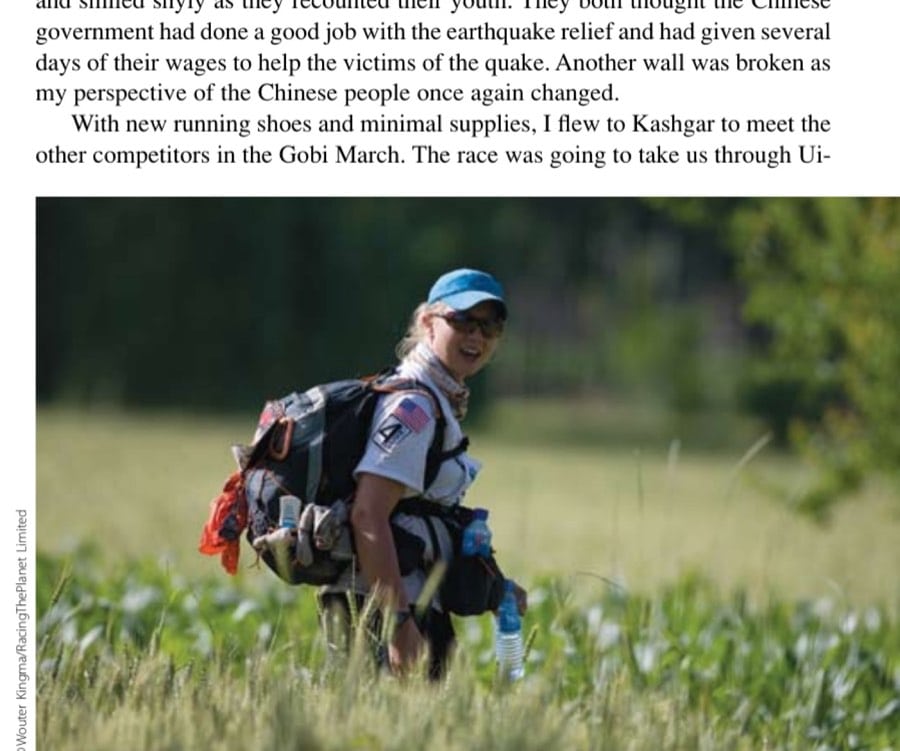
▲ The author walking through a Uighur village during the 2008 Gobi March in China.
ghur and Kirghiz villages, over mountains, and through sweltering, cactus-filled deserts where the temperature would soar to 120 degrees. Instead of stressing about the race and how underprepared I was, I realized that I was going to have to find a stronger place within myself and meet the challenge. What I did not realize at the time was the countless ways the other runners would help and the crucial role that humor would play.
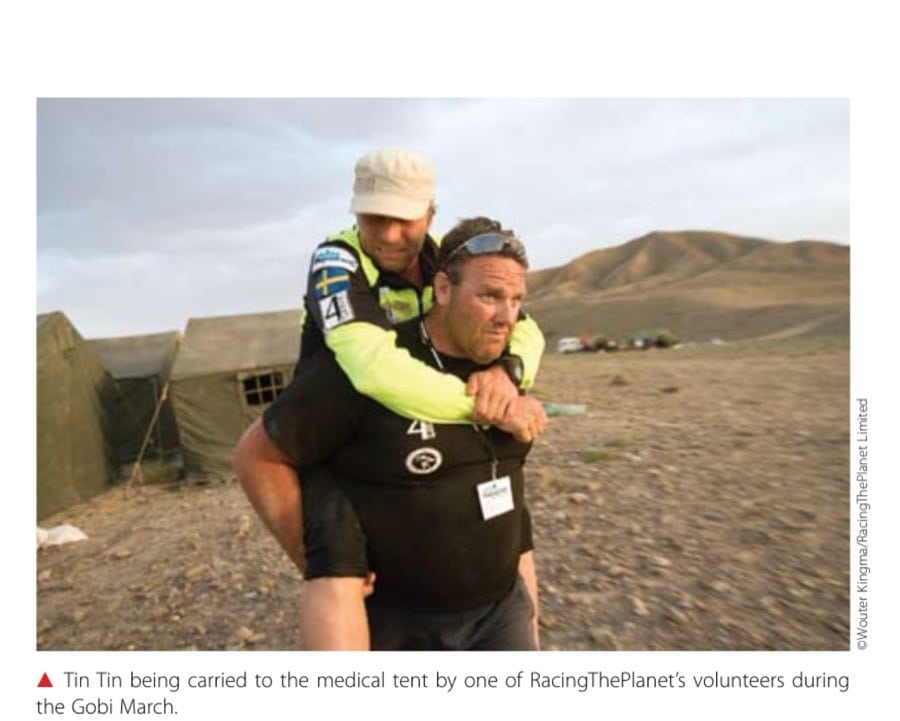
Though some of the athletes, like ultramarathoner Dean Karnazes, were superstars, most of the runners who took on the Gobi did so out of a thirst for adventure or to test their limits. The story of this kind of race was not the quick times of the front-runners but the courage and determination of the people at the back of the pack, people who were running or walking at their absolute limit, adapting as Mother Nature or their own inexperience threw down the gauntlet. “I always do things the hard way,” grimaced Kenneth “Tin Tin” Johansson, a 43-year-old professional athlete from Sweden. The night before, I had watched in horror as he pulled off his shoes and the layer of skin on the bottom of his foot slid off, along with two toenails. Despite the pain, he mustered the strength to start the race the following day. Barely able to walk, through sheer determination he climbed to Heaven’s Gate. More accurately called Shipton’s Arch, it was first made known to the world in 1947 when English explorer Eric Shipton mentioned it in his book Mountains of Tartary. Nearly 1,200 feet tall, roughly the size of the Empire State Building, the arch was a beacon for Tin Tin and me to get to the top of the mountain.
Laughing through the pain “This is good training for climbing Everest,” joked Tin Tin with a forced smile, as we paused to look at the stunning mountain views. The Gobi March was his second 4Deserts race put on by RacingThePlanet, which stages a global series of 250-kilometer, self-supported footraces across four of the world’s deserts each year. He planned to complete all four and climb Everest in a year. As the day wore on, his condition worsened. But what could we do? We were stuck in the middle of the desert with only a camel on the course to take us to safety. Instead of being negative, we realized that the only thing that was going to get us through the day was laughter. By allowing ourselves to laugh at the craziness of our situation, we overcame our fear and made it to the finish line. When we reached the finish, Tin Tin was transported by medevac back to Sweden because he was having chest pains from the intense stress he had put on his heart during our 13-hour, 42-kilometer day. We managed to joke through the tears that rolled down our faces as he was carted off to the hospital. I learned that sometimes overcoming a wall is simply having the courage to be there for a friend and, no matter what the obstacle, take the positive road.
© Wouter Kingma/RacingThePlanet Limited
▲ Tin Tin being carried to the medical tent by one of RacingThePlanet’s volunteers during the Gobi March.
Tin Tin’s strength and ability to laugh stayed with me, like Randy’s words, into my next escapade in Mongolia. After the Gobi March, my best friend, Bridgette, a runner and an accomplished photographer, joined me. She is one of the toughest people I have ever met and was the ideal travel companion as we faced many hurdles in getting our next story.
Modern day nomads In an epic journey that would have made Genghis Khan, Mongolia’s founder, shutter, we went to the extreme north of Mongolia to ride horses for 10 days and then planned to run the 100-kilometer Sunrise to Sunset Ultramarathon, held near Lake Hovsgol in the northern part of the country. However, after the horse trek, we broke down on the way to the race, were stranded for two days with limited supplies, and made it to the start of the race only an hour before it began. I was already exhausted, so the 100 kilometers (62 miles) was the most grueling 19 hours of my life. I finished the race second to last, aching from head to toe and drained in mind, body, and spirit. The journalist in me, hungry for the next story, woke my tired, aching body after only three hours of sleep and dragged my virtually paralyzed legs out of bed and onto a flight to Ulan Bator, the capital of Mongolia, to cover the Naadam Festival.
© Bridgette Auger
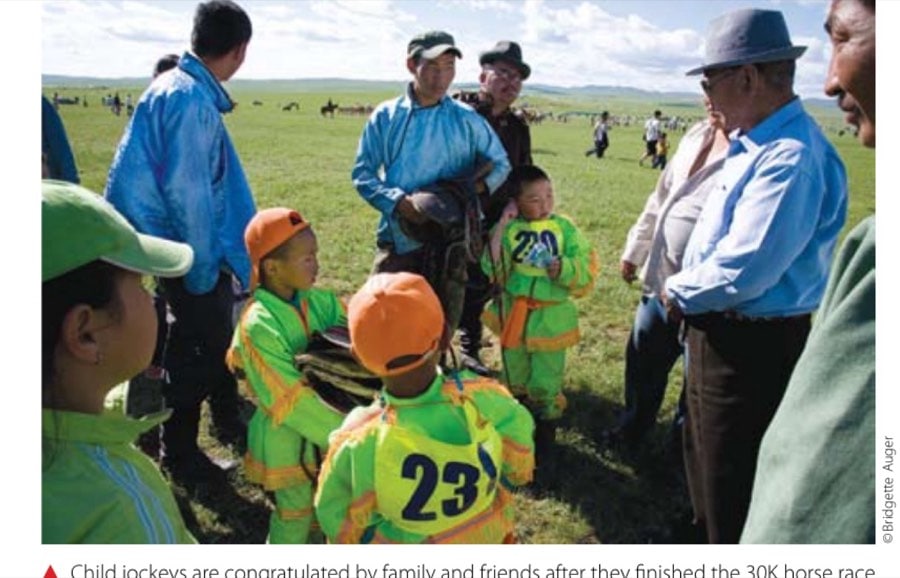
Genghis Khan started the Naadam Festival more than 800 years ago as a way to train his soldiers for military and hunting expeditions. Today it formally commemorates the 1921 revolution, when Mongolia declared itself a free country. One of the events in the two-day festival is a 30-kilometer horse race across the Mongolian plains. The age limit for riders was raised from 4 to 6 when one of the children was killed in a race several years ago. “Raw” is the only word I can use to describe the present-day Naadam Festival. After the race, one of the tykes, who stood no more than 4 feet tall, slid off his sweat-soaked horse. I asked him what the most difficult part of the four-hour ride was. “It was hard to sing to my horse while riding the whole race,” he replied. Mongols believe that they can communicate with their horses through singing and that it is a sacred act. For these stoic athletes, the importance of the race was not finishing first or the physical demands of the sport but rather the ancient tradition of singing to their horses. I understood what the boy’s comment implied: the walls overcome by continuing to sing through physical pain are what have kept this tradition alive for hundreds of years.
Still very much like the Wild West, Mongolia is an extremely difficult country to travel in. Just being a spectator at the horse race was an Olympic event because most of the local people turned out on horseback to watch the race and did not heed pedestrians. The spectacle reminded me of a charged crowd at an American
▲ Child jockeys are congratulated by family and friends after they finished the 30K horse race during the Naadam Festival in Mongolia.
football game, except that the Mongolians clutched the reins to their horses with one hand and their liquor bottles with the other. There is nothing more frightening than having just finished a 100K race, not being overly mobile, and having a stampede of drunken Mongolians on horseback galloping toward you. Bridgette and I were grateful that we managed to hobble out of the way. We had to laugh at the situation because no one understood why we could not walk.
The lessons in laughter, which started with Tin Tin in the Gobi, were reapplied in Mongolia the next day as we drained our energy reserves to attend the wrestling, archery, and anklebone-shooting events. Anklebone shooting was designed to strengthen Mongols’ forefingers so they could be better archers. Competitors now use pieces of deer antler instead of anklebones. The objective was to flick the antler at a target several yards away. Accompanied by a translator, Bridgette and I argued our way into the wrestling locker room. The comedy came into play as two blue-eyed, fair-skinned, blonde American women stood in a locker room full of 300-pound-plus professional Mongolian wrestlers. Not easily intimidated, I approached the biggest wrestler. His coach said that he did not talk before a match. After we walked away, our translator politely told us, “That guy is like the David Beckham of Mongolian wrestlers. Perhaps you should pick another wrestler.” We did. Gantogtokh, an eighth-generation wrestler, talked with us as he packed his bag, having been eliminated from round six of the nine rounds of competition. Weighing in at 120 kilos (264 pounds), he proudly told us about his father, who was the first Mongolian to represent his country in the Olympics. Gantogtokh had competed in the Naadam Festival for 22 years. Once a star, he recognized that his competitive days were drawing to a close. He hoped that his 12-year-old son, who was already competing in the children’s division of the Naadam Festival, would one day be a champion.
On to Cambodia After the festival, I flew from Mongolia to Hong Kong to meet my editor at CNN. While in Mongolia, I had jumped through the summer’s visa hoops and had managed to get a visa back to China and had even purchased Olympic tickets. But, after meeting with my editor, I learned that I would not be going back to Beijing. With most of CNN’s journalists in China, my editor did not need me to cover the Olympics. Secretly relieved, since I did not want to deal with the chaos in China, I asked him where he needed journalists. “
Well, we don’t have anyone in Southeast Asia right now,” he replied. That was all I needed to know. With another layer of bricks removed from my wall, I knew that I could find a story. After our meeting, I Googled Cambodia and learned that the country would hold its national elections the same week. I boarded a plane to Phnom Penh, the capital, the following day.
▲
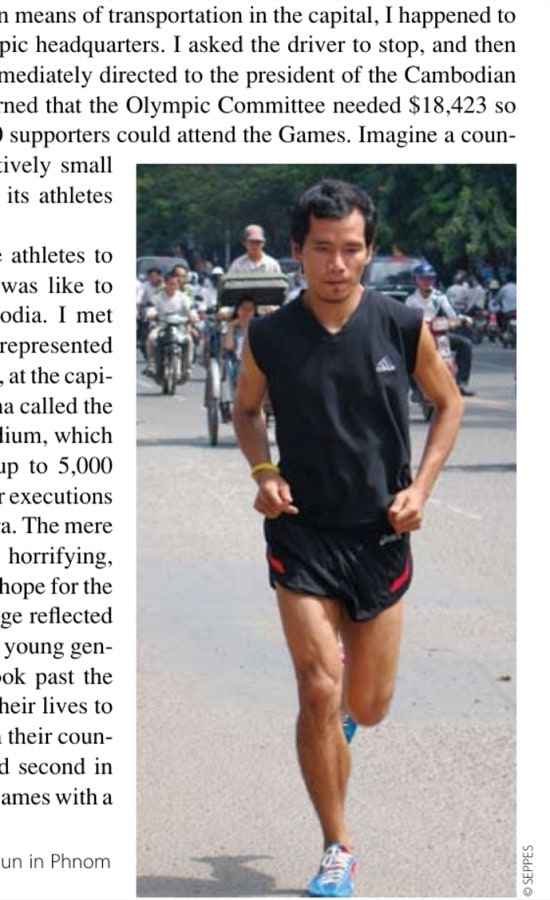
Hem Bunting on a training run in Phnom Penh, Cambodia.
© SEPPES
When I landed, my story changed. I was greeted by directors of nongovernmental organizations, private investors, and government officials, and my knowledge of the country deepened. Through conversations with Cambodians and foreigners who had come to help improve the country, I found that Cambodia’s sports programs, economy, and infrastructure had been destroyed during the Khmer Rouge reign. Between 1975 and 1979 an estimated 1.5 million people were killed. The government now focused first on lining its own pockets and then on building roads, providing electricity to the hundreds of thousands without power, and providing fresh water. With so many immediate needs, there was limited funding for education, let alone for sports programs.
The story would soon take another unexpected turn. While clinging to the back of a motor scooter, the main means of transportation in the capital, I happened to pass the Cambodian Olympic headquarters. I asked the driver to stop, and then I dropped in for a chat. Immediately directed to the president of the Cambodian Olympic Committee, I learned that the Olympic Committee needed $18,423 so that its four athletes and 10 supporters could attend the Games. Imagine a country in need of such a relatively small amount of money to send its athletes to the Olympics.
I wanted to meet these athletes to better understand what it was like to be an Olympian in Cambodia. I met with Hem Bunting, who represented his country in the marathon, at the capital’s dilapidated sports arena called the Olympic Stadium. The stadium, which has the capacity to hold up to 5,000 spectators, became a site for executions during the Khmer Rouge era. The mere thought of this violence is horrifying, but Hem’s tenacity offered hope for the country’s future. His courage reflected the strength of Cambodia’s young generation, which wants to look past the scars of war and dedicate their lives to bringing positive change in their country. At age 22, Hem placed second in the 2007 Southeast Asian Games with a
time of 2:26:28, which qualified him for the 2008 Olympics. Standing in front of his tiny, ramshackle apartment, which is inside the stadium, he informed me that he did not have the basic things he needed to train, such as nutritious food and decent clothes. Hem did not even have proper shoes until he was sponsored by the Australia and New Zealand Bank. His conviction moved me. He understood that he was breaking through the wall for future Cambodian Olympic athletes.
Growing up in a village that did not have electricity, Hem had been educated in a school built with foreign aid and now studied development in the capital. Convinced that education was the only way his country was going to move forward, he dreamed not to be an Olympic champion but to take part in the development of his country through education. He hoped that one day, with the help of private donors, he would be able to develop a sports program so that future Olympians would have a more equal playing field on which to compete. Hem placed 73rd in the Olympic Marathon in 2:33:32. Though he was disappointed with his performance, his success was making it to the Games. As often happens in life, by being flexible and persistent, I found that the story had transformed from elections to the needs of Olympic athletes. With the Cambodia story complete, I sensed a transition within myself.
After Cambodia, I decided to skip the Olympics in Beijing altogether and headed to Thailand to reflect. Drained but content, I knew that it was time to regroup. The last lesson I would learn was not from an Olympic athlete but from Australian Wade Mallet, a fellow traveler and kindred spirit who sat next to me on the 17hour bus ride to Bangkok. As we talked over blaring Thai music, I tried to recap the remarkable summer, which had started as a dream just four months earlier. I realized that every person I had encountered—from Lekshey to Margaret to Tin Tin to the tiny child jockeys in Mongolia to Hem—had helped me overcome my personal wall, while they overcame their own. Now, I wondered what the next steps would be, and I grappled to make sense of the lessons learned. Wade, who has since become a life-long friend, sensed my need to understand, and his wise advice helped me recognize the final wall. “
There are times in life when you go for it and break through the walls that stand in your way,” Wade said. “Then, there are times when you use that wall as a safety zone to take cover, rest, get your breath, and build your strength and trust in yourself. Then, you will know when to go for it again, when to push through the next wall.”
It was time to be still. The summer’s dream was complete, as I had watched determination triumph over the walls of the world.We all have within us the spirit to overcome. My wall was knocked down, not by pounding at it with my fist but by listening to and telling the stories of champions who faced and conquered more substantial walls than I ever knew existed.
This article originally appeared in Marathon & Beyond, Vol. 13, No. 1 (2009).
← Browse the full M&B ArchiveMore like this
1,000+ stories from 19 years of Marathon & Beyond
The complete archive of the legendary long-distance journal — digitized and free to read.
