

Pacing As Soulcraft
My ex-husband was a big, handsome guy—lumbering, soft spoken, quick to make a gentle joke. But you would never call him graceful. Not unless you saw him on skis. On skis he was balletic. He moved so sweetly that the first time I saw him go down a mountain I felt like he’d been keeping a secret from me.
When we first started seeing each other, it had been years since I’d participated in winter sports. I’d skied as a kid, then easily gave it up. Too much gear, too much travel, too much money, too much hassle, too much cold. So I was, when we first went to Killington for a weekend, a bit rusty.
My future ex-husband did for me what ski instructors, parents, and dance partners do: he let me follow in his tracks. Turn when I do, he said. Keep your eyes on my back. Don’t think, just follow. I did. And we got down everything—green, blue, and black. He didn’t do the skiing for me—it was my own muscles and sense of balance that kept me upright and moving down the hills. But he showed me the way. We were perfectly harmonized. It was like dancing. It was like sex.
Often in athletic endeavors, it’s our heads that get us into trouble. It’s a gift to be able to put our bodies in the hands of others, to turn off the noisy mind and settle into a path that’s already been carved.
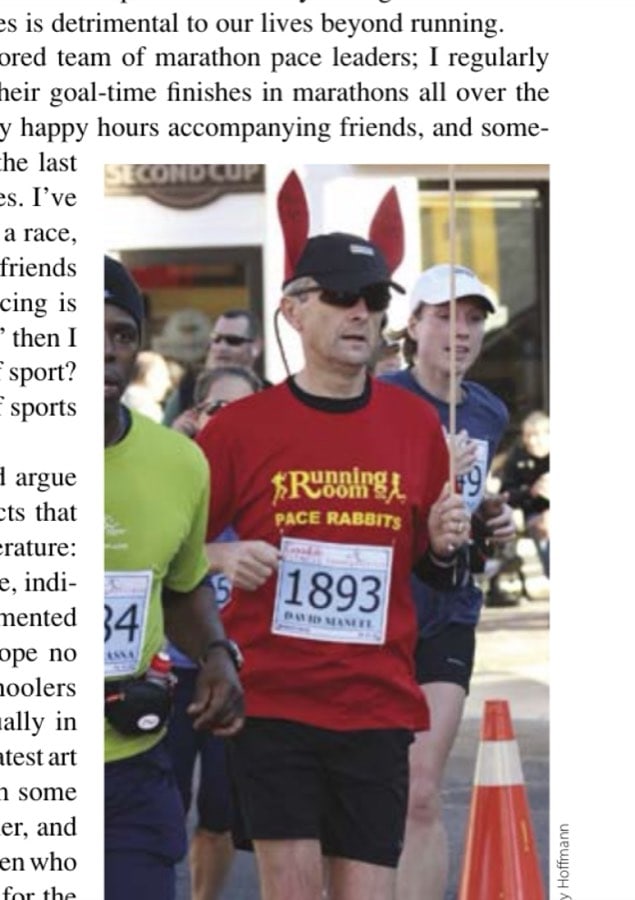
When I proposed an article about pacing in all of its various incarnations— from the elite rabbits who are paid to set a pace, to marathon support groups, to those of us who love nothing more than to accompany runners for the last portion of a 100-mile race—to an editor of a running magazine, he said that he hated pace groups. They take up a lot of space, he said, sometimes forming a human barrier that individual runners have a hard time penetrating. He also related a bad experience where, at one marathon, the nearby sound of a pacer’s voice was enough to force him to run faster than he’d planned just to get away from it. It was, he said, like torture. That I can understand. Some of these pacers do sound
like drill sergeants, barking orders the whole way, never allowing for the silence that lets you travel into your own thoughts. What I didn’t understand, though, was that he thought the story would be of limited interest: “Of the thousands of people who race, maybe a tenth of a percent ever pace someone else (at least officially).” This editor, a sharp and kind guy who has been around a lot of running blocks, continued, “Then there is the feeling that pacing is somehow against the spirit of the event—that learning how to pace yourself is one of the skills of running.”
Perhaps back when I was a hardcore marathoner I might have seen his point. But now I don’t. And not only that, I believe that the small number of purists who believe in keeping alive the “spirit of the sport” are actually killing it and that the logical extension of these values is detrimental to our lives beyond running.
I was formerly on a sponsored team of marathon pace leaders; I regularly escorted groups of people to their goal-time finishes in marathons all over the country. I have also spent many happy hours accompanying friends, and sometimes new acquaintances, for the last 20 to 40 miles of 100-mile races. I’ve never been an official rabbit in a race, but I have unofficially led my friends to PRs. If you believe that pacing is against the spirit of “the sport,” then I have to ask, what is the spirit of sport? What, indeed, is the purpose of sports in our culture?
There are some who would argue it’s one of those classic conflicts that are a necessary ingredient of literature: you have humans against nature, individuals against society, and tormented souls against themselves. (I hope no one is still teaching high schoolers that it’s “man” who is perpetually in conflict. Surely much of our greatest art is about man against woman in some kind of attempt to come together, and even more surely, often it’s women who are doing the heroic feats.) So for the purists, the sport of running is woman
© Tony Hoffmann
At odds with the editor’s philosophy
against herself, against the clock, against the competition, and against the terrain. Adding another human helper into the mix somehow waters it down. But does it? If Alberto Salazar had let frisky Lance Armstrong go as fast as he felt like in the early miles, the world’s best athlete would have no doubt crashed and burned far worse than he did in his first 26.2-miler at New York. He might have learned a lesson and the next time might have taken it out more slowly. But Salazar doled out nothing more than the benefit of his experience. Does that constitute cheating? Does it go against the spirit of the sport?
Big races pay fast “rabbits” to set a fast pace. They keep the top competitors from dogging it and running tactically just to win; they pull along those who want to chase records. Khalid Khannouchi once told me that the reason he bombed in his debut marathon as an American citizen was that the rabbit went out too slowly. The unaccustomed pace forced Khalid to change his stride, and he ended up with race-ending blisters. It’s a big responsibility, this pacing. Rabbits get paid well because there can be a lot of money on the line.
The challenges of being a pacer But even when there’s no money at stake, it’s still nerve-racking to know that people are counting on you. Everyone I know who has paced a marathon is an extraordinary athlete. Pacers tend to compete in their own events—marathons, ultras, and Ironmans. When it comes to other people’s races, they are able to finish within plus or minus two minutes at the half and no more than a minute fast after 26.2 miles, regardless of the conditions. They do it while talking the whole time, telling stories, offering advice, soothing away the miles. But they don’t do the running for anyone. They just keep track of the pace, kind of like having a human Garmin.
Pacing the last portion of a 100-mile race is a similar and different thing. Running through the night on gnarly trails can be a dangerous game, especially after you’ve already run 60 or 70 miles on your own. Having someone around to brush you off when you fall, suggest that perhaps you take a drink or try to pee, and shine an extra flashlight on the trail just plain makes sense. I don’t understand the people who do 100s without pacers. If they get into trouble, they must rely on others who are doing the race, or those who are pacing, to help them out. An airline pilot once asked me if I knew why there were flight attendants on the plane. “Um,” I said, “to bring the drinks and peanuts?” “No,” he said. “Because the FAA says they have to be there. They’re for your safety in case of an emergency. Most of the time, you don’t need them. You don’t want, in fact, to need them. But it’s good to have them around just in case.”
I’ve never done a one-day 100-mile race, and I don’t want to. I am, however, always game to pace someone. (Ask me! I’ll go!) It’s because little means more to me as a runner. And that is because I see pacing as soulcraft.
Millennials and volunteering You’d be hard pressed to find a high school student in the United States who doesn’t do some form of community service. It’s a function of their generation, the group now referred to as the “millennials,” born between 1978 and 1998. Sometimes they do it because it’s required, like gym class or arriving at school on time. But more often, I think, it’s out of a reflexive concern to do good in the world, even if only because it makes them feel better about themselves.
It’s too facile to complain about “kids today”—not that this stops me from doing it. Sure, I can be as pissy as the next guy about the narcissism and selfcenteredness of the millennials. But I tend not to hold it against them. For me, the blame goes to the hovering, helicoptering parents of my generation, the boomers who tell their kids that they hung the moon, that the world revolves around them, that people really want to read stories about their poop. The children of blinded, doting parents have become giant pains in the butt for those who engage them as volunteers (say, at marathons), as teachers (often, parents do the homework and come in to discuss it), and as employers.
In summer 2008 William Deresiewicz wrote an article in The American Scholar describing why, after 10 years of teaching at Yale, he was giving it up. It was the students. He railed against the entitlement, the anti-intellectualism, and the
ad
careerism of the kids, charges that, by the way, have been hurled against Yalies and other products of fancy-pants schools for more than a century. Deresiewicz— who starts his essay by claiming that having gone to Columbia and teaching at Yale left him unable to make small talk with a plumber who had come to fix his pipes (I am not making this up)—assumes that all of his students are rich and that this is the root of the problem. I know, from working in elite college admissions, that’s simply not the case. More than half of these students are on financial aid, but they learn quickly to be embarrassed by and hide their family’s finances and to act as rich and bratty as their rich and bratty friends.
While I believe that the millennial generation has been ill served by a national epidemic of ambitious, barnacle-like parents, especially from the more comfortable classes, the majority of “kids today” are guided, I think, by a different set of values. The students I teach (at a regional, comprehensive university) are often the first in their families to attend college. They approach learning as a privilege, not a right. They work hard—often many hours a week to pay for school— but they also toil at making the lives of others better. They believe that everyone should get a fair shake, even as they understand that life is not fair, and they do what they can to help out. They often don’t care as much about winning as they do about the feelings of those who lose. They do their community service because they understand something about community, something that the “Me” generation skipped. Despite an irritating tendency toward, well, childishness, the millennials’ progressive values are, I think, shaping the way the world works, and I’m not sure that’s a bad thing. It may even change running.
Rethinking running and racing Racing is, by its nature, a zero-sum game. If somebody wins, somebody else loses. Duh, right? But does it have to be that way? Is there a different way to think about running, if not racing?
I am weary of the charges against “American running,” whatever that is. We’re too slow. Soccer has siphoned off a lot of the raw talent. People aren’t training as hard. Too many runners are content with mediocrity—they’re not willing to put in the hard work to do better. Marathon finishing times are way up (as are, by the way, marathon entries).
I think we would do well to learn from the millennials and to try to think beyond ourselves and our small goals. What I love most about running is the sense of community. I love the connections that get forged for 26.2 or 40 or 100 miles. The shared suffering. The commitment to make it through the tough parts. The sense that we’re in it together. The appreciation that we get to do this, rather than have to.
The Western States Endurance Run, and several other 100-milers, requires runners to complete a number of hours of trail service in order to be able to take part. I love this. But what I’d also like is for serious runners to have the experience of pacing someone, and not necessarily someone who is going to win. Try it at an ultra, a marathon, or a local 5K where you just get your unathletic friend to the finish—it doesn’t matter. What it does for your soul will make it worth your time and a “wasted” race entry.
I’ve been doing this long enough to be able to predict the thought path of new marathon pacers. First they complain about the speed. It’s always too slow. “I can’t run that slow,” they say. True, it’s hard on the body to go at a suboptimal pace. There’s a U-shaped curve of energetic efficiency, a running biologist once explained to me. Anything on either side is uncomfortable. I’ve heard that pacing a marathon adds the equivalent of about a half hour to your “regular” time. But when you tell this to potential pacers, they don’t really believe you. “I can’t run that slow,” they say.
Because there’s something else. Running at a slower pace requires us competitive athletes to rejigger the idea of our marathoning selves. You have to get your head out of the results list. You can’t define yourself solely by the numbers. You have to rethink: faster no longer translates to better; slower doesn’t mean
ad
unserious or that you had a rare bad day. Getting comfortable with the pace requires as much mental adjustment, for many of us, as it does an adjustment in stride.
Is running a solo activity? Committing to pace means that you’re giving up the idea of racing as a zero-sum game. With each additional runner who gets to her goal, more win. It’s a communitarian ideal, antithetical to the individualist ethic that has for so long driven our society. Much has been made of the decline of social capital. Robert Putnam’s influential book, Bowling Alone, uses the fact that while more people are bowling now than in the 1950s, there are fewer leagues, to make a larger argument about something other than bowling. More people, as we runners know, are doing things alone, for and by themselves. Those who claim that pacing is somehow against the spirit of the sport are clinging to the notion of sport as an individual venture, seeing athletes as the modern descendents of the Greek heroes. Which, of course, they are. But is that all they are? Or all they can be?
Let’s think about those heroes for a moment. They were a different race, born of one mortal parent and a divine one. They had special powers and were looked after by the gods, which allowed them to do outrageously heroic things (they were also, don’t forget, the puppets of the gods, who often manipulated them in hideous ways for their own amusement). But the heroes were good only on the battlefield. They were never able to lead a normal domestic life. They weren’t members of a community; they could never be comfortable at home. Pacing means giving up the Greek ideal of the hero; instead of being Odysseus off on an epic journey, you have to think of yourself as Penelope, home taking care of the kid, the house, and the dog. Sure, every age needs its heroes. But my sense is that we’re coming around to thinking differently about what’s important. Staying at home with the kid and the dog may turn out to be a harder and more worthwhile enterprise. Pulling people together may be more important than tearing them to shreds.
Newbies are always surprised at how much more worried they are before pacing than they are at the start of their own races. Unused to having anyone else count on them, they freak out about the burden. Social responsibility—now there’s a concept. Worrying about others. Getting the focus off yourself. Are these values we want to inculcate?
The focus is the accomplishment of other people I have yet to meet a person who has not been transformed by the experience of pacing. When they finish, they talk not about their own run, but only about “their” people. They’ll tell you those people’s names, where they were from, stories from their lives. Because these strangers’ lives have become part of the pacer’s. My most profound runs have always been races where I’ve not been competing. I
Courtesy of the Rite Aid Cleveland Marathon
don’t remember much about my own marathon PR, but I can tell you a lot about a lot of other people’s PRs. Maybe Americans are getting slower. Frankly, I don’t give a damn. There are more people running marathons and ultras than ever before. There are also more people who are helping them to do it. I love how if you look at a large race from a far-off vantage, you can see how individuals form a mass, the way we all become an organism. This, I think, is the spirit of the sport, or it should be. Sports should teach us not only about who we are but also about who we can become. And unless we go to live alone on a coral atoll, that means being part of a community.
I’m not immune to the lure of individual pursuit and healthy competition. I love to nail a race, to feel good and well trained the whole time, to push myself beyond what I thought was possible, to exceed my own great expectations, to win. I love to win. I even like to knit faster than everyone else. I admire people who are naturally talented but respect those who have to work hard for every second they shave off their times. Of course there’s something to be said about what playing to win can do for body and soul, but it has been said many times, in practically every book and movie about sport. There are concomitant clichés about the values of teamwork. But not, usually, in connection to running.
My beef is with those who see the world in either/or rather than both/and terms. I don’t like the fast guys who dismiss the “Gallo-walkers.” It angers me when racers complain about charity runners. Why do they care how slow or fast other people run? What does it take away from them if other people are running in a more leisurely fashion? Why do they think it’s somehow against the “spirit of the event” if there are pace groups at marathons? Could it be that those who bemoan
the decline in competitiveness are somehow missing something? Are they simply elitist snobs?
A few years ago a political philosopher named Matthew Crawford wrote an essay—which he expanded into a best-selling book— “Shop Class as Soulcraft.” He argued that our cultural and technological sophistication is leading us to devalue the practical and spiritual lessons that come from making stuff by hand. He called for a reevaluation of the importance of manual labor.
I’m suggesting something similar here. Like those who are drawn to the movements of slow food, smaller houses, more fuel-efficient cars—of sustainability—I’m wondering if there isn’t something to be said for taking the focus off our own small selves, our greedy little lives. Perhaps it is the case that running, the most individualistic of sports, and marathons, the equivalent of the Greek epic journey, appeal to those who are not interested in community. We all know the clichés of the long-distance runner. But I think those who lament a change in the spirit of the sport are missing a bigger point about the spirit of life.
And, let’s remember, even those rugged heroes often weren’t alone. Achilles didn’t go into battle solo. He had his BFF Patroclus with him. Ishmael had Queequeg. Huck had Jim. Batman had Robin. Milo had Otis. Does companionship dilute heroism? I don’t think so, and neither did many of our greatest authors. But who from the “me” generation wants to be a sidekick, a second banana, an Ike-ette? We all want to be heroes and rock stars. Maybe this new generation of community-spirited, outward-directed millennials, annoying as they can be, will care about different things. If we listen to them, they might be able to teach us some useful things about running. And about ourselves.
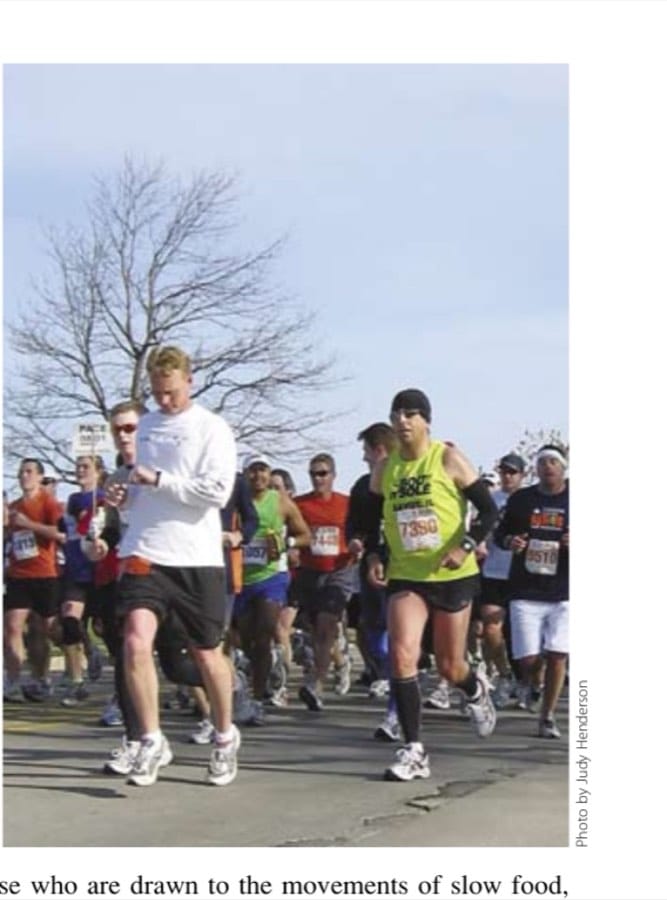
Photo by Judy Henderson
An aversion to sidekicks
This article originally appeared in Marathon & Beyond, Vol. 14, No. 1 (2010).
← Browse the full M&B ArchiveMore like this
1,000+ stories from 19 years of Marathon & Beyond
The complete archive of the legendary long-distance journal — digitized and free to read.
