

Painting On Walls
I must not fear. Fear is the mind-killer. Fear is the little-death that brings total obliteration. I will face my fear. I will permit it to pass over me and through me. And when it has gone past I will turn the inner eye to see its path. Where the fear has gone there will be nothing. Only I will remain. —Frank Herbert (not known to be an ultrarunner, if runner at all), author of Dune
It doesn’t seem like much, a line of runners heading uphill in the dark, lit by the overhead arc lights of a dormant ski area at the end of summer. There is a faint dust cloud rising from the feet of the runners that mixes with the morning mist, the rising dew. The rope-tow shack is empty, silent witness to an annual rite of passage for the running community—the Waldo 100K.
It begins in the dark and for some, it will end nearly 22 hours later in the dark. The frontrunners disappear quickly, surefooted and steady; the rest begin to spread out along the trail, slowly finding their pace, their comfort zone. Amid the relentless litany of internal complaints about ill-fitting shoes, poor breakfasts, wrong choices, bad life decisions, and foolhardy training errors is the daunting recognition that it will be a long day, a challenge of unforgiving time over relentless distance and for some, an unsympathetic, tough love conversation between their reality and their dreams.
As a photographer, I find that this has its appeal and its challenges. Other than the headlamps and their handheld flashlights, there won’t be much light for the next several hours. This lack of light poses its own problems for the shooter, not the least of which is the combination of carrying lighting gear to remote locations and equally the risk of “lighting out” (washing out) the natural beauty of the location, which is, of course, the real reason to be there. As with everything else inside an ultra event, balance is key once you have succumbed to the madness of participating. Light is the heart of photography, which in this case means getting
somewhere and setting up, practicing, and then . . . waiting. Lighting, patience, anticipation, stamina, remaining steady as you go—these are the elements of shooting an ultra event, these and the passage of time, the changing light, the sound of the place, and memory as it comes in the silence. Finally there are runners, and then they are gone, the picture is over, no matter the result. The process begins again, and unlike road races it goes on for hours and hours, a metaphor playing out in real time as the sleek and bone-thin front-runners race by, the soon-to-be elite and once-were follow on and then the dreamers in all sizes and shapes, of all ages, the damage and victories of the years are there for the camera to record, for the shooter to embrace, to share in the fleeting exchange “thanks for being here, you’re doin’ fine, stay steady, see you at the end.”
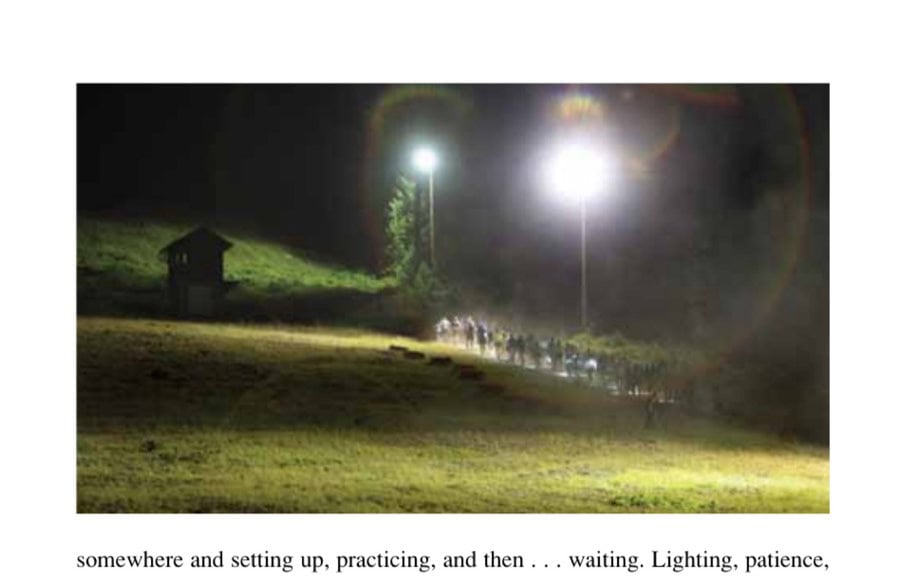
This 2011 version of the Waldo 100K (formerly Where’s Waldo?) is not the usual venue for The LongRun Picture Company. We’re a road race company—or were until the summer of 2011. Setting up for a road race is not complicated once you get the hang of it. The shorter races are about starting line photos, midrace runner shots, and finish line shots, all aimed at capturing some element of grace and effort, some wisp of something the runner will want to remember, a take-away from the day. As much effort as there is in any run, a 100K, 62.2 miles, is a long way to go and seven, eight, nine, 10, 15, 20 hours of climbing and descending roots, rocks, and rapids (creeks) make for a very different sense of grace, of accomplishment.
To be sure, runners get to the 100K by starting out at some point on the road. They find their own way to the silence of the trails, the terrain, the difference in attitude and altitude that defines off-road running. For a photographer, it is no longer a matter of picking a midpoint, of simply shooting the start, of grabbing a finishing shot. The true images are on the course, on the steeps, in the rising sun or
the late afternoon, best taken in the late miles when courage and fate are at hand, when every runner on the trail has something to say, in their facial expressions, in their eyes, in the slow, relentless drumbeat of their tread on what has become, for some, a death march, and for others, a journey of enlightenment they have never known before. It is our job as photographers to make our way to the places where those images happen, capture them, and then do everything in our power to present the images as if they were actual fragments of what the runners have seen in themselves during their endless miles of preparation to get to that moment.
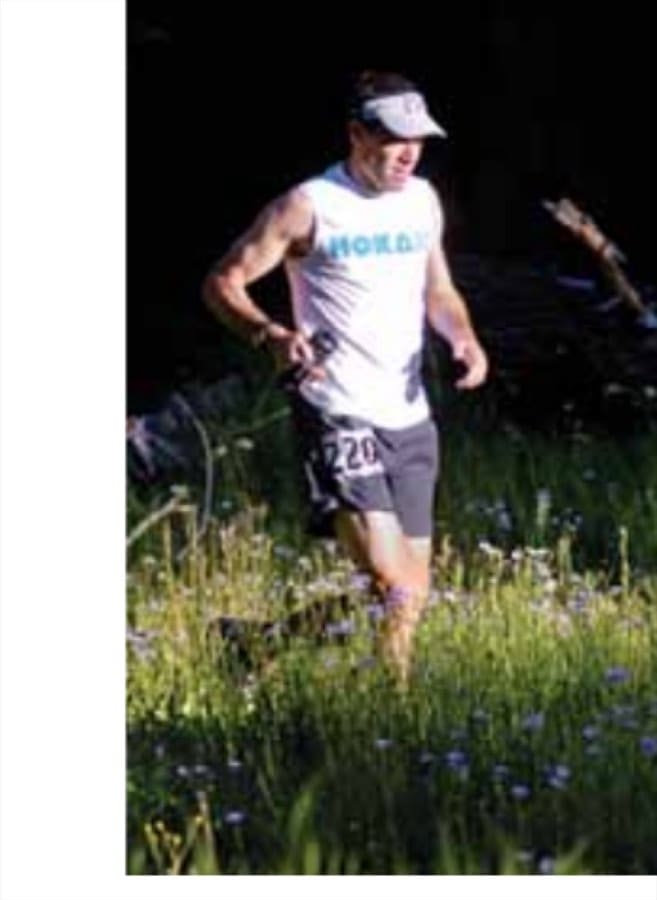
Early-morning light: warm, yellow, almost too bright, shot on a 200-millimeter long lens from a tripod. This is Dave Mackey (left), world-class ultrarunner. He has it in his mind to set the course record. Pothole Meadows, where this shot is taken,
is 18 miles into the Waldo race. The dew is still on the wildflowers, the air is fresh, and the mosquitoes are ravenous. From the picture, you can see the footing appears to Mackey to be treacherous. We
didn’t know at the time that he was leading—hell, we didn’t know who he was—only that he burst out of the woods to the right rear and was moving strongly and with confidence. His focus is unwavering. We saw him later, at 58 miles, and he looked
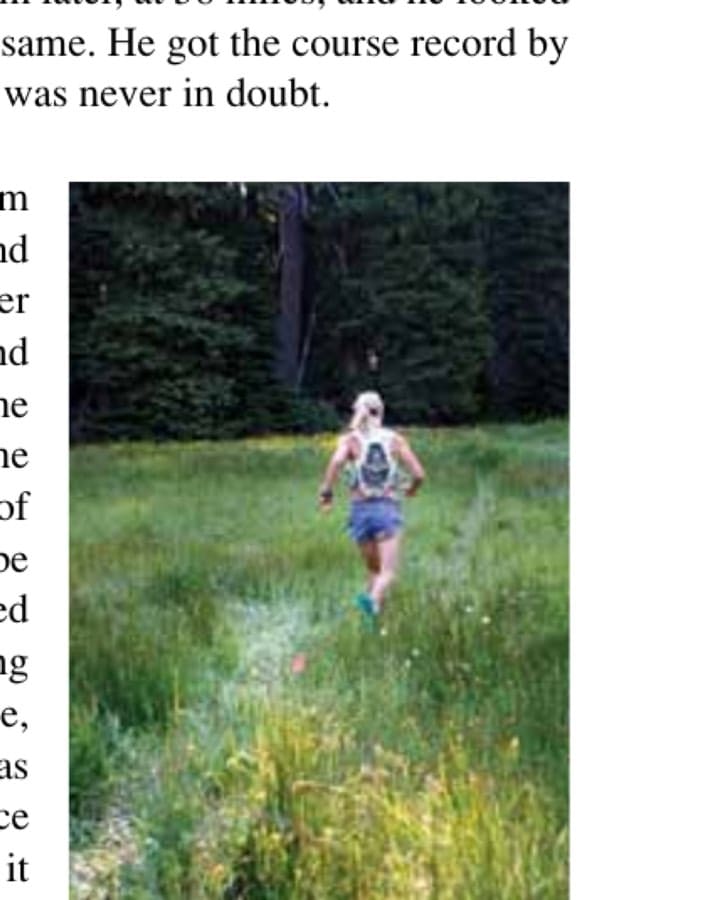
damn near the same. He got the course record by six minutes. It was never in doubt. Denise Bourassa (right) is heading away from the meadows. She is a beautiful runner, strong and determined and wanting to break into the upper ranks of the ultra population. She has in her mind that this race can get her a qualification for the Western States 100-Mile Endurance Race if she finishes first or second. We have other photos of her coming toward the camera; they could be cover shots for the effort on her face juxtaposed to her ripped abdominals and her breathtaking smile. This picture, though, is about the distance, the difference between road racing and trail ultras where time over distance is secondary to distance over time for all but the very few. And because it works this way, there is time to dream, to allow
the imagination to drift inside the focus, inside the concentration on the next step. I took this shot because the trail behind her is visible in the wet, crushed grass, and the trail in front appears only by implication; a journey as yet untaken, unfolding with every step, an imagination yet to be realized. She finished under 11 hours, second female, a trip to Western States 100, 2012, in hand.
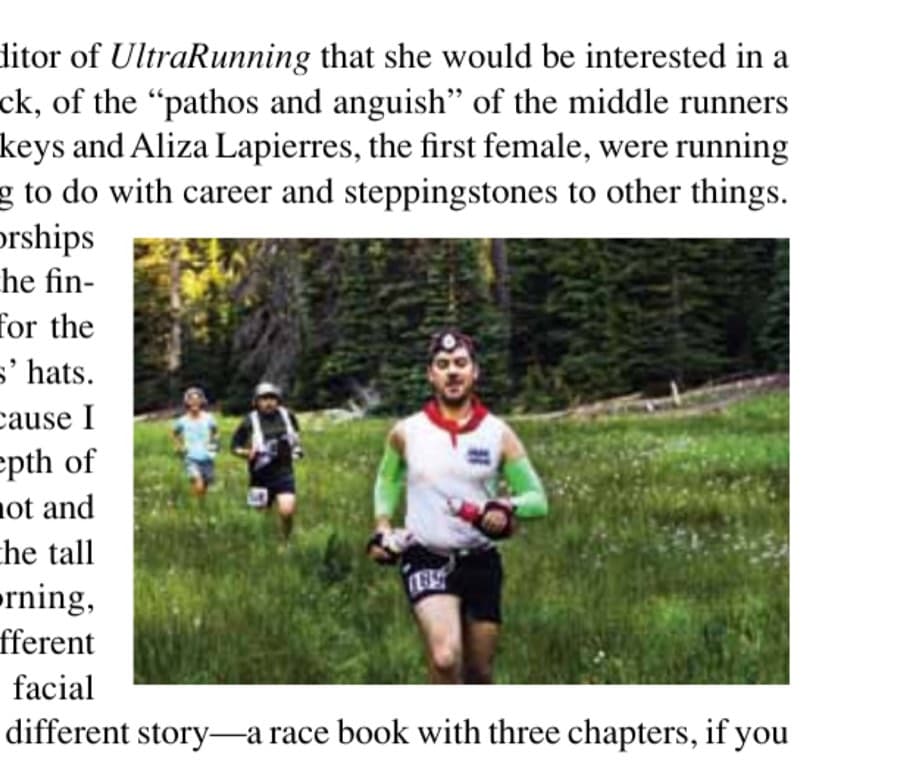
We were told by the editor of UltraRunning that she would be interested in a shot of the back of the pack, of the “pathos and anguish” of the middle runners who, unlike the Dave Mackeys and Aliza Lapierres, the first female, were running for reasons having nothing to do with career and steppingstones to other things. There would be no sponsorships waiting for these folks at the finish line, no freebies but for the barbecue and the finishers’ hats. I took this shot (right) because I noticed that if I set my depth of field, I could get a three shot and flowers: three runners in the tall grass on a beautiful morning, three runners each with different body language, different facial expressions, each telling a different story—a race book with three chapters, if you will. I noted the blood on the first runner, the care and tentative step on the second runner, and the huge smile on the third. Looking for pathos and anguish has its rewards, but what we found here at 18 miles was resolution and determination that there was nothing out here but the beauty of the day and the miles to come and that, together, it was going to blend into something special for each of them. We didn’t get the cover shot, but we did get into a national running magazine with 10 photos from this race, this for the first time in the company’s history. Everyone on the course has dreams to live by, and we are no different.
It’s always in the eyes. What it is varies from runner to runner, but make no mistake, it’s there, and every ultrarunner has it. Distance. Stillness. Fear. Acceptance. Exhaustion. Joy. Time. I am photographer at first by accident and now by choice, a writer by nature and a runner by something cellular that I have never truly understood. In none of these am I any better than generally competent, but in all of them I have learned that showing up is most of the battle, that doing what is in front of you to be done that day is the rest of it. Ultrarunning seems to me to be about extensive preparation in hope of being able to do what is in front of you to do on the day. All of the preparation can go down the proverbial drain with one misstep, a bad fuel choice, an unlucky weather pattern. Then it is a matter of
finding out who you are that day, of making good friends with that person, of relying on that person as you would a comic-book hero because in truth, they, you, and your new best friend are the only ones who are going to get you home.
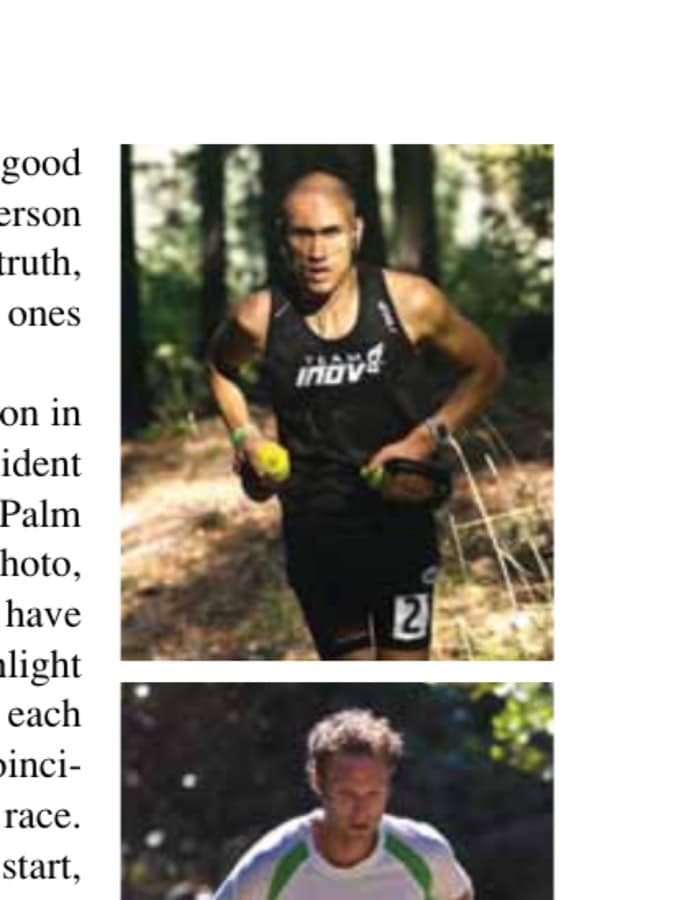
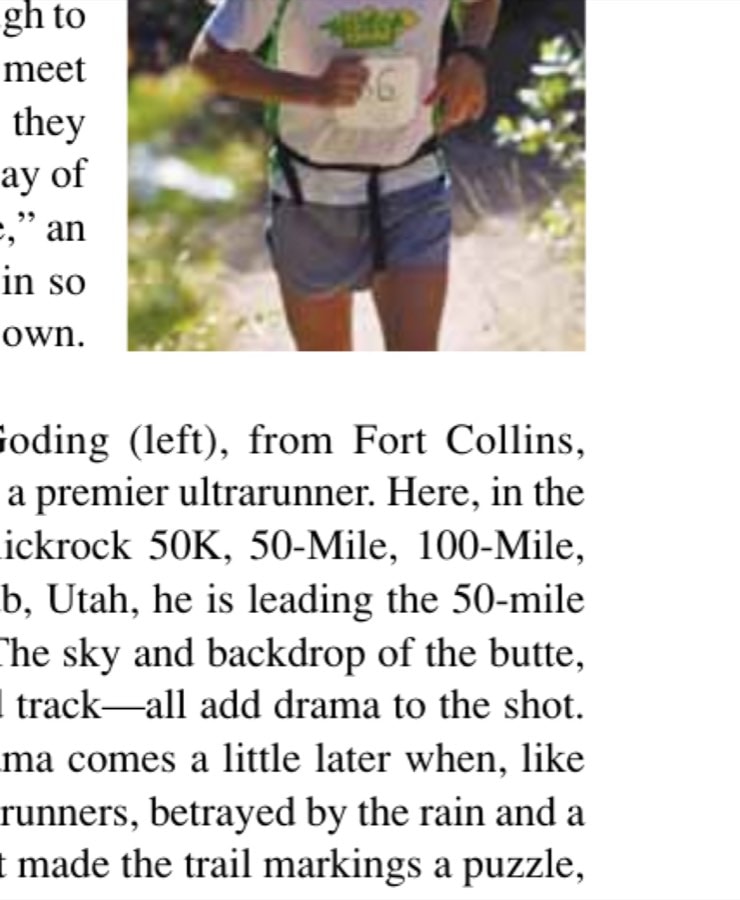
As a photographer, I look for that realization in the runners who pass me by. The struggle is evident in both Yassine Diboun (top right photo, Pine2Palm 100, 2011) and Michael Lucas (bottom right photo, Wild Idaho 50K, 2011). The image would not have been complete if their body posture didn’t highlight the downcast set of their eyes, the weight of each uphill step, the distance to go. Each photo, coincidentally, is at approximately 28 miles of each race. Both races are hilly, remote, difficult at the start, and more difficult in the middle. It is easy enough to see that both runners are deep inside. When I meet them later, at the finish and at other events, they remember these moments out loud to me by way of greeting, by way of “thank you for being there,” an implicit invitation to share their victory and, in so doing, giving me permission to recognize my own.
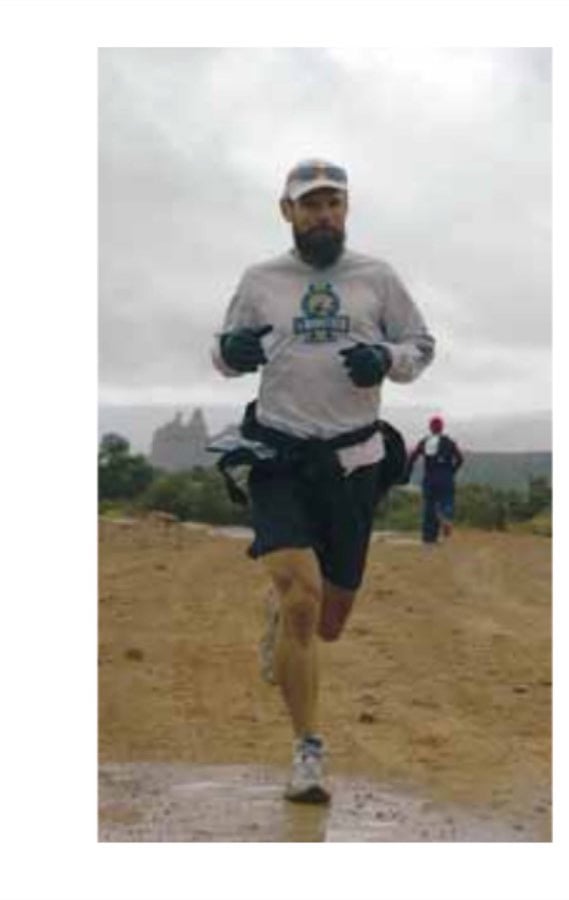
Bryan Goding (left), from Fort Collins, Colorado, is a premier ultrarunner. Here, in the inaugural Slickrock 50K, 50-Mile, 100-Mile, held in Moab, Utah, he is leading the 50-mile at mile 18. The sky and backdrop of the butte,
the wet mud track—all add drama to the shot. The real drama comes a little later when, like many of the runners, betrayed by the rain and a washout that made the trail markings a puzzle, he got lost and ran some 60-plus miles. He
finished by bushwhacking his way across the landscape, and still, he finished first. He appeared to be amused, disturbed, and in the end invigorated by the adventure. He refused to accept the winner’s prize and left it to the runner
who ran the “course.” “It didn’t feel right,” he said. The finish line pictures don’t get that but this one, I think, does.
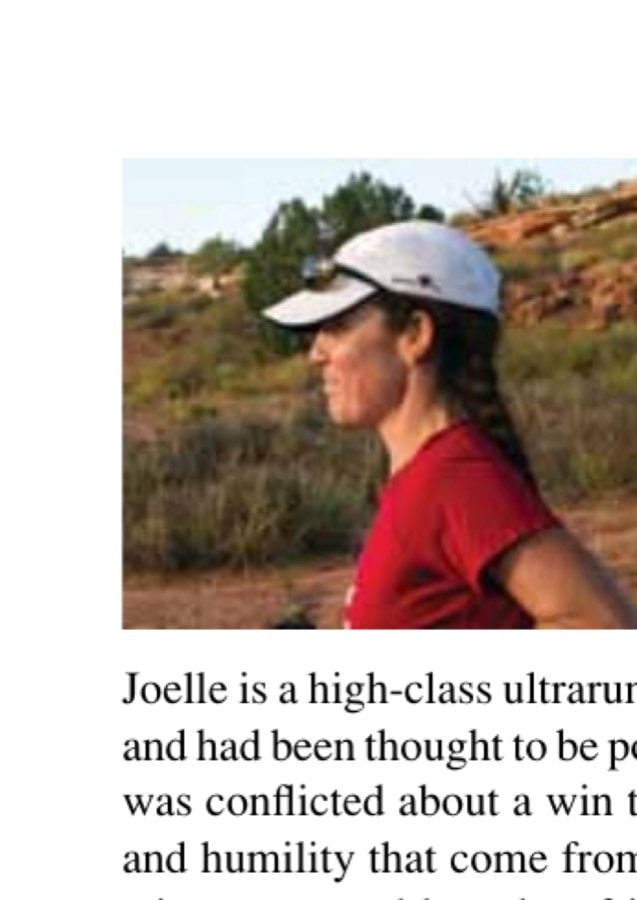
Joelle Vaught (left) is coming in to the finish line, damn near 70 miles after she started her 50-mile run. She had told me earlier that morning that she thought she had a great chance to win the event. She didn’t, although, despite the
detour, common to many of the runners, she came second. The winner, who didn’t get lost, finished a mere 15 minutes ahead of Joelle. The winner was clearly embarrassed since she knew that Joelle is a high-class ultrarunner, a winner of multiple ultras at varying distances, and had been thought to be possibly the strongest overall runner in the field. Joelle was conflicted about a win that got lost in the Utah canyons, but with the grace and humility that come from countless miles of trail running, she embraced the winner, greeted long-lost friends, went back to her hotel, and slept like a baby. The image is taken less than a mile from the finish, and once again, it says more about the day than any finish line photo could. I took it through the passenger window of my car, handheld, at high shutter speed. I was pretty damn lucky.
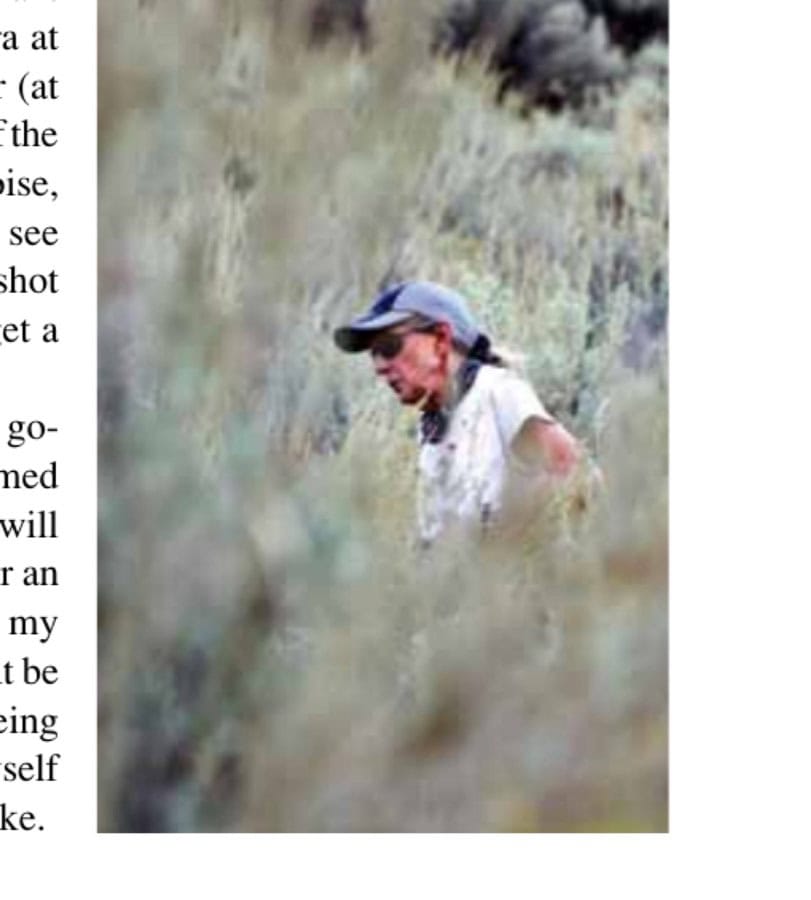
Ande Wilkes is a special gal, vibrant and alive; she is running her first ultra at the age of 62. I shot this photo of her (at right) through the tall grass at mile 22 of the inaugural Foothills 50K Frenzy in Boise, Idaho, on October 22, 2011. You can see that the light was clear and bright. I shot this with a long lens, as I wanted to get a different perspective on the runners.
In Ande’s case, I had two thoughts going on: the first was that the grass framed her beautifully, and any photographer will tell you that finding a natural frame for an image is a gift. Second, somewhere in my runners’ mind, I felt that the shot might be a little bit like how Ande might be seeing herself, a goal toward which I direct myself with every ultra-photo image that I take.
A head-on shot is pretty standard running-magazine stuff and expressive under the right conditions. See Denise Bourassa (in the photo on the following page) as she comes out of the copse of fall-colored leaves, through the high grass, holding her speed on the downhill, fighting the urge to look at the camera, staying
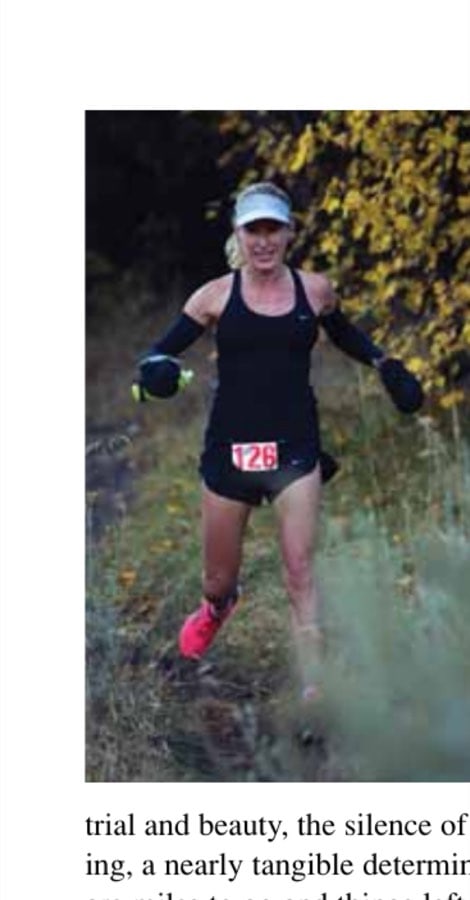
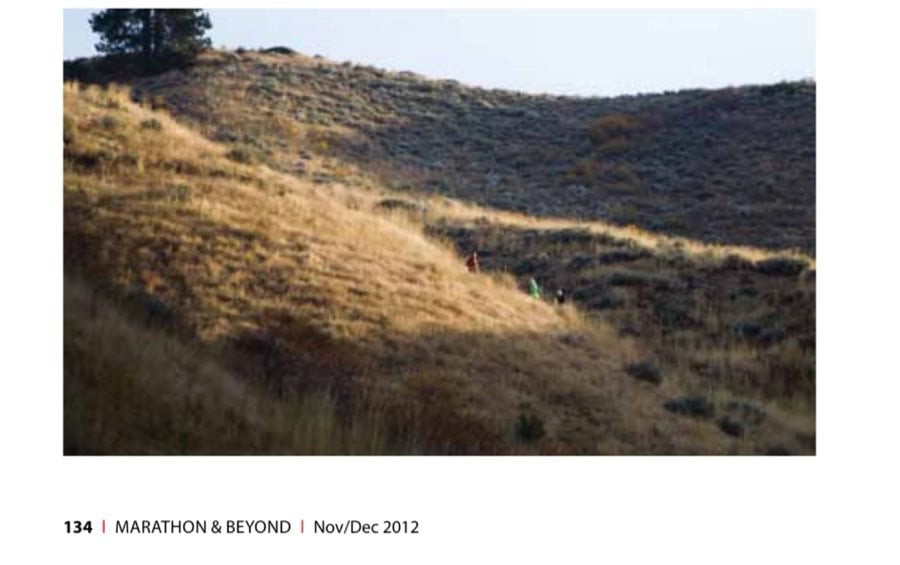
focused on the task at hand. Once again she finishes second, in a fast time, to Joelle Vaught, another of the powerful runners who come out of the West. The long shot below of the runners climbing the hill makes me want to have a 300- or
400-millimeter prime lens like the big-shot football/basketball/baseball/Olympic shooters have so that from a great distance away, I can get a close-up of the facial expressions. But in this case there is something to be said for the
image information. The sky is blue and cloudless, there is a single tree, and the grass is winter brown. Even at this distance you can see the body posture of the runners as they toil uphill, one foot in front of another. This is going to be
a long day, and while this is a moment of both trial and beauty, the silence of the hills is broken by footfall and labored breathing, a nearly tangible determination that this hill will not be their last, that there are miles to go and things left yet to do. At least, that’s how it felt to me when I looked up and saw the image, focused, and pressed the shutter.
Wild Idaho Endurance Runs (WIER) includes a 50K, a 50-mile, and a 100mile race, held on the first weekend in August 2011 at Boiling Springs, Idaho.
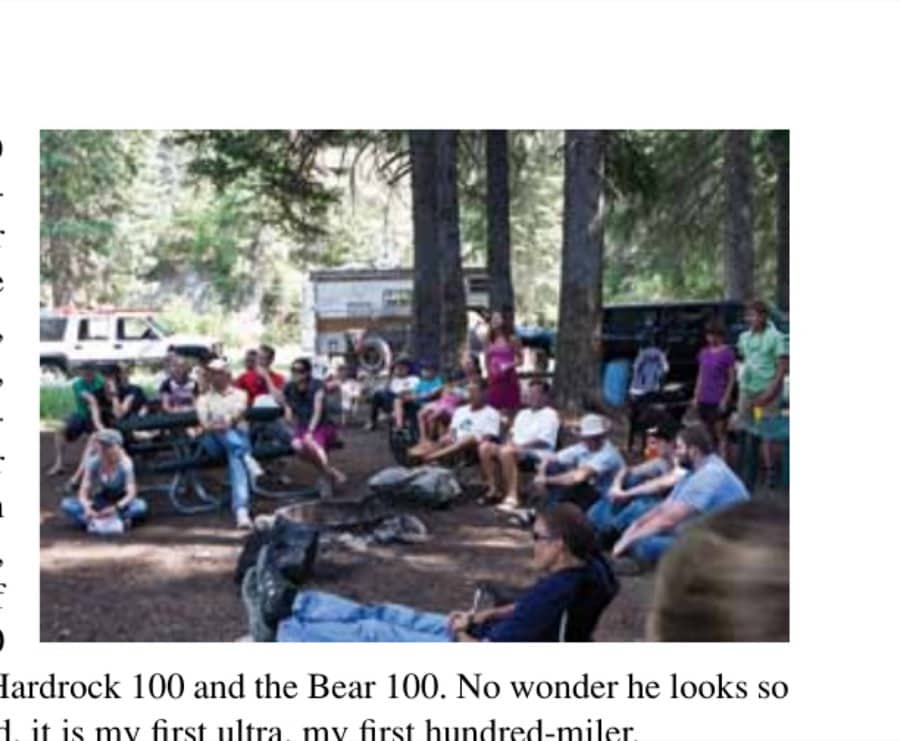
The prerace meeting (right) kind of looks like a family gathering, a summer weekend in the woods. The fellow in the foreground, feet up, looking relaxed, carefree, is Wayne Rancourt, a Boise ultrarunner in the midst of a Western States 100, Hardrock 100, and Bear 100 summer of racing. The Wild Idaho 100 will be inserted between Hardrock 100 and the Bear 100. No wonder he looks so relaxed. On the other hand, it is my first ultra, my first hundred-miler.
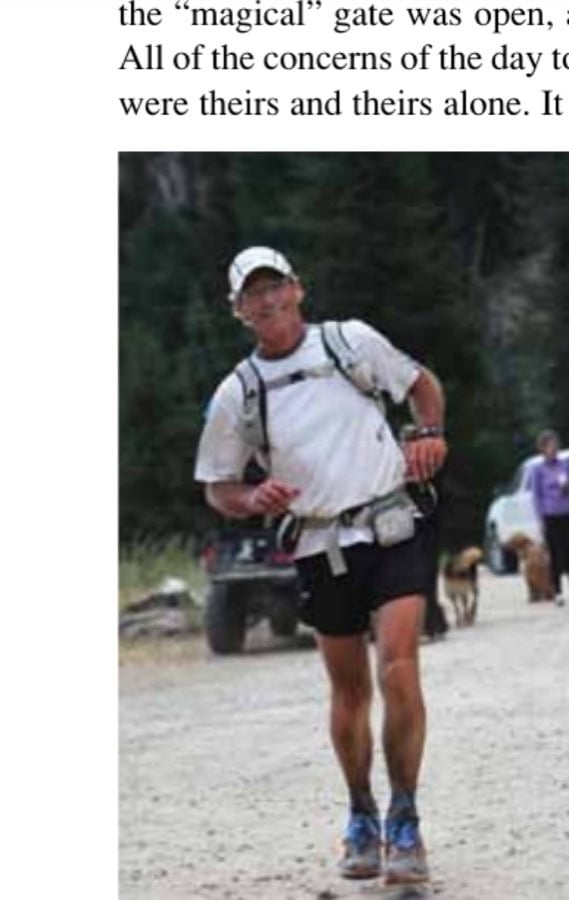
I had gone out to shoot it, not really having given it much thought. It’s a race; I shoot races. It took less than an hour of talking to the 100-milers to get that this was no simple deal I had signed up for. This was beyond anything I had seen up close, more akin to a loosely organized vision quest, a tribal understanding without the drumming and face painting. Calmness pervaded the campgrounds that did not quite hide the underlying urgency in each of the runners; it was nearly time, the “magical” gate was open, and the “real” world was soon to be left behind. All of the concerns of the day to day were secondary and the next 24/36/48 hours were theirs and theirs alone. It touched me on a level I had not felt for years, as
if I were suddenly thrust, in this landlocked, dusty campground, into a sea poem from my childhood: “Before him not the ghost of shores/ Before him only shoreless seas” (“Columbus,” by Joaquin Miller). Everything I knew behind
me, the great unknown in front of me. I gave up my room at the inn down the road, slept in the front seat of my car, if I slept at all. Thirty-eight hours later, it was finished. I had shot my first 100-miler.
The effort of the runners is singular, but the ultra is a community—friends, crew, family, the other runners—and for the first time, I am included. What they do and what I do is forever and intangibly linked. Agent and witness, we
are bound together. Because we care about what we do, the community is made stronger,
complete, made entirely human. Dennis Aslett, a 62-year-old former Marine, a door gunner over Da Nang 40 years earlier, finished 38 hours after he began, his body bent severely to the right (see bottom left of page 135). “No, Michael, I’m not hurt,” he said when I asked him, “I’m just tired.” His smile broke through the dust and weariness like summer lightning in the night sky.
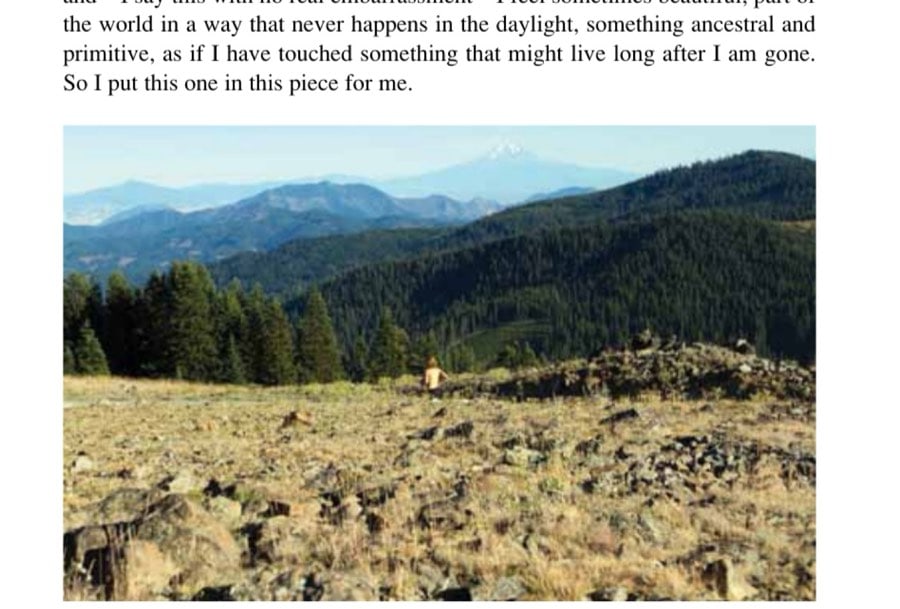
Timothy A. Olson is one of the finest ultrarunners we have in this country, a multiple winner of this event, Pine2Palm 100, and the course record holder. Seen alone against the mountain vista, Shasta in the setting sun, ahead of his closest competitor by over an hour at this point, I took the photo (below) with the idea that it might be a cover shot. It didn’t turn out that way, but it is one of my favorites. As Tim went by me, I saw how hard he was working. I like the shot from the back for the implication of distance, for the “John Ford” single, small human in the immense natural world, for the pain etched into his back.
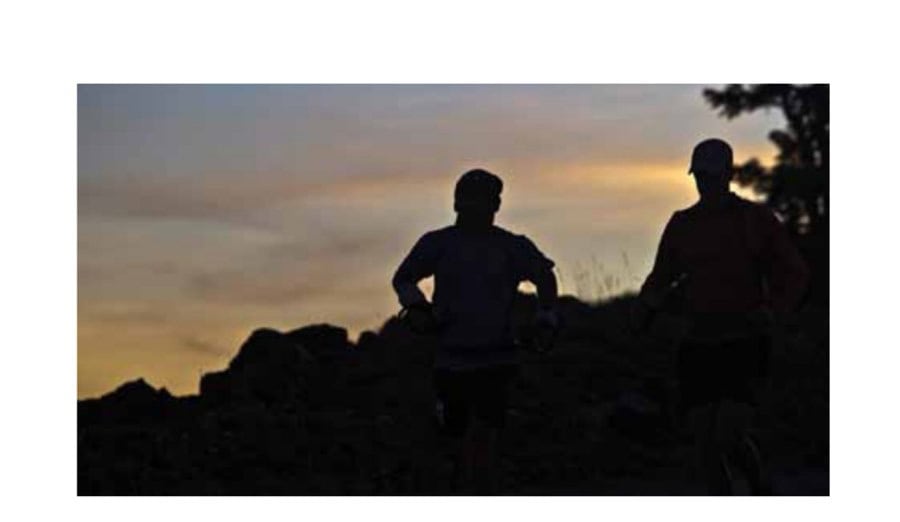
Silhouettes against the lowering night sky—Jeff Kozak and a pacer friend (top of page 137) caught quickly just as I was losing the light. Thus from Diamond Peak facing south to Mount Shasta at mile 60 of the Pine2Palm 100, 2011. I shot it, and I like it. Just that simple. Well, maybe not. When I have been running in the dark, I have often felt like a shadow, invisible in the night, an outline, a shade, and—I say this with no real embarrassment—I feel sometimes beautiful, part of the world in a way that never happens in the daylight, something ancestral and primitive, as if I have touched something that might live long after I am gone. So I put this one in this piece for me.
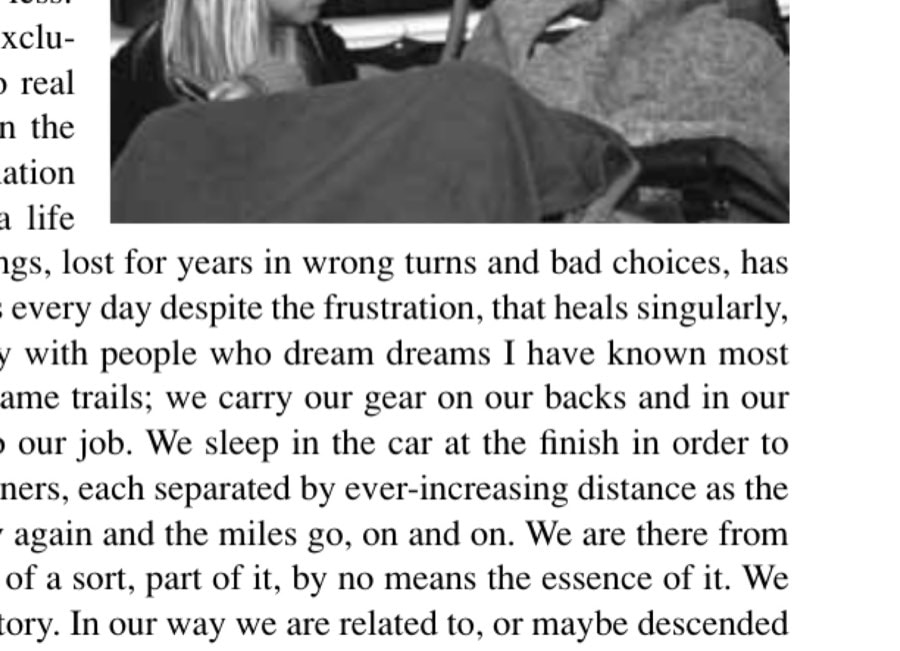
Tim and his wife, Krista (right), at the end of a long, record-setting run at Pine2Palm 100, 2011. Black and white because it says more with less. I shoot ultras almost exclusively these days. It is no real way to make a living. On the other hand, it is the culmination of many things for me: a life lived over the edge of things, lost for years in wrong turns and bad choices, has become work that satisfies every day despite the frustration, that heals singularly, that grants me community with people who dream dreams I have known most of my life. We walk the same trails; we carry our gear on our backs and in our hands in order that we do our job. We sleep in the car at the finish in order to catch the single file of runners, each separated by ever-increasing distance as the day turns to night and day again and the miles go, on and on. We are there from beginning to end, hunters of a sort, part of it, by no means the essence of it. We bear witness; we tell the story. In our way we are related to, or maybe descended from, the hunter-painters that came back to the caves and scratched their stories on the wall. We are moved by what we see, and in the end, gratitude and respect are in the bond we share with the runners; these pictures are hard work; the miles, weight, sweat, anxiety, preparation, our own ambitions and dreams make the moment of the image something of value. Sometimes we even make a buck or two. You really cannot ask for more from a day at the office. All photos © Michael Lebowitz/The Long Run Picture Company
This article originally appeared in Marathon & Beyond, Vol. 16, No. 6 (2012).
← Browse the full M&B ArchiveMore like this
1,000+ stories from 19 years of Marathon & Beyond
The complete archive of the legendary long-distance journal — digitized and free to read.
