

Paramount Beginnings
Chicago 200 Chicago 200 O
BY HAL HIGDON
n February 22, 1958, a small group of runners gathered on a balcony above the lobby of the Paramount Hotel in New York City. Most of the runners were in town to compete in, or watch, the National AAU Indoor Track & Field Championships at Madison Square Garden later that night. The organizer of the meeting was Browning Ross, a two-time Olympian and publisher of Long Distance Log, a newsletter with a circulation of barely a thousand: in other words, every single long-distance runner and fan of the sport in North America. While that evening’s track meet would attract 15,000 fans to the Garden, earning headlines in sports pages around the world, nobody cared much about road running, except once a year for the Boston Marathon.
Browning wanted to change all that. I missed that groundbreaking gathering on the balcony, probably because I was in my room resting for the three-mile run at the Garden. Later that afternoon, I did connect with the group, which continued to meet in Browning’s room, so small that it barely accommodated a single bed, much less many chairs. Even after 50 years, I remember sitting on a radiator in the window and hearing Browning talk about the Road Runners Club in Great Britain, a country where the sport flourished, producing top distance runners on the track and on the roads. He felt we needed such a club to promote our sport in RRCA Convention promotes fun, idea The Conventio the United States.The
sharing, camaraderie among leaders in the We invite everyo running community, best practice discuscommunity to j Thus was founded the Road Runners Club sions, the development of quality road through 25, 200
races that anyone can run, and much more. years of convenin of America (www.rrca.org), now an organiroots distance r At the 50th Annual RRCA National Convencountry. The Alpi zation of more than 774 clubs and 175,000
tion, the RRCA will introduce the RRCA: Zurich and Illinois College . 50th Annual RRC runner-members Club that in Chicago on March tion in Chicago, will be held in c 21-25, 2007, will celebrate its 50th annual
28th Annual LaSa Shuffle 8K, the la convention.1 country, which is Within the United States and because of 25, 2007. Not only does the the large shadow cast by the Boston Marathon, offer a fun traditio
ing and network road running flourished in New England with fits your budget. numerous races every weekend in the sumWho Should At ®
RRCA: Club College® is a core group of For more info see educational sessions offered at the Convenwww.rrcaconvention2007.org tion designed to increase participant’s MAR/APR 2007 knowledgel in key areas of running club management. The sessions include managing your Presented by: nonprofit, effective financial management & resource development, insurance & managing risk, and implementing RRCA programs & services to benefit your club.
Club and event offi directors & official teers, running & fit coaches, everyone ning community o course – runners.
Ross, groups of runners in different sections of the country decided that if they wanted their sport to prosper, they needed to assume the task of organizing races for themselves, encouraging others to join them.
This included a growing group of postgraduate runners who trained at the University of Chicago under Coach Ted Haydon. I was part of that group as was Gar Williams, later an RRCA president. Members of the University of Chicago Track Club (UCTC) began organizing races on the South Side at various distances on a strip of pavement several miles long that had been abandoned and isolated after the city relocated Lake Shore Drive. No traffic to control meant we needed few officials or volunteers to complicate our organizational efforts. In 1959, we started the Windy City Marathon (now discontinued), which I won five years later as a tune-up for placing fifth at Boston. The race was up and back several times on our strip of pavement, a course that no runners from today would tolerate, but we didn’t care.
The UCTC bid for and obtained the right to hold one of the National AAU road running championships about that same time. Chris McCarthy, a racewalker on the 1964 Olympic team, was assigned the task of pacing the runners by bicycle so they wouldn’t get lost. Unfortunately, Chris’s bicycle suffered a flat tire, and Peter McArdle of the New York AC, leading the race by a large margin, missed a turn and ran off course. In a similar incident at the New York World’s Fair several years later, I was running with the leaders behind a police car assigned to guide us through city streets.
Suddenly, the police car accelerated away from us, lights flashing, apparently called to prevent some crime. Unsure how to continue, those of us in the lead, including John J. Kelley (the younger), discussed what to do. We decided to turn back toward the starting line. Everyone else followed. Several minutes later an AAU official collected our group of lost runners running the wrong way down a
Dr. Edward H. Kozloff Collection
▲
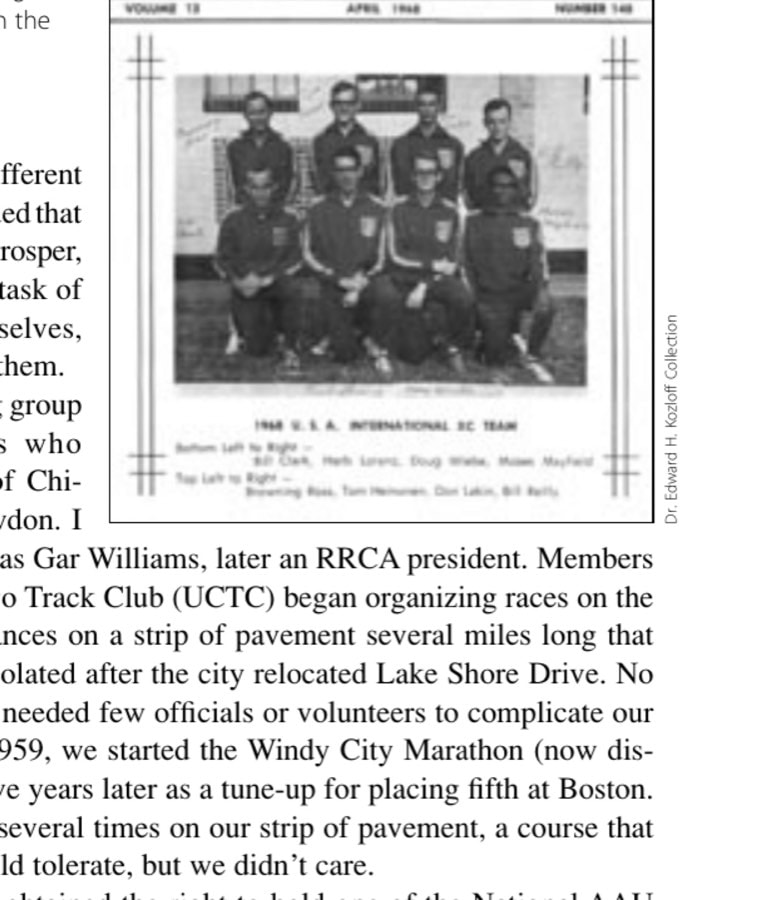
Browning Ross (back row, far left), one of the RRCA’s founders, started the monthly newsletter Long Distance Log in 1956. Ross ranked as one of America’s best distance runners in the 1940s and early 1950s, competing on two Olympic teams as well as in the Pan American Games.
one-way street and directed us back to the course. We didn’t get angry. Nobody lost position, and this was before certification of courses guaranteed that races you ran were a precise distance. Disorganization was part of being a long-distance runner in the RRCA’s first years of being. I eventually won the race, surging away from Kelley in the final mile. On the North Side of Chicago within the next few years, a separate group of runners also began organizing road races, although very low key. Pat Savage, currently the track and cross-country coach at DePaul University, describes how low: “We’d hand the watch to the fastest runner. If he got caught, he had to yield
Marathons in 1958 How many marathons were held in North America in 1958, the year Browning Ross founded the Road Runners Club of America? One of the best sources for information on older races is the library of the Boston Athletic Association,
which includes in its collection back issues of Ross’s Long Distance Log, beginning with the May 1958 issue, listed as Volume 3, Number 29. Gloria Ratti of the B.A.A. identified the following marathons run in 1958: •
Middle Atlantic (Polar Bear) Marathon on January 5, 1958, won by Ted Corbitt • Boston Marathon, April 19, 1958, won by Franjo Mihalic of Yugoslavia in 2:25:54 • 28th Annual Petaluma (California) Spartans 26-Mile Marathon, April 20,
1958, won by Jesse Van Zant • National AAU Marathon Championships in Yonkers, New York, in May 1958, won by John J. Kelley in 2:21:00 • 12th Annual St. Hyacinthe Marathon (the North American championship)
in Quebec in September 1958, organized by former Boston Marathon champion Gerard Cote and won by John J. Kelley in 2:31:57 • BECG (British Empire and Commonwealth Games) 26-Mile marathon trial, won by Gordon Dickson in 2:21:50.5 •
11th Western Hemisphere Marathon in Culver City, California, September 14, 1958, won by Michael G. Allen in 2:32:35.4 • First Annual International Marathon Race sponsored by the Journal Square Board of Trade, Jersey City, October 11, 1958, won by John J. Kelley in 2:20:55.6 • There was also a 50-Mile Relay in Greenfield, Massachusetts, on October 18, 1958.
▲
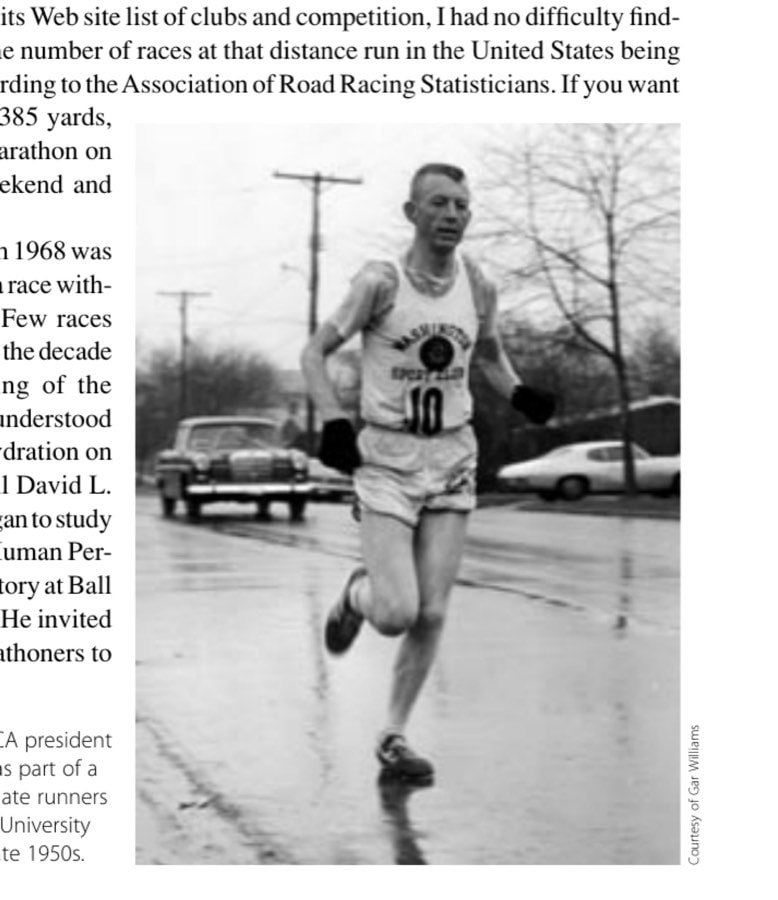
Gar Williams, RRCA president from 1973-1976, was part of a group of postgraduate runners who trained at the University of Chicago in the late 1950s.
Courtesy of Gar Williams
the watch to whoever passed him, so after the winner crossed the finish line he could turn around and time everybody else.” But, thanks to Browning, the first seismic rumbles of what a decade later would be identified as the running boom had begun to be heard. Races began to appear even in relatively small cities, where there previously had been no history of competition. In 1960, a group of track athletes in Columbia, Missouri, challenged a group of boxers who trained on the roads to a race on Labor Day between Columbia and Fulton, Missouri. Distance: 26 miles. Race day, no boxers showed, and out of six runners starting the first Heart of America Marathon only two finished, the winner being Joe Schroeder, who used track shoes with tape over the spikes. Once out of town, he removed the tape and ran the rest of the race on the dirt shoulder. Heart of America helped fill the gap between the two coasts. It was a race I won in 1968 and have run two times since, most recently in 2001, when I ran seven marathons in seven months at age 70 to raise more than $700,000 for charity. Thanks to the RRCA and its Web site list of clubs and competition, I had no difficulty finding marathons, the number of races at that distance run in the United States being 339 in 2004, according to the Association of Road Racing Statisticians. If you want to run 26 miles, 385 yards, you can find a marathon on almost every weekend and in every state.
That victory in 1968 was accomplished in a race without aid stations. Few races had aid stations in the decade after the founding of the RRCA. Nobody understood the effect of dehydration on performance until David L. Costill, Ph.D., began to study that issue at the Human Performance Laboratory at Ball State University. He invited a number of marathoners to
run on a treadmill for 20 miles, three days in a row, and measured how efficiently we could run with (a) no fluids, (b) water, and (c) Gatorade (which sponsored the research). No fluids lost. Armed with that research, I had run Heart of America followed by my wife, who handed me a plastic bottle every two miles. She and the wife of the runner who finished second, Carl Owczarzak of Kansas City, were able to accompany us because there were few runners and little traffic.
That soon would change. It is wrong to claim that Browning Ross’s founding of the RRCA was the spark that ignited the running boom that continues today. There were multiple sparks during the next several decades. In 1962, Bill Bowerman, the University of Oregon coach, returned from a visit to Arthur Lydiard in New Zealand and was coauthor of a booklet, soon to become a bestseller in paperback, titled Jogging that surprisingly sold more than 300,000 copies. Sports Illustrated published an article written by me about the Boston Marathon and titled “On the Run from Dogs and People” one week before the 1963 race. Within the next few years, Boston doubled in size and soon would post qualifying standards to try to limit its field to fewer than 1,000.
Kenneth H. Cooper, M.D., who ran Boston while a postgraduate student at Harvard University in 1962 and 1963, in 1968 wrote the book Aerobics, which would sell tens of millions of copies worldwide in various editions. David H. R. Pain, a San Diego attorney, organized in 1966 a masters mile for runners over 40, soon to grow into a full-event track and field meet for runners over that age. Age-group classes became a de rigueur addition to road races, inspiring runners in their 20s and 30s to continue in competition as they aged. Frank Shorter’s gold medal in the marathon at the 1972 Olympic Games added luster and respectability to the American running revolution. Then along came James F. Fixx and his million-copy bestseller The Complete Book of Running. It is hard to say whether Fixx created the running boom that began almost simultaneously or merely fed off it. Truth be told, it was probably a little bit of both.
The same might be said for Runner’s World, the publication founded in 1966 by Bob Anderson when he was in high school, a publication similar to Browning Ross’s Long Distance Log, except it went beyond merely results and offered articles about the sport including how to train. (Its original title was Distance Running News.) Anderson published an article by me in his second issue, making me the magazine’s oldest contributor. The article was about Ted Corbitt running the London to Brighton Race, originally commissioned by Sports Illustrated. (For Ted’s comments about the founding of the RRCA, see pages 25-26 “The 11th Man.”) By the early 1980s, Runner’s World’s circulation had reached half a million, and if you considered yourself a serious runner, you were a subscriber.
Ross eventually discontinued publication of his newsletter, being unable to cover the huge number of road races whose creation he had managed to inspire. The organization he founded, the Road Runners Club of America, continues to this
The 11th Man Ten individuals are generally credited with being founding fathers of the Road Runners Club of America, according to research conducted by Jeff Darman for the 40th anniversary of that organization. Nine of those individuals, including Browning Ross, met on a balcony of the Paramount Hotel in midtown Manhattan on February 22, 1958. Their names, in addition to Ross’s, were Kurt Steiner, Harry Murphy, John Sterner, Dick Donahue, Bob Chambers, Lou White, Bob Campbell, and Joe Kleinerman, all apparently now deceased. Nine in all. Ross continued the meeting in his room at the same hotel, and I joined them, allowing me to claim credit for being a 10th founding father. Ted Corbitt, a 1952 Olympian, probably deserves credit for being the 11th man. Corbitt recalls his memories of these early days: “I knew of Browning Ross’s plans. I was interested in the idea but missed the meeting because I wanted to see the National Interscholastic Track & Field Meet, then the National AAU Indoor Championships. I ran 30 miles early in the day training for the Boston Marathon and spent the rest of the day watching the two track meets. I think I ran 4:20 to 4:45, not racing speed. Two years later, I ran around Manhattan Island with teammate Gordon McKenzie, who was switching from the 10,000 to the marathon. We ran 31 miles (50 kilometers) in 3:43, still not at a racing speed. “While I was interested in the idea of a road runners club, I did not plan to get involved other than joining. I already had more than enough to do. Two other New Yorkers did attend: John Sterner of the New York Pioneer Club, a club mate, and Joseph Kleinerman of the Millrose AA. Sterner told me the next week that they got there late.
▲
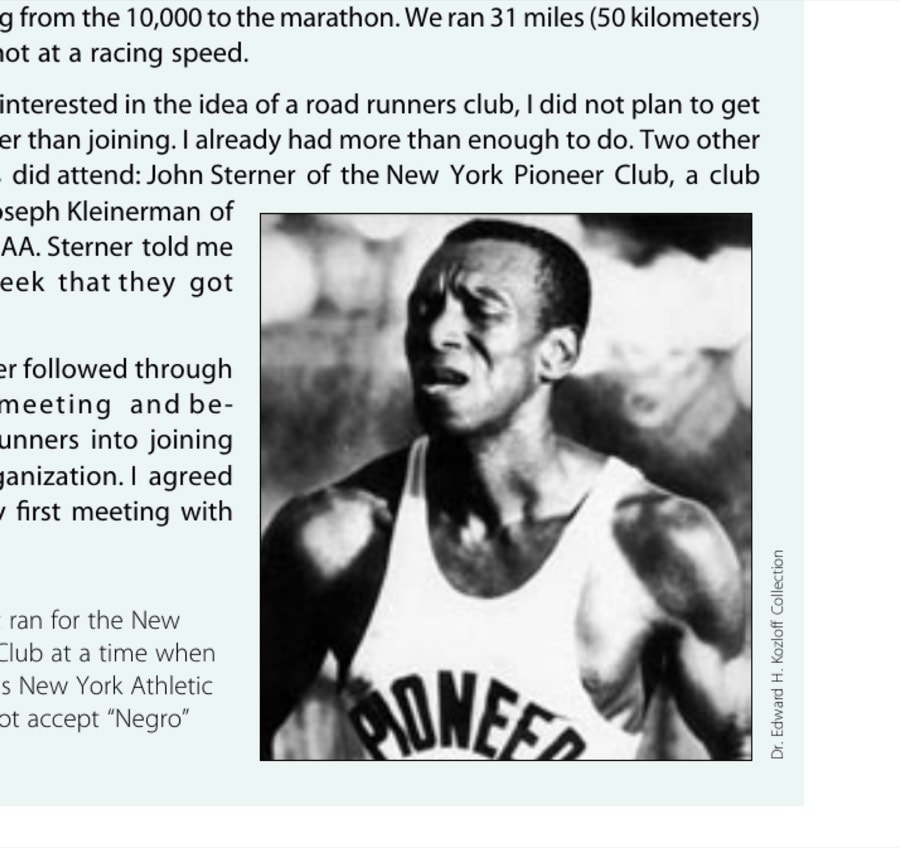
Ted Corbitt ran for the New York Pioneer Club at a time when the prestigious New York Athletic Club would not accept “Negro” members.
Dr. Edward H. Kozloff Collection
“John Sterner followed through after the meeting and began to talk runners into joining the new organization. I agreed to join at my first meeting with
Sterner. However, he wanted me to run for president of the RRC, New York Association, which later became the New York Road Runners Club and now is called New York Road Runners. I said no several times, and John tried one or
two other runners who said no, too. John wanted someone with a reputation. In addition to being an Olympian, I also was a national marathon champion. I eventually did agree. There was an election, and I won. I was reelected a year
later. After that, I was elected the third president of the RRCA and used that as an excuse not to run a third time for the New York presidency. There were about a half-dozen clubs scattered around the country at the time, more to come later. “
John Sterner exchanged written messages with Ross, and I did too after being elected president of the New York RRC. I eventually contacted the RRC of England and had long-term contacts with various members of that group. “The first club meeting of the New York RRC was a talk and coaching ses
sion at Van Cortlandt Park featuring Australia’s Percy Cerutty, who stayed with us for a week on his way to the Commonwealth Games, some place in the British Isles.” Several months after the 1958 founding of the RRCA, Corbitt appeared at
the gym in Hopkinton for the then-obligatory physical exam for the Boston Marathon. A doctor listened to Corbitt’s heart and discovered it to be beating at 140. Corbitt had a diagnosed heart murmur and apparently was nervous
about failing the exam. The doctor rejected Corbitt’s entry along with those of Al Confalone and John Lafferty. The three ran anyway, lining up behind the official runners. Corbitt placed an unofficial sixth with Confalone and Lafferty unofficially seventh and ninth. No ombudsman existed at that point
to stand up to the Amateur Athletic Association (AAU) with its archaic rules that often prohibited running as much as promoted it. The RRCA soon would change that. A plaque in the health club of the Paramount Hotel commemorates the founding of the Road Runners Club of America at that hotel.
day, celebrating its 50th convention in Chicago at The LaSalle Bank Shamrock Shuffle, an eight-kilometer race with a very visible sponsor and a field of 30,000 runners, the field limited to that number. Did Browning or any of the founding fathers of the RRCA who met at the Paramount Hotel on February 22, 1958, have any idea how running would change during their lifetimes? Certainly not, but we’re happy it happened. The RRCA will celebrate its 50th anniversary in February 2008. Plans for a birthday celebration are pending.
1
This article originally appeared in Marathon & Beyond, Vol. 11, No. 2 (2007).
← Browse the full M&B ArchiveMore like this
1,000+ stories from 19 years of Marathon & Beyond
The complete archive of the legendary long-distance journal — digitized and free to read.
