

The History of Western States
events can trace their origin back to Ainsleigh’s crazed run in the summer of 1974.
Gordy’s sub-24-hour finish also led to a tradition that has become the standard for most 100-mile races, that is, the awarding of a silver belt buckle to those who break 24 hours. The expression “I buckled” has come to mean “I finished in under 24 hours.” (The standard cutoff time for most 100-milers is 30 hours, with those finishing between 24 and 30 hours earning a bronze belt buckle.)
THE EARLY YEARS
The year after Gordy Ainsleigh set out on his own to cop a silver belt buckle, another runner, inspired by Gordy’s hardiness, decided to attempt to duplicate the feat. Ron Kelley ran with the horses and was well on his way to a sub-24-hour finish when suddenly, for no apparent reason, he terminated his run at No Hands Bridge, a mere 3.5 miles from the finish. Those who witnessed his
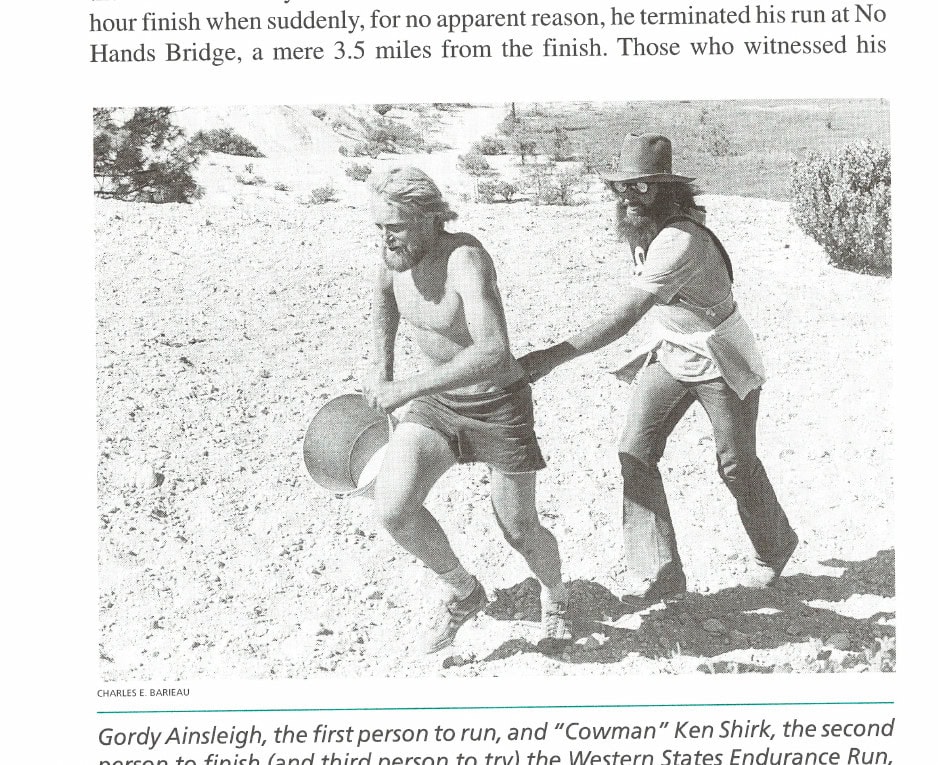
decision to stop running were quite shocked because he did not appear to be under any physical duress and was well within the time frame to reach his goal. To this day, no one is quite sure just why Kelley decided to quit running when he was so close to a successful finish.
Nineteen-seventy-six brought another mountain maverick to the event—Ken “Cowman” Shirk. Very similar in size and stature to Gordy Ainsleigh, Ken took on the name “Cowman” because he felt he was too old to be called “Cowboy.” Wearing a headdress that consisted of a set of buffalo horns, this rugged, bearded adventurer bellowed his way through the canyons, making certain all within earshot were aware of his presence. His friend, Gordy, accompanied him over the last 25 miles, thus introducing the concept of “pacers.” Runners are now allowed to have another runner accompany them over the last miles of an ultradistance race (the last 38 miles of the Western States course, for example), so they don’t have to run the night sections alone. The distance a pacer is allowed to accompany a runner varies from race to race and is done strictly for safety reasons. Pacers cannot assist runners in any way except in the event of an emergency, nor can they act as packmules by carrying anything for them. In most cases, runners who are 60 years of age can be accompanied by pacers for the entire distance, but again this is only done for safety purposes.
First “Official” Year
Nineteen-seventy-seven marked the first “official” Western States 100-Mile Endurance Run, where runners actually entered the race as a competition against other runners.
Wendell Robie, the patriarch whose idea in 1955 led to the organization of the Western States 100-Mile One-Day Ride, later nicknamed the Tevis Cup, felt that it was time that runners had a separate competition, although the run would still be held the same day as the horse race.
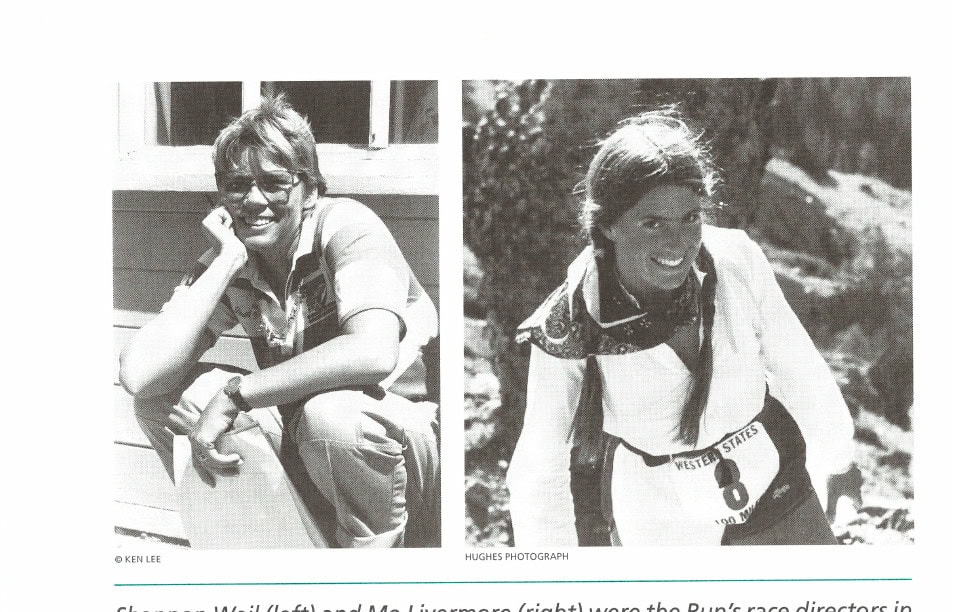
Wendell gathered a small “executive” committee to organize the race, consisting of Gordy Ainsleigh, Mo Livermore, Curt Sproul, and Jim Larimer. All were experienced riders and veterans of the Tevis Cup, so they were familiar with the course and the mechanics of staging such an event. Bob Lind, MD, an emergency room physician who had been present at Gordy’s run in 1974, served as medical director, assisted by Carol Van Ness, RN.
Fourteen men from four different states lined up at the start at Squaw Valley, and the runners headed up the trail with the horses. It was a very low-key affair, with only three aid stations, which were staged in conjunction with veterinary checks for the horses. The runners were required to rely on drop bags and crews for whatever their needs were along the way. Compare that to today’s race, where there are 1,300 volunteers, 30 aid stations, 11 medical checkpoints,
a medical and podiatry corps that could staff a small hospital, communications networks, search-and-rescue units, massage therapists, and on and on.
The outcome of the 1977 race was decided by the time the runners had reached the Michigan Bluff checkpoint, which is slightly past the halfway point of the race. Of the 14 runners, 11 had already dropped out or were too late through checkpoints to continue safely and were pulled from the course.
Of the remaining three runners, only 22-year-old Andy Gonzales was able to finish under 24 hours to earn a silver belt buckle. Peter Mattei and Ralph Paffenbarger, ages 53 and 54, respectively, ran together on their own and finished unofficially in 28:36. This led to the establishment of a 30-hour cutoff the following year.
Following the race, the Western States Endurance Run Board of Governors was established to work independently but under the corporate umbrella of the Western States Trail Foundation. Three of those original members (Mo Livermore, Shannon Weil, and Bob Lind) still serve on the board today.
Course Challenges
In a single year, the Western States Endurance Run developed a national reputation as runners from many states came to Northern California to do battle with the trails and the heat for which the race had become famous. The following
factors show why competing in the Western States 100 is not to be taken lightly: heat (it is not unusual for temperatures in the canyons to exceed 110 degrees), the possibility of snow, altitude, elevation changes (18,000 feet of elevation gain and 22,000 feet of elevation loss), rocks, dust, river crossings, nighttime running where temperatures can drop to below freezing, rattlesnakes, mountain lions, bears, dehydration, hyperthermia, hypothermia, kidney shutdown, bee stings, and so on. In spite of—or perhaps because of—these factors, 63 runners braved the conditions and participated in the 1978 edition, which for the first time was run independent of the horse race. It was also the first year that women competed. Five women started, with Pat Smythe going on to become the first official woman finisher (with a time of 29:34:21). It was also the first year that a 30-hour cutoff was made official. Andy Gonzales won the race for the second straight year, to become the first of a number of repeat winners.
In 1979 the race truly became an international event, as runners from three foreign countries were among the 143 runners who took the starter’s command. Nineteen-seventy-nine also saw a key change in the race. Runners were now required to do a qualifying run to be able to participate in Western States. To prove that they had completed at least one run longer than the marathon in a credible time, runners had to show proof that they had run a 50-miler in under 10 hours.
In 1979 women proved that they could compete with men when Skip Swannack Gibbs became the first female sub-24-hour finisher with an impressive 21:56.
THE SECOND DECADE
Further proof that women were capable of holding their own on the tough Western States course came when Sally Edwards and Bjorg Austrheim-Smith dueled until the final mile in 1980 with Sally winning by a mere two minutes. Both finished in the top 20. Considering that in 1980 there were 250 entrants, this fight to the finish marked a landmark achievement in the race.
Another significant event in 1980 was that for the first of several times, the course was lengthened. Upon review, earlier measurements revealed that the course was short, so an additional 4.5 miles was added. (An additional 6.5 miles was added in 1985 when even more accurate measurements were made. The present course, used since 1986, has been measured on four different occasions and is accurate at 100.2 miles.)
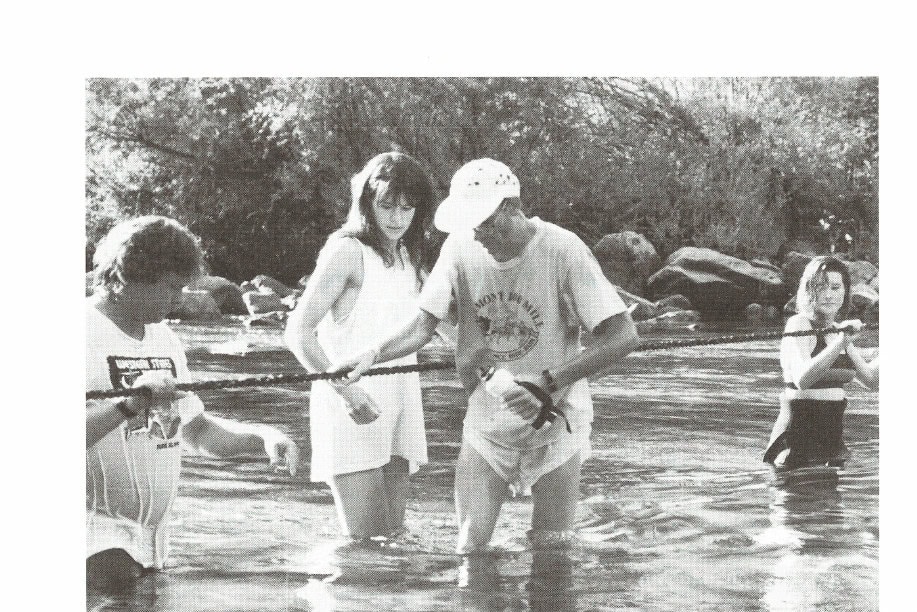
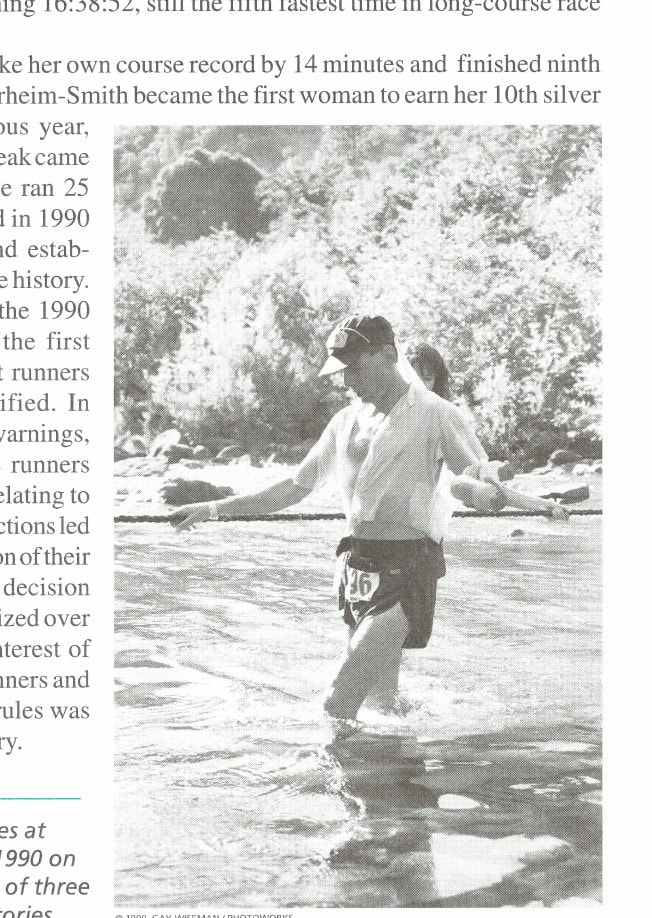
The 1980 race also marked the first of the bad snow years (although not nearly as bad as the record-setting years of 1983 and 1995). The first 10 miles were run over a very deep snow pack. Due to the heavy snow melt, the river crossing at Ruck-A-Chucky was made by boat rather than on foot. Usually the
river is held back on raceday at the Ox Bow Dam, 10 miles upstream from the actual crossing. This is done to allow the runners to traverse safely the 200-foot crossing on foot, aided by a rope, with volunteers standing in the icy cold water to assist the runners and pacers as they cross. But because of the heavy snow melt, the water could not be held back at the dam and thus a boat had to be used. (A similar situation occurred during the 1983 race.) Mike Catlin repeated his winning performance of 1979 and thus became the second two-time winner.
TV Comes to the High Sierra
As is the case with everything, evolution infers change, and Western States is no exception to that natural law. By its eighth running, Western States had become so popular that for 1981, runners were selected by lottery.
Doug Latimer, a magazine publisher from Palo Alto, California, had held the lead for most of the race in 1980 until severe cramping forced him to withdraw 20 miles from the end. In 1981 Doug staged a fierce duel from the start with Jim Howard. In an act of true sportsmanship, the two put their competitive instincts on hold in the final miles and came across the finish line together, the only time in the history of the race that this has happened.
On the women’s side of the 1981 race, Sally Edwards and Bjorg Austrheim-Smith were at it again, staging a duel for the lead. This time Bjorg won by more than an hour, with both women finishing in the top 10, the only time in the history of the race that two women have cracked the top 10. Bjorg’s victory began a dynasty of sorts, as she went on to repeat her victory in 1982 and 1983, finishing 17th and 13th, respectively.
Television came to the High Sierra in 1982—just in time to witness a “first” for Western States. Centreburn Productions came to the race to make a fine film they titled Desperate Dreams. Coincidentally, they were able to film the incredible accomplishments of a young Southern California runner who ran every step of the course, something that had never been done before, as most runners walked the hills—especially the incredibly steep hills. Jim King, however, was different. He ran every step of the course, including the steepest hills. King took the race one giant evolutionary step farther. On another front, Bill Peterson of Louisville, Kentucky, became the first runner over 60 to “buckle.”
Record Snow
The theme for 1983 was snow, as a record 786 inches fell during the winter, completely blanketing the high country, which meant that the first marathon of the 100-miler had to be run over a 5-foot thick snowpack. The deep snow didn’t just cause problems for the runners. Race management was forced to have water helicoptered in to several of the early checkpoints because vehicular access was impossible. Additionally, the course had to be changed since it was impossible for runners to reach Robinson Flat at 30.2 miles. Course marking was made more difficult, and the river crossing again had to be done by boat.
Jim King, intent on repeating his 1982 victory, took the early lead only to become lost in the high country, since the entire trail was covered by snow. In spite of being lost for almost 45 minutes, Jim managed to battle back and take the lead with 20 miles to go. In what would become the closest race in history, Jim Howard ran like a madman and caught King with less than a half-mile to go and went on to win by one minute. In a true act of sportsmanship, King was the first to congratulate Howard.
Is the Course Short?
Undaunted, Jim King returned to the victory stand in 1984 and was joined by women’s winner Judy Milkie. Judy had finished second to Bjorg Austrheim-Smith in 1983, but in 1984 she ended Bjorg’s win streak at three.
The U.S. Congress initiated the Wilderness Act in 1984, which immediately threatened serious implications for the future of the race since four miles of our historic trail were encompassed by the newly created Granite Chief Wilderness Area. (The Act precluded organized events taking place in Wilderness Areas.) That same year, Outside magazine bestowed a perverse honor on the race by naming it the “toughest endurance event in the world.”
Nineteen-eighty-four was also the year that 61-year-old Helen Klein became the first female over the age of 60 to complete the race. It would be the first of four finishes for Helen. More importantly, it demonstrated that with proper training, women of virtually any age could compete successfully at 100 miles.
In 1985, at the insistence of an observer who felt that the course was still short of 100 miles, it was remeasured. Indeed, the observer’s intuition was correct, and the course was found to be 6.5 miles short. The additional mileage was added in the Auburn area, and the course was extended to its current 100.2 miles.
The Race Is Invaded
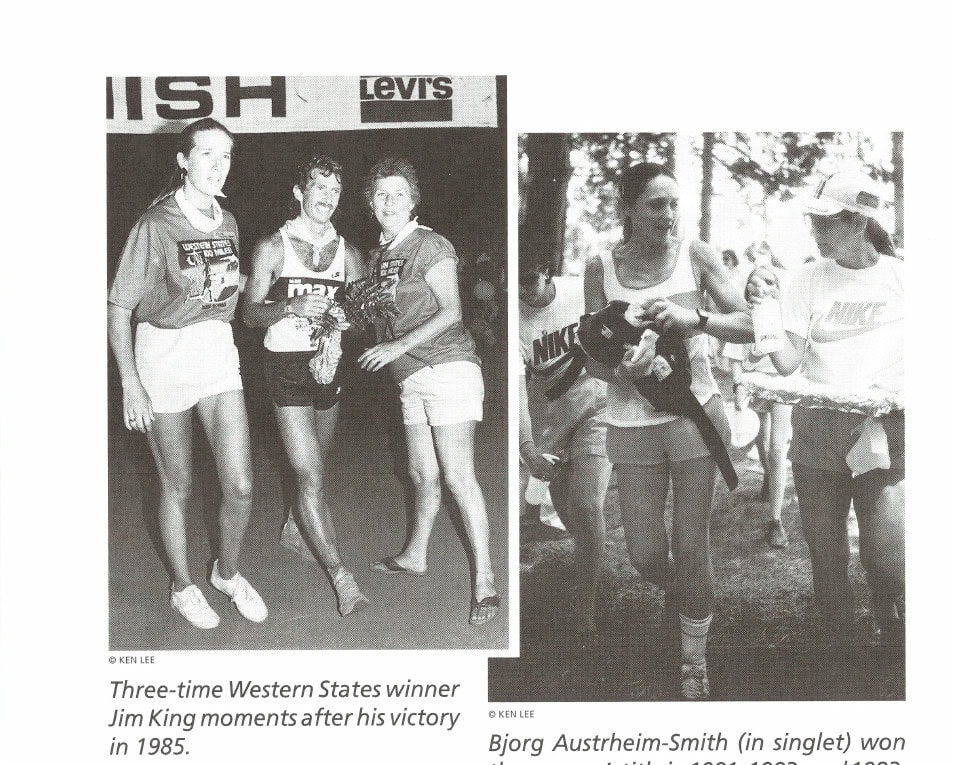
ABC’s Wide World of Sports made their debut at Western States in 1985. They shot more than 86 hours of film that was edited down to a 90-minute show (54 minutes of action, the rest commercials). ABC truly invaded the race. They brought in 26 camera teams, two helicopters, 25 four-wheel-drive vehicles, and a broadcast team that included Jim Lampley, Bob Beattie, Kathrine Switzer, and Diana Nyad. Jim King won the race again (for his third and final time), and Teri Gerber took the women’s title.
The current course configuration was introduced in 1986. In an attempt to get the runners off the streets of Auburn, the California Street Trail (between Foresthill and the river crossing at Ruck-A-Chucky) was added. ABC returned in 1986 and immediately found that the dominant element for ’86 wasn’t snow but heat!
Temperatures soared to 114 degrees in the canyons and baked the 415 runners who started the race. The medical personnel truly displayed their skills, as many runners were forced to withdraw due to hyperthermia, dehydration, and exhaustion.
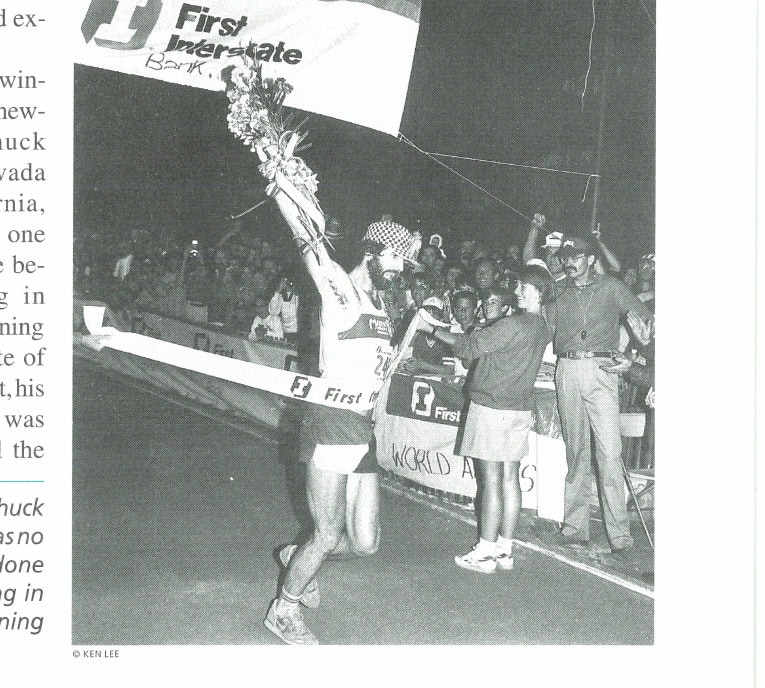
The 1986 winners were two newcomers. Chuck Jones of Nevada City, California, trained as no one had ever done before, putting in 200+-mile training weeks. In spite of the intense heat, his winning time was 16:37:47, still the fourth fastest time run on the current course. Considering the conditions, and the fact that the course was not only longer but also much more difficult, his performance was amazing!
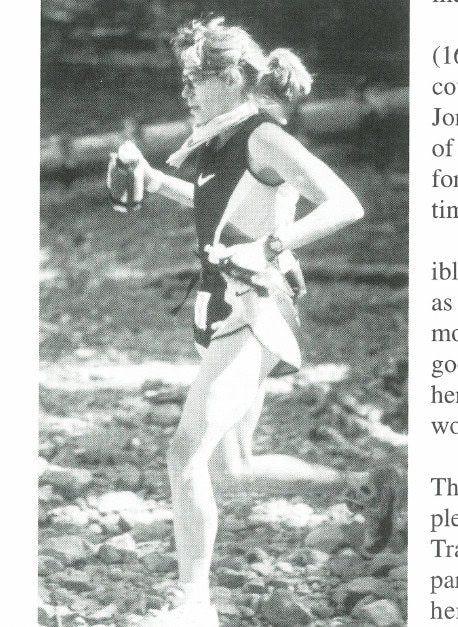
Equally impressive was the performance of the women’s winner, 21-year-old Kathy D’Onofrio of Menlo Park, California. Standing just 4’11” and weighing in at 95 pounds, Kathy finished in 20:58:16 and finished 16th overall.
California Monopoly Is Broken
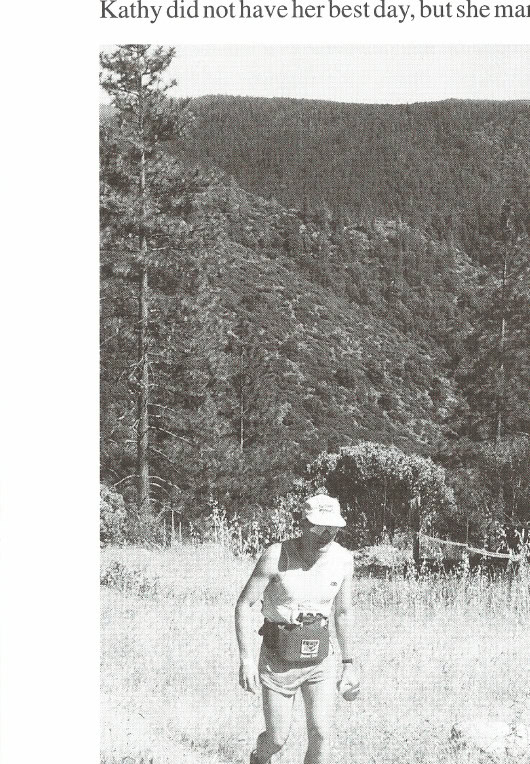
Mary Hammes, a medical student from Ft. Worth, Texas, made race history in 1987 by becoming the first non-Californian to win the women’s race. She defeated ’86 winner Kathy D’Onofrio as well as a first-time contestant named Ann Trason, who would evolve into the finest female ultrarunner in the world. Kathy did not have her best day, but she managed to finish under 24 hours, while Trason withdrew for medical reasons. Herb Tanzer, a Southern California runner, overtook Steve Warshawer in the last six miles to win the race in 17:41:06. Once again, heat was the order of the day, as temperatures in the canyons topped 110.
The entire Western States organization witnessed an incredible year in 1988 when, after four long years of petition drives, letter-writing campaigns, and actually going before members of Congress, that body produced a mandate that allowed the U.S. Forest Service to grant both the Run and the Tevis Cup Ride permission to use—forever—the trail within the Granite Chief Wilderness Area. This virtually ensured the future of both events. This was only accomplished through the yeoman-like efforts of an army of supporters under the guidance of Western States Run board member Tony Rossmann.
In 1988, the race had television coverage once again, as Golden Gater Productions produced a film that appeared on NBC’s Sports World. In spite of another very hot day where temperatures again soared to over 110 degrees, three runners made race history.
Doug Latimer, at age 50, ran 18:43:53 and finished 10th overall. More importantly, Doug became the first runner to earn a 1,000-Mile Buckle, commemorating 10 sub-24-hour finishes.
Brian Purcell broke the course record (16:24:00 for the remeasured 100.2-mile course) set two years earlier by Chuck Jones, lowering it by 13 minutes. In spite of the high temperatures, Brian’s performance remains the third fastest of all time on the long course.
Not to be overlooked was the incredible performance of Kathy D’Onofrio, as she broke her own course record by more than two hours. Her 18:52:40 was good enough for 12th place overall, and her victory made her only the second woman to win the race more than once.
In 1989, a new era was ushered in—The Trason Era. After failing to complete the course in 1987 and 1988, Ann Trason finally marked her “coming out party.” Not only did she win the race, but her 18:47:46 broke by five minutes Kathy D’Onofrio’s record of the year before. Ann’s victory marked the beginning of one of the most incredible victory streaks not only in running, but perhaps in all of sports. The streak continues, as Ann Trason won the race again in 1997, her ninth straight year. Her time in 1989 was good enough for a 10th-place overall finish.
On the men’s side, Mark Brotherton won the race in 16:53:39, 13 minutes ahead of second-place finisher Tim Twietmeyer, a rising star from Auburn, who was on the threshold of becoming a Western States legend. Golden Gater Productions again produced a television show on the race for NBC, and many observers feel this was the finest special ever done on the Run.
WESTERN STATES IN THE ’90S
The television exposure from the previous two years accounted for the largest number of runner applications ever for the 1990 race. More than 1,000 runners from 46 states and 12 foreign countries applied for the 369 spaces that the Forest Service permitted.
Tom Johnson of Sacramento continued the dominance of Northern California runners by running 16:38:52, still the fifth fastest time in long-course race history.
Ann Trason broke her own course record by 14 minutes and finished ninth overall. Bjorg Austrheim-Smith became the first woman to earn her 10th silver buckle. The previous year, her sub-24-hour streak came to an end when she ran 25 hours. She returned in 1990 to run 23:48:00 and establish her place in race history.
Unfortunately, the 1990 race also marked the first year in history that runners had to be disqualified. In spite of numerous warnings, the crews of three runners violated the rules relating to crewing, and their actions led to the disqualification of their runners. This was a decision that the board agonized over but which in the interest of fairness to other runners and the sanctity of the rules was absolutely necessary.
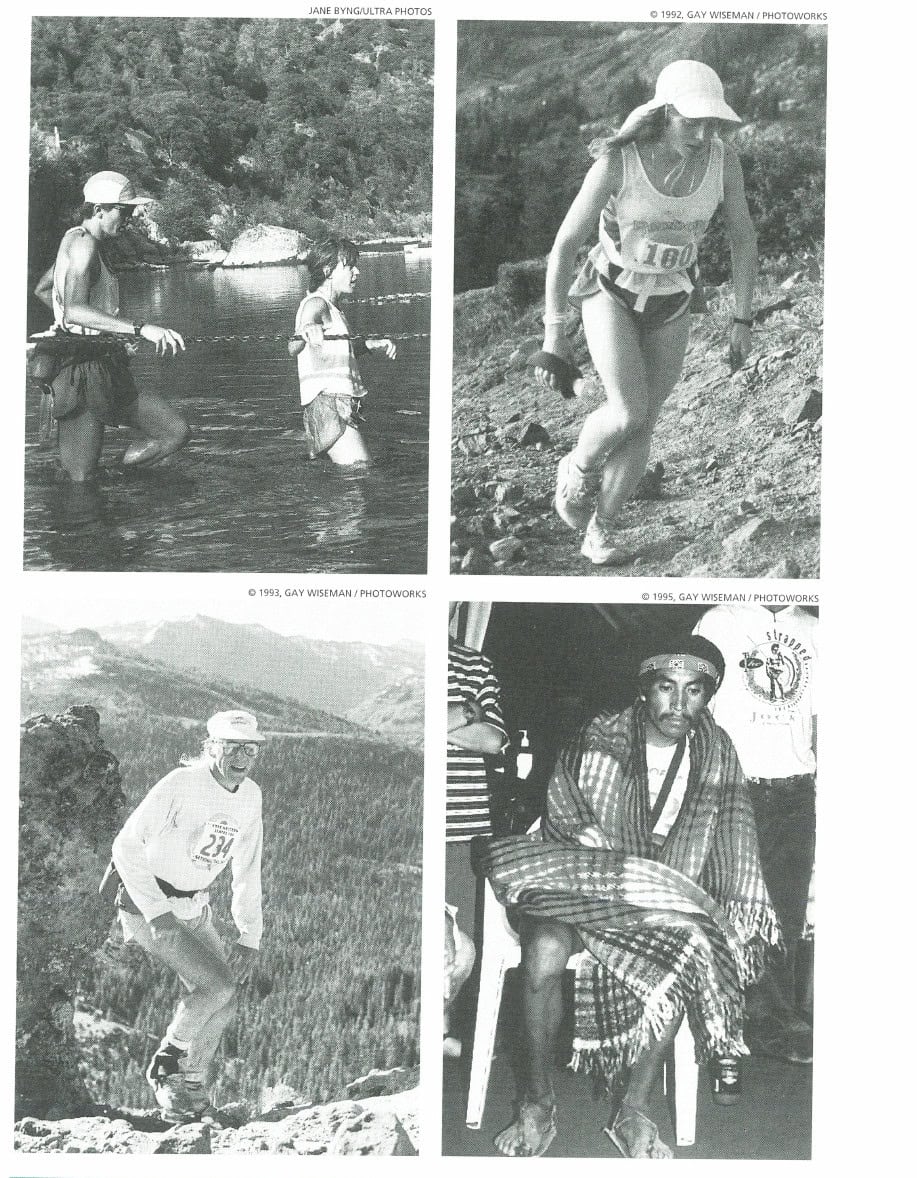
Rain, snow, and frigid temperatures dominated the course in 1991. Raceday temperatures never exceeded 74 degrees, rain greeted runners at the start, and snow flurries occurred at Emigrant Pass. Temperatures at the start hovered around freezing.
Runners entering Robinson Flat (30.2 miles) are usually perspiring heavily, but this year instead of the usual shorts and singlets, they arrived in tights, jackets, hats, and gloves. The cold weather was certainly a bonus in the generally steaming canyons, and the impact of the cool weather was reflected in the finishing times. Tom Johnson won for the second straight year, and his time of 15:54:05 broke the course record by 30 minutes. Ann Trason broke her course record by 4 minutes and for the second year in a row placed ninth overall. For the first time in race history, two over-60 runners, Rob Volken and Dick Laine, won silver buckles. Jim Pellon became the first runner to earn 12 consecutive silver buckles.
Tim Twietmeyer and Ann Trason were the big stories in 1992, as Twietmeyer not only earned his 11th silver buckle, but also made it to the victory stand for the first of four trips. Trason, as had become tradition, again broke the course record for the fourth consecutive year. More impressively, she finished third overall, her first of four consecutive top three or better finishes. Helen Klein and Ed Fishman, both 69 years old, became the oldest finishers in race history. It was Helen’s fourth finish and Ed’s fifth. Their records still stand.
What has come to be known as “The Sierra Triangle” prevailed in 1993: deep snow in the high country, 105+ temperatures in the canyons, and the grueling California Street Trail combined to account for the lowest percentage of silver buckle winners since the 1977 race. Only 56 runners were able to make it to Auburn in under 24 hours. Tom Johnson joined Jim King as a three-time winner of the race, and Ann Trason won for the fifth straight year, finishing third overall for the second straight year. The Triangle Effect played havoc with the entire field, as both winners were well off their course records.
Western States Turns 20
Ray Piva’s performance in 1994 equaled that of anyone who crossed the finish line at Placer High. Piva, age 67, ran 23:29:19 to finish 62nd overall and become the oldest runner to ever earn a silver belt buckle.
The race celebrated its 20-year anniversary, which continued virtually to the last minute of the race, as Joann Hull entered the stadium with under two minutes remaining on the clock. In a dramatic dash to the finish line and with the entire crowd in an uproar, Joann crossed the line with a mere 16 seconds to spare. Without question, it was one of the most dramatic finishes in the race’s history.
Twietmeyer won for the second time, and Trason was again spectacular. She not only moved up to second overall, but she also demolished her course record by 37 minutes. It was always felt there would never be a female overall winner of the Western States, but Ann Trason has been causing many skeptics to abandon the word “never.”
The Toughest Western States
As a race director who has staged many ultramarathons and marathons, I have often been asked about the toughest race and the best race I’ve ever directed. Without question, the 1995 Western States 100 wins on both counts.
Nature played havoc for everyone involved: race management, runners, volunteers, and crews. The record snowfall in 1983 paled in comparison to 1995, as 836 inches of snow blanketed the high country. Not content with the volume of snow, nature dropped 10 more inches the week before the race.
Because the snow made parts of the course inaccessible, as in 1983, the course had to be rerouted. Personnel and supplies had to be airlifted into the Lyon Ridge and Red Star Ridge aid stations. To make matters worse, the water at the Ox Bow Dam could not be restrained to facilitate the river crossing at Ruck-A-Chucky because of the rapid snowmelt. Trail marking was almost impossible in the high country, and because it had been a very cool spring, runners had had no hot-weather training, which could be devastating if the canyon temperatures rose.
In fairness to the runners facing such obscene conditions, we raised the absolute cutoff time from 30 to 32 hours. Since a number of runners only get the opportunity to run every third year (runners not lucky enough to be drawn in the lottery for two consecutive years receive automatic entry the third year), we wished to give everyone every opportunity to finish.
As race weekend approached, our worst fears materialized as the daily temperatures climbed steadily. After being forced to endure 24 miles of deep snow, the runners were subjected to blazing sunshine and canyon temperatures of 107. In spite of it all, and thanks to Herculean efforts by the volunteer staff, very few problems developed.
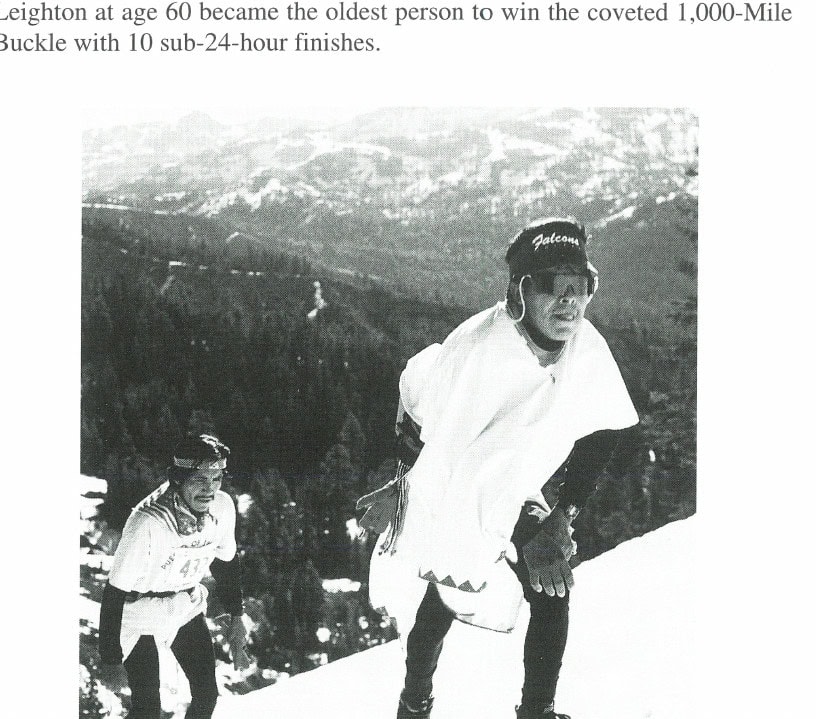
Twietmeyer and Trason were victorious again, and as incredible as it may seem considering the conditions, Trason finished only six miles behind Twietmeyer. Additionally, the legendary distance-running Tarahumara Indians made their debut at Western States, and Gabriel Bautista from the Sonora region of Mexico finished third, only 12 minutes behind Twietmeyer. Gard Leighton at age 60 became the oldest person to win the coveted 1,000-Mile Buckle with 10 sub-24-hour finishes.
The Spirit of the Western States
The true spirit of Western States can best be described by three incidents that occurred just prior to and during the 1995 race.
Because of all the snow, we had to wait as long as possible to mark the course in the high country. This was necessary because access to the area was virtually impossible. Tim Twietmeyer, who knows the trail in the high country as well as anyone, volunteered to lead a trail-marking party the Saturday before the race. Tim would be running the race to defend the title he won in 1994, yet in spite of knowing that the conditions would be most difficult, he jeopardized a possible repeat victory and perhaps even a finish to make certain the trail was properly marked. On the return trip to where the party had begun marking, the snowstorm that they had encountered at the beginning of their labors turned to a whiteout, and the team had grave difficulty finding their way back. The mountain gods rewarded Tim for his incredible act of courage and self-sacrifice, and he earned his third victory on raceday.
The second incident of considerable significance was performed by a group of runners who volunteered to serve as our snow patrol. Because of the snow, we felt the need to enlist the support of some runners who were veterans of the course but who were not in the race to serve as a form of safety patrol. When we announced that we were looking for volunteers to serve on this patrol, the response was incredible: within a week, we had 25 volunteers. These runners, based on their abilities, would be in groups and dispersed amongst the entire field of participants. We even had several physicians and nurses in the groups.
Each person in the groups would be outfitted with an orange
safety-colored T-shirt so they could be easily identified by the runners; each person would be equipped with a first-aid kit and a sun-reflecting mirror, and each group carried a ham radio. They were provided with information on how to communicate with the aid stations and how to make contact with the helicopter we had on standby.
In an operation that would have made the U.S. Army proud, when a runner fell, breaking her ankle, within a matter of a few minutes, one of the snow patrol groups came to her rescue. A member of this particular group happened to be an orthopedic surgeon. The group immediately contacted our communications network, giving their location. The information was relayed to the helicopter pilot who took off and had no difficulty locating the runner and the patrol because of the contrast of the orange T-shirts against the immaculate snow. The pilot was able to land on the snowfield, and the injured runner was loaded aboard and airlifted to the predetermined landing zone. From there she was placed in a volunteer’s car and was on her way to meet her crew and from there to the hospital for treatment. The entire operation took just 30 minutes. As a result of our experience with the 1995 race, the safety patrol has now become a permanent part of the race and is almost as popular an assignment with veteran runners as running the race itself.
The third incident occurred at the river crossing. Because of the copious snowmelt, the water could not be held back at the dam. The currents and rapids at the actual crossing were so severe that it was not even safe to transport runners across by boat.
As a result, an ingenious series of ropes and pulleys were stretched across the river, and a raft was attached to the ropes. The runners were pulled across the river in the raft. Though it was a slow process, had it not been for the rope-and-raft system, the race would have had to be cancelled. The person who devised this plan estimated that it would require at least 20 volunteers to take shifts handling the ropes since it would involve at least 14 hours from the time the first runner arrived to when the last runner left.
Less than six hours after this ferrying operation began, I received a call at the finish line from the aid station captain. The volunteers pulling the ropes were at a state of exhaustion, and in spite of wearing gloves, their hands had become badly blistered. Would I be able to get some help to relieve them?
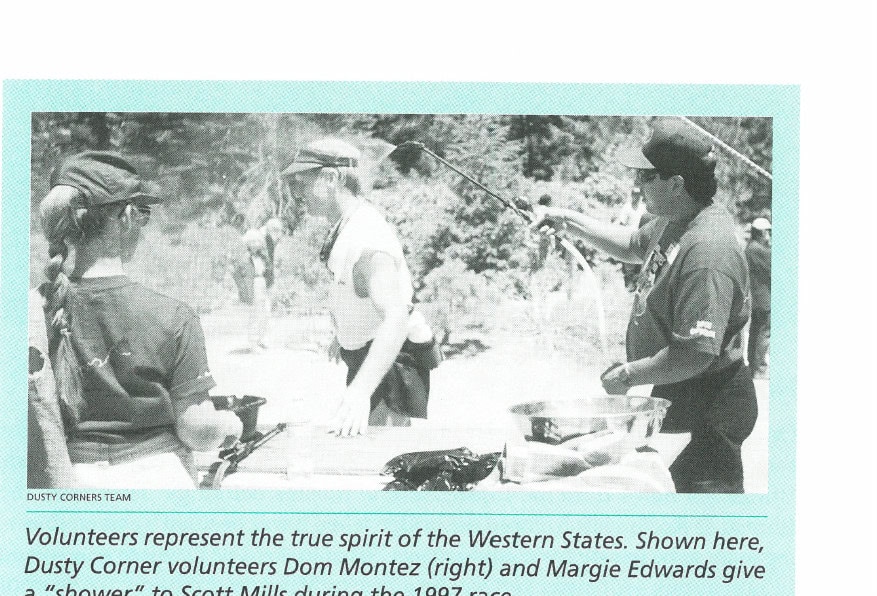
I immediately had the announcer in the stadium indicate that we needed volunteers to go to the river to assist with the crossing. In spite of warning the potential volunteers that they would be required to stay throughout the night, in less than 15 minutes nearly 60 people volunteered to go. Several hours later, I received a second call from the aid station captain begging me not to send any more people since they now had more volunteers than they knew what to do with. The volunteers’ actions represent the true spirit of the Western States.
Increasing the cutoff time to 32 hours for the grueling 1995 race is something that I am proud of, as it again proved that we attempt to do everything possible to enable the runners to finish the race. This extension of the cutoff made 28 runners (14 percent of all finishers) particularly happy.
1,300 Reasons Why the Western States Endurance Run Exists
In the beginning there was the Gang of Four. . . . It was spring, 1978, and the challenge was how to create a great Western States Endurance Run, to be held for the first time independent of its progenitor, the Tevis Cup. Phil Gardner, Shannon Weil, Curt Sproul, and Mo Livermore devoted countless weekends to exploring the high country, deciding upon appropriate locations for 21 aid stations (instead of just the 3 used the previous year, when the Run had used the Ride’s vet checks!) and solving a multitude of logistical problems. All four were endurance riders, but none had experience running races. Each was totally dedicated, however, to making this fledgling event as safe, well organized, and fun as possible for the ever-growing band of adventurers attracted to it.
This type of dedication, amplified now by over 1,300 volunteers annually, is truly the foundation for this extraordinary event. Without these hundreds of loyal people, there simply would be no Western States.
These days, when Stormin’ Norman Klein mobilizes his troops for each year’s race, a multitude of energetic volunteers give up a precious weekend to help perfect strangers fulfill their dream. Scores of enthusiastic helpers staff the 30 aid stations and 11 medical checks, many of which are in remote areas and difficult to reach by vehicle. Entire families turn out to assist the race; Gregory Griffith anchored his parents’ Bath Road checkpoint every year until he was a sophomore in college! Everyone seems willing to help in any way.
Physicians, nurses, chiropractors, podiatrists, EMTs, paramedics, and massage therapists contribute their professional skills. The Auburn Communications Group and a special group of licensed radio operators led by Jim Pearce track runners through the high mountains and deep river canyons. The Auburn Motorcycle Club, organized by Duane Purdue; the Foresthill Safety Club; the TevSweep mounted patrol, coordinated by Martin Macken; and the Auburn Police Department all play integral roles in maintaining the safe conduct of the race. Placer County Search and Rescue riders have worked for 20 years monitoring the progress of runners and hauling out those who needed to thumb a ride to the next checkpoint. The generous folks at Placer High School allow us space and facilities to enjoy a fittingly grand finale to the Run, the Foresthill Elementary School opens its campus, the Squaw Valley Ski Cooperation generously provides us with their facilities, and the communities of Michigan Bluff, Foresthill, and Auburn lend their support in countless important ways. Throughout the year, the Western States Trail Foundation, which puts on the Tevis Cup Ride, works side by side with the Run organization to accomplish goals common to both events.
Public agencies play a crucial part as well. Representatives from the United States Forest Service, the California Department of Parks and Recreation, the Bureau of Reclamation, and the Placer County Water Agency all work with race director Norm Klein to ensure a safe and smooth journey for the runners.
Many volunteers share a long history with the Run: Luke and Judy Rinehimer; Larry, Marilyn, and Greg Griffith; Jan Floyd; Dave Mullins; Bill Worcester; and Al and Helen Beck are aid station captains whose tenure has spanned 20 years. Betty Veal, RN, a member of both the Run and Ride organizations, has presided over the recording of runners’ progress since Gordy Ainsleigh went through with the horses, and Jerry Holm has aided the event in myriad ways since beginning radio communications work with the Tevis Cup over two decades ago. Millie Hazzard, RN; T. J. Cantrell; Mary Ann Simmons; Marge Haviland; Rod Carveth; and Gil Lang, MD, are just some of the others who have been part of the event for over 20 years, and whose invaluable contributions have made the Run the success it is today.
All of these outstanding individuals—each of whom has given so unselfishly of time and talent—are owed a debt of gratitude from every Western States runner and from the Western States Endurance Run Foundation itself. A vital and treasured part of the Western States family, these volunteers are without doubt the mainstay of the event.
—Mo Livermore
No End to the Obstacles
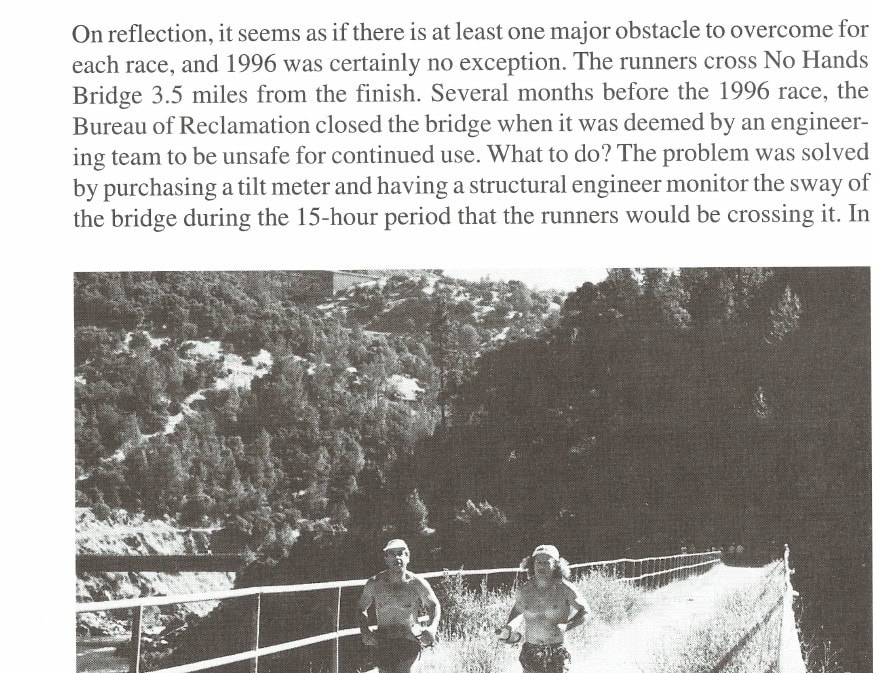
On reflection, it seems as if there is at least one major obstacle to overcome for each race, and 1996 was certainly no exception. The runners cross No Hands Bridge 3.5 miles from the finish. Several months before the 1996 race, the Bureau of Reclamation closed the bridge when it was deemed by an engineering team to be unsafe for continued use. What to do? The problem was solved by purchasing a tilt meter and having a structural engineer monitor the sway of the bridge during the 15-hour period that the runners would be crossing it. In
that the bridge is only used by hikers, runners, and equestrians, we felt that it would not suffer an inordinate amount of sway, and fortunately no problems were encountered.
Aside from this headache, in 1996 it was Twietmeyer and Trason as usual. Twietmeyer not only became the first runner to win the race for the fourth time, but he also earned his 15th sub-24-hour buckle. Trason dropped to third overall in winning for the eighth time. Her accomplishment can only be termed incredible, as just 12 days earlier she had won and set a women’s course record at the Comrades Marathon, a 90K ultramarathon in South Africa. The entire week prior to Western States, she was sick and not even certain that she would be able to make it to the starting line. It was truly a remarkable double-header!
The Morton Comeback
The only words necessary to describe the 1997 race are “Mike Morton.” A U.S. Navy diver from Maryland, Mike had a difficult time in the 1996 race, withdrawing after 86 miles. Certainly no stranger to ultramarathoning with victories at the Old Dominion 100 and the Vermont 100, Mike returned to Western States with just one thought in mind: make up for 1996.
It has been repeated a thousand times over that no runner can win Western States without having the advantage of training on the Western States Trail. Most experienced runners will contend that knowledge of the trail is worth at least two hours off the total time. Further proof of this is that in the first 23 years of the race, there had never been a men’s winner who didn’t live in California. And furthermore, every winner since 1987 had lived in Northern California. Well, Mike Morton apparently wasn’t privy to the prevailing knowledge.
Fortunately for everyone involved, weather conditions on raceday were the finest in the history of the race. Temperatures never topped 80 degrees, and the night was very cool, although by the time Morton arrived in Auburn, the sun hadn’t even had a chance to go down.
Mike took the lead at 17 miles, and when he arrived at Robinson Flat (30.2 miles), everyone felt he would “lose it in the canyons.” All he lost when he hit the canyons were the runners who were pursuing him. At Foresthill (62 miles) people said, “he’ll crash and burn on California Street Trail.” The only things Mike burned were the rocks as he blazed over them. At the river crossing (78 miles), the sentiment was “he’ll never finish at that pace!”
Not only did Mike finish at that pace, but he also became the first non-Californian to win the race, defeating Tim Twietmeyer (who finished second) by an hour and 33 minutes. To those who thought he’d crash and burn, instead Mike burned Tom Johnson’s course record by 14 minutes. Skeptics felt that if an “outsider” won, he wouldn’t be accepted by the “Western States family.” I’ve been involved in 15 Western States awards ceremonies, and Mike Morton received the loudest and longest standing ovation I’ve ever witnessed.
But lest we forget the exploits of Ann Trason, she won for the ninth consecutive year and pulled off the Comrades/Western States double-header for the second straight year. To prove that she is actually human, she dropped all the way back to eighth place in 1997.
A tragic footnote to the 1997 race occurred with the untimely deaths of two legends of the Western States 100. Both Dick Collins, with 10 Western States finishes, and Jim Pellon, with 12, died prior to the 1997 race, both from heart attacks. Dick was 63, and Jim was only 47. Both runners were loved and admired by all who knew them, and they will be greatly missed.
25 YEARS AND GOING STRONG
The 1998 race marks the 25th running of the now-classic event. When Gordy Ainsleigh attempted the impossible in 1974, nobody ever dreamed that the race would evolve into the extravaganza it has become or that it would achieve the popularity and prestige that it has in worldwide running circles.
What surprises does 1998 have in store for the race? We hope only good ones. Will Ann Trason be able to win for the 10th consecutive year? Will Mike Morton be able to defend his title? Will any of the five 70-year-old entrants become the first 70-year-old ever to finish the race? Will Helen Klein, at age 75, be able to finish the race? Will some unknown emerge and upset the plans of the favorites? Will El Nino be kind to us and not drop tons of snow in the high country? These are all interesting questions that will be answered on June 27, 1998.
I’ve been asked this hundreds of times over the years: Why do people want to subject themselves to the rigors of training and participating at Western States, not only Western States, but other ultramarathons as well? The time involved in preparing for these events is time away from family, time away from professions; and since there are no financial rewards, runners spend considerable sums of money to train and participate. As a result of these factors, families have drifted apart, runners have lost their jobs. Yet people go through great waves of depression when their names are not drawn in the Western States lottery and they learn they’ll have to wait until next year or quite possibly even the next year after that to run in the race.
One need only look at the race demographics to answer these questions. First, consider the age of our applicants. The average age of Western States runners is 43, with the largest number of applicants in the 40–49 age group. We actually have more runners apply in the 60-and-over age group than in the 18–29 group. This fact tells us that most of Western States entrants no longer possess the speed they once had in earlier years, so they now are looking for other challenges. What better way to find that challenge than to run Western States?
Second, the occupation of our runners can also help answer this question. The average educational level of our runners beyond high school is between five and six years of college. The majority of our runners are engineers, attorneys, physicians, dentists, educators (professors, teachers, coaches, etc.), scientists, computer scientists, private business owners, nurses, CEOs, and executives.
These people have had to be highly motivated to attain the educational levels that they have. Once reaching these levels, the motivation does not stop, and if they find that running motivates them to attain a new or different goal, then certainly Western States will be a goal for which they will strive. Again, since no prize money is awarded, it can only be the thrill of achieving this goal that allows them to sacrifice so much to reach success.
A third reason, of course, is ego. If most runners are truly honest with themselves, they will have to admit that ego plays an enormous role in their decision to attempt events of this nature. Many runners I know, and many athletes in general, have insatiable egos, and the only way to fuel those egos is to say, “Hey, I can run 100 miles over mountain trails in 110 degree temperatures”—inferring that most people can’t, which is certainly a fair assumption. The smart athletes do not allow their egos to affect their performance, but there is at least a little bit of ego in all of us or we couldn’t achieve what we do.
The Western States 100 provides a crucible in which people can test themselves and in which they can reach lofty and difficult goals. No runner who has ever crossed the finish line at Placer High School remains the same person who left Squaw Valley “roughly”—and I stress roughly—a day before. The race is an incomparable journey of self-discovery.
| Western States 100 Winners | ||||
|---|---|---|---|---|
| Year | Male winner | Time | Female winner | Time |
| 1974 | Gordy Ainsleigh | 23:42 | ||
| 1975 | Ron Kelley | Dropped out at No Hands Bridge | ||
| 1976 | Ken Shirk | 24:29 | ||
| 1977 | Andy Gonzales | 22:57 | ||
| 1978 | Andy Gonzales | 18:50 | Pat Smythe | 29:34 |
| 1979 | Mike Catlin | 16:11 | Skip Swannack Gibbs | 21:56 |
| [In 1980, 4.5 miles were added to the course.] | ||||
| 1980 | Mike Catlin | 18:35 | Sally Edwards | 22:13 |
| 1981 | Doug Latimer / Jim Howard | 16:02 | Bjorg Austrheim-Smith | 18:46 |
| 1982 | Jim King | 16:17 | Bjorg Austrheim-Smith | 18:23 |
| 1983 | Jim Howard | 16:07 | Bjorg Austrheim-Smith | 19:11 |
| 1984 | Jim King | 14:54 | Judy Milkie | 20:18 |
| [In 1985, 6.5 miles were added to the course.] | ||||
| 1985 | Jim King | 16:02 | Teri Gerber | 20:30 |
| [In 1986, the course was changed to the current set-up.] | ||||
| 1986 | Chuck Jones | 16:37 | Kathy D’Onofrio | 20:58 |
| 1987 | Herb Tanzer | 17:41 | Mary Hammes | 21:45 |
| 1988 | Brian Purcell | 16:24 | Kathy D’Onofrio | 18:52 |
| 1989 | Mark Brotherton | 16:53 | Ann Trason | 18:47 |
| 1990 | Tom Johnson | 16:38 | Ann Trason | 18:33 |
| 1991 | Tom Johnson | 15:54 | Ann Trason | 18:29 |
| 1992 | Tim Twietmeyer | 16:54 | Ann Trason | 18:14 |
| 1993 | Tom Johnson | 17:08 | Ann Trason | 19:05 |
| 1994 | Tim Twietmeyer | 16:51 | Ann Trason | 17:37 |
| 1995 | Tim Twietmeyer | 18:34 | Ann Trason | 18:40 |
| 1996 | Tim Twietmeyer | 17:42 | Ann Trason | 18:57 |
| 1997 | Mike Morton | 15:40 | Ann Trason | 19:19 |
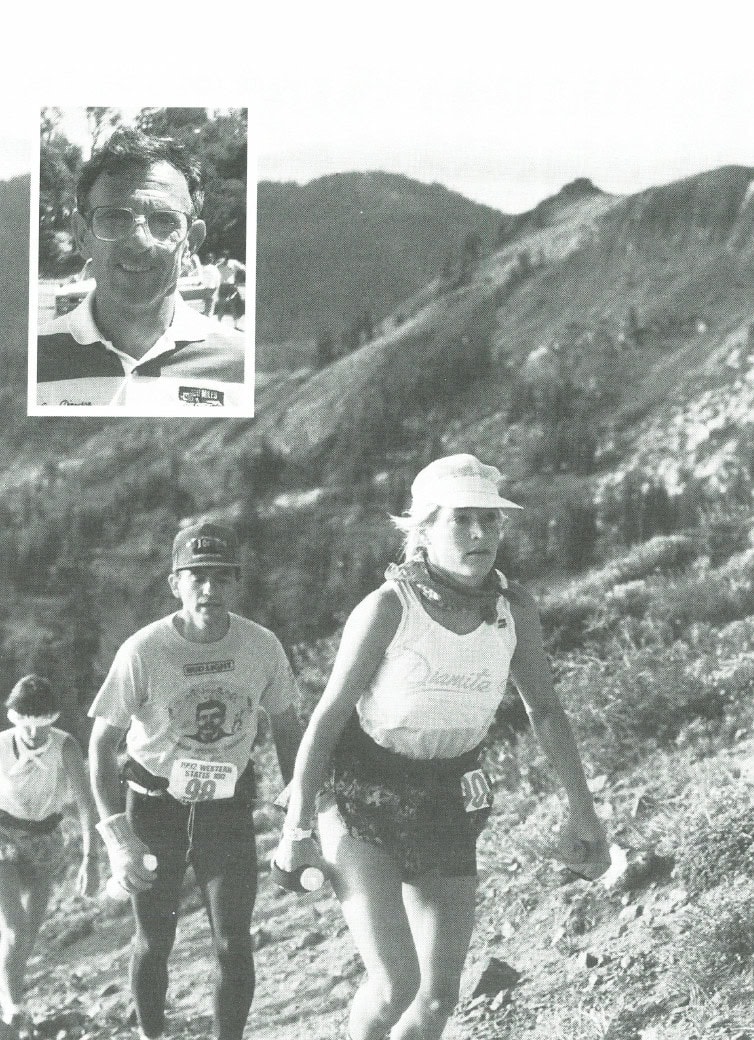
“No runner who has ever crossed the finish line at Placer High School remains the same person who left Squaw Valley ‘roughly’ a day before. The race is an incomparable journey of self-discovery.”—Norm Klein, race director (inset)
“NEVER AGAIN!” I said those words for the final time on June 25, 1983, following my first attempt at the Western States Endurance Run. I had taken up running five years earlier at the age of 55, when my husband and I were challenged to run a 10-mile race, the first race ever held in Hopkinsville, Kentucky, the town where we were living at the time.
After 10 weeks of training, we entered and finished the race together, and although we finished dead last, my only competition came from three high school girl cross-country runners. As a result, I was able to take home my first trophy—I had won the masters division.
From this point on I progressed to additional shorter races, then graduated to the marathon and, finally, to the ultramarathon realm. The next logical step, then, had to be an attempt at the Western States 100, and in 1982, I applied for the ’83 States, my first attempt at a 100-miler.
Although we had heat and humidity to train in while living in Kentucky, hill training was nonexistent. Our strategy was to arrive in Squaw Valley two weeks before the race so we could get some idea what the course looked like and to acclimatize to the altitude. Coming from sea level, our concerns for doing well became profound. The race started at 6,200 feet and within a mere 4.5 miles climbed to 8,750 feet. Then there was the promised heat in the canyons and, of course, the incredible distance.
We were also unlucky in that El Nino had hit the western Sierra pretty hard that year, and the snow pack even in mid-June was impressive. We had heard that snow in the high country was not uncommon at Western States, so we were not unduly alarmed to see snowdrifts up to 16 feet and to learn that we’d be running the first 26 miles over a five-foot snowpack.
It’s been said that “ignorance is bliss,” and we were totally ignorant of the fact that these were not “normal” conditions at Western States. In reality, the snow had caused such a problem that the course had to be rerouted between
This article originally appeared in Marathon & Beyond, Vol. 2, No. 3 (1998).
← Browse the full M&B ArchiveMore like this
1,000+ stories from 19 years of Marathon & Beyond
The complete archive of the legendary long-distance journal — digitized and free to read.
