

Peter Gilmore
It’s certainly no secret that marathoning is among the pursuits that demand the most patience. At the upper echelons of the sport, in particular, there is simply no way of achieving success without heaping many miles upon many years.
Elite marathoners do not fall, fully intact, from the sky. Rather, they mature gradually from the ground up, like stately apple trees—initially developing a sturdy network of roots, then a robust trunk from which sprouts a substantive collection of branches, and then, and only then, the blossoms that will eventually evolve into fruit.
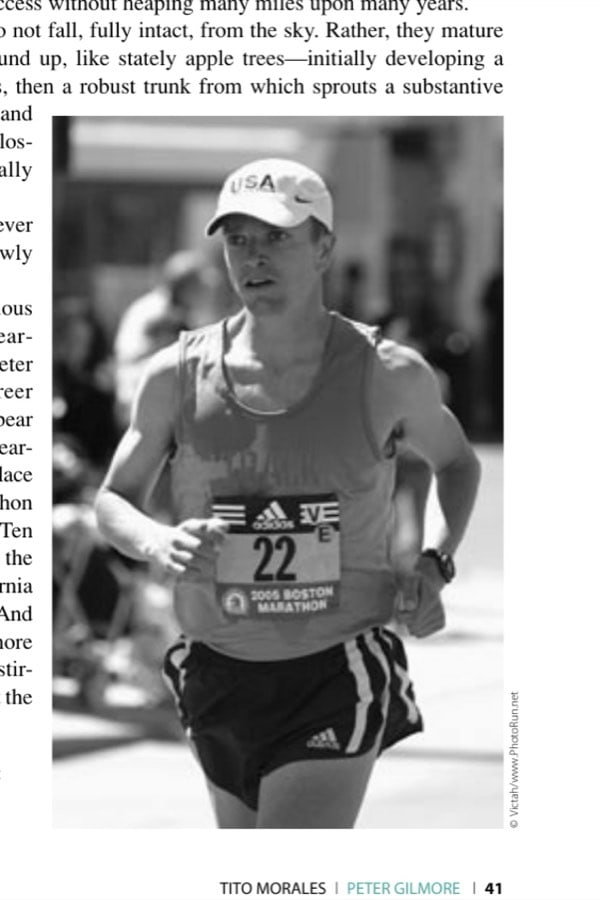
Some trees, for whatever reason, yield more slowly than others. After a long and arduous journey that began nearly two decades ago, Peter Gilmore’s running career is finally beginning to bear fruit. In 2004, the 28-yearold produced an eighth-place finish at the U.S. Marathon Olympic Team Trials. Ten months later, he crossed the line second at the California International Marathon. And on April 18, 2005, Gilmore followed that up with a stirring tenth-place finish at the Boston Marathon.
▲
A picture of persistence: Gilmore at the 2005 Boston Marathon.
© Victah/www.PhotoRun.net
IThanks to such impressive results, Gilmore, unknown to all but the most ardent admirers of distance running, was selected to represent the United States at the 2005 World Championships in Helsinki, Finland. However inspiring Gilmore’s story may be, though, it’s even that much more illuminating as to the monumental challenges that confront late developers in the sport of distance running.
PLANTING THE SEED To fully comprehend just how far Peter Gilmore has come, it’s perhaps best to first understand what he hasn’t accomplished in his lengthy career. Gilmore was not a mile or two-mile state record holder in high school. He was not a top fin
isher at the Footlocker Cross-Country National Championships. He competed at the University of California at Berkeley, but he earned neither NCAA titles nor All-American certificates. Gilmore was born in 1977, in the swell of the running boom fanned by the words
of Jim Fixx and the legs of Bill Rodgers, Frank Shorter, and Alberto Salazar. He was raised in the Pacific Palisades in Southern California, where his parents, Ed and Rita, were among the converts. Rita Gilmore was a chain smoker before
she took up the sport and completely overhauled her lifestyle. She is still very much a fixture, and a successful one, on the masters racing scene. As a toddler, Gilmore remembers accompanying his mother to a dirt track to
watch her interval sessions. Some of his earliest memories, too, entail watching his parents compete in various road races, including marathons. Competitive running, it can be said, was a part of his consciousness since about the time he
learned to walk. “The way you start running and the reasons that you did are big indicators of how long you’ll stay in the sport,” Gilmore says reflectively. It seems almost inevitable that Gilmore’s parents would pass along their love
of running to their youngest child. The question, though, was how deeply it would affix inside his soul. Gilmore joined a local YMCA program in the sixth grade and found the experience to be so enjoyable that, at an age where
most of his friends were directing their attention to basketball and
Rita Gilmore
▲
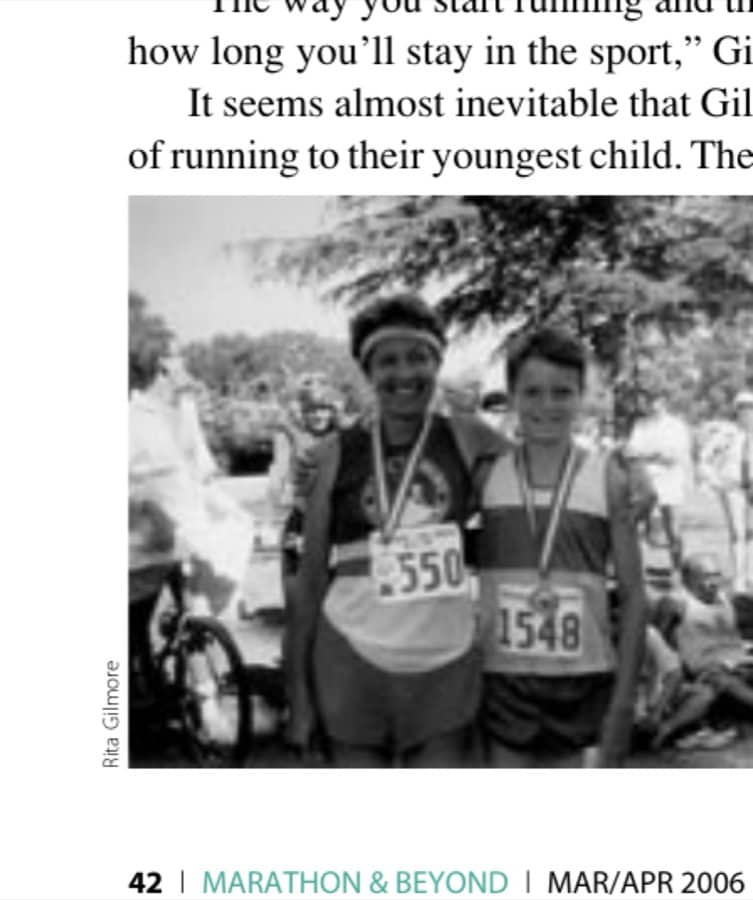
Gilmore and his mom, Rita, after the 1989 Will Rogers 5K/10K, where Gilmore won the 12 and under division in 20:26.
baseball, he hungered to see how quickly his legs could carry him around the oval. By the time Gilmore reached college, he not only still had the yearning, but it was stronger than ever. A natural distance runner, he quickly turned his focus to the 5K and 10K.
Division I competition, though, can be a rude awakening for even the most determined of athletes. Runners who have grown accustomed to breasting the tape in secondary school and reading about their athletic brilliance in the local newspaper suddenly discover that there are legions of others out there just like them.
Collegiate sport, while a springboard for a special few, is the most rigid of ceilings for most. Many talented athletes abandon their aspirations midstream, choosing to not even compete all four years. Others, like Gilmore, manage to go the distance—but may be worse from the experience. “
I was pretty fried by the end of it,” Gilmore says of his career at Berkeley. “I stayed on for a fifth year, because I had redshirted both cross-country and track earlier for injury stuff.” He describes his final collegiate competition, the 2000 Pac-10 Championships at Oregon’s famous Hayward Field, as disastrous. “
I didn’t run a very good race, and I hadn’t run a good race in a long time prior to that,” he recalls. “I didn’t run for a couple of months. I just wanted a time-out. I was pissed at the coaches. I was pissed at myself. I knew I wasn’t gonna stop running. I knew that wasn’t the end. But I needed to kind of figure out what was going to happen next.”
AN UNSOUND PYRAMID “There are people who don’t like me being open and honest about what’s going on with the sport in this country,” says Gilmore, a familiar presence on
Cal Media Relations
▲
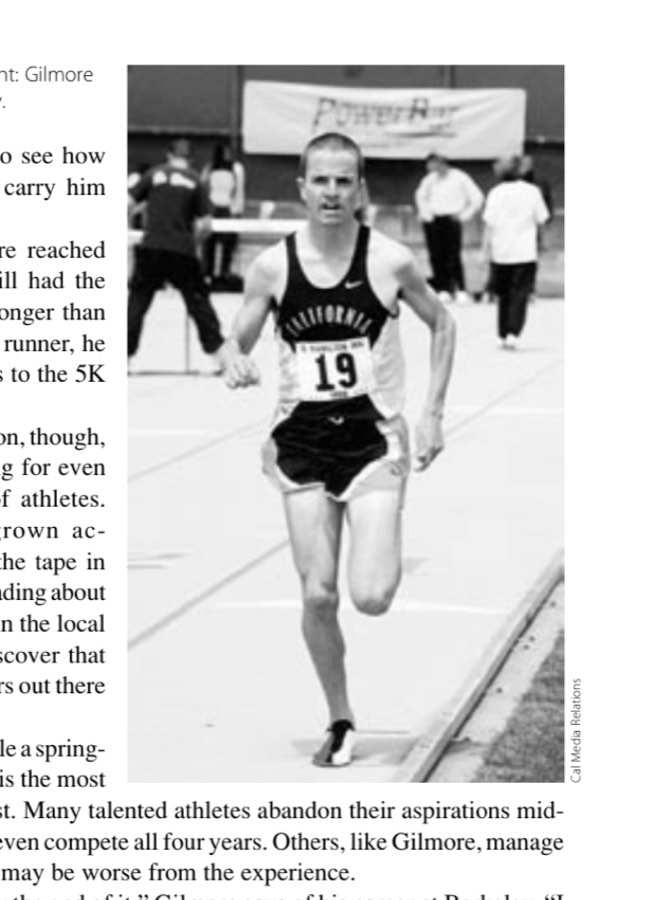
A Golden Bear in full flight: Gilmore competing for U.C. Berkeley.
LetsRun.com’s wildly popular message boards. “But I’d feel like a fool if I didn’t come out and talk about it.” When Gilmore laments the sizable hurdles confronting slow developers in the sport, though, there is not the slightest hint of bitterness in his voice. Wistfulness, yes. Frustration, ditto—there is, of course, some of that too. But, very much to his credit, there is no bitterness. “
Obviously we aren’t as good as we used to be in the U.S. on the world level,” he explains. “On an absolute level of performances, in terms of times, if you took our top 20 guys in every event from—pick a year, 1982 or 1980—they would beat our top 20 guys now probably across the board. Not only that, but those guys then were much closer to being the best, if not being the best, in the world. In other words, the rest of the world has advanced while we’ve actually gotten worse. We haven’t even held even.”
Gilmore placed in the top 10 at the Olympic Trials with a time of 2:15:43. While pleased with the result, he is candid with his overall assessment of the field’s performance. “I really shouldn’t have been eighth,” he says. “If the sport was very healthy, I should have been further down. In reality, if we had some of these folks sticking around the sport longer and really training the right way, the ranks would be a lot deeper. It would be tougher, but tougher in a good way.”
To Gilmore, the biggest reason for the decline of distance running success in this country is the lack of postcollegiate opportunities. Gilmore describes how he has been on the front lines of a disheartening battle of attrition. He has personally witnessed one gifted runner after another fall by the wayside, not so much because they lacked the physical strength or the mental toughness to continue on, but because they grew dispirited by the lack of monetary incentive to do so.
While he is thrilled that our top American athletes, such as Deena Kastor, Alan Culpepper, and Meb Keflezighi, are finally posting some good results on the international scene, Gilmore is concerned that, because of a lack of structure in place at the next levels down, all of their hard work in reelevating the profile of the sport in the United States will go for naught. “
We still have this big hole right below them,” he explains. “There are not a lot of guys in the midrange. I don’t think we’re ever gonna have a whole lot of worldbeaters if you don’t have a lot of guys in the middle, and then even more guys right below that. It’s a pyramid thing, and, right now, it’s very unbalanced.”
Gilmore is convinced that feeding the second and third tiers should be of paramount importance to large sport-related corporations. It is those levels, he insists, that will invariably produce the champions of the future. “
Everything is so tied up with how well you do in college—especially your last year or two—as to your fortunes when you graduate,” he says. “It doesn’t
make a lot of sense to me, because there are a lot of guys who can do really well who just need a little bit more time. But once they do improve, the door is closed as far as financial opportunities in the sport.”
REDISCOVERING THE WHY When Gilmore’s career came to a close at Berkeley, he, as is the case with a good many other former collegians, found himself in no man’s land. Gilmore had been good enough to run at the very challenging Division I level. His body had adjusted to the increased workload and the frequent racing, both in cross-country and on the track. More important, though, he had graduated with his interest in the sport still intact, and he knew in his heart that his best running was still ahead of him. The question, though, was how to stay afloat while he figured out how to get at it.
Gilmore decided to remain in the Bay Area and joined a club team called Adidas TranSports. To help make ends meet, he worked at the TranSports retail store. “The Pacific Association here in Northern California is a great USATF chapter,” says Gilmore. “There’s a whole series of races. They’re really competitive. There are a ton of clubs that get into it.” Gilmore admits that when he first immersed himself in the local road racing scene, he expected, because of his training at Berkeley, to be top dog. That, though, was far from the case. “
It was a year of getting second and third every time,” he says. “It taught me a lot about how to race. I learned a lot of good lessons that first year.” The prize money was minimal, perhaps a few hundred dollars for winning a race and more at the end of the series if you happened to be one of the top point scorers. But the most valuable aspect of the circuit was that Gilmore had surrounded himself with like-minded individuals who were striving, both individually and as a group, to continue to improve their running.
While he mulled over his future in the sport, Gilmore decided to act upon a longtime dream—to travel to Africa to spend some time with Kenyan runners. “I was sort of obsessed with getting over there and training,” he says. “I thought that if I went over there for a couple of months and trained, it would allow me to kind of leap ahead and be the runner that I really wanted to be.”
To Gilmore, the trip was less about adventure than it was about common sense. “I didn’t want to follow the path that everyone else had followed,” he explains. “It wasn’t working for everyone else, so why would it work for me?” Gilmore flew to Africa with little more than a few pairs of running shoes. He had no idea what he was searching for, or where, exactly, he was going to uncover it. He just knew that he wanted to run with the best runners in the world.
Gilmore’s pilgrimage led him to Eldoret, which he knew from research was in the Kenyan highlands and was where many of the country’s best runners lived and trained. After a few days of meandering about, he learned that distance legend Kip Keino owned a shop in town. He made a beeline for the store, met two of Keino’s sons, and they eventually helped him find his way to the runners.
Gilmore stayed in Kenya for six weeks, living and training daily with world record holders and other Kenyan elites. He was the only non-African around, but the Kenyans took him in as if he was one of their own. “
I ran a couple of races over there and got thoroughly whooped,” laughs Gilmore. “I mean, just destroyed. But it was fun.” For Gilmore, the years immediately following Berkeley represented an extended internship of sorts. He saw firsthand how to approach the sport from a different perspective. He learned new methods of training and racing. Above all, he had rediscovered his love of running.
When he returned to the United States, though, he was still confronted with the harsh reality of having to push the boulder up the mountain mostly by himself. He would soon lower his track 10K personal best to 29:26 and then to 28:57. Sponsors, though, never gave him even a second glance.
RUNNING AND BASEBALL In Gilmore’s mind, the entire postcollegiate structure for developing talent needs to be completely revamped. “A lot of people talk about the college system being broken—of kids being overraced and things like that,” he says. “I’m not so sure. But, certainly, there is stuff that we can fix in the postcollegiate system. I think we need to get guys running more out on the roads. Maybe get guys moving up to the marathon sooner. We need to tie that in with the shoe companies or other corporations who are interested in reaching the masses of runners who are participating in the road races and the marathons.”
Gilmore, an ardent baseball fan, equates some of the troubles he has witnessed in distance running to some of the same problems detailed in Billy Beane’s Moneyball regarding major league baseball. In the controversial book by the general manager of the Oakland Athletics, Beane goes to great lengths to describe how the major leagues’ age-old methods for identifying and developing future talent are fundamentally flawed. As proof, Beane points to how he has been able to turn a small-market team with one of the lowest payrolls in baseball into one of the league’s perennial powerhouses mostly by throwing out standard operating procedure. “
I love that book,” says Gilmore. “I love the whole philosophy of realizing what’s important and what other people are missing out on, and, consequently,
what’s affordable. I figure if there was a Billy Beane in the world of running, I would have been signed a while ago—or at least something better would have been going on.” What Gilmore has experienced, firsthand, is that shoe sponsors, like major league scouts, are woefully shortsighted when it comes to choosing which athletes to help support. “If you’re an All-American, especially if you get first, second, or third in NCAAs in your senior year of track or if you’re in the top five or whatever in cross-country, then you’re gold. You’re gonna be all right. But it’s not a terribly great predictor of success.”
Just as in basketball, baseball, and football, whose draft histories are littered with the carcasses of overly hyped and foolishly rewarded bonus babies gone bust, the same miscalculations also regularly occur in track and field. “
People should want to hear about it,” Gilmore says of his observations. “If they don’t, they’re just kidding themselves. I don’t want my generation to be just another one that kind of let it go by and didn’t take up the issue and fight for it.” When Gilmore reflects back upon what he has been through as he has struggled to find the means to keep his passion burning, it is the generosity and the little acts of encouragement that reverberate the most.
Gilmore talks about race organizers who, at the 11th hour, find a spot in the elite bin for 2:20 marathoners trying to run a 2:17 and others who agree to place 2:23 or 2:25 marathoners’ special drinks out on the course. It may not sound like much, he explains, but it represents some much-needed validation for athletes who are sacrificing the better part of their waking hours to pursuing the running dream.
One of the kindest gestures Gilmore has ever experienced was when he ran the Chicago Marathon in 2003. Paula Radcliffe, who had been scheduled to participate, pulled out. Race organizers decided that rather than keep the extra money they had allocated for Radcliffe’s appearance, they would direct it to American finishers who went under certain times, ranging from 2:22 to below. “There was a little bit of flak for it because a lot of people thought it was soft for guys to be making money like that,” he says. “These old guys think that it’s no way to encourage people to really go for it and try to run 2:12 or 2:13 or 2:14 when you’re giving them money for running 2:20 or 2:22, which I think is ridiculous. The guys who can run 2:12 and 2:13 aren’t the guys that really need it [the money]. Sure, they need it, but it’s not gonna make a big difference to a Dan Browne. But the guys who are the ones we want to encourage—who are gonna fill that middle ground—it’s gonna make a difference for them. They [race organizers] didn’t have to do it, and they did. It was a really generous thing.”
After his stint with TranSports, Gilmore went to train with the Nike Farm Team on the other side of the San Francisco Bay. Day after day and mile after mile, he mixed it up with the likes of former Stanford University stars Gabe Jennings, Michael Stember, and Brad Hauser. “We really trained hard,” he reflects. “Boy, I still think back on those workouts. They were just mind-blowing. We all thought we were gonna go out there and tear the track apart when we raced, and none of us did. We were massively overtrained.”
Contrary to popular belief, the Farm Team was anything but a cushy type of country club for track and field athletes. “Everybody thought it was just a rich, well-funded program, but it never was,” says Gilmore. “When you have, whatever we had on the team—60 or more people—it stretches pretty thin. Imagine taking a couple of squads to the cross-country nationals. You’ve gotta pay for flights, hotel rooms, and everything like that.”
Dues amounted to $300 per year. Yes, there were actually annual dues for financially strapped runners like Gilmore. It was the spring of 2002. Gilmore, now 24, was disheartened by his lack of results. He was consistently putting in the work, and he had whittled down his PRs, but he had little to show for his running. To cover his bases, Gilmore set about on a ▲
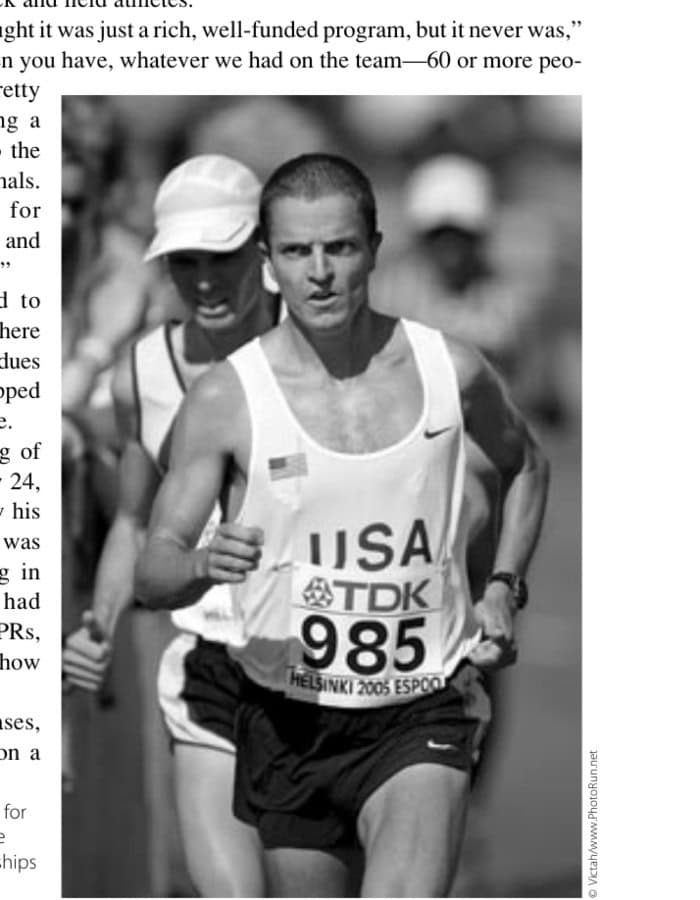
Gilmore competing for the United States at the 2005 World Championships in Helsinki.
© Victah/www.PhotoRun.net
FINALLY FINDING HIS FEET
new course of action outside of his sport. He would eventually become a part-time, in-class special-education aide at Woodland Elementary School in Oakland and then begin pursuing a master’s degree in finance. While Gilmore was still not finding either the performances or monetary rewards he had hoped for in Palo Alto, though, he did find something that would eventually raise his running to a new level: an exercise physiologist by the name of Jack Daniels.
Daniels, a former professor and coach at the State University of New York in Cortland, has published a variety of highly acclaimed works on physiology and running. Some of the athletes he has worked with over the years include Jim Ryun, Mary Decker Slaney, and Joan Benoit Samuelson. As luck would have it, Daniels was affiliated with the Farm Team when Gilmore was training there and when he decided to make the move up in distance. “
I thought, I could . . . do a marathon in the fall,” says Gilmore. “Chicago’s in October, and that seemed like a good place to start, so Jack wrote me up a program. I spent that summer building up the miles and doing his workouts.”
As Gilmore put his track career further and further behind him with each new mile on the roads, Daniels represented a glimmer of salvation. “It was all new, so I put total faith in him,” he explains. “I did whatever he told me to do. I went out to Chicago and ran decently.” “
Decently,” for Gilmore, meant running 2:21:48 and qualifying for the Olympic Trials. In Chicago, he sailed through the first half of the race in a little over 67 minutes, but then, as he approached the last 10K, he came face to face with all the horrors that he had heard about the distance. Poor hydration, overambitiousness, or whatever the case, he watched in utter frustration as his pace disintegrated from 5:10 miles, to 6:00s, 7:00s, and even slower. “
I mean, it was really bad,” he laughs. To compound matters, he made the ill-conceived plan of flying back home that afternoon right after the race. “I could barely get out of the seat on the airplane,” Gilmore recalls. But when he did finally make it back to his apartment, and after he had had a chance to digest the experience, he realized that the marathon distance had breathed new life into his running career.
A RUNNING REVOLUTION IN MICHIGAN Gilmore is convinced that the answer to the conundrum of how best to ensure that still-developing U.S. athletes remain in the sport may well lie in Grosse Pointe Woods, Michigan. “The model that I think is absolutely the best, and something that needs to be copied, is what Brooks and the Hansons are doing,” says Gilmore. “I think it’s a great deal for both parties.”
Kevin and Keith Hanson created what has evolved into the Hansons-Brooks Distance Project in 1999. Through a unique arrangement, the athletes chosen to take part in the program are afforded, among other things, housing, health insurance, equipment, and travel expenses. There is also an incentive-based bonus structure in place where the athletes are compensated for notable race performances. “In other words, they’re not having to make a sacrifice,” says Gilmore of the Hansons runners. “And they shouldn’t have to, because they’re doing something, if it’s marketed right, which is a valuable thing to companies like Brooks.”
The Brooks booth at the Boston Marathon expo, Gilmore points out, was plastered with pictures of the Hansons runners. It was an inspiring fusion of sport and commerce—with Brooks using the very same athletes whom they help support to assist in reaching the running masses. “I think they’ve really done a great job with finding a new business model in how you market the sport and how you market your company,” says Gilmore.
Gilmore looks upon the Hansons and Brooks joint venture as a novel sort of minor league in running that is long overdue. Their most successful runners, Trent Briney, Clint Verran, and Brian Sell, he points out, were certainly not stars in college by any stretch of the imagination. Still, they placed fourth, fifth, and 13th at the 2004 U.S. Olympic Marathon Trials. “
Which shows that if you’re willing to give guys a little bit of time, and the guys who are receiving this [Hansons/Brooks types of incentives] are willing to put in the work, great things can happen,” he says.
RUNNING TOWARD THE FUTURE It was only after Gilmore’s high-profile effort in Boston (in which he earned just $4,000 for being the second American and 10th overall finisher) that shoe companies began to approach him about possible representation. But by the time the world championships rolled around, Gilmore was still competing without a major sponsor.
Helsinki proved to be a tough day for many marathoners. The Athens Olympic Games gold and bronze medalists, Stefano Baldini and Vanderlei de Lima, were among a horde of athletes who stepped off the course. One-third of the field, in fact, logged a DNF.
It came as no surprise to those familiar with his career, though, that Gilmore chose to go the distance—even though he struggled to a 51st-place finish. His, after all, has never been the path of least resistance.
When it comes to the sport of marathoning, there is a tremendous disparity between the haves and the have-nots. Paula Radcliffe, for instance, reportedly receives an appearance fee in the neighborhood of $300,000 to $500,000 just to line up for a big-city race.
On the other end of the spectrum, though, are the legions of athletes like Peter Gilmore who struggle day in and day out to keep their passion afloat. The dream for Gilmore, of course, is that as he continues to gain more experience and some well-deserved recognition for all of his talent and hard work, the pursuit of his goals, which includes getting his marathon PR down to 2:12, will be a little less solitary and a lot less of a financial hardship.
Despite his travails and the bluntness of his observations, though, Gilmore is encouraged about the prospects of distance running in this country. “These kids that are in high school now are running ridiculous times,” he says. “I just read that this decade is going to be the fastest decade of high school distance running ever.”
The seeds, Gilmore feels, have been planted and are continuing to be planted. The trick is to find the very best way to nurture them. “We have to figure out what future path we’re going to take that’s going to be successful,” Gilmore says. “How are we going to take this thing to the next place—so that it’s going to get even bigger for the following generations?”
This article originally appeared in Marathon & Beyond, Vol. 10, No. 2 (2006).
← Browse the full M&B ArchiveMore like this
1,000+ stories from 19 years of Marathon & Beyond
The complete archive of the legendary long-distance journal — digitized and free to read.
