

Philadelphia Marathon
The City of Brotherly Love has been embracing marathoners for more than 25 years. Unfortunately, neither marathoners nor sponsors seem eager to embrace it back, despite the Philadelphia Marathon’s excellent organization and history-steeped tour of the nation’s first capital. Philadelphia has all the right ingredients to host one of the country’s major marathons, yet in 1996 the race could boast a mere 2,275 finishers.
With urban and metro populations of 1.7 and 5.78 million, respectively, Philadelphia is the largest city in Pennsylvania, the second largest city on the east coast, and fifth largest in the United States. Its population is young, with a median age of 33.9. The city reeks with history—it was the location of the First Continental Congress in 1774, the signing of the Declaration of Independence in 1776, and the first U.S. capital, from 1790 to 1800. And the city is nuts about sports. Philadelphia supports four major league sport teams: the Phillies in baseball, the 76ers in basketball, the Eagles in football, and the Flyers in hockey. The city’s sports fans are, like Boston’s, knowledgeable, opinionated, and quirky. They are known for booing Santa Claus when he appears at Veterans Stadium during a pro football game. The local fans even went so far as to pay for and erect a life-sized bronze statue of fictional hometown boy Rocky Balboa.
Yet their hometown marathon goes wanting.
A Little History
The first attempts to stage a marathon in Philadelphia came more than 25 years ago when local clubs put together a course that consisted of multiple loops of Fairmont Park—not unlike the New York City Marathon’s loops in Central Park during the same period. Today loop races would be thought archaic, but they were not without their outstanding—and historic—performances.
At the May 9, 1971, running of the Philadelphia Marathon, for example, 19-year-old college student Beth Bonner turned in one of the world’s bests, running 3:01:42 in a year when only five women in the world went under 3:00, one of them Bonner, who also won the second New York City Marathon in 2:55:22.
The New York City Marathon eventually moved out of Central Park, and in the process became a major sporting event. In the mid-80s the Philadelphia Marathon evolved into the Philadelphia Independence Marathon, sported a point-to-point course, and even had a sponsor: Provident National Bank, which was later replaced by Thrift Drugs.
The success of the Rocky movies, filmed in part in Philadelphia, had a role in the new course route—at least the last six miles. The new course began in the northern suburban town of Ambler, progressed through Bucks County farmlands, where runners were spectated by more horses and cows than people, then ambled through Chestnut Hill, which at the 9-mile point featured the course’s one major hill and some of the most enthusiastic spectators. From Chestnut Hill, the course ran through Mount Airy and onto Wissahicken Drive, then crossed the Schuylkill River on East Falls Bridge, ran along Boathouse Row and West River Drive, before passing the Philadelphia Museum of Art steps where the redoubtable Rocky Balboa had run up its steps and into film history. For several years the bronze statue of gray sweatsuited Rocky Balboa, arms raised in victory, stood just where he had in the film.
Before the course finished at Independence Mall and The Liberty Bell, it ran down Broad Street and back up 9th Street, and actually ran through the Italian Market area where Rocky supposedly lived and wooed Adrian.
Unfortunately, the new course was slammed with a citywide, roundhouse right to the jaw when the use of the major streets caused a monumental traffic tie-up of the side streets that crossed Broad Street, one of the city’s major thoroughfares. The local joke
| The Basics | |
|---|---|
| PHONE: | 215/685–0054 |
| RACE DIRECTOR: | Joe Callan |
| YEAR RACE ESTABLISHED: | 1971 |
| SANCTION: | USATF |
| CERTIFIED: | USATF #PA 94019 RE |
| START TIME: | 8:30 A.M. |
| COURSE CLOSES: | 2:00 P.M. |
| COURSE RECORD HOLDERS (COURSE CHANGED IN 1994): Male: Nicolic Srba, United States, 2:19:55 (1996) Female: Jeanne Peterson, United States, 2:39:44 (1995) |
|
| PRIZE MONEY: | $5,000 in prize money awarded |
| TIE-IN EVENT: | Rothman Institute 8K, Celebration of Mobility 2–Mile Walk |
| NO. VOLUNTEERS: | 800+ |
| MARATHON FINISHERS IN ’96: | 2,275 |
| PROPORTION MALE/FEMALE FINISHERS: | 78% male; 22% female |
| COURSE MARKING: | every mile |
| NO. AID STATIONS: | start/finish, every two miles |
| FUTURE RACE DATES: | 23NOV97, 22NOV98, 21NOV99, 19NOV00 |
| ENTRY COST FOR 1997 EDITION: Before 01NOV97: $35 After 01NOV97: $40 |
|
| AREA HOTELS: | Embassy Suites Center City, 215/561–1776; Wyndham Franklin Plaza, 215/448–2000; Sheraton University City, 215/387–8000; Holiday Inn Express, 215/735–9300. |
| FOR INFO ON PHILADELPHIA: | Philadelphia Convention and Visitors Bureau is located at 16th and John F. Kennedy Blvd. and is open every day of |
the year from 9:00 A.M. to 5:00 P.M., except for Thanksgiving and Christmas. Phones are 215/636–1666 or 800/537–7676.
GETTING THERE: Philadelphia is easily accessible by plane, train, bus, and car. The distance from Montreal is 447 miles, from Boston 296 miles, from Washington, D.C. 133 miles, from New York 100 miles, and from Baltimore 95 miles. The Philadelphia International Airport is 8 miles from center city and is served by all the major airlines, with more than 1,000 arrivals and departures daily. The Airport info number is 215/937–6800. Amtrak rail service provides daily runs to Philadelphia’s 30th Street Station. Phone 800/USA–RAIL for schedules for trains from Boston in the north and Washington, D.C., in the south. The Greyhound Bus Terminal is located at 10th and Filbert Streets. Philadelphia is served by the Pennsylvania Turnpike (I–76, I–95) and the New Jersey Turnpike, which enables motorists to reach center city quickly and conveniently.
was that the course was changed to avoid the Italian Market area, where the aroma of hoagies, sausage sandwiches, and Philly cheese steak sandwiches lured half the runners into the restaurants and out of the final miles of the race.
THE NEW, NEW COURSE
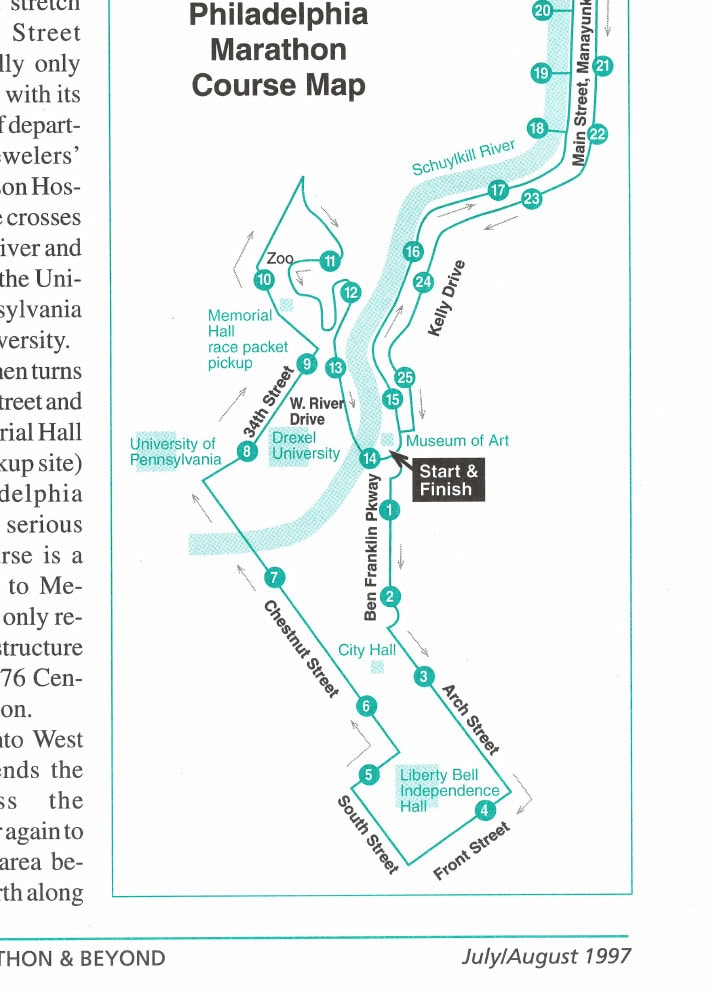
The current course used for the sponsorless Philadelphia Marathon begins at the museum steps where Rocky raised his arms in victory. Although not as varied as the old point-to-point course, the new one certainly has its share of Philadelphia flavor.
The city’s mayor starts the race at 8:30. The course heads south along Benjamin Franklin Parkway, the roadway lined with flags of all nations, before heading down Arch Street. It then makes a 90-degree turn onto Front Street, which runs parallel to the Delaware River and Penn’s Landing. The Landing houses the Independence Seaport Museum, the Workshop on the Water, a cruiser (Olympia), a submarine (Becuna), and the Vietnam War Memorial, as well as The Great Plaza, home of the Jam on the River, a free concert series and ethnic festivities center.
The only rough segment on Front Street is a cobblestone dogleg. It wouldn’t take much talent to turn an ankle on this part of the course. Across the river is the New Jersey State Aquarium at Camden.
The next hard right puts you on the famed South Street. If you’re 40 years of age or older, you may remember the 1963 Orlon’s hit “South Street”—”Where do all the hippies meet? South Street!” Today, the street is laced with 75 restaurants and 150 stores, theaters, and nightclubs, and some of the more colorful characters in Philly. Body piercing, tattooing, and hair coloring are available in just about any variation you could imagine, and some that are beyond imagination.
Another hard right puts you at the 5-mile point on 6th Street, and five more city blocks take you past Independence Hall and The Liberty Bell.
Next comes a left onto a long, seemingly endless straight stretch on Chestnut Street (which is actually only 28 blocks long), with its endless blocks of department stores, Jewelers’ Row, and Jefferson Hospital. The course crosses the Schuylkill River and passes between the University of Pennsylvania and Drexel University.
The course then turns right onto 34th Street and rolls past Memorial Hall (race packet pickup site) and the Philadelphia Zoo. The only serious hill on the course is a 100-foot climb to Memorial Hall, the only remaining major structure left from the 1876 Centennial Exposition.
The drop onto West River Drive sends the course across the Schuylkill River again to the start/finish area before heading north along the east side of the river for an out and back along Kelly Drive, named after John Kelly, father of Monaco’s Princess Grace Kelly and three-time Olympic gold medalist in rowing. This portion of the course is not as historic or as scenic as much of the rest of the course, but it does run along the river and it’s flat.
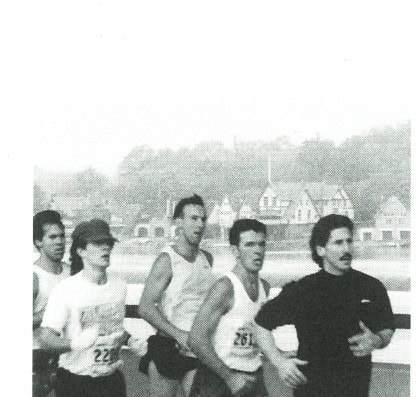
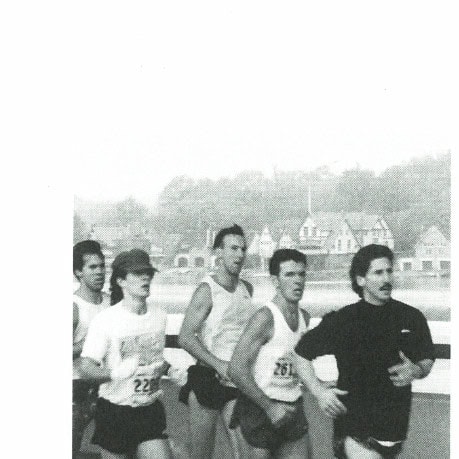
“Around the Schuylkill River, it got kind of quiet because there wasn’t a convenient way for fans to get there,” said a 38-year-old male, two-time finisher of the race.
A FLOURISHING FINISH
The best thing about the Philadelphia course (besides passing more history than you can absorb) is the finish area, which is bristling with spectators, family and friends, and very vocal and excitable fans. The finish area is also well organized with sweatbag pickup, drinks, food, and medical assistance. If there is a shortcoming here, it’s the lines for food and drinks, which are sluggish, but the sweatbag pickup is a snap. The volunteers are top-shelf—young, enthusiastic, and patient.
EXPO AND GOODIES
Race packet pickup is held at Memorial Hall on Friday and Saturday. The $35 entry fee includes your race number, a T-shirt, a copy of the Friday Philadelphia Inquirer (which includes no prerace coverage), and a few discount coupons for shoes and massages at local stores. The pasta feed in the downtown is an additional $10. One 41-year-old, three-time race veteran felt it was ironic that the Inquirer is listed as a sponsor, but it carries precious little coverage of the race.
The expo is well-staffed and features a good selection of running shoes, clothing, and performance food
| HIGHS | LOWS |
|---|---|
| Wonderful foot tour of an historic city | Last 12 miles out and back can be discouraging |
| Flat, fast, and scenic course in first half | Long lines at food booths at finish |
| Only one hill (100-feet) | Cobblestone segment on Front Street |
| Figure-8 loop | Very little community support |
| Fine T-shirts | |
| The Mayor starts the race |
Must See/Must Avoid
Every major city in the world features an array of attractions that make it unique and that enlighten and entertain visitors. And, because of its very size, every major city is saddled with areas it would rather have vanish in a puff of smoke. The following is a brief consideration of both.
GO SEE IT
The Philadelphia Museum of Art. Located between Pennsylvania Avenue and the Schuylkill Expressway at the end of Benjamin Franklin Parkway, the museum is a great place for your friends and family to lose themselves for a few hours while you run the race. Founded in 1876, the museum offers the full range of fine and applied arts from Asia, Europe, and the United States. There are masterpieces in painting, prints, drawings, sculpture, furnishings, glasswork, silver architectural elements, and rooms furnished from historic periods. 215/763–8100.
Academy of Natural Science Museum. Located at 1900 Benjamin Franklin Parkway, the academy is another wonderful place to visit. You can play Indiana Jones at a paleontological dig—a recreated field station is set up where you can dig for fossils and climb into the world of spiders (including into a spider’s web). Dinosaur Hall is a must for young and old. 215/299–1000.
Philadelphia’s Historic Park. Begin at the Visitor’s Center where you can plan your stops at The Liberty Bell Pavilion, Independence Hall, Congress Hall, Old City Hall, The New Hall Military Museum, Carpenters’ Hall, Christ Church and burial ground, Bishop White House, Todd House, The Edgar Allan Poe National Historic Site, and the Thaddeus Kosciuszko National Memorial. The Visitor Center phone is 215/597–8974.
South Street. Home to 75 restaurants and 150 stores, South Street advertises itself as the only street that has fine dining, entertainment, shopping, crafts, contemporary cuisine, and unique culture day or night. Take the advertising at its word. South Street has all this and more—much more. People-watching is the local sport, and the people run the gamut from GQ to MTV.
The Italian Market. Rocky’s old neighborhood. Great food—from hoagies (submarine sandwiches) and sausage sandwiches to pizza, pasta, veal, poultry, seafood, antipasto, beef, cannelloni, rustic breads, black ravioli—will dazzle and overwhelm your taste buds.
AVOID IT
The Gallery. There are many better ways to spend your time than going to The Gallery where you can spend money buying the same things you’d
exhibits. Unfortunately, the Atlantic Health and Fitness Expo doesn’t live up to its promotional piece in the race packet which states, “You can participate in pro-active sessions which will be scheduled during the expo.” No list was posted, and no sessions were in evidence.
After the Fact
A results postcard listing a runner’s finishing time, pace, overall place, total finishers, place among (10-year) age groups, and place among sex is sent in a timely fashion—postmarked 10 days after the finish. There is also a finisher’s certificate, but no results book. There is also no race program. The finishers’ medals are excellent.
The Philadelphia Marathon could use a shot of major sponsorship to get the good word out. The race committee is obviously dedicated and committed to the race. They do a wonderful job, considering the seeming apathy of much of the city to a race that has the potential to be one mighty fine urban marathon. An infusion of sponsorship money could make this a major player in the fall marathon scene. It would not hurt the race, either, if it were scheduled a little bit farther away from Thanksgiving.
Before you leave the finish area, you must limp up the same Art Museum steps that Rocky Balboa ran up, grasp your finisher’s medal in your fist, and look out on the Philadelphia skyline while runners continue to stream over the finish line below. For a few seconds you can imagine that you’re Rocky Balboa. Yeah, Adrian! Adrian! I did it!
The Bottom Line
We have weighed various aspects of a marathon within a 1,000-point scoring grid. Besides the author of the article, a dozen runners at the race were randomly chosen to score the race for us. (PM = Philadelphia Marathon.) The results follow:
1. History/Tradition
Evaluate the race’s sense of history and tradition.
[Possible points: 30 PM score: 19]
2. Entry Form
Is the race entry form clear, concise, attractive, complete, and easy to fill out?
[Possible points: 20 PM score: 17]
3. Entry Cost
For most races, the entry fee covers between 30 and 50 percent of the cost of putting on the event. Rate the value of your dollar relative to this race.
[Possible points: 30 PM score: 23]
4. Locale/Scenics
Is the race held in an area that is easy to get to and scenic, offers adequate food and housing services, and nonrace activities for family and friends?
[Possible points: 50 PM score: 44]
5. Registration
Is registration well-organized and efficient? Does it bog down unnecessarily?
[Possible points: 20 PM score: 19]
6. Prerace Activities
Evaluate activities such as pasta feeds, parties, and so on, during the days before the race.
[Possible points: 50 PM score: 39]
7. Expo
Does the expo offer a fair number and variety of booths relative to the race’s size? Are there quality exhibitors and good guest speaker(s).
[Possible points: 50 PM score: 33]
8. Course
Take into consideration the following: degree of difficulty, certified, sanctioned, quality of road or trail surface, adequate mileage and directional markers, aid stations, medical coverage, race communications, accessibility to course for friends and family, typical weather, and so on.
[Possible points: 400 PM score: 336]
9. Race Amenities
This category includes race T-shirt, finisher’s medal, finisher’s certificate, adequate and efficient finish area, ease of sweatbag retrieval, showers, postrace refreshments, awards ceremony, raffles, results postcard, results book, and so on.
[Possible points: 250 PM score: 212]
10. Volunteers
Are the volunteers experienced and adequate in number?
[Possible points: 100 WM score: 96]
Total Score for Philadelphia Marathon:
838 points (out of 1,000)
This article originally appeared in Marathon & Beyond, Vol. 1, No. 4 (1997).
← Browse the full M&B ArchiveMore like this
1,000+ stories from 19 years of Marathon & Beyond
The complete archive of the legendary long-distance journal — digitized and free to read.
