

Pulling Thetrigger At 40
MOTIVATION
What makes a real runner? What constitutes an athlete? Do I run or do I jog? As I approached my 40th birthday, I reflected on these questions and also on my socalled athletic achievements: over 30 marathons (12 in one year), two 50-milers, two 100-milers, half a dozen triathlons, and a few mountaineering expeditions. But looking back at my race photos, I noted that I looked distinctly overweight in several of them, especially in a couple of triathlon photos where a definite paunch was hanging over my tight triathlon swim trunks. Yes, I had done a lot of running over the last 12 years, but had I really given everything I could to training, even just for one race? I didn’t think so.
The time felt right. My 40th birthday was coming up toward the end of the year, and the fall would be a good time to run a marathon. Coincidentally, my birthday fell on the same day as a couple of fast-rated marathons: Chicago and Steamtown (Scranton, Pennsylvania). I decided on Steamtown since my family and I could drive there and visit my wife’s relatives. I had less than nine months to train for the race and had incurred an irritating injury after my second 100miler—probably patellofemoral pain syndrome (runner’s knee)—but it didn’t seem to hamper my running, so on went my plan.
I then had an even bigger idea: why not try to qualify for the Boston Marathon? My fastest time was still my first marathon of 3:38 (back in 1998), and I would need to run 3:20 at Steamtown to meet Boston’s strict regulations, which seemed like a daunting task. But turning 40 had given me another five minutes to qualify (it was 3:15 previous to this), so I thought I would take that opportunity. To cap off my initial preparations, I requested the number-40 bib, and Steamtown kindly obliged. There was no turning back now. I had nine months to get to Boston, and I would have no excuses. I wanted to give everything I had to a training plan to see what this 40-year-old body could do. I had plenty of excuses to avoid the challenge, including three young kids and being constantly on the road with my
![The author after an embarrassing 4:51 performance at the 2000 Tupelo Marathon. His daughter looks on in disgust as he eats pizza. [Note: the author was in the middle of a 12-marathon year and it was 100 degrees that day.]](https://marathonhandbook.com/wp-content/uploads/905788_fig1.jpg "Pulling Thetrigger At 40 1")
Courtesy of Kevin Polin
▲ The author after an embarrassing 4:51 performance at the 2000 Tupelo Marathon. His daughter looks on in disgust as he eats pizza. [Note: the author was in the middle of a 12marathon year and it was 100 degrees that day.]
consulting job, but I wanted to give it one big push since it occurred to me that a personal-best time is more likely earlier rather than later in your running career. For the first time in my life, I even changed my diet and paid attention to what I was putting in my body. Even more astounding: I moderated my pub drinking! I was a regular at one of Atlanta’s well-known pubs but quickly discovered that I could still make appearances and say hello to everyone even if I limited myself to just three pints once a week. I even experimented with long runs and drinking and found that I could still do a decent early-morning long run after consuming four pints the previous night. Three pints was better, but five pints tipped me over the edge and made it difficult to even get up early enough for the run. So I made it a point to tell the barmen that four pints was my limit, and they and my friends began to respect my self-imposed limit.
PREPARATION Having established a running goal, new diet, and maximum alcohol allowance, I decided next to set up a good training plan. I took out my trusty old Jeff Galloway running book that I had bought more than 10 years ago. Jeff had one page dedicated to a 3:20 marathon training plan, and a typical week looked like this: Monday: three miles, Tuesday: six miles, Wednesday: two miles, Thursday: five miles, Friday: three miles, Saturday: rest, and Sunday: alternate between a long run (up to 28 miles in length) and speed work
Interestingly, the speed work was all done at 7:10 pace, which I found to be quite easy after testing it on my treadmill. The total weekly mileage ranged from 17 to 46 miles. I thought the program to be quite achievable, and excluding the speed work, it was about what I would do to train for a marathon, anyhow. It seemed too easy to me; I didn’t understand how I could run a 3:20 marathon on a program similar to what I had done in the past—never topping a time of 3:38. Perhaps my diet change and alcohol limit would make the difference.
Feeling a bit nervous about the plan, I scoured the Web looking for alternatives. Promptly I found Hal Higdon’s site and immediately took a liking to his advanced training program. Hal also had a novice and intermediate plan, but I felt a 3:20 time deserved the advanced plan. A typical week for Hal’s program looked like this:
Monday: three miles, Tuesday: “sorta long run” of about nine miles, Wednesday: four miles, Thursday: speed work, Friday: rest, Saturday: seven-mile pace run, and Sunday: long run (up to 20 miles) The total weekly mileage ranged from 21 to 55 miles, which illustrated the first major difference between the programs—Hal’s higher mileage. The second major difference was Hal’s inclusion of pace runs, and the third was his dedicating one day each week to speed work rather than alternating it with long runs (as Jeff’s did). Hal also included long runs up to only 20 miles (three 20-milers in all), advising that runs over 20 miles only invite injury and are not as productive as you might imagine. Also, Jeff’s plan had only three hill workouts and no tempo work. Hal set aside Thursdays to rotate hill, tempo, and speed work.
Hal’s program made more sense to me, and I knew the more aggressiveness of it would give me more confidence on the starting line. The only hole I found in it was that speed work didn’t seem to be defined. After a bit of research, I decided to run my speed work (usually 800-meter repeats) at 6:40 pace. This was a significant difference from Jeff’s book, which listed speed work at 7:10 pace. I ran my pace runs at 7:30 per mile. To finish in 3 hours, 20 minutes, I would need to run at a 7:38 pace in the race, but I chose a faster pace to give me a cushion in time and also to make it easy to remember target split times during the race.
So, I had a training plan but one major worry: I was still dealing with the knee injury I mentioned earlier from the Vermont 100. This didn’t stop me from running, but it made training a little painful and usually made me feel as if my left knee could give way and send me to the ground in a pathetic heap at any moment. I tried icing for a while, but it gave only temporary relief. In fact, from the Vermont 100 to the Steamtown Marathon (about 16 months), I was unable to sit on the floor and cross my legs. For some odd reason, I never had my knee looked at professionally, thinking that as long as I could run, then things can’t be too bad.
There were many other challenges during the nine months of training. I worked out of town most of the time, so organizing training runs was difficult. When I was home on the weekends, the area where I did long runs was frequently flooded. I swallowed a fly during the first mile of a crucial 10-mile pace run, thus introducing a level of trepidation to my training runs. Then there was soapsuds syndrome—a little-known condition experienced by runners who wash their running clothes by hand, usually because they travel often. Overuse of soap can invite ridicule from passersby as they see soapsuds dripping down the runner’s legs when sweat activates the soap. Most demanding was the fact that my family—I, my wife, and three kids—was in the middle of moving from Georgia to North Carolina.
The training itself was not a problem, just the logistics of organizing it and staying on track. The year 2005 was probably the worst year logistically to train for a Boston qualifier, but my 40th birthday spurred me on. As the training program progressed, it became apparent that Hal Higdon seemed to really know what he was doing, pushing me as far as I could go, but not enough to break me. Due to my alternating schedule and travel, I trained almost exclusively alone, but a BQ on my birthday was all the encouragement I needed to get out of bed for an early-morning 20-miler while on the road in a strange town.
STEAMTOWN MARATHON Scranton isn’t the most glamorous of places to run. Downtown has few hotels. A couple of really nice ones were too expensive for me, and the rest left a lot to be desired and were overpriced. We settled for a 1950s-era motel run by an Indian family that used a room close to ours to cook and feed the staff—a cafeteria of sorts, producing pungent odors for the rest of us to enjoy. A convenient downtown mall provided plenty of meal options.
October 9, 2005, was the 10th running of Steamtown. It’s known as a fast course and is often used as a Boston qualifier because of its 955-foot elevation drop. The race expo was well organized, with friendly staff, easy parking, straightforward packet pickup, and interesting displays. In fact, the whole race was organized very well. Directions and information were abundant, and the small field (fewer than 2,000 in most previous years) meant that driving and parking at the start, warming up, and finding porta-potties were easy matters. Also, prior to the race, regular e-mail updates keep entrants up to date.
School buses shuttled runners from the downtown area to the start. This also was well organized and efficiently implemented. By the time I got to the starting line, I was already well impressed by the race organization.
After studying the course map, it seemed to me that the race could be split into thirds: the first was noticeably downhill, the second was mostly flat but slightly downhill, and the final third was relatively flat with some challenging uphills.
Overall, the 955-foot drop seemed to be mostly in the first third. I was concerned that the drop came so quickly, because I didn’t want to end up with quivering quads in the first part of the race, which happened to me at the Vermont 100 after running down the first mountain. All in all, I didn’t think I could better Steamtown for a BQ attempt.
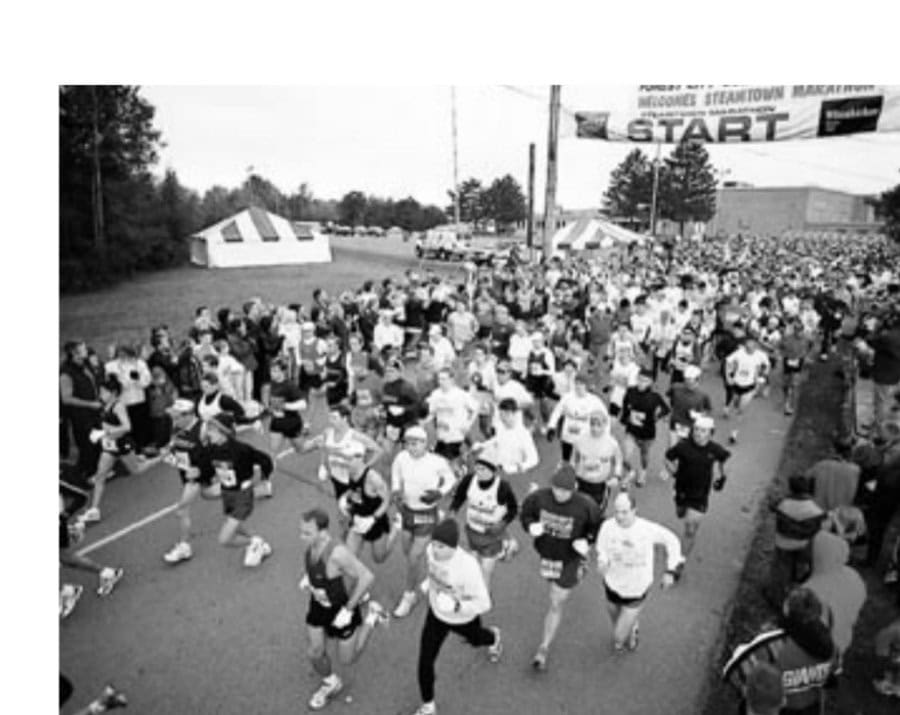
RACE On race morning, I took a note from Hal Higdon’s book (Marathon: The Ultimate Training Guide) and woke myself early (4:00 A.M.), ate a PowerBar, drank a large glass of water, and then returned to sleep—all to make sure that I was hydrated and had fuel digested before the race. Race-day morning at the Forest City High School start location was quite convenient. There was plenty of room for stretching and warm-up jogs and lots of staff around to answer last-minute questions. I got to the start much later than I wanted to but was able to easily find a place toward the front of the starting line.
With my nine months of hard training, I felt that I deserved to start up front— foreign territory for me, but having lost 20 pounds, I at least looked the part. The runners up front looked fast, very fast. Quite a number of them seemed to know each other, exchanging handshakes and “good lucks.” I tried to stay loose and act
ad
The Times Tribune
▲ The 2005 Steamtown Marathon begins.
casual, but the strain on my face probably showed through my smiling façade that tried to shield my jittery nerves. Standing on the line, I realized that nine months of training and time away from my family were on the line. Not only that, but since it was my 40th birthday, a lot of family and friends would be sure to look up the results. Failure here would be under a spotlight.
The cannon used for the start was a nice touch, and I took off at a fairly fast pace. The steep downhills carried me to several easy 6:30 miles, even though I needed to stay only at 7:30 pace. I seemed to be floating on air, and it felt easy. By 10K, I had what was once for me a very respectable time for that distance in a race.
After six miles, I had to focus my attention on keeping at goal pace. The first six miles had been so easy that it felt as if the run had just started, almost as if the first quarter of the race merely warmed me up. But now I started to focus on my split times and kept locked onto my goal.
Reality set in as I passed the halfway point and realized that I would need some heavy effort to keep the goal pace going. Slight pain in my legs began to filter throughout my body. It wasn’t overwhelming, but the pain made me realize that from this point, it would not be easy. It was a strange feeling indeed for
me to be running at this speed, not just the speed itself, but the remarkable difference in runners around me. There were many fewer runners than I was used to at other marathons, where I ran much slower, and these runners were serious runners—obviously very fit, lean, athletic, and in top form. I felt privileged to be in this select group.
Toward the 20-mile mark I saw something that provided me with an excellent diversion: lying nonchalantly in the gutter was a large, blue transparent dildo covered in lifelike veins. At first I thought I was seeing things, but then I realized it was real. I started to chuckle and wondered where it had come from. I had noticed several sex shops on my drive to town, but had someone planted it there the night before as a joke? Maybe a passerby had dropped it by accident and was looking for it at that very moment? I then concluded it would be a wonderful idea for the Steamtown Marathon to change its name to the Blue Dildo Marathon, kind of like Cincinnati’s Flying Pig Marathon. This surely would generate interest and more entrants. It was hard to control my laughter as I rolled along the streets of Scranton. I was almost hysterical before forcing myself to stay focused on the running.
MY FIRST ENCOUNTER WITH THE WALL Around the 20-mile mark, the race moved into an industrial park. Upon crossing a railroad track, I noticed something strange. A half mile ahead of me, on a straight but slightly uphill road, about a half-dozen runners were walking, some with hands on hips, one was lying on his back and performing knee-to-chest stretches, while another sat on a grassy verge. What’s going on? I wondered. As I ran past these runners at a steady pace, I shouted words of encouragement, “Come on mate, you can do it—I know you can.” These were runners I recognized since most had passed me during the previous 10 miles. It then occurred to me that this was the first time I had seen someone hit The Wall. It further occurred to me that I had never hit The Wall since I had never run fast enough. My theory is that only if you are running fast (relatively) for 20 miles can you be eligible for The Wall. Fourhour marathoners probably just don’t burn enough carbohydrates to completely eliminate all their glycogen stores; however, anything around three hours for the marathon is going to use up all your available stores and possibly send you on a collision course with The Wall. It surprised me immensely to see these very fit and well-trained runners slamming on the brakes. I just hoped it wouldn’t be my turn to hit The Wall. I kept drinking as much Gatorade as I could and pushed on at my goal pace while feeling quite pleased with myself.
Toward the 24-mile mark, I realized that keeping up my goal pace was becoming extremely difficult. Everything in my body was telling me to stop for a few minutes, since I had a bit of time in hand to afford a short rest. But I kept on,
not wanting to give in to the devil talk. This was particularly hard as the course turned up a steep but short hill. At the top was a large group of people, and as I closed in on them I realized that 20 or so children in wheelchairs were clapping and cheering the runners. I almost stopped in my tracks. I wanted to stop and talk to them; I wanted to tell them how much it meant to me to see them there on the side of the street giving me encouragement. I wanted to tell them that it should be me giving them encouragement. It should be me telling them that what they go through in life every minute of each day is far superior to my running 26 miles. I passed shouting, “Thank you” and clapped toward them before wiping some wetness off my cheek and picking up the pace. Seeing those kids made me accelerate to my fastest speed, and I kept it up for the remaining miles.
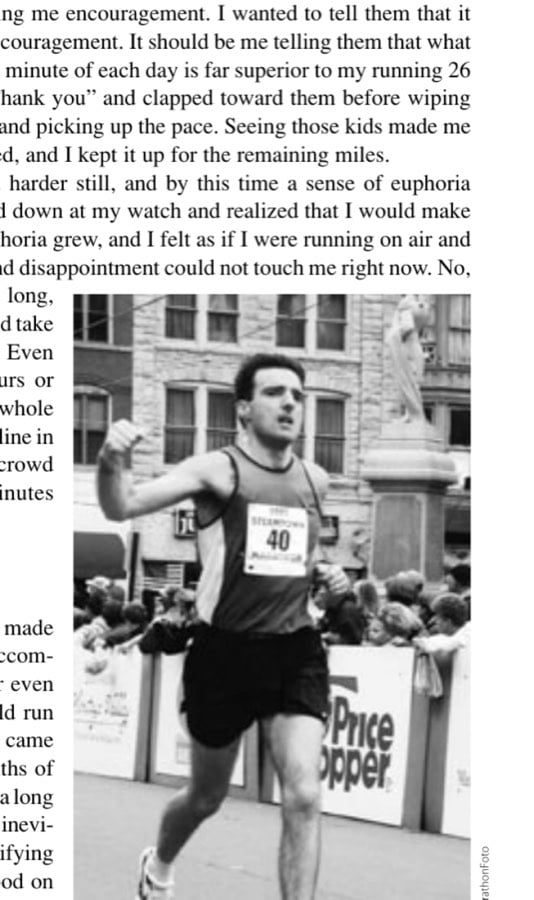
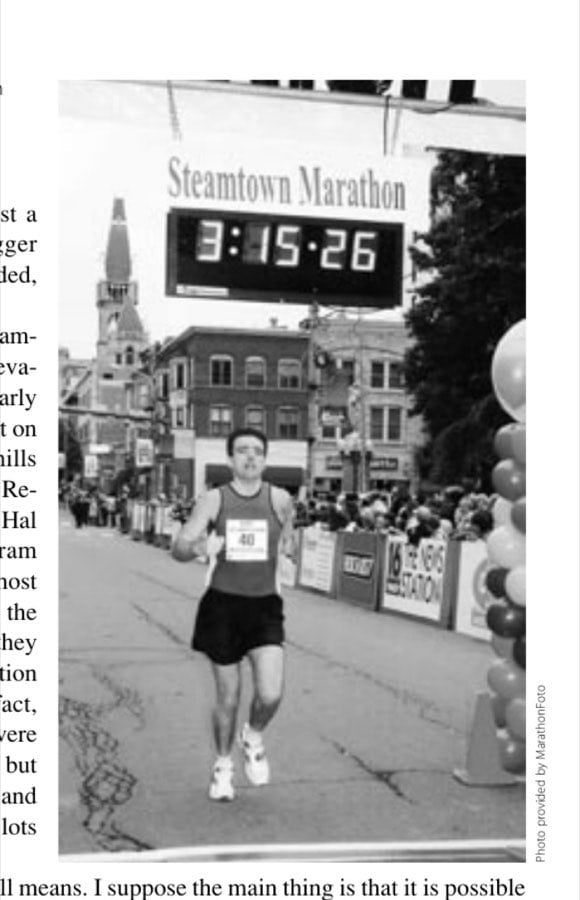
I kept pushing hard and harder still, and by this time a sense of euphoria washed over me as I glanced down at my watch and realized that I would make the qualifying time. The euphoria grew, and I felt as if I were running on air and had a sense that life’s pain and disappointment could not touch me right now. No, when I run this fast for this long, then nothing can catch me and take away this feeling of ecstasy. Even if it was for only three hours or so, the feeling was worth a whole year’s training. I crossed the line in front of a surprisingly large crowd in 3:15:26—nearly five minutes faster than required.
The Steamtown experience made me rethink what I could accomplish. For years it had never even entered my mind that I could run this fast, and in the end it all came down to training. Nine months of hard, dedicated training goes a long way. Looking back, it seemed inevitable that I would get the qualifying time, since by the time I stood on ▲
The author punches the air for victory on realizing that he’s about to qualify for Boston.
Photo provided by MarathonFoto
POSTRACE
the starting line, it was just a matter of pulling the trigger on a wound-up, spring-loaded, athletically trained body. As for the race itself, Steamtown is harder than the elevation charts suggest. The early downhills are quite difficult on the knees, and the later hills were an unpleasant surprise. Regarding the training, well, Hal Higdon’s advanced program is a winner. Probably the most useful training for me was the Saturday pace runs, since they gave me a definite indication of how I was doing. In fact, the early, short pace runs were quite difficult to maintain, but later they became easier, and completing them gave me lots of confidence.
I’m not sure what this all means. I suppose the main thing is that it is possible to redefine what you believe are your limits. Even if you’ve been stuck in a rut for years, sometimes a big event (like my 40th birthday) is needed to change what you think are your boundaries. The Boston qualifying experience has made me reflect on my roller-coaster approach to running and to life in general. The truth of the saying, “Everything in moderation,” became apparent. It’s easier to stay fit than to lose fitness and try and regain it; taking weight off is harder than putting it on. Why did it take me so long to figure this out? I now take my diet seriously and make every run a high-quality run. Since Steamtown, my Levi’s scale has remained steady at 32 inches.
What made me change? Certainly my 40th birthday has made me reflect on many things. I’m not indestructible—I see this every morning while looking at the growing bald spot on the back of my head and wondering what happened to my thick mop of hair. I’m mortal, but at least there will always be challenges like qualifying for the Boston Marathon.
Photo provided by MarathonFoto
▲
The author crosses the finish line with five minutes to spare.
This article originally appeared in Marathon & Beyond, Vol. 11, No. 4 (2007).
← Browse the full M&B ArchiveMore like this
1,000+ stories from 19 years of Marathon & Beyond
The complete archive of the legendary long-distance journal — digitized and free to read.
