

Qualifying For Boston At Kona
How to land that qualifying time after swimming 2.4 miles and biking 112. by Cathy Tibbetts
Of thousands of people who run marathons every year in the United States, most would like to run one fast enough to qualify for America’s oldest marathon—Boston. Crossing the finish line with a time fast enough to qualify is not easy. Only the top 8 to 10 percent in a given age group ever make it, even with the 2009 cutoff of 26,500 runners. “
Qualifying times for the Boston Marathon represent an evolution of time standards put in place in the early ’70s to manage the overall field size,” Jack Fleming of the Boston Athletic Association said. “The course could only handle 1,000 people in the ’70s, but as race systems became more efficient we could allow more runners out here.”
Many marathons are advertised as fast and flat to attract Boston hopefuls. The St. George Marathon, decidedly downhill, fills up instantly. There is even the Last Chance for Boston Marathon in Dublin, Ohio, every February, with 26 one-mile loops in a flat business park with every quarter mile marked.
Then there are the runners who pull off Boston-qualifying times after swimming 2.4 miles in the Pacific Ocean and biking 112 miles in the oppressive heat and battering winds of Kailua-Kona in the Hawaii Ironman World Championship.
There are usually about 150 pros in the field of 1,800 at the most prestigious triathlon in the world. In 2009, 145 athletes out of 1,777 starters were pros. They’re supposed to be fast. Yet most Kona-bound triathletes are age groupers, racing on their own dime just to see how they stack up against the best in the world in their age divisions. With families and jobs, they somehow make time to
swim, bike, and run as part of their weekly training—and do all three very well.
You’ll see no junk miles with this crowd. Every workout has to count. Six athletes who ran Boston Marathon qualifying times at the end of the Hawaii Ironman World Championships were interviewed to see how they train. Their training schedules may give some insight on how to land a Boston Marathon qualifying time.
Carol Hassell, age 56, West Palm Beach, Florida Hawaii Ironman marathon time 2008: 4:14:49 1. Occupation: Registered nurse in an electrophysiology lab working anywhere from 16 to 30 hours per week. 2. Personal info: I am the oldest of five kids and the only athlete in my fam
ily. I am married to Mark, who is also a triathlete and got me into Ironman triathlons. No children. 3. Athletic background: Didn’t do any sports in high school, didn’t go to college until mid-30s, and did no sports there, either. Started running 5K
and 10K running races. Decided to do a marathon in 1995. Started with a few sprints and then did Ironman France in 2003, where I qualified for my first Kona. 4. What does your training week consist of? Do you have a coach? Training
consists of whatever my coach has written. Depends on how close my race is, on how much mileage, and on whether I am training for an Ironman. Usually swim 10,000 yards or meters per week. Bike about 10 to 15 hours
per week. Shorter bike workouts sometimes have intervals incorporated. I try to do a hard group ride every week. Some runs had pickups and intervals. Coach is Jeff Cuddeback. www.jeffcuddeback.com. 5. Break down just your running training schedule. How many miles of
distance, speed work, tempo runs? Run 20 to 40-plus miles per week with at least three longer runs of 18-plus miles the month before an Ironman. Some runs had pickups and intervals. 6. What do you do besides swim, bike, and run? I do run drills occasionally
and find them somewhat helpful but don’t really enjoy them. I do yoga for athletes every day. Water jog several times per week. Stretch daily. Try to get a massage once a month or so. Don’t do any weight lifting. Don’t like it at all.
7. What cross-training activity do you think helps your running the most? I find that training for triathlon really keeps my injuries to a minimum compared to when I just train for a marathon. I am always having hamstring and
hip flexor issues when training for marathons only. Swimming, I think, is
▲
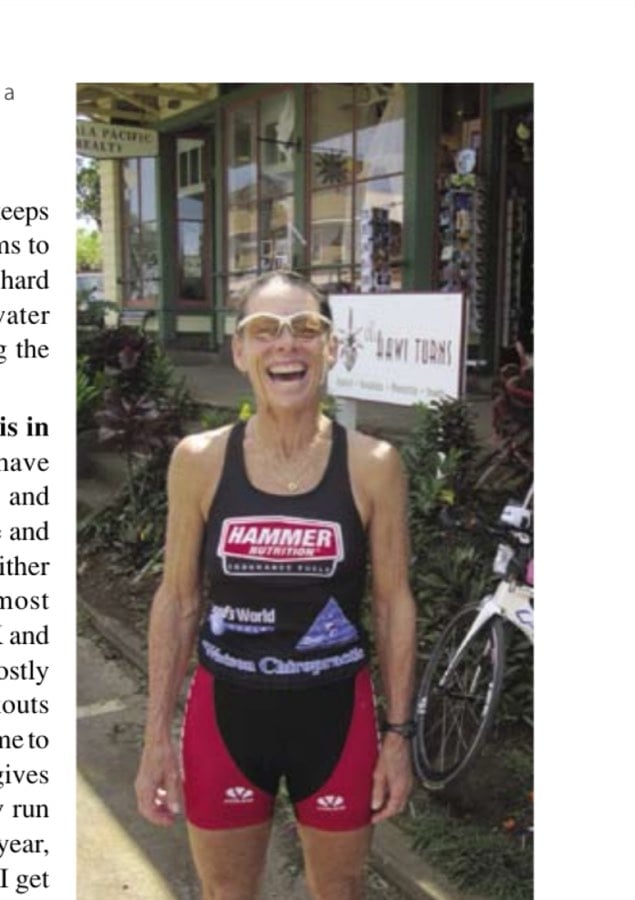
Carol Hassell takes a break during a training ride in Hawi, Hawaii.
8. How do you fit all of this in with having a life? I have no life other than work and workout. I do like to race and usually do a triathlon (either sprint or Olympic) almost every month. I also do 5K and
10K running races and mostly use them as track workouts since I really don’t have time to make it to the track. This gives me speed work. I usually run at least two marathons a year, and if I do two Ironmans I get
a total of four per year. I like to run half-marathons, and the recovery for these and halfIronmans is so much quicker. 9. How were the first few miles of the run after getting off the bike in Kona? I usually feel pretty good the first few miles, and then after about
12, I start to struggle. Sometimes I think I might start off too fast, but Jeff has me doing lots of bricks (doing two disciplines back to back), so I feel that I run faster and better off the bike than I do just going out to run 20 miles.
10. Advice for Boston hopefuls. Get a coach or follow a structured workout plan specific for your marathon goal time. Pick races that have courses that are known for fast times. Water jog and do yoga or some stretching
exercises to avoid injury. Don’t get caught up in the competitiveness at the track because it will get you injured. Work on your hydration and nutrition during training because you are going to need that knowledge on marathon race day.
© Cathy Tibbetts
very important because it keeps me stretched out and seems to loosen me up after a very hard bike and run. I think water jogging helps my running the most.
Liz Sponagle, 55, Santa Fe, New Mexico Hawaii Ironman marathon time 2009: 4:12:06 1. Occupation: Running-store manager at The Running Hub, working full time and coaching other runners. 2. Personal info: Single mom with two daughters, 20 and 16 years old. My oldest got married two weeks before the race, so I was planning and producing her wedding, including making her dress, while training and working. 3. Athletic background: I have been a runner for 25 years, took up triathlon four years ago, and wonder why I didn’t start sooner. It’s been great!
4. What does your training week consist of? Do you have a coach? At the peak of training, I would do four rides (hills, bricks, long, easy/moderate), four runs (speed, hills, bricks, long), three swims (speed, distance, open water—usually a brick). A former pro rider helped me on the bike, adjusting my position and bike fit, teaching me to ride relaxed and efficiently to be better able to run off the bike.
5. Break down just your running training schedule. How many miles of distance, speed work, tempo runs? My long runs build to 25 miles, usually around 8:30 pace. Tempo runs from eight to 14 miles in the 8:10–8:15 pace range. I don’t really like running at the track, though I do some 1,600 and 800 repeats, so I incorporate speed into a road run. My favorite workout is one I call “speed bumps.” After a 15-minute warm-up, I alternate 60 seconds of speed with 60 seconds of moderate pace for up to 45 minutes, then a cool-down. I run after every long bike but only until I feel my body relaxing into run mode. 6. What do you do besides swim, bike, and run? As much as I’d like to do other things I think would be beneficial, I simply don’t have time to squeeze in anything else on a regular basis. I do try to take one adventure trip a year, which usually involves climbing. I’ve been up Kilimanjaro, base camp of Mount Everest, Via Ferrata routes in the Dolomites, and ice climbing in the Himalayas.
7. What cross-training activity do you think helps your running the most? Once I learned to mix up the types of runs I do—speed, trails, long, short, tempo—my running improved. Mixing in cycling and swimming allows
me to stay injury free and not have to put in as many miles to maintain run fitness. I did a run focus (cutting biking and swimming down to maintenance levels to put more effort into running) last winter and found
it really improved my running. At 54 years old, my 1:30 half-marathon
time put me at the bottom of world-class level for age-graded running. I didn’t think I could run like that anymore! 8. How do you fit all of this in with having a life? During IM training, most of the time it felt like all I did was work, train, eat, and sleep. What little time I have is devoted to my daughters, though I do get occasional social outings with friends. Most of my close friends are not athletes, which I like in a way because it keeps me grounded. It reminds me that I am so much more than a triathlete or runner.
9. How were the first few miles of the run after getting off the bike in Kona? My feet were burning after the bike, so starting on the run was painful. I chose to wear my Nike Lunar Glides instead of the thinner racing
shoes I normally wear for a marathon. I’m so glad I made that decision. In addition, I was overheated and my turnover rate felt very sluggish. I took many walk breaks during the first four miles, dumped cold water and ice
on and in me, and finally got going. After mile five or so I felt much, much better. The last seven to eight miles of the marathon felt the best out of the entire race. The final mile felt smooth, effortless, as if I was gliding.
10. Advice for Boston hopefuls. The biggest training mistake I see runners doing is running the same route and pace all the time. To improve, you need to mix up the training, continually stressing the body in different
ways. That’s one of the reasons I do speed work on the road. If the 60second speed interval comes around when there’s a hill, then that’s what I do. Another key element to get ready for a specific race is to mimic the
course as much as possible in training. Runners usually pick a downhill course to try to qualify for Boston. That means practice running downhill for long distances, because your quads are going to take a beating and you need to be ready for that.
Brooke Tvermoes, 28, Durham, North Carolina Hawaii Ironman marathon time 2009: 3:33:20 1. Occupation: I do research and am a postdoctoral candidate at the National Institute of Environmental Health Science (NIEHS). Work 40 to 50 hours per week. 2. Personal info: Have my husband and cat. 3. Athletic background: I grew up swimming and then played water polo at Northern Arizona University. 4. What does your training week consist of? Do you have a coach? I swim two times a week and try to ride three to four times a week and try to run
▲
Brooke Tvemoes training on the swim course in Kailua-Kona.
three to five times a week. Coach is Jay Crooker.
6. What do you do besides swim, bike, and run? Working full time and trying to get in the hours for IM training doesn’t really leave much free time, so I don’t do anything else besides swim, bike, and run.
7. What cross-training activity do you think helps your running the most? Biking. 8. How do you fit all of this in with having a life? I think I have a life, but if you asked my lab mates, they would say I didn’t. I try to stay organized and not waste time during the day. During the last big push of IM training, it is really hard to keep things balanced. I am fortunate that my husband does this crazy stuff with me and a lot of our friends are into endurance sports as well, so we try to do some of our training together. But all in all, when it comes down to it, you just make the time to be with your family and friends. To me it’s really important to find that time for your friends and family because they’re the ones that are there for you at the end of the day, and they’re the ones that are supporting me every step of the way.
9. How were the first few miles of the run after getting off the bike in Kona? I actually have to say the first few miles of my run felt really good. I took the bike really controlled, and I think I was just plain happy to get
© Cathy Tibbetts
5. Break down just your running training schedule. How many miles of distance, speed work, tempo runs? This is a tough question because it changes a lot during the season. The last few weeks of big IM training I do a long run every 10 days and average 30 miles a week. I don’t do a lot of speed work toward the end but focus more on tempo and do a tempo run once a week, and then I try to do a couple of other just normal runs during the week.
off that bike. I was very pleased with the first 13 miles, the next nine were a bit rough—the turnaround at the energy lab is really tough and the last four were really hard because my legs cramped. But I cannot complain because I am absolutely thrilled with my run time on that course. 10. Advice for Boston hopefuls. Get involved with a good coach who knows what they are doing. Don’t build too fast but make sure you train consistently. Speed work and taper are very important for long-distance stuff, too. And most important, have fun and enjoy the training.
Barry Lewis, 50, Philadelphia, Pennsylvania Hawaii Ironman marathon time 2009: 3:35:12 1. Occupation: Executive Director, GreenTreks Network (environmental nonprofit), spinning instructor, writer/photographer/contributor to Marathon & Beyond. Work 45 to 50 hours per week. 2. Personal info: Wife, two birds. 3. Athletic background: In high school and college, I was active in all kinds of sports, but most extramural. I grew up in Vancouver, Canada, and played soccer, ice hockey, lacrosse, rugby, and started running to keep fit for these various other sports. I ran my first marathon in 1981 with a rugby buddy.
4. What does your training week consist of? Do you have a coach? Training really depends on what specific key race I am focused on. For Ironman, a typical week involves three to four swim workouts (two with masters, one to two shorter sessions on my own); four to five bike workouts (two early a.m. group rides, two to three spinning workouts, one long ride); and four to five runs (one to two short bricks at tempo, one hill workout, one to two easy, one long). I’m self-coached, develop my own programs, and coach others.
5. Break down just your running training schedule. How many miles of distance, speed work, tempo runs? Mileage is a rough guesstimate, as I don’t log miles so much as focus on the purpose of each specific workout
and time. During my three-month Ironman training phase, my long run was between two hours and 2:45 (16 to 23 miles), my bricks varied between 30 minutes and 1:30 (five- to 12-mile range, varied between steady
tempo, fartlek, easy), my hill workouts were between 45 minutes and 1:20 (7.5- to 12-mile range; short hill bursts on a rolling course, steady tempo on route with longer climbs), and my easy runs varied between 25 and 55 minutes (three to seven miles).
6. What do you do besides swim, bike, and run? I weight train and do a lot of core/balance work in the “off” or nonracing season (winter for me), along with more fun group-trail runs, but find I don’t have the time to fit it all in during the season. Same goes for yoga, although I do more on my own than in a facilitated class and try to stretch consistently year-round.
7. What cross-training activity do you think helps your running the most? I’ve been a spinning instructor for almost 10 years now, and I’ve found that the workout I get from that and real-world riding keeps me strong and cardiovascularly fit while keeping me from being a slave to the running miles.
8. How do you fit all of this in with having a life? I have an incredibly supportive wife who is the best handler in the history of the world and my number one fan. She also kicks my butt when I start slacking off.
10. Advise for Boston hopefuls. To me, the key is really knowing yourself and sticking to your race plan—and don’t get psyched out or sucked up in the hype, excitement, other people’s pace, etc. If you’ve done the homework, the race is the payoff: Be positive and enjoy the experience no matter what the day brings. After all, how many people even get to the starting line? ▲
Barry Lewis in Kailua-Kona on the first half of the Ironman run.
© Elissa Torre-Lewis
9. How were the first few miles of the run after getting off the bike in Kona? I felt awesome starting the run at Ironman, because I held to the mantra “be patient, the run is your thing” all day. I had to hold myself back when I got off of the bike because I was so psyched to finally be running! Unfortunately, my guts went south about seven miles in and I had to run/ walk/visit the side of the road to deal with stomach cramps and diarrhea.
Richard Nixon, 45, Coconut Creek, Florida Hawaii Ironman marathon time 2009: 3:32:01 1. Occupation: Building inspector (40 hours a week), triathlon coach at www.fit2tri.com (20 hours a week). 2. Personal info: Married, two children. 3. Athletic background: I ran high school track, then started with 5Ks and 10Ks. In 1998 I saw an ad in the paper to run a marathon in 26 weeks and I signed up.
4. What does your training week consist of? Do you have a coach? I average 16,000 meters of swimming a week, 250 to 400 miles a week on the bike, and 25 to 50 miles a week of running. Self-coached. 5. Break down just your running training schedule. How many miles of distance, speed work, tempo runs? As I am getting ready for an Ironman race, most of my running is 70 percent aerobic and 30 percent tempo. Those are the two energy systems that I focus on for an Ironman. For shorter events, I do more threshold pace. 6. What do you do besides swim, bike, and run? I do basic full-body strength training in the gym, nothing heavy. I believe that strength training helps prevent injury.
7. What cross-training activity do you think helps your running the most? Swimming and biking help to have a more balanced body. I think runners run too much, and the miles they put in are more than they need. Some of my friends just train for marathons, put in 60 to 80 miles a week of running, and always seem to end up with overuse injuries.
8. How do you fit all of this in with having a life? I have an understanding and supportive family, which is the biggest help. I wake up early and get in a workout, then do one after work. Then weekends, like everyone else.
9. How were the first few miles of the run after getting off the bike in Kona? I feel fantastic when I get off the bike. I use a GPS to watch my running pace and make a conscious effort to slow down at first. I feel bet
ter running off the bike than I do just going out running. I think it takes a while for people to get used to that, but many of my clients say the same thing once they get used to it. 10. Advice for Boston hopefuls. Make each running session have a purpose.
There is no such thing as an easy run. If you’re going out just to put in junk miles, you’re better off not doing it.
Patrick Baldwin, 33, Del Mar, California Hawaii Ironman marathon time 2009: 3:09:55 1. Occupation: Landscape architect, working 45 to 50 hours/week. 2. Personal info: I have a beautiful wife who shares in the triathlon lifestyle, and we are working now to expand our little family! 3. Athletic background: I ran cross-country and cross-country skied in Minnesota during high school. I went to college in Wisconsin but focused more on being a bartender and having fun but kept the running up—just socially, though. I did my first triathlon in 2001, crossed the finish, and told my coach at the time: one down, 200 to go . . . I was hooked.
4. What does your training week consist of? Do you have a coach? I average about 20 hours a week of training for six weeks prior to an IM. Year-round it’s about 14 hours per week. Consistency is key. I get up very
early; the coffee maker goes off at 4:00 and the alarm at 4:05. My wife is way into it as well, so she understands the early mornings. This year Kevin Kutjar with www.enduranceplanner.com got me in better run shape for IM than ever before.
ad
5. Break down just your running training schedule. How many miles of distance, speed work, tempo runs? I have two key runs per week. One is a tempo/interval run during the workweek. This is between six and 10
miles of speed work totaling about 1.5 hours. It’s the hardest run of the week. Saturday or Sunday is the long run. For IM training, I try to hold and average for 1.5 to 2.25 hours of tempo at least 20 to 30 seconds per
mile faster than race pace. I only do this about four to five times before an IM. I start out slow, as usually the legs are a little beat up from the week’s training, so the meat of the workout is closer to a minute per mile faster
than IM pace. The key, though, is to stay in control. If I’m spent after and feeling it two days after the workout, I try to back off. Two-plus hours of this pace along with everything else is a fine line, but it can pay dividends
if it works out. The balance of the running is a few runs off the bike and recovery runs. The run off the bike after the longest weekly ride is key. It doesn’t have to be long, but I like to do it fast. I’ve found running a 7:30
mile after a long ride really doesn’t feel much different than a 6:30—so go for it!
▲
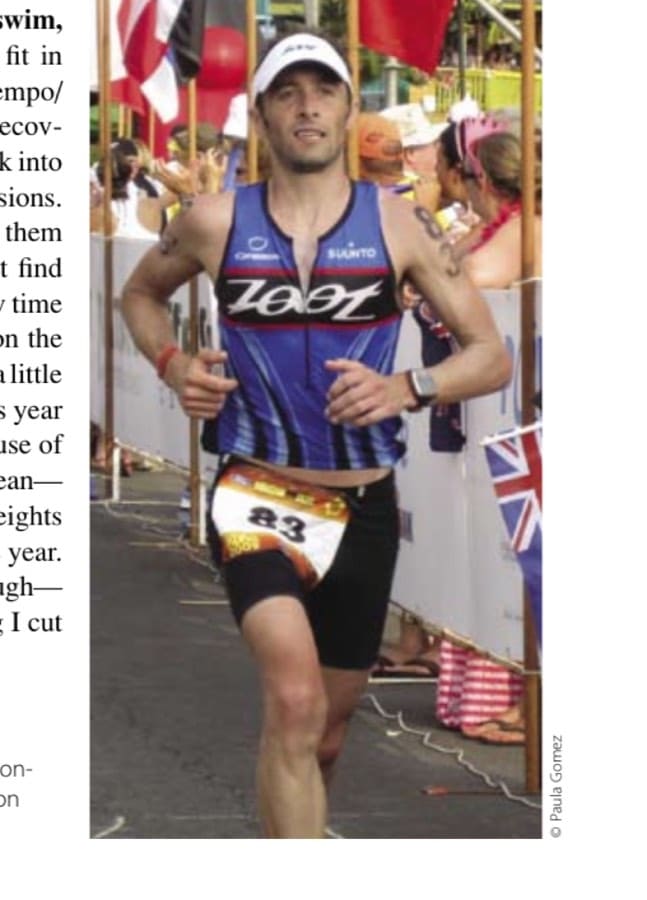
Patrick Baldwin nears the Hawaii Ironman finish line with a Boston Marathon qualifying time of 3:09:55.
© Paula Gomez
6. What do you do besides swim, bike, and run? I try to fit in running drills after my tempo/ interval runs. It helps the recovery and gets my body back into alignment after hard sessions. For weights—I focus on them during the off-season but find during the race season my time is better spent focusing on the three sports. But I did get a little more beat up in Kona this year and think it may be because of coming into the race too lean— so I may focus now on weights a bit more throughout the year. It’s a tough balance, though— weights are the first thing I cut out when time is tight.
7. What cross-training activity do you think helps your running the most? Cooking and eating good food along with nice red wine. 8. How do you fit all of this in with having a life? To achieve your goals you need to surround yourself with people who believe in them as well. After that, you can fit anything in with a little bit of good coffee and a dependable alarm clock.
9. How were the first few miles of the run after getting off the bike in Kona? This past year, they were a little heartbreaking. I hit my pace but knew I wasn’t going to be able to hold what I wanted. Dealing with that
was far harder than any pain I felt later in the run. It’s such a mental game. The heat killed many of us this year trying for top-end runs. During better IM runs, I’ve gone out as hard as my body lets me and just hung on. It’s
a technique that not many will follow, but sometimes it works for me. If I can get to 13 or 14 at the pace I want—mentally I’m so happy, it can carry me home. I’ll slow down a bit but have the energy and motivation
to fight. I know the finish is close and I’m doing what I trained to do—it’s amazing what you can get your body to do when it is confident. 10. Advice for Boston hopefuls. Train the pace you want to run in the condi
tions you will run. Be confident but humble at the start and give respect to the other racers and conditions! If you do those simple things, Boston and all of your goals are achievable.
This article originally appeared in Marathon & Beyond, Vol. 14, No. 3 (2010).
← Browse the full M&B ArchiveMore like this
1,000+ stories from 19 years of Marathon & Beyond
The complete archive of the legendary long-distance journal — digitized and free to read.
